Dairyman Cuts Diesel Emissions 92%

Kings County Dairyman Cuts Diesel Emissions 92% With Electric Mixer

By Laurie Greene, Editor

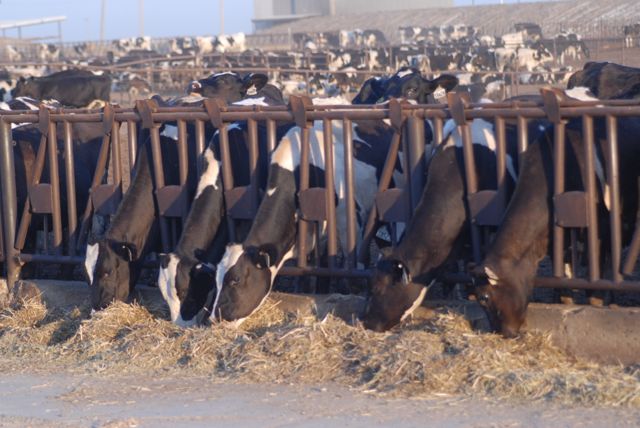
On his dairy in the Kings County town of Hanford, Philip Verway reduced his diesel consumption a remarkable 92% from 7,000 to 500 gallons in a given three-week period. His innovative secret to cutting diesel emissions is converting a diesel-powered commodity mixing machine to an electric mixer.

Kevin Abernathy, director of environmental services for the Milk Producers Council, said, “Rob VandenheuvelGeneral Manager for Milk Producers Council, Philip and I helped him get a grant from the San Joaquin Valley Air Pollution Control District, a state-appointed board which aims to minimize diesel exhaust output. We put together a proposal, submitted it, and their governing board actually approved the grant. What began as a concept on paper led to the reality of the processes being implemented on-farm. We had it up and running in about three months. Most importantly, the end results are not only meeting, but exceeding our expectations,” said Abernathy.

The entire operation dramatically reduces total nitrogen oxides (NOX gases), pollutants in the San Joaquin Valley, “Our initial expectation based on the modeling was 22 tons of NOX emissions.” The post-project NOX rates were about two tons—a major reduction.

Abernathy said Verway worked with contractors Duport and Supreme to engineer the electrification of the vertical mixers and built some fail-safe components into the system. Impressed, Abernathy said, “Based on what I have seen, they have done a remarkable job, particularly on the multiple fail-safes. Hats off to Duport and Supreme for coming up with technology that works day-in and day-out, 365 days of the year.”

Abernathy also admired the ingenuity in the California dairy industry, “They continue to come up with some of the most extraordinary ideas. It is an absolute blessing to work with them, and they make my job so much fun with projects like this!”

2016-05-31T19:27:05-07:00November 2nd, 2015|

Milk Marketing Order in CA Worries Other Dairy States

By Kyle Buchoff, Assistant Editor

Tom Van Nortwick, owner and publisher of Agribusiness Publications in Fresno for the last 35 years, has been attending the USDA dairy hearing in Clovis to adopt a Federal Milk Marketing Order in California. Van Nortwick warned that should California go with the Federal Milk Marketing Order, the move could hurt prices for all milk producers across the nation.

“Dairymen in other parts of the country have expressed concern that if California dairymen were paid more for their milk, they may go ahead and produce more milk,” Van Nortwick said. “California is a milk-making machine with comparatively fewer dairies. More milk on the market has been proven to create volatility and huge price fluctuations up or down, depending on demand. So California producers’ getting paid more and producing more milk would reduce the price of all milk throughout the country.”

“We found that 2-3% too much milk in the market at any one time can create up to a 40% reduction in price paid to producers,” Van Nortwick explained. “And of course, California is not the only overproducing state; Wisconsin, Minnesota and other midwestern states are also overproducing at this time.”

Van Nortwick also pointed out, “Domestic demand is strong, but exports have shrunk by about 50%, which is about 8% of last year’s market. So when you add an 8% oversupply of milk volume to the market as we broach the time for holiday season orders, and there are strong indications that inventories of milk, butter, powder, and cheese are rising across the country, prices paid to producers will fall.

“Nobody needs prices to go any lower,” stated Van Nortwick. “Our counterparts in New Zealand, Australia, and the European Union are suffering mightily, even more than we are, with record-setting low prices because they think they can just produce more than they can sell. If you produce more than you can sell, you are going to take a hit, and unfortunately it is the producers who end up taking that hit.”

2016-05-31T19:27:06-07:00October 19th, 2015|

More on Federal Milk Marketing Order

Continued Coverage on Federal Milk Hearing in Clovis

More on Federal Milk Marketing Order: Let the Market Sort it Out

By Patrick Cavanaugh, Deputy Editor


Bill Verboort is the General Manager for AgriTech Analytics (ATA), a national company based in Visalia Calif. Owned by the Holstein Association USA, AgriTech is part of the U.S. Dairy Herd Improvement Association System, and provides data to dairy producers for management, genetic improvement and pedigree purposes. Verboort has been attending the USDA Federal Milk Marketing Order (FMMO) hearing in Clovis, Calif., which is gathering testimony from milk industry people who want, or do not want to abandon the California Milk Marketing Order and adopt the FMMO.

“I think it is a very historic day, because I think California is one of the only major markets outside the FMMO,” said Verboort. “When the Federal system came in the 1930s, there were good reasons for us to be on a state order due to geographic isolation, etc. Today, I don’t see us as geographically isolated as we once were. So why not be part of the FMMO?”

Verboort noted that the FMMO should put California producers on par with the rest of the country when it comes to milk and cheese prices. “That is the intended and anticipated effect,” he said.

Of course there are many against adopting the FMMO. “Some are saying if the California producer is going to get more money for his milk, he is going to produce more,” said Verboort. “If you look at the industry over decades, when the price of milk has gone up, producers have produced more. You’ve got to make hay when the sun shines, so to speak. And when prices are down, the cash flows are down, so a producer needs to get more cash. What is the solution to that? Produce more milk!”

“So the California producers are going to produce more milk whether the FMMO system is in place or not; at least that’s the way I see it,” Verboort explained. “But if our producers in California are at a disadvantage to producers in other parts of the country, we need to make an equitable situation here.”

“And the market will shake it out. It is as simple as that,” he said. “We can produce milk products more efficiently in California and I think that is good for the U.S. and for the consumer. If the producer can produce it here more efficiently by getting on the right strategy with the FMMO rather than the California milk order, then we are on the right track.”

“California producers have been on the short end of the stick for a long time,” Verboort said. “Even though last year was a very good year for most producers throughout the country, and for California producers as well, they still sold their milk for several dollars per hundred weight less than the rest of the country,” Verboort said.

As for the hearing taking place in Clovis, Verboort said it seems that the momentum is going in a good direction. “But we will find out; that is what these hearings are about,” he added.


AgriTech Analytics (ATA) is a certified Dairy Records Processing Center.   

Part of the U.S. DHIA System, AgriTech Analytics provides data to dairy producers for management, genetic improvement and pedigree purposes.  

By utilizing the reports and herd analysis made available by AgriTech Analytics, Herd owners are able to maximize profitability and better position themselves in today’s competitive dairy industry.

________________________________________

Links:

AgriTech Analytics

U.S. Dairy Herd Improvement Association System


2016-05-31T19:27:07-07:00October 14th, 2015|

Cornell Kasbergen On Federal Milk Marketing Order

Continued Coverage of Milk Hearing

Dairyman Cornell Kasbergen: We Need Federal Milk Marketing Order

By Patrick Cavanaugh, Deputy Editor

Cornell Kasbergen, a dairyman in Tulare County, is fed up with the flawed California State Milk Marketing Order. So much so, that he and other dairymen and women have a great desire to switch to the Federal Marketing Order.

This idea is presently front-and-center in Clovis, CA as USDA officials are holding an historic hearing that may extend into early November.

“It started three to four years ago when our milk prices were dramatically less than those in the rest of the country, and we wanted to get our industry on a level playing field. It has been a lot of work getting the co-ops together, but we are just at the beginning of this whole process.”

Having the USDA here is, in itself, a big beginning,

Kasbergen has worked hard to drum up interest in the idea. “When I was a co-op board member at Land O’Lakes, Inc. [a national, farmer-owned food and agricultural cooperative milk cooperative], we worked with other dairy co-ops and their members to get educated.  We discovered, for the last three to four years, California’s whey value in its milk pricing formula deviated from national prices, and California producers were losing money. Once we realized we were leaving a lot of money on the table—over a million dollars a day—it opened people’s eyes. That’s why we are having this hearing.”

“The California Department of Food and Agriculture intentionally left the state’s whey prices lower than the rest of the nation, and though we’ve been petitioning them over and over again to rectify the issue, they have failed,” said Kasbergen. “That’s why we have gone this route in getting our milk prices formulated by the federal government rather than by the state. Our state has really let us down.”

“The CDFA has taken hundreds of millions of dollars out of the dairy farmers’ pockets, the loss is killing the dairy industry in California,” said Kasbergen.

2016-05-31T19:27:07-07:00October 9th, 2015|

Dairyman Xavier Avila on Federal Milk Marketing Order

Continued Federal Milk Marketing Order Hearing Coverage

Kings County Dairyman, Xavier Avila Worked Hard to Get Federal Milk Marketing Order on the Docket 

By Laurie Greene, Editor

Xavier Avila, a dairyman in Kings County, is monitoring the USDA Federal Milk Marketing Order (FMMO) Dairy Hearing in Clovis very closely. “Well, I was one of the ones who pushed for it five or six years ago. It’s kind of dear to me to get it done,” he said.

Avila explained, “As a kid growing up in the sixties and seventies, all my family members who were in the dairy business talked about how bad it was before the orders. Milk needs to be picked up everyday, so it it’s really easy to mess the market up if you don’t pick up a guys’ milk or threaten not to pick it up. So the California marketing order was established to bring order to California milk.”

Avila said the California marketing order worked for many years when dairies across the country were making the same amount of money per hundredweight. But prices are not equal now, and California dairy farmers are getting paid much less than those other parts of the country.

“We set up a solution on end-product pricing. Yet in California, the CDFA was not following the rules. If the rules had been followed, we wouldn’t have a need to go to the FMMO,” said Avila. “But CDFA just wouldn’t follow the rules regarding end-product pricing and the USDA does follow the rules; so it is just a simple matter of going with the people who are following the rules.”

“For the past ten years,” Avila said, “our whey prices have been much less than the national whey price, so the California dairy industry has lost billions of dollars.”  “It’s really simple. There are six pounds of whey per every 100 pounds of milk. Basically for the last few years, whey was 60 cents/pound. Doing the math, 60 cents times 6 pounds; you come up with a total of $3.60 for the whey in each 100 pounds of milk. With the California Milk Marketing Order, we were paid just 25 cents towards that total and the plant kept the rest. The Federal order is basically the reverse; not quite, but almost the reverse.”

Avila is bullish on the California dairy industry’s conversion to a FMMO. “I think it’s going to happen. Nothing is for certain, but the industry is united. Milk is the same everywhere, and I think it is in California dairy farmers’ hands because we are going to vote on this. Whenever you produce the same product and earn far less for it, it is inevitable that something is going to happen.”

Avila noted it will take some time, “but I knew that from the start, it would not be quick and easy. We are looking at anywhere from one to two years,” Avila said, affirming his belief the California dairy industry can hang on for two years. “We’ve got not choice. Now with the drought, there are other crops you can do better with. Some dairy farmers will leave the business just because they have something better to do than milk cows. So we see this as saving the California dairy industry,” Avila said.

Click here to view Video of Xavier Avila, September 22, 2015.


2016-05-31T19:27:08-07:00October 6th, 2015|

Historic Milk Pricing Hearing in Clovis

Historic Milk Pricing Hearing in Clovis:

Converting California to the Federal Milk Marketing Order

By Patrick Cavanaugh, Deputy Editor

In Clovis last week, an historic USDA milk pricing hearing commenced to gather testimony from the California dairy industry, which for the most part, favors changing to the Federal Milk Marketing Order (FMMO). This represents an abandonment of the state marketing order which has been harmful to dairies since it was altered 10 years ago to disallow dairies from getting paid the same price for their milk and whey products.

William Francis, director, USDA Order Formulation and Enforcement, is involved in the formal rule-making process for marketing orders. Francis commented, “There’s been tremendous interest in a federal order for California and we are holding a formal rule hearing for the promulgation of a California FMMO. This is an historic event. For years, the state has operated a program. But, farmers have gotten together and invited us to come in for the state’s hearing.”

The hearing could last as long as eight weeks to review each of four proposals. Francis noted, “We are here as long as it takes. We want to make sure we have a complete and accurate record so there are no time constraints,” He said the USDA will post a transcript on their website, filter through all of the documentation and make a recommendation.

A comment period with a sufficient amount of time will follow the public announcement of the USDA decision. “Then we will generate a modified final decision,” Francis said. “By the time we complete that process, farmers will have the opportunity to vote on the modified decision through a referendum process, which could be up to two years away.”

USDA Federal Milk Marketing Order (FMMO)

Industry Information Request postings

All of the proposals can be viewed at www.ams.usda.gov/CAOrder.

2016-05-31T19:27:08-07:00October 2nd, 2015|

Ag in the Classroom

Teaching Ag in the Classroom


By Charmayne Hefley, Associate Editor


As the disconnect between consumers and the source of their food grows, many students do not understand where their food comes from. California teachers are doing their part to bridge the educational gap by teaching ag in the classroom.

Agriculture in the ClassroomKathy Yager, a fifth grade teacher at Fowler Unified School District, as well as a farmer, brings agriculture education to her students in several ways. “We’ve been using programs through the California Foundation for Agriculture in the Classroom,” Yager said.

“I’ve participated in Taste Test grants,” Yager said. The grant allows teachers to bring in a new ag product, “and the students get the opportunity to try those things.” Yager said it also helps expose students to new products, and allows them to become better informDairy Council of CAed consumers in the future.

“We also have visits from the Dairy Council of California and students get to see a dairy cow and how the whole milking process works,” Yager said.

In addition Yager brings farmers, including her own brother, into the classroom to educate students, “and [they] show students how agriculture works and how a product gets from the field, to the stores, and to them.”

Healthy Eating

California Foundation for Agriculture in the Classroom (CFAIC)

More than 7 million California students are fed, clothed and housed with products grown right here on our farms, in our fields and within our forests. California Foundation for Agriculture in the Classroom is dedicated to helping students and teachers across our great state gain an understanding of how agriculture provides the daily essentials necessary to make our society and our world function.

From the cotton in our jeans and the food on our tables, to our landscaped yards and playing fields, we all depend on agriculture. The survival of this vital industry depends on educating and encouraging the next generation of decision-makers. We do this by engaging students and educators in meaningful ways: developing and sharing unique classroom curriculum, supporting school garden efforts, spreading our message at local Ag Days, honoring outstanding educators, rewarding students who learn and write stories about agriculture and so much more.

http://www.cfaitc.org/imaginethis/Featured Programs:

Imagine this… Story Writing Contest

Meet Academic Content Standards for California schools through this creative writing contest!

Create a positive learning experience that promotes reading, writing and the arts, and furthers the understanding of agriculture in our lives by using this award-winning contest in your classroom.

PUBLISHED AUTHOR

State-winning authors will have their stories published in an illustrated book and will be distributed to school libraries and classrooms across the state!

DEADLINE: NOV. 1

Entries must be postmarked by November 1, annually.
Download entry form (PDF, 331 KB)

California Fruits and Vegetables Seasonal Chart (PDF, 18 KB)

2016-05-31T19:27:09-07:00September 22nd, 2015|

High Pricing Keeps Tulare County Ag #1

Tulare County Ag Tops all Counties

By Laurie Greene, Editor

The 2014 crop report from Tulare County indicates another record-setting year. Marilyn Kinoshita, Tulare County Ag Commissioner, noted how well the dairy industry did, “30% of our overall value was actually milk, so dairy is incredibly important to our county. They had some good prices for most of the year. That is what brought up the value of milk to $2.5 billion. It is a significant increase over the prior year. A little bit more yield, but it is the price that kicked up well over two billion dollars.”

Tulare County Ag sales topped $8 billion in 2014, and the dairy industry overcame significant pricing obstacles to contribute to the County’s success.

Kinoshita continued, “We’ve got several classes of milk, and California producers are at a disadvantage to the other folks in Wisconsin or Nebraska, or wherever milk is produced. California producers feel singled out. They have their own system by the Secretary of Ag, so they have lobbied to get some hearings to be put under the federal system of pricing. California is lower than the federal standard.”

Citrus sales also played an important role in setting the new sales record, she said, “They had a really good year and went up considerably. So there is our number three crop. We are the nation’s number one citrus county. When our growers are having a good year, it benefits the county. We have 71 citrus packing sheds in our county and all the major juicing plants in California are right here.”

Kinoshita also mentioned some of the ways that citrus has become the number three crop, “It is sort of supply and demand, and great marketing. We ship to 90 different countries around the world. A portion of our production is exported.”

In 2014, livestock in general was up 40%, which also made an impact on sales in Tulare County, “You’ll find when you go to a grocery store that steaks, chicken, and turkey all cost more. So all of our species had an increase in price per unit for this crop reporting year.”

2016-05-31T19:28:06-07:00August 30th, 2015|

Chew on This Tour

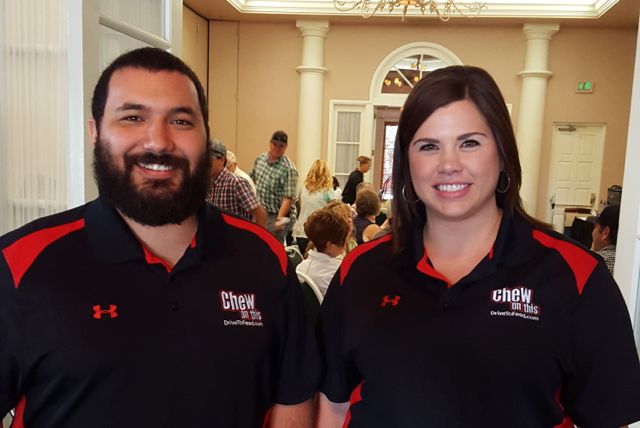
Kyle Olguin and Sarah Weber on Chew On This Tour


By Charmayne Hefley, Associate Editor

To counter the abounding misconceptions surrounding agriculture, companies are fighting back through education. Kyle Olguin, assistant operations manager for Nutra Blend LLC, a company that specializes in manufacturing nutrients for the feed industry, said that Nutra Blend began a program called “Chew On This Tour” to educate consumers about common farming misconceptions.

For the tour, Olguin said, “we drive trucks around the country, trucks turned into movie theatres, and educate people on where their food comes from, the misconceptions about farming, what we [farmers] do in America, and how we have one of the safest food supplies in the world.”

Olguin said that the perception of agriculture among the masses is that Ag is unnecessary because of the existence of grocery stores.

“We are constantly being attacked by non-ag promoting groups that agriculture is bad,” Olguin said, “and now the perception is out there that agriculture doesn’t really provide anything good or that agriculture doesn’t really need to exist. We have grocery stores, and the general public does not understand the link between agriculture and farmers and those grocery stores.”

“So we decided to start a campaign, and we kicked it off in Oregon driving this truck around the U.S. and showing people one simple video.” Olguin said, “We ask people questions, like: How many eggs does a chicken lay? How many pounds of bacon do you get from one cow?”

Sarah Weber, a sales representative for Nutra Blend, said the next step for the program was to raise money for backpack programs linked with food banks.

“The second movement is ‘Drive to Feed Kids’,” Weber said, “a nonprofit program with our suppliers and vendors to work with our customers, in their own communities, to raise money for student backpack programs that are linked in with the food banks.”

Weber said, “Our third stage in this movement is the ‘Ivy League Farmer’,” Weber said, “which is a movie that has been produced and will air on network TV pending this fall. It is a reflection on a dairy farm and the positive influence the farm has on the community. It is a way for us to reach out to the public with an emotionally positive connection to educate them.”


2016-05-31T19:28:06-07:00August 24th, 2015|

Ag Leader Paul Martin Inducted into Sonoma County Farm Bureau Hall of Fame

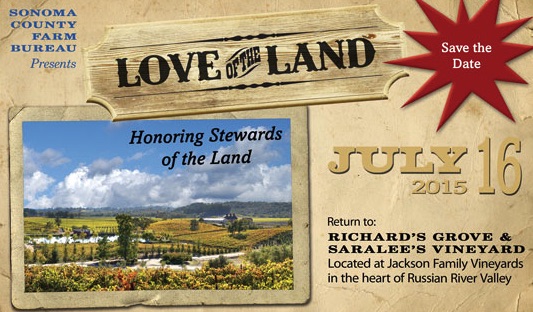
Paul Martin, a Petaluma rancher and agricultural leader who has dedicated his life to building bridges between farmers and regulatory agencies, will be honored at Sonoma County Farm Bureau’s “Love of the Land” celebration on July 16 at Richard’s Grove and Saralee’s Vineyard in Windsor, Calif.

Paul_Martin

Paul Martin (Sonoma County Farm Bureau)

Martin’s remarkable agricultural legacy has earned him a prominent place in Sonoma County Farm Bureau’s Hall of Fame. The annual award recognizes agricultural leaders who are a guiding force in preserving, protecting and propelling Sonoma County’s $4 billion farming industry. Martin joins legendary leaders in the Hall of Fame, like the late Saralee McClelland Kunde, who was the Saralee of Richard’s Grove and Saralee’s Vineyard; Gene Benedetti, who was founder of Clover Stornetta Farms; and Larry Bertolini, who was founder and president of Western Farm Center.

Martin is a former dairy rancher who had a second career as a representative for the dairy and agriculture industries. After selling his cows in the late 1990’s, Martin started working as field representative for Western United Dairymen, utilizing his knowledge of the dairy industry and his excellent communication skills to represent milk producers. After retiring from Western United Dairymen in 2012, he served a two-year stint as Gov. Jerry Brown’s Deputy Director in the Office of Business and Economic Development. Martin and his wife Jill have retired to their ranch in Two Rock.

Sangiacomo Family Photo

Sangiacomo Family Photo (Sonoma County Farm Bureau)

The Sonoma County Farm Bureau will also honor the Sangiacomo Family, a multi-generational Sonoma Valley family respected for their land stewardship, agriculture leadership and dedication to growing world-class grapes, as “Farm Family of the Year”. In addition, the Bureau will present the “Luther Burbank Conservation Award” to Harmony Farm Supply & Nursery in Sebastopol. The Farm Bureau refers to Harmony as, “It could easily be called the Institution of Organic & Sustainable Farming & Gardening, a revered center of learning that upholds an environmental ethic while helping growers produce crops the natural way.”

Harmony Farm Supply & Nursery (Sonoma County Farm Bureau)

Harmony

Love of the Land honors the stewards of the land and Sonoma County’s agricultural bounty. The event starts at 5 p.m. with a tasting of Sonoma County wine and food. A dinner featuring an array of Sonoma County grown products is at 7 p.m. The dinner will be followed by the awards presentation and live auction. The event is open to the public and anyone who wants to join in recognizing the stewards of Sonoma County’s working landscape.

Individual tickets are $65. Corporate sponsor tables for eight people are $1,250. General seating tables of eight are $700.

To make reservations, visit Sonoma County Farm Bureau or call 707-544-5575. Tickets are available until July 2 or until sold out.


2016-05-31T19:28:13-07:00June 21st, 2015|
Go to Top