AB-1513 Tough on Piece-Rate

Challenge to Farmworker Piece-Rate Pay May Actually Depress Wages

By Brian German, Associate Editor

Assembly Bill No. 1513 requires employees who are paid on a piece-rate basis to be compensated separately for rest and recovery breaks, and to be paid an hourly wage for non-productive time under the employer’s control, according to Anthony Raimondo, a Fresno-based attorney who has represented farmers and farm labor contractors since 2001.

Raimondo contends that while the bill was designed with the best intentions, its application may be detrimental to farmworkers. “The State of California believes that if piece-rate workers are not paid additional hourly wages for their ten minute breaks, they are being cheated,” Raimondo explained, “even though, every single day, every worker in California on a-piece rate basis always makes above minimum wage for the hours they work on that day.”CA Legislature

Raimondo, who has assisted employers with strategic planning and labor relations and who regularly defends wage claims before the California Labor Commission, elaborated on why farmworkers prefer piece-rate compensation. “You won’t see a day in our fields where a worker on piece-rate’s total earnings total less than what he would have made hourly on a minimum wage. That is why the unintended consequences of these laws will be to depress worker’s wages,” said Raimondo.

“It is why workers demand piece-rate from us; they don’t want hourly wages. Because we work in market-based commodities, the more the employer can tie earnings to production, the higher the wages that employer can deliver to the worker. They are both benefitting from an economic bargain that generates revenue through the ranch for both the employer and the employee. When compensation is tied to production, everybody makes more money,” he noted.

2016-05-31T19:24:06-07:00April 19th, 2016|

Bill Chandler on Farming

Bill Chandler Builds a Legacy

By Patrick Cavanaugh, Deputy Editor


A third-generation farmer in Fresno County, Bill Chandler farms near Parlier, Selma, and Fowler. The family operation has traditionally produced tree fruit such as peaches, plums and nectarines, but they are certainly expanding their crop diversity. “We have gone more into almonds lately because of unavailable labor,” Chandler commented. “We are looking into citrus, which is not as perishable as soft fruit—which, if you don’t harvest it right away, you’ve lost the whole year’s effort.”

Like so many farm families in California, the Chandlers go back a couple of generations farming here. “My grandfather came out here in 1888 from Illinois,” Chandler expounded, “and looked at this area. It was appealing because the land prices were not that bad compared to Illinois. But the big deal was the weather; we don’t have all that snow in the winter time. We also  have relatively level ground and not a lot of rocks in our soil. We, too, have hardpan under the soil, but that can be worked out.”peaches

“My father got out of school in 1921 and started farming in this area,” said Chandler. “I was the only son and I always wanted to farm. I have a sister who was able to inherit some, and I bought my sister out, so that’s what our farm is now.”

Bill Chandler and his wife, Carol, have two sons, Tom and John, who are both back on the farm. “They both majored in ag, which was kind of neat; one in ag econ and the other in food science, and we are very proud that they are both back farming with us now. Tom, the older one, majored in ag econ at UC Davis and was in banking for about 12 years. Now he has come back and has been helping us on that side of the farming, which is very very important. He also did some land appraisal on the side. His brother, John, who majored in in fruit science at Cal Poly, is more into field work, and he does some beekeeping on the side as well.”

Chandler said a lot of success and wonderful things about farming have always been accompanied by a lot of challenges as well. “Yeah, there is always something,” he said. “I don’t care if it’s labor, weather or regulations. We are really fortunate; we stand at a place here, Kearney Field Station*, where the UC has done a great job helping us solve some of these regulations or pests.”

Chandler’s sons, Tom and John, are going to pick up where their dad leaves off, but that may be awhile, “You know,” Chandler philosophized, “a farmer never does retire. Fortunately, I am able to live on the farm. They are doing most of the farmwork, but they do ask me questions.”

This year’s above-average rainfall, along with the snowfall, has been great, but Chandler said,  “There is still going to be a lot of work to dig ourselves out of this four-year drought. I have experience and so do many other people. Not only are our trees suffering from lack of proper irrigation, but we are spending a lot of money putting in new wells or new irrigation systems so that we can handle this drought.”

Chandler doesn’t take nearby UC and USDA researchers for granted. He always attends meetings and takes notes. “We can go to these folks and have these seminars that are really helpful.”

____________________________________________

*Kearney Agricultural Research and Extension (KARE) Center

2016-05-31T19:24:07-07:00April 12th, 2016|

Agriculture Science Recognition Awards, Part 4

Elizabeth Mosqueda, Agriculture Science Recognition Award Honoree

By Charmayne Hefley, Associate Editor


Elizabeth Guerrero Mosqueda, a graduate student in the Department of Plant Science at Fresno State, was one of four students to receive the Agriculture Science Award in mid-March presented by Jim Patterson, California assemblymember, along with, Sandra Witte, dean of the Jordan College of Agricultural Sciences and Technology and Lawrence Salinas, Fresno States’s executive director of government relations.

Jim Patterson, California Assemblymember

Jim Patterson, California State Assemblymember

Patterson said Mosqueda, the child of migrant farmworkers from Mexico,“set her sights on overcoming many obstacles from an early age. Elizabeth’s parents worked on the lettuce fields in the Salinas Valley, which led to her understanding the vital role farmworkers have in harvesting crops and the impact of frequent labor shortages on farming. All of that experience led her to study ways to improve lettuce production.”

Patterson said the labor shortage has required the use of automated lettuce thinners to raise lettuce, one of the state’s biggest crops.  “But some farmers are hesitant to use new technology,”said Patterson, “so Elizabeth decided to roll up her sleeves two and a half years ago” and conducted her graduate studies on the comparison of using lettuce thinning machines to lettuce work done by hand. “She completed her study and has since traveled nationwide to share her findings with other scientists and agronomists.”

Patterson added Mosqueda was recently selected as one of fifty students nationwide to attend American Society of Agronomy’s Graduate Student Leadership Conference.Amer Society of Agronomy

“Elizabeth believes that life is a challenge that shapes us into the people that we are meant to be,” Patterson said. “And each and every struggle and accomplishment that life has presented her has made her, and is making her, into the dedicated, hardworking and successful woman she is today.”

While at Fresno State, Patterson said Mosqueda helped to reestablish the Plant Science Club, serving as both the club’s secretary and president. “Elizabeth is also a member and has volunteered for the Central Valley California Women for Agriculture,” Patterson said, “and many other local, statewide and national farming organizations.”

Mosqueda was encouraged to apply for the award by professors in her department. “I’m very proud to be a part of the Department of Plant Science,” Mosqueda said. “I’m very thankful to all my professors, my advisor and all the other mentors who have helped me achieve this prestigious award.”

One month away from completing her program, Mosqueda hopes to obtain a position with the University of California Cooperative Extension (UCCE), Monterey County as a farm advisor either in vegetable crop production or weed science upon graduation. Mosqueda said she would like to “help growers firsthand with the problems that are going on in our agriculture industry today.”

2021-05-12T11:05:57-07:00April 11th, 2016|

Ryan Jacobsen on 5 Percent Water Allocation

Fresno County Farm Bureau CEO on Water Allocation

 By Patrick Cavanaugh, Deputy Editor

California Ag Today staff interviewed Ryan Jacobsen, CEO and executive director of the Fresno County Farm Bureau moments after the Bureau of Reclamation announced only 5 percent of contracted water would be allocated to Federal surface water users south of the Sacramento Delta during this El Niño year.

California Ag Today: Forget how you feel about the Bureau of Reclamation’s initial 5 percent allocation for Federal water users. How many times can we say, “Frustrated?” 

Jacobsen: Absolutely just despicablethe announcement we heard earlier today. The frustration is that we’ve continually been told over the last couple of years with zero percent water allocations that it’s been Mother Nature.

Even though it’s not necessarily the big bang year we were hoping for in northern California, Mother Nature provided. We’ve seen the reservoirs overflowing. We’ve seen the reservoirs flood-releasing, and here we are with a five percent allocation. We saw outflows in the delta this winter that exceeded the 300,000 acre/feet a day, and yet we weren’t doing anything to capture it. So, it’s just frustration, frustration, frustration that here we aremore of the sameand what does this mean long-term for California agriculture? We can’t be viable without a surface water supply, and when Mother Nature provides, unfortunately the federal government’s not trying to collect it.

California Ag Today: What is going on? Why are they doing this? Do you have any theories?

Jacobsen: Obviously, it has so much to do with the environmental side and the belief that the federal government is doing all they can to protect these species up there. We have seen that it’s doing no good; the fish species are seeing no recovery; it’s actually going in the opposite direction. It is plain mismanagement. The unfortunate part is sound science isn’t even going into this right now; it is purely the emotional side of whoever decides to pull the trigger on the federal side. And here we are on the resulting end, losing millions and millions of dollars in our economy, idling more farmlandthe most productive farmland in the countryin the worldand losing the jobs that are associated with it.

San Luis Reservoir -Empty, California Farm Water Coalition

San Luis Reservoir Suffering the 2015 Drought is now barely half filled even after the El Nino rain, runoff and massive flood releases from Shasta an Oroville

California Ag Today: You speak brilliantly on this whole situation. Way more water has flowed out to the ocean than needed for the protection of any of the species or the environment, so who are they listening to?

Jacobsen: Right now, this is simply the administration’s decision. Reclamation falls under the federal side of things, so obviously, ultimately, it lays on the President’s desk. If we talk about resolution: by 9 a.m. tomorrow morning, we could see a resolution to this whole issue. If Congress would get their act together and pass some kind of bill, get it on the President’s desk and get it signed, we could see some resolution.

Unfortunately, here we are, April 1:  a good portion of the precipitation season is now behind us, the high flows through the delta are pretty much over. We still have healthy reservoirs up North, but unfortunately it doesn’t mean anything for us down here because we can’t convey it through the Delta to get here. That lack of  and the lack of ability on the federal side to make the decisions that would allow us to pump that water makes this just another year of doom and gloom. Again, how much more of this can we take? I think the long-term outlook for those farmers with permanent crops who have tried to scrape by, has to be, “Is this even viable for us to continue to do this anymore?” ‘Because Mother Nature provided, and yet we don’t see the water.

California Ag Today: Very bleak. Ninety-five percent of normal snowfall, too.

Jacobsen: The percentages in northern California, while good, weren’t the El Niño banner year we were expecting. The season looked bright, like it was going to be good. Yet, the fact of the matter is that during the months of January, February and March, when these just incredible numbers of high water flows were going through the Delta, pumps were pumping in single digits. And that’s not even close, or anywhere near where they should have been.

I think the misconception is when we talk about the water that is taken from the Delta, it’s such a small percentage, particularly during those high-flow times; it would have meant no difference to water species. It’s just a frustration that we continue to be bombarded by these environmental restrictions that are having no good effect on the long-term viability of these species they are trying to protect.

California Ag Today:  What is the economic impact of these water cutbacks on the Central Valley?

Jacobsen: Well, when you look at the five percent allocation, we are ground zero. Fresno County, right in the heartland of the Central Valley, is ground zero. We are going to see probably in excess of 200,000-250,000 acres of land continue to be fallowed and the loss of the tens of thousands of jobs associated with that, and millions, tens of millions of dollars. It’s obviously a very dire situation when it comes to long-term viability here in the Valley.

California Ag Today: Because they are going to hear a lot of outrage from us, do you think the Bureau of Reclamation would go to a 20 percent water allocation? Farmers must be thinking, “We got to get the seeds ordered today for the crops.” Is there any hope for an increase in water, or do you think farmers just can’t bank on it?

Jacobsen: It’s already too late. For this season, it’s already too late. It is April 1 already, and, unfortunately, this is not a joke. This decision is about one month-and-a-half late. I think the Bureau of Reclamation was hoping the numbers would improve magically. They didn’t.

The five percent allocation, while said not to be our final allocation, is likely to be close. It won’t go up to 20; it won’t go up to 15. Maybe if we pray enough, it may go up to ten, but that would be on the high side. Right now, it looks very realistic that five percent is where we end up, where we are going to stand for the year.

California Ag Today: Okay, I know growers who have planted tomatoes in Fresno County, thinking, “Hey, we gotta get water.” They’re not getting it.

Jacobsen: They’re not getting it, no.  And lack of surface water supply continues to make a huge dent in our groundwater supply, so this just can’t continue the way it is going. Plus, upcoming implementation of the Sustainable Groundwater Management Act (SGMA), combined with the lack of federal surface supplies, will absolutely hammer farms here in the Valley.

2016-05-31T19:24:07-07:00April 8th, 2016|

AgVocating in Hawaii

Food Blogger Lorie Farrell AgVocates Conventional Ag

By Laurie Greene, Editor

Lorie Farrell helps farmers and agriculture by amplifying their voices. A freelance blogger and self-described AgVocate for food, farm and public policies that support agriculture and combat misinformation and junk science head-on, Farrell resides on Hawaii’s Big Island, the birthplace of the Rainbow GMO papaya that saved the state’s papaya industry. Having observed, firsthand, many activist groups who have sought to halt progress in conventional agriculture, she has a unique perspective on the issues and shares her views on her website and social media.

Lorie Farrell, Hawaii Food Blogge and self-described AgVocate

Lorie Farrell, Hawaii Food Blogger and self-described AgVocate

And while many food bloggers lean heavily toward organic production, Farrell stays away from it.  “Organic production gets plenty of traction, so I tend to stay away from that part of agriculture production,” Farrell said.

“Some in the organic crowd seem to think that it is all one way or all the other, and it is not,” remarked Farrell. “It is really a mixture of methods. We need all of them at the table, and the table today looks much like what it is going to look like in a few years from now—a mixture of crop production methods and all the technology,” she noted.

Farrell wants to educate her audience to learn more about agriculture and advocate on its behalf. She stressed the importance for all of us to ask more questions, “but at the same time, it is also our job to give them good information and shine the light on good sources of information. It is not their fault they don’t understand. But at a certain point, we can lead a horse to water; they have got to make the choice.

And Farrell said emphatically that food shaming and food fear are intolerable. “Food shaming is when a person makes a judgement call on another person based on their choices of food,” she explained. “This happens very often with females and moms and it is unacceptable. Someone might see a mom buying a food that’s unhealthy and feeding it to their child. They will call the mom out on it. I’ve had moms tell me that people ask them, ‘You are feeding your kids organic food, aren’t you?’ They answer, ‘Well no, I am feeding them balanced meals, or I am feeding my baby formula.'”

“People will shame and bully you into making different food choices based on their perception of food. They will do it in person, but social media is also a very effective way to food shame. The objective of online food shaming is to change your choices of foodto take away your choice of food, actuallyso you purchase organic or non-GMO. I don’t even know what the word ‘natural’ means.”

2021-05-12T11:00:55-07:00April 7th, 2016|

Westlands Water Allocation “Despicable”

Westlands Water Allocation “Despicable”

By Patrick Cavanaugh, Deputy Editor

Earlier TODAY, the United States Bureau of Reclamation (USBR) stunned the farming industry by announcing a  5% water allocation for most of the farmland to the Westlands Water District on the Westside in the Central San Joaquin Valley. This single digit water allocation to the comes during an El Niño year of wet weather, following four years of drought and restricted water deliveries to Westlands of 40% in 2012, 20% (2013), 0% (2014) and 0% again (2015).

Westlands Water District LogoLes Wright, agriculture commissioner for the Fresno County Department of Agriculture—ground zero for agricultural water cutbacks, said, “I can’t think of a word to describe how I am feeling about our federal water managers. It’s despicable what they’re doing to this Valley.”

“You have two major reservoirs in flood stage,” said Wright, “but they are refusing to turn the pumps on. It’s like they want to starve out the Valley, its farmers and communities. Agriculture is the major economic driver for the Valley communities, and they’re doing everything they can to drive the people out of this Valley.”

Established in 1902, the USBR, according to its website, is best known for the building of more than 600 dams and reservoirs, plus power plants and canals, constructed in 17 western states. These water projects led to homesteading and promoted the economic development of the West. 
Sign of drought Westlands Water District Turnout

The USBR website reads, “Today, we are the largest wholesaler of water in the country. We bring water to more than 31 million people, and provide one out of five Western farmers (140,000) with irrigation water for 10 million acres of farmland that produce 60% of the nation’s vegetables and 25% of its fruits and nuts.”

Yet, some Western farmers have received a 0% water allocation for each of the past two years, and now may receive only 5% this year. Already, Westlands Water District reports over 200,000 acres of prime farmland in the district have already been fallowed.

Ryan Jacobsen, Fresno County Farm Bureau CEO

Ryan Jacobsen, Fresno County Farm Bureau CEO

“Reservoirs throughout the state have been filling,” said Fresno County Farm Bureau CEO, Ryan Jacobsen, in a statement TODAY. “However, the government’s restrictive interpretation has resulted in the permanent loss of 789,000 acre-feet of water,” said Jacobsen. “Since December 2015, more than 200 billion gallons of water have been forever lost to the ocean, with almost no water being allocated to agriculture.”

Commissioner Wright reflected, “President Obama and both California senators have been here in the Valley, on the ground. They have seen what we are doing. They recognize the crisis; yet they refuse to use their authorities to correct the situationin a year when we’re dumping millions of gallons of water to the ocean.”

Wright explained the federal government is sending fresh water to the ocean in excess of what is needed for the environment and the protected species. “They are just wasting the water,” he said, “and yet, we have the Governor telling us to cut back 25% to 35%. And all of that water we saved last summer and in the last year, they have more than doubled the waste.”

“Where is the governor on this issue?” Wright asked. “It is despicable what the government is doing to its people.”

2016-05-31T19:24:08-07:00April 1st, 2016|

36th Annual UnitedAg Meeting & Conference Discusses Future of Agriculture 

36th Annual UnitedAg Meeting & Conference Discusses Future of Agriculture 


UnitedAg, California’s member-owned agricultural trade association, recently concluded its 36th Annual Meeting and Conference, held March 15-17 in Anaheim, California.

POLA6651 (1)

Pictured left to right, Karri Hammerstrom, Karen Caplan, Kirti Mutatkar, Ellen Way, Judy Lundberg, Abby Taylor-Silva and Fiona Ma. (Photo source: UnitedAg)

The three-day event, themed “Breaking Through,” featured speakers included, California State Assemblymember Fiona Ma, Tax Lobbyist Jon Coupal, Inspirational Speaker Lt. Col Kevin Sweeney, Agricultural Speaker/Comedian Jerry Carroll and Chapman University President Dr. James Doti who discussed issues and opportunities facing the California’s agriculture industry.

The conference also included a 5K Walkathon and member golf tournament benefitting UnitedAg’s scholarship foundation, as well as a member awards banquet.

“We believe the UnitedAg 36th Annual Meeting and Conference started a conversation for the future of the agriculture business here in California,” said Kirti Mutatkar, UnitedAg’s CEO and President.

Founded in 1980, UnitedAg is a member-owned agricultural trade association dedicated to providing innovative solutions for California’s strong and healthy agricultural industry.

UnitedAg works in close partnership with its 500 agriculture-affiliated member organizations to meet their employee benefits needs, promote their interests with lawmakers, and help them comply with legislation and regulation so members can focus on what they do best – run successful businesses and organizations.

_____________________________

For more information about UnitedAg and its activities, please visit www.unitedag.org.

2016-05-31T19:24:08-07:00March 29th, 2016|

FFA Members are #FFAProud

FFA Members are #FFAProud

By Charmayne Hefley, Associate Editor


Thousands of National FFA Organization (FFA) members have taken to social media to support a growing campaign known as #FFAProud. Sydnie Sousa, the 2015-2016 California FFA state vice president, said the #FFAProud movement stems from the pride its members feel at being a part of an organization that builds leadership skills and more.

“#FFAProud started,“ Sousa said, “because we want to be clear what we do in agriculture and what FFA was founded upon: premiere leadership, personal growth and career success. Students achieve all this by working with animals and caring for those animals properly.”

Sousa said students are proud to advocate because, “We work hard and diligently within this organization to make sure it is being showcased correctly from all different stages. We are in this organization developing leaders to educate people on the accurate story of agriculture. We truly are proud of the truth behind agriculture and the FFA,” Sousa said.

Sousa said the clear and confident response of FFA members to questions about agriculture and its practices demonstrates that FFA is strong. “It’s the core of our foundation; students rise to meet these challenges within agriculture,” Sousa said. “We are proud to share our stories and to be a part of this organization.”

_____________________

The National FFA Organization website reports the letters “FFA” stand for Future Farmers of America. These letters are a part of our history and our heritage that will never change. But FFA is not just for students who want to be production farmers; FFA also welcomes members who aspire to careers as teachers, doctors, scientists, business owners and more. For this reason, the name of the organization was updated in 1988 after a vote of national convention delegates to reflect the growing diversity and new opportunities in the industry of agriculture.

_____________________

Photo Source: Twitter

2016-05-31T19:24:09-07:00March 28th, 2016|

Landfill Dzine Partners with My Job Depends on Ag

Landfill Dzine Partners with My Job Depends on Ag

By Charmayne Hefley, Associate Editor

Todd and Heather Carpenter, of Landfill Dzine

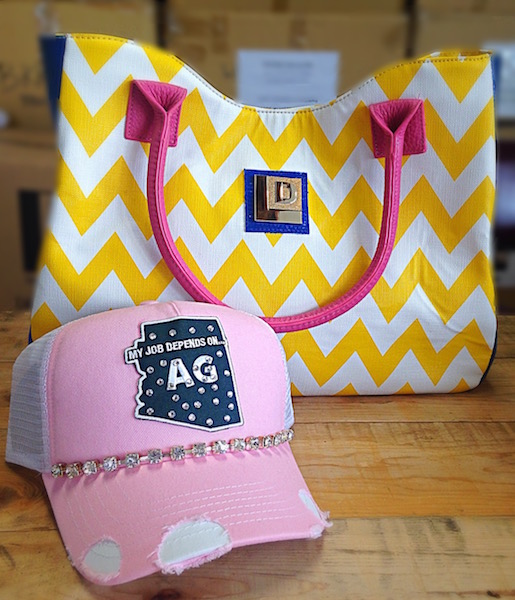
Heather and Todd Carpenter of Landfill Dzine and A&J Industrial sell recycled lay-flat tubing made into into belts, purses,bracelets, flip-flops.

Landfill Dzine has partnered with My Job Depends on Ag (MJDOA) to sell specialized MJDOA merchandise, including the already-popular bling MJDOA baseball caps. Heather Carpenter, co-owner with her husband, Josh, of A&J Industrial and Landfill Dzine, said the partnership just makes sense because Landfill Dzine is a company based on upcycling old irrigation hoses, which depends on the agricultural industry for its existence.

“MJDOA is everything we already do,” Carpenter said, “so it’s just like a match made in heaven for us.”

Carpenter said that Landfill Dzine upcycles old irrigation hoses called Layflat that is made with rubber, nylon and other materials all woven or melted together, which makes the hoses un-recyclable.

We upcycle it into everyday, wearable products: flip flops, handbags, belts. We divert it from going to the trash, and we use it in all of our products. We cut [the irrigation hose], wash it, clean it and make it into something else.”

Carpenter said Landfill Dzine is able to help the agricultural community by taking waste straight from the field and giving it a new purpose. “It helps farmers save money because they don’t have to throw old irrigation hoses in the trash.”

Carpenter said she strongly believes the mission of MJDOA applies to Landfill Dzine; hence, the partnership between the two companies. “We help distribute MJDOA’s products as well,” said Carpenter, “ and increase awareness on what we’re trying to do in California and with water and waste.”

2016-05-31T19:24:09-07:00March 25th, 2016|

Agriculture Science Recognition Awards, Part 1- Megen Morales

Agriculture Science Recognition Awards, Part 1 – Megen Morales

By Patrick Cavanaugh, Deputy Editor

Assemblyman Jim Patterson joined Dr. Sandra Witte, dean of the Jordan College of Agricultural Sciences and Technology at California State University, Fresno (Fresno State) and Lawrence Salinas, Fresno State’s executive director of Government Relations, at the 23rd Assembly District’s 2016 Agriculture Science Recognition Awards on March 17 at Fresno State.

California Ag Today will highlight each of four Fresno State students in the Fresno State Honoree series, Meghan Loper, Megen Morales, Elizabeth Mosqueda and Nick Wolfenden, who were selected from among several students nominated for their dedication to the future of agriculture in the Central Valley.

“These brilliant students represent the best of the best,” said Assemblyman Patterson. “Their devotion to making a difference in our agriculture science community is to be commended and I can’t wait to see what the future holds for them.”

______________________________________

Megen Morales, a senior at Fresno State majoring in enology and chemistry, was honored recently for leading the way in the study of mold in winegrapes. “She’s also helping others in agriculture measure and quantify the amount of mold,” noted Patterson.

After a grapevine-judging contest in high school, Morales knew she wanted to work in the viticulture industry. So for the past three years, she has worked with her enology professors to create a new standard for wineries to follow for the amount of mold that is acceptable in harvested wine grapes. “The current maximum of moldy grapes acceptable in wineries is two percent,” noted Patterson, “but there is no process that accurately determines the level of mold content.” Morales explained, “Right now, you simply look at the grapes and usually determine that it looks like 1.5 to two percent mold.”

“So Megen harvested White Zinfandel Grapes from 15 farms throughout the Central Valley, and brought them back to the lab to study the levels of several types of mold,” noted Patterson. “Morales compiled the data, and her results are now used by large-scale wineries to determine how much mold is in their harvested grapes.”

A member of Central Valley Women for Agriculture (CWA) and a volunteer at the Fresno State Winery, Morales has also helped promote agriculture at Valley Children’s Hospital. As current manager of the laboratory, she trains other students on how to use it.

In fact, Morales has dedicated much of her time to teaching young people about the important role agriculture plays in everyday life. She says her experiences at Fresno State will help her excel in her future as an empowered, humble person, with the skills and mindset to accomplish great things. She hopes to work as an enologist at a major winery and eventually plans to become a senior wine maker. Morales’ ultimate goal is to serve as a role model, a mentor to women in agriculture, and to advocate for agricultural education to preserve the agricultural world of tomorrow.

“My passion started with crop production and it evolved towards viticulture,” noted Morales. “I really enjoyed chemistry in high school. Combining the two fields [agriculture and chemistry] was a challenge, but then I found enology. It has been really exciting learning how to make wine.”

“The winegrape scan spectrum we are developing will enable wineries to scan one sample of grapes coming in and better quantify the amount of mold,” Morales elaborated. “Since wine is filtered before it goes into a bottle, mold has not been a big problem. However, [mold] does affect the sensory impact of wine, so once you get above five percent mold you start to smell a funky, sweet, almost vinegary smell. It doesn’t affect the palate, but it does affect the nose,” she stated.

 ______________________________________

2021-05-12T11:05:57-07:00March 24th, 2016|
Go to Top