Winegrape Cultural Practices Go Mechanical

Winegrape Cultural Practices Must Go Mechanical for Sustainability

By Emily McKay Johnson, Associate Editor


Higher wages handed down by the California Legislature are driving California winegrape growers to mechanize many farming operations. Doug Beckgeographic information systems (GIS) specialist and agronomist for Monterey Pacific Incorporated who works with winegrowers in the Salinas Valley, commented, “We don’t have the people; that’s the main problem. We can put bodies out in the field, but we can’t get the work done the way it needs to be done, at the time it needs to be done,” he said.

Mechanical Box Pruning on Winegrapes

Mechanical Box Pruning on Winegrapes


So the industry has no choice but to go mechanical on pruning, leafing as well as harvesting. Beck explained pruning has been tough to mechanize. “We’re basically just trying to do a system that is pruned by a tractor, creating a box head that self-regulates—it sets the amount of crop it needs and grows the size canopy it needs in order to balance that vine, produce good quality grapes and produce enough to be economically viable,” noted Beck.


Economic viability—profit—is critical, according to Beck. “In fact, it is true sustainability. Otherwise we’re not in business,” he said.


Mechanical pruning essentially creates a hedge every year. Beck explained, “Typically we have pruning spurs that have two buds or three buds, a hand space apart, coming off that cordon that we cut by hand. Instead of just having spurs, we let that grow into a box, and the mechanical pruner cuts along the sides and then across the top of the vine in one pass,” Beck explained. “It looks basically like a long box,” he said.


Beck has discovered that mechanical pruning into a box shape on the trellis wires, “works across all varieties we’ve tried. We’re definitely in a cool area for grape production,” Beck said, “so those are the kind of grapes that we’re growing: Pinot Noir, Grenache, Chardonnay, and Pinot Gris, along with some Cabernet.”


Beck said that winegrape vineyards have a lot of vigor in the Salinas Valley. “You also have big crops, which may also require some shoot or crop thinning. You have to come up with other machines to do the rest of the operations that they usually do by hand.”


“The mechanical process appears to be working well because growers are seeing a bump in yield of 30 to 50 percent,” Beck commented, “and they are saving about $1,000 per acre. Economically, it makes a lot of sense.”


“Quality is definitely acceptable. It’s as good as any other trellis system we have out there. Quality comes from vine balance and fruit exposure to light, and that box prune system accomplishes both,” said Beck.

2021-05-12T11:05:49-07:00August 11th, 2016|

CULTIVATING COMMON GROUND: Almond Board on Assessment Increase

Almond Board’s Response on Assessment Increase


Editor’s note: We thank Mike Mason for his contribution to California Ag Today’s CULTIVATING COMMON GROUND, in response to the letter submitted by John Harris.

By Mike Mason, chairman of the Board of Directors, Almond Board of California


Over the history of this [almond] marketing order, assessments have risen and fallen to meet changing business conditions. This increase was voted on by the Board of Directors after much input from growers and handlers.  After the vote, the industry had an opportunity to weigh in again during a USDA-administered comment period.  They will get another chance during a second comment period.

Only after growers have had all of these opportunities to voice their opinions will the USDA make a final decision on the assessment.

The Almond Board of Directors welcomes your feedback and is available to discuss any questions you may have about the critical investments and justification for this assessment increase.

Below you will see a memo I sent to the industry, dated April 14 2016.  It covers why and how the assessment is needed and will be used.

Sincerely,

Mike Mason                                                                                                               


Mike Mason is a first generation almond farmer and partner of Supreme Almonds of California, a family owned and operated almond handling operation in Shafter. He is also the Chairman of the Board of Directors of the Almond Board of California.


CA Almond Board Header


To: Almond Handlers and Growers

From: Mike Mason, Chairman of the Board of Directors, and

Kent Stenderup, Vice Chairman of the Board of Directors

Re: Almond Board of California FY 16/17 Budget and Assessment Increase

Date: April 14, 2016

On April 12, the Board of Directors met to review the program and budget recommendations coming forward as a result of the extensive strategic planning efforts which have taken place over the past year.

The Board unanimously agreed to recommend a budget for FY 16/17 with an increase of the assessment from 3 cents per pound to 4 cents for a three year period. The increase is limited to three years due to the expectation that almond production will increase significantly during that time period thereby providing additional funding. This decision was made after extensive dialog among Board members as well as outreach between Board members and Handlers and Growers in the almond community.

There are three principal reasons the Board determined an assessment increase was needed. They are:

  1. 30% increase in production anticipated by 2020. This estimated 600 million pound increase needs to be planned for now, to invest in global demand prior to the production hitting the market.

This substantial volume increase is nearly as much as our largest market currently consumes, and is more than the consumption of our four largest export markets combined. This will require doing more of what has been working, as well as implementing innovative new marketing programs.

  1. Strain on agricultural resources has never been higher. Almonds are currently California’s highest value agricultural crop and soon will be its largest acreage crop. With this leadership comes responsibility. Additional investment will allow us to take a leadership role by investing in and accelerating research which will enable us to address concerns, such as:
    • our changing water supply and quality system,
    • air quality as it relates to harvesting, pesticide and energy use,
    • bee health, which is critical to our success
  2. Transformation of the consumer landscape. The environment in which we are growing and marketing almonds is quickly changing. Consumers are more interested in where and how their food is made. In response to this, the industry needs to take a leading role in the world of sustainable farming, as we have done for so long in the world of nutrition, by transparent communications regarding our meaningful and measured sustainable improvements.

To plan for and address these challenges, your Board of Directors has worked across the Environmental, Production Research, Almond Quality, Technical and Regulatory, and Global Market Development Committees to develop a plan of action. This plan is a two pronged approach including investment in research, via the Accelerated Innovation Management or AIM program (launched at our annual conference), and global marketing:

  • AIM Program: Expand and Accelerate sustainability and production research in 9 areas:
  1. Irrigation and nutrient management
  2. Orchard and rootstock development
  3. Harvesting innovations
  4. Pest management tool development
  5. Pollination research and management practices
  6. Bio-mass and by-product innovation
  7. Food safety leadership
  8. Soil health research
  9. Energy Innovation
  • Global Marketing: Expand our programs to address production growth & changing consumer needs by:
  1. Accelerating programs and results in current markets
  2. Considering additional markets for investment
  3. Increasing communication transparency and trust
  4. Ensuring confidence in our sustainability efforts

Your Board of Directors welcomes your feedback and is available to discuss questions you may have about the critical investments and justification for this assessment increase. The assessment increase will be reviewed by the USDA and an opportunity for public comment will be provided before any change is implemented.


1150 Ninth St., Ste. 1500  *  Modesto, CA  95354  USA

T: +1.209.549.8262  *  F: +1.209.549.8267


To read the original post to which the Almond Board is responding, go to: CULTIVATING COMMON GROUND: Almond Growers on Assessment Increase, by John Harris.


The opinions, beliefs and viewpoints expressed by the various participants on CaliforniaAgToday.com do not necessarily reflect the opinions, beliefs, viewpoints or official policies of the California Ag Today, Inc.

2016-08-10T17:24:51-07:00August 10th, 2016|

CULTIVATING COMMON GROUND: Almond Growers on Assessment Increase

Almond Growers Want Justification and Vote on Almond Board’s Assessment Increase


Editor’s note: We thank John Harris for his contribution to California Ag Today’s CULTIVATING COMMON GROUND. The Almond Board’s Response can be read at Almond Board’s Response on Assessment Increase.

By John Harris, owner, Harris Ranch


Marketing orders give agriculture a great tool to collect fees from producers to promote products and/or conduct research projects.  The concept is great, and increasing demand is always good. To be successful, the plan needs to be affordable and explained so it is understood and backed by a big majority of the producers.  I am concerned the Almond Board’s recent assessment increase from 3 to 4 cents a pound—in the absence of an almond producer vote—is unwise.

Harris Farms Fresh LogoAt the current rate of 3 cents per pound, money raised will increase as production increases, which seem fairly certain.  Plus, the fund receives significant help from a government program to encourage exports.  A year or so ago, almond growers were doing really well, when many sales were exceeded $4 a pound.  But last fall prices dropped significantly, in some cases to the $2 range. This loss in revenue made it tougher for almond growers to break even. A grower producing 2,500 pounds per acre is now paying $75 per acre in assessments; under the new plan it would increase to $100 per acre.

To get feedback from growers, the USDA published a request for comments. The comment period opened on July 18 and closed on August 2. But the industry was not notified until July 27. I commented at the time that I was not in favor of the assessment without full knowledge of the purpose of the extra money. I am certain many growers have an opinion on this, but only five comments were submitted. I think most growers did not realize both the assessment increase was under discussion and a producer vote would not be forthcoming.

The time frame for comments was alarmingly short; however, the USDA has decided to reopen the comment period for 10 days.  The reopening of the comment period is expected to be announced within the next two weeks and will be communicated immediately to the industry once it is published in the Federal Register.

I urge all producers to take a good look at the proposal and voice your opinions.

This link will take you to the almond assessment comment page: https://www.regulations.gov/docket?D=AMS-SC-16-0045.

There should be more of a democratic process. I think this proposed assessment increase needs to go to a vote among the growers affected by it and should require strong approval by at least 51 percent of the growers representing 60 percent of the production. We don’t want to micromanage the Board’s process, but large changes like this assessment increase should demand some form of referendum.

I also think everyone would like to know how the millions of extra dollars collected would be used.

And, of course I think the industry deserves more awareness of this proposed increase in assessment. I do not hear people talking about it; many growers may not even learn about the extra assessment until they get their check from their handler next year. I think all almond growers need to know this is happening now and not be surprised next year.

If I asked my boss for a 33% raise, I believe the onus would be on me to sell the idea and win support, rather than just push it through providing little information to the guy who would be paying me.

If the Almond Board is increasing their budget by 33%, shouldn’t the burden be placed on the Board to win the support of growers?  I would think they would communicate a clear plan on how to spend the enormous increase—a strong and strategic plan—they would be eager and proud to share with growers and handlers.

To increase any tax/assessment, the logical thought process should be, “No, unless proven to be needed, supported, and affordable,” instead of defaulting to, “Increase the tax unless we get stopped.”


The Almond Board’s Response can be read at Almond Board’s Response on Assessment Increase.


Harris Ranch and Allied Companies


The Harris Family’s commitment to agriculture spans over 100 years, four generations, and four states, from Mississippi, to Texas, to Arizona, and eventually into California.

J. A. Harris and his wife, Kate, arrived in California’s Imperial Valley in 1916 to start one of California’s first cotton gins and cotton seed oil mills. They later moved to the San Joaquin Valley and began farming there.

In 1937, their only son, Jack, and his wife Teresa, began what is now known as Harris Ranch, starting with a previously unfarmed 320 acres of desert land on the Valley’s Western edge. With vision and determination, Harris Ranch has grown into the most integrated, diversified, and one of the largest agribusinesses in the United States.

Beginning with cotton and grain, Harris Ranch now produces over thirty-three crops annually, including lettuce, tomatoes, garlic, onions, melons, oranges, lemons, almonds, pistachios, walnuts and winegrapes, all backed by their commitment to superior quality and satisfaction. Harris Farms thoroughbreds are raised and trained to compete internationally. Harris Feeding Company, California’s largest cattle raising operation, and Harris Ranch Beef Company produce and market a premium line of packaged and fully-cooked beef products, including Harris Ranch Restaurant Reserve™ beef. All Harris products are served and sold at the internationally acclaimed Harris Ranch Restaurant and Inn.


The opinions, beliefs and viewpoints expressed by the various participants on CaliforniaAgToday.com do not necessarily reflect the opinions, beliefs, viewpoints or official policies of the California Ag Today, Inc.


2016-08-10T16:46:47-07:00August 10th, 2016|

Farmers Leave California Due to Regs

Nassif Warns that More Farmers Will Leave Highly Regulated California

By Brian German, Associate Broadcaster


Earlier this summer, the California legislature voted down Assembly Bill 2757 which would have ended the 10-hour workday for farmworkers and eliminated their opportunity for overtime pay. Now, the bill’s author, Assemblywoman Lorena Gonzalez, is trying again with Assembly Bill 1066.

Tom Nassif, who has presided as president and CEO of Western Growers for the past 14 years, described this bill as a major cause for concern for farmers. “That’s very top-of-mind,” said Nassif. “Many of our members tell us the increase in minimum wage is onerous and the overtime bill is even worse; it will be more expensive and all it’s going to do is drive more producers out of production or into foreign countries,” he said.
Western Growers logoFrom his many years as a labor attorney working with multiple growers and shippers throughout the state, Nassif has a clear understanding of how this type of bill would adversely affect the farmworkers it’s being touted as helping. “When you think about the fact that you’re going to be taking ground out of production or moving production somewhere else, eventually you’re not going to have enough jobs. Additionally, people are starting to move into crops that don’t require so much labor, like tree nuts, which are mechanized,” noted Nassif.

Nassif explained that over the past few years, the overall cost of farming in California has risen more than 30 percent resulting from the climbing cost of water, various types of government regulation, and increased wages. “If AB 1066 were passed and put into effect, farmers will do what they need to do in order to survive, including limiting worker hours and hiring additional workers to make up the difference, or simply moving the entire farming operation to another state that’s more cost-effective.”

Nassif noted he has already heard of some farmers who are not waiting for costs to become more expensive and have already left California. “No question; it has been happening for a number of years,” said Nassif, adding the number of departures is growing all the time.

“You cannot put up with the high cost of production and micromanagement by the government, whether it’s the state government or the federal government or even regional governments, and have an effective economic model for farming,” Nassif stated. “Pretty soon that is just going to drive everybody away. They can produce much more cheaply in foreign countries.”

2016-08-10T12:23:54-07:00August 10th, 2016|

Fresno County Ag Value Down in 2015 Crop Report

Fresno County Ag Commissioner Les Wright on the 6.55 Percent Drop in Ag Value

The Fresno County agriculture value for the 2015 fiscal year was calculated at $6.6 billion. It was down 6.55 percent from 2014, when Fresno County had a record year of $7.0 billion in agriculture value. The report included nearly 400 commodities; 62 of which had a value in excess of $1 million.

The report represents the resiliency and hard work of farmers and farm workers, as well as those allied in the industry.

In the video above, Les Wright, the Fresno County Ag Commissioner, spoke about the implications of the drop.

2016-08-11T06:50:05-07:00August 10th, 2016|

Boxer Jose Ramirez Presents Check to SJVWIA

Professional Boxer Jose Ramirez Helps SJVWIA Fight for Water

(Updated from an earlier version 8/5/16)

By Patrick Cavanaugh, Farm News Director


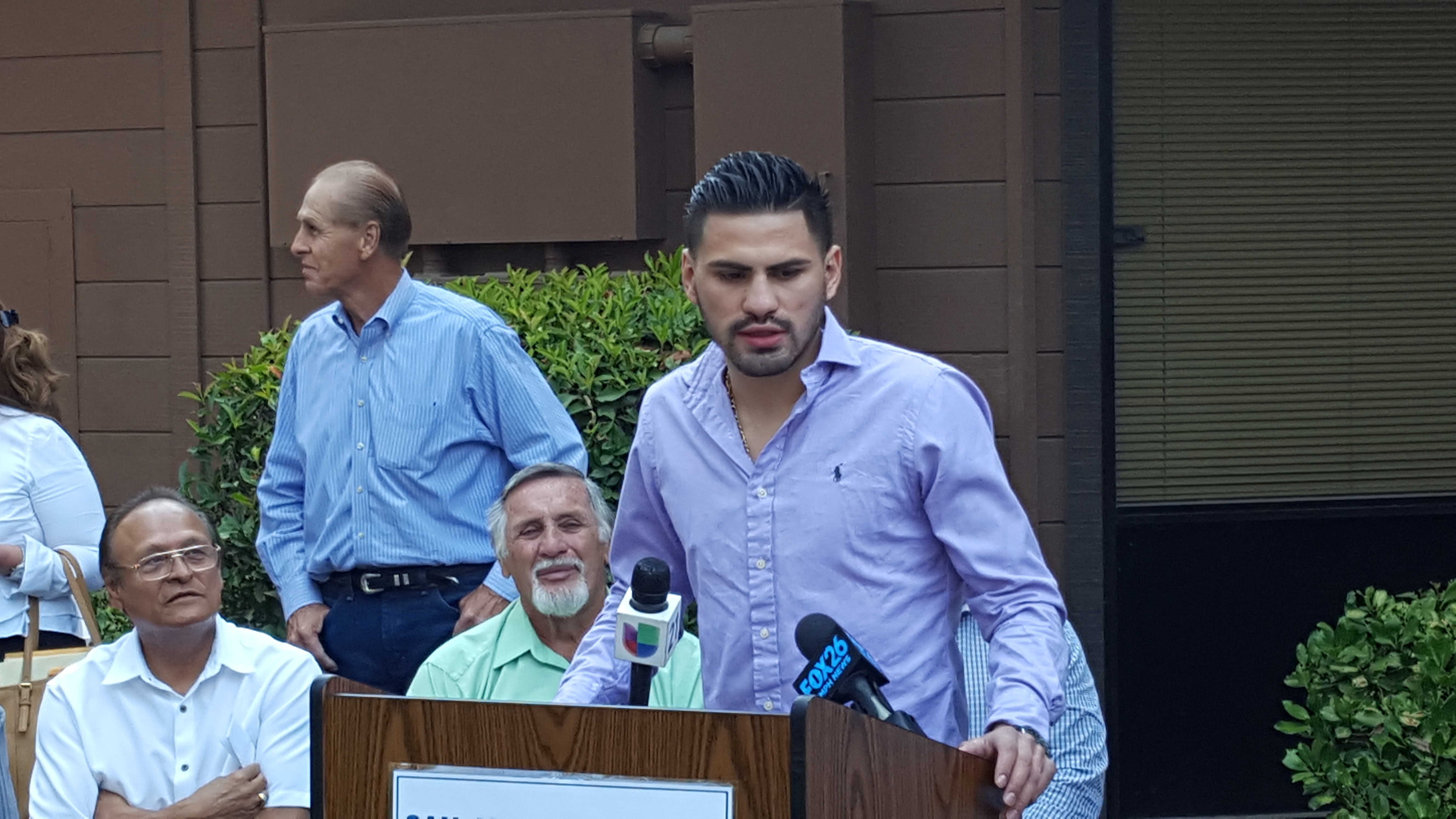
Jose Ramirez, a 2012 Olympian and current World Boxing Conference Continental Americas Champion, spoke at a special event TODAY at the Nisei Farmers League in Fresno, where in the name of the City of Avenal—a community member agency of the San Joaquin Valley Water Infrastructure Authority (SJVWIA), Ramirez presented a $3,300 check to the SJVWIA. SJVWIA, in turn, is working with the U.S. Bureau of Reclamation and many Valley counties, cities and water agencies to coordinate and complete the Temperance Flat feasibility studies and prepare the necessary bond funding application.


Ramirez, whose remarkable boxing record includes 17 fights and 17 wins—with 12 wins by knockoutgrew up in Avenal, California (Kings County) with his parents working in the fields. “I knew those jobs were important to my family because they gave me a future; they gave my brothers and sisters their future; my friends, their families, their future; they brought food to the table,” he said.


“When you’re a kid growing up in a small town like Avenal, you grow up with such innocence. There are a lot of questions that you don’t ask. There are a lot of things you don’t understand. I was just a kid who was happy to have any type of toy,” he said. “I didn’t have the privilege of having electronic games or the best clothes, but I had just enough to survive, just enough to have fun. I was very active.”


Boxing Champ Jose Ramirez presents a check to the SJVWIA

Boxing Champ Jose Ramirez presents a check to the SJVWIA

One day Ramirez asked his dad, why he bought his children sweaters instead of jackets. His dad replied, “Well, because jackets are expensive.” Ramirez reflected, “As a kid, you don’t really understand the way he managed his financials, but everything was given because of those jobs working the fields. Everything was given because of the agriculture in Central California.”


The “Fight For Water” boxing series, developed to help bring attention to the dire water issues in California, particularly in the Central Valley, has featured Ramirez in five victorious bouts to date. Despite an average year of precipitation, contracted federal water deliveries to many farmers in the Westlands Water District, for instance, have been cut by 95% thus far, this year alone, and the remaining 5% is now in jeopardy. Deliveries for the previous 10 consecutive years, were: 100% (2006), 50% (2007), 40% (2008), 10 (2009), 45% (2010), 80% (2011), 40% (2012), 20% (2013), 0% (2014), 0%(2015).


“We got in contact with Mario Santoyo and Manuel Cunha, from the Latino Water Coalition, and it has been an honor working with them. The experiences—I have really matured myself as a person,” Ramirez said. “Besides a fighter, I have learned so much. I have become more passionate about this issue. I want to continue fighting for the water. I want to continue fighting for what’s right for the people, for what’s right for my family, for what’s right for my friends’ families and for other families where I grew up,” he said.


“I am happy to work with the City of Avenal. I want [Avenal] to stay involved as much as they can. I want them to be a part of the programs, because I know Avenal is a good community,” he said. “They’ve done great with all the kids there.”


“It’s because of Avenal, I am who I am,” Ramirez said. “The opportunities that they’ve given me I will never forget. This is why I’m here, to make sure that they stay involved, to help them, to raise what needs to be raised and for them to be part of the team that we’re making, because I know that team is created by leaders, and I know that Avenal will do a good job being a part of it,” he said.


“I’m happy to say I will do as much as I can to make that happen. We’re going to continue fighting for the water, because I know that this is our future,” Ramirez said. “Being a father, I have to think about the future of my kids. And I have lots of friends who are fathers too, so I’ve got to make sure that they’re set, or at least have hope,” he concluded.


Resources

The Nisei Farmers League informs grower members about regulations and policies through meetings, seminars, newsletters and special bulletins.; provides legal assistance for labor and workplace related issues; maintains a close working relationship with local, state and federal agencies and legislators to protect grower interests; and collaborates with other grower and agricultural organizations in California and other states to help provide a powerful, unified voice for the agricultural community.

San Joaquin Valley Water Infrastructure Authority (SJVWIA)

Upper San Joaquin River Basin Storage Investigation


2016-08-08T07:51:19-07:00August 5th, 2016|

CAWG Gears Up to Fight New Overtime Bill

Following Defeat of Overtime Bill AB 2757, CAWG Gears up to Fight New Overtime Bill AB 1066

By Laurie Greene, Editor


California Assembly Bill 2757, which called to end the 10-hour workday for farm laborers (by enforcing overtime) and to illuminate extra work time opportunities, was voted down in June 2016, but a new version of the bill, AB 1066, is back on the drawing table.


Brad Goehringtreasurer of the California Association of Winegrape Growers (CAWG) Board of Directors and current chair of the CAWG State Government Affairs Committee, spoke about the process of fighting back on this bill. “We already beat it and we had a major victory in the California State Assembly earlier in the year. The author of the bill didn’t like that result, and it is all union-backed and backed by taxpayer groups like California Rural Legal Association, Inc. (CRLA),” Goehring said.


cawg

“But the pressure is back,” said Goehring, also a fourthgeneration winegrape grower and owner of Goehring Vineyards, in Clements, near Lodi. “They did a dirty gut and amend bill¹, which is a slide of hand and basically reintroduces the bill again under a different bill number. This time it’s going to start in the Senate and we’re expecting a tough battle; but we’ve got a very organized coalition of Ag associations and we’re going to put the same energy into fighting this that we did before,” explained Goehring.


“It was a bloody fight in the Assembly,” noted Goehring. “But still, we’re optimistic as there are plenty of no votes from the party that wanted this to go through that we think it will be hard for the governor to sign even if [the bill] makes that far.


Goehring maintained, “The key is to educate legislators that the bill would hurt farmworkers because it would force farmers to minimize work hours to prevent overtime payroll. In fact, farmworkers are pushing for this second bill to fail.”


“Where the lack of understanding lies is the clear line between the urban legislators and the rural legislators,” Goehring commented. “The urban legislators, ironically, are the ones who already hav $15 minimum wage laws in their towns—San Diego, San Jose, Los Angeles, and San Francisco. These legislators are trying to cram it down our throats and our lives here in the rural areas. We’re not having any real hard times getting to agreement with either party, if they are in the rural areas. It’s the urban ones that are doing all the damage.”


“We’ve had these legislators out to our farms. We’ve walked away and let them talk openly with our employees, and our employees have told them they don’t want it,” Goehring said. “Our employees have told them that they want to make an honest living. They want to teach their kids how to do the same thing. Our employees have taken it one step further; we overheard them telling the legislators they are not even in favor of any of the entitlement programs because that’s not the way to make an honest living that they want for their kids.”


“With all that said,” Goehring concluded, “the urban legislators are turning their backs on and ignoring our employees. This is all about unions and CRLA. They don’t care about the employees—is basically what they’re saying,” noted Goehring.


¹GUT AND AMEND is when amendments to a bill remove the current contents in their entirety and replace them with different provisions. (Source:  California State Legislature Glossary of Legislative Terms).

2021-05-12T11:05:50-07:00August 5th, 2016|

Breaking News: The 5 Percenters May Not Receive All of Their Water Allocation

5 Percenters and Endangered Fish May Both Lose 

By Patrick Cavanaugh, Farm News Director


Will the 5 Percenters—the Federal water users in California who were restricted by a 95% water allocation reduction this year—actually receive the promised 5% allocation? This scenario follows a more-than-average winter rainfall and snowfall throughout the state.

Ryan Jacobsenexecutive director and CEO of the Fresno County Farm Bureau, said, “arguably it’s turned out to be much worse. Right now, for the initial 5% allocation to even be questionable right now is just absolutely insane. It all boils down to the amount of water being held up in Lake Shasta for fish purposes, which has put a major stranglehold on what’s happening down here at this point,” noted Jacobsen.

Central Valley Project (CVP) Water

Central Valley Project (CVP) Water

At Shasta Reservoir, a keystone reservoir of the Central Valley Project, the U.S. Bureau of Reclamation essentially discharged flood releases earlier this year just to make room for the water that was expected to come in.  Shasta now stands at a above average full for this time of year, because the Feds are holding all the water for release for salmon later.

This is part of the plan to have cold water available to release for the salmon. And Shasta actually has 30 percent more cold water than what they thought, and water leaders are pushing hard to get the Feds to release it for agriculture.

San Luis Reservoir dead pool

San Luis Reservoir at Dead Pool Status

And San Luis Reservoir is  at a dead-pool status, which insures no more water can be sent south from that reservoirDead pool means no more water can be drawn from San Luis Reservoir, which does not bode well.

Jacobsen said, “This means our federal contractors’ 5% is in question. And that’s the irony: we were looking at such a strong year—or at least an average year [of precipitation]—and ending up now where our meager water supply is in jeopardy. This is incomprehensible and inexcusable from the federal side.”

Shasta has both federal and state water, and the federal side is essentially nothing at this point, explained Jacobsen. “Farmers rely upon San Luis Reservoir water for July and August irrigation, “and the water is essentially gone at this point,” he said. “It just shows you the major mismanagement we’re seeing from the federal side and the inability to capture water even when it is available, and not at the demise of any of these species.”

Jacobsen reiterated, “Back when the precipitation was falling [last winter], water was available at some extraordinarily high levels; yet, we never saw the increase in pumping that we would have expected under the normal conditions. “Of course, we’ve seen less pumping this year for the farmers and the cities south of the Delta,” noted Jacobsen. “During the times of the rainfall this year, it was essentially excuse, after excuse, after excuse. Some newer excuses pertained to why the pumps were not operating or operating at a very reduced capacity,” explained Jacobsen.

“The situation has been frustrating for a couple of years, but the anger continues to build because right now, this is not a ‘Mother Nature’ issue. It is completely a man-made regulatory drought that is, again, just incompetency at its best.”

“When we talk about the water stored behind Shasta [Dam] right now, really it is for the fish,” noted Jacobsen. “The most-watched fishery, at this point, is the salmon fishery. We’re in year four of this drought, but when it comes to the critical side of fish, the salmon essentially operates in three-year cycles. The last two years have been arguably two of the worst years on record for them, and this potential third year is a kind of make-it-or-break-it for salmon fisheries in the Delta region.”

Unfortunately, per Jacobsen, many decisions have been based on guesstimates. “There are a lot of folks who think we need to reserve all of this cold water for a fishery that may or may not be responding to what has been done in the past for this [contracted irrigation] water that has been given up for those purposes,” Jacobsen explained. “Right now, I think we’re doing a lot of experiments at the cost of jobs and employment, and most importantly, the farms here in the San Joaquin Valley. The frustration is that science is really not playing a big part in it. A lot of decisions are just simply, ‘We think we should be doing this versus what the science actually says we should be doing.’”

Jacobsen’s leading frustration is that all that water taken from farmers and given to fish has not helped the fish at all. In fact, the smelt and salmon numbers continue to decline. “I talk about growing frustration and anger from so many folks in the last couple of years… specifically because it hasn’t made a difference,” said Jacobsen. “An exorbitant amount of water has been given up for these fisheries, [endangered fish populations] continue to decline and crash, and as we’ve been saying for years, it is beyond time to look at just the water exporters,” he added.

Jacobsen maintains other stressors should be seriously investigated. “Many other issues taken place in the Delta should be pulled into play here, but again the regulators and the environmentalists continue to look only at the exporters as the sole issue for fish decline. There are so many other factors out there that need to be looked at,” he said.


Highly recommenced reading: “We are the 5 percenters, stretching our water supplies to get by,” by Joe Del BosqueContributing writer, The Orange County Register, July 14, 2016.

2021-05-12T11:05:50-07:00August 3rd, 2016|

Duarte Nursery v. U.S. Army Corps of Engineers Update

PLF Attorney Reports Duarte Appeals Court Decision—Once Again

By Patrick Cavanaugh, Farm News Director


Damien Schiff, principal attorney at Pacific Legal Foundation (PLF) who has been representing the Duarte family in their legal battle with the U. S. Army Corps of Engineers (Corps), provided this update after Judge Kimberly J. Mueller, U.S. District Court for the Eastern District of California dismissed their summary judgment motions on June 10, 2016, and ruled the Corps’ February 23, 2013 cease and desist order did not deprive Duarte of liberty or property. Schiff said his client’s next course of action is filing for an appeal of the judgment.

“It’s disappointing, in particular, because earlier in the case, we had received a very favorable decision from U.S. District Judge Lawrence K. Karlton, the original Federal Judge assigned to our case who ruled in our favor on our due process challenge to the Army Corps’ cease and desist order.” Judge Karlton retired from the bench in 2014 and passed away in 2015. “It was particularly disappointing to see Judge Mueller reverse Judge Karlton’s decision.”

“Launching the appeals process will take some time,” Schiff explained. “Unfortunately, the case is complicated because there are a lot of claims going on and not all of them have been resolved by Judge Mueller’s decisions. The general rule in Federal Court is that you cannot appeal until a final decision has been made that decides all the claims against all the parties.”

Damien M. Schiff

Damien M. Schiff, Principal Attorney, Pacific Legal Foundation’s National Litigation Center

Considering the preponderance of hills and valleys across the United States, the magnitude of this case has growers—not just from California, but nationwide—concerned about the outcome and precedents resulting from this case, as well as the significance of future Army Corps-issued cease and assist orders.  “It is an amazing assertion of power by the United States Environmental Protection Agency (EPA) and the Corps,” Schiff said, “and I think that’s why we see not just farming groups and property rights groups, but also a majority of the states, challenging the Agency’s Waters of the U.S. (WOTUS) Rule.”

EPA Fact Sheet Clean Water Rule_Page_1A significant point of contention in the case, Schiff explained, stems from Judge Mueller’s ruling that because the Duarte property had not seen any farming activity since 1998, the Clean Water Act’s farming exemption was no longer applicable. “That’s, in part, why we challenged the cease and assist orders,” said Schiff, “because the Corps issued this directive without giving any prior notice, much less any opportunity to present contrary information. The reality is, this property, and the other properties in the entire area, have traditionally been used for agriculture, and are, in fact, zoned for agricultural use.” EPA Fact Sheet Clean Water Rule_Page_2

The Duarte case is so multifaceted,” Schiff said. “The land was always agricultural, and what was done on the property is consistent with normal agricultural farming practices; there is really nothing exceptional about what went on. What’s particularly problematic for the Corps here is that Duarte went above and beyond the call of duty by having a wetlands consultant ensure that all of the areas assessed to have vernal pool or wetlands characteristics were marked and avoided entirely.”

Whatever the outcome, the Duarte case will have far reaching effects on legal precedent throughout the agricultural community as well as on the cease and assist orders issued by the Army Corps to families throughout the country. “Surprisingly, there isn’t very much case law on what process, if any, is owed to the landowner before the agency issues these orders,” Schiff remarked. “However the Duarte case ends up, I think that will have to be litigated in other parts of the country.”

2021-05-12T11:05:50-07:00August 2nd, 2016|

WGA Conflicted on SCOTUS DACA Decision

Western Growers Association has Mixed Feelings on Recent Supreme Court DACA Decision

By Patrick Cavanaugh, Farm News Director

The 4-4 ruling on immigration reform last month by the Supreme Court of the United State’s (SCOTUS) affirmed the lower court’s injunction against President Obama’s executive order, which would have granted deportation deferrals and temporary legal work status to about five million undocumented immigrants. Tom Nassif, president and CEO of Western Growers Association (WGA), has been vocal about the need to establish some type of immigration reform.

Nassif compared the recent SCOTUS ruling to what happened when a 2013 U.S. Senate-endorsed bill that supported a pathway to citizenship was never passed in the U.S. House of Representatives. “The House did not want a pathway to citizenship,” said Nassif. “They were not even sure if they wanted a pathway to legalization. Most Republicans did not even want a border security bill in the House coming to the floor for a vote because they didn’t want any immigration reform—whatsoever.”

Western Growers logoNassif said, “The House was part of that Send-them-home! crowd that considered anything you did—even if it was putting them on probation—as amnesty. It is interesting that with the House doing nothing about immigration, what we have today is amnesty, because we’re not doing anything about it.”

Nassif expressed mixed feelings about the SCOTUS decision. “In a way, it disappointed us; in a way, it didn’t. It didn’t disappoint us because there was no requirement that people working in agriculture who might qualify for this Deferred Action For Childhood Arrivals (DACA) or Deferred Action for Parents of Americans (DAPA) would actually remain working in agriculture.”

To get a pathway under the Senate bill, farmworkers would have to stay in agriculture for a certain number of years, but they could eventually work in other industries. So if you have a choice of working in any industry, why would you go to work on the farm? But, in this instance, you would adversely affect other American jobs,” said Nassif.

Nassif said the motivation of the Obama administration is understandable due to the inability of Congress to compromise on immigration reform, yet Nassif maintains the Immigration Reform should not be done with Executive Orders as the President has done. Instead, Nassif stressed that Congress should take up Immigration Reform and pass it.

2016-08-04T15:40:15-07:00August 1st, 2016|
Go to Top