ASTA Fills Big Void

ASTA Counteracted Free Seed Giveaway by USDA

By Patrick Cavanaugh, Editor

The American Seed Trade Association is one of the oldest trade associations in the United States. We spoke with Jane DeMarchi, Vice President of government and regulatory affairs with the American Seed Trade Association (ASTA).

“We were founded in 1883, and we represent all different kinds of seeds. So amongst our 700 members, we have row crops, vegetables, grasses and forages, and also conservation seed,” DeMarchi said.

And the seed trade association was created out of necessity when those in the seed sales industry were upset that the USDA was giving away free seed.

“Regionally in its history, USDA used to give away seed. And so there was a feeling amongst businesses that were selling seed that is was not appropriate for the government actually to be giving away seeds. So I think that it was the impetus for founding the association way back in the day,” said DeMarchi. “But now we deal with a wide range of issues that are related to the seed industry. We have such a diverse group of members, so within each of those different crops, there are different issues. And then there are some overarching things that we’re working on as an association.

California is a hotbed for the seed industry concentrated in the Salinas Valley. ASTA has several companies that have operations there within the tomato, broccoli, onion, and carrots. “These are some massive seed industry players that are working in California to support the California industry,” said DeMarchi.

And one of the things that are so interesting also about the vegetable seed production that goes on in California is that the U.S. is both the most significant market and the biggest exporter seed. “And some of those seeds might take a path of moving between several countries before they are commercialized. And then they may be processed in California and then shipped out to Mexico and Canada or other places to be grown for their agriculture sector,” DeMarchi said.
2019-08-20T07:17:29-07:00August 19th, 2019|

SB1… Fix It or Nix It

California Water Alliance Opinion on SB1

By William Bourdeau, Chair, California Water Alliance

Water is life in California. Earlier this year, Sacramento politicians introduced Senate Bill 1 (SB1) which seeks to inject politics into California’s environmental regulations. SB1 will restrict water deliveries to the Central Valley and make California even more unaffordable. SB1 puts our communities in danger.

The California Water Alliance is a non-profit and non-partisan organization with a mission to increase the water supply for municipal, agricultural and environmental needs. We have been working with a digital public affairs company to raise awareness about this dangerous piece of legislation.

SB1 will be considered in the California Assembly Appropriations committee later this month. Time is Short.

William Bourdeau

As written, SB1 would freeze the existing federal biological opinions. Future permits would be subject to outdated science and ineffective federal baseline measures, thus permanently, constraining the coordinated operations of the Central Valley Project and the State Water Project.

SB1 will hurt disadvantaged communities throughout California with inconsistent state and federal regulations. This bill will compromise access to drinking water and limit economic prosperity. The California Water Alliance is leading the charge on SB1 by engaging voters and demanding that Sacramento politicians Fix or Nix SB1.

We need your help. Please consider donating to the California Water Alliance by clicking here.

Related Story

Califonia Chamber of Commerce: SB1 is A Job Killer

The California Chamber of Commerce today announced the second job killer of 2019 — SB 1 (Atkins; D-San Diego). The bill would give broad and sweeping discretion to state agencies to adopt rules and regulations that they determine are more stringent than federal rules and regulations adopted after January 19, 2017.

According to CalChamber, SB 1 (Atkins) is a job killer because the uncertainty created by the bill’s vague, ambiguous, and broad language and lack of due process in the rulemaking process would negatively impact the growth, employment, and investment decisions of almost every major California business. Due to costs and anticipated litigation associated with SB 1 (Atkins), companies doing business in the state would be hard pressed to hire more workers or expand California operations.

The proposal seeks to create an expedited administrative procedure not subject to the California Administrative Procedure Act when promulgating emergency rules pursuant to SB 1. Should the measure become law, it will likely instigate a wave of new litigation from interested parties wishing to compel a state agency to perform an act required by, or to review a state agency’s action for compliance with, any of the laws subject to SB 1. Businesses would inevitably be forced to intervene in these lawsuits in order to ensure that their interests are adequately represented.

2019-08-15T13:17:56-07:00August 13th, 2019|

SB 1 Is the Same Bad Legislation in a New Dress

SB 1: Bad legislation is bad legislation

Opinion From GVwire

By Bill McEwen

It doesn’t matter how many times you try to dress it up. Or bring it back with a new number.

SB 1 is not only redundant, anti-science, and a barrier to environmental progress, it would put a brake on California’s economy, too.

We’re talking about Senate Bill 1, which is officially titled the California Environmental, Public Health, and Workers Defense Act of 2019.

Senate President Pro Tem Toni Atkins (D-San Diego) says the bill is an “insurance policy against the exploitation of our natural resources and our people.”

Related Story: ‘Job Killer’ Bill Nears Final Vote. Who Supports, Who’s …

SB 1 Is Flawed Overreaction to Trump Administration

But, at its heart, SB 1 is a highly flawed overreaction to a Trump administration that many state Democratic leaders and their environmental allies have called “anti-science.”

If it passes the Legislature and is signed by Gov. Gavin Newsom, the bill would empower state agencies to adopt rules and regulations that they determine are more stringent than federal rules and regulations adopted after Jan. 19, 2017.Tuolumne River-Modesto Irrigation District

For the record: Donald Trump was sworn into office Jan. 20, 2017. That’s not a coincidence.

This bill has little to do with ensuring clean water and air, protecting wildlife, and standing up for workers. The real goal is to provide a legislative vehicle for Democratic lawmakers to polish their “Trump resistance” credentials ahead of the 2020 elections.

We are confident in saying that because many of California’s environmental and labor protections already are more stringent than their federal counterparts. Moreover, California has ample tools to fend off unwise decrees from the Trump administration.

This bill has little to do with ensuring clean water and air, protecting wildlife, and standing up for workers. The real goal is to provide a legislative vehicle for Democratic lawmakers to polish their “Trump resistance” credentials ahead of the 2020 elections.

SB 1 Rolls Back Scientific Advances

One big problem with SB 1 is that it would wipe out the gains the scientific community has made since 2017 in understanding what has contributed to the decline of the Sacramento-San Joaquin River Delta. This new knowledge is opening the door to helping imperiled fished populations such as salmon while freeing water for cities and industries, including agriculture.

“Over the last 30 years, several fish species have continued to decline despite significant expenditures and diversion curtailments mandated by Endangered Species Act rulings,” writes Rick Gilmore, general manager of the Byron-Bethany Irrigation District spanning Alameda, Contra Costa, and San Joaquin counties.

“New procedures and agreements (negotiated by the Brown administration), which incorporate new species management science, are currently being incorporated and scrutinized by the federal and state fish agencies. These updated methods should be deployed and evaluated rather than stymied and derailed. The new science and better practices present the best available option for species recovery.”

And, although Atkins says revisions have allayed fears that voluntary environmental agreements praised statewide won’t be handcuffed by SB 1, the bill’s opponents rightfully continue to be skeptical of such claims.

Bill Is a ‘Job Killer’

SB 1 is not only redundant, anti-science, and a barrier to environmental progress, it would put the brakes on California’s economy, too.

“Due to costs and anticipated litigation associated with SB 1, companies doing business in the state would be hard-pressed to hire more workers or expand California operations,” says the California Chamber of Commerce, which calls the bill “a job killer.”

Earlier Version Died, So Should This One

Two years ago, then-state Senate President Pro Tem Kevin de León pushed SB 49, a bill nearly identical to SB 1. Just like Atkins’ bill, it passed the upper house. However, de León’s version nose-dived in the Assembly.

SB 1 deserves the same fate. It’s flawed legislation driven by a knee-jerk reaction to President Trump. And it’s bad for California — especially those inland regions, like the Valley, that Newsom has promised to help.

Newsom should weigh in immediately to fix SB 1’s substantial flaws. If it reaches his desk without those revisions, he should veto it.

https://gvwire.com/2019/07/24/editorial-sb-1-is-the-same-bad-legislation-in-a-new-dress/

2019-08-11T13:45:50-07:00August 11th, 2019|

China Threatens All US Agriculture

Trade War Escalates Into Worse Case Scenario

This week, China announced that state-owned companies have suspended purchases of U.S. agricultural products.  Additionally, China may impose import tariffs on newly purchased U.S. agricultural products after August 3. This announcement, so far, does not pre-empt purchases from non-state-owned enterprises.

The Chinese Ministry of Commerce says that this action is in retaliation for the proposed ten percent tariffs announced by the U.S. on $300 billion of Chinese imports, which may be in place on September 1.

A trade meeting between US Trade Representative Robert Lighthizer, US Treasury Secretary Steven Mnuchin and Chinese officials was held last week in China. The goal of the meeting was to restart the trade negotiations that had ended in May. Another meeting is planned for early September.

In 2017, California farmers/ranchers exported $2.27 billion in agricultural products to China/Hong Kong. The market ranked third for California farm exports, behind the European Union ($3.4 billion) and Canada ($3.3 billion).

Top California farm exports to China in 2017 were:

Pistachios – $663.3 millionAlmonds – $500.8 millionWine – $185.3 millionDairy and products – $174.9 millionOranges and products – $123.8 million

The full list can be found here, on Page 11 of the 15-page PDF file. 
Lastly, USDA recently rolled out updated trade data that indicated the U.S. exported $19.5 billion of agricultural products to China in 2017.  As a result of retaliatory tariffs, agricultural exports were reduced to $9.1 billion in 2018 and have continued to decline, with a $1.3 billion drop in the first half of 2019. 
Source: CFBF Federal Policy Division
2019-08-11T13:43:26-07:00August 8th, 2019|

Employee Satisfaction is Key

Farm Employee Satisfaction: It’s Not Money, It’s Respect

By Jessica Theisman, Associate Editor

Showing respect to your field and farm workers and can really pay off. According to Raul Calvo of Employers Services, he’s all about leadership, management development, human resources, and employee relations training. Calvo described a situation recently in the central valley. It was a farm operation with two Labor contractors contributing.

California Fresh Fruit Association

California farm workers harvesting tree fruit

The employees from both farm labor contractors are interested in the same thing. “We want more money and we want more benefits. We want to improve our lives.’ So, they all wanted this,” said Calvo. The UFW union showed up and was able to latch on some of the employees of one of the Labor contractors.

“The UFW was able to convince almost all of the employees from farm labor contractor one to walk out of the field,” he said. These employees basically went on strike until they get higher pay. After seeing one group walk, Calvo decided to talk to employees from another company to see their views on the subject. “It got down to yes, we want a better life. Yes, we would like this company to pay us more and to give us more benefits, but we’re willing to give them the benefit of the doubt,” Calvo said.

The other companies treated their employees with respect and that is why they did not walk out. The company relates to their employees and treats them as individuals.

2019-07-31T21:12:33-07:00July 30th, 2019|

Field Bindweed is A Struggle to Control

Field Bindweed Difficult to Manage

By Jessica Theisman, Associate Editor

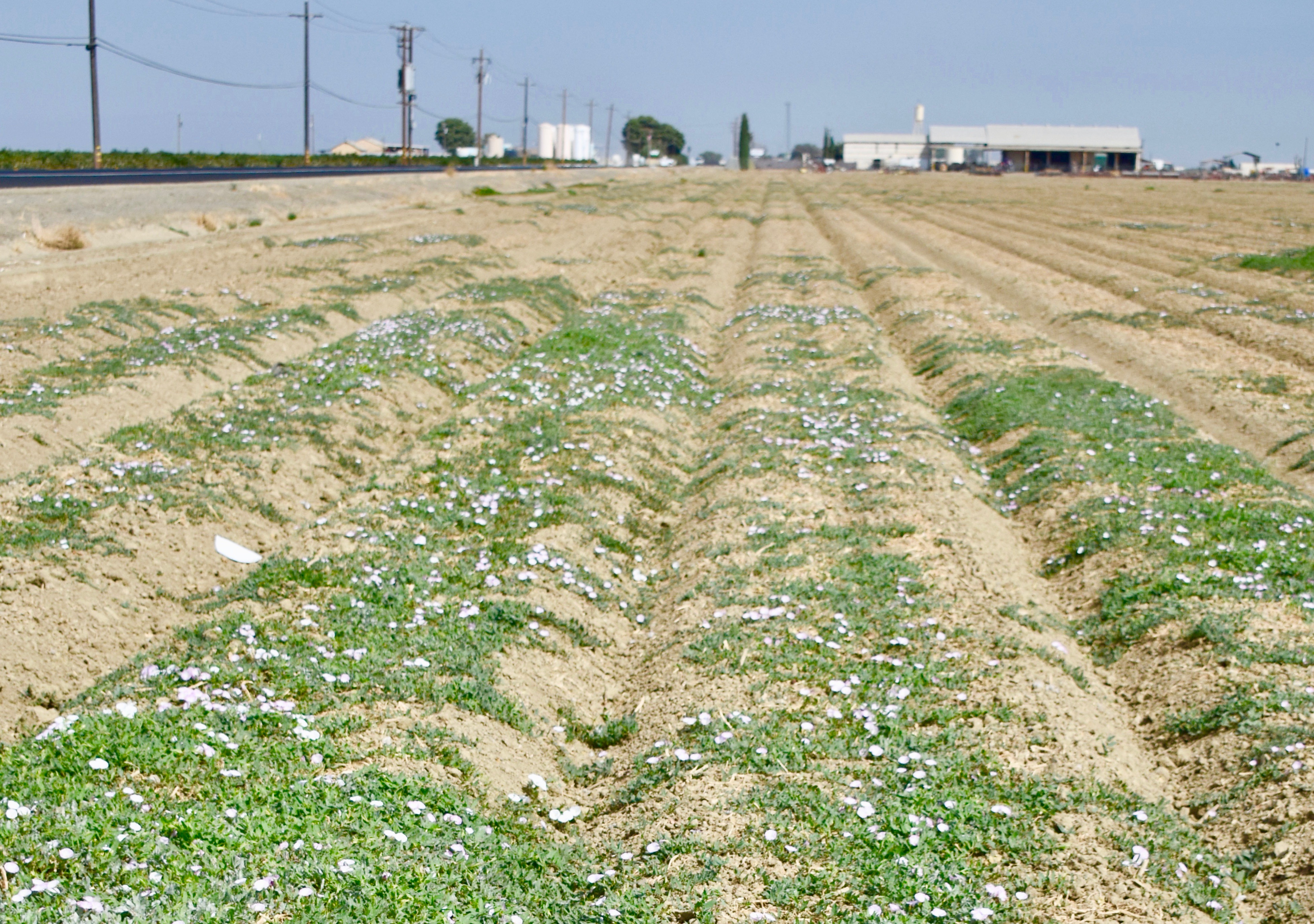
Field Bindweed is a struggle in the summer months. Scott Stoddard, UCANR Cooperative Extension Farm Advisor, Merced County, discussed with California Ag Today how to manage the weed during the summer in annual crops.

“Field Bindweed is predominantly a summer weed, so we are trying to manage it more in our summer annual crops such as cotton, corn, melons, and tomatoes,” Stoddard said.

This weed has been documented back 100 years but only recently has become more of a problem for farmers.

“It did not seem to be as universally impacting people as much as it does now,” Stoddard said.

Farmers are asking themselves what they are doing irrigation-wise that impacts the weeds.

“Does drip irrigation favor this weed? Does conservation tillage favor this weed? There are all kinds of unknowns,” Stoddard explained.

Stacking herbicides can help and control the Field Bindweed.

“Herbicides in the annual crop systems are marginal and you have to stack them. You have to combine the Roundup with something like a Treflan and then combine that maybe with some applications of other herbicides,” Stoddard said.

Even with stacking the herbicides, they are still marginal. On the herbicide angle, this is one of the things that makes weeds so challenging.

2021-05-12T11:01:46-07:00July 26th, 2019|

Calif. Dairy Organizations Collaborate Regarding Quota Program

Groups Launch Exploratory Effort to Solicit and Analyze Proposals

News Release

Recently, the United Dairy Families of California, California Dairies, Inc., Land O’Lakes, Inc., Dairy Farmers of America, and the STOP QIP organization announced a multi-phase process aimed at soliciting and analyzing industry input on California’s historic quota program.

Included in this process is a series of meetings, starting later this month, open to all dairy producers and interested parties. These meetings are intended to solicit various pathways for the state’s quota program.

1) This multi-phase process includes three key parts: The Think Tank, Producer Feedback, and Analysis.

2) The Think Tank phase is for information-gathering from various segments of the dairy industry. This will include the meetings identified below, where producers will be able to voice their opinion and contribute ideas or concepts.

3) The Producer Feedback phase will allow producers to comment and challenge the ideas developed in the Think Tank phase.

In the Analysis phase, dominant ideas from the Producer Feedback phase will be analyzed for economic impacts, and legal pathways to adoption will be determined.

This process will be implemented with the assistance of dairy industry economist Dr. Marin Bozic and dairy market analyst Matt Gould. Dr. Bozic and Mr. Gould will be conducting an economic analysis of the proposed ideas.

The first series of meetings associated with the Think Tank phase are as follows:

● Tuesday, July 30 – 2 pm to 4 pm – Embassy Suites, Ontario

● Wednesday, July 31 – 9 am to 11 am – Heritage Complex, Tulare

● Wednesday, July 31 – 2 pm to 4 pm – Turlock Ballroom

● Thursday, August 1 – 9 am to 11 am – Washoe House, Petaluma

Meeting space is limited. All participants are strongly encouraged to register at

www.dairyfamilies.org/events

2021-05-12T11:17:08-07:00July 24th, 2019|

Put Your Public Water Outreach Programs on Steroids

Water Storage Projects are Essential To Counter Inconsistent Wet Weather

By Stephen Baker, Operation Unite

How can the short memory of the public maintain the long-term commitments of water projects and conservation behaviors? On one hand, California’s recent extended drought demonstrated that the public water users could reduce their water use, but can it be maintained permanently?

And then there is water storage.

Water storage projects are essential to counter the inconsistent presence of natural yearly precipitation and sporadic wet winters, but is the public supporting projects that get the job done? Water shortage is imminent without an ability to treat, store and, ultimately, satisfy the demand of the 40 million Californians while, at the same time, maintaining a healthy environment. And without adequate water storage, we rely on groundwater aquifers. Unfortunately, this is also a bit of a sore spot. The public water users either feel that groundwater is theirs for the taking, or they consider groundwater as someone else’s problem. Either way, communities are fragmenting from misunderstanding, misconceptions and the politics of water.

Thanks to Climate change, these issues are each magnified. Climate change is now instigating our communities to adapt. Adaptation means that we have an infrastructure and public behavior that allow easy management when highly variable conditions occur.  What we need is buy-in from the public that is unwavering throughout the life of the project. It’s just not happening fast enough. It’s time to put your public water outreach program on steroids!

I know you can relate to these conditions because water purveyors, County Board of Supervisors, cities, GSAs, and Flood Control Districts face this each day with every project. Ask yourself: Are you building permanent public buy-in, or is it a fragmented and fleeting commitment? Conventional outreach methods have their successes, but it is hard to effectively engage from across the room. We need to get more personal.

It’s about relationship, and relationship is a two-way street. It is one thing to respond to the squeaky wheel and very much another to manage the entire machine in a manner that the machine operates successfully. Having the right relationship leaves your public knowing that you care and confident that you are considering an alternative that generates confidence. It gets even better. When a good relationship is built, we work better together, even when there are disagreements. Working together means you listen to understand. This is a major contributing factor needed in today’s diverse world, where building and maintaining a healthier community is critical. It even leads us to many other benefits that have nothing to do with water (e.g. homeless problem, fire safety, community economics, crime). Building relationships does take time, but if approached innovatively, it can be accomplished effectively and within a shortened period of time.

You currently engage in many public meetings, forums, private meetings, social media, conferences, and workshops on water projects. Each of these gatherings is an opportunity to build a relationship with specific emphasis on the quality of interaction. When done effectively, you will recognize that your public and you are coming together. Enhancing everyone’s ability to hear and be heard each will contribute to building healthy relationships. The vehicle for this to happen can be provided by new relationship-building tools.

So, if the strategy is about building a relationship, how is it actually developed? It’s about communication.

Many times, an opinion on communication strategy success is measured based on the number and type of events that are scheduled. Although this effort may satisfy regulatory or legal requirements, it misses the mark because the numbers of events independent of one another usually stall out in effectiveness, and you miss the opportunity to completely succeed. Let’s not forget the content of the event itself. This is where the steroids come in. Supplementing your current water outreach programs with some enhancement tools will increase public interactions and decrease pushback. Why lollygag reaching your success? Let’s get the job done.

We need communication tools that ramp up positive outcomes of your current efforts. Tools involve a mix of strategy and conduits of communication. When addressing strategy, plan a dynamic set of actions that are pre-assessed with knowledge of your public. Frequently revisit the pulse of your public through a variety of personal encounters and modify the strategy as needed. As we said earlier, we need to get more personal. There are new tools that effectively provide a community level of personal connection with a water project, and this is where the steroids come into view.

Communication is where the magic takes effect. Simultaneously connecting at varying scaled levels brings both the emotions and analytical understanding into focus with the meaning of your water projects. Accomplished effectively, this strategy of communication under the influence of the proverbial steroids develops a public that pushes a water project forward. The public will understand the value of water and the project’s relevance to their lives. At the end of the day, you feel heard, everyone is on the same page, and the project is completed on time and on budget. You even have money left over for the next project. Life doesn’t get better than that!

Stephen J. Baker is a Hydrogeologist and Founder of Operation Unite, a group that has developed communication tools for building mutually beneficial, engaged, and collaborative relations with the public and water projects. He can be contacted at stevebaker@operationunite.co or +1530-263-1007.

2019-07-22T17:16:54-07:00July 22nd, 2019|

Activist Groups Promote Fear on Consumer Food Choices

Activists Driving Consumers to Organic Food Only—Beyond Consumer Affordability

By Safe Fruits and Veggies

Despite recent and repeated calls by scientists and nutritionists to increase efforts to improve consumption, activist groups have created and promoted new webpages and infographics designed to raise fears among consumers about the safety of the more affordable and accessible fruits and vegetables.

These groups continue to ignore peer-reviewed research, which has shown these tactics don’t just negatively impact consumers’ purchasing decisions regarding conventionally grown produce—consumers’ reluctance also includes purchasing of organic produce as well. In other words, the work of these activists isn’t meeting their goal of driving consumers toward organics and maybe driving them away from produce altogether. How crazy is this?

Let’s review just some of the study findings, which have been released during the time these groups chose to create and promote new fear-based content:

“Prescriptions” for healthy foods could save more than $100 billion in healthcare costs. The healthy foods included fruits and veggies plus seafood, whole grains, and plant oils. The study concluded: “These new findings support the concept of ‘Food is Medicine.’”

Eating and drinking better, including increasing consumption of fruits and veggies, could prevent one in five deaths around the world. The study concluded: “Our findings show that suboptimal diet is responsible for more deaths than any other risks globally, including tobacco smoking, highlighting the urgent need for improving human diet across nations.”

Low fruit and veggie consumption resulted in an estimated three million deaths from heart disease or stroke. “Our findings indicate the need for population-based efforts to increase fruit and vegetable consumption throughout the world.” Click here to continue reading and to “like” and share this blog post.

2021-05-12T11:05:02-07:00July 19th, 2019|

Pesticide Air Monitoring Shows Low Numbers

2018 Air Monitoring Shows Most Pesticides Below Health Screening Levels

News Release

 The California Department of Pesticide Regulation (DPR) released air monitoring results indicating that most of the pesticides monitored in the DPR air monitoring network in 2018 were found below levels that indicate a health concern.

However, data from a separate two-year study of the pesticide 1,3-dichloropropene (1,3-D), a known carcinogen, shows air concentrations in Parlier (Fresno County) will require further action.  1,3-D is used to fight pests that attack a wide range of crops, including almonds, grapes, strawberries, and sweet potatoes.

“Air quality is fundamental for all Californians, and the latest data from DPR’ s air monitoring network shows levels of agricultural pesticides in most communities that are well within our public health standards,” said Val Dolcini, DPR acting director. “In many cases, the amount of pesticide in the air was negligible, but our scientists will continue to use this data to help DPR develop plans to reduce the presence of 1,3-D in the future.”

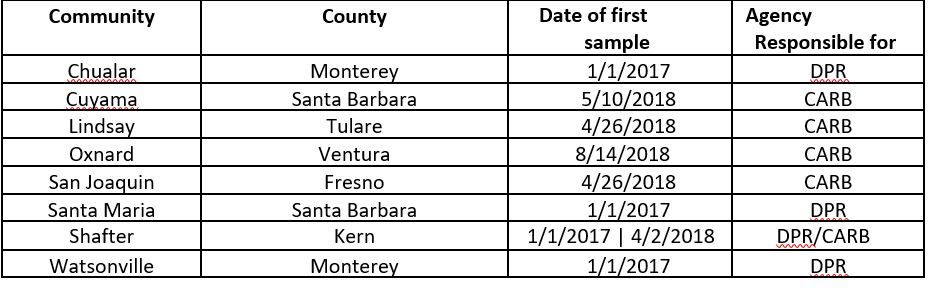
In 2018, DPR, with assistance from the California Air Resources Board (CARB) and the Santa Barbara County Agricultural Commissioner’s Office, monitored air concentrations of 31 pesticides and 5 pesticide breakdown products in eight agricultural communities. The monitoring stations are in Shafter (Kern County), Santa Maria, Cuyama (Santa Barbara County), Watsonville (Santa Cruz County) and Chualar (Monterey County), Lindsay (Tulare County), Oxnard (Ventura County) and San Joaquin (Fresno County).

The air-monitoring network, which began in 2011, was established to help expand DPR’s knowledge of the potential long-term exposure and health risks from pesticides in the air. California is the only state that monitors air as part of its continuous evaluation of pesticides to ensure the protection of workers, public health, and the environment.

The 2018 air monitoring report shows that of the 36 pesticides and breakdown products measured at the monitoring sites, most did not exceed screening levels or regulatory targets.

Other highlights include:
  • 8 pesticides were not detected at all and
  • 17 pesticides were only detected at trace level.

In January 2018, however, the air monitoring results showed that the pesticide 1, 3-D had a 13-week average concentration in Shafter of 5.6 parts per billion (ppb), which is significantly above the short-term (13-week) screening level of 3.0 ppb. A screening level is a level set by DPR to determine if a more detailed evaluation is warranted to assess a potential health risk.

DPR, along with the Kern County ag commissioner, investigated this detection and determined that it largely arose from a single application of 1,3-D made during this 13-week period. While this reading was not high enough to indicate an immediate health threat, DPR is consulting with other state agencies on next steps to reduce the exposures to 1,3-dichloropropene.


List of communities in the Air Monitoring Network

communities in air monitoring 2018 table.JPG


In addition to the 2018 annual air monitoring results mentioned above, DPR conducted a two-year air monitoring study of 1,3-D in Parlier (Fresno County) and Delhi (Merced County) from 2016 to 2018. The measured air concentrations in Parlier also exceed DPR’s screening levels and indicate that more mitigation is needed to reduce the exposures of this pesticide.

 These findings will be discussed at the next Pesticide Registration and Evaluation Committee (PREC) on July 19. The meeting will be live webcast.

Read the full 2018 air monitoring report here 

2021-05-12T11:01:47-07:00July 18th, 2019|
Go to Top