World Ag Expo 3-day Show Had More than 106,000 Visitors.


The 53rd World Ag Expo Comes to A Close

Sunny skies, large crowds and optimistic attendees defined the 53rd edition of World Ag Expo. The world’s largest annual outdoor agricultural exposition came to a close on Thursday, February 13 and boasted 1,442 exhibitors on 2.6 million square feet of exhibit space. The three-day show hosted 106,357 attendees representing 46 states, the District of Columbia and 56 countries

Exhibitors reported high traffic, quality leads and a well-organized event. First year exhibitor Agland Management Consulting, Inc. was in the Hemp Education & Marketing Pavilion and their team was pleased with their first trip to World Ag Expo.

“It was great. We’re excited hemp was part of the show. We got multiple good leads and will be working with new counties on regulations,” shared Josiah Thomas of Agland. “The second day was the best and the show was better than we could have imagined.”

Attendees came from all over the world to network and learn about the newest ag equipment, services and technology. More than 130 educational seminars, demonstrations and workshops were held over three days and covered a variety of topics ranging from irrigation to hemp, livestock to international trade.

“What a fantastic show!” said Jerry Sinift CEO of the International Agri-Center. “There were 124 international business matchmaking sessions, hemp was included as a new option for farmers, new products were launched – there are just so many good things to say. Our exhibitors step up their game every year and it creates an even better business platform for our attendees.”

American Farm Bureau Federation President Zippy Duvall kicked off opening day with a well-received speech and took a tour of his first World Ag Expo that focused on technology, the international flavor of the show, hemp and dairy.

Other popular attractions at the 2020 World Ag Expo included the Ride & Drive areas, Wine and Cheese, and the Demonstration Pavilion.

 

2020-02-17T18:11:01-08:00February 19th, 2020|

Tulare County Farm Bureau’s Scholarships are due March 1

TCFB Scholarship Deadline, is Coming Up Soon! March 1st is the Deadline

This year, the Tulare County Farm Bureau will present Tulare County students with more than $18,000 in college scholarships. Applications for 2020 scholarships must be postmarked by March 1. Or physically received in the office by 5pm on Monday, March 2. (With March 1 falling on a Sunday, we will take them at the office on Monday).

The Tulare County Farm Bureau Education and Scholarship fund annually awards scholarships in a variety of categories. Some are directed to qualified applicants according to the wishes of those who provided the funds; others go to those seeking careers in agriculture; two are given to students whose parent(s) are a farm employee and others are simply based on merit.

Students will be publicly recognized for their achievements at Tulare County Farm Bureau’s annual meeting on May 5.

To apply, students must complete and return an application; submit two letters of recommendation; submit school transcripts and attend school currently or have graduated from a school in Tulare County to be eligible. Applications and a complete list of available scholarships can be found by visiting www.tulcofb.org.

Completed scholarship application and all required material must be sent to Tulare County Farm Bureau Scholarship Fund, P.O. Box 748, Visalia, CA 93279. Applications must be postmarked by March 1st. For more information about TCFB scholarships, visit www.tulcofb.org, email TCFB@tulcofb.org or call 732-8301.


2020-02-14T18:55:23-08:00February 18th, 2020|

APHIS Bird Health Awareness Week Coming

Help APHIS Celebrate Bird Health Awareness Week by Joining a Free Webinar on February 27

The United States Department of Agriculture’s (USDA) Animal and Plant Health Inspection Service (APHIS) invites you to join poultry health experts for a webinar on Thursday, February 27. We’ll be celebrating Bird Health Awareness Week by helping anyone who owns or handles poultry learn about the importance of biosecurity and ways to prevent the spread of infectious poultry diseases.

Whether you are just starting out raising poultry or have years of experience, practicing good biosecurity is the best way to keep flocks disease free. The “Defend Your Flock from Poultry Disease: Know the Signs and How to Respond” webinar will take place on Thursday, February 27 from 2:30-3:30 PM EST. Register for this FREE webinar today at bit.ly/APHISWebinar.

If you don’t already follow APHIS’ Defend the Flock campaign on social media, check out our Twitter and Facebook during Bird Health Awareness Week (February 24-28) to get daily tips and resources you can use to protect your flock’s health.

2021-05-12T11:17:08-07:00February 17th, 2020|

Urgent Help Needed—A Call To Action!

CALL TO ACTION! telltrump@gmail.com

By Kristi Diener with The CA Water for Food and People Movement

Call to Action! Last summer this group wrote more than 300 water letters to the U.S. Ag Secretary Sonny Perdue. He left the Los Banos water forum with the secret service, and our letters in his car! With President Trump coming to town next week, I think it’s a great time to beat that record and submit another stack! telltrump@gmail.com

California does not care about reliable or affordable water for its own people or their food producers. They prove that year after year when they dump billions and trillions of gallons of fresh drinking water out into the Pacific Ocean. Even when voters approved a $7.5 billion dollar water bond for surface storage in 2014, we still have not gotten any infrastructure for which we voted.

President Trump has proved he is listening and does care. He has already done more to secure CA water for food and people in three years, than CA has in 40 years. What Trump saved our country from becoming in 2016 with his victory over Hillary Clinton, is happening in concentrated form in California, and water is simply being used as a political tool to implement an agenda we don’t want. We need continued federal help. But you know the issues. telltrump@gmail.com

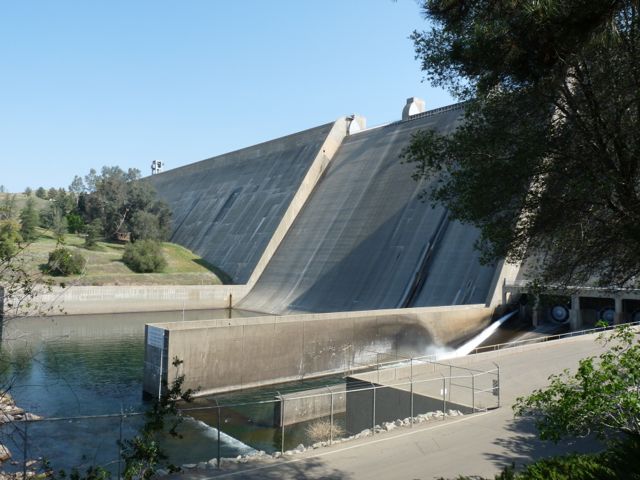
I have set up an email for you to use. Write a sentence, a paragraph, or a novel, and tell Trump what’s happening to our water, and what we need. Thank him for executing the Biological Opinions update, for allocating money to raise Shasta Dam, or for his administration’s recent infrastructure designation that will focus attention and resources to ensure our state’s federal dams are robust, maintained and safe. Or pick any issue you want! telltrump@gmail.com

The emails will come to me, I will print them up, and I will find a way to see that he gets them next week. telltrump@gmail.com

Stuck? Not sure what to write? Scroll this group. You have my permission to use anything I’ve written here as your own.

Maybe you just want to write, “WATER DAM IT!” or maybe you want to tell him how California’s water policies and rate hikes have affected your family?

Maybe you want a federal audit for the billions of water-bond dollars CA keeps taking in? What about how the lack of surface water deliveries is going to idle a million acres of America’s most productive farmland and impact our food supply? Or how losing our nation’s food independence creates a national security issue? I don’t read them. I just print, stack, package, and deliver…so have at it. telltrump@gmail.com

2020-02-15T16:24:23-08:00February 15th, 2020|

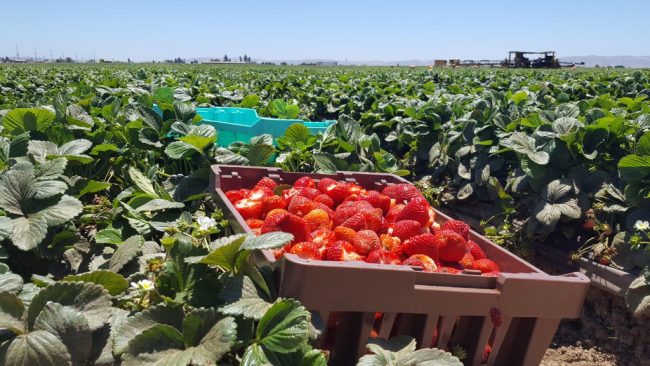
Automated Strawberry Harvest Still a Way Off

The Challenge of Automation in Strawberry Fields

By Tim Hammerich,with the AgInformation Network

A few weeks ago, we were able to report that the strawberry crop outlook was very optimistic for California growers. While supply and demand both look strong, farmers are still wrestling with a big challenge: labor.

California Strawberry Commission Communications Director Carolyn O’Donnell said it will be a challenge.

“Labor is definitely one of the biggest concerns that they see is the ability to be able to plant, weed, and harvest to their crop, because all of those things are done by hand,” said O’Donnell.  “There are some efforts going underway to find different ways to use automation or mechanical ways to do this, but because it’s such a delicate fruit and it’s picked on the plant and packed directly into the clamshell where you buy it in the grocery store.

The goal is to find machinery that can mimic, not only the touch of a hand, which can adjust itself to how firm things are. But also something that doesn’t damage the plant because they’re harvesting from the same plants two, sometimes three times a week, over a number of months. So you want to keep the plants intact,”she said

O’Donnell said it’s not just the fact that human labor is more delicate with the fruit and the plants. It’s also the art of identifying and picking only those fruit that are ready for market.

“The other thing is that being able to judge. Is this berry ready and ripe to be picked? So having the optics that are able  to judge what’s right for picking,” she said.

The future is likely a combination of skilled labor and new technologies to help our strawberry growers remain competitive.

2020-02-12T19:10:19-08:00February 12th, 2020|

Will Extra Water Storage Ever Become Reality?

Storage Reality!

Commentary from Families Protecting the Valley

Remember “The Water Quality, Supply, and Infrastructure Improvement Act of 2014”, otherwise known as Prop1? At last month’s meeting of the California Water Commission, staff updated the commissioners on the status of the projects in the Water Storage Investment Program (WSIP). Those are the storage projects in Prop 1. So, that was 2014, and it’s now 2020, and we’re still just talking, not building.

This process has gone on and on and on and on…So, here’s what’s happening. According to the California Water Commission in “2018, the Commission completed the application review process and made Maximum Conditional Eligibility Determinations or MCEDs for the eight projects under the Water Storage Investment Program.” Don’t know about you, but we love the bureaucratic lingo.

Since then the applicants have been moving forward with their projects to meet the statutory and regulatory requirements of the WSIP. So the applicants “submit quarterly reports to “summarize their activities as they move towards the final award hearing.

Click here for an article from the Commission the staff sho has put together an estimated timeline for the final award hearings and construction and operation of the projects. If you click on the link you will see projected construction will start on one project this year, one next year, and 3 in 2022. BUT the Program Manager noted that in 2018 when the conditional funding awards initially were made, the Commission made 9 determinations for each project and one of those determinations was that the projects appeared feasible. Appeared feasible? That doesn’t sound too good.

Here’s another thing. By January, 2022 the projects must have have a 75% commitment of non-public benefit cost share. So, they’re still trying to get funding. That’s a big maybe. If they get the funding and complete all the other requirements, the applicant will come before the Commission for the final feasibility finding.  That’ll be December 2021. Here is something they ask you to keep in mind: “there is no deadline in statute for the final award hearing, and some projects could take years to complete these items. This is a long-term program.”

Used to be we’d pass a bond and build a dam. But now, this is how bureaucracy works. Good luck with whatever storage project you’re rooting for.

2020-02-07T15:41:35-08:00February 11th, 2020|

Food Safety In the Produce Supply Chain

Food Safety is Paramount in Produce Industry

By Tim Hammerich, with The Ag Information Network of the West

Food safety is something everyone in the produce industry is concerned about, from growers all the way through the supply chain.

United Fresh Produce Association is a trade group that exists to empower produce industry leaders to join forces to shape sound government policy. California Ag Today’s Patrick Cavanaugh caught up with United Fresh President and CEO Tom Stenzel at the association’s Fresh Start Conference in Tucson.

“We’ve got to do a better job in traceability We’ve got to be able to get to the source of these issues right away. You know, our products are grown outside in nature,” said Stenzel. “There’s no kill step. We don’t cook our salads. So we’re probably never going to get to zero, but we’re going to keep getting better in prevention and then we’ve got to do better tracing it back.”

That traceability aspect can be a challenge in complex supply chains like those of some fresh produce. But Stenzel says their members are committed to finding innovative solutions.

“So the grower/shipper community, they’re trying to figure out how do I prevent food safety issues. And we’re learning a lot. Every time there’s an outbreak, as tragic as it is, we learn from it. And that’s really what the growers are trying to do right now, is to take every possible step of precaution in how they use water; or how they use compost,” said Stenzel. Making sure that we’re not contributing to contamination. Wholesalers, retailers, everybody’s got to work together on those things.”

Stenzel said just about every meeting they had around the Fresh Start Conference addressed some aspect of food safety.

2021-05-12T11:01:45-07:00February 10th, 2020|

UC Davis Will be at World Ag Expo!

Associate Dean Oberbauer to join UC Davis agricultural experts at World Ag Expo

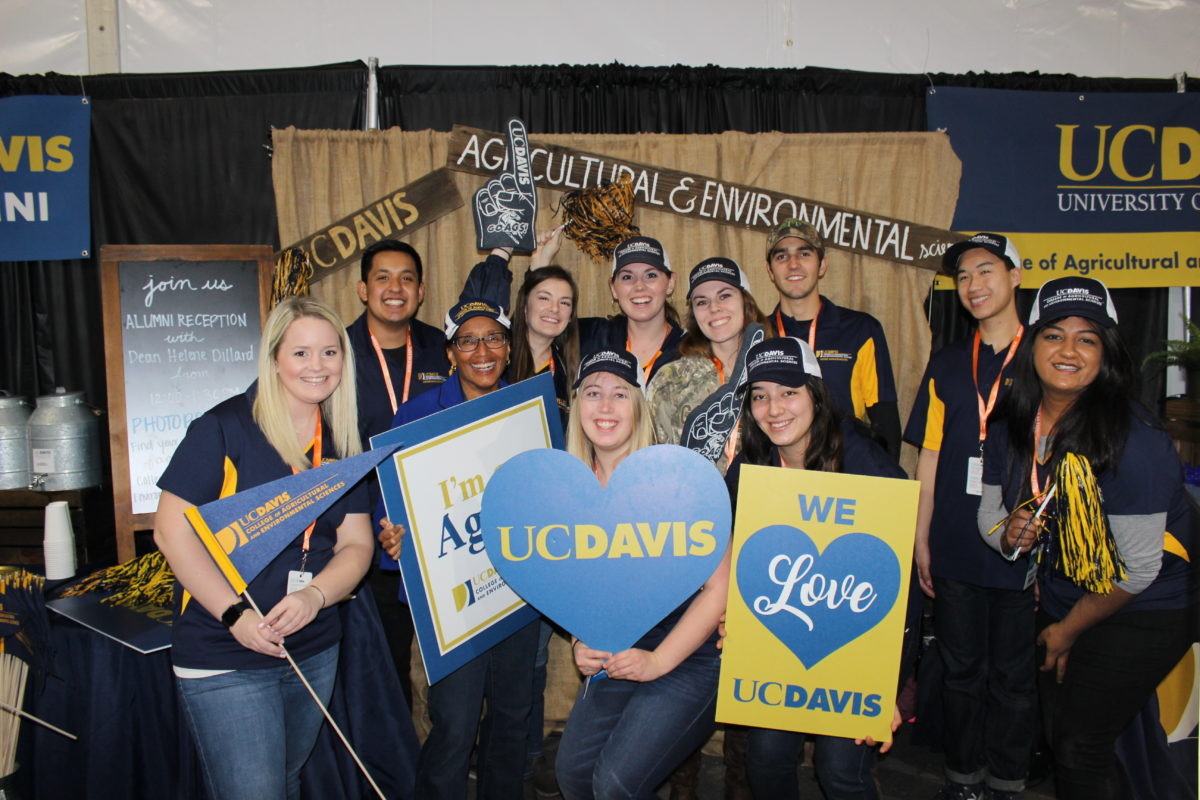
(Pictured are UC Davis Aggie Ambassadors, who will on hand to greet expo-goers.)

Associate Dean Anita Oberbauer with the UC Davis College of Agricultural and Environmental Sciences will gather with fellow scientists, staff and students at the World Ag Expo in Tulare, February 11-13, to chat with farmers, prospective students, alumni and leaders throughout the agricultural industry.

More than 100,000 people are expected to attend the 53rd annual event, where 1,400 exhibitors display cutting-edge agricultural technology and equipment over a massive 2.6 million square feet of show grounds.

“I’m delighted to take part in this incredible agricultural exhibition,” said Oberbauer, who is associate dean of agricultural sciences for the college and a professor in animal science. “I look forward to discussing the college’s latest development in agricultural research, meeting prospective students and reconnecting with alumni and friends from the Central Valley and beyond.”

Professor Oberbauer will be at the UC Davis booth—located in the Ag Career and Education Center—from 11 a.m. to 1 p.m. on Thursday, Feb. 13. She will be joined by Christopher Glick, associate dean for development and external relations, who will attend the expo all three days. The UC Davis booth has been expanded this year to provide extra space for alumni and others to gather.

Throughout the event, various college experts in livestock, nutrition, plant pathology, engineering, economics and more will be available to discuss agricultural issues and visit with attendees. Aggie Ambassadors and undergraduate student advisors will be on hand to answer questions about UC Davis majors and campus life.

“Prospective students can learn about our majors and the career paths they provide,” said Sue Ebeler, associate dean of undergraduate academic programs and professor in viticulture and enology. Ebeler will be at the UC Davis booth on Feb. 13.

In addition to Associate Deans Oberbauer, Glick and Ebeler, college experts attending the expo include:

  • Deanne Meyer, Cooperative Extension specialist in livestock waste management, who will be available all days
  • Rachael Goodhue, department chair and professor in agricultural and resource economics, who will be available Feb. 11
  • Florent Trouillas, assistant Cooperative Extension specialist in plant pathology, who will be at the expo Feb. 11
  • Farzaneh Khorsandi, assistant Cooperative Extension specialist in biological and agricultural engineering, will be available Feb. 11 and Feb. 12
  • Gerado Mackenzi, associate professor of nutrition, will be available Feb. 12
  • Patricia Oteiza, nutrition professor, will be available on Feb. 12.

UC Davis is ranked first in the nation for agriculture, plant sciences, animal science and agricultural economics. The College of Agricultural and Environmental Sciences enrolled more than 2,000 new students in the fall of 2019, many of them from California’s Central Valley. The college offers 28 majors—everything from agriculture to nutrition to global disease biology.

“The World Ag Expo is an incredible event,” Ebeler said. “We get to meet with leaders from around the world, as well as with the passionate young people who are the future of agriculture.”


2021-05-12T11:05:01-07:00February 7th, 2020|

California’s Trucking Industry Hurting with Regulations

Regulations Put Trucking Industry in Peril

By Patrick Cavanaugh, Editor

The trucking industry, moving California agricultural crops from processors to distributors around the country, is facing many uphill challenges.

Tejinder Singh Mehta, also known as TJ, owns InTrade Industries based in Fresno. His company only focuses on a refrigerated fleet handling sensitive perishable commodities, and other refrigerated cargo from California, across the states, and also backhauls.

“The trucking industry is going through a lot of problems. The biggest problem that we are facing now is the extreme shortage of drivers, noted Mehta. “Even if we get drivers, they are not qualified enough to take the challenge, which includes safety regulations and timely deliveries. So that is the biggest issue right now

There is also AB5, which restricts independent contractors in California. “AB5 is affecting the trucking industry in a big way, because earlier small operators, could be hired by midsize fleet companies for outsourcing some freight jobs,” said Mehta. “Because if you have some business that needs to be taken care of, some contracts to be taken care of, you cannot hire independent contractors. They’re so hard to find. In the given situation, we cannot add on to more trucks on our own.”

“Because of the shortage of drivers, if we cannot hire independent contractors, it’s going to affect the industry in a big way,” he noted. “And since California has more trucks, it gets struck by these regulations, which can affect the whole nation in a big way.”

Another significant regulation is the Electronic Logging Device (ELD), which restricts drivers operating more than eight hours.

What happens is that a driver gets close to a destination, and his eight hours restrict any more driving time. The driver cannot continue for even 10 minutes or 15 minutes to go and deliver the load. “This is affecting the efficiency of the job. This is going to affect the actual time for the driver. This impacts the entire trucking industry across the nation, including shippers and receivers,” Mehta said.

Mehta said that the California trucking industry needs a good dialogue between the regulatory authorities, with the truckers at the table, and take on these problems head-on “before they snowball and paralyze the whole industry,” he said.


2020-02-05T08:41:14-08:00February 7th, 2020|

American Farmer Art at Temecula Valley Museum

Art Exhibit Honors the American Farmer

By Tim Hammerich, with the Ag Information Network of the West

We in agriculture are often looking for ways to connect with consumers removed from where their food comes from. The City of Temecula has decided to bring farming to their residents through photography in an art exhibit called “American Farmer”.

Tracy Frick is the Community Services Manager for the City of Temecula, and she oversees the Temecula Valley Museum.

“It’s a rented exhibit that we have rented from a company called Mid-America Arts Alliance,” noted Frick. “And it deals with the American farmer. I’m always looking for exhibits that relate to Temecula and Temecula Valley, but are also beautiful and also have an artistic component. And this exhibit does both.”

Frick said that the exhibit which contains both black-and-white as well as color photography, really captures the personality and the diversity of America’s farmers.

“Some of the select photographs have the story of the farmers and the farmer’s families,” noted Frick. “And the descriptions also tell a story about how being a farmer is embedded in the lives of them and their families, and how it’s not just about raising the crops. It’s, it’s a way of life. And it’s really just beautiful and interesting to see how they view what they do.”

The “American Farmer” exhibit at the Temecula Valley Museum opened January 31st and will be available until March 15th. Show up any time Tuesday – Sunday, 10am – 4pm.

2020-02-06T08:42:14-08:00February 6th, 2020|
Go to Top