Crop Protection

GMO Technology Can Help Prevent Starvation

First World Activists Dictate to Third World

By Patrick Cavanaugh, Editor

Needed GMO technology to help citizens in Third World countries is being thwarted by activist groups in First World countries who are anti-GMO, said Alison Van Eenennaam, a UCANR Cooperative Extension Specialist focused on Animal Genomics at UC Davis.

“If the African people choose to use this to develop better bananas, they should have the right to use that and not be dictated to by activist groups in the First World promoting fear around this technology,” she said.

GMO technology could greatly benefit those in the developing world, especially those who struggle with starvation on a daily basis.

“Most people have never seen starvation. People take food for granted, and when you see people that have problems in their agricultural production systems that are actually affecting the food security, you have to address those problems, whether they be drought or disease problems,” Van Eenennaam explained.

“And I’m all for using whatever technology that works best to address a problem. Maybe it’s conventional breeding or maybe its GMO, or gene editing. I don’t really care. I just want to use the best tool that is available. But it doesn’t make sense to take some tools off the table for no reason, and I think that’s what’s happening around the debate of genetic engineering,” she said.

And the use of GMO crops in a third world country has dramatically decreased the use of pesticides, which should be celebrated by activists.

“About 90 percent of the farmers growing GMO crops are on small acreage producers in the developing world, that are growing insect-protected Bt cotton. And the dramatic decrease of insecticide use resulting from that—well environmentalist should be singing this from the rooftops,” Van Eenennaam said.

“It’s incomprehensible to me that if your real intent is to decrease pesticide use in agriculture, to not appreciate what those Bt crops have done for global insecticide use is to be willfully ignorant of what the data shows,” Van Eenennaam said. “It’s just a win-win for everyone.”

2021-05-12T11:05:12-07:00April 11th, 2018|

Helping Anti-GMO Consumers Know the Truth

Van Eennennaam: It’s Tough to Change Emotion

By Patrick Cavanaugh, Editor

California Ag Today recently spoke with Alison Van Eenennaam, a UCANR Cooperative Extension Specialist focused on  Animal Genomics at UC Davis. She discussed the argument against GMOs and the difficulty that some science communicators have with reaching anti-GMO consumers whose arguments are more emotion-based than fact-based.

“When every major scientific society in the world says something, then I don’t believe it’s a giant conspiracy theory,” Van Eenennaam said. “I believe that’s what the data show, and I get a little bit frustrated when people cherry pick an outlining study and just selectively ignore the consensus opinion of every single scientist in the world. That doesn’t make sense.”

“It becomes more like a denialist instead of a skeptic at that stage. Then discussion around the safety of GMOs is just out of kilt with the actual scientific data. It’s frustrating trying to correct that with science because it’s very hard to counter an emotional argument. So we need to peel back the story in a narrative form,” she said.

Van Eenennaam highlighted a movie called Food Evolution, narrated by American astrophysicist Neil deGrasse Tyson, which presents a factual representation of GMOs.

“I think that’s what’s been encouraging to me, just with general audience populations watching it, is they’ll come up afterwards and say, ‘You know what? This film made me think.’ ” Van Eenennaam said. “As a science communicator, I cannot ask for more than that. That’s exactly what I want people to do. I want them to dig down into the data and recognizing where they are getting the information and what it’s saying. I think that is a positive outcome.”

And certainly the movie has changed the mind of some people.

“And that is great, but we are wanting people to reevaluate on why they are changing their minds and are they willing to change their minds based on the evidence?  That is one of the focal points of the movie,” Van Eenennaam explained.

The Food Evolution movie can be seen free if you subscribe to Hulu. It can also be seen in different areas on the web. Simply search for it online.


2021-05-12T11:05:12-07:00April 9th, 2018|

Registration of Hives for Notification

Beekeepers Should Register the Position of their Hives

By Laurie Greene, Founding Editor

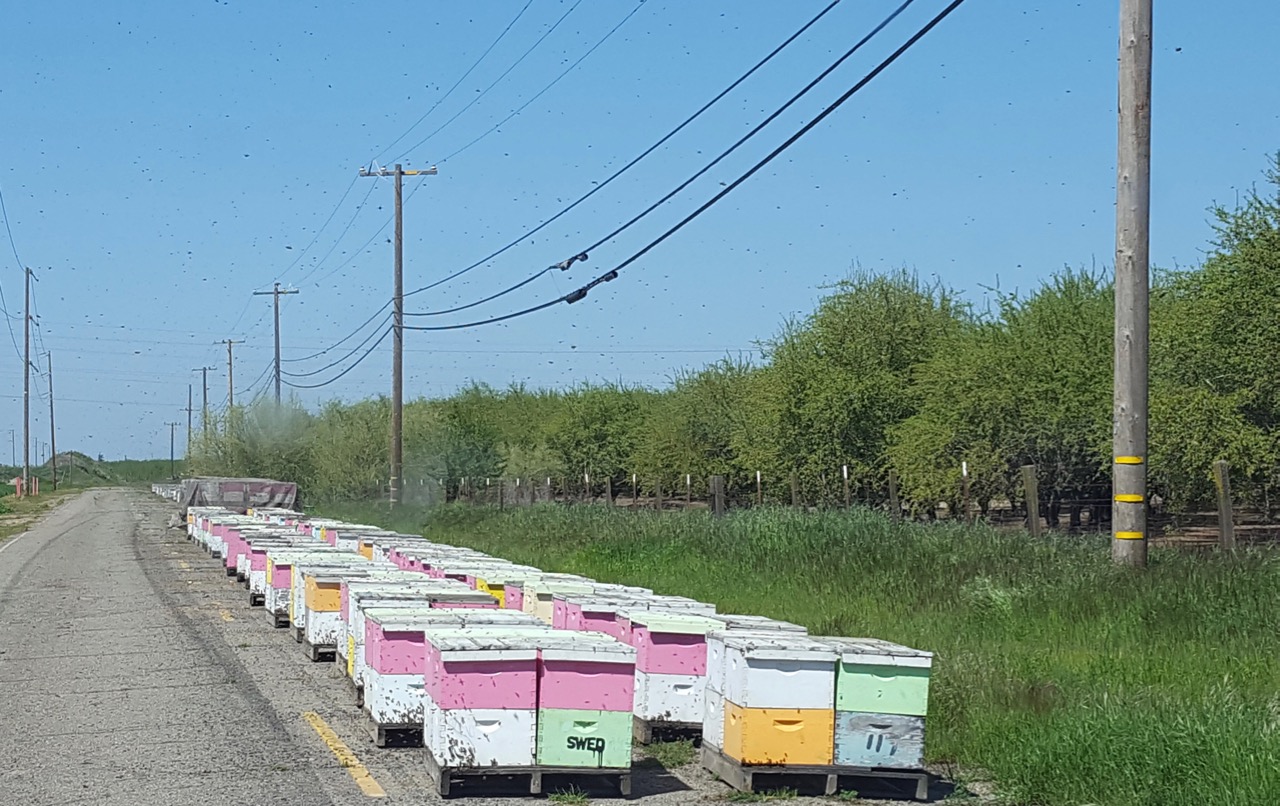
Tim Pelican, Agricultural Commissioner for San Joaquin County, recently explained to California Ag Today the critical importance for beekeepers to register the location of their delivered hives to farm operators, so the beekeepers can be notified when farmers are preparing to spray.

Pelican suggests farmers not spray during the day when bees are active, even if the product label does not suggest this restraint. He also reported that state agricultural commissioners are working on “our concern about the lack of notification by beekeepers to farmers about the exact location of their delivered beehives when we have instances of reported bee kills.”

“Beekeepers are supposed to register with the county,” Pelican explained, “when they move beehives into the counties. It is like a $5 fee, but for some reason people just do not do it. Beekeepers tend to be secretive sometimes, but we do keep all of that information strictly to ourselves. That’s not something we issue to the public.”

Pelican also mentioned that Ag commissioners will attempt to encourage farmers to notify schools about nearby spraying.

“We are actually notifying growers who are impacted. When they come in and do their pickup, their permits, we will have computers available to them to help them get their notification done. Their PCAs or dealers, if they are listed on their permit, can do the notification for them as well.”

“That notification then goes directly to the affected school,” he continued. “Then that school also can take a look and see which growers are applying what products. That information, however, is available only to the people who can get into the computer program—school officials, the grower, or the Ag commissioner. This is not information that is out there for the general public. The program has the ability to transfer the chemicals listed on the permit over to the notification. That way we are avoiding duplication of effort.”

2021-05-12T11:01:55-07:00March 29th, 2018|

When Spraying, Avoid Water, Bees and High Wind

Spraying Safely Prevents Major Issues

By Laurie Greene, Founding Editor

Safe spraying is an important topic. Making sure that crop protection spray materials stay on target is at the interest of all growers, Tim Pelican, Agricultural Commissioner for San Joaquin County, explained recently to California Ag Today.

“We want to make sure that we are not applying sprays to water bodies, especially standing water or running water,” Pelican emphasized, “Especially because it will run off into other larger bodies of water. If you look at any product label, it will tell you not to apply to standing water. The scenario will show up in our water coalition’s work reports.”

“Drift in the Delta can be an issue because of the high winds out there,” he explained. “So, we must avoid spraying during high winds to avoid drift issues. Another issue we have is when blast sprayer operators do not turn their rigs off at the end of a row. So they come out and make their turn, and then we receive complaints about vehicles being sprayed or something like that.”

“Spray safety hazards have been coming from a variety of materials,” Pelican reported. “We have had issues with people using sulfur, copper or something similar; it could be any material, so spray safety is always important.”

“When it comes to spraying in San Joaquin County,” Pelican said, “We treat more than just almonds. Cherry crops require sprays as well. Melon crops are big users of apiaries, so we aim to make sure that people have as much information as they can so that they can make wise application choices.”

“Another suggestion is not spraying during the day when bees are active, even if the label states that it is okay, do not apply.”

2021-05-12T11:01:55-07:00March 27th, 2018|

Herbicide Limits Plantings Following Cilantro

Caparol Label Change Sought To Reduce Plant-Back Restrictions Following Cilantro

By Patrick Cavanaugh, Editor

Cilantro production is important in California and more growers are planting it. However, an herbicide used in cilantro has plant-back restrictions to other crops.

It’s easy to grow and works well as a rotation crop, explained Oleg Daugovish, a UCANR Cooperative Extension Strawberry and Vegetable Crop Advisor serving Ventura County.

“It’s an easy fit in our production systems. You can fit it between many crops,” Daugovish said. “It’s a quick crop and can be planted in a small planting window.”

To help minimize weeds, Caparol herbicide is labeled for use on cilantro. “It works very well and it’s all we need to control weeds in cilantro,” Daugovish explained.

“But the problem is that we have some plant-back restrictions. Some of the crops, we obviously have to rotate your cilantro with something,” Daugovish said. “You have to have a label that allows you to go back to the field with other crops such as peppers, lettuce, Brussel sprouts or spinach.”

That’s the biggest problem for growers, as they like how it works on cilantro, but need an allowance to go back in with different crops without worry.

Under the IR-4 program, Daugovish conducted research to see if other crops could safely be planted after a cilantro crop. The research indicated that crops following cilantro within the plant-back restrictions were safe for the most part.

“They treatments were similar to the untreated,” said Daugovish. “We are putting some numbers together and running statistics in different locations such as Salinas, Santa Paula, and Ventura.”

Daugovish said it appears that it is safe to follow cilantro without waiting for plant-back restrictions, and he plans to submit the data to the IR-4 program who can get it to the registrant who can amend the label.

“We need to make the change on the label so growers can use it without the plant-back restrictions,” said Daugovish. “We expect to have the data sets to support a label change so that growers can use it.”

“As far as herbicides, we may not have another option for a while, but if growers can use is safely with peace of mind it will be a major benefit,” he said.

2021-05-12T11:05:13-07:00March 21st, 2018|

Fighting Huanglongbing Is Job One

Citrus Health Program Protecting State’s Industry

By Patrick Cavanaugh, Farm News Director

Joel Nelsen, president and CEO of the California Citrus Mutual based in Exeter, spoke to California Ag Today about a recent trip to UC Riverside to discuss the Citrus Health Response Program and huanglongbing disease.

“For the last several years, the federal government and the California citrus industry had a wonderful partnership with some ideas, some regulation, and most importantly, with some funds,” Nelsen said. “So periodically, USDA comes to do an audit as to what we’re doing, how we’re doing it, and whether or not there needs to be some reevaluation.”

“The Citrus Health Response Program is the program we call a CHRP for a two-day evaluation. You had scientists and regulators from USDA; you had regulators from CDFA, along with a few scientists,” Nelsen explained.

“You had that entire stakeholder group and members from the scientific community and UC Riverside to evaluate what we’re doing and why, but eventually we did achieve one objective and that’s coming up with several action steps that we need to do as an industry in partnership with government,” he said.

The concern of Huanglongbing disease was discussed and game plans were presented.

“What was interesting is this was a friendly audit. They weren’t interested in taking money away, they weren’t interested in determining if we’re using dollars appropriately, but they wanted us to talk about why we were still spraying in the urban environment for the Asian Citrus Psyllid, which vectors Huanglongbing,” Nelsen said.

“They wanted us to talk about whether or not growers were doing what they were supposed to be doing and of course, they are doing what they need to do to keep the deadly disease out of commercial citrus orchards,” Nelsen said.

2021-05-12T11:01:56-07:00March 8th, 2018|

Mycotoxins are Serious Business

Sanitation Fights Mycotoxin Infections

By Jessica Theisman, Associate Editor

In nature, there are fungal metabolites called mycotoxins, and some of them can infect crops. However, certain cultural practices can eliminate them. California Ag Today recently spoke with Bob Klein, manager of the California Pistachio Research Board, based in Fresno, about the topic.

“We see mycotoxins as a result of fungal infection that comes from the Navel Orange Worm. It is damaged predominantly, and if a crop is contaminated with possible mycotoxins, such as one known as Aflatoxn, it can hurt exports. Over 70 percent of our crop is exported, and some of our major markets are very sensitive to a mycotoxin contamination,” Klein said.

“The best programs start with orchard sanitation. Many growers are lax on sanitation or spend low amounts of money,” he explained. “Those who are frugal are spending $200-250 an acre on sanitation, and so growers need to be prepared for that.”

As far as insecticide applications, look at the growers’ data, not what is published in replicated field trials.

“More sprays are better than fewer sprays,” Klein said.

2021-05-12T11:01:56-07:00February 15th, 2018|

Rootstocks Offer Production Attributes

Tomato Rootstocks Grafting

By Jessica Theisman, Associate Editor

California Ag Today recently spoke with Brenna Aegerter, a UC Cooperative Extension farm advisor in San Joaquin County, about grafting rootstocks to tomato plants.

“Rootstocks are cut below the cotyledons, while the scions are cut above the cotyledons at an angle,” she said.

These two plants are then clipped together and go into a high humidity healing chamber for about one week.

Aegerter explained that, “In the beginning, there is no light. They gradually increase the light because they do not want to stress the plants, and so if those two angles match … then everything grows back together.”

Each tomato plant can differ depending on the rootstock that it has been grafted to. Different rootstocks have varying levels of resistance to disease and pests. Rootstock resistance does have an effect on crop yield. If all of the fruiting varieties had the nematode resistance gene, they could potentially improve their yields.

There is great success rate on grafting these tomato plants.

“We have had pretty good success, 90 percent and up,” Aegerter said.

The remaining 10 percent is because the angles were not matched up quite right and there is not enough contact between the two tissues.

“Rootstocks are for the most part, hybrids between our cultivated tomato and wild tomato species,” Aegerter explained.

Wild tomatoes are used often to bring in new genetic material due to their diversity and natural resistance. Depending on the type of tomato that is being used, the resistance can differ.

The fruiting varieties are resistant, but are resistant to a shorter list of diseases.

“These root systems are are bigger, the crown is bigger, and sometimes they aren’t even purely resistant to the disease, but just by virtue of the fact that they grow faster, they can outgrow it,” Aegerter said.

2021-05-12T11:05:14-07:00February 2nd, 2018|

Cannabis Growers May Be Using Illegal Materials

Illegal Pest Control by Cannabis Growers

By Patrick Cavanaugh Farm News Director

Big problems are arising in the cannabis growing areas of California.

John Fournier runs Acadia Regulatory Consulting in New York State. He on an EPA list of registration consultants. And because his company is high on the alphabetical list, he gets calls from cannabis growers in California who are looking for help in dealing with pests and diseases on their crops. Because cannabis production is federally illegal and the registered crop protection material products fall under federal guidelines, there are essentially few materials that growers can use.

“The biggest pressures for cannabis growers are powdery mildew, fungus gnats, and mites. If a grower had a bad spider mite outbreak, they would want to protect a super valuable investment. The question is, what are they willing to do to protect that investment? And in a situation like that, maybe you’ll go buy a miticide off the shelf somewhere,” Fournier said.

“As long as it’s not restricted use, anyone can buy it and use it on your crop. In that situation, that’s going to be a product that’s not approved for cannabis use on the state approved lists, difficult to control legally. There are also fungus gnats, which are a problem with plants that are overwatered.”

A lot of growing happens underground, and growers will have a soil mixture that is overwatered, which is one of the most common problems in cannabis.

“When the soil is overwatered, algae will start growing in the soil, and fungus gnats will find the crop and start feeding on the algae,” Fournier explained. “And then they’ll start feeding on the fine root hairs of the crop itself so they can actually kill the crop, if the outbreak is bad enough. Fungus gnats can be controlled by either an insecticide to kill the gnats, or you can use a biocide to kill the algae. Again, the materials must be registered for cannabis.”

According to Les Wright, Fresno County Agricultural Commissioner, illegal cannabis farms have been raided and officials have found empty containers of rodenticides, nematicides, insecticides, and miticides, all illegal for use on cannabis. “We always find illegal crop protection materials and many of them had labels in Spanish, most likely from Mexican syndicates.

Again, there are no conventional materials registered.

Now here’s the part where it gets dangerous. According to Fournier, “In states where recreational cannabis has been legalized, I have spoken to people who have said they’ve discovered through some means or another … dangerous levels of pesticide residues on cannabis, where a grower had obviously used hundreds of times more than the labeled rate of an insecticide to save their crop, and obviously this could be dangerous to consumers.”

2021-05-12T11:01:56-07:00January 26th, 2018|

Survey Coming To Gauge Nitrogen Fertilizer Use

Understanding How Growers Are Using Nitrogen Fertilizers

By Brianne Boyett, Associate Editor

Nitrogen fertilizer applications are an important topic for growers. They’re expensive, and farmers only want to give crops what they need. UC Davis researchers want to know more about how growers are using nitrogen, and they’re sending out a survey to growers throughout the state at the end of January.

Jessica Rudnick is a third year Ph.D. student in the Graduate Group of Ecology at the UC Davis Center for Environmental Policy and Behavior, and she is overseeing the survey.

“UC Davis is sending out a survey to about 8,000 growers in the Sacramento and San Joaquin Valley [areas]. We’re asking about perspectives and attitudes on nitrogen management. This is really to understand what the education and outreach resources that are available around nitrogen, how people are understanding the new policies that are coming down the pipeline and how we can optimize both the extension and outreach around nitrogen,” Rudnick said.

“They’re looking for ways to optimize infield use of nitrogen, which is increased efficient production and protection and stewardship of the land and water resources,” Rudnick explained.

Of course, all this stems from new nitrogen regulations and the nitrogen budgets that growers are forced to put together. UC Davis wants to find out how growers feel about all this.

“ I frequently hear from growers that nitrogen regulations are a lot of paperwork. They’re taxing for their valuable time. I know that there’s file cabinets full of paperwork for various pesticides, nitrogen and farm employee information. The list goes on, and from a regulatory burden perspective, it’s another piece of paper that everyone hates filling out.

“However, we are trying to tighten up our systems so that we’re spending resources in the most efficient way, and that we’re producing food efficiently, saving money where we can, cutting costs and not overly applying fertilizer,” Rudnick said.

These surveys will be arriving in the growers’ mailboxes later this month. Please take the time to fill it out and send it back. It’s all self-stamped for growers so that these researchers can find out just how growers are using these regulations.

2021-05-12T11:05:14-07:00January 22nd, 2018|
Go to Top