Farmer Mac Admires California Farmers

Farmer Mac Knows the Strength of California Farmers

By Patrick Cavanaugh, Deputy Editor

Curt Covington, senior vice president, agricultural finance for the Federal Agricultural Mortgage Corporation or ‘Farmer Mac,’ knows a lot about the California farmer, and the Central San Joaquin Valley farmer in particular. Covington said, “This grower has experienced “an ‘us’ versus ‘them’ mentality for a number of years.”

“The voting block in this state resides in Los Angeles and the Bay Area. There has been, particularly over the past ten years, this view that the American farmer–the California Farmer particularly given the drought–has not been a good steward of resources. The facts have proved otherwise. And despite everything that has been thrown at us by the uninformed consumer in Los Angeles and San Francisco, Central California farmers continue to thrive, and will find their way out of this problem. I am convinced of that,” said Covington.

Covington also has a lot of respect for the farmers’ management strategies in all parts of their businesses and lives. “Farmers are price takers; they do not set the price for their commodities. This forces them to be good managers of their expenses, good managers of their balance sheet, good managers of their assets and good managers of their labor,” Covington said.

“And no where else in this country, in my opinion, do you have a group of farmers who have dealt with more problems and come out on top than the California farmer. It is not only an honor, but a pleasure to work with many of them. They are just an incredible group of people,” Covington said.

2016-05-31T19:28:08-07:00August 6th, 2015|

#AgLaw: Safe and Accurate Food Labeling – GMOs

2016-05-31T19:28:08-07:00August 5th, 2015|

Subsurface Drip in Alfalfa

Subsurface Drip in Alfalfa–A Growing Interest

By Laurie Greene, Editor

Dan Putnam is a faculty member and Cooperative Extension specialist at UC Davis with a statewide responsibility for alfalfa and forage crops. He said there has been an increased interest in subsurface drip irrigation in alfalfa, which is usually flood-irrigated. Alfalfa is a key forage source for the state’s top agricultural product, dairy, to the tune of more than $7 billion per year.

“It does come with some challenges,” but he said, “the growers who have really treated this as an educational experience are continually learning how to manage this system; not only the gophers, but the irrigation management component as well. To establish a crop with drip irrigation, growers need to plant in early fall and use sprinklers to germinate the seeds. A lot of growers fail on agronomic issues, like not planting at the right time of year rather than on drip irrigation issues,” Putnam said.

Putnam noted that growers are more interested in learning about subsurface drip irrigation because of increased yields. “I think over time, we are going to see a greater adaptation of this technology in California,” Putnam explained, “particularly in areas that have very high yield potential. For example, in the San Joaquin Valley and the Imperial low desert areas where the crop is actually capable of 12-16 ton yields, our yields average about 7-8 tons per acre. And so,” he added, “we do have a yield potential that we are unable to achieve, and part of that is in the limitation of surface irrigation.”

Putnam also noted one advantage of drip irrigation is efficient nutrient delivery, which in turn fosters increased uniformity across the system. “Growers can ‘spoon-feed’ the crop rather than inefficiently apply it on the surface,” stated Putnam. “I think a lot of growers have figured this out, although alfalfa does not have a nitrogen issue. Nevertheless, we have to apply significant phosphorous, potassium and several other nutrients in some deficient soils.”

As with most things, there are drawbacks, and Putnam outlined two. “One is an increased cost of the drip line and filtration system,” Putnam said. “Growers who are considering subsurface drip need to wrestle with the cost to be sure they can increase yields enough to justify the cost. In most cases, growers have been able to substantially increase yields in their systems to pay for the $1500-2500 per acre upfront investment in the technology,” he said.

“The other drawback is maintenance,” Putnam continued, “particularly with regard to rodent infestations. We’ve seen gophers, in particular, ground squirrels and meadow voles absolutely devastate drip-irrigation fields. As our vertebrate pest specialist at UC Davis says, ‘It is essentially an ideal habitat for gophers as they have plenty of food, plenty of shelter, plenty of water, and they are able to reproduce pretty readily.’ ”

“You should consider this system only if you are willing to accept a very high level of maintenance and no tolerance for rodent infestation because, if left unchecked, they will chew on the tapes and ruin the system,” he said.

Putnam reported there are strategies to get around gophers and other rodent issues, “You have start clean and do some deep tillage. We also recommend  retaining the capability of flood irrigation in those fields to use once in a while because it reaches the furrows very effectively,” he noted.

For those gophers, Putnam recommends every trick in the book. “There are traps organic farmers are able to use, flood irrigation, and boxes to help control the population,” Putnam said. “There are products available for baiting and other types of control measures that should be used. It is really too expensive a system to allow the gophers to have their way with it, so we need to have a high level of management,” he concluded.

2016-07-30T21:43:15-07:00August 3rd, 2015|

#AgLaw: Country of Origin Labeling (COOL)

S.1844 – Voluntary Country of Origin Labeling for Beef, Pork and Chicken

Status:

Sen. John Hoeven, [R-ND] introduced S. 1844 on July 23, 2015 to amend the Agricultural Marketing Act of 1946 to provide for voluntary country of origin labeling for beef, pork, and chicken. The bill was read twice and referred to the Senate Committee on Agriculture, Nutrition, and Forestry.

Description:
S. 1844 allows voluntary designation of country of origin labeling by packers of any raw single-ingredient beef, pork, or chicken product intended for retail sale as exclusively having a United States country of origin. No federal agency, state, or state agency may supercede this law by labeling beef, pork, or chicken for retail sale with a U.S. origin in a manner that is less stringent than, or inconsistent with, the federal requirements. S. 1844 does not affect any other federal marketing or regulatory program or similar state initiative.
2016-05-31T19:28:08-07:00August 2nd, 2015|

Alliance Against Food and Farmer Disparagement

The Alliance for Food and Farming Counters Food and Farmer Disparagement

By Patrick Cavanaugh, Laurie Greene and Courtney Steward, CaliforniaAgToday

Experts around the world agree that eating more fruits and vegetables is the best thing we can do to reduce disease, prevent obesity, and improve our health. But sometimes consumers need to know more about organic and conventional fruits and vegetables so they can make the right shopping choices for themselves and their families.

The Alliance for Food and Farming (AFF), based in Watsonville, is a non-profit organization comprised of both organic and conventional farmers that delivers credible information to consumers about the safety of organic and conventional fruits and vegetables.

According to Teresa Thorne, with AFF, “Many organizations such as Friends of the Earth (FOE), and the Environmental Working Group (EWG) are at odds with AFF for providing science-based and peer-reviewed information to consumers so they can make good shopping choices for their families.”

Friends of the Earth logo“Whether consumers purchase organic or conventional produce, both are safe,” Thorne said. “Health experts say simply that we should be eating more. Decades of nutrition science and health experts everywhere support the recommendation to eat more organic and conventional produce every day for better health. So, it is a little puzzling why FOE and some of the other activist groups would be concerned about that message. But, apparently they are.”

“So, what we are trying to do,” explained Thorne “is present accurate and more balanced information for consumers. Our Board of Directors, nearly 7 years ago, established that calling our healthy and safe produce “dirty” or “toxic” has to stop. We are not going to allow the disparagement of these nutritious products and the disparagement of the farmers who are working hard every single day to provide these healthy products to consumers, to stand.”

Thorne said, “So, AFF got in gear to stop it, largely by going toe-to-toe with the EWG’s so-called ‘Dirty Dozen’ list—one of the main vehicles of product disparagement. Not long ago, when the EWG published the list, nearly all newspapers, television networks and cable channels gave it widespread media coverage in major media markets and publications.”

AFF has achieved some success by introducing peer-reviewed science from experts into consumer media, with the credible message that both organic and conventional produce are safe, healthful, and people should eat more of them every day. “Just in the course of the last six years of the campaign,” said Thorne, “we’ve seen coverage of the EWR list diminish to the extent that in 2015, only one daily newspaper in Ohio covered the story. So their message is mostly limited to blogs for those who are very friendly to their message.”

ewg logo


Aside from the “Dirty Dozen” list, the EWG website does support the same scientific research as the Alliance:

Should we eat more fruits and vegetables?

…The health benefits of a diet rich in fruits and vegetables outweigh the risks of pesticide exposure. Eating conventionally grown produce is far better than skipping fruits and vegetables. And with EWG’s Shopper’s Guide™, consumers don’t have to choose between pesticides and healthy diets.

Do all these pesticides mean I shouldn’t eat fruits and vegetables?

No, eat your fruits and vegetables! The health benefits of a diet rich in fruits and vegetables outweigh the risks of pesticide exposure. Use EWG’s Shopper’s Guide™ to reduce your exposures as much as possible, but eating conventionally grown produce is better than not eating fruits and vegetables at all.

Shouldn’t I try to buy everything organic?

EWG recommends buying organic whenever possible.

…However, we know that organics are not accessible or affordable for everyone, so we created the Shopper’s Guide™ to help consumers make the healthiest choices given their circumstances.

…EWG always recommends eating fruits and vegetables, even conventionally grown, over processed foods and other less healthy alternatives.

SafeFruitsandVeggies logo

AFF claims on its website:

We have an obesity epidemic and current media and internet reporting is increasing fears consumers have about eating fruits and vegetables and is lowering the faith people have in the government regulations implemented to protect them.  It is inaccurate to suggest that organic is the only safe choice when it comes to selecting safe fruits and vegetables; because there is no scientific consensus to substantiate this claim.

-See more at the Alliance’s website, SafeFruitsandVeggies.com.

Thorne believes the Alliance’s success has lead to another activist group, Friends of the Earth (FOE), taking them on. Thorne said FOE is trying to discredit the Alliance by calling it a “front group”.

In its “Spinning Food” report, published in June 2015, the FOE reports:CFBF logo

While the Alliance presents itself as a science-based resource on the safety of organic and conventional produce, its funding comes from trade groups for industrially grown apples, citrus, pears and grapes, among other industry groups.

The “leading corporate Board Members or Donors” of the Alliance are listed as:

-California Farm Bureau Federation

-Western Growers

-Produce Marketing Association

Western Growers logo


Wikipedia defines a front organization as “any entity set up by and controlled by another organization, such as intelligence agencies, organized crime groups, banned organizations, religious or political groups, advocacy groups, or corporations. Front organizations can act for the parent group without the actions being attributed to the parent group.”

Thorne stated, “We’re not a front group. We are who we are—very transparent. The entire tax return is posted on the “About Us” section of the AFF website, as well as:

Who is Behind the Alliance for Food and Farming?   andPMA Logo    How is the Alliance for Food and Farming funded?

“But they never attack the scientific content we present,” stated Thorne, “and that really underscores our science is good and solid. They only try to discredit the organization itself with those unfounded ‘front group’ allegations.”

2016-05-31T19:28:08-07:00July 31st, 2015|

New APG Ambassadors Shine!

American Pistachio Growers Introduces New Ambassadors 

By Patrick Cavanaugh, Deputy Editor, California Ag Today

American Pistachio Growers (APG) held its annual summer luncheon late last week in Visalia, shared the organization’s marketing plans with a large crowd of growers, and introduced the newest APG ambassadors.

Richard Matoian, executive director of APG, framed the meeting, “We’re voting on our budget for the upcoming year, so it is a good opportunity to tell our growers what we are doing on their behalf to promote and to help sell pistachios.”

From Left, Sanya Jones, Cheryl Forberg and Judy Hirigoyen, APG

From Left, Sanya Jones, Cheryl Forberg and Judy Hirigoyen, APG

Bree Morse, recently crowned Miss California and now serving as an ambassador for American Pistachio Growers, effused, “We have so many once-in-a-lifetime opportunities being here today at the annual luncheon. It’s neat today because I get to meet and interact with the people in the industry, APG staff and the growers themselves, who are behind what I’m representing. We have amazing opportunities; I get to go to China in December to be Ambassador of American Pistachios abroad, and I’m just really excited to be the face of pistachios.”

Another great APG Ambassador introduced at the lunch was Sanya Jones, the recent Season 16 Biggest Loser television show runner-up, who lost 144 pounds. And guess what? Jones considers pistachios an important part of her success, “Well the funny thing is, I always loved pistachios. I would always get them for my dad as a kid and we would sit in front of the tv and eat them mindlessly.” Anecdotally, Jones shared that pistachios was the one food that her dad would put his teeth in to eat!

“But once I got to the ranch,” Jones continued, “Cheryl Forberg, chef and nutritionist for the tv show, got them on the menu for us. Pistachios are nice when you are a food-addict or a bulk-eater because they make you slow down. I can’t just inhale them; I have to slow down and crack them open. Plus, they are so nutritionally wonderful and keep me fuller longer.”

Who can argue with success?

Featured Photo: Bree Morse, Miss California

2016-05-31T19:28:09-07:00July 30th, 2015|

Westlands on Drought Relief Act

Westlands Water District Statement on the Introduction of the California Emergency Drought Relief Act of 2015

FRESNO, CA – Westlands Water District is encouraged TODAY by the introduction by Senator Dianne Feinstein of the California Emergency Drought Relief Act of 2015. The State is facing unprecedented drought conditions, and the water supply shortages caused by four years of extraordinary dry conditions have been exacerbated by the restrictions imposed on the operations of the federal Central Valley Project and the California State Water Project under federal law.

The introduction of the California Emergency Drought Relief Act of 2015 is an important step in the enactment of legislation to provide much-needed relief for the public water agencies that receive water from these projects and for the people, farms, and businesses they serve. There are great similarities between this bill and H.R. 2898, the Western Water and American Food Security Act of 2015, which passed in the House of Representatives on July 16, 2015. However, there are also great differences.

Westlands looks forward to quick passage of the California Emergency Drought Relief Act of 2015 by the Senate and to subsequent discussions in conference to reconcile the two bills. Through its work with Senator Feinstein and Members of the House of Representatives, Westlands knows that these policymakers are genuinely interested in working together with the District and other interested entities (a) to find a meaningful legislative solution to the chronic water supply shortages that have devastated the San Joaquin Valley and other regions of the State and (b) to provide effective means of protecting at-risk species. The District looks forward to working with them to find common-sense solutions that serve the interests of all Californians.

2016-05-31T19:28:09-07:00July 29th, 2015|

Ag Major Scholarships


It Pays to be an Ag Major: Friends of Dixon May Fair Awards $12,500 in Scholarships

Seven Solano County residents majoring in agriculture will receive some financial relief when they head for their college campuses this fall, thanks to a combined total of $12,500 awarded them in college scholarships from the Friends of the Dixon May Fair.

Dixon Winners

Olivia Ramirez of Dixon is the 2015 recipient of the Ester Armstrong Memorial Scholarship from Friends of the Dixon May Fair. With her are Donnie Huffman (far left) of Vacaville, president of the Friends; Tom Armstrong of Rocklin, husband of the late Ester Armstrong, former interim chief administrative officer of the Dixon May Fair; and JoAnn Giannoni of Dixon, scholarship chair. (Photo by Kathy Keatley Garvey)It Pays to be an Ag Major: Friends of Dixon May Fair Awards $12,500 in Scholarships

The seven include four from Dixon; two from Vacaville, and one from Rio Vista. Most are current or former members of the 4-H youth development program. Over the last 15 years, the Friends of the Dixon May Fair, headed by Donnie Huffman of Vacaville, has awarded a total of $154,500 in college scholarships to Solano students majoring in an agricultural-related field in a California university or community college.

Olivia Ramirez of Dixon, a 2015 graduate of Dixon High School headed for California State University, Chico, received the Ester Armstrong Memorial Scholarship of $3000. Her career goal is to become a veterinarian. The award memorializes fair industry veteran Ester Armstrong of Rockville, a former director of the California Division of Fairs and Expositions who served as interim chief executive officer of the Dixon May Fair from 2006-2009. She died in May 2009 of cancer.

Jordan Dosker

Jordan Dosker of Vacaville received a $2000 scholarship from the Friend of the Dixon May Fair.

Jordan Dosker of Vacaville, a third-year student at California Polytechnic University (Cal Poly), San Luis Obispo, received $2000. A 2012 graduate of Vacaville High School, she plans to become a veterinarian. This is the third year she has received a Friends of the Dixon May Fair award.

Marla Kogler of Rio Vista, a third-year student at California State University, Chico, received a $2000 scholarship.  A 2013 graduate of Rio Vista High School, she plans to become an agriculture teacher and FFA advisor. This is the third year she has received a Friends’ scholarship.

Jillian Raycraft, of Dixon, a 2015 graduate of Dixon High School, received a $2000 scholarship. She will attend Cal Poly, majoring in ag business.

Lyle Glass of Vacaville, a 2015 graduate of Vacaville High School, received the $1500 Jack Hopkins Scholarship award, memorializing  a longtime Dixon resident and supporter of the Dixon May Fair. Glass will attend Woodland Community College and plans to pursue a degree in agribusiness management.

Kyle Garlick of Dixon, a second-year student at Butte Community College, received a $1000 award. A 2012 graduate of Dixon High School, he is pursuing a career in agribusiness management. This is the second year he has received a scholarship.

Nicole Talken of Dixon, a 2015 graduate of Dixon High School, received $2000. She is currently attending Sacramento City College with plans to transfer to UC Davis as a junior. She plans to become a veterinarian.

The Friends, an all-volunteer organization raises funds by selling beverages at the Dixon May Fair. They use the proceeds for building and grounds improvements on the fairgrounds, exhibitor and special event awards, and college scholarships.

Only Solano County residents planning a career in agriculture and accepted into a California college, are eligible to apply, said JoAnn Giannoni of Dixon, the scholarship chair. Applicants have graduated from a Solano County high school and must be enrolled in or accepted for enrollment in either a four-year or two-year college.  They must major in an agricultural-related field, which can encompass dozens of majors, including agricultural business, forestry, pomology, nematology, plant pathology, viticulture, wildlife and fisheries biology, and child, family and consumer science.

Recipients are selected on their personal, civic and academic experience, academic standing, personal commitment and goals, leadership potential, civic accomplishments, and agricultural interests. Desired but not mandatory is 4-H, FFA or Grange experience.

All applicants must submit a personal statement of no more than two typed pages, explaining “why they are pursuing their desired career and what they hope to accomplish,” Giannoni said.  The rules are at http://www.friendsofthefair.org/.  Applications are generally due March 1.

The scholarship committee is comprised of Giannoni; Tootie Huffman, treasurer of the Friends; Vacaville veterinarian John Howard, who received his degree from UC Davis; and Kathy Keatley Garvey of Vacaville and Carrie Hamel of Dixon, both of UC Davis.

Capsule information on the recipients:

Olivia Ramirez was active in 4-H and FFA and also played basketball, water polo, volleyball, powderpuff football and softball in Dixon. “My plan is to go to Chico State for four years and get my bachelor of science degree in animal science, and then apply to the UC Davis Vet School to become a large animal veterinarian,” she said.  Ramirez said she intends to start a veterinary practice and also start a program that helps troubled youth of her community “learn the importance of farming, caring for animals.”  She remembers saving “every dollar from babysitting, allowance, birthday money, anything I could save” to buy a horse” when she was in middle school. She’s also raised swine and sheep and exhibited them at the Dixon May Fair.

Jordan Dosker says her ultimate goal is to become a veterinarian “and to work with either large or exotic animals.”  She didn’t grow up around animals but interned at the Sacramento Zoo. Dosker said she’d like to help people care for animals both in the United States and in third-world countries. “From Solano County to sub-Saharan Africa, I want to make an impact on people’s understanding of agriculture by taking my education on medicine and animal management and sharing it with numerous communities.”

Maria Kogler was active in the Rio Vista 4-H Club, showing market goats, and later joined the Rio Vista FFA. Both “created many opportunities for me to share my passion for agriculture with so many people,” she said. Her desire to teach is fueled by her passion for agriculture. “I want to create the same opportunities for future studenets that I was offered,” Kogler said.

Lyle Glass grew up on a 10-acre farm and continues to be active in 4-H. He served as a Solano County 4-H Ambassador, the highest 4-H rank in the county and then was named a California State Ambassador, the highest 4-H rank in the state. He seeks a career in agribusiness. “I love agriculture because of my extensive involvement in the industry,” eh said. “Also I enjoy working with people. I like to feel like I am a positive influence on people and can inspire greatness in them. I want to see people fulfill their full potential and I credit that to all the people who wanted to see me do the same.”

Of 4-H, Glass said it has morphed him into “who I am today, however, it was also the things I learned and achieved in the organization that helped make me who I am today. I was in an environment that helped me learn more about myself and what I love to do. I had a unique experience in my life that set me up for success.”

Kyle Garlick, a former 4-H’er, recalls his family moving to the country when he was in the second grade. “This was the beginning of my love for agriculture,” he said.  He credits Rhonda Rayn, a Dixon 4-H leader and former coordinator of the Dixon May Fair Junior Horse Show, with getting him involved in agriculture.  He later joined the Dixon FFA.  Garlick served as a foreign exchange student  in Argentina and attended a dairy school half of the day. “I had the opportunity to work in the dairy plant learning how to make yogurt, milk and cheese,”  he said. After graduating from Butte Community College, he plans to obtain his bachelor’s degree in ag business from Chico State and a “pursue a career with a company or agency specializing in agriculture.”

Nicole Talken, who plans to become a veterinarian, was active in both 4-H and FFA, and is presently involved in breeding and raising grand-champion rabbits. Her projects have included market goats, market lambs, market swine, dairy goats, horses, dogs, rabbits, poultry, photography, art work, taxidermy and ag mechanics. A second-year student at  Sacramento City College, she plans to transfer to UC Davis her junior year. She is majoring in animal science and management and minoring in animal nutrition and American sign language. Talken, a cancer survivor, was diagnosed with a rare cancer at age six. Her motto is “Never give up.” Said Talken: ‘Cancer opened my eyes to the world around me and I grew up wise beyond my years.:

Jillian Raycraft, raised in Dixon on a small farm, says that “agriculture has come to have most of my heart. She has fond memories of “sitting on my father’s lab, driving tractor and standing next to him trying to start an irrigation siphon with all my seven-year-old body’s might.” Raycraft was heavily involved in FFA and “raising animals and farming my own four acres of field corn and oat hay seasonally.” That further sparked her interest in pursing a career in agricultural business, which “permits me to combine the passion that I already encompass for agriculture with my willingness and dedication to further my knowledge and advocacy in this field.”  Already sparking much of her interest “are the ideas of seed distribution and agricultural lobbying.”

2016-05-31T19:28:09-07:00July 28th, 2015|

California Safe Soil Honored

California Safe Soil Honored By Forbes Reinventing America

By Patrick Cavanaugh, Associate Editor, California Ag Today

At the recent invitation-only Forbes Ag Tech Summit “Reinventing America: The AgTech Summit” in Salinas, California Safe Soil (CSS) was awarded the Thrive Accelerator Sustainability Award. The Thrive Accelerator program is a highly selective mentorship and investment program for technology-enabled startups in precision agriculture.

Mark Bauer, California Safe Soil

Mark Bauer, California Safe Soil

Mark Bauer, director of business development for CSS said, “Forbes just started this process over a year ago when they interviewed over 100 companies throughout the world. About three months ago they notified us we were among the top ten finalists, and today we found out we won the Sustainability Award! So we are extremely pleased and quite honored to receive that award, ” said Bauer.

California Safe Soil, based in West Sacramento, is a fresh food recycler that increases a farm’s productivity at a low cost, while helping to improve the environment. The company converts food that supermarkets cannot sell or donate into its Harvest to Harvest (H2H) fertilizer which promotes sustainable agriculture by returning nutrients to the soil and increasing plant vigor and crop yield.

“We think it is really important to find sustainable solutions in agriculture today,” Bauer explained. “We have partnered with Save Mart Supermarkets because Save Mart recognized the value of our process. We take all of the organic food waste that Save Mart can’t sell or donate, interrupt that trip to the landfill, and we put it through a three-hour enzymatic-digestion process that takes all the available food energy and forms it into small particles that growers apply to the roots of their crops through their existing drip lines.”

Bauer noted, “We are seeing terrific response in a number of crops, especially with strawberries, raspberries and processing tomatoes. We are growing thousands of acres of almond trees right now and seeing great results. We’ve been working in the areas of leafy greens as well growing broccoli, cabbage and lettuce crops,” he said.

California Safe Soil (CSS)

California Safe Soil (CSS)

“The H2H material moves with the irrigation water through the drip or micro-sprinklers and supercharges the soil microbes,” Bauer explained. “After it goes through our process, the H2H material is composed amino acids, fatty acids and simple sugars–not what plants eat, but what soil biology needs. H2H is the food for the microbiology of the soil; it makes the micronutrients and macronutrients in the soil more available to the plant,” he said.

CSS’s unique full-cycle process assists supermarket customers in recycling their organics, improving store hygiene, and reducing costs. In addition, H2H is a safe, low-cost, high-volume and high-quality liquid fertilizer that helps agricultural customers save money, increase crop yield, and reduce nitrate runoff. These benefits deliver improved quality in air, water, and soil environments, while employing safe, efficient, and effective solutions.

2016-05-31T19:28:09-07:00July 27th, 2015|

Grape Harvester Safety

Grape Harvester Worker Safety


By Charmayne Hefley, Associate Editor, California Ag Today

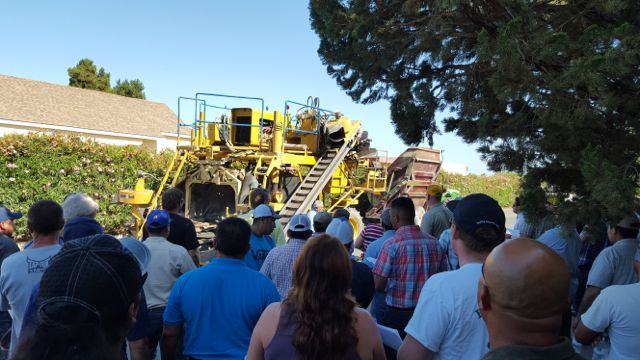
Worker safety is top-of-mind for agriculture, and a special raisin and wine grape mechanical safety training event was held in the Fresno County town of Easton. Grape harvester safety suggestions were  conveyed in both English and Spanish to more than 150 attendees.

Ryan Jacobsen, CEO of the Fresno County Farm Bureau, one of the event sponsors, said,Ryan Jacobsen Fresno County Farm Bureau “It’s no secret, grapes are one of the top crops here is Fresno County. So this raisin and wine grape mechanical harvest safety training is really just to make sure that all of our employers and employees have a safe harvest.”

“They’re working with some machinery that is used only during the harvest time,” said Jacobsen, “which is only a six-week to eight-week period of time. So we just want to get more familiarized with safety as the upcoming season approaches.”

“Most importantly,” Jacobsen continued, “farmers and farmworkers are working a lot of long hours during the harvest season, and this is just a constant reminder that safety is the number one priority. It’s most important that our folks go home safe every evening,” Jacobsen said.

Clint Erling, and his employer, Kingsburg Cultivator, also known as KCI Equipment, which manufactures vineyard equipment such as mechanical raisin harvest machines and almond harvesting equipment, wants to make sure everybody’s safe and gets to go home at night. “Some of this equipment can be extremely dangerous,” Erling explained, “so we engineer guards for areas of the machine to increase worker safety, while maintaining the machine’s effectiveness in the field.”

Worker safety is important to Erling, even after the sale. “We go to the field and work with farmworkers during the harvest or on any projects they’ve got going on,” he said.

2016-05-31T19:28:09-07:00July 23rd, 2015|
Go to Top