The Peril of Smoke Taint on Winegrapes

Wildfires Threaten Smoke Taint on Winegrapes

By Charmayne Hefley, Associate Editor

There are at least two dozen major fires burning in the wilderness of California. Many are now contained, while others are only minimally contained. One recent serious fire, known as the “Rocky Fire” in Lake, Yolo, and Colusa counties burned nearly 70,000 acres before firefighters extinguished it last month.

But smoke from that fire may yet cause problems for the wine grape industry in Napa, Sonoma, and Lake counties. James Kennedy, chair of the Department of Viticulture and Enology and director of the Viticulture and Enology Research Center at California State University Fresno, explained the threat of smoke taint on winegrapes. “Anytime you have wildfires near vineyards,” Kennedy said, “there is a concern about how that smoke might become associated with grapes, and as a result, become associated with wine.”

Kennedy said they learned a lot about this problem from the Australian wildfires in 2003 that tainted their wine. Kennedy explained,“grape growers are oftentimes not aware of the extent to which smoke can damage fruit. In a sense, it is a two-edged sword. When wine is made from smoke-tainted grapes, it will have characteristics reminiscent of ‘the morning-after ashtray’ that is quite obnoxious and certainly not desirable. The other side of the sword occurs when smoke compounds interact with the grapevine and grape berries, it is modified by the grapes. Like an iceberg in the ocean, the ice above the water suffers the apparent smoke taint; whereas, the massive chunk underneath the ocean, though not initially as obviously smoke-tainted, reveals obvious taint over time.”

Kennedy said, “Winemakers in Australia realized that while you can treat that initial smoke taint, you don’t resolve the long-term taint problem. We, as an industry, are trying to identify vineyards with smoke taint problems before their fruit is made into wine. By testing grapes in laboratories, we are trying to prevent those wineries from wasting significant investment in converting tainted fruit into tainted wine.”

The Napa Valley Vintners nonprofit trade association reported on its website yesterday, “So far no vineyards or wineries in Napa County have been threatened by any of this season’s wildfires. Most of the time the fires were burning, the smoke blew away from Napa County due to the typically prevailing winds from the southwest. The weekend of August 15/16, we did experience very hot temperatures and a wind shift that caused our air to be hazy and smoky as a result of the many fires burning throughout CA. However, there were no reports of smoke taint affecting Napa Valley wine grapes as a result.”

“Most reports on smoke taint indicate that it exists only after an extended period of close contact with smoke; conditions that have not, to our knowledge, existed within Napa Valley this summer. Furthermore, Napa Valley is known for the highest standards of fine wine production and our winemakers will be paying very close attention to this situation as they harvest grapes for the 2015 vintage.”

2016-05-31T19:28:05-07:00September 3rd, 2015|

No-tillage Grows in California

The list of crops that have been successfully grown using no-tillage in California continues to increase with garbanzo beans being the latest addition, according to Jeffrey P. Mitchell, CE cropping systems specialist, University of California, Division of Agriculture and Natural Resources.

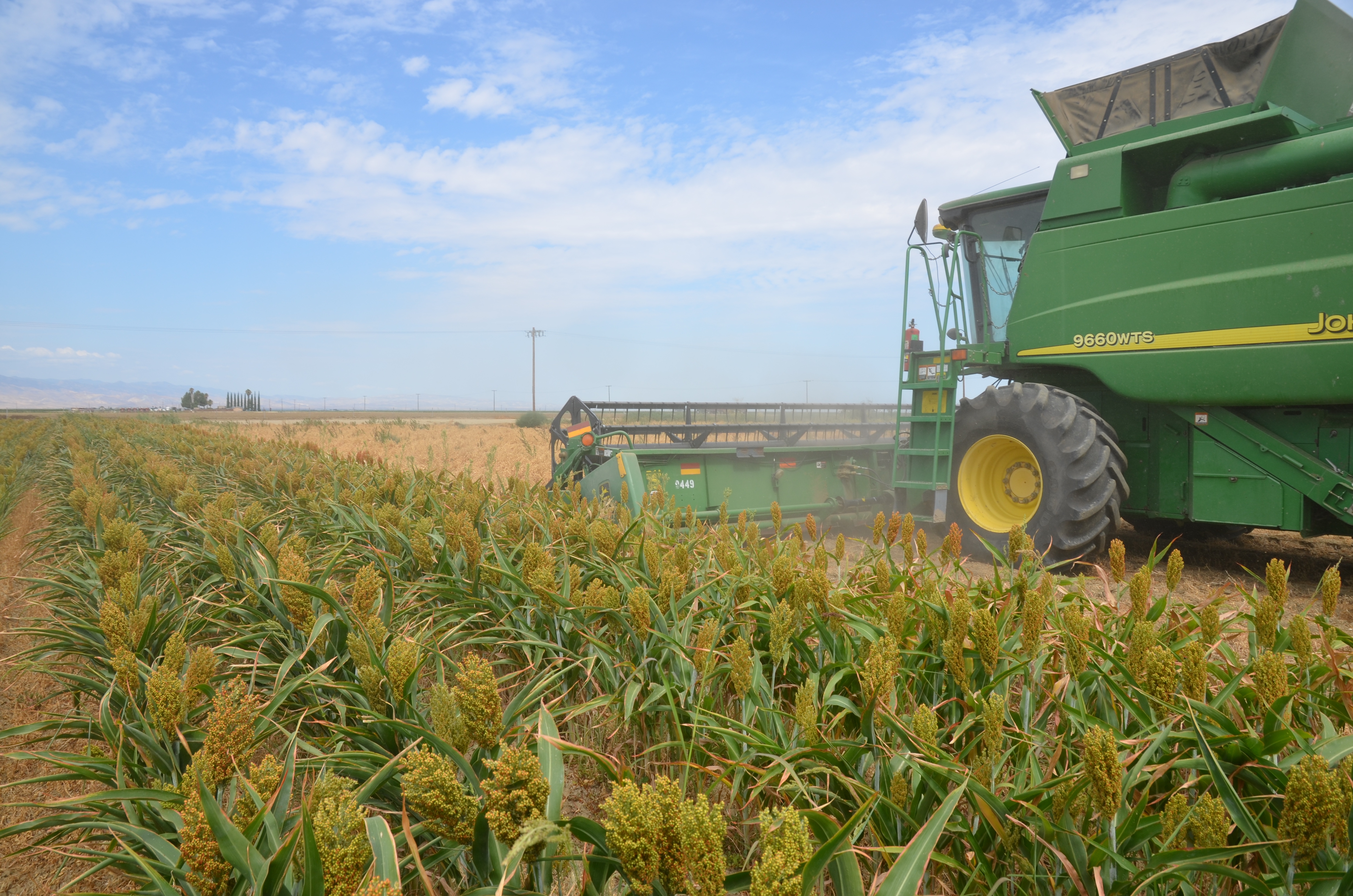
Harvest data from the Conservation Tillage Workgroup are now in for a 2015 garbanzo crop that was no-till seeded in January in the longstanding conservation agriculture systems study field in Five Points, CA, and these data indicate no difference in yield between the no-till with and without cover crop treatments and the standard till with and without cover crop systems. Garbanzo yields for the four systems averaged about 3,600 lbs / acre with no statistical differences seen between the four experimental treatments.

Other than an herbicide spraying in the fall of 2014 to knock down weeds, the no-tillage systems relied on zero tillage prior to seeding that was done with a John Deere 1730 6-row 30” planter. Conventional tillage consisting of several passes of a Wilcox Performer bed-shaping tillage implement was done to prepare planting beds in the standard tillage plots as would be commonly done in the region.

There is now a growing list of several crops, including processing tomatoes, cotton and dairy forage that have been successfully produced, both in research studies and on California farms, with economically viable yields using no-tillage seeding.

Additional information about this study is available at the Conservation Agriculture Systems Innovation Center (CASI) website and by contacting Jeff Mitchell at jpmitchell@ucdavis.edu.

Established in 1998, the Conservation Cropping Systems Workgroup is a diverse group of more than 1,500 farmer, University of California, California State University, USDA – NRCS, Resource Conservation District, public agency, private sector and environmental group members that have come together to promote conservation cropping systems in California.

Featured Photo Soure: Source: CASI (Conservation Agriculture Systems Innovation) Center, University of California, Division of Agriculture and Natural Resources

2016-05-31T19:28:05-07:00September 2nd, 2015|

Super PAC Needed to Save Forests, Wildlife, Ag, Part 1

Rachel Martin on Need for Super PAC to Save Forests, Wildlife, Ag

By Charmayne Hefley, Associate Editor

Part 1:

This is part one of a three-part series with Rachel Martin, the national chairperson of Homeland Security for the National Federation of Republican Women (NFRW), on the importance of creating a political action committee (super PAC) to save forests, wildlife, and ag suffering from limited water allocations during this extensive drought.

Martin said a super PAC must be created to combat the environmentalists who have been lobbying in Washington and Sacramento for years and to improve conditions for all constituencies. The resulting environmental regulations have prevented forest maintenance, such as logging, thinning of the forests, and controlled burns, which has increased the likelihood and severity of wildfires that burn thousands of acres each year and kill the animals environmentalists are trying to protect.

“I’ve been working with public safety as well as a lot of animal activists since ’99,” Martin said, “and I know that with ag, it’s been a fight for the last 30-plus years with the environmentalists and the Environmental Protection Act. Ag alone is not the only affected group of agencies or businesses. People don’t often think about how the lack of water significantly affects California Department of Forestry and Fire Protection (CAL FIRE), the U.S. Forest Service, and law enforcement agencies as well. We need to come together.”

“Law enforcement agencies and the U.S. Forest Service have told me the environmentalists are actually hurting and killing a lot of the creatures they stand to protect,” Martin said. “Other animals die during those fires, and they’re dying the most horrible deaths—which is death by fire.”

2016-05-31T19:28:06-07:00August 31st, 2015|

High Pricing Keeps Tulare County Ag #1

Tulare County Ag Tops all Counties

By Laurie Greene, Editor

The 2014 crop report from Tulare County indicates another record-setting year. Marilyn Kinoshita, Tulare County Ag Commissioner, noted how well the dairy industry did, “30% of our overall value was actually milk, so dairy is incredibly important to our county. They had some good prices for most of the year. That is what brought up the value of milk to $2.5 billion. It is a significant increase over the prior year. A little bit more yield, but it is the price that kicked up well over two billion dollars.”

Tulare County Ag sales topped $8 billion in 2014, and the dairy industry overcame significant pricing obstacles to contribute to the County’s success.

Kinoshita continued, “We’ve got several classes of milk, and California producers are at a disadvantage to the other folks in Wisconsin or Nebraska, or wherever milk is produced. California producers feel singled out. They have their own system by the Secretary of Ag, so they have lobbied to get some hearings to be put under the federal system of pricing. California is lower than the federal standard.”

Citrus sales also played an important role in setting the new sales record, she said, “They had a really good year and went up considerably. So there is our number three crop. We are the nation’s number one citrus county. When our growers are having a good year, it benefits the county. We have 71 citrus packing sheds in our county and all the major juicing plants in California are right here.”

Kinoshita also mentioned some of the ways that citrus has become the number three crop, “It is sort of supply and demand, and great marketing. We ship to 90 different countries around the world. A portion of our production is exported.”

In 2014, livestock in general was up 40%, which also made an impact on sales in Tulare County, “You’ll find when you go to a grocery store that steaks, chicken, and turkey all cost more. So all of our species had an increase in price per unit for this crop reporting year.”

2016-05-31T19:28:06-07:00August 30th, 2015|

My Job Depends on Ag Update

My Job Depends on Ag Update

By Charmayne Hefley, Associate Editor

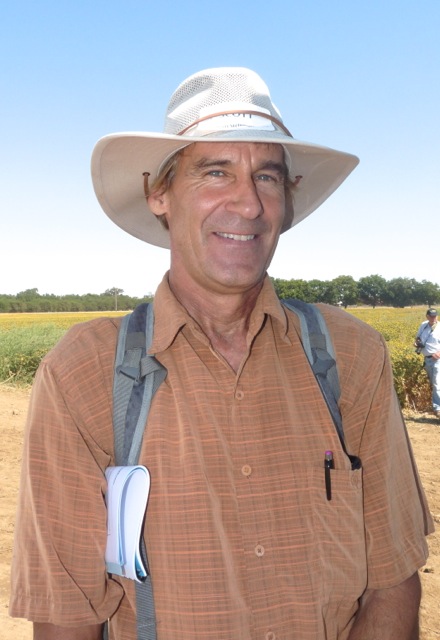
The “My Job Depends on Ag” Movement has more than just decals and a potential festival in the making. Erik Wilson, co-founder of “My Job Depends on Ag” with Steve Malanca, explained at the group’s meeting earlier this month, they hope to become a non-profit and use proceeds from decal sales to provide scholarships for students in agriculture. “We would like to keep young people connected to agriculture through scholarships and education,” Wilson said, “and foster their creative ideas about how their food is grown and processed.”

Erik Wilson

Erik Wilson

Wilson wants to see the movement grow to become an educational resource for agricultural topics directly from those involved in Ag. “I would really like to see anyone who is curious about how their food evolves from field to fork view our Facebook page as a open source of first-hand information—not from a news desk miles away from a field—but from the people in the field who are cultivating it. Because the people who do it and their kids, eat the same food and yet their stories haven’t been told.”

Wilson would like people to see that phrase My job depends on Ag, “and ask themselves if their own job depends on Ag. For me it would be a win-win for the public to grasp the value in growing food. I think growing food is the most honorable industry in the world.”

2016-05-31T19:28:06-07:00August 29th, 2015|

2014 Fresno County Crop Report Sets Record Production

2014 Fresno County Crop Report Sets Record Production — $7 billion+

Les Wright, Agricultural Commissioner/Sealer submitted the following information to Karen Ross, California Department of Food and Agriculture Secretary, TODAY accompanied by the 2014 Fresno County Crop Report showing record production.

It is my pleasure to submit the 2014 Fresno County Agricultural Crop and Livestock Report. This report is produced in accordance with Sections 2272 and 2279 of the California Food and Agriculture Code, and summarizes the acreage, production, and value of Fresno County’s agricultural products. The figures contained herein represent gross returns to the producer, and do not reflect actual net profit.

Jacobson, Wright and Matoian

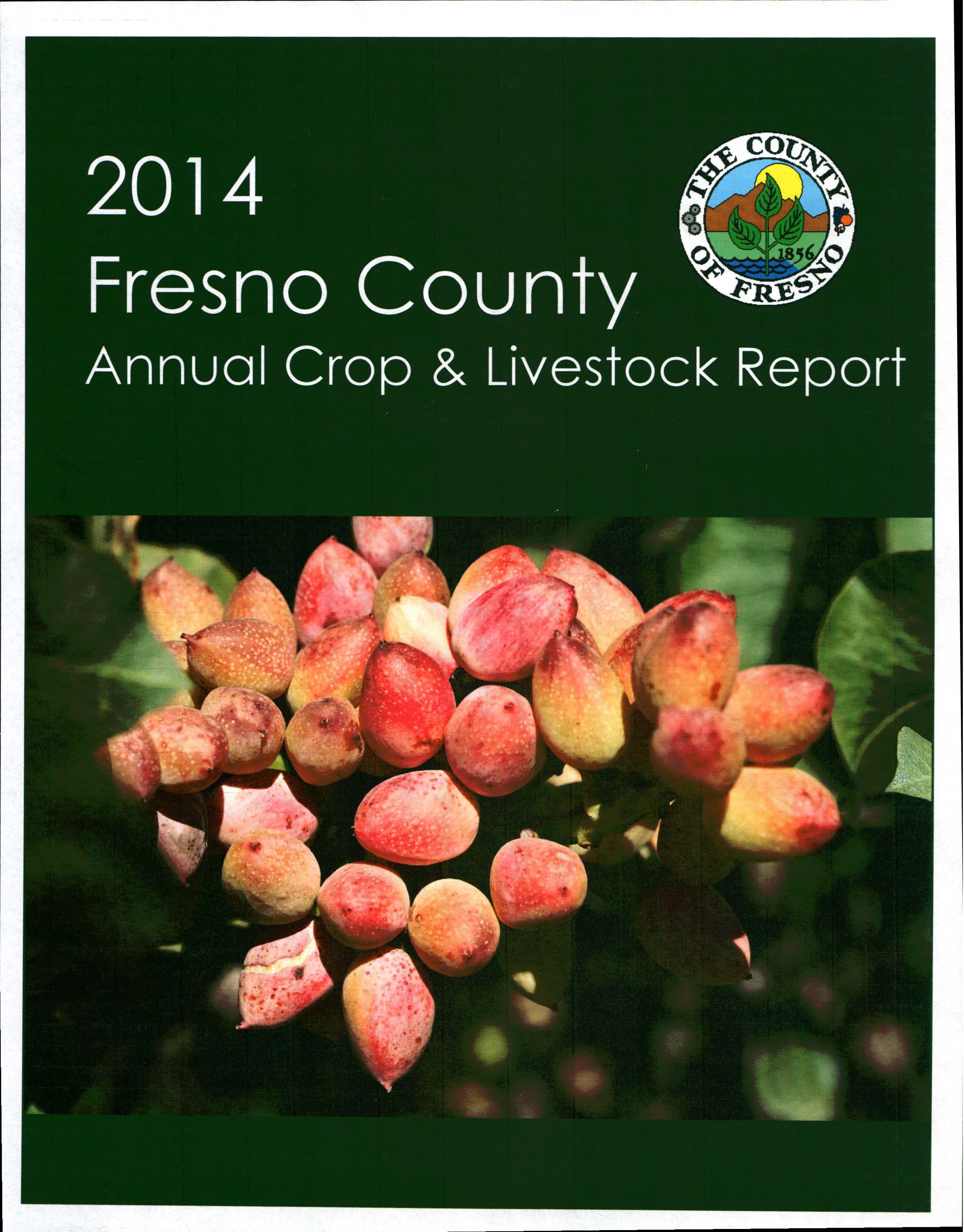
Photo, from left, Ryan Jacobson, Fresno County Farm Bureau CEO, Les Wright, Fresno County Ag Commissioner and Richard Matoian, American Pistachio Growers Executive Director

This report is a testament to the resiliency and determination of the Fresno County agricultural industry. For the first time ever, the gross value of Fresno County agriculture exceeds seven billion dollars. Almonds remain the number one crop at a value of 1.3 billion dollars with grapes a close second at $905 million.

The total gross production value of Fresno County agricultural commodities in 2014 was $ 7,039,861,000, a 9.26 percent increase from the 2013 production value of $6,443,236,500.

Increases were seen in:

  • vegetable crops (0.47% = $5,599,000)
  • fruit and nut crops (13.16%= $422,664,000)
  • nursery products (46.89%= $20,022,000)
  • livestock and poultry (31.48% = $301,144,000)
  • livestock and poultry products (22.09% = $116,299,000
  • apiary (17.39% = $10,738,000)
  • industrial crops (107.05% = $3,795,500).

Decreases in:

  • field crops (-36.20%= -$149,822,000)
  • seed crops (-14.67%= -$5,823,000).

I would like to express my appreciation to the many producers, processors, and agencies, both private and public, who supported our efforts in producing this report. I would also like to thank all my staff, especially Fred Rinder, Scotti Walker, Angel Gibson, Vera Scott-Slater, and Billy Hopper. Without their hard work and valuable input this report would not be possible.

Pistachios, featured on the cover of the 2014 Fresno County Crop Report, were Fresno County’s seventh top crop last year, with a value of nearly $380 million dollars.

The top nut—and crop, for that matter—was almonds, followed by grapes, poultry, milk, cattle and calves, tomatoes, pistachios, garlic, peaches and cotton.

Also included in the report was this quote from President John F. Kennedy:

Our farmers deserve praise, not condemnation; and their efficiency should be cause for gratitude, not something for which they are penalized.

2016-05-31T19:28:06-07:00August 25th, 2015|

Trinity Reservoir Releases Water

U.S. Bureau of Reclamation Releases Shared Water From Trinity Reservoir Despite Making Claims Of “California’s Historic Drought”

The San Luis & Delta-Mendota Water Authority (Authority) along with Westlands Water District, according to their press release, has filed a lawsuit in federal court to stop the Bureau of Reclamation (Reclamation) from releasing Central Valley Project (CVP) water from the Trinity Division to the Klamath River.
The U.S. Bureau of Reclamation said releases started Friday from Lewiston Dam on the Trinity River, the Klamath’s primary tributary, and would continue into late September.SLDMWA logo
Yesterday, Reclamation announced the release of up to 88,000 acre-feet of CVP water from Trinity Reservoir in the hope of aiding returning non-listed Chinook salmon with the optimism of diminishing the effect of a naturally-occurring disease endemic known as “Ich” (pronounced “ick”) to the Klamath River system to which the Trinity River is connected. This action, which is outside of Reclamation’s authorized place of use, is a repeat of a similar action taken last year with the intention to help avoid an outbreak which has only been documented to have occurred once in 2002. Since 2000, a significant supply of water has been set aside each year from the Trinity Reservoir for fishery protection purposes. Specifically, over the past four years, this has equated to more than 200,000 acre-feet of water lost that was literally flushed down the Lower Klamath River.
“As our state is faced with a water supply crisis affecting every sector of people, businesses, and communities, an action like this is unthinkable. This will cause irreparable damage to drought-stricken communities already facing water restrictions,” said Dan Nelson, executive director of the San Luis & Delta-Mendota Water Authority.
The CVP and State Water Project (SWP) provide water for more than 25 million Californians who depend upon a reliable water supply. In the 50-year history of the Projects, water deliveries have never been lower–the CVP is experiencing its second year of a zero water allocation and the SWP sits at a mere 20 percent water allocation.
Reclamation is once again choosing to ignore the harms of its actions through the issuance of a “Finding of No Significant Environmental Impact” (FONSI) that hasn’t been properly analyzed. Further, Reclamation’s decision to release 88,000 acre-feet of CVP water for the Klamath River is a sad irony given that Reclamation is currently unable to meet its legally-mandated obligations within the CVP and SWP.
 Westlands Water District_logo
“The hardworking people of the State of California have been directed by state and federal agencies to conserve water in the form of dying lawns, fewer showers, unplanted fields, trees uprooted or turning brown, and community wells drying up. Yet Reclamation, which has been unable to deliver any water to farmers, has decided to release tens of thousands of acre feet in an arbitrary manner that the courts have previously held to be unlawful.” said Tom Birmingham, general manager of the Westlands Water District. “The fact that 88,000 acre-feet can be casually released without regard to the potential impacts on the environment, including at risk-species in the Sacramento River and the Delta, is a gross mismanagement of the state’s water supplies. The action filed today is intended to compel Reclamation to comply with its mandatory duties,” said Birmingham.
“During a time when we are experiencing the worst water management challenges in decades, when communities and agriculture throughout the state are suffering severe impacts that have negatively affected our economy, the labor force and the environment, the decision by the Bureau of Reclamation to repurpose precious Central Valley Project water resources to augment Klamath flows for non-endangered fish, an action that is of questionable benefit, is both irresponsible and incomprehensible. While the needs of cities, family farms, and endangered species that rely on CVP resources continue to go unmet, the reallocation of the Project’s limited supply of water defies all logic,” said Jeff Sutton, general manager of the Tehama-Colusa Canal Authority, an organization that represents seventeen Sacramento Valley water districts that hold CVP water service contracts, that are also highly critical of the action being undertaken by the Bureau of Reclamation.
The water planned for release is enough to farm 31,000 acres of food, or to serve the domestic needs of more than 175,000 families for an entire year. The devastating effects of the drought will be felt for decades to come especially if arbitrary decisions like these continue.
2016-05-31T19:28:06-07:00August 21st, 2015|

New Medfly Quarantine

A portion of San Diego County was placed under Medfly quarantine earlier this week following the detection of 4 adult Mediterranean fruit flies (Medflies) in the La Mesa area.  The United States Department of Agriculture (USDA), the San Diego County Agricultural Commissioner, and CDFA are working collaboratively on this project.

The quarantine area in San Diego County measures 93 square miles, bordered on the north by Prospect Avenue; on the south by Mount Miguel Road; on the west by Fairmount Avenue; and on the east by Vista Grande Road.  A link to the quarantine map may be found here: www.cdfa.ca.gov/plant/medfly/regulation.html.

To eradicate the infestation, the release of sterile male Medflies began on August 10, at a rate of 250,000 flies per square mile per week.  The new release area is approximately 59 square miles.  In addition, properties within 200 meters of detections are being treated with an organic formulation of Spinosad, which originates from naturally-occurring bacteria in soil, in order to eliminate any mated females and reduce the density of the population. Finally, fruit removal will occur within 100 meters of detection properties in order to remove any fruit infested with eggs and larvae.

The quarantine will affect any growers, wholesalers, and retailers of susceptible fruit in the area as well as local residents. Home gardeners are urged to consume homegrown produce on site and not move it from their property.  These actions protect against the artificial spread of the infestation to nearby regions where it could affect California’s food supply and our backyard gardens and landscapes.

In the eradication program,  sterile male Medflies are brought to San Diego County from the joint CDFA/USDA sterile insect rearing facility in Los Alamitos, which prepares sterile files for release everyday over the Los Angeles basin.  The sterile release program has a proven track record of eradication in southern California.  Sterile male flies mate with fertile female flies in the environment but produce no offspring.  The Medfly population decreases as the wild flies reach the end of their natural life span with no offspring to replace them, ultimately resulting in the eradication of the pest.

The Medfly can infest more than 250 types of fruits and vegetables, causing severe impacts on California agricultural exports and backyard gardens alike.  Residents who believe their fruits and vegetables are infested with fruit fly larvae are encouraged to call the state’s toll-free Pest Hotline at 1-800-491-1899.

2016-05-31T19:28:06-07:00August 21st, 2015|

A Thought on Sustainability

Scott Steinmaus on Getting the Sustainability Message Out

By Charmayne Hefley, Producer and Associate Broadcaster

When considering the longevity of a farmer’s land, the question of the sustainability of modern day farming practices is often raised. Scott Steinmaus, professor and department head of the Horticulture and Crop Science Department at Cal Poly San Luis Obispo, said that it is important to get the message out to consumers that farmers are sustainable because their land is the future for their own children.

“Farmers are sustainable,” Steinmaus said, “even when the general public might say that unsustainable activities might include pesticide applications. There’s no farmer out there who wants to spray pesticides—it costs money. And they don’t want to hand off their land having exposed it to something that’s not sustainable. They have a piece of land, something they value and cherish, and they want to hand it off to their sons or daughters.”

Steinmaus said it is important for consumers to realize that farmers are humans too, and they care about the health of the planet in a way that more directly relates to their careers.

Steinmaus believes it is important for consumers “to understand that direct connection farmers have with the earth, to realize that farmers are humans too, with kids of their own, and to acknowledge that farmers care about the planet more than a lot of urbanites might do themselves. There’s nothing more important than sustainability—minimizing all farm inputs for safe, acceptable food production.”

2016-05-31T19:28:06-07:00August 20th, 2015|

Gladwin’s Final Year As A Farmer

Tonetta Simone Gladwin on Final Year as a Farmer

As the fourth-year drought continues, some farmers have conceded to the elements and the limited water allocations and have made the decision to make their final year in the farming business. Tonetta Simone Gladwin, the third generation owner of Passion Fruit Farms, a fig operation in Merced, Calif., said this year would be her last.

“As a third generation, I’m the last generation in my family. We’ve all farmed figs,” Gladwin said. “I don’t think Grandpa had any idea of the challenges we have to face today. Never did he think we’d have $10 per hour in labor wages, no water deliveries and some of the regulations we’ve had to face and overcome. These challenges are so different from those in his day.”


Passion Fruit Farms FBPassion Fruit Farms

2016-05-31T19:28:06-07:00August 18th, 2015|
Go to Top