Union Advances Fair Market Access

National Farmers Union Advances Fair Market Access for Growers

By Brian German, Associate Editor

Chandler Goule

Chandler Goule, senior vice president of Programs for the National Farmers Union (NFU)

Chandler Goule, senior vice president of Programs for the National Farmers Union (NFU), introduced his organization,”The National Farmers Union is the second largest general farm organization in the United States. We represent about 200,000 family farmers and ranchers. We have membership in all 50 states, but we’re organized in 32.”

Goule described NFU membership, “We were founded in 1902 down in Point, Texas, so we represent everybody from row crops, to dairymen, to ranchers, to specialty crops, to those who are selling in Community Supported Agriculture (CSAs) . You name it, we’ve got somebody. Bee collectors and honey producers are also in our organization.”

Since its inception, the NFU has been an advocate for helping the family farmer address profitability issues and monopolistic practices by increasing cooperative rights along with advancing fair market access for growers. “We are a federation of states,” Goule said, “so we’re a grassroots organization. NFU could not exist without California Farmers Union and North Dakota Farmers Union and Minnesota Farmers Union. So when you bring all the state farmers union devisions together, that’s what makes up National Farmers Union. It’s a very bottom-up approach.CA Farmers Union

“Of course, with California being the bread basket for the United States and by far the largest in gross domestic product (GDP) in agriculture,” Gould stated, “California Farmers Union membership is very heavy in dairy, has a little bit of viticulture and then specialty crops.”

____________________________________

National Farmers Union is a grassroots, producer-driven organization that believes good opportunities in production agriculture are the foundation of strong farm and ranch families, and strong farm and ranch families are the basis for thriving rural communities. Vibrant rural communities, in turn, are vital to the health, security and economic well-being of our entire national economy.
2016-05-31T19:24:04-07:00May 9th, 2016|

TPP Must Pass

Kent Bacus: Congress Must Pass TPP To Help All Ag Exports


By Brian German, Associate Editor


The Trans-Pacific Partnership (TPP) trade agreement has the potential to increase demand for U.S. food products among 500 million consumers in 11 Pacific Rim countries that are included in the partnership. Many of those ag products are from California, including beef.

NCBA LogoKent Bacus, director, International Trade and Market Access for National Cattlemen’s Beef Association (NCBA), said, “First and foremost, Congress needs to hear more from the people back home and they certainly need to hear from the business community.

Recently, we sent a letter to Capitol Hill urging a vote this year on TPP, that was signed by 225 agricultural associations and companies from all across the United States, from cows to cranberries,” stated Bacus. “We had a very diverse group of people on that letter. But, by and large, it really says, ‘It’s time to move. It’s time to stop finger-pointing. Its time to put our differences aside, and its time to move forward with TPP.’”

Kent Bacus, Director of International Trade for NCBA

Kent Bacus, Director of International Trade for National Cattlemen’s Beef Association (NCBA)

Bacus said passing TPP will greatly help California farmers and ranchers. “Unfortunately,” he explained, “we have a 38.5 percent tariff on our beef that goes into the Japanese market. TPP levels the playing field for us with our leading competitors for those Japanese consumers. Without that, we’re going to see our market share continue to drop in our leading export market. The benefits of this trade agreement far outweigh the status quo,” he said.

Noting opposition from both the right and the left, Bacus  stated, “Politically this is an easy target to swing at because not a lot of people understand trade. So it’s important for us to tell the positive stories of trade, and for the beef industry, it is simple: Americans aren’t willing to pay a premium for cuts like the beef tongue or short ribs, much like our Japanese consumers will,” he said.

One key component of the TPP is the reduction in tariffs and other market barriers. Failing to get the agreement passed would essentially give other nations a competitive advantage in the international market. “In 2015 we sold $1.3 billion dollars worth of beef to the Japanese,” Bacus said. “But that was down nearly $300 million dollars from 2014 because our leading competitors, the Australians, had a trade agreement that went into effect giving them a 10+ percent tariff rate advantage over us into our leading export market.”

“So unless we want to level that playing field—if we are fine with the status quo,” Bacus said—then we’re going to lose that market. And we’re going to lose a lot of the value added that the market brings back to cow-calf producers and feeders, and everyone along the production chain.”

2021-05-12T11:17:13-07:00May 6th, 2016|

ILRP Changes Target All Calif. Farmers

Proposed Changes to Irrigated Lands Regulatory Program (ILRP) Could Impact Farmers Statewide

By Patrick Cavanaugh, Deputy Editor


Kings River Water Quality Coalition LogoThe recently proposed changes to the Irrigated Lands Regulatory Program (ILRP), open for public comment until Wednesday, May 18, could significantly impact farmers, according to Casey Creamer, coordinator for the Kings River Water Quality Coalition“The proposed modifications concern the east San Joaquin Region, within Madera, Merced and Stanislaus Counties,” Creamer said. “That’s the scope of it.”

According to the State Water Resources Control Board’s (SWRCB) website, ILRP “regulates discharges from irrigated agricultural lands. This is done by issuing waste discharge requirements (WDRs) or conditional waivers of WDRs (Orders) to growers.” Discharges include irrigation runoff, flows from tile drains and storm water runoff, which can transport “pollutants including pesticides, sediment, nutrients, salts (including selenium and boron), pathogens, and heavy metals, from cultivated fields into surface waters. Orders contain conditions requiring water quality monitoring of receiving waters and corrective actions when impairments are found.”

While ILRP currently targets only the east San Joaquin region, Creamer said, “It’s a precedent-setting deal, so everything in there is going to affect not only the entire Central Valley, but the Central Coast and the Imperial Valley—that may not have near the issues or the current regulatory programs that we have here in the Central Valley. So, its very important statewide.”

Creamer emphasized, “Farmers need to know that this is not a minor issue; this is a big issue that affects their livelihoods and their ability to operate. They need to get involved. They need to communicate with their other growers, communicate with their associations, get involved and have their voices heard.”

__________________

The State Water Board is hosting a public workshop on the proposed order on Tuesday, May 17, in Fresno—one day prior to the closing of the ILRP public comment period. The workshop will be held at 9:00 a.m. in the San Joaquin Valley Air Pollution Control District, Central Region, 1990 E. Gettysburg Avenue, Fresno.

The SWRCB is also soliciting written comments on the proposed order. Written comments must be received by 5:00 p.m., Wednesday, May 18, 2016. Please indicate in the subject line, “Comments to A-2239(a)-(c).” Electronic submission of written comments is encouraged. Written comments must be addressed to:

Ms. Jeanine Townsend

Clerk to the BoardSWRCB-logo-water-boards

State Water Resources Control Board

1001 I Street, 24th Floor [95814]

P.O. Box 100

Sacramento, CA 95812-0100

(tel) 916-341-5600

(fax) 916-341-5620

(email) commentletters@waterboards.ca.gov

  __________________

The Kings River Water Quality Coalition is a non-profit joint powers agency established by the irrigation districts in the Kings River service area. It is governed by a board of directors of landowners from each of the districts. Staffing of the Coalition is administered through an agreement with the Kings River Conservation District located in Fresno. The Coalition was formed in 2009 in order to allow growers within the region a cost-effective avenue to comply with the regulations developed by the Central Valley Regional Water Quality Control Board. The Coalition conducts regional monitoring and reporting and assists members in compliance with regulations. The Coalition is not a regulatory agency. Enforcement of the ILRP is handled by the Regional Water Quality Control Board.

2016-05-31T19:24:04-07:00May 4th, 2016|

ACP Found Near Juice Plant

More Asian Citrus Psyllids Found in Tulare County, 10 ACPs near Juice Plant


By Patrick Cavanaugh, Deputy Editor, and Laurie Greene, Editor


Announced Today, more Asian Citrus Psyllids (ACP) were found recently in several Tulare County traps, two of which were adjacent to an orange juice plant near Tipton.

“There were a few [ACPs] on sticky traps on a residential tree, one in a commercial grove, and even more concerning, four on one and six on a second sticky card near the juice plant,” said Marilyn Kinoshita, Tulare County ag commissioner.” ACP is known to vector Huanglongbing (HLB) disease, a disease that is fatal for citrus trees.

Marilyn Kinoshita, Tulare County ag commissioner

Marilyn Kinoshita, Tulare County ag commissioner

“The juice plant ACP finds could have come from southern California trees, most likely from Ventura, Orange, Riverside, and Imperial Counties, that were stripped of crop and did not go through a shed,” said Kinoshita, referring to a necessary cleaning protocol. “It’s very frustrating because there’s a certain protocol in shipping citrus but not everybody follows it.”

“When citrus is field-run [from the field to the packing shed],” continued Kinoshita, “the fruit should be separated from stems and leaves—which may harbor ACPs—then cleaned and manipulated over rollers before being packed for shipping or transported in bulk by truck to the juice plant.”

“So it’s a real concern finding ACPs at the Tipton juice plant,” Kinoshita explained, “because it is isolated from our citrus belt and they are the first ACPs found near a plant. It means that the psyllids possibly hitchhiked to the plant in Tipton, which is right along Highway 99. Even if the fruit had been cleaned, the psyllids, which are strong fliers, could have ended up in the cab of the truck and transported to Tulare County,” noted Kinoshita.

Kinoshita noted protection spray protocols are now in motion. “We’ve got two active programs, residential treatments in unison with our orchard treatments, and those are all managed by a treatment coordinator who works with our treatment groups. These are smaller groups of growers, so their treatments are hopefully done within a 2-week period to cover an area and try to control this pest.”

“The Number One citrus county in California doesn’t need ACP,” said Kinoshita, “and heaven forbid they come in while infected with HLB disease! Already about 20 trees have tested positive for the fatal HLB—all in southern California, starting with Hacienda Heights in April 2012, with more found in and around San Gabriel residential areas, last year in July and this year in February.”

Kinoshita advocated for everyone to stay vigilant and keep educating—not only the citizens of the state, but these transporters too. “They need to be more careful,” said Kinoshita. “All equipment that moves though the citrus groves must be cleaned before moving into another grove. It’s going to take everyone’s cooperation.”

“There is so much capability for [ACP] hitchhiking into this County where we are ground zero for potential problems—for the sheer number of packing sheds, orange groves and juice plants. So it’s a pretty difficult situation, but fortunately we’ve got a system that is in place; we just have to keep at it and not let our guard down,” she said.

2021-05-12T11:03:02-07:00May 3rd, 2016|

Connecting with Consumers

AgChat Reaches Out to Consumers


By Laurie Greene, Editor


Jenny Schwiegert, AgChat Foundation chief executive director, spoke to Laurie Greene, California Ag Today editor, at the recent Bayer AgVocacy Forum about one of the biggest challenges to agricultural advocacy. “We’ve got excellent bloggers out there,” Schwiegert said, “however, the audience they [reach] tends to be other growers and ranchers. We do not want to be singing to the choir. We need to find other ways to connect with non-ag consumers.”

Schwiegert elaborated on some of the resources for non-ag readers posted on the AgChat website, “There’s a page under “Resources” that talks about different non-agricultural hashtags people can use when they tweet or use Instagram or Snapchat. We also have a post about people with whom we need to connect on Twitter who are not necessarily in the agricultural industry.”

Jenny Schiegert, AgChat executive director

Jenny Schiegert, AgChat chief executive director (Photo Source: LinkedIn)

To [farmers and Ag bloggers] who are trying to determine who their audience might be, Schwiegert advised, “There is more to you than just farming and ranching. You know, I like to do renovations at my home; I like photography; and I’m a baseball mom. When I began blogging, which I don’t do as much recently, my strategy was always to be incognito and not say, ‘Hey, this is what I do.’ I would only talk about farming.”

However, Schwiegert discovered that when she talked about those other topics that are not necessarily related to farming, her posts attracted a lot more of a mom-based or photographer-based audience. She suggested, “Find that spark, the other part of your life that is not related to farming and ranching, and explore and talk about it. Connect with other people [consumers] who have that same desire to have a hobby or whose kids are also in baseball, or whatever it might be.”

While connecting with people via a distinctly different interest can be constructive, Schwiegert held that consumers do trust and want to hear about agriculture from farmers and ranchers. She referred to a recent finding that while the majority of people do not know how to get in contact with a farmer, farmers are the people they want to talk to and get their information from.

“We have also experienced this on a personal basis,” Schwiegert shared. “While our operation is very small, we like to take people, and not necessarily adults. Sometimes we will bring our children’s friends out, show them the sheep, and take them to my in-laws’ dairy. My younger two sons have an egg business, so we’ll show them that too.”

“Ninety-nine percent of the time,” Schwiegert said, “someone will say, ‘Oh these are so much better than the store-bought, and the store-bought has been sitting on the shelves for months.’ That’s where I stop and say, ‘that is not necessarily true. Let me connect you with Katy who is in Iowa or let me connect you with Greg in Oregon, whose egg farm is producing 1.5M eggs a day.’”

“I like to connect people,” she explained, “to help them understand what modern agriculture is all about because we tend to have a [rustic] romantic, idealistic view of what a farm is, and that is what people want.” But, she contends, that may not match what farming really is in today’s world. “I think people really do want to talk to the farmers and ranchers,” said Schwiegert. “They just don’t know how to go about connecting with them.”

Schwiegert does not know if there is a definite ‘disconnect’ between this romantic view of the rustic farm scene with antiquated tools, and consumers who use the latest devices and apps. She said, “I am not sure how to re-connect that. For instance, why is it ok to use an antibiotic if you have pneumonia, but it is not ok to use it in chicken? And I’m not sure how we mend that because consumers are not trustworthy of statistics and science, so I guess that it is one of the million-dollar questions out there. You know, how is it OK for them to have a Fitbit, but our farmers can’t use GPS or auto-steer in their tractors or precision Ag drones?

“That is a huge disconnect, and we need to address it as an industry,” Schwiegert reflected. “I think a lot of people in agriculture are intimidated and scared to share their stories because there are folks out there who are ready to pounce. And especially if you have small children, you do not want to have those types of people on your property. So people are hesitant to share their stories.

“I have the same fears,” Schwiegert stated. “I don’t want people like that on my farm. But the more that we can share our stories out in public, using different methods—whether through social media or a farm-to-table type of event with a commodity group at a public location—the more likely we are to mend that disconnect.”

2021-05-12T11:00:54-07:00May 3rd, 2016|

Talk, Merely Talk

Farmer Hears Plenty of Talk But Sees No Action on Water Management

Erik Hansen

Erik Hansen, Legacy Farmer in Kings County

By Patrick Cavanaugh, Deputy Editor

Erik Hansen, a big legacy farmer down in the Tulare Lake Basin in Kings County, is quite frustrated by how the state’s freshwater has been managed this year. “The most important thing,” he said, “is that people realize politicians in this state do not have your best interests in mind when it comes to how the water is run. We have infrastructure that is out of date and needs to be improved, but they are not even using the existing infrastructure at the full capacity it should be used, even though we are in a water emergency.”

“Now there is just nobody who can tell me that that’s OK,” stated Hansen. “Plenty of people can talk around it; they can say, ‘environmental this’ and ‘environmental that.’ But in the end, we need to take a very hard look at how these decisions are being made at the top levels—where people should be losing their jobs in a big way. ‘Starting from the governor having to explain—How do you have a water emergency; yet your appointments at the State Water Resources Control Board are not running the water as they should?

Hansen expects water mismanagement will continue and worsen until the California public holds their feet to the fire. “It is a power move,” Hansen declared.”They are able to hold off one of our most precious resources in the state, and currently two thirds of the state is suffering for it. Northern California has plenty of water, and that is where all the votes are. They forgot about the southern two thirds, and there are plenty of people here who are not happy about it.”

Hansen recounted, “There are higher bills in just about every municipality. Wells are running dry. Certain areas of the state are completely dry to the point where they require 250 gallon totes of water by truck delivery. This is unsustainable, and hopefully the politicians in Northern California can understand that word.”

2016-05-31T19:24:05-07:00May 2nd, 2016|

California Groups Join National Effort to Reject TPP

California Farm and Rural Groups Join 160+ Organizations to Ask Congress to Reject TPP, Stand Up for Independent Farmers and Ranchers

The Trans-Pacific Partnership (TPP) has become a divisive issue in the nation’s capital, and criticism intensified after 161 food, farm, faith and rural organizations, including 9 from California, sent a letter to Capitol Hill yesterday, April 27, 2016–urging lawmakers to reject the trade pact.

“The main beneficiaries of the TPP are the companies that buy, process and ship raw agricultural commodities, not the farmers who face real risks from rising import competition. TPP imports will compete against U.S. farmers who are facing declining farm prices that are projected to stay low for years,” the organizations wrote. California groups including Belcampo, California Dairy Campaign, California Farmers Union, Community Alliance with Family Farmers, Ecological Farming Association, Food & Water Watch, Rooted in Community, Rooted in Community Youth Food Justice Leadership Network and Roots of Change signed the letter.TPP madeInAmerica

The White House has promoted the TPP as an export-boon for farmers to generate support for the agreement, but past trade agreements have not always delivered on export promises, the letter noted. For example, the United States’ total combined exports of corn, soybeans and wheat have remained steady at about 100 million metric tons for the last 30 years despite a raft of free trade agreements since the mid-1990s.

“Trade deals do not just add new export markets – the flow of trade goes both ways – and the U.S. has committed to allowing significantly greater market access to imports under the TPP,” the groups explained. Especially “alarming” to the organizations is the agreement’s complete lack of enforceable provisions against currency manipulation, a substantial cause of America’s debilitating $531 billion trade imbalance.

California Dairy Campaign President Joe Augusto stated, “The Trans-Pacific Partnership will mean that imports from New Zealand and other countries will greatly increase, especially imports of concentrated dairy products. As more and more dairies in California go out of business, passage of the TPP will lead to a further decline in milk production across our state.”

The TPP poses particular risks for dairy farmers and cattle producers. The TPP dairy export opportunities were more modest than promised, but the TPP will likely increase imports of milk and whey protein concentrates from global dairy powerhouse New Zealand during a period of declining farmgate milk prices in the U.S. The United States imported nearly 2.3 billion pounds of beef from TPP partners but only exported about 1.2 billion pounds in 2015. The TPP will also increase beef and cattle imports while domestic cattle prices are plummeting.

California Farmers Union President Joaquin Contente stated, “Farmers in California are some of the most highly regulated in the world, and under the Trans-Pacific Partnership, they will have to compete against a flood of imports that do not meet the same high standards that farmers here are required to follow. Any potential export gains can be erased at any point when our competitors devalue their currency because currency manipulation is not addressed in the TPP. The TPP also does not crack down on the value-added taxes (VAT) that our competitors can impose which make our exports uncompetitive in other markets.”

The TPP also covers important agricultural policy areas such as investment, procurement, labeling, food safety, animal health and crop disease. The stringent rules and dispute system under the TPP make it easier to successfully challenge and overturn domestic laws, as happened last year to country of origin meat labels.

“The TPP will bring a wave of fruit and vegetable imports that will inundate farmers, consumers and inspectors,” said Food & Water Watch California Director Adam Scow. “The TPP benefits the biggest agribusiness and food companies at the expense of California communities that are trying to strengthen and rebuild local, sustainable food systems.”

The letter and complete list of signers can be read here.
http://www.foodandwaterwatch.org/sites/default/files/farm-food_tpp_coalition_letter_4-27-16.pdf

California Farmers Union contact: Lynne McBride, 925-385-0217, lmcb44@comcast.net
California Dairy Campaign contact: Lynne McBride, 925-385-0217, lmcb44@comcast.net
Food & Water Watch contact: Adam Scow, ascow@fwwatch.org
_______________________________
See the California TPP website for the government’s perspective.
2021-05-12T11:17:13-07:00April 28th, 2016|

Water Priorities Initiative Aims for 2018 Ballot

New Deadline for Water Priorities Ballot Measure

The California Water Alliance (CalWA) announced TODAY it has shifted its focus to qualifying the The Water Priorities Constitutional Amendment and Bond Act Ballot Initiative for the 2018 ballot instead of this fall’s general election, as originally planned.

With massive public support, CalWA has in a very short time succeeded in collecting more than half of the 585,407 signatures required to qualify the measure but fell short of today’s deadline to place the issue before voters this November, said CalWA’s executive director, Aubrey Bettencourt, who underscored that all signatures collected to date count toward the July 25, 2016 deadline for 2018 as well.

“While we certainly would have preferred to get this critical issue in front of voters this year, we have every confidence that we will be able to collect the remaining signatures by this summer’s deadline for 2018,” she said. “One of the benefits of setting a very ambitious timeline is that we have already surpassed the halfway signature mark and established a solid campaign operation, strong momentum and growing public awareness about the failed promise of the high-speed rail project and how to best fix California’s broken water system.”

Aubrey Bettencourt, executive director of the California Water Alliance

Aubrey Bettencourt, executive director of the California Water Alliance

Additionally, Bettencourt said the signature gathering process for the water priorities initiative will become more productive and affordable now that the April 26 deadline has passed.

“The new deadline is turning out to be a blessing in disguise because the unusually large number of ballots in circulation had driven up costs to a ridiculous level,” she said. “The 2018 ballot will likely be less cluttered and provide Californians more time to focus and appreciate the benefits of the proposal.”

Recent polls show Californians strongly support terminating the Governor’s priority high-speed rail project and using its funds to provide people with more water.

“Our donors and volunteers are excited that we have a clearer path and more time to solve a problem that frankly has been 50 years in the making,” said Bettencourt. “This also provides our community leaders with enough time for Sites and Temperance to go through their approval process under Proposition 1.”

Information about the measure is available online at CaWater4All.com.

__________________________________________________

About the California Water Alliance The California Water Alliance is a statewide nonprofit organization dedicated to raising awareness about the nature of water and promoting long-term, sustainable solutions that meet the health and security needs of families, cities, businesses, farmers and the environment. To learn more, visit www.CaliforniaWaterAlliance.org.

__________________________________________________

About the California Water Alliance Initiative Fund Committee The California Water Alliance Initiative Fund Committee (FPPC ID#1381113), sponsored by the California Water Alliance, a non-profit IRC §501(c)(4) organization, is a state primarily formed ballot measure recipient committee organized to qualify two or more state ballot measures for the November 2016 ballot. It is permitted to accept unlimited, non-tax-deductible donations from individuals, corporations, partnerships, nonprofit organizations, and any other lawfully permissible sources. For more information and restrictions, please visit http://cawater4all.com/

__________________________________________________

Included at bottom of press release: Paid for by California Water Alliance Initiative Fund, with major funding by California Westside Farmers State PAC and Chris J. Rufer, Sacramento, CA

2016-05-31T19:24:05-07:00April 28th, 2016|

New FFA State Stars Honored

Halley Lauchland Wins FFA Star State Degree in Agriscience Award

By Charmayne Hefley, Assistant Editor

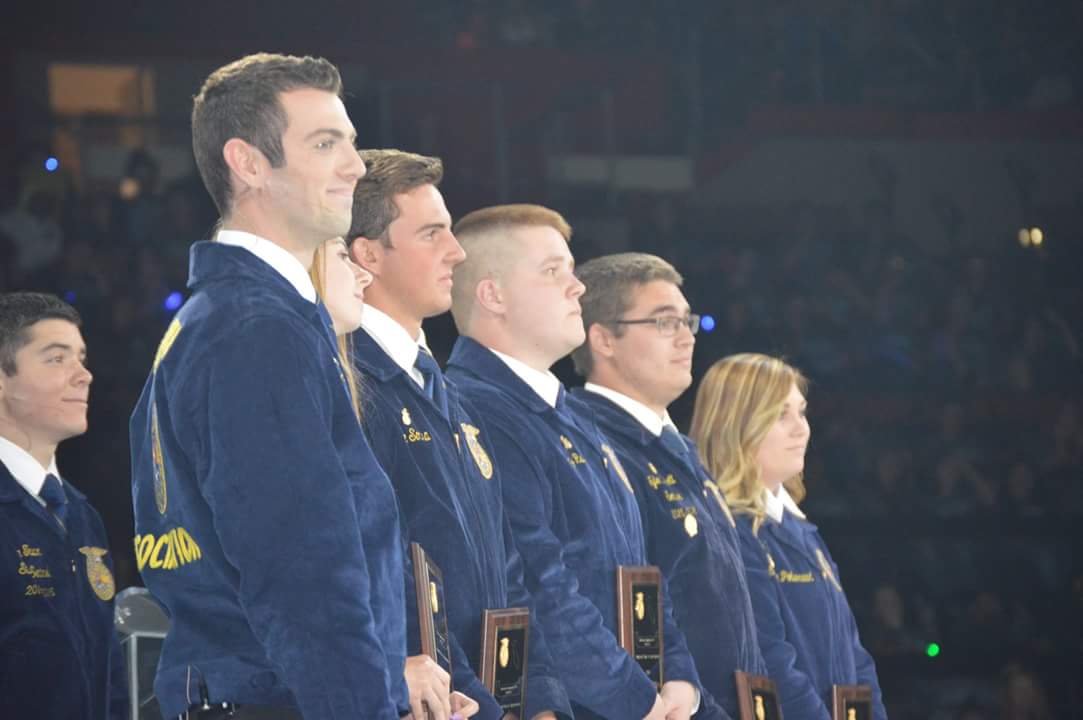
During the opening session of the 88th California Future Farmers of America (FFA) State Convention in Fresno last Saturday night, four California FFA members were honored with the top Star Awards during an onstage ceremony. As reported by the California FFA Association in a press release, each of them excelled in one of four areas:

Andrea Thomas from the Colusa FFA chapter was named the California Star Farmer state winner in recognition of proven leadership skills for an aspiring young farmer. Thomas raises and maintains hogs, cattle and hay.

Halley Lauchland, 2016 FFA Star State Degree in Agribusiness Award winner

Halley Lauchland, 2016 FFA Star State Degree in Agriscience Award winner (Photo Credit: California FFA)

Nitin Gupta from the Tulare FFA chapter was named the California Star in Agribusiness state winner, the highest achievement for a person pursuing a career in agribusiness. Gupta started the business Simple Sand three years ago in which he collects, markets and distributes sand from his family’s ranch to local businesses.

Paul Barcellos, also from the Tulare FFA chapter, was named the California Star in Agricultural Placement state winner, the highest recognition in the state for a young person excelling in job placement in the agricultural industry. Barcellos works alongside his dad at Cain Trucking as a Foreman in the Composting and Air Pollution Control Operations in recycling agriculture products and preventing air pollution.

Halley Lauchland, a high school junior from the Lodi FFA chapter received the 2016 FFA Star State Degree in Agriscience Award, the highest achievement for a person pursuing a career in agriscience.

“My project was cane pruning for the control of Eutypa Dieback in winegrapes,” A fifth-generation winegrape grower, Lauchland told CalAgToday, “The disease is commonly found in cabernet franc finds.”

Lauchland conducted her research in part to help her family’s 18-year-old vines with the Eutypa Dieback disease,  which she defined as “a fungal spore that enters the vine through pruning wounds. This will eventually kill the vine, causing the farmer to have to replant, which costs a lot of money and isn’t efficient.”

Lauchland tested cane pruning versus the commonly-used method of spur pruning to keep the disease at bay. “We tested two rows and found [cane pruning] was a more efficient way to do it, and it was going to save us more money in the long-run.” Spotting her research catching on in local vineyards, Lauchland said  “It seems people are going to the cane prune.”

Lauchland’s research was published in the Lodi District Grape Growers Association Update last year as, “Lodi High School Student to Compete in State FFA Agriscience Fair with Eutypa Dieback Research Project.” Lauchland stated, “That helped put out the word, what this [method] does and how it helps farmers.”

Overjoyed to have been selected to win the Star in Agriscience award, Lauchland said, “Words can’t really describe how I feel right now.”

The California Future Farmers of America (FFA) State Convention was sponsored by PG&E and the J.G. Boswell Foundation, as a special project of the California FFA Foundation.

2021-05-12T11:00:55-07:00April 27th, 2016|

Tree Nut Theft Alert

Roger Isom Warns: Take Precautions to Thwart Tree Nut Theft

By Patrick Cavanaugh, Deputy Editor


Roger A. IsomWestern Agricultural Processors Association (WAPA) president and CEO, told CalAgToday, “Tree nut theft is still a serious issue this year, as it was last year. Folks behind the thefts have not been caught. We’ve had over 30 thefts in the last 6 months.”

There is good news. “We’ve had numerous attempts thwarted,” Isom commented, “because folks have started to implement some of the procedures that we talked about at our emergency Tree Nut Cargo Theft Summit back in December.” Following the successful Summit, nut theft legislation sponsored by the WAPA passed out of the Assembly Agriculture Committee unanimously. According to WAPA, AB 2805 (Olsen) would form a statewide California Agriculture Cargo Theft Crime Prevention Task Force with combined law enforcement services and support activities to fight agricultural cargo theft. Among the loads of tree nuts stolen was a load of almonds reportedly stolen during the Summit.”

Roger Isom, president and CEO, Western Processors Association

Roger Isom, president and CEO, Western Processors Association (source: LinkedIn)

Isom explained, “We brought experts in cargo theft from across the country to the training seminar held in mid-April in Modesto to make sure all members understood: What has happened? How are the thefts occurring? What have we learned from those thefts and the investigations? What can people do to prevent these thefts from happening at their locations?”

“What we’ve learned, for sure,” he explained, “is that if you do not implement the procedures, you will be hit. Following the December meeting, we’ve had companies hit by cargo theft; the [companies] that implemented the practices we talked about prevented thefts from occurring; those that did not have lost truckloads of tree nuts.”

Isom understands it is time consuming to follow the recommendations, and there is some cost associated with it. “You have to take the time to take pictures of the drivers,” he elaborated. “You have to fingerprint the drivers. You’ve got to make calls. You’ve got to make sure these truckloads of shipments have been placed at least 24 hours in advance. If there are driver changes, you cannot allow that. It takes some serious steps to prevent [theft].”

“We had one a few weeks ago,” Isom explained, “where they switched drivers and trucks—literally the day of [transport]. It ended up being OK, but the alarms went off. The next time it could be an actual fictitious pickup.”

Tracking a stolen truckload is difficult. Isom reported, “Typically they do get the license plate number. Prior to these thefts, they might have just asked the driver for the license plate number and taken his word for it. Maybe they would go to the extent of taking a picture of [the plate], but what if it is what they call a “cold plate”, a stolen plate?”

“In at least one of the thefts,” said Isom, “the license plates had been switched. The thieves literally stole somebody’s license plates off a pickup truck and put them on the truckload of nuts. Had someone in charge been educated on license plate numbers—just normal [information]—they may have easily discovered the plates were not valid; they were not applicable for a truck-tractor-trailer setup.

Isom remarked the thieves are clever. “Most occur on a Friday or just prior to a holiday,” he stated. “In some cases, the theft might not be discovered for 3 or 4 days. The damage depends on the value of the nuts at the time,” Isom said, “and are we talking about finished product? Has it been processed? Seasoned? But you’re talking a stolen value of at least $100k-$150k. That’s what makes it so attractive and why cargo theft is on the increase across the country.”

Furthermore, Isom stated, “We’ve been told by law enforcement that Los Angeles (LA) is now the highest cargo theft location in the world. It has increased dramatically in the last couple of years, and more so this past year. We did not see theft in tree nuts until recently. We had the occasional theft out-in-the-field or maybe at the huller—someone picks up a couple of trailers and tries to get rid of them—but not to this level, not this brazen, and not with finished product.

Cargo Theft Interdiction Program (CTIP) with the California Highway Patrol

Cargo Theft Interdiction Program (CTIP) with the California Highway Patrol

“Now it’s over 30 loads!” he said. “We’ve had almonds taken from 4 or 5 different locations; we’ve had walnuts; we’ve had pistachios from several different locations; and we’ve had cashews stolen. We didn’t even know there were cashews here in California, but they are imported and processed here in Fresno, and there have been multiple loads stolen.”

“Nobody is immune to it,” Isom commented. “Tree nuts are the preferred product right now compared to other cargo thefts—TVs, tires, or tablets. Tree nuts have no serial numbers; thieves can turn and burn them faster than you-know-what. The other attractive part about the tree nuts is you can also store them for while. You can hit the farmers’ markets just a little bit at a time. It’s easy.”

“This is not the common criminal,” Isom surmised. “This is something sophisticated. Look how they have hacked into the U.S. Department of Commerce (DOC) database to get this information. Look how shipping papers have been modified; they put their phone numbers on them, and it looks legitimate. We’ve had trucking companies’ identities stolen. They’re using their forms, their information, their drivers’ names, but it is somebody else doing this.”

“And trust me,” Isom added; “it’s not the guys just right along California State Highway 99 (‘the 99’), they’ll go to the smallest processor off the beaten path. They fool people with what looks like very legitimate paperwork. This isn’t something that somebody took a sharpie to; these look like legitimate shipping papers.”

Isom and WAPA are engaged with “all the law enforcement, not just the local county sheriffs, including the Cargo Theft Interdiction Program (CTIP) with the California Highway Patrol. We’ve got the U.S. Department of Justice, Federal Bureau of Investigation (FBI) involved now. There are a lot of people on it, but, because of the value, it’s so attractive that we’ve got to make everybody is aware of this.”

“This is a new type of theft facing our industry,” warned Isom, ” and you have to do your due diligence. It takes somebody taking some time, and it is going to slow down shipments. There’s no doubt about it; you have to be prepared and aware.”

Through the use of fictitious pickup, even if the drivers are caught, Isom explained it’s not a felony anymore due to changes in California laws. “If you hold the driver at gunpoint,” he said, “and you basically carjack the truck; that’s a felony. So they’re basically saying that legally, the processor or handler voluntarily gave up the load. So it is not a felony; it’s a misdemeanor. So guys aren’t doing any state prison time. They’re doing a couple of weeks in county jail. With all the overcrowding, Boom, they’re gone; let them go.”

“Quite frankly,” Isom relayed, “the majority of the trucks end up in LA, so that’s where law enforcement finds the trucks. And that’s where they say the theft ‘happened.’ You can’t get the LA district attorney to prosecute these cases because they are too busy with murderers, rapists, and other—what they consider more serious—crimes than your voluntarily giving up a load, in their opinion. Even though some of these loads are worth half a million dollars.”

“But now we have the FBI involved,” Isom affirmed. “Thieves are now stealing on interstate highways; these are now federal crimes. There is certainly more teeth in federal law. When we catch these guys, they’ll be in federal prison, doing some serious time.”

(Featured Photo Source: USDA-NRCS)

2016-05-31T19:24:05-07:00April 26th, 2016|
Go to Top