CA Agriculture Leadership Transitions

CA Agricultural Leadership Transitions: Barry Bedwell to Head CALF, George Radanovich to Lead CFFA

By Patrick Cavanaugh, Farm News Director

There is a change in leadership at the Fresno-based California Fresh Fruit Association (CFFA), where Barry Bedwell has served as president for 13 years. The new president, as of August 1st, is former eight-term member of Congress for Mariposa County, George Radanovich, “and a five-year retiree in Mariposa, too,” said Radanovich.

“Don’t forget to add that,” he insisted. “Yes, the opportunity came up. My son King graduated from high school, and now he’s off to college at Ole Miss. This gives me the time to get back and start working on water and labor issues that I love—and being involved with the ag industry. The timing is perfect, and it’s a real exciting adventure for me.”

George Radanovich

George Radanovich will head California Fresh Fruit Associaition

Radanovich served in Congress from 1995 to 2011, representing a big chunk of the Central Valley in California’s 19th District in the U.S. House of Representatives. While there, he served on the Committee on Energy and Commerce and its subcommittees: Communications, Technology and the Internet, Commerce, Trade and Consumer Protection (Ranking Member) and Oversight and Investigations. Radanovich also served as co-chair of the Water Caucus, Congressional Wine Caucus and Congressional Croatian Caucus, as well as being considered an agricultural expert in areas related to water supply and immigration reform.

Barry Bedwell will now assume presidency of the California Agricultural Leadership Foundation (CALF), a non-profit corporation committed to leadership training and transformational learning experiences in partnership with California Polytechnic State University (Cal Poly) in San Luis Obispo and Pomona; California State University, Fresno; and the University of California, Davis.

“I am excited about it,” Bedwell said. “I think it’s a great opportunity for myself and a chance to really take what I’ve learned over four plus decades in California agriculture and put it to good and practical use.”

Bedwell will be replacing Bob Gray at the Agricultural Leadership Foundation. “Bob Gray has done an absolutely fantastic job in really focusing the program more on leadership development,” noted Bedwell. “It is really doing personal coaching and working on leadership tendencies. When I was there thirty-four years ago in Class 13, the foundation tried to expose people in agriculture to things outside of the realm of agriculture; but now, they’ve taken it even a step further to say, ‘Here’s how to make you a better leader. Here is how to really strengthen your areas so that in the end, everyone coming out of this program will be a better person and representative for California agriculture.'”

Barry Bedwell

Barry Bedwell Will lead the CA Ag Leadership Foundation

“The program has changed from 24 months down to 17 months, but it’s still a very valuable proposition,” noted Bedwell. “I think the estimated monetary value of what this means to the individuals involved is something like $50,000,” he said.

Bedwell brings to CALF a depth of experience in agriculture. “How do you develop the Leadership Program for maximum benefit?” asked Bedwell. “That’s where I think I can particularly help, knowing the issues that face California agriculture and what we have to deal with primarily in Sacramento. I think that will be a big help.”

Bedwell also emphasized the importance of keeping CALF alumni engaged. “With over 1300 graduates, this program is a powerful force out there,” he said. “We want to continue to build on what we have, and engagement with those alumni is critical, moving forward,” said Bedwell.

And perhaps certain alumni could be the new messengers to Sacramento. “What’s clear right now is we don’t necessarily have the right messengers. This Ag Overtime bill [AB-2757 Agricultural workers: wages, hours, and working conditions], which was reintroduced after failing in the Assembly a few weeks ago, has convinced me that although we went in and explained the negative impact it would have on employees, quite frankly, certain members did not believe us,” said Bedwell.

“We have to change the messenger, or the message gets lost sometimes,” Bedwell commented. “So that’s part of what we have to think about in looking at the future. We say the right things, but they are not getting through, so now we have to figure out how we get through,” Bedwell said.

2016-07-04T16:58:42-07:00July 1st, 2016|

Joel Nelsen on Departure of UK from the EU

Joel Nelsen Comments on EU and Impact on Ag from Recent Washington D.C Trip

Yesterday, we were fortunate enough to meet up with Joel Nelsen of California Citrus Mutual at Fresno-Yosemite Airport. He filled us in about his recent trip to Washington, D.C.

Nelsen told us about the discussion he and his colleagues had with foreign trade leaders regarding imports into the United States, as well as how California Ag will be impacted by the United Kingdom exiting from the European Union.

Click below to check it out!

2016-08-03T21:10:59-07:00June 30th, 2016|

Temperance Flat Dam Brings Five Valley Counties Together

Key July 1 Signing Ceremony to Launch Temperance Flat Dam Process

by Patrick Cavanaugh, Farm News Director

Mario Santoyo, executive director of the San Joaquin Water Infrastructure Authority (SJWIA), which represents the five-county joint powers of authority in the Central San Joaquin Valley, has announced an important event will launch the process needed for Temperance Flat Dam: the Temperance Flat Project Partnership Agreement Signing Ceremony outside Old Fresno County Courthouse overlooking Millerton Lake at 10 a.m. sharp on Friday, July 1, 2016.

USBR Water“This is a major event, a significant milestone in terms of the process to get Temperance Flat Dam built.” Santoyo said. “In essence, it is a partnership between the new joint powers of authority and the U.S. Bureau of Reclamation, and, more specifically, their study team who worked on the technical studies and the feasibility reports for Temperance Flat.”

Merced, Fresno, Kern, Kings and Tulare Counties are joining forces with leaders of cities, Tribes, and other agencies to begin this significant move towards building the Temperance Flat Dam. “Working together, we are going to put the application together and submit it to the California Water Commission for their consideration for funding through Proposition 1, Chapter 8,” Santoyo said.  “It’s a solid statement that needs a signature.”

“It’s a memorandum of understanding between the Bureau of Reclamation and the joint powers of authority,” he said, “that defines the scope of work. In essence, it’s full cooperation between their technical people and our joint powers of authority. Our people are tailoring the application to the state to optimize funding. Keep in mind, we’re talking big dollars here; we are not talking a million or a hundred million; we are talking a billion.”

Temperance Flat Dam would create nearly 1.3M acre-feet of new water storage, according to the SJWIA, 2.5 times the current capacity of Millerton Lake, and would be a part of the Federal Central Valley Project.

“Chapter 8, which is the storage chapter in Prop 1, has $2.7 billion in it,” Santoyo explained. “Projects that are submitted for funding are limited to up to 50% of the capital costs of their project. If we were to take Temperance Flat, for instance, that’s going to cost somewhere around $2.8 billion. The maximum you could ask from the state is $1.4 billion, but we don’t expect that because there is a lot of competition. There’s not enough dollars to go around. We’re hoping to shoot for somewhere around $1 billion.”

“I see [the July 1 event] as being historic,” Santoyo reflected, “because it is one of the most critical things to happen—to be able to build Temperance Flat, as well as a good opportunity to be at a place where history’s being made.”

__________________________

For more information, contact Mario Santoyo at 559-779-7595.

Featured image: Mario Santoyo, executive director of the San Joaquin Water Infrastructure Authority (SJWIA)

2021-05-12T11:05:53-07:00June 29th, 2016|

JUST RELEASED: Monterey County Ag Value Up Nearly Eight Percent

Monterey County 2015 Crop Report Shows Ag Value Up 7.75 Percent

By Patrick Cavanaugh, Farm News Director

Monterey County Ag Commissioner Eric Lauritzen announced TODAY the production value by farmers in Monterey County for 2015 is $4.84 billion, an increase of 7.75% or $348 million over the previous year. According to the the 2015 Monterey County Crop Report released TODAY, the Monterey is again the fourth highest Ag producing county in California, following Tulare, Kern, and Fresno Counties.Lettuce fields

“Crop values vary from year to year based on production, market and weather conditions,” said Lauritzen. “As often the case, there was much fluctuation in the 2015 values, with 22 commodities down and 29 commodities increasing in value.

Notable results include:

  • head values increased 12% on better pricing.
  • Head lettuce showed a decline of 2% with fewer acres planted but higher prices.
  • Spring mix and salad products also declined in overall value.
  • Strawberry values increased by 21% on increased acreage and higher production.
  • Cauliflower and celery each saw values increase by approximately 25%. Celery showed a decrease in production with stronger pricing and cauliflower posted increases in both production and pricing.
  • Winegrapes declined 25% in 2015, after above-average production in previous years. This followed the statewide trend, with lower production and slightly higher prices.
  • Despite reduced acreage related to the drought, the value of nursery products increased by 11% on stronger pricing for many products.
Monterey County Strawberries

Monterey County Strawberries

“It is always important to note that the figures provided here are gross values and do not represent or reflect net profit or loss experienced by individual growers or by the industry as a whole,” Lauritzen clarified. “The numbers are big and only tell part of the story. It’s really about diversity and the ability to withstand changes, whether it is commodity change or Mother Nature,” said Lauritzen. 

“Growers do not have control over increased input costs such as fuel, fertilizers and packaging, or drought and labor shortage conditions,” Lauritzen explained, “nor can they significantly affect market prices. The fact that the gross value of agriculture increased reflects positively on the diversity and strength of our agriculture industry and its ability to respond to the many challenges,” he noted.

“The mainstays in Monterey County are the cool season vegetables,” said Lauritzen. “County growers are able modify planting programs even within the same year depending on market strengths or changes in consumer needs. When the cable food shows or restaurants decide to feature certain vegetable there is suddenly increase demand so Monterey County growers are often flexible in their planting schedules to meet demand.

“The Salinas Valley floor is very tight on acreage and available land planted out on the bench lands,” he said. “And growers are being asked to produce more with the same amount or even less ground and we are seeing that it increases prices,” he noted.winegrapes

“Each year we like to highlight a component of the industry in our report,” Lauritzen elaborated, “and this year we chose Certified Farmers Markets. We include a short piece on some of the people who produce and sell their own products directly to consumers at the 14 markets in Monterey County and elsewhere,” he said. “This important segment of our industry lets consumers meet farmers face-to-face and to become more directly connected with the food they eat.”

“Monterey County is proud to produce the crops that are healthy for the nation,” Lauritzen said, “and if consumer demand really matched what we need for a healthy diet, there would not be enough vegetables produced. We produce the food that consumers need to eat and it’s not just an economic driver for our region, but for the health of our nation,” he added.

“This 2015 Crop Report is our yearly opportunity to recognize the growers, shippers, ranchers, and other businesses ancillary to and supportive of agriculture, which is the largest driver of Monterey County’s economy,” Lauritzen summarized. “Special recognition for the production of the report goes to Christina McGinnis, Graham Hunting, Shayla Neufeld, and all of the staff who assisted in compiling this information and improving the quality of the report.”

2021-05-12T11:05:54-07:00June 28th, 2016|

Steve Koike on Resistant Cultivars

The Search for Resistant Cultivars

By Emily McKay Johnson, Associate Editor

In the second part of our series with Steve Koike, plant pathology farm advisor for UC Division of Agriculture and Natural Resources, Cooperative Extension in Monterey County, the focus is on the critically needed research on resistant cultivars. Koike, who has focused his research since 1989 primarily on the understanding of disease systems and the investigation of new methods of disease control, said, “The role or the need for resistant cultivars is tremendous.”

“Some good case studies of resistant cultivar research address soil-born problems on lettuce,” Koike explained. “For example, Fusarium wilt and Verticillium wilt on lettuce could be managed lightly; but in order to overcome those diseases, resistant lettuce varieties need to be in place.”

Steve Koike, UC Cooperative Extension, Monterey County.

Steve Koike, UC Cooperative Extension, Monterey County.

“First discovered in 1995 on the Central Coast,” said Koike, “Verticillium wilt has the potential to infect and damage numerous different crops. And although Fusarium wilt was typically unseen in the San Joaquin Valley, it has recently begun to appear on the Central Coast.”

Continued improvement of management techniques upon discovering initial disease symptoms is necessary, according to Koike. “Symptoms of the disease usually appear on the lower leaves of plants, around the edges, and the areas between the veins can turn a yellowish-brown.”

“Strawberries currently have three really important disease pressures state-wide: Verticillium wilt, Macrophomina (charcoal rot) and Fusarium wilt,” Koike commented. “Even the fumigation tools we have are not cleaning them up 100 percent, so we have problems.”

“We will continue to have problems,” Koike elaborated, “until there are truly resistant strawberry varieties to those pathogens. Plant breeders understand that IPM management of these diseases is so dependent on developing resistant varieties,” he said, “but we’re not there yet. We do not yet have truly resistant lettuce or strawberry varieties out in the field,” Koike said.

_______________________________

Koike and his fellow researchers discovered a new race of the downey mildew pathogen in spinach that has been designated race 16. While there are some varieties that are supposedly resistant to race 16, Koike noted that there is still more research to be done.

To read the first part of our series on Downey Mildew, click here.


2021-05-12T11:05:54-07:00June 27th, 2016|

Call for Action to Oppose Overtime Bill AB 1066

Overtime Bill AB 1066 Needs Immediate Opposition

By Laurie Greene, Editor

California Assembly Bill (AB) 1066 to change overtime requirements for agricultural workers is returning as a “gut and amend”* measure scheduled for a hearing in the Senate Labor and Industrial Relations Committee on June 29, 2016. Emily Rooney, president of the Agricultural Council of California (Ag Council), is urging the agricultural industry to tell the State Senate TODAY how this bill would hurt farmworker wages.

California Senate SealCalifornia already requires agricultural employers to provide overtime pay to farmworkers after they work 10 hours in one day and 60 hours in one week, which recognizes the flexibility that farmers and employees need given the variable nature of farming and seasonal labor. Authored by Assemblywoman Lorena Gonzalez (D-San Diego), AB 1066, phases in a new overtime wage law requiring California farmers to pay agricultural workers overtime after eight hours in one day or 40 hours in one week by the year 2022.

Rooney says AB 1066 adds an unnecessary regulatory burden on the agricultural industry, and, combined with the recently passed $15 minimum wage law, makes it difficult for farmers in the state to remain competitive. “We do need six democrats to vote with us to oppose the bill, which will be a challenge,” said Rooney. “The Senate is left of center, at least compared to the Assembly, but we are working very hard to secure those votes and just hope that the bill doesn’t get back to the Assembly.”

Rooney said the Assembly killed a similar bill earlier this month. “It is very disappointing that the bill has been repackaged and presented to the Senate as a gut and amend bill, AB 1066,” she said. “The new bill was basically reintroduced less than two weeks after we defeated it in the Assembly.”

agricultural-council-of-california-logo140Rooney stressed the importance that the Senate not approve AB 1066, because should the Senate approve it, the bill would go back to the Assembly because both houses are needed to pass the bill. “And while the earlier bill failed in the Assembly, we are not sure that it would fail again,” she said.

There are Assembly legislators who voted against it before, who are willing to vote against it again, said Rooney, “but the timing of it is really unfortunate. We expect that while the legislators are on summer recess in July, they may have time to build up support for the bill. It’s the end of session, and we have a number of challenges to defeat the bill; but we are hopeful that if the California Senate does not defeat it, the Assembly will,” said Rooney.


Rooney suggested those who oppose AB 1066 go to the post, “Oppose Gut & Amend Legislation to Change Ag Overtime Wage Requirements” on the Ag Council Action Center webpage“to easily send an opposition letter to their state legislator.


*GUT AND AMEND, according to the California State Legislature Glossary of Legislative Terms describes when amendments to a bill remove the current contents in their entirety and replace them with different provisions.


Featured Photo:   Emily Rooney, president Agricultural Council of California


2016-07-05T17:41:30-07:00June 27th, 2016|

Postharvest Short Course Focused on Taste and Quality

UC Davis Postharvest Course Covers Food Loss, Produce Handling

By Lauren Dutra, Associate Editor

The 38th annual Postharvest Technology of Horticultural Crops Short Course concluded TODAY, June 24 at UC Davis. Presented by Beth Mitcham, director of the Postharvest Technology Center, the course focused on postharvest produce quality and safety.

Beth Mitcham, Director of the Postharvest Technology Center at UC Davis.

Beth Mitcham, Director of the Postharvest Technology Center at UC Davis.

“This class provided a really broad overview of all the topics that are relevant for postharvest handling of produce, including fruits, vegetables, nuts, and also ornamentals,” said Mitcham. “We cover the crops that are grown in California, but because our audience includes a lot of people from around the world who want to learn the basics about postharvest handling, we also cover a few crops that aren’t grown in California for commercial purposes. Furthermore,”she noted, “we also address some of the latest technologies that are available for maintaining excellent quality,”

Maintaining a good cold chain throughout the entire shipping line is critical, according to Mitcham. “We talk a lot about temperature,” she elaborated. “In fact, we tell students the three most important things about postharvest biology and technology are: temperature, temperature and temperature. We discussed many other technologies during the week, but they are secondary to good temperature management,” she noted.

Mitcham also mentioned food waste and how to control it. “So much effort goes into growing the crop, which includes harvesting at the prime of ripeness and getting it in the pre-cooler, on the trucks and to the market. But, people buy it, put it in their refrigerator and then don’t eat it. It goes bad and they waste it. It does happen,” said Mitcham. “Our goal is to try to make the product as hearty as possible while retaining really good flavor so it can last in your refrigerator as long as possible but also so people want to eat it, so hopefully it doesn’t sit in there and degrade.”
UCD Postharvest Technology Center

In reducing postharvest losses, Mitcham commented on the dissonance between addressing postharvest flavor and consumer satisfaction, “In some ways they are two opposite ends of the spectrum; some of the things we do to reduce losses are counter to delivering good flavor to consumers,” she said. “We really need to do both, and that was a big part of our message this week.”

Also at the event, the California Leafy Green Marketing Agreement (LGMA) discussed food safety principles, and Trevor Suslow, a UC Davis Plant Pathologist with the Postharvest Technology Center, discussed good agricultural practices (GAP) for food safety.

2021-05-12T11:05:54-07:00June 24th, 2016|

Supreme Court Ruling on Immigration

Manuel Cunha Jr. Fires Off Letter RE:  Supreme Court Ruling on Immigration 

The following is a letter that Manuel Cunha, president of the Nisei Farmers League sent out about the Supreme Court ruling on immigration TODAY:

“As the president of the Nisei Farmers League, board member of the National Immigration Forum in Washington, D.C., chair of the Insure America Project, and as a farmer myself, I am deeply disappointed in the Supreme Court ruling that was announced TODAY. Their ruling provided no guidance nor direction to this Congress and ignored the safety of those affected by the ruling.

The 4-4 deadlock leaves in place an appeals court ruling blocking President Obama’s immigration plan. His plan would have allowed parents of citizens or of lawful permanent residents to apply for a program that would spare them from deportation and provide them with work permits.

Dignity, integrity and justice is what this country believes in and has made this country great. This country was built and strengthened by immigrants. Many of us today realize it was our parents and ancestors from other countries that brought us here. However, there are those that have forgotten, many of which are currently members of Congress.

This decision does not move us closer to immigration reform, but allows Congress to repeatedly refuse to support bipartisan legislation to update immigration laws. Congress continues to not deal with Immigration, but rather deal with their own party politics.

Millions of families will remain in limbo, and our system remains broken. The attention now turns to Senate and House Republicans to provide leadership on this issue. What is their solution to our broken immigration system? This escalates many of the problems that currently exist. Drug and human trafficking will continue, U.S. Immigration and Customs Enforcement (ICE) raids will not go away. Millions of immigrants living in the shadows is not the answer. Deportation of the people that clothe and feed us is shameful and not the answer.DACA Dreamers logo_2016

We must remember that the “Deferred Action for Childhood Arrivals,” DACA (Dreamers), is untouched. We need to focus on providing alternatives to the children who were brought here and have grown up here as Americans and identify themselves as Americans. The DACA program is still in play and we need to encourage those that are eligible to apply.”

2016-06-24T19:48:29-07:00June 23rd, 2016|

New IPM Work on Brown Stink Bug

New IPM Approach to Brown Stink Bug In Desert Cotton

By Patrick Cavanaugh, Farm News Director

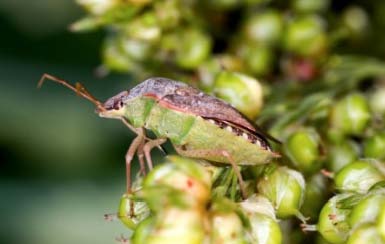
This year, the UC Division of Agriculture and Natural Resources, Cooperative Extension, Riverside County began an Integrated Pest Management (IPM) program to control Euschistus servus, or brown stink bug, a problem in Southern California’s cotton production areas.

Vonny Barlow

Vonny Barlow, a UC Cooperative Extension farm advisor in Riverside County

Vonny Barlow, a UC Cooperative Extension farm advisor in Riverside County began evaluating brown stink bug in cotton last year, and he received additional funding this year from a National Institute of Food and Agriculture (NIFA) grant administered through North Carolina State University, to continue his research this year. Barlow just hired two interns to work with brown stink bug in the Palo Verde Valley in Southern California.

The pest was known to exist in Arizona for about eleven years, but was not a critical issue until about three years ago, when it moved into California. California cotton growers had to spend a lot of money to spray to manage the insect, and it just wasn’t economically feasible.

“In many areas in the south, the brown stink bug pierces into the cotton boll with its proboscis-like mouthpart—a stiff, short straw,” said Barlow. “Once the cotton boll is pierced, the brown stink bug tries to feed on the cotton seed. The problem is the puncture allows bacteria to enter and boll rot to set in. Boll rot is the issue because it lowers yield quality; without boll rot, the brown stink bug is much more of a manageable pest.”

Spraying is not the answer to control the bug, according to Barlow. “We are going to look at an area-wide pest management approach by just essentially surveying the pest control advisers (PCAs) and growers about cropping that is near or even some miles away from cotton,” he said. “Where is the brown stink bug showing up? When did it show up? Is it moving? When are you going to harvest? Is it moving into the cotton? That way, we can give the cotton growers a better idea of when they should start management practices for brown stink bug, instead of just routinely calendar-spraying every two weeks.”

“We hope to predict when brown stink bug will move into cotton. Farmers who just harvested wheat should expect it will come into your field within the week. Start scouting; it is another very good IPM tactic to reduce sprays and to better manage pests,” said Barlow.

Featured image: Brown Stink Bug (Source: Brown Stink Bug (Source: “Chemical Efficacy Trial using Select Insecticides against Brown stink bug, Euschistus servus on Commercially Planted Cotton” by Vonny Barlow, University of California, Agricultural and Natural Resources, Riverside County, April 2016 issue of “Postings from the Palo Verde” newsletter)

2021-05-12T11:05:54-07:00June 23rd, 2016|

MRL Discussion Continues to Expand

MRL Transparency is Needed to Avoid Hurting Exports

by Emily McKay Johnson, Associate Editor

Gary Van Sickle, executive director of the California Specialty Crops Council (CSCC), and host of the annual Maximum Residue Level (MRL) Harmonization Workshop in San Francisco earlier this month, spoke about the increased MRL discussion that has taken place in the last decade. “We had the vision about 11 years ago to see there was a need to start talking about MRLs in a public forum,” he said.

With nearly 125 attendees at their workshops, CSCC “has anywhere from eight to ten international countries participating,” said Van Sickle. And as the organization has grown, Van Sickle and his team have found that MRL awareness is increasing. “One of the major focuses here is to bring into the sector an awareness of what is going on with MRLs. Through this workshop, that comes to light.” he said.

Gary Van Sickle,

Gary Van Sickle, Executive Director of California Specialty Crops Council.

“Also very important,” Van Sickle said, “is the linkage between the different sectors represented here—the registrants, the agricultural industry, the government agencies and even the universities and academia.”

Van Sickle discussed how MRLS are convoluted in other countries. “There are disconnects between crop protection measures in one country versus another,” he began, “which can hurt exports for American farmers. When a crop protection company develops products for crops, the crops are tested for what could be a maximum residue level, say it is 0.5 parts per billion,” Van Sickle explained. “The trouble comes when an importing country puts the MRL at a different level, say .1 parts per billion. Suddenly, that limits the crop’s importing potential into that country.”

Van Sickle added, “Some [countries] have tolerances that are on the low side and under our usage levels here in the states, so they can apply the [standard] properly.” Problems occur when MRLs for an American crop export “does not make the residue level for the country that it is going into,” according to Van Sickle.

Another important discussion was implementing consistency in regulation over the years. “We are also in a situation where there’s a lag-time for getting MRLs registered,” he said. “As new products come out, they get registered here for growers to use. Sometimes there’s a lag-time of three to five years or more for another country to get [the same product] registered so that the American grower can use that new chemical, which could slow the export to a particular country, keep it diverted to another country that has MRLs, or keep it off an export situation altogether,” he concluded.

2021-05-12T11:05:55-07:00June 23rd, 2016|
Go to Top