Cavanaugh Wins Fresno County Farm Bureau Journalism Award

Patrick Cavanaugh Wins Award for Audio Report on Temperance Flat Dam

By Laurie Greene, Founding Editor

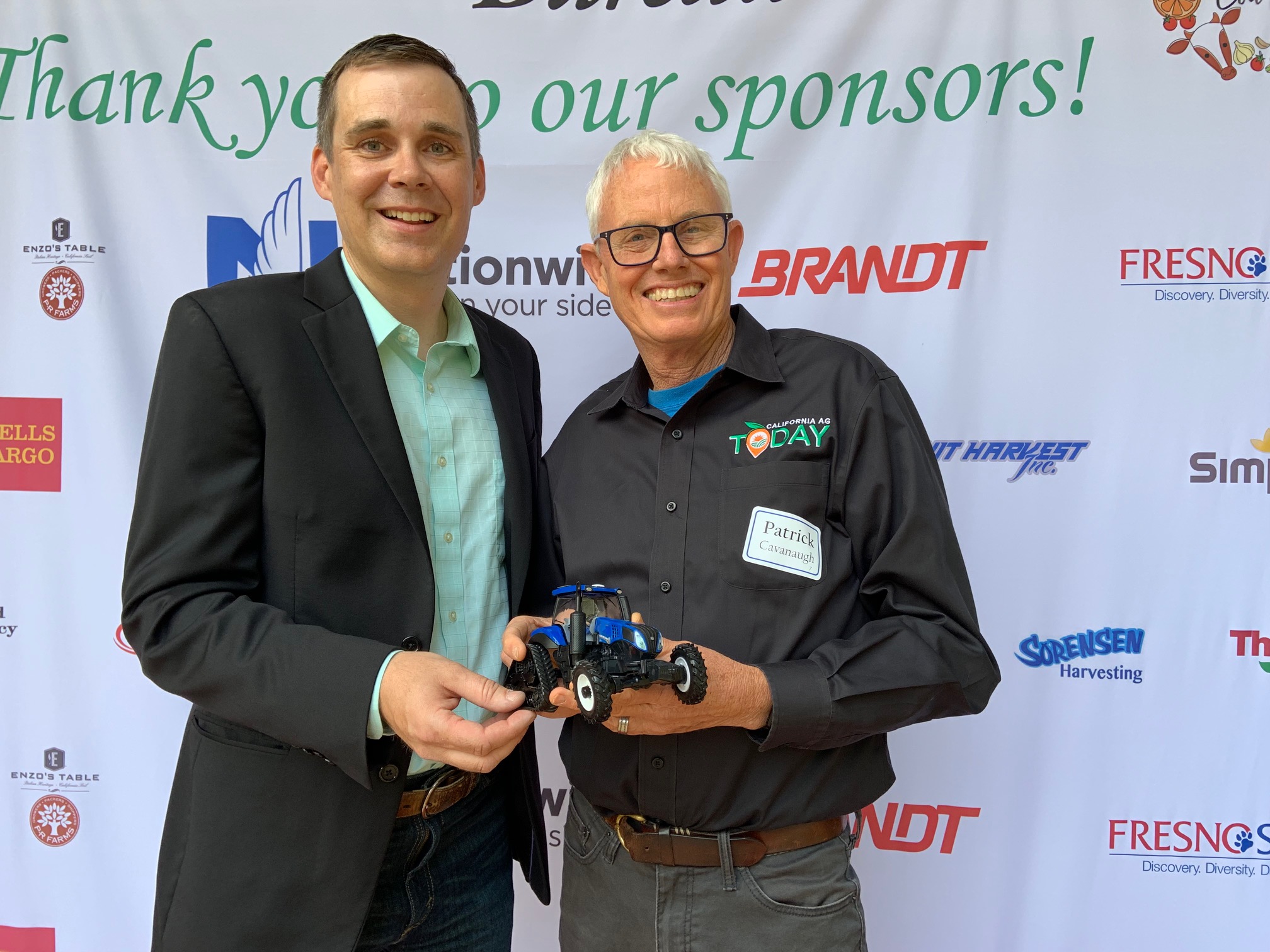
The Fresno County Farm Bureau (FCFB) recognized Patrick Cavanaugh, Ag News Director and co-owner of California Ag Today Radio Network and CaliforniaAgToday.com, with a First Place Journalism Award in the Audio category on May 9. Cavanaugh’s radio report entitled “Temperance Flat Dam Denied Full Funding” broadcasted across our 26-station network, focused on the California Water Commission’s failure to fund the Temperance Flat Dam storage project.

Cavanaugh was among four award winners recognized by the FCFB at its second annual “Bounty of Fresno County” event at Wolf Lakes Park in Sanger. This year marked the FCFB’s 25th annual Journalism Awards.

Patrick Cavanaugh Wins FCFB Journalism Award


Over 25 entries were received from publications, websites, radio and television stations. The criteria for the awards were: thorough and objective coverage of issues, given time and space limitations; educational element for the agriculture industry or the consumer; and portraying the personal stories of those who make up the food and agriculture industry, making issues relevant to consumers and Valley residents.

Serving as judges were Westlands Water District Public Affairs Representative Diana Giraldo, farmer Liz Hudson of Hudson Farms, and journalist Don Wright of Water Wrights.

Award winners are:

Audio

Patrick Cavanaugh, California Ag Today Radio, “Temperance Flat Dam denied full funding,” March 9, 2018

Cavanaugh discusses the California Water Commission’s failure to fund the Temperance Flat Dam storage project.

Farm Trade Print

Vicky Boyd, Cotton Farming Magazine, “A bird’s eye-view of cotton,” September 1, 2018

Boyd explains the value of drones and how California farmers and ranchers are enlisting such technologies to help boost efficiency, optimize crop inputs and yields, and ultimately, remain profitable.

General Print

Robert Rodriguez, The Fresno Bee, “Will adding a sour kick get millennials to eat raisins?,” August 19, 2018

Rodriguez speaks with the President and Chief Executive Officer of Sun-Maid Growers of California, Harry Overly, about the company’s national campaign focused on rekindling consumers’ fondness for the brand.

Video

Alexan Balekian, KSEE24, “Is the gas tax putting California’s most valuable resource in jeopardy?,” February 19, 2019

Balekian explores the implications of Prop. 6, “the gas tax,” on California agriculture.

Check the CaliforniaAgToday.com Google News-recognized website for additional coverage on Temperance Flat Dam.

Featured Photo:  Ryan Jacobsen, CEO, Fresno County Farm Bureau, and Patrick Cavanaugh, California Ag Today Radio Network, holding tractor award.

###

Fresno County Farm Bureau is the county’s largest agricultural advocacy and educational organization, representing members on water, labor, air quality, land use, and major agricultural related issues. Fresno County produces more than 400 commercial crops annually, totaling $7.028 billion in gross production value in 2017. For Fresno County agricultural information, visit www.fcfb.org.
 

Recommended:  The Fresno County Farm Bureau (FCFB) held the 22nd Annual Journalism Awards at the organization’s Celebrating Friends of Agriculture social where it awarded Vernon and the mental health series the Audio Award. 

2019-05-13T16:39:59-07:00May 13th, 2019|

New Location for Center for Land-Based Learning Breaks Ground

$1.5 Million Lead Gift Launches Campaign for Center for Land-Based Learning’s New State Headquarters

News Release

The Center for Land-Based Learning announced a lead gift of $1.5 million from the Yocha Dehe Wintun Nation at a groundbreaking celebration today for the Center’s new site in Woodland.

The gift officially launches the Center for Land-Based Learning’s $4 million Growing Our Future Campaign to build a new statewide headquarters and expand its programs and services. In recognition of this generous gift, the Center for Land-Based Learning will name its new administrative building the Yocha Dehe Wintun Nation Farm House.

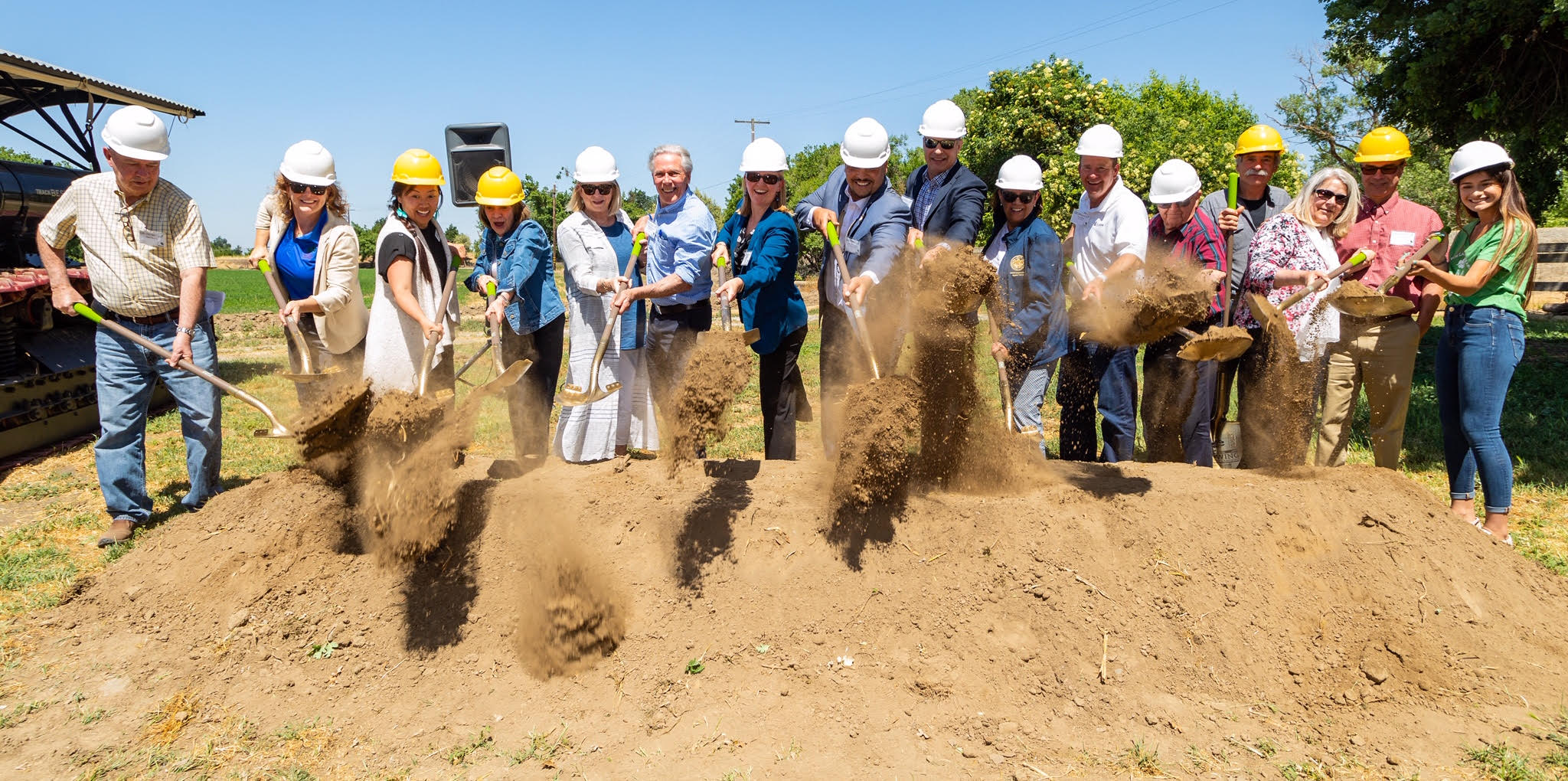
The Center For Land-Based Learning Groundbreaking today.

The groundbreaking, which coincided with the Center for Land-Based Learning’s 25th anniversary, took place on part of the original Patwin Tribal Land. The site, a historic 50-acre farm in Woodland known as The Maples, is owned by Clark Pacific, which is providing the Center with substantial support, including a no-cost, 25-year+ lease for major portions of the property and buildings.

“We are extremely grateful to the Yocha Dehe Wintun Nation for their remarkable and inspiring gift,” said Center for Land-Based Learning Executive Director Mary Kimball. “Their donation, in conjunction with the generous support of Clark Pacific, gives us the capacity to train, support, and resource stewards as we look forward to the next 25 years.”

A rendering of the new Center For Land-Based Building.

The Center will include:

-Yocha Dehe Farm House — A 5,400 square-foot building to house new administrative offices, community services, and classrooms.
-New and existing barn buildings — For storing training equipment and supplies and housing a produce washing, packing, and cooling station.
-Three farm fields totaling 30 acres — This is six times more acreage than the current site in Winters.
-Cache Creek riparian habitat and restoration area — Nearly nine acres of creek-side habitat and floodplains for restoration education.
-Space for training in resource conservation and “beautification” — Landscaping and designated areas for farm and conservation training and education in aesthetically-designed spaces.

“The Yocha Dehe people have a deep connection with the land of the Capay Valley, where our ancestors lived for hundreds of years, and we are committed to protect and preserve it,” said Yocha Dehe Wintun Nation Tribal Chairman Anthony Roberts. “One of the best ways we can do that is to work together as a community to educate about the importance of and ways for caring for the beautiful valley, soil, and environment around us. For 25 years, the Center for Land-Based Learning has led the way in developing agricultural leaders and natural resources stewards among us, and we are proud to partner with the organization to support what we are confident will be an incredible success over its next quarter century.”

Established in 1993 by walnut farmers Craig and Julie McNamara, the nonprofit Center for Land-Based Learning inspires, educates, and cultivates future generations of farmers agricultural leaders, and natural resource stewards.

“Agriculture is our heritage and our future,” said Craig McNamara. “By training a new generation of farmers and decision makers, the Center is helping ensure the long-term prosperity of California. Their passion and their mission deserve our support.”

2019-05-11T07:57:48-07:00May 10th, 2019|

Grape Crush for Wine Up in 2018

Red Wine Varieties Accounted For Largest Share

News Release

The 2018 crush totaled 4,506,583 tons, up 6.2 percent from the 2017 crush of 4,241,945 tons. Red wine varieties accounted for the largest share of all grapes crushed, at 2,447,930 tons, up 8.8 percent from 2017. The 2018 white wine variety crush totaled 1,833,755 tons, up 3.8 percent from 2017. Tons crushed of raisin type varieties totaled 82,508, down 12.5 percent from 2017, and tons crushed of table type varieties totaled 142,391, up 8.0 percent from 2017.

The 2018 average price of all varieties was $831.63, up 6.8 percent from 2017. Average prices for the 2018 crop by type were as follows: red wine grapes, $1,019.03, up 5.5 percent from 2017; white wine grapes, $634.84, up 8.0 percent from 2017; raisin grapes, $299.48, up 18.4 percent; and table grapes, $192.01, up 7.6 percent.

Leading Grape Varieties and Districts

In 2018, Chardonnay continued to account for the largest percentage of the total crush volume with 15.8 percent. Cabernet Sauvignon accounted for the second leading percentage of crush with 15.1 percent. Thompson Seedless, the leading raisin grape variety crushed for 2018, was only 1.5 percent of the total crush.

District 13, (Madera, Fresno, Alpine, Mono, Inyo Counties; and Kings and Tulare Counties north of Nevada Avenue (Avenue 192)), had the largest share of the state’s crush, at 1,370,068 tons. The average price per ton in District 13 was $318.38.

Grapes produced in District 4 (Napa County) received the highest average price of $5,571.44 per ton, up 6.6 percent from 2017. District 3 (Sonoma and Marin counties) received the second highest return of $2,817.92, up 0.3 percent from 2017. The 2018 Chardonnay price of $970.76 was up 5.1 percent from 2017, and the Cabernet Sauvignon price of $1,683.25 was up 8.3 percent from 2017. The 2018 average price for Zinfandel was $600.21, up 1.5 percent from 2017, while the Pinot Noir average price was down 0.9 percent from 2017 at $1,674.62 per ton.

The entire Grape Crush Report is available online in both PDF and spreadsheet format at www.nass.usda.gov/ca.

2019-04-17T16:01:12-07:00April 17th, 2019|

Honor Cesar Chavez’s Legacy by Confronting UFW Corruption

Chavez Spent His life Trying to Improve Farm Worker’s Lives, Instead of Threatening Their Lives

By Jesse Rojas, Spokesperson for Pick Justice

Cesar Chavez spent his life trying to improve life for farmworkers, fighting for changes he felt would bring about civil rights and justice for workers. At the end of this month, California state legislators plan to honor Cesar Chavez’s birthday as a day of public service.

The work Cesar Chavez did organizing farmworkers is credited with spurring better working conditions and increased wages, putting people who perform difficult work but still struggle to provide for their families a step closer to achieving the American Dream in California.

Jesse Rojas, CEO, The Redd Group

Cesar Chavez has been portrayed as the founder of The United Farm Workers union to help struggling farm workers achieve a better life.
Growing up in the fields in the Central Valley town of Delano, this fight begun by Cesar Chavez is personal to me. I too come from an immigrant background, I’ve eaten with the farmworkers who fought alongside Cesar Chavez and heard their stories.

Today, however, Cesar Chavez would be saddened to see what the UFW has become.

After voting overwhelmingly to leave the UFW, Gerawan farmworkers spent five long years in court fighting the UFW and the ALRB, who refused to count their votes until they were ordered to by a judge.
The Gerawan workers, just like the farmworker activists before they were fighting for a better life – and against a UFW contract that would have lowered their pay.

While in Cesar Chavez’s time the UFW gave farmworkers a voice, today’s UFW instead seeks to silence the workers.

When Gerawan farmworker activist Silvia Lopez, one of the leaders of the fight to leave the UFW, tried to speak with former Governor Jerry Brown, a top UFW leader physically blocked her way. The whole incident was captured on video and reported by the Sacramento Bee.

Cesar Chavez spoke out against humiliation and oppression, such as the methods of today’s UFW bosses.

The Gerawan farmworkers are far from alone. Today, the UFW represents just 1 percent of farmworkers, and more petition the ALRB to leave all the time. As reported by the Los Angeles Times, former ALRB Chairman William B. Gould IV, who resigned from the agency in disgust, stated the ALRB now spends more time on petitions from workers trying to leave the union than those trying to join.

In fact, the UFW even abuses its own workers, who the Los Angeles Times reported had to take the union to court to force the union to pay almost $2 million in unpaid wages and penalties.

Cesar Chavez devoted his life to fighting for workers rights. He supported workers right to choose whether or not to join a union. Civil rights for farmworkers cannot be achieved when the government looks the other way when workers are abused, regardless of who is committing the acts of oppression.

That’s why we cannot honor Cesar Chavez’s legacy without speaking out against the abuses of today’s UFW.

Jesse Rojas is a farm worker rights activist, spokesperson for Pick Justice, and founder of California Farm Workers & Families PAC. Rojas is a tireless advocate for liberty and civil rights and often provides news commentary on issues such as entrepreneurship, labor relations, and politics. 

Rojas also launched Mi America En La Radio, the first conservative Spanish-language radio show in the Central Valley. As CEO of The Redd Group, LLC, his organization offers labor relations, human resources consulting, public relations and political consulting.

2019-03-24T12:52:59-07:00March 22nd, 2019|

4-H Learning Model Helps Two Lost children Survive

Thankfully, Children Were Found


2019-03-14T18:48:46-07:00March 14th, 2019|

Modesto Irrigation District Offers Agreement Package in Lieu of Unimpaired Flows

Major Milestone Achieved in Continued Effort to advance Voluntary Agreements

Districts applaud Governor Newsom’s commitment to Voluntary Agreements

Today, the California Department of Fish and Wildlife and California Department of Water Resources submitted a package of voluntary agreements to the State Water Resources Control Board. The package

– supported by the Modesto Irrigation District, Turlock Irrigation District, City and County of San Francisco and more than 40 other water agencies, resource agencies and non-governmental environmental groups – is being offered as an alternative to the unimpaired flow paradigm adopted by the State Water Resources Control Board last December.

This historic step forward is the result Governor’s Newsom’s commitment to “cross the finish line on real agreements to save the Sacramento-San Joaquin Bay Delta” (State of the State, February 12, 2019). Under the leadership of Cal-EPA Secretary Blumenfeld and Natural Resources Agency Secretary Crowfoot, MID, TID, Sacramento Valley water users and non-governmental organizations finalized river-specific project descriptions and a planning agreement.

“Governor Newsom’s commitment to the voluntary agreement concept has been evident since the day he took office,” TID General Manager Casey Hashimoto said. “He’s dedicated significant amounts of his administration’s time and resources to work collaboratively with water users and environmental communities to advance the voluntary agreement framework that will serve as a durable and beneficial solution for all – our environment, our rivers, our water supply, and our communities.”

The agreement includes a proposed schedule and procedures for assisting the State Water Resources Control Board as it updates the Bay-Delta Plan. This includes the parties to the agreement – in coordination with the State Water Resources Control Board – conducting further analyses of the benefits and other effects of the project description. Work will continue throughout the year with a request that the State Water Board consider adoption of a comprehensive plan and proposed amendments consistent with the voluntary agreements by the end of this year.

The project descriptions and planning agreement submitted today integrate river flow and non-flow measures to establish water quality conditions that support the viability of native fisheries and achieve related objectives in the State Water Board’s Bay-Delta Plan.

The Tuolumne River project description included in the package will ensure water security and reliability, includes environmental improvements, are projected to enhance fish populations beyond what is projected in the State’s current plan and provides for timely implementation.

“We’ve done the science on the Tuolumne River; we’ve negotiated in good faith and now we’ve memorialized all of our work and progress to date,” MID General Manager Scott Furgerson said. “The Districts remain committed to advancing this historic water agreement as it is key to balancing the needs of our communities and our environmental resources.”

The full project descriptions and planning agreement can be viewed here.


2019-03-01T16:40:47-08:00March 1st, 2019|

Jim Patterson on Governor Newsom’s High Speed Rail Project Admissions

Patterson: “They Never Had the Land, They Never Had the Money”

News Release from Assembly Member Jim Patterson

Governor Newsom put the final nail in the coffin of high speed rail recently. His admission that this project will never go from Los Angeles to San Francisco as voters intended echoes what I have been warning about for years. The results of the audit I requested provided indisputable proof that there is no way forward. They never had the land, they never had the money, and now we know that it will never be a reality.

Jim Patterson

Governor Newsom also confirmed today that if California doesn’t finish the Bakersfield to Madera portion of the track, we will be forced to repay $3.5 billion in federal funds.

With this stunning turn of events, Central Valley rail supporters and skeptics, must band together to make sure we are left with a functional track. After tearing up prime Ag land and ripping up the heart of our cities, we must ensure that we aren’t left with the unfinished scraps of a failed project.

“The only way this bureaucracy works is by keeping the pressure on. Today’s turn of events is proof of that.

2019-02-13T16:52:57-08:00February 13th, 2019|

Strawberries Need Protection From Mites

New Predatory Species May Help Manage the Pest

 By Patrick Cavanaugh, Editor

Two-spotted mites in strawberries continue to be one of the biggest problems every year.

“We see more of it coming from the nurseries, and this year is no exception,” explained David Peck, COO and Farmer of Manzanita Berry Farms in Santa Maria.

“What’s interesting to me is that in the years that we’ve been using persimilis predator mite, and that has been since the early ’80s, we don’t see the persimilis taking over two-spot populations as early in the season as we used to,” Peck continued. “Whether that’s weather-related, humidity-related, or if there’s a change in the genetics of the commercially available persimilis, I don’t know.”

David Peck

Peck said growers need to be aware of another trouble mite, the Lewis mite.  Lewis mites have been seen on strawberries and raspberries in the Ventura area for some time, but growers appear to be noticing increased infestations in the recent years.  Some growers have also seen them in Santa Maria in recent years, but they have so far not been reported from the Watsonville area.  Considering the recent trend, growers might keep them in mind while scouting for pests.

“They’re out there, some places greater than others. Persimilis don’t like to eat Lewis mite. They are susceptible to all the same miticides. However, if you are relying heavily, on biologicals, you got to know if you have Lewis mite,” Peck said.

“I add fallacis predatory mites early in the season as a preventative for Lewis mite. The fallacis will eat two-spot or Lewis mite equally well and have done a pretty good job of keeping that initial early-season population of both mite species under control,” he explained.

Peck said that if there are mites in the strawberry nurseries, and the nurseries do not want to spray miticides, he understands that due to the possible development of pesticide-resistant mites showing up with plants.

“That’s a valid reason not to spray miticides at the nursery level. But there’s good data that fallacis will exist in those Northern California strawberry nursery areas, and they’re actually less expensive to procure than persimilis, and they survive through a wider environmental range than persimilis. They can handle colder, dryer, and hotter,” Peck said.

Some of the best data on strawberries and raspberries come out of Oregon State. It shows numerical data on how to put out the predatory mites, including how few you can put out.

“Personally, I’d be willing to spend an extra 50 cents or a dollar a thousand if the nurseries would inoculate their fields with fallacis. You might get a few predators coming in with your plants,” he said.

There is additional research on fallacis versus another predatory mite known as andersoni. Data shows that andersoni may be stronger than fallacis, thus doing a better job at controlling two-spotted mites.

Peck said that he has used andersoni on a test basis.

“I did not have enough of the predator to thoroughly complete a test in our organic fields, but I’m thinking that I will use that species for early season mite control.”

2019-01-30T16:53:58-08:00January 30th, 2019|

Gar Tootelian Has Big Annual Appreciation Lunch in Dinuba

AG Retailer Appreciates its Customers

By Patrick Cavanaugh, Editor

Farmers, PCAs and other stakeholders in Ag packed the Veterans Memorial Building In Dinuba, and all had something in common: They were being appreciated by Reedley based Gar Tootelian, which for 70 years has been serving the Central San Joaquin Valley including Fresno, Kings, Kern, Madera, and Tulare Counties.

Big Crowd at Lunch during Gar Tootelian Customer Appreciation Day

“It’s all about cultivating and nurturing our small communities for the next generation. A lot of us grew up together. A lot of us went to school together. Our children, our grandchildren are growing up in those same communities.,” said Karen Musson, a partner with Gar Tootelian. “We share the same values and morals. It’s about nurturing for the next generation. Our legacy is the preservation of those legacy farmers that are continuing to farm and do the work to feed the world, and we’re just so pleased to be their partners.”

Musson noted that it’s just such an exciting time in agriculture in general. There is a growing population, more significant needs, more conscientious consumers, more than ever before. “They’re worried about their health and nutrition, about the health and nutrition of their children and grandchildren, so it’s a very exciting time to be a part of an industry that provides such a vital commodity to the world,” Musson said.

Of course, California farmers produce the food that people love to eat and should be in more abundance. “We do it the most sustainable, the most environmentally way. All of our of practices, of course, are with the consumer in mind at every step of the way, whether it be about the preservation of the land or the recycling or the water or just the nutritional commodity that we’re producing,” noted Musson. “We’re always more conscious about producing more with less and having less of an impact.”

Greg Musson, President and CEO of Gar Tootelian, hands out cookies during the Company’s Customer Appreciation Day Nov. 1 2018 in Dinuba

Gar is celebrating its 70th Anniversary as a chemical and fertilizer retailer. “We have the next generation. We’re already cultivating them. I can tell you that both generations love to eat as much as I do, and they love those fresh fruits and vegetables that we bring home in the evening.

California farmers are sustainable. They take care of the land and are very conscientious of what they do every day.

“The fact that somebody would think that they would purposely use unsustainable practices when their investment, everything they have in their legacy is in their land, there is nothing more valuable to them than preserving that for the next generation and the next generation and the next generation,” Musson said.

“For somebody in California to enter farming today is quite an undertaking, so the preservation of the land, the sustainability practices, the conscientious practices of conservation of the soil or water or whatever the inputs are, the plant nutrition of the commodity, and the inputs. That their legacy. Their land is part of their legacy. Family, land, and legacy are all connected for the next generation,” said Musson.

The company has been honored several times on the national scale.

In 2017 GAR was recognized for the Change Award, presented by Habitat for Humanity for its distinguished record of decisive leadership, entrepreneurship and service to the agricultural industry and the community.

In 2016 GAR was Honored by its national peers for the National Ag Retailer of the Year.

In 2015, GAR received the top honor for the Best North America for its environmentally safe facility and community outreach efforts.

In 2013 GAR received the Fresno Chamber and Baker, Peterson and Franklin Ag Business Award.

In 2009 it was recognized at the Top Employer in Central California.

2018-11-02T06:51:14-07:00November 1st, 2018|
Go to Top