Humiston Touts USDA Climate-Smart Programs Before House Agriculture Committee

Testimony highlights UC ANR’s role in advancing prosperity, sustainability and climate resilience

By Pam Kan-Rice, UCANR

Glenda Humiston, Ph.D., University of California vice president of agriculture and natural resources, director of the Agricultural Experiment Station and director of the Cooperative Extension Service, testified before the U.S. House of Representatives Committee on Agriculture at today’s (March 16) hearing “A 2022 Review of the Farm Bill: The Role of USDA Programs in Addressing Climate Change.

A recording of the hearing can be viewed at https://youtu.be/2_GQI6b6CCs. Congressman Jimmy Panetta, who represents California’s Central Coast, introduces Humiston at the 16-minute mark of the recording. She begins speaking at the 40:38 mark.

In Washington, D.C., Humiston delivered the following prepared statement:

Good morning, Chairman [David] Scott, Ranking Member [GT] Thompson, and Members of the Committee, my name is Glenda Humiston, and I serve as the Vice President of Agriculture and Natural Resources (ANR) for the University of California (UC) system. I am honored to have this opportunity to discuss the importance of agricultural research, and other USDA programs, as you begin work on the next Farm Bill.

With UC ANR serving as a vital partner, California continues to be the nation’s top agricultural state. For more than a century, California’s $50 billion agricultural sector has depended on UC ANR, in partnership with our UC campuses, for the stream of new technologies and research breakthroughs needed to stay competitive and be responsible stewards of the land. We are proud to be part of the Land Grant partnership that was developed between states and the federal government with the 1862 Morrill Act, 1887 Hatch Act and the 1914 Smith-Lever Act. That enterprise has, for over 130 years, advanced scientific knowledge in all aspects of food production, and improved production capacity, profitability, and safety of the nation’s food system.

With over 71,000 farms producing 400 different commodities, California is an agricultural behemoth and the sole provider of many high-demand farm products while also exporting roughly a third of its agricultural production each year. Beyond on-farm production, California’s working landscapes include farmland, ranches, forests, wetlands, mines, water bodies and other natural resource lands, both private and public, that are vital sources of ecosystem services. These services are ways that the natural world provides biological necessities, such as clean water, nutritious food, and a livable climate, as well as indirect economic benefits, such as jobs and revenue created along food value chains. More broadly, they encompass intangible goods that contribute to human well-being, such as recreation, aesthetic inspiration, and cultural connection.

Ensuring that those ecosystem services are functioning and remain available to utilize is an ever-growing challenge. There can be no doubt that extreme climate events are changing California’s landscape – fires, floods, drought, more invasive pests are already affecting agriculture. For example, unseasonably warm weather now causes many fruit and nut trees to bloom before the last frost, causing great economic losses. In the coming decades, the changing climate is likely to further decrease the supply of water, increase the risk of wildfires, and threaten coastal development and ecosystems.

To combat such future perils, we must harness the ability of our agricultural and other working landscapes to adapt, to mitigate and where possible, to become a solution to climate change. According to the National Academy of Sciences, U.S. soils and forests have the potential to sequester about 500 million metric tons of carbon dioxide annually. Emerging markets for carbon credits and government incentive programs could generate tens of billions of dollars per year in new investment for working farm and forest lands within the next several years.

Within this framework, USDA programs are critical to our efforts to support carbon sequestration, improved water management, healthy soils, forest restoration, hazardous fuels management, and wood products innovation, among other provisions that support natural climate solutions. USDA’s new Partnerships for Climate-Smart Commodities is a great example of how targeted funding for pilot projects can create market opportunities for commodities produced using climate-smart practices.

As we pursue those climate-smart practices, it is critical that we make full use of existing programs and leverage collaborations among them wherever possible. Supporting partnerships between government agencies with academia and the private sector will enable production of multiple benefits from various actions. As part of this we need to utilize voluntary, market and incentive-based programs to the greatest extent possible and maintain a focus on science-based outcomes. In many situations, transformative innovation is needed – moving beyond just improving existing methods and processes to totally re-thinking how our systems are designed to deliver policy and programs.

UC ANR supports California farmers and ranchers to be resilient to extreme weather events with data-driven tools, methods, and technologies. For example, we are developing drought, heat, and pest-tolerant crop varieties that allow farmers to remain economically viable while also being resilient to extreme weather. Finding new crops suitable for California soils and ecosystems not only improves the productivity of the farm but can have co-benefits such as improving water-holding capacity of the soil, increasing native pollinator habitat, and boosting local economies by increasing value-added products.

We are also pushing our research system to expand collaborative efforts between experts in soil sciences, plant pathology, biochemistry, and other sciences with technology experts in robotics, sensors, artificial intelligence, materials, supply chain logistics, and energy systems to solve today’s complex problems in agriculture. Much like the biomedical revolution, it is the integration of multiple disciplines into a single project that can lead to transformative innovation that improves productivity, food safety, and ecosystem services while also giving rise to new businesses. Great examples of such transdisciplinary research and development include:

  • An initiative to place solar panels over irrigation canals to reduce evaporation of precious irrigation water supplies for farmers while also producing electricity.
  • Implementing healthy soil practices, like cover crops and no-till, to enhance capture of rain and improve groundwater recharge.
  • Programs for farmers to install dairy digesters to convert potentially harmful greenhouse gases into valuable biofuels.

To develop the science, new technologies and better farming practices that are desperately needed, increased funding for agriculture and food-related research and extension is necessary as are new investment in agricultural research facilities. Public funding for agricultural research in the U.S. has declined in real dollars over the past few decades while deferred maintenance of research facilities greatly hampers scientists’ work. Greater investments will help ensure farmers and ranchers have access to the scientifically rigorous tools and information they need to build climate resilience, mitigate environmental impacts, and increase the productivity of their land.

Other exciting opportunities can be found in forest health efforts that convert excessive fuel loads – biomass – into valuable bioproducts while reducing risk from catastrophic wildfires. California’s wildfire crisis continued its destructive march in 2020, each year worse than the one before. Working closely with regional economic development organizations and our California Economic Summit partners, UC ANR is a key partner in developing and implementing recommendations to improve forest health, reduce wildfire risk, incentivize innovation in new and innovative wood products industries and build capacity for manufacturing to enhance forest and environmental health and resilient rural communities. Examples of this work include:

  • Organizing controlled burn associations with local communities and other forest treatment practices such as a software program, Match.Graze, that improves use of grazing.
  • Partnering with the Inland Empire Economic Partnership and the southern California commercial ports to convert biomass into hydrogen and other liquid biofuels to replace diesel in trucks – the largest source of air pollution in that region.
  • Educating homeowners on landscaping, defensible space, and fire-wise plants to improve home-hardening, reduce risk from fire and conserve water.
  • UC Engineering research on materials science is developing new advanced wood products and data to demonstrate the multiple values of construction with such products.
  • Teaming up with community colleges to provide workforce training in forest professions.

The US needs robust funding for wildfire prevention, research, recovery, and extension. Cooperative Extension academics are lead experts in forestry and wildfire research and they provide critical resources to inform strategic fuels management, enhance community wildfire planning, and build community fire adaptation and resiliency. USDA’s Climate Hubs should be expanded so that they can regularly engage stakeholders and prioritize vital research amongst more partners. The U.S. Forest Service’s work on bioproducts is extremely valuable as is their willingness to enter into long-term stewardship agreements with state and local partners.

In California, we are very excited to be working with the Governor and the state legislature to secure a $185 million investment in UC to build new capacity in climate-focused research, innovation, and workforce development. For example, with this funding we would establish Regional Workforce Hubs that will provide on-the-job training opportunities for university and community college students as well as well as leverage the professional learning and career certification infrastructure of the UC Extension programs to offer a portfolio of training opportunities, tools, and resources for college-prep and non-degree seeking individuals.

Just as these programs allow us to implement climate smart agriculture and healthy forests’ initiatives, they also support regional economic development and job creation. Rural Development, the Agricultural Marketing Service and many other USDA programs are important partners as we build climate solutions through more efficient regional food systems, improved supply chains, workforce training, manufacturing of BioPreferred products, and food security initiatives.

If we are to promote resilience and help rural economies better adapt to climate change, we need to harness all programs throughout the U.S. Department of Agriculture. That means having senior USDA leadership coordinating climate issues across the entire agency and robustly serving as USDA’s climate representative at all interagency climate-related meetings. For example, USDA must collaborate with federal entities like the Federal Communications Commission to support improvements to broadband access, which is critical for climate-smart precision technologies and rural economies. Similarly, just as USDA has partnered with the National Science Foundation on research initiatives and jointly funding competitive grants, it needs to build closer partnerships with programs like Commerce’s Economic Development Agency and Treasury’s Community Financial Development Institutions to ensure that access to capital, effective economic development planning and infrastructure investments are targeted appropriately and delivered well.

One important way to help ensure wise distribution of program dollars to give the current definition of “rural” serious examination and re-engineering; as it stands now, far too many communities are improperly denied USDA resources due to the antiquated definitions of rural and metropolitan. Strongly encouraging more cross-agency proposals throughout USDA and enhanced support for public-private partnerships would remove barriers and hurdles for industry and communities alike.

The current mix of federal and state capacity funds is generally leveraged many-fold by federal competitive grants, grants from private industry, and other types of unrestricted gifts and awards to faculty conducting research at the nation’s land-grant universities. Competitive funding processes can elicit new ideas and speed up certain research projects; however, they also encourage a shift from programmatic research towards shorter-term project research. Failure to invest in a well-balanced mix of capacity and competitive funds for food and agriculture research could have very negative consequences for decades to come – consequences that would take significant time to reverse.

It takes at least seven to 15 years of research and development to develop a new crop variety – longer for trees/vines. Deploying and/or adapting new agricultural technologies can be even longer. For example, when UC Davis engineer, Coby Lorenzen, designed a machine to automate the harvest of tomatoes in the 1960s, it also required agronomist, Jack Hanna, to develop a less-delicate variety of tomato that ripened uniformly and could be easily plucked from the plant, essential qualities that made machine harvesting feasible. Federal funding that recognizes these realities as well as improvements in technology transfer and support for commercialization is vital.

Faculty and staff at land-grant universities across the nation recognize that their work takes place on behalf of a greater good, a broader goal, and a common vision that is much bigger than their individual achievements. Members of this House Committee on Agriculture can be confident that every dollar of federal investment authorized by the Farm Bill and expended at land-grant universities is guaranteed to be leveraged further, and to spawn innovation and discovery that will be translated into solutions to improve the lives of U.S. citizens. I thank you for this opportunity to provide testimony.
2022-03-17T10:44:04-07:00March 17th, 2022|

Quality Walnuts Are Grown in California

California Walnut Growers Produce Higher Quality Products

By Patrick Cavanaugh, with the Ag Information Network

Walnuts are grown in many countries around the world but California walnuts really shine when it comes to quality. Pam Graviet is a Senior Marketing Director International for the California Walnut Commission. Graviet said it comes down to those growers and the processors.

“It’s really what the growers do. I mean, they spend so much care in the orchard, and then when it gets to processing there’s all the extra steps that are taken,” said Graviet. “What they do is partially regulated and partially because of their desire to have a superior product. And that’s actually recognized around the world,” noted Graviet.

“You can get a walnut from Moldova, China, Italy or Australia. There are so many countries that produce them but they see the value that our industry delivers and they want our product,” noted Graviet.

But Graviet said the challenge, and it’s a big challenge, is the price that the growers receive.

“Just like almonds, you have a large supply and you have to develop that demand. And over time that happens, but in the meantime, the price will fluctuate depending on what the supply is on any given year,” she said.

2022-03-16T10:46:05-07:00March 16th, 2022|

The Story of Rising Fertilizer Prices

High fertilizer prices in the past year have increased costs for farmers, but for some crops more than others. Multiple potential causes could explain these price increases, stemming from both supply and demand factors. If farmers respond to high prices by using less fertilizer per acre, it will provide an environmental benefit in the form of less nitrogen and phosphorus in streams, rivers, and lakes.

By Aaron Smith, DeLoach Professor of Agricultural Economics in the Department of Agricultural and Resource Economics at UC Davis.

https://s.giannini.ucop.edu/uploads/pub/2022/02/24/v25n3.pdf 

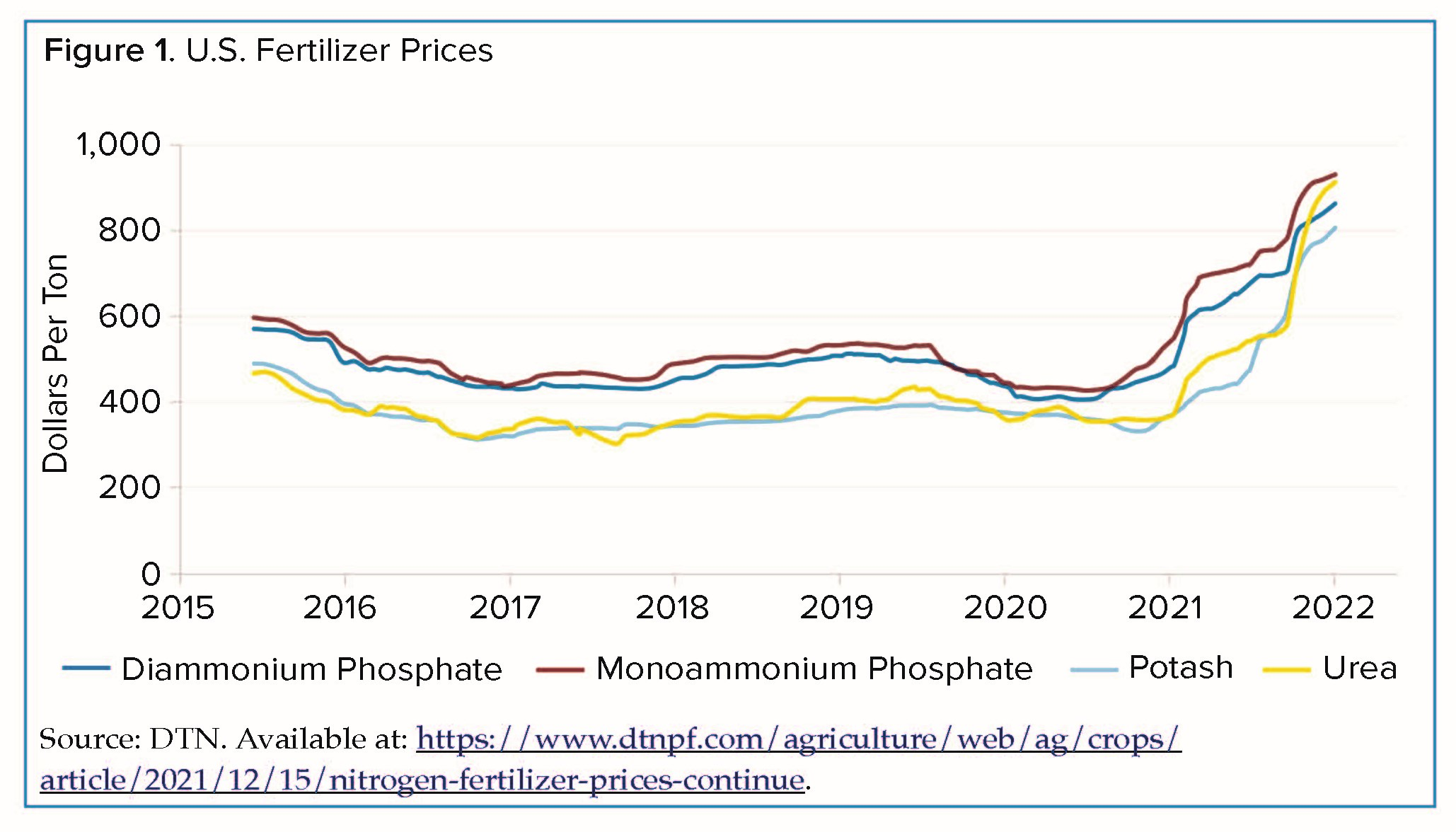
Fertilizer prices approximately doubled between the summer of 2020 and the end of 2021. Prices had been relatively stable in the prior five years at around $500 per ton for phosphate products (phosphorus) and just below $400 per ton for potash (potassium) and urea (nitrogen). In January 2022, phosphate products hit $900 per ton, and potash and urea prices were $800 per ton (see Figure 1).

What caused these price increases, and how much do they matter?

Agricultural Fertilizers

Most fertilizers deliver one or more of the following macronutrients to plants: nitrogen (N), phosphorus (P), or potassium (K).

Nitrogen makes up three-quarters of the air we breathe and is essential in plant growth. However, atmospheric nitrogen needs to be converted to ammonia (NH3) before it is accessible to plants. This conversion process, known as fixation, occurs naturally through bacteria and archaea that live in the soil or in the roots of some plants. Animals also produce ammonia by eating nitrogen-laden plants and excreting manure.

These natural processes typically do not produce enough ammonia for crops to reach their maximum potential. The invention of the Haber-Bosch process in 1909 enabled the production of synthetic ammonia by reacting nitrogen with hydrogen under high heat and pressure. U.S. nitrogen producers use natural gas as an energy source in this process.

Phosphorus helps plants grow by promoting photosynthesis and other functions important for development. Phosphorus fertilizers are typically produced by mining phosphate rock and treating it with sulfuric or phosphoric acid, causing a chemical reaction that converts it to a form that can be absorbed by plants.

Potassium strengthens plants, making them resistant to disease and higher in quality. Potassium fertilizers are created by mining potash from deep underground, similar to table salt. Chemical reactions convert it into a form usable by plants.

It is impossible to apply the exact amount of fertilizer that plants require, and there is a perception that many farmers over-apply fertilizer because they fear yield and profit losses from applying too little. This extra fertilizer is sometimes called “insurance nitrogen.”

Nitrogen and phosphorus that are not taken up by plants often end up in waterways, where they can cause a massive overgrowth of algae, known as an algae bloom. Certain types of algae emit toxins that are absorbed by shellfish. Consuming these tainted shellfish can lead to stomach illness and short-term memory problems. Drinking or coming into contact with toxins from algae blooms can cause stomachaches, rashes, and more serious problems. Algae blooms also reduce the recreational value of lakes and rivers.

U.S. Fertilizer Consumption

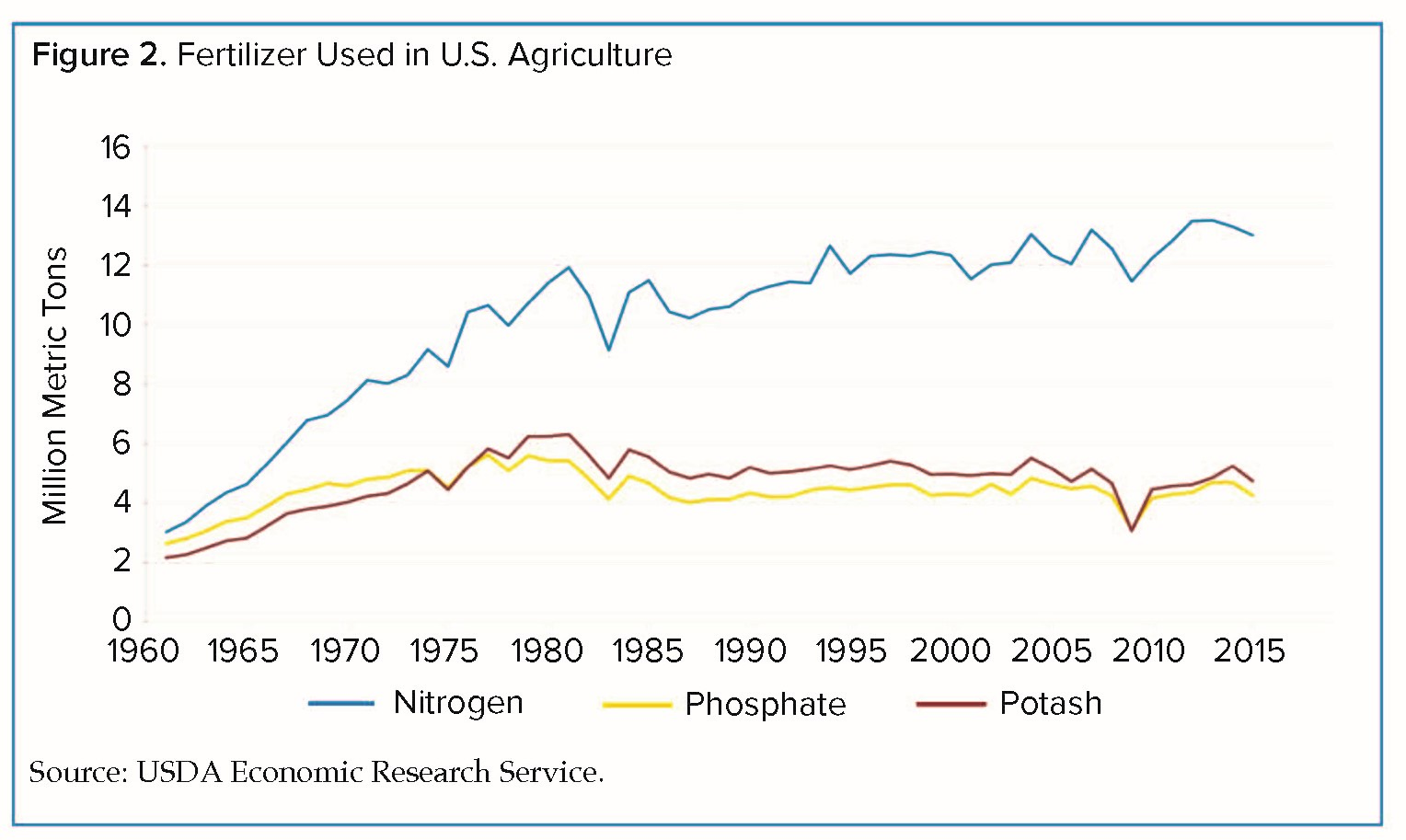
Nitrogen fertilizer use increased by a factor of four from 1960–1980, as shown in Figure 2. This increase coincided with dramatic increases in crop yields. In the 1970s, high agricultural commodity prices created a farm boom in which farmers planted more acres to crops and increased fertilizer applications.

After a slight drop during the farm crisis of the early 1980s, nitrogen fertilizer use has increased steadily, but at a slower rate than in the 1960s and 1970s. Phosphate and potash use has been relatively constant since 1985. Use of all fertilizers dropped substantially in 2009 after fertilizer prices increased fivefold during the 2008 commodity boom—a much larger increase than in 2021.

Nitrogen is by far the most used agricultural fertilizer by weight. It now makes up almost 60% of all fertilizer used, whereas phosphate and potash each comprise just over 20%. However, the trends in phosphate and potassium use mirror those in nitrogen, perhaps because many farmers apply multi-nutrient fertilizers.

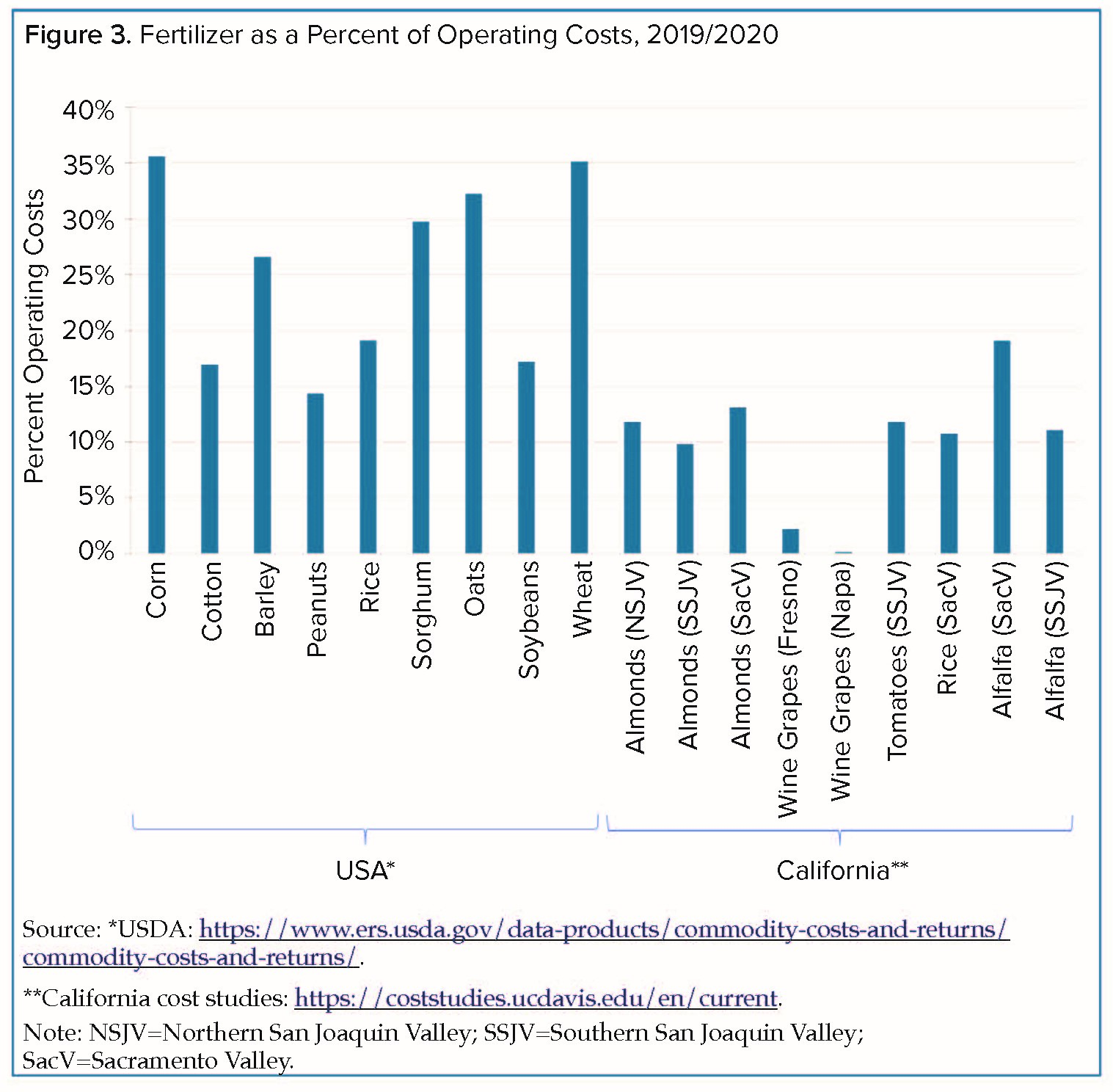
Two facts provide insight into the role of fertilizer in the U.S. farm economy. First, corn uses about 45% of each fertilizer type, yet it takes up only a quarter of all cropland—90 out of about 390 million cropland acres in the nation. Second, in 2020 fertilizer made up 35% of operating expenses for corn growers—more than any other crop. Fertilizer is a major expense for the biggest crop in the nation, so the 2021 fertilizer price increases will significantly raise the cost of growing it.

As Figure 3 shows, fertilizer makes up more than 25% of operating expenses for several other major crops, including barley, oats, sorghum, and wheat. Between them, these crops use an additional 50 million acres each year.

In percentage terms, fertilizer is a much smaller expense for major California crops than the major national crops. It makes up about 10% of the cost of growing almonds, less than 2% of the cost of growing wine grapes, and 11% of the cost of growing processing tomatoes.

These percentages are useful for understanding the salience of fertilizer price increases for farmers. A jump in the price of one of your largest expense items will be noticed.

However, these percentages obscure the amount of fertilizer used on each crop because major national crops such as corn are relatively inexpensive to grow. Most corn is grown without irrigation, which saves the cost of acquiring and pumping water. Corn also requires little labor, especially now that tractors practically drive themselves.

According to cost and return studies by the University of California, bearing almonds cost $3,000–$4,000 per acre per year, which is about 10 times as much as growing corn in Illinois. So, although they spend a smaller percentage of their budget on fertilizer, California almond growers spend about three times as much per acre on fertilizer as Illinois corn growers, including about 25% more on nitrogen and multiple times more on potassium.

Fertilizer Production 

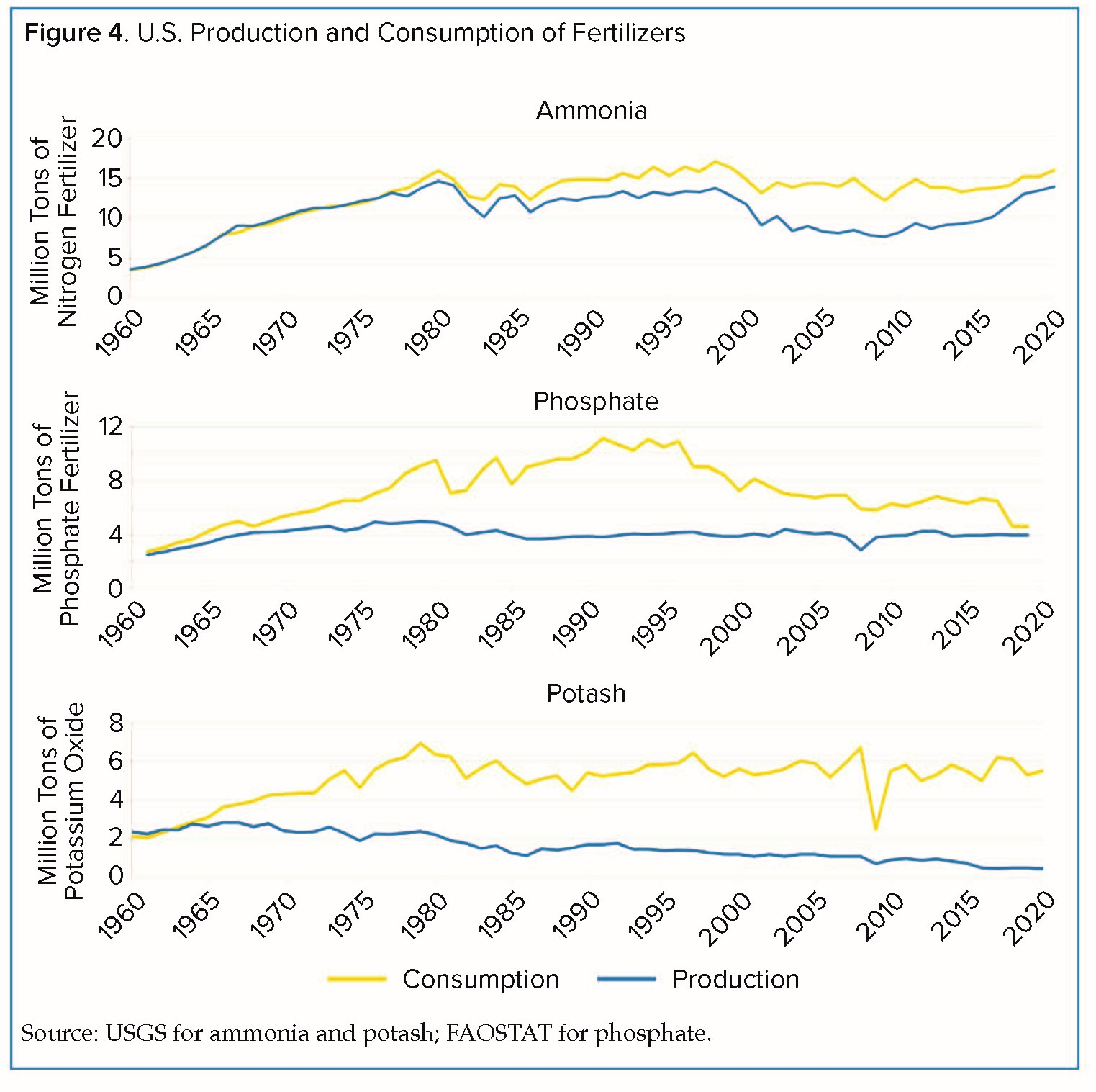
Fertilizers are produced throughout the world and traded heavily between countries. Figure 4 shows that the United States currently produces about 85% of the ammonia it uses, most of which becomes nitrogen fertilizer, and it produces 90% of the phosphate rock it uses, most of which becomes phosphate fertilizer. It imports 90% of its potash.

Most U.S. ammonia production capacity is in Louisiana, Oklahoma, and Texas—close to natural gas fields. Natural gas constitutes about 80% of the cost of producing ammonia. Domestic production declined substantially from 2000 to 2010, a period when U.S. natural gas prices were historically high. In the latter part of this decade, two major producers merged as part of a period of consolidation in the industry.

After 2010, the deployment of hydraulic fracturing (fracking) increased the supply of natural gas and thereby lowered the cost of production dramatically. Fertilizer prices, however, remained high in this period and U.S. firms enjoyed large margins. In the last five years, production has rebounded, as more plants were built to take advantage of cheap natural gas.

Ammonia imports have mirrored domestic production, increasing as production declined between 2000 and 2010 before declining when production rebounded after 2016. Two-thirds of U.S. imports come from Trinidad and Tobago, and most of the remainder comes from Canada.

U.S. potash production has declined by 80% since 1965. Most of the remaining U.S. production comes from deep mines in southeastern New Mexico. Most potash imports come from Canada, which is the world’s largest producer by a significant margin.

Most domestic phosphate is mined in Florida and North Carolina, although there is also some production in Idaho and Utah. U.S. phosphate production declined steadily from 1980–2019, but phosphate fertilizer use in U.S. agriculture remained relatively constant over this period.

Each year between 1980 and 2019, the  U.S. exported about half its phosphate production, mostly to Canada and Mexico. As production declined, the U.S. maintained domestic consumption by increasing imports, mostly from Morocco, Russia, and Israel. In March 2021, the U.S. International Trade Commission ruled that imports from Morocco and Russia had affected the U.S. producers adversely, and they imposed countervailing tariffs ranging from 9% to 47%.

The U.S. Geological Survey (USGS) is an excellent source for data on mineral commodities, and I use this source for ammonia and potash in Figure 4. For phosphate, USGS reports data on phosphate rock, which is the product that is extracted from mines. Production and consumption of phosphate rock shows an incomplete picture of the phosphate fertilizer market. Each ton of phosphate rock generates about 0.2 tons of fertilizer. The U.S. imports some phosphate rock, mostly from Peru, which domestic firms make into fertilizer. In addition, the U.S. imports a significant amount of phosphate fertilizer. Thus, Figure 4 presents phosphate fertilizer data from FAO rather than phosphate rock data from USGS.

Prices

So, why have prices increased? To answer this question, I consider supply- and demand-side factors.

On the supply side, U.S. natural gas prices doubled between the summer of 2020 and the end of 2021, which significantly raised the cost of nitrogen production. Energy is also a component of phosphate and potash mining costs, but it is much less important in the production of these products than for nitrogen. For this reason, the increasing price of natural gas cannot fully explain the fact that all fertilizers increased in price by a similar percentage.

Weather events also disrupted nitrogen supply, including the freeze in Texas in February 2021 and Hurricane Ida in August 2021. There were also some supply disruptions due to COVID-19. However, these events caused only a temporary reduction in production and so do not explain a sustained price increase. Moreover, these events did not hit phosphate and potash production regions.

Also on the supply side, shipping costs increased dramatically in 2021, especially on shipments from Asia to North America. However, most fertilizer imports to the U.S. come from the Americas and would be less affected by shipping costs.

On the demand side, crop prices are high. Corn, soybean, and wheat prices increased by 60% from the summer of 2020 through the end of 2021. High crop prices incentivize farmers to apply more fertilizer per acre, which would place pressure on fertilizer prices.

The high crop prices did not spur a substantial increase in acreage in 2021, and it is too early to know whether we will see an acreage increase in 2022. However, an increase in demand from farmers planning to expand acreage in response to high crop prices is a plausible factor behind rising fertilizer prices.

Conclusion 

Predicting commodity prices is a fool’s errand. When natural gas and agricultural commodity prices come down, I would expect fertilizer prices to also come down.

When the price of a pound of fertilizer exceeds the expected increase in revenue from spreading it on the field, it is not profitable to use that pound. Fertilizer prices have increased by more than most crop prices, so in 2022 producers have an incentive to apply less fertilizer per acre. If farmers do apply less fertilizer per acre, it will provide an environmental benefit in the form of less nitrogen and phosphorus in streams, rivers, and lakes.

Moreover, to the extent that farmers apply more than the recommended amount of fertilizer as insurance against low yields, reducing use in 2022 provides an opportunity to experiment and to learn how much such insurance is necessary.


2022-03-14T16:07:26-07:00March 14th, 2022|

Grape Experts Give Workshops on Drought Preparedness, Red Blotch

By UCANR

Grapevine Drought Preparedness Workshop

Grape growers and other industry members interested in grape production and water management in vineyards are invited to UC Cooperative Extension’s Grapevine Drought Preparedness Workshops.

The workshops will be held in person on Friday, March 4, in San Luis Obispo and Friday, April 1, in Hopland.

Registration is $50 and includes a full day of live instruction from UC Cooperative Extension viticulture and grapevine experts. Lunch will be provided.

For more information and to register, visit https://ucanr.edu/sites/ShortCourse17.

UC Davis Grapevine Red Blotch Disease Symposium

On Wednesday, March 16, UC Cooperative Extension and the UC Davis Department of Viticulture and Enology will host a Grapevine Red Blotch Disease Symposium 9 a.m.-3:30 p.m.

Red blotch disease in grapevines, which can dramatically reduce the value of winegrapes, harms plants by inhibiting photosynthesis in the leaves. Infected vines are unable to conduct water effectively, leaving sugar that is created by photosynthesis stuck in the leaves instead of in the berries.

This event will be presented both in person at the UC Davis Conference Center and livestreamed for those unable to attend in person.

Presentations will cover the role of treehoppers, treatments, mitigation strategies, the impact of the disease on the composition of wine, and more.

Registration is $250 for the in-person symposium at UC Davis and $150 for the livestream. An application for 3.5 CCE units has been submitted to California Department of Pesticide Regulation and is pending approval.

To see the agenda and to register, visit https://wineserver.ucdavis.edu/events/uc-davis-grapevine-red-blotch-disease-symposium.

2022-02-24T09:14:03-08:00February 24th, 2022|

Westlands Water District Statement on Initial CVP Water Allocation

Today the Bureau of Reclamation announced an initial allocation of 0% for Westlands Water District and other south-of-Delta Central Valley Project (CVP) irrigation contractors. This is the fourth time in the last decade the south-of-Delta irrigation contractors have received a 0% allocation. Despite significant precipitation in the fall and early winter, the 2021-22 water year is likely to be classified as dry. January and February were exceptionally dry. The District is disappointed with the allocation but is aware that hydrologic conditions, including low CVP reservoir storage conditions at the beginning of the water year and record low precipitation in January and February, and Reclamation’s obligation to meet Delta water quality and outflow standards imposed by the State Water Resources Control Board, prevent Reclamation from making water available under the District’s contract.

Within Westlands, the continued drought conditions in 2021 resulted in over 200,000 acres fallowed, countless lost jobs, and thousands of acres of food unharvested. The circumstances in 2021 and those facing us in 2022 demonstrate the need invest in infrastructure to better manage the State’s water resources, which includes increased capacity to capture water when its available for transport and use in times of drought. California needs new storage, both surface and groundwater, and improved conveyance facilities. The state must also establish effective water policies that enable adaptive management of the system to maximize the beneficial uses of water throughout the State. Despite the current lack of precipitation, the District is focusing on comprehensive approaches to ensure a sustainable water future.

In spite of the current drought, the District continues to plan, pursue, support, and implement regional and local projects to ensure a sustainable water future for the families that live and work in and around the District. And, as always, the District will look to the coming months with the hope of improved precipitation and an increased allocation.

2022-02-23T12:21:51-08:00February 23rd, 2022|

Congressman Valadao Statement on Bureau of Reclamation’s Central Valley Project Initial 2022 Water Allocation

Today, Congressman David G. Valadao released the following statement in response to the Bureau of Reclamation’s (Reclamation) initial 2022 water allocation announcement for Central Valley Project (CVP) contractors. Reclamation announced an initial allocation of 0% for South-of-Delta agricultural repayment and water service contractors. They also announced an initial allocation for Municipal and Industrial repayment and water service contractors of only 25% of their historic use.

“This unacceptably low water allocation is a devastating blow to small community agricultural producers throughout the Central Valley. The livelihoods of these people and our global food supply depend on the industry,” said Congressman Valadao. “The Central Valley farming community has endured drought conditions, burdensome regulations, and below adequate water allocations for years. This community is resilient, but the fact remains that our farms will not survive without a reliable water supply for South-of-Delta agriculture. This dire situation emphasizes the need for more storage capacity so we can capture water when we have surplus. California’s water supply allocations must reflect the needs of these farmers and producers so they can continue providing food for the nation. This is alarming and unwelcome news to communities that have continued to suffer from issues like the ongoing supply chain crisis.”

Central Valley agriculture contractors rely on meaningful allocations from Reclamation for their yearly planning. Central Valley farmers and communities have endured disproportionately low water allocations for many years, with contractors receiving well below their contracted supply even during wet years. As a lifelong dairy farmer, Congressman Valadao has experienced firsthand the challenges and frustrations surrounding this issue. He has consistently called for CVP allocations to reflect the needs of the agriculture community, the backbone of the Central Valley economy. Read more on Congressman Valadao’s work on California water issues here.

2022-02-23T11:38:17-08:00February 23rd, 2022|

Real California Milk Spotlights Foodservice Innovation With 2022 Events For Professional Chefs

4th Annual Pizza Competition, CADairy2Go and Cal-Mex Invitational Events Showcase On-Trend Recipes and Techniques Using Real California Cheese and Dairy Products

By California Milk Advisory Board

The Foodservice Division of the California Milk Advisory Board today announced the kickoff date for the 4th Annual Real California Pizza Contest, the return of the CADairy2Go competition and the rollout of a new culinary event focusing on Cal-Mex to round out its foodservice events for 2022.

The 4th annual Real California Pizza Contest, a search for the best pizza recipes using cow’s milk cheeses from California, gets underway on March 1st. Professional chefs and pizzaiolos from throughout the U.S, can enter their innovative recipes from March 1 through April 24, 2022, for a chance to make it to the bake-off final on June 22, 2022, in Napa, Calif. and compete for up to $25,000 in prize money.

The CADairy2Go Invitational is inspired by chefs and foodservice operators who made quick, creative pivots to adjust their menus for the takeout and delivery model during the disruption caused by the pandemic. Now in its 2nd year, the event will feature culinary professionals representing a variety of foodservice backgrounds, such as major restaurant chains, independent restaurants, ghost kitchens and food trucks who will gather in October to compete for a chance at up to $5,000 for their innovative To-Go recipes.

The inaugural Cal-Mex Invitational, scheduled for August, captures creations from chefs who specialize in the culinary and flavor fusion of California and Mexican cuisines.

“Cheese is at the heart of culinary innovation – from creative pizzas to flavorful to-go and fusion dishes. As the leading producer of Hispanic-style cheese and dairy products, we’re excited to add the Cal-Mex Invitational to our foodservice outreach program and to see what the chef’s develop,”

said Mike Gallagher, Business and Market Development Consultant for the CMAB. “These competitions offer a tremendous opportunity to partner with culinary professionals to spotlight their creativity using our sustainably sourced Real California dairy products.” 

California is a reliable, consistent source of sustainable dairy products used by chefs throughout the world. As the nation’s largest dairy state, California boasts an impressive lineup of award-winning cheesemakers and dairy processors, that are helping to drive dining innovation.

California leads the nation in milk production and is responsible for producing more butter, ice cream and nonfat dry milk than any other state. The state is the second-largest producer of cheese and yogurt. California milk and dairy foods can be identified by the Real California Milk seal, which certifies they are made with milk from the state’s dairy farm families.

2022-02-16T08:56:00-08:00February 16th, 2022|

Special Education Students Cultivate Farm Skills at South Coast REC

Partnership with Esperanza Education Center provides blueprint for other adult transition programs

By UCANR

For students at Esperanza Education Center, an adult transition program serving students with disabilities in south Orange County, there was something deeply satisfying about handpicking 2,000 pounds of avocados.

“There’s a tangible, visual element where you’re like, ‘Wow, I did that – I did it, I can see it, I can feel it in my bones and my muscles,’” said Ray Bueche, principal of the school in Mission Viejo, within the Saddleback Valley Unified School District. “There’s a real sense of accomplishment that you’re seeing in some of these students.”

Ranging in age from 18 to 22, the students are in an adult education program that helps advance their independent living skills and prepare them for meaningful work and careers. They are able to experience the thrill of the harvest – and a variety of other farming activities – through the school’s innovative partnership with UC South Coast Research and Extension Center, a UC Agriculture and Natural Resources facility that supports researchers and delivers outreach and education programs.

Given UC ANR’s emphasis on workforce development, Jason Suppes, a community education specialist at South Coast REC, contacted Bueche in 2019 about a potential collaboration. While Esperanza has many partnerships with retail stores and nonprofits that give students invaluable work experiences, none of them offer the farm environment that South Coast REC could provide.

“Part of developing [our students] is getting a wide range of opportunities in a variety of vocational areas,” Bueche explained. “Agriculture is one that’s very hard for us to find.”

Program ‘wildly successful’ from beginning

Unlike other job sites that bring the students in less frequently, South Coast REC committed to hosting the young people every week for three hours (COVID-19 measures permitting), with Suppes and colleague Tammy Majcherek leading them in planting, weeding, maintenance, harvesting and more.

“We can provide opportunities for students to learn skills that could help them potentially find employment in a garden center, in a nursery, at landscapers,” Suppes said. “The program was wildly successful out of the gate.”

Mike Seyler, an Esperanza teacher who accompanies the students to South Coast REC, has seen firsthand the positive impacts of the partnership. He said one student – who at first balked at the idea of being outside, getting dirty and performing physical labor – eventually grew to like the work and took great pride in pulling carrots from the ground and sharing them with his family.

“To physically actually ‘see’ the work you did – they don’t always get to do that,” Seyler said. “It was cool to see someone, who didn’t necessarily like being outdoors, really enjoy it now.”

The change of pace – and place – was especially beneficial for one young woman at Esperanza. Bueche said the nature of the work and the setting helped the student grow socially, as she relished the teamwork and camaraderie needed to accomplish their goals on the farm.

“We really saw a different person come out through her experiences there – she felt more self-confident; she was more personable with people; she was talking more,” said Bueche, who added that she has leveraged the skills she gained into a paid work-based learning experience with a local retailer.

Students bring produce to school, community

All students benefit from Esperanza’s partnership with South Coast REC, as surplus produce from the center’s fields is donated to make healthy school lunches. In addition, students use REC-grown fruits and vegetables at their monthly pop-up restaurant, where they hone skills in preparing and serving a three-course meal.

Their peers, who harvested the produce, derive immense satisfaction from seeing the fruits of their labor go directly to the school.

“They’re able to enjoy eating the stuff that they’re working for,” Seyler said. “And then they see everyone else enjoying it, and I think that really translates well for these guys.”

The students also played a prominent role in an avocado sale last summer, for which they picked 2,000 pounds of produce, bagged the fruit in 10-pound bags and then distributed preorders to the public from a stand at South Coast REC. Proceeds from the event were used to purchase farm tools, shirts and other gear.

“It was an incredible success – everyone loved the avocados,” Bueche said. “The students loved it; the parents came out; community members supported it.”

Those successes illustrate the power of a strong partnership; the South Coast REC team, in fact, received the school’s “Community Partner of the Year” Award for 2020-21, for persevering through the pandemic to deliver the beneficial programs for students.

Over the last two years, Suppes and Bueche – through a lot of creativity and some trial and error – have sketched a roadmap for growing productive relationships between similar organizations and adult transition programs. And after presenting those results to colleagues, other local school districts and nonprofits such as Goodwill and My Day Counts have contacted South Coast REC to provide similar experiences for community members.

2022-02-08T08:40:05-08:00February 8th, 2022|

Solano County Residents Majoring in Ag Could Share $15,000 in College Scholarships

Friends of Dixon May Fair to Award $15,000 in Ag Scholarships; Deadline March 1

By Kathy Keatley Garvey, UC Davis Department of Entomology and Nematology

The Friends of the Dixon May Fair this year will award eight college scholarships, totaling $15,000, to Solano County residents enrolled in a California college or university  and majoring in an agricultural-related field.  Applications must be postmarked by 5 p.m. March 1.

Scholarship chair Carrie Hamel of Dixon announced the awards are the $3000 Ester Armstrong Award and the $2500 JoAn Giannoni Award,  both in the four-year college category; and the $1500 Jack Hopkins Scholarship Award to a student attending a two-year college.  In addition, three $2000 scholarships  will be given in the four-year college category; and two 1000 scholarships  in the two-year college category.

The all-volunteer organization, headed by president Donnie Huffman of Vacaville, is the service-oriented and fundraising arm of the fair.  Since 2003, the Friends have awarded more than $200,000.  The organization raises funds from the sale of beverages at the four-day fair and donates the proceeds for exhibitor awards, building and grounds improvements, as well as college scholarships. Last year, however, the coronavirus pandemic mandates canceled the Dixon May Fair.

Applicants are scored on personal, civic and academic experience; academic standing; personal commitment and established goals; leadership potential; civic accomplishments; chosen field in the areas of agriculture, said Hamel.  Most applicants have experience in 4-H, FFA or Grange, criteria desired not mandated.

Agricultural-related fields, Hamel said, include such majors as agricultural and resource economics, agricultural business, agronomy and range science, agricultural science, agricultural systems management, animal science, avian sciences, bio-resource and agricultural engineering, plant protection science, dairy science, entomology, earth sciences, environmental horticultural science, environmental design, environmental management and protection, landscape architecture, food science, environmental toxicology, forestry and natural resources, fruit science, soils and biogeochemistry, agricultural education and communication, home economics, environmental resource sciences, agribusiness, pomology, animal science, vegetable crops, nematology, earth and soil sciences, plant pathology, food science and nutrition, wildlife and fisheries biology, horticulture and crop science, pest management, natural resources management, child, family and consumer science, viticulture and enology, atmospheric science, and  hydrologic science.

Last year’s top recipient was Kyle Esquer of Dixon, a student at California Polytechnic State University (Cal Poly), winner of the $3000 Ester Armstrong Scholarship Award. Linzie Goodsell of Dixon, a student at California State University, Chico, won the $2500 JoAn Giannoni Scholarship Award.  At the community college level, Vacaville resident Jared Tanaka, enrolled at Modesto Junior College, won the $1500 Jack Hopkins Scholarship. Other recipients of Friends of the Fair scholarships last year were Maya Prunty of Vacaville, a student at the University of California, Davis, $2000; and Haylee Hoffmann of Dixon, a student at Modesto Junior College, $1000.

The annual deadline to apply for the scholarships is 5 p.m., March 1. More information on the scholarship application rules is available on the Friends of the Fair Facebook site at https://www.facebook.com/FriendsoftheDixonMayFair. Applications must be on Friends of the Fair forms and include a personal essay and letters of support. They are to be mailed to the Friends of the Fair, P.O. Box 242, Dixon, Calif.

The scholarship committee, chaired by Hamel, also includes Tootie Huffman, Kathy Keatley Garvey and Linda Molina of Vacaville, and Marty Scrivens of Dixon.  Huffman serves as treasurer of the all-volunteer Friends of the Fair, and Scrivens as secretary.


2022-02-07T10:25:51-08:00February 7th, 2022|

Dry January Conditions Return Snowpack to Near Average Levels

By Department of Water Resources

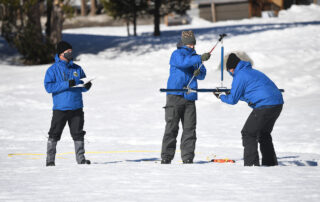
The Department of Water Resources conducted the second snow survey of the season at Phillips Station. Following a dry January, the manual survey recorded 48.5 inches of snow depth and a snow water equivalent of 19 inches, which is 109 percent of average for this location for this date. The snow water equivalent measures the amount of water contained in the snowpack and is a key component of DWR’s water supply forecast. Statewide, the snowpack is 92 percent of average for this date.

“We are definitely still in a drought. A completely dry January shows how quickly surpluses can disappear,” said DWR Director Karla Nemeth. “The variability of California weather proves that nothing is guaranteed and further emphasizes the need to conserve and continue preparing for a possible third dry year.”

Snowmelt during January has been minimal. However, with little to no accumulation of snow during January, snowpack levels are closer to average February 1 conditions, meaning that a return of winter storms in the Sierra Nevada is needed during February and March to remain at or above normal levels.

Regionally, the Southern Sierra snowpack is not faring as well as the Northern Sierra. Water supply forecasts for the south San Joaquin Valley are below average due to the lack of rain and snow in this region.

“These dry January conditions demonstrate the importance of continuing to improve our forecasting abilities and why these snow surveys are essential,” said Sean de Guzman, Manager of DWR’s Snow Surveys and Water Supply Forecasting Unit. “While we always hope for a generous snowpack, DWR’s ongoing investments in forecasting techniques will help the state better prepare for both drought and flood conditions.”

In light of last year’s poor runoff, DWR has increased its efforts to improve climate and runoff forecasting by strengthening its collaboration with partner agencies and academia and by investing in proven technologies to improve data collection and hydrologic modeling. One example is DWR’s investment in remote snowpack measurements through the Aerial Remote Sensing of Snow program by partnering with Airborne Snow Observatories, Inc. (ASO). Data from ASO has proven to be the most accurate assessment of snowpack conditions that, when coupled with newer, sophisticated runoff models, will improve runoff forecast accuracy.

Although early season storms helped alleviate some drought impacts, a lack of storms in January has underscored the need for Californians to continue focusing on conservation. Most of California’s reservoirs are still below average, and groundwater supplies are still recovering. California still has two months left of its typical wet season and will require more storms in those months to end the year at average.

DWR conducts four media-oriented snow surveys at Phillips Station each winter near the first of each month, January through April and, if necessary, one additional in May.

2022-02-02T13:07:34-08:00February 2nd, 2022|
Go to Top