Associations, Organizations, Educational and Research Institutions
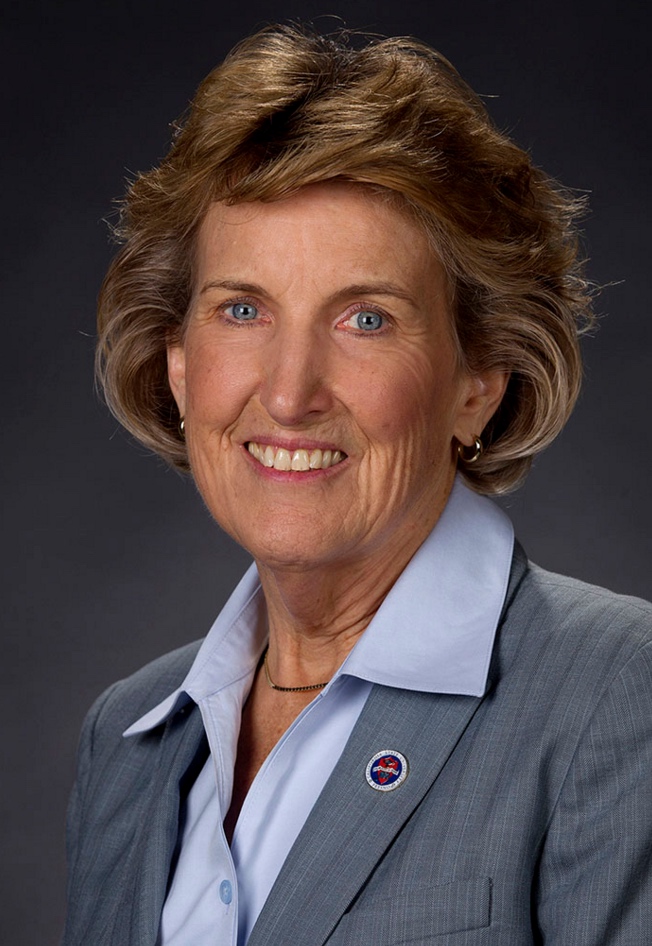
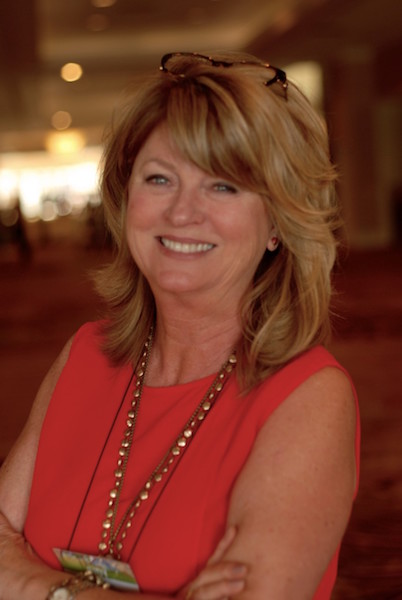
Sandra Witte, New Ag Dean at Fresno State

Dr. Sandra Witte Named Dean of Jordan College at Fresno State

(March 16, 2016) – Dr. Sandra Witte, who has been serving as interim dean of the Jordan College of Agricultural Sciences and Technology at Fresno State, has been appointed permanent dean, effectively immediately.

Dr. Lynnette Zelezny, provost and vice president for Academic Affairs, said Witte’s exceptional work as interim dean made her the best person for the position.

“We conducted a yearlong national search for a dean but did not find the right candidate for this important position,” said Zelezny. “In the meantime, it became clear to me, the faculty, staff and our strong partners in the agriculture community that Dr. Witte was the right candidate. I’m pleased she agreed to stay at Fresno State as permanent dean.”

Zelezny added: “This is a critical time for the Jordan College as we prepare for the opening of the Jordan Agricultural Research Center this spring and continue our laser-focus on crucial issues related to water and sustainability. I am confident Dr. Witte will lead the college to increasing national prominence.”real JCAST Logo

Witte has taken an unconventional route to the dean’s position, starting her career as a registered dietitian and serving as a professor and chair of the Department of Food Science and Nutrition, one of seven departments in the Jordan College.

“In the Jordan College, we often talk about offering programs from farm to fork and all the business in between,” said Witte. “While most people think of agriculture from the farm end, my connection is clearly on the fork end. I have always had an appreciation for traditional agriculture, and in my time at Fresno State, that has bloomed into a passion. After all, where is the food without the farmer?” she said.

Witte joins a growing number of women in agricultural leadership positions that traditionally have been held by males in universities, industry and commodity groups in the U.S.

The Jordan College maintains an enrollment of approximately 2,400 undergraduate and 100 graduate students from diverse backgrounds from throughout California, the U.S. and the world. Undergraduate, graduate and continuing education programs are offered in the major areas of agricultural business; animal sciences and agricultural education; child, family and consumer sciences; food science and nutrition; industrial technology; plant science; and viticulture and enology.

Faculty and students conduct applied research and public service in selected areas of agriculture, food sciences, industrial technology and family sciences. Students engage in learning science, technology and management in the classroom and by experience on the 1,000-acre on-campus University Agricultural Laboratory.

Witte has served as interim dean since October 2014. Previously, she jointly held the positions of associate dean of the Jordan College and dean of the Division of Graduate Studies. She joined the Fresno State faculty in 1992 and took her first administrative assignment in 2007.

She completed her bachelor’s degree in foods and nutrition at California State Polytechnic University, Pomona; master’s degree in home economics, nutrition and dietetics option at Fresno State; and her Ph.D. in food systems management at Oregon State University, Corvallis.

____________________________

Photo: Sandra Witte, dean of Agricultural Sciences and Technology at Fresno State (source: Fresno State

2016-05-31T19:24:10-07:00March 16th, 2016|

CA Farm Bureau Awards Ag Students

CA Farm Bureau Awards Young Farmers and Ranchers Program Students

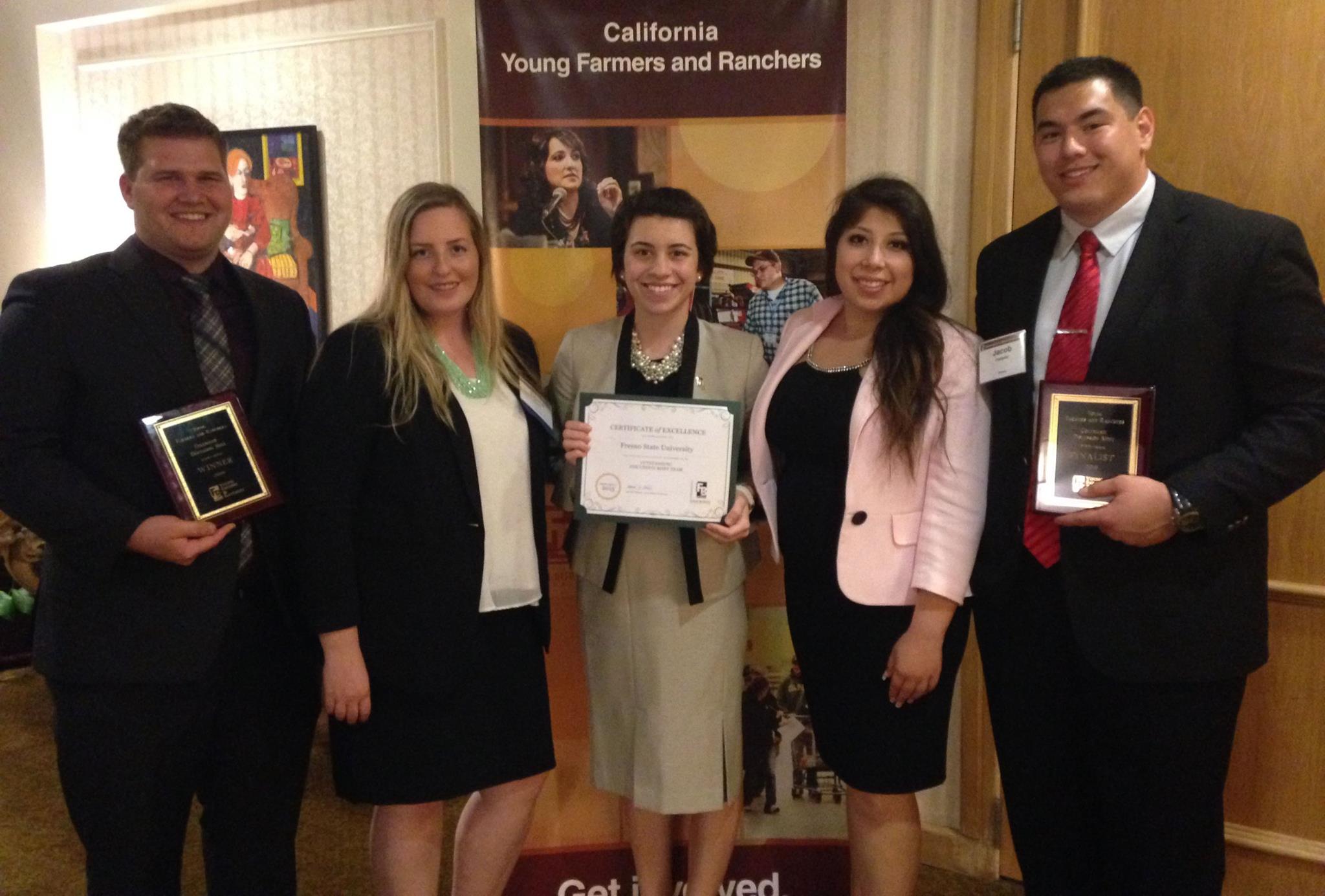
Service to community and Farm Bureau earned awards for participants in the California Young Farmers and Ranchers program, and a student from California State University, Fresno, won the state’s annual Collegiate Discussion Meet. The awards were presented at the Feb. 27 annual California Young Farmers and Ranchers Leadership Conference in San Luis Obispo.

For a second straight year, the San Joaquin Farm Bureau Young Farmers and Ranchers Committee earned the YF&R Committee of the Year Award, for its activities during 2015. The committee, composed of 45 active members, volunteered at numerous Farm Bureau and agricultural education events; donated food to local food banks and toys to children of military service members; presented three college scholarships; and raised money for the scholarship program and for the California Farm Bureau Federation Fund to Protect the Family Farm.

Napa County Farm Bureau member Johnnie White received the Star YF&R Award, which recognizes a young farmer or rancher for service to agriculture. White, a sixth-generation farmer, works as operations supervisor for a vineyard-management company and as a volunteer firefighter in St. Helena. He has been an active YF&R volunteer since 2006, serves as first vice chair of the State YF&R Committee and is a member of the 2016 Leadership Farm Bureau class.

California Farm Bureau Federation Young Farmers and Ranchers 2016 Conference logo

California Farm Bureau Federation Young Farmers and Ranchers 2016 Conference

Fresno State junior Hunter Berry (San Jacinto), an agricultural business major, won the Collegiate Discussion Meet, which simulates a committee meeting with active participation and positive group discussion. Berry began his agricultural training in high school classes and FFA activities. At Fresno State, he is pursuing an accounting concentration and hopes to obtain a master’s degree on his banking or financial analysis career path. Next February, Berry will become the sixth Fresno State student to represent California at the American Farm Bureau’s Collegiate Discussion Meet national competition.

Riley Nilsen (Nipomo), an agricultural science student at Cal Poly San Luis Obispo, was first runner-up in the competition. The other finalists were Fresno State senior agricultural business student Jacob Vazquez (Cottonwood) and Cal Poly student Haley Warner (Angels Camp). Berry earned a $1,250 prize sponsored by AgroLiquid; Nilsen earned $750 and the other finalists each earned $500.

Fresno State won the collegiate team competition, the fifth team and individual titles for the group under the direction of adviser Dr. Steven Rocca, Fresno State agricultural education professor. Other team titles came in 2014, 2013, 2008 and 2006. Berry said. “Dr. Rocca did a great job of mentoring us before and during the competition, as well as arranging for guest speakers beforehand such as Ryan Jacobsen from the Fresno County Farm Bureau. Having four of our team members make the semifinals was especially rewarding.

In addition to Berry and Vazquez, Fresno State’s team included agricultural education-communication senior Dominique Germann (Ceres), animal science-livestock business management junior Emma Briggs (Santa Rosa) and animal science-pre-veterinary senior Ana Lopez Campos (Tulare).

________________________________________________

American Farm Bureau’s Young Farmers and Ranchers program serves agriculturalists between the ages of 18 and 35 who are actively involved in production and affiliated professions.

The California Farm Bureau Federation works to protect family farms and ranches on behalf of more than 53,000 members statewide and as part of a nationwide network of more than 6.2 million Farm Bureau members.

________________________________________________

Sources: 

California Farm Bureau Federation

California State University, Fresno, Jordan College of Agricultural Sciences and Teçhnology (Geoffrey Thurner).

Photo: Collegiate Team Award Winners (2016); source: California State University, Fresno, Jordan College of Agricultural Sciences and Technology

2016-05-31T19:24:10-07:00March 14th, 2016|

National Days Celebrations at Fresno State Farm Market

Fresno State Farm Market Hosts National Day Events

By Charmayne Hefley, Associate Editor


Fresno State’s Rue and Gwen Gibson Farm Market hosted its Annual Pistachio Day on February 26 in honor of World Pistachio Day. Miles Robinson, a student market lead, said, “We’ve been working with American Pistachio Growers (APG) to market this campaign and give away pistachio samples, all courtesy of APG. We are also raffling a gift basket with several of our products and APG items as well.”12821589_10153999748978330_676533612082576193_n

Robinson said the Fresno State farm market plans to host monthly events to feature the store and student products, including that very fowl day, Poultry Day, on March 18, and National Raisin Day on April 29. “For Poultry Day,” Robinson said, “we’ll be sampling Foster Farms chicken in a couple of different recipes. We look forward to having people actually taste our chicken. We will also have a chicken dance contest. For National Raisin Day we’re partnering with the California Raisin Board to bring information, samples and have a fun time.”

Robinson said the student-run farm market, which specializes in student-made products, is in the process of creating new recipes for its coated nuts and raisins. “Over the past year, we’ve been slowly rolling out new recipes for our milk chocolate raisins, milk chocolate almonds, milk chocolate cabernet raisins and dark chocolate raisins,” Robinson said. “All of our products will have brand-new recipes, 100 percent Fresno State-done.”

2016-08-10T11:56:30-07:00March 11th, 2016|

Semios Approved for Navel Orangeworm Control

Semios Aerosol Pheromone Approved for Navel Orangeworm Control


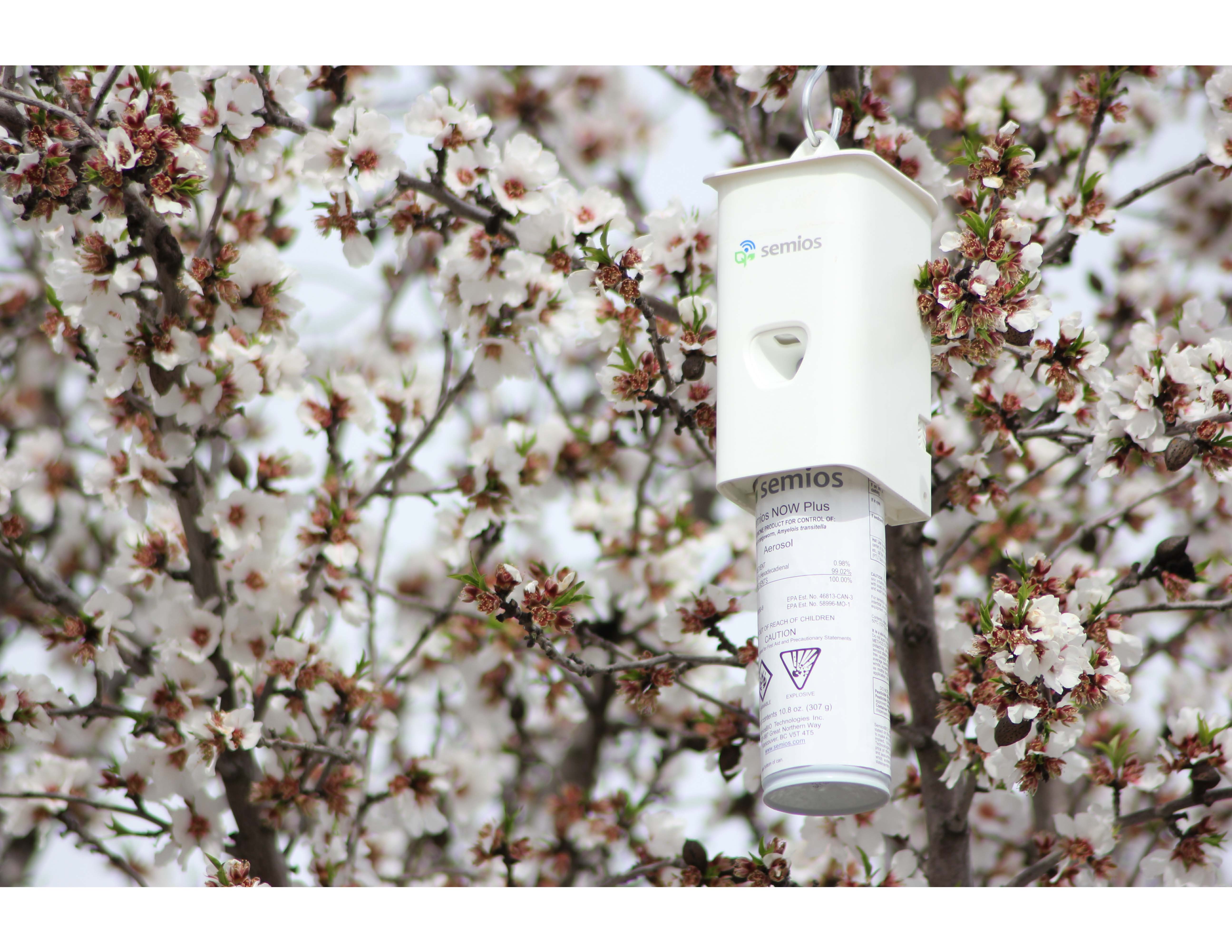
Announced TODAY, Semios, a leading provider of real-time agricultural information and precision pest management tools, has received US Environmental Protection Agency (EPA) approval and California Department of Pest Regulation (DPR) approval for aerosol pheromone biopesticide products that disrupt the mating of the Navel Orangeworm (NOW).  
Michael Gilbert, founder and CEO of Semios said, “The Navel Orangeworm pest causes significant loss of crop and revenue in the California almond and pistachio industries, and it’s getting worse every year.  The Semios NOW pheromone aerosol formulas give farmers the ability to reduce and control pest populations and, as a result, significantly reduce crop damage.  The Semios pheromone aerosol dispenser is part of a custom-designed controller and sensor network that gives farmers decision-making tools and remote access to the field conditions in real-time- all day, every day.”

Remote Control Makes it Highly Effective

The Semios platform includes in-field camera traps that monitor the number of pests and flight strength, which when combined with wind, temperature and other environmental conditions measured and reported by Semios, optimize pheromone deployment.  The combination of traps, pheromone dispensers and other sensors on the same network means farmers can deploy the right amount of pheromones where and when needed through a single interface.

A Destructive Pest for Many Crops

NOW is the most destructive pest of introduced nut crops. Semios NOW Plus and Semios NOW Standard (for organic growers) are available for control of NOW in orchards growing walnuts, pistachios, almonds, dates, figs, citrus, pome and stone fruits.


Sustainable Solution

Pheromones are a naturally occurring part of the communication systems used by insects.  Semios uses pheromones to disrupt the mating cycle of insects, thus diminishing pest populations and reducing crop damage.  Pheromones do not kill or damage the target insects and, as pheromones are species-specific and only target the specific pest, pollinators and other beneficial insect species are not affected.

_______________________________

About Semios

Semios is a leading precision farming platform that provides real-time information and pest management tools for the tree fruit, nut and grape growers.   Semios combines hardware with powerful secure online software that monitors field and weather conditions and allows remote pest monitoring and deployment of mating disruption pheromones. It’s easy to use, reduces labor and allows farmers to make decisions that preserve and increase crop value.
2021-05-12T11:03:03-07:00March 2nd, 2016|

Pistachios Trump Diabetes

Pistachios Trump Diabetes

By Brian German, Associate Editor

Just eating the right foods can benefit people diagnosed with pre-diabetes or with type 2 diabetes.  Recent research* suggests including pistachios as part of a balanced diet is a sound strategy to help lower the risk of developing type 2 diabetes. And the news could increase pistachio imports into China, where the disease is rampant.

Judy Hirigoyen, vice president of global marketing for the Fresno-based American Pistachio Growers organization that represents more than 800 growers in California, Arizona and New Mexico, noted pistachios have a good future in the global diabetes epidemic, especially in China. “Believe it or not,” she explained, “one-third of the entire world’s population of diabetics lives in China. Diabetes is associated, not with overweight or obesity, but with their diet. In particular, a lot of fingers are pointed at a lot of white rice,” she said.

“The good news for the pistachio industry,” said Hirigoyen, “is the Chinese population really loves American products, including pistachios. They’re looking for healthy foods to eat, and pistachios are very widely recommended, especially as part of a diet for someone who either has diabetes or who wants to prevent pre-diabetes from developing into diabetes.”

American Pistachio Growers Infographic - Pistachios and Diabetes

American Pistachio Growers Infographic – Pistachios and Diabetes

__________________________________

*A study, published in Diabetes Care, suggests that pistachios may have glucose- and insulin-lowering effects and promote a healthier metabolic profile in people with pre-diabetes. (Hernandez-Alonso, P., et al. Nutrition attributes and health effects of pistachio nuts. Br J Nutr. 2015 Apr;113 Suppl 2:S79-93.)

Another study, published in Nutrition, Metabolism and Cardiovascular Diseases, suggests that daily consumption of pistachios may shift the lipoprotein size and particle profile to a less atherogenic pattern in people with pre-diabetes. (Hernandez-Alonso, P., et al. Effect of pistachio consumption on plasma lipoprotein subclasses in pre-diabetic subjects. Nutr Metab Cardiovasc Dis. 2015 Apr;25(4):396-402.)

2021-05-12T11:05:58-07:00March 2nd, 2016|

Fresno State Students are Ag Ambassadors

Fresno State Students are Ag Ambassadors

By Charmayne Hefley, Associate Editor

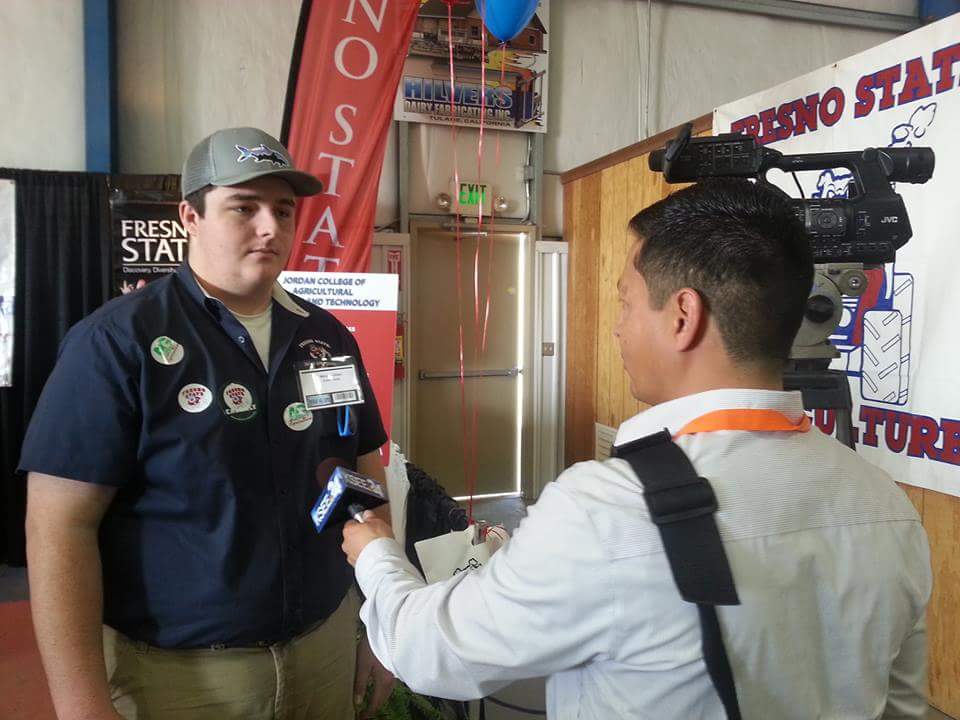
Students serving as Ag Ambassadors for the Fresno State Jordan College of Agricultural Sciences and Technology represented the school at the 2016 World Ag Expo. Steve Rocca, associate professor of agriculture education at California State University, Fresno said “It’s a group of about 80 student ag ambassadors who attend events and are really an extension of the outreach and recruitment efforts by our College.”

“There’s nothing better [for prospective students] than to learn about our college from actual students who are studying in our college and who know firsthand what Fresno State has to offer,” Rocca said. “Approximately 80 students has been the norm for the past several years. It’s a large group. They’re very enthusiastic and are great supporters of Fresno State. At events like the World Ag Expo, they talk to both prospective students and also to alumni, as a lot of loyal alums stop by and want to talk about Fresno State.”

In addition to the ambassador program, Rocca said Fresno State students can join the FFA State Conference Committee, which assists the California FFA Association in organizing the California FFA Field Days/State Finals Contests and State Conference in Fresno every April. “The California FFA State Conference is the largest annual conference in the city of Fresno,” Rocca said. “There are about 6,000 students as well as advisors who come to Fresno each year to develop their leadership skills, enhance their personal growth and compete in various career development activities. Our students at Fresno State assist directly with the events that take place during that convention.”

2016-05-31T19:24:11-07:00March 1st, 2016|

Falcons Work in Agriculture, Too

Farmers’ Other Best FriendFalconsWork in Agriculture, Too

By Charmayne Hefley, Associate Editor

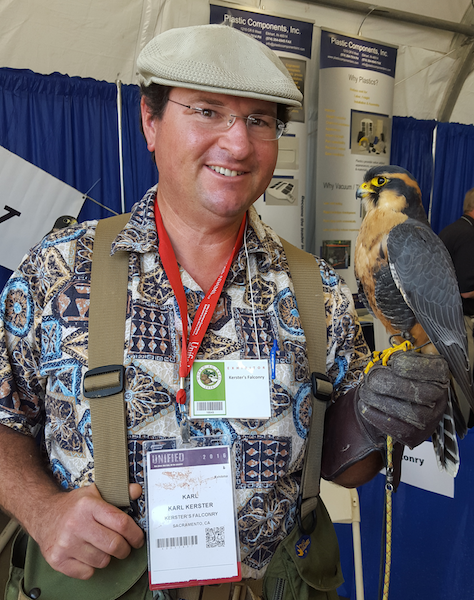
Charmayne Hefley, California Ag Today broadcaster and associate editor, and farmers’ other best friend – the falcon.

Agriculturalists have found ways to employ some animals to assist them in the fields. Karl Kerster, owner of Sacramento-based Kerster’s Falconry, employs farmers’ other best friend, falcons, to keep agricultural products safe before and during harvest. More specifically, Kerster’s five falcons perform bird abatement—removal of nuisance birdsto protect cherries, berries and grapes. Pest birds are defined as sparrows, swallows, finches, starlings, pigeons, blackbirds and more.

“We work to protect the farmer’s crop,” Kerster said, “and we really enjoy doing it—which is a plus when you’re having to do it for a hundred days straight to keep a crop safe. We start when the fruit starts to ripen enough that the birds are going to attack, until the crop has been substantially harvested. I work five birds, and I have several more in reserve, but the five that I work keep me very busy.”

Kerster, a master falconer, has been serving as a falconer since 1996, and his birds have a high success rate at keeping pest birds away from crops.“We are 99 percent successful in protecting a crop in most situations,” Kerster said. “We also take care of any other bird problems that may or may not be on the berries, cherries and grapes that we normally do. Any customer who wants us to dispose of a problem, we’re ready to help.”

______________________________________

Becoming a falconer is not an “overnight” achievement and is not for the meek. The first of the “up-front questions you need to be able to answer to yourself,” according to the California Hawking Club is, “Will you, can you, commit part of your waking hours to a creature who at the very best of times will merely tolerate your presence, is as affectionate as a stone, and at the worst of times will cause you heartache and puncture wounds? Can you commit to an average of a half-hour a day, every day, and two to four hours on a hunting day, regardless of school, family, or job – forever?

The eight steps required to become a falconer in the state of California are provided by the California Hawking Club.

Becoming a Master falconer, according to the North American Falconers Association, “takes at least seven years; finishing your apprenticeship alone will take at least two.”

______________________________________

Falconry is a heavily-regulated practice, governed by federal and state laws and regulations.  For more information, go to:

California Natural Resources Agency Department of Fish and Wildlife

California Hawking ClubCalifornia-Hawking-Club-logo

Kerster’s Falconry 

Electronic Code Of Federal Regulations

______________________________________

2021-05-12T11:03:03-07:00February 29th, 2016|

National Dairy Crisis Continues—Part 2

National Dairy Crisis—A Way Forward, Part 2

By Laurie Greene, Editor

In our continuing coverage of the national dairy crisis marked by high inventories and below-production costs-prices, industry proponents are considering ‘market responsive’ ways to help with inventories, such as donating to the Feeding America organization or to other food banks. Tom Van Nortwick, owner and publisher of Fresno-based Agribusiness Publications, which has published a dairy magazine for 35 years, has been closely involved with hundreds of dairy producers from 2009 through June 2014 in the organization and establishment of the National Dairy Producers Organization. This nationwide organization focuses on keeping dairies profitable especially when market conditions squash dairy pricing.

Van Nortwick, who believes donating excess milk would be relatively easy and painless for the dairy industry, commented, “We are not going to specially package it; it is going to be what it is and where it is. It is then their responsibility to deal with it after that. The milk has already been processed and stored, and it’s waiting to be sold.”

In picking up all these excess dairy products, food banks such as Feeding America would dramatically reduce inventories. Van Nortwick explained, “We have found in studying these inventory levels, that when inventory gets to a certain level, it starts to impact the value of what someone is willing to pay me—a dairy producer—for the milk that I am pulling out of our cow today. And so we are recommending to our dairy producers that it might take literally 15 cents to impact the price of milk today which is currently $5 under the price of production and $7-$10 away from profitability.”

“The idea,” he continued, “is to have producers put up 15 cents per hundredweight into a savings account, which, when needed, would buy up excess inventory on the finished product side—the milk, cheese, milk powder and butter markets. Producers would then donate the purchased product to churches, food banks and Feeding America.

Tom Van Nortwick further expounded, “What if you invest $1 and get a $10 return? What if you invested 15 cents and got a $10 return? Is that a great plan? That is a great plan. The ‘investment’ is actually buying up [excess] inventory from the inventory [of processors and manufacturers] so it is no longer there. Because all of that is tracked, everybody knows how much there is and where it is. So if you are watching the market, you know if you should be buying more cheese, or making more cheese, or more powder. GM doesn’t make more cars than the dealers can sell; otherwise GM shuts the plant down. Everybody screams and hollers, but guess what? They know if they are going to survive, they have got to back off and not make more cars until the dealers, the selling organizations, pick up the slack.”

Van Nortwick says the dairy industry needs to focus more on the milk after it leaves the farm, “It is vitally important that we in the dairy producers sector start paying attention to what is going on with the milk, and the products being manufactured from milk after it leaves the farm. We are doing a wonderful job in how we produce it, the care and keeping of the animals, the sustainability of the environment, the recycling of the waste material; all of that we do better than anybody else in the world.”

“Do we need to be ever watchful?” he asked. “We have a new program called, ‘Picture Perfect’ in the industry, especially agriculture. All of agriculture needs to be ‘Picture Perfect.’ Do you know why? ‘Because everyone has a camera. Everyone’s got their own video recorder and anything can be seen anytime and filmed anytime. And a picture taken can go viral tomorrow, or tonight—even while we are asleep. So, we have to be picture perfect. We already do that.

He implored, “I want to say to dairy producers across the country, ‘You win. You make the most. You make the best. But that is not what we need right now in order to be sustainable. We need you to pay attention to your milk and what happens with your milk after it leaves the farm.”

______________________________

Links:

National Dairy Producers Organization

Feeding America


2021-05-12T11:17:14-07:00February 25th, 2016|

PCA Training At UC Davis

UC Davis Offers Pathway to PCA Training

By Laurie Greene, Editor


Frank Zalom, distinguished professor of entomology, agricultural experiment station entomologist, and extension specialist at UC Davis, teaches a class for students that forms a pathway to becoming a Pest Control Advisor (PCA). “It is the only class that a lot of them had ever taken in entomology,” said Zalom, “so we try to structure it to give them a good, solid background in entomology. Then we lead them through all the different pest management options. We even bring in someone from the California Association of Pest Control Advisors (CAPCA) Pathway to PCA program for the very last lecture.”

Zalom, whose research interests include integrated pest management (IPM), tree crops, small fruits and vegetable crop entomology, wants to provide a valuable education to his students. “Most of the kids taking my classes are interested in taking the PCA exams and there is a huge opportunity for those students out in the future.”

“We teach them about integrated pest management (IPM) and the pests,” Zalom noted. “Then we show them some of the many career opportunities for PCAs,”  he said, adding. “There will always be a big need for professional PCAs to help protect our crops from pests and diseases. They assist growers all over the state.”

________________________

Links:

California Association of Pest Control Advisors (CAPCA)

CAPCA Pathway to PCA

2021-05-12T11:03:03-07:00February 24th, 2016|

LA Included in Water Priorities Act

CaWater4All-Proposed Water Priorities Act Includes Los Angeles

By Patrick Cavanaugh, Deputy Editor

The Water Priorities Constitutional Amendment and Bond Act is good for all of California—people, farms and the environment. Should the required 565,880 petition signatures necessary for inclusion on the November 2016 ballot be collected by the April 26, 2016 deadline, and should the Water Priorities Act receive a majority of affirmative votes in November, it will provide big benefits to cities such as Los Angeles.

“The availability of regional water projects is massive for our urban centers,” stated Aubrey Bettencourt, executive director of the California Water Alliance, the ballot initiative’s sponsor. “The ability for urban centers to create water in their own regions and become less dependent on other parts of the water system, actually helps the other regions in the system as well.”
CaliforniaWater4All

The proposed water priorities act creates flexibility all around. Bettencourt explained, “Consider that the Los Angeles (LA) River loses as much water in an average storm event as the water supply for 180,000 homes annually—in one storm! In an average normal water year, Los Angeles loses the equivalent of the Shasta Reservoir in stormwater runoff, and they are under state and federal mandates to capture that water, recycle it and put it back in their water supply. This helps clean up their beaches and ocean water, which would otherwise end up with a lot of pollution through runoff,” she said.

“This ballot measure would increase their regional water supply by capturing and injecting stormwater runoff back into their groundwater supply. That would providing flexibility and reliability to the water supply for Southern California, but also affordability, which is such a key part of this effort,” Bettencourt noted.

“And Governor Brown just extended the drought cut mandates through the end of October of this year, and a lot of communities are conserving and conserving,” she said.”They are conserving so much that they using less; and, now they have to pay more because they are using less. So they are using less water, paying more for it, and still being punished. And that should not have to happen if we have a system big enough to supply all of our diverse water needs: agricultural, urban and environmental.”

Bettencourt noted, “The system hasn’t been updated since the late ’60’s-early ’70’s, in terms of some of our large-scale infrastructure. And you have to remember, our population was half the size it is today, and we didn’t have the same type of demand on that system that we do today,” she emphasized.

“Currently, we allocate 50% of our surface water to environmental protection. That is not wrong; but what is wrong is that we didn’t expand the system enough to take care of that allocation and our people. That is what this water ballot initiative is aiming to provide:  to increase our infrastructure to meet the demands of the 21st century,” said Bettencourt.

_____________________________

Links:

California Water Alliance Initiative Fund

California Water Alliance

2016-05-31T19:24:12-07:00February 18th, 2016|
Go to Top