Associations, Organizations, Educational and Research Institutions
DPR Has Big Funding for Pest Managment Program

The Department of Pesticide Regulation’s (DPR’s) 2020 Pest Management Research Grant solicitation is now available

See the Grant here: http://www.cdpr.ca.gov/docs/pestmgt/grants/research/index.htm

This year, the Pest Management Research Grant Program will allocate:

1-   $2,100,000 to fund projects that identify, develop, and implement safer, practical, and sustainable pest management alternatives to Chlorpyrifos. DPR will consider proposals requesting $150,000 to $500,000.

2-   $500,000 to fund projects that develop methods or practices to reduce risks associated with pesticides of high regulatory concern and/or are considered to high-risk and which can be incorporated into an IPM system. DPR will consider proposals requesting $50,000 to $500,000.

Concept proposals must be submitted by 5:00 PM PST on Monday, October 7, 2019.

Concept application must be downloaded from DPR’s Research Grants webpage, here:

https://www.cdpr.ca.gov/docs/pestmgt/grants/research/solicitation.htm 

A Proposal Package will be provided to applicants invited to submit full proposals.

Completed Concept and full Proposal applications must be submitted to the following email address: dprpmgrants@cdpr.ca.gov

If you know groups or individuals who may be interested in applying for a Pest Management Research Grant, we encourage you to pass on this information. 

 For additional information on the Pest Management Research Grant Program, please visit http://www.cdpr.ca.gov/docs/pestmgt/grants/research/index.htm

If you have any questions, please contact Atefeh Nik at 916-445-2509 or Atefeh.nik@cdpr.ca.gov or John Gerlach at 916-445-3909 or John.Gerlach@cdpr.ca.gov.
2019-09-15T19:07:11-07:00September 18th, 2019|

Fight Against SB1

Contact your Assemblymember and State Senator today to ask them to oppose SB 1 (Atkins).  Despite amendments taken last night, SB 1 still threatens the water supply of our agricultural communities.

Amendments to SB 1 were made on September 10thto remove the language redefining “waste” and “waters of the state” in the Water Code and the requirement that the state adopt old federal Biological Opinion standards for species that are listed under the provisions of SB 1.

However, SB 1 attempts to apply the California Endangered Species Act to the federal operations of the Central Valley Project so that they can justify smaller water deliveries to farming and ranching communities.  California does not have the authority to mandate an action by the federal government.  Including this provision will likely lead to a collapse of negotiations to implement the Voluntary Settlement Agreements (VSA) which would ensure science and reason are part of the water management in this state.  This would leave the draconian unimpaired flow standards proposed by the State Water Board in place – a potential reduction of 40-60% of our annual water deliveries.

Act now to ask that SB 1 be voted down or made a 2-year bill. Contact here:  Fix SB 1 – Urgent Update!

2019-09-15T19:07:48-07:00September 16th, 2019|

Congressman Harder: Veto SB1

Harder, California Members of Congress Statement on Planned Veto of SB1

WASHINGTON – Representative Josh Harder (CA-10), alongside Senator Dianne Feinstein (D-CA) and Representatives Jim Costa (CA-16), John Garamendi (CA-03), and TJ Cox, (CA-21) released the following statement in advance of Governor Gavin Newsom’s veto of SB1. 

Josh Harder

Congressman Harder

 “While we support the objectives of SB1 – to protect clean air, drinking water, and our environment – the bill as written would jeopardize those very goals. It is critical that all Californians, especially those in our disadvantaged communities, have a reliable supply of clean, fresh drinking water, in addition to water for our environment and essential agriculture industry. We applaud the Governor’s leadership in vetoing this bill, and his efforts to solve California’s difficult water challenges with solutions that meet the needs of the 21st century.

“Working together with all water users provides the best hope for avoiding endless litigation on the management of California’s water supply. We know this through experience. Continuing the collaborative process put in motion by the Governor can result in improved habitats and protect fish and wildlife species, while also ensuring improved water supply reliability for our communities and family farms across California.”


2019-09-15T19:05:40-07:00September 16th, 2019|

Action Needed to Amend SB1

Urge your Representatives to AMEND SB 1

From California Citrus Mutual

This week the Assembly will consider Senate Bill 1 by Senate Pro Tem Toni Atkins.

SB 1 proposes dangerous changes to how the state implements the Endangered Species Act (ESA) and will have devastating impacts on how water is managed in California.

The bill seeks to preserve environmental regulations against perceived rollbacks by the Trump Administration by empowering state agencies to immediately adopt the “baseline” standard in place before January 19, 2017 (the day before President Trump was inaugurated).

As currently written, SB 1 would lock in the existing biological opinions that determine how much water must flow out of the Delta to protect native fish species. This directly influences how much water is available to ALL water users south of the Delta.

The State and Federal agencies are currently in the process of updating the biological opinions, which will result in lower flows and more water for communities and agriculture. But, by locking in the existing biological opinions, SB 1 prohibits State from using the best available science to manage how water moves through the Delta.

Recent amendments do not go far enough to address the ESA provisions.

California Citrus Mutual and many other agricultural and business-sector groups have proposed constructive amendments to address these concerns.  The Pro Tem’s office, however, did not make substantive changes to the bill before it was passed out of the Assembly Appropriations Committee on Friday despite pressure from the Governor’s Office.

The Legislature will adjourn next Friday and it is imperative that SB 1 be amended THIS WEEK.

We are calling on our Assembly Members and Senators to urge the Senate Pro Tem to accept amendments to the ESA section.

Please click on the link below to send a letter to your representatives asking them to support amendments to the ESA section in SB 1.

California Citrus Mutual Action Center

2021-05-12T11:05:02-07:00September 4th, 2019|

Calif. Ag Leaders Chosen for 50th Class

CA Ag Leadership Considered the Premier Leadership Program in U.S.

Twenty-four individuals have been selected for Class 50 of the California Agricultural Leadership Program, an advanced leadership development experience for emerging agricultural leaders. The new fellows will be inaugurated into the program on Oct. 10 at the Clovis Veterans Memorial District. The program, which inaugurated its first class in 1970, will celebrate its 50th anniversary in Monterey in October 2020.

Through dynamic seminars during an intensive 17-month program, fellows will study leadership theory, effective communication, motivation, critical and strategic thinking, change management, emotional intelligence and complex social and cultural issues. Seminars are delivered by four partner universities: Cal Poly Pomona, Cal Poly San Luis Obispo, Fresno State and UC Davis. Fellows will participate in 55 seminar days, including an eight-day national travel seminar and a 15-day international travel seminar.

“After an application and alumni-assisted interview process that witnessed a record number of applicants, we are very pleased to announce the 24 individuals making up Class 50,” said Barry Bedwell, president of the California Agricultural Leadership Foundation (CALF). “This distinguished group, made up of 12 women and 12 men, will begin their 17-month formal leadership program shortly, but more importantly, this is the start of a lifelong leadership process that will not only make them better leaders but benefit California agriculture as well.”

CALF invests approximately $55,000 per fellow to participate in the program, which is underwritten by individual and industry donations. Ag Leadership is considered to be one of the premier leadership programs in the United States. Since it was first delivered in 1970, more than 1,300 men and women have participated in the program and have become influential leaders and active volunteers in the agriculture industry and other areas.

Class 50 Fellows:

Celeste Alonzo, Junior Enterprises LLC, Coachella

Leeann Bettencourt, Bonipak Produce, Santa Maria

Tyler Blackney, Wine Institute, Sacramento

Adrian Calixtro, Wonderful Orchards, Selma

Yezmin Carrasco Valle, Reiter Affiliated Companies, Oxnard

Mitch Coit, Marv Coit Inc., Firebaugh

Kris Costa, California Milk Advisory Board, Turlock

Natasha Crivelli, Chris and Natasha Crivelli Farms, Dos Palos

Rocco Cunningham, R.O. Shelling & Barlas Feeds, Petaluma

Brian Gill, Gill Cattle/Nielsen Insurance, Exeter

Erin Gorter, Cal Poly San Luis Obispo, Templeton

Megan Grima, Stephens Ranch Inc., Yuba City

Ted Kingsley, Vann Bros., Williams

Lindsey Liebig, Sacramento County Farm Bureau, Galt

Holly Little, Acadian Seaplants, Walnut Grove

Julian Lopez, Imperial County, Imperial

Megan Marques, California Farm Bureau Federation, San Luis Obispo

Jonathan Merrill, Merrill Farms LLC, Salinas

Michael Newton, Newton Farms, Stratford

Erin O’Donnell, The Sun Valley Rice Company, LLC, Arbuckle

Brian O’Neill, Huron Orchard Services, Fresno

Matt Peyret, First Northern Bank, Woodland

Priscilla Rodriguez, Western Ag Processors Association, Fresno

Trevor Tagg, West-Gro Farms Inc., El Centro

2019-09-04T08:02:20-07:00September 4th, 2019|

California Oak Trees Harbor Insect-Eating Bats

Oak Trees in Vineyards a ‘Win-Win’ For Bats and Growers

By Pam Kan-Rice  UC ANR Assistant Director, News and Information Outreach

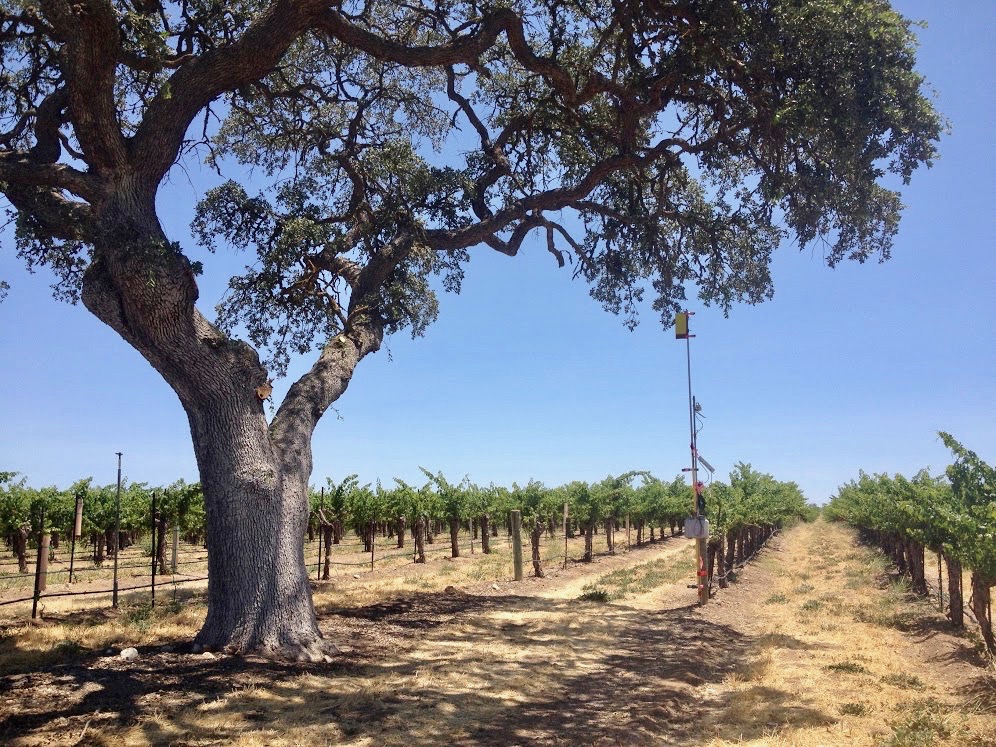
Californians love their oak trees. During vineyard development, Central Coast grape growers often feel compelled to leave an old iconic oak standing, even if it ends up right in the middle of their vineyard. While driving through the Central Coast, it’s not unusual to see the pattern of vineyard rows broken by a majestic oak tree. Aside from their beauty, what are some of the ecosystem services that these majestic trees provide?

To find answers, a UC Cooperative Extension scientist in San Luis Obispo County collaborated with a U.S. Forest Service scientist to study how bats use blue oak and valley oak trees in vineyards. UC Cooperative Extension specialist Bill Tietje, a co-author of the study, says they focused on bats that eat insects because bat populations have declined dramatically in some areas due to habitat loss and disease. “And bats don’t hurt grapes. As a matter of fact, thanks to the huge number of bugs they consume, bats could be very good for a vineyard.”

To understand the potential value of remnant oak trees for insectivorous bats, the researchers placed microphones to detect bat calls within 14 Central Coast vineyards. The recordings revealed 11 species of insectivorous bats foraged within the vineyards. Bat foraging activity was 1.5 times greater at the trees compared to open, tree-less areas within the vineyard. And the bigger the tree, the bigger the number of bats it attracted.

“The study results suggest that the large oak tree in my vineyard not only increases the beauty and biodiversity of the agricultural landscape, but also attracts insect-eating bats that can provide natural pest control—a win-win,” said grape grower Jerry Reaugh, who cooperated with the researchers.

In fact, the trees more than doubled the number of insectivorous bats called woodland-adapted bats within the vineyards. The study indicates that the oak trees attracted woodland-adapted bats that would normally be absent from vineyards.

Tietje hopes that the free insect-reduction services provided by bats will increase grape growers’ incentive to manage and maintain the trees, and even to plant new oak trees in suitable areas around their vineyard, in mutual benefit to both agriculture and biodiversity.

“In addition to their value for insectivorous bats, remnant trees maintain bird and insect diversity by providing food, habitat, cover and stepping stones that facilitate the movement of wildlife within agricultural landscapes,” said Tietje.

This study comes at a time when declining blue oak and valley oak populations are of great concern.

“We hope the study will increase awareness of these beautiful and beneficial trees and make the case for conservation and restoration,” Tietje said. “Preserving and enhancing biodiversity in the midst of climate change is key to ensuring resilience in our landscapes and communities.”

The study by University of Washington graduate student Anne Polyakov, Theodore Weller of USDA Forest Service and Tietje is published in the September 2019 edition of Agriculture, Ecosystems and Environment.


2021-05-12T11:05:02-07:00September 2nd, 2019|

SB1 Advances in Sacramento

SB1 Advances to California Assembly

The California Water Alliance announced today California Senate Bill 1, or SB1, by Senator Toni Atkins (D-San Diego), advanced from the California Assembly Appropriations Committee. SB 1 will now be considered on the California Assembly floor before the Legislature adjourns on September 13th.

Assemblyman Frank Bigelow (R-O’Neals), Vice-Chair of the Assembly Appropriations Committee, shared with the California Water Alliance, “I am disappointed that SB1 was released off suspense file with amendments that make it much worse for farming and California as a whole.”

SB1 effectively declares that California would adhere to laws governing clean air, water, endangered species and labor that were in place in January 2017, before the beginning of the Trump Administration.

“SB 1 is bad for farmworkers, farmers, and communities throughout the state of California,” said William Bourdeau, Chairman of the California Water Alliance. “Our environmental laws and regulations should be defined by current, sound science, not petty politics.”

SB1 would freeze the existing federal biological opinions. Future permits would be subject to outdated science and ineffective federal baseline measures, thus permanently, constraining the coordinated operations of the Central Valley Project and the ç.

Action Needed

The California Water Alliance has led effort to demand that the California Legislature “Fix or Nix SB1”: https://californiawateralliance.org/fix-it-or-nix-it/. The California Water Alliance is a non-profit, non-partisan organization that advocates for an increase in water supply for municipal, agricultural and environmental needs: https://californiawateralliance.org/.

2019-08-30T18:16:06-07:00August 30th, 2019|

UCR’s Dr. Charles Coggins Memorial Service Sept. 7 2:00 pm

Coggins Served As Long Time Citrus Plant Pathologist

The family of Dr. Charlie Coggins would like to welcome all citrus industry friends to attend his memorial service at First Baptist Church 51 West Olive Avenue Redlands, California 92393

Charles W. Coggins, Jr. passed away on Aug 18, 2019 at the age of 88. Coggins served as Chairman of the Board of Directors for the California Citrus Quality Council from November 1992 to January 2008. In 2003, he was presented with CCQC’s highest honor, the Albert G. Salter Memorial award which recognizes an individual who has made outstanding contributions to and achievements in the citrus industry.

Charles Coggin

Coggins was an industry pioneer who recognized the potential advances with plant growth regulators (PGRs), beginning with gibberellic acid (GA) and continuing with programs to retain 2,4-D. It was said that his research on PGRs has been described as the single most economically beneficial research result of the last century. He authored more than 100 technical publications and nearly 50 semi-technical publications that have proved to be invaluable tools for citrus growers worldwide. He was the recipient of numerous awards for his leadership, agricultural excellence and research accomplishments.

Coggins, Professor Emeritus of Plant Physiology, officially retired from the University of California Riverside in 1994. During his 37 years at the University, he served as Chairman of the UC Riverside Department of Plant Sciences and helped create the Department of Botany and Plant Sciences. He also served 15 years as Executive Secretary/Treasurer for the International Society of Citriculture. To help succeeding generations of researchers, Coggins created The Coggins Endowed Scholarship Fund at UCR to provide financial assistance for graduate students in the College of Natural and Agricultural Sciences who demonstrate academic excellence, quality research and benefit to the citrus industry.

Charles Coggins inspecting citrus earlier in his career at UCR

He was born November 17, 1930 in North Carolina. He was proceeded in death by two sons from cystic fibrosis. He is survived by his wife Irene of 68 years, a son and four grandchildren. A memorial service is pending. In lieu of flowers, contributions can be made to support his scholarship at UCR in honor of him, to the Parkinson’s disease foundation or cystic fibrosis charities. Cards can be sent to 819 Alden Road, Redlands, CA 92373.

2019-08-23T22:35:10-07:00August 26th, 2019|

ASTA Fills Big Void

ASTA Counteracted Free Seed Giveaway by USDA

By Patrick Cavanaugh, Editor

The American Seed Trade Association is one of the oldest trade associations in the United States. We spoke with Jane DeMarchi, Vice President of government and regulatory affairs with the American Seed Trade Association (ASTA).

“We were founded in 1883, and we represent all different kinds of seeds. So amongst our 700 members, we have row crops, vegetables, grasses and forages, and also conservation seed,” DeMarchi said.

And the seed trade association was created out of necessity when those in the seed sales industry were upset that the USDA was giving away free seed.

“Regionally in its history, USDA used to give away seed. And so there was a feeling amongst businesses that were selling seed that is was not appropriate for the government actually to be giving away seeds. So I think that it was the impetus for founding the association way back in the day,” said DeMarchi. “But now we deal with a wide range of issues that are related to the seed industry. We have such a diverse group of members, so within each of those different crops, there are different issues. And then there are some overarching things that we’re working on as an association.

California is a hotbed for the seed industry concentrated in the Salinas Valley. ASTA has several companies that have operations there within the tomato, broccoli, onion, and carrots. “These are some massive seed industry players that are working in California to support the California industry,” said DeMarchi.

And one of the things that are so interesting also about the vegetable seed production that goes on in California is that the U.S. is both the most significant market and the biggest exporter seed. “And some of those seeds might take a path of moving between several countries before they are commercialized. And then they may be processed in California and then shipped out to Mexico and Canada or other places to be grown for their agriculture sector,” DeMarchi said.

2019-08-20T07:17:29-07:00August 19th, 2019|

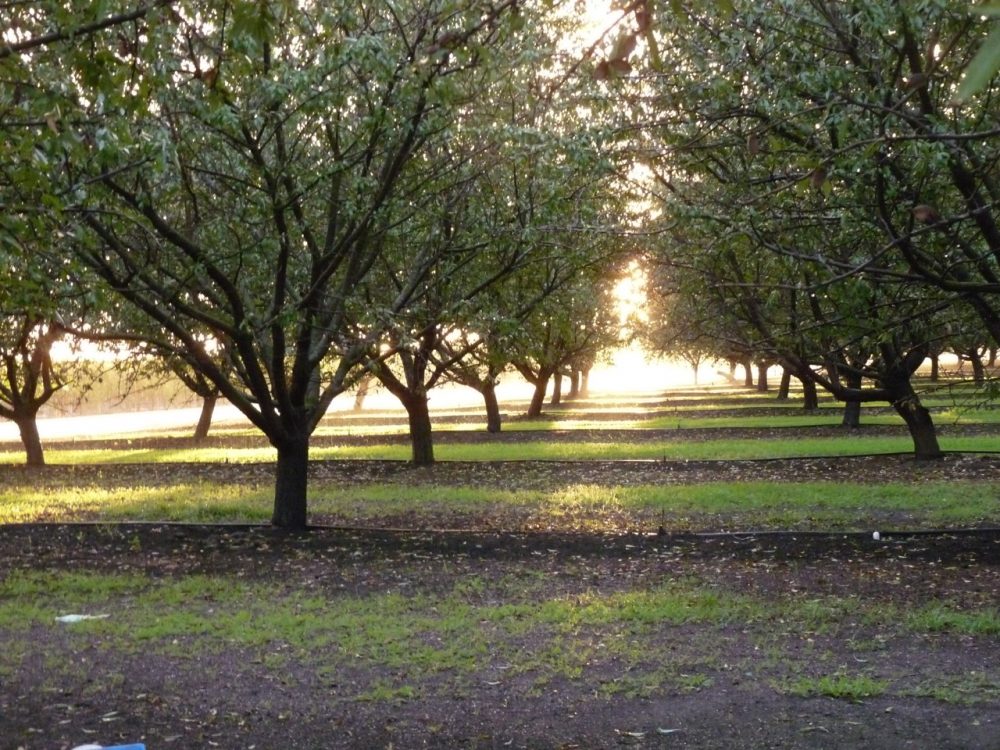
Almond Harvest Underway

A Whole Lot of Almond Shaking is Going On Throughout California

By Patrick Cavanaugh, Editor

It’s a busy time of year for the almond industry as harvest is going strong. It starts in Kern county and moves all the way north or Chico. It will take nearly two months to get across 1.4 million acres, and it’s going to be about a 2.2 billion pound crop, which is down 3.5% from 2018 where the production was about 2.28 billion pounds. It was less than ideal weather conditions in the spring, which caused us dip in production.

However California remains the best place in the world to grow almonds. It’s all about the Mediterranean climate in California— long hot summers with the rain and cold in the winter, ideal for almond trees.

Navel Orangeworm is a critical pest in almonds, pistachios and in a lesser way for walnuts. And they continue to be a significant pest during  almond harvest season as the adult moths can lay eggs, which can pupate later in almonds turning them off-grade. Once shaking is done and the almonds are picked up out of the field, it’s important to get that crop out of the orchard as soon as possible to minimize navel orange worm infestation.

Almonds are the first tree nut to be harvested. Later on, pistachios will start, following that we’ll be walnuts.


2019-08-08T10:54:00-07:00August 7th, 2019|
Go to Top