About California Ag Today

This author has not yet filled in any details.
So far California Ag Today has created 2014 blog entries.

Chew on This Tour

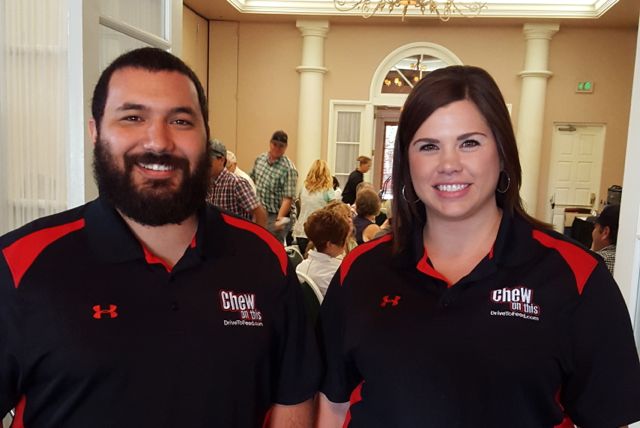
Kyle Olguin and Sarah Weber on Chew On This Tour


By Charmayne Hefley, Associate Editor

To counter the abounding misconceptions surrounding agriculture, companies are fighting back through education. Kyle Olguin, assistant operations manager for Nutra Blend LLC, a company that specializes in manufacturing nutrients for the feed industry, said that Nutra Blend began a program called “Chew On This Tour” to educate consumers about common farming misconceptions.

For the tour, Olguin said, “we drive trucks around the country, trucks turned into movie theatres, and educate people on where their food comes from, the misconceptions about farming, what we [farmers] do in America, and how we have one of the safest food supplies in the world.”

Olguin said that the perception of agriculture among the masses is that Ag is unnecessary because of the existence of grocery stores.

“We are constantly being attacked by non-ag promoting groups that agriculture is bad,” Olguin said, “and now the perception is out there that agriculture doesn’t really provide anything good or that agriculture doesn’t really need to exist. We have grocery stores, and the general public does not understand the link between agriculture and farmers and those grocery stores.”

“So we decided to start a campaign, and we kicked it off in Oregon driving this truck around the U.S. and showing people one simple video.” Olguin said, “We ask people questions, like: How many eggs does a chicken lay? How many pounds of bacon do you get from one cow?”

Sarah Weber, a sales representative for Nutra Blend, said the next step for the program was to raise money for backpack programs linked with food banks.

“The second movement is ‘Drive to Feed Kids’,” Weber said, “a nonprofit program with our suppliers and vendors to work with our customers, in their own communities, to raise money for student backpack programs that are linked in with the food banks.”

Weber said, “Our third stage in this movement is the ‘Ivy League Farmer’,” Weber said, “which is a movie that has been produced and will air on network TV pending this fall. It is a reflection on a dairy farm and the positive influence the farm has on the community. It is a way for us to reach out to the public with an emotionally positive connection to educate them.”

 

2016-05-31T19:28:06-07:00August 24th, 2015|

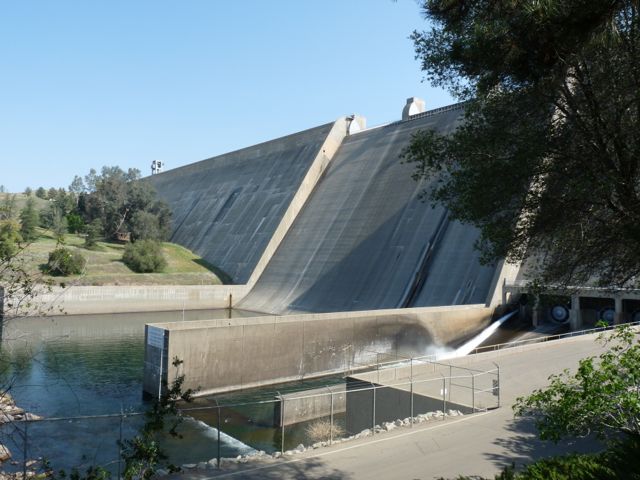
Trinity Reservoir Releases Water

U.S. Bureau of Reclamation Releases Shared Water From Trinity Reservoir Despite Making Claims Of “California’s Historic Drought”

The San Luis & Delta-Mendota Water Authority (Authority) along with Westlands Water District, according to their press release, has filed a lawsuit in federal court to stop the Bureau of Reclamation (Reclamation) from releasing Central Valley Project (CVP) water from the Trinity Division to the Klamath River.
The U.S. Bureau of Reclamation said releases started Friday from Lewiston Dam on the Trinity River, the Klamath’s primary tributary, and would continue into late September.SLDMWA logo
Yesterday, Reclamation announced the release of up to 88,000 acre-feet of CVP water from Trinity Reservoir in the hope of aiding returning non-listed Chinook salmon with the optimism of diminishing the effect of a naturally-occurring disease endemic known as “Ich” (pronounced “ick”) to the Klamath River system to which the Trinity River is connected. This action, which is outside of Reclamation’s authorized place of use, is a repeat of a similar action taken last year with the intention to help avoid an outbreak which has only been documented to have occurred once in 2002. Since 2000, a significant supply of water has been set aside each year from the Trinity Reservoir for fishery protection purposes. Specifically, over the past four years, this has equated to more than 200,000 acre-feet of water lost that was literally flushed down the Lower Klamath River.
“As our state is faced with a water supply crisis affecting every sector of people, businesses, and communities, an action like this is unthinkable. This will cause irreparable damage to drought-stricken communities already facing water restrictions,” said Dan Nelson, executive director of the San Luis & Delta-Mendota Water Authority.
The CVP and State Water Project (SWP) provide water for more than 25 million Californians who depend upon a reliable water supply. In the 50-year history of the Projects, water deliveries have never been lower–the CVP is experiencing its second year of a zero water allocation and the SWP sits at a mere 20 percent water allocation.
Reclamation is once again choosing to ignore the harms of its actions through the issuance of a “Finding of No Significant Environmental Impact” (FONSI) that hasn’t been properly analyzed. Further, Reclamation’s decision to release 88,000 acre-feet of CVP water for the Klamath River is a sad irony given that Reclamation is currently unable to meet its legally-mandated obligations within the CVP and SWP.
 Westlands Water District_logo
“The hardworking people of the State of California have been directed by state and federal agencies to conserve water in the form of dying lawns, fewer showers, unplanted fields, trees uprooted or turning brown, and community wells drying up. Yet Reclamation, which has been unable to deliver any water to farmers, has decided to release tens of thousands of acre feet in an arbitrary manner that the courts have previously held to be unlawful.” said Tom Birmingham, general manager of the Westlands Water District. “The fact that 88,000 acre-feet can be casually released without regard to the potential impacts on the environment, including at risk-species in the Sacramento River and the Delta, is a gross mismanagement of the state’s water supplies. The action filed today is intended to compel Reclamation to comply with its mandatory duties,” said Birmingham.
“During a time when we are experiencing the worst water management challenges in decades, when communities and agriculture throughout the state are suffering severe impacts that have negatively affected our economy, the labor force and the environment, the decision by the Bureau of Reclamation to repurpose precious Central Valley Project water resources to augment Klamath flows for non-endangered fish, an action that is of questionable benefit, is both irresponsible and incomprehensible. While the needs of cities, family farms, and endangered species that rely on CVP resources continue to go unmet, the reallocation of the Project’s limited supply of water defies all logic,” said Jeff Sutton, general manager of the Tehama-Colusa Canal Authority, an organization that represents seventeen Sacramento Valley water districts that hold CVP water service contracts, that are also highly critical of the action being undertaken by the Bureau of Reclamation.
The water planned for release is enough to farm 31,000 acres of food, or to serve the domestic needs of more than 175,000 families for an entire year. The devastating effects of the drought will be felt for decades to come especially if arbitrary decisions like these continue.
2016-05-31T19:28:06-07:00August 21st, 2015|

New Medfly Quarantine

A portion of San Diego County was placed under Medfly quarantine earlier this week following the detection of 4 adult Mediterranean fruit flies (Medflies) in the La Mesa area.  The United States Department of Agriculture (USDA), the San Diego County Agricultural Commissioner, and CDFA are working collaboratively on this project.

The quarantine area in San Diego County measures 93 square miles, bordered on the north by Prospect Avenue; on the south by Mount Miguel Road; on the west by Fairmount Avenue; and on the east by Vista Grande Road.  A link to the quarantine map may be found here: www.cdfa.ca.gov/plant/medfly/regulation.html.

To eradicate the infestation, the release of sterile male Medflies began on August 10, at a rate of 250,000 flies per square mile per week.  The new release area is approximately 59 square miles.  In addition, properties within 200 meters of detections are being treated with an organic formulation of Spinosad, which originates from naturally-occurring bacteria in soil, in order to eliminate any mated females and reduce the density of the population. Finally, fruit removal will occur within 100 meters of detection properties in order to remove any fruit infested with eggs and larvae.

The quarantine will affect any growers, wholesalers, and retailers of susceptible fruit in the area as well as local residents. Home gardeners are urged to consume homegrown produce on site and not move it from their property.  These actions protect against the artificial spread of the infestation to nearby regions where it could affect California’s food supply and our backyard gardens and landscapes.

In the eradication program,  sterile male Medflies are brought to San Diego County from the joint CDFA/USDA sterile insect rearing facility in Los Alamitos, which prepares sterile files for release everyday over the Los Angeles basin.  The sterile release program has a proven track record of eradication in southern California.  Sterile male flies mate with fertile female flies in the environment but produce no offspring.  The Medfly population decreases as the wild flies reach the end of their natural life span with no offspring to replace them, ultimately resulting in the eradication of the pest.

The Medfly can infest more than 250 types of fruits and vegetables, causing severe impacts on California agricultural exports and backyard gardens alike.  Residents who believe their fruits and vegetables are infested with fruit fly larvae are encouraged to call the state’s toll-free Pest Hotline at 1-800-491-1899.

2016-05-31T19:28:06-07:00August 21st, 2015|

A Thought on Sustainability

Scott Steinmaus on Getting the Sustainability Message Out

By Charmayne Hefley, Producer and Associate Broadcaster

When considering the longevity of a farmer’s land, the question of the sustainability of modern day farming practices is often raised. Scott Steinmaus, professor and department head of the Horticulture and Crop Science Department at Cal Poly San Luis Obispo, said that it is important to get the message out to consumers that farmers are sustainable because their land is the future for their own children.

“Farmers are sustainable,” Steinmaus said, “even when the general public might say that unsustainable activities might include pesticide applications. There’s no farmer out there who wants to spray pesticides—it costs money. And they don’t want to hand off their land having exposed it to something that’s not sustainable. They have a piece of land, something they value and cherish, and they want to hand it off to their sons or daughters.”

Steinmaus said it is important for consumers to realize that farmers are humans too, and they care about the health of the planet in a way that more directly relates to their careers.

Steinmaus believes it is important for consumers “to understand that direct connection farmers have with the earth, to realize that farmers are humans too, with kids of their own, and to acknowledge that farmers care about the planet more than a lot of urbanites might do themselves. There’s nothing more important than sustainability—minimizing all farm inputs for safe, acceptable food production.”

2016-05-31T19:28:06-07:00August 20th, 2015|

Gladwin’s Final Year As A Farmer

Tonetta Simone Gladwin on Final Year as a Farmer

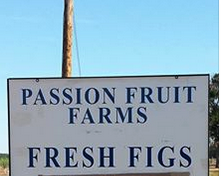
As the fourth-year drought continues, some farmers have conceded to the elements and the limited water allocations and have made the decision to make their final year in the farming business. Tonetta Simone Gladwin, the third generation owner of Passion Fruit Farms, a fig operation in Merced, Calif., said this year would be her last.

“As a third generation, I’m the last generation in my family. We’ve all farmed figs,” Gladwin said. “I don’t think Grandpa had any idea of the challenges we have to face today. Never did he think we’d have $10 per hour in labor wages, no water deliveries and some of the regulations we’ve had to face and overcome. These challenges are so different from those in his day.”


Passion Fruit Farms FBPassion Fruit Farms

2016-05-31T19:28:06-07:00August 18th, 2015|

2015 Drought Costs Ag Nearly Two Billion!

DROUGHT COSTS CALIFORNIA AGRICULTURE $1.84B AND 10,100 JOBS IN 2015

The drought is tightening its grip on California agriculture, squeezing about 30 percent more workers and cropland out of production than in 2014, according to the latest drought impact report by the UC Davis Center for Watershed Sciences.

In 2015, the drought costs to the state’s agricultural economy will reach about $1.84 billion and 10,100 seasonal jobs, the report estimated, with the Central Valley hardest hit.

The analysis also forecasts how the industry will fare if the drought persists through 2017.

‘NOT A FREE LUNCH’

Currently, the industry overall remains robust. The agricultural economy continues to grow in this fourth year of severe drought, thanks mostly to the state’s vast but declining reserves of groundwater, which will offset about 70 percent of the surface water shortage this year, the researchers said.

California is the world’s richest food-producing region. Continued strong global demand and prices for many of its fruits, nuts and vegetables has helped sustain the farm economy along with intrastate water transfers and shifts in growing locations.

“We’re getting by remarkably well this year — much better than many had predicted — but it’s not a free lunch,” said lead author Richard Howitt, a UC Davis professor emeritus of agricultural and resource economics.

The heavy reliance on groundwater comes at ever-increasing energy costs as farmers pump deeper and drill more wells. Some of the heavy pumping is in basins already in severe overdraft — where groundwater use greatly exceeds replenishment of aquifers — inviting further land subsidence, water quality problems and diminishing reserves needed for future droughts.

Further, several small rural communities continue to suffer from high unemployment and drying up of domestic wells because of the drought, particularly in the Tulare Basin.

“If a drought of this intensity persists beyond 2015, California’s agricultural production and employment will continue to erode,” said co-author Josue Medellin-Azuara, a water economist with the UC Davis Center for Watershed Sciences.

MAJOR CONCLUSIONS

The UC Davis team used computer models and the latest estimates of surface water availability from state and federal water projects and local water districts. They forecast several drought-related impacts in the state’s major agricultural regions for the current growing season, including:

  • The direct costs of drought to agriculture will be $1.84 billion for 2015. The total impact to all economic sectors is an estimated $2.74 billion, compared with $2.2 billion in 2014. The state’s farmers and ranchers currently receive more than $46 billion annually in gross revenues, a small fraction of California’s $1.9 trillion-a-year economy.
  • The loss of about 10,100 seasonal jobs directly related to farm production, compared with the researchers’ 2014 drought estimate of 7,500 jobs. When considering the spillover effects of the farm losses on all other economic sectors, the employment impact of the 2015 drought more than doubles to 21,000 lost jobs.
  • Surface water shortages will reach nearly 8.7 million acre-feet, which will be offset mostly by increased groundwater pumping of 6 million acre-feet.
  • Net water shortages of 2.7 million acre-feet will cause roughly 542,000 acres to be idled — 114,000 more acres than the researchers’ 2014 drought estimate. Most idled land is in the Tulare Basin.

The effects of continued drought through 2017 (assuming continued 2014 water supplies) will likely be 6 percent worse than in 2015, with the net water shortage increasing to 2.9 million acre-feet a year. Gradual decline in groundwater pumping capacity and water elevations will add to the incremental costs of a prolonged drought.

GROUNDWATER LAWS COULD HELP

The scientists noted that new state groundwater laws requiring local agencies to attain sustainable yields could eventually reverse the depletion of underground reserves.

“The transition will cause some increased fallowing of cropland or longer crop rotations but will help preserve California’s ability to support more profitable permanent and vegetable crops during drought,” said co-author Jay Lund, director of the UC Davis Center for Watershed Sciences.

The report was primarily funded by the California Department of Food and Agriculture.

Other authors on the report include Daniel Sumner, a UC Davis professor of agricultural and resource economics and director of the UC Agricultural Issues Center, and Duncan MacEwan of the ERA Economics consulting firm in Davis.

2016-05-31T19:28:07-07:00August 18th, 2015|

Drip Irrigation is King During Drought

Terranova Ranch Surviving the Drought: Drip Irrigation

By Patrick Cavanaugh, Deputy Editor

As the drought continues to preside, farmers persist in their efforts to improve farming techniques to make the most out of what little water they have available. Don Cameron, general manager of Terra Nova Ranch, Inc., said the 7000-acre ranch in Helm, in Fresno County has managed to keep its 30 crops viable in the middle of the drought by changing its irrigation methods.

“We’ve been able to continue farming the acreage that we have, even in the fourth year of a drought,” Cameron said, “because we’ve changed all of our row crops irrigation to buried drip irrigation. We use every drop of water that we have.”

“We’ve also put in drip irrigation systems on all our trees and vines,” Cameron said. “We have irrigation scheduling. We use evapotranspiration data—we’re not putting on anything more than what we’re actually using.”

“So we’re able to find a solution just to get through these tough times,” Cameron said, “and we hope to have a wet winter and get a good snowpack so next year we’ll have more water. We’re farming like we’re in a drought every year. We’re never really going to go back to the ways that we used to farm.”

2016-05-31T19:28:07-07:00August 17th, 2015|

ALRB Pushes Worksite Access

ALRB Pushes Worksite Access in Upcoming Public Hearings

By Laurie Greene, Editor


Announced TODAY, The Agricultural Labor Relations Board ( ALRB) will be traveling to key agricultural areas in the state next month to hear comments from  farmworkers, employers and the public on the ALRB’s proposed rule to permit ALRB staff worksite access to educate farmworkers and field supervisors about the rights and responsibilities provided by the Agricultural Labor Relations Act (Act).


The public hearings will be held in Fresno, Salinas, Santa Maria and Oxnard, from 10 a.m. to 5 p.m. or until such time that all public testimony has been received.


Further information about the hearings appears at the end of this article.


THE PURPOSE OF THE ACT


The ALRB reports:

In 1975, the California State Legislature passed the Agricultural Labor Relations Act guaranteeing certain rights to California farm workers. The purpose of the Act is to “ensure peace in the agricultural fields by guaranteeing justice for all agricultural workers and stability in labor relations.” The Act states that it is the policy of the State of California to encourage and protect the right of farm workers to act together to help themselves, to engage in union organizational activity and to select their own representatives for the purpose of bargaining with their employer for a contract covering their wages, hours, and working conditions. The law prohibits the employers from interfering with these rights, protects the rights of workers to be free from restraint or coercion by unions or employers, and it prohibits unions from engaging in certain types of strikes and picketing.


The Agricultural Labor Relations Board is the agency which administers the Act and protects the rights of agricultural employees in various ways. For example, the Act creates a method by which workers may select a union or other representative to bargain with their employer if they wish. Agents of the Board conduct secret ballot elections to determine whether workers wish to be represented and if so, by whom. Also, the Act gives authority to the ALRB to investigate, process and take to trial employers or unions who engage in actions which the Act describes as “unfair labor practices” (ULPs). When Board employees conduct an investigation and obtain enough evidence to show that an unfair labor practice has been committed, a “complaint” is issued and a hearing is held at which each party has a right to present its side of the case. The Act guarantees the rights of employees to engage in, or to refrain from, union activities or “concerted activities,” such as acting together to help or protect each other in matters related to their employment.


ALRB HEARINGS AND LOCATIONS

  • Each facility will accommodate between 150-200 persons.
  • Spanish, Mixtec, Trique and Hmong interpreters will be available for language assistance. Other language services are available upon request.
  • The hearings will be recorded and an electronic copy of the transcript will be available.

FRESNO

Wednesday, September 9th

Doubletree by Hilton Fresno Convention Center 2233 Ventura Street, Salon C, Fresno (559) 268-1000


SALINAS

Monday, September 14th

Elks Lodge, 614 Airport Boulevard, Salinas  (831) 424-8039


SANTA MARIA

Tuesday, September 15th

Santa Maria Inn, 801 South Broadway Santa Maria (805) 628-7777


OXNARD

Wednesday, September 16th

Courtyard by Marriott, 600 E. Esplanade Drive Oxnard (805) 988-3600


You may contact the ALRB Executive Secretary’s Office at (916) 653-3741 or jbarbosa@alrb.ca.gov with any questions.

2016-05-31T19:28:07-07:00August 14th, 2015|

Appellations Beyond Napa . . .

Grower Andy Beckstoffer on Lake and Mendocino County Appellations

By Charmayne Hefly, Associate Editor

When people discuss California wine, they most commonly associate it as having been grown and produced in Napa. However, Napa isn’t the only northern county to grow grapes that become iconic California wines.Lake County Winegrape Commission

Andy Beckstoffer, owner of Rutherford-based Beckstoffer Vineyards, owns more than 3,000 acres of premium winegrapes. He began his own vineyard in the 1970s in Mendocino and Napa counties before expanding into Lake County as well.

Beckstoffer said that Lake and Mendocino counties were some of the most promising new wine districts in the new world of wine. He ought to know; the California Association of Winegrape Growers named Beckstoffer 2015 Grower of the Year last month.

“Mendocino County has consistently produced some of the best Chardonnay for years,” Beckstoffer said. “We started back in the 1970s, and they continue to do it in the Red Hills of Lake County. The appellation, Red Hills Lake County AVA, is where we’re producing Cabernet at a reasonable price–North Coast Cabernet. It’s really the most promising new wine district in the new world of wine because it is encompassed by the vast North Coast AVA,” Beckstoffer said, “and the quality has been proven to be excellent.”

The North Coast AVA encompasses smaller appellations in six counties north of San Francisco: Lake, Marin, Mendocino, Napa, Sonoma, and Solano. Lake County AVAs


2016-05-31T19:28:07-07:00August 14th, 2015|

Big Water Rally at Grizzlies Stadium Aug. 21

Water Rally August 21 to Fill Grizzlies Stadium for #moreDAMstorage

Valley Ag Retailer gives away thousands of complimentary tickets in effort to promote #moreDAMstorage as a long-term solution to California’s water woes.

Gar Tootelian, Inc. (GAR) has invited Central Valley growers and businesses to rally around the backdrop of a Fresno Grizzlies Game on Friday, August 21, 2015 in support of #moreDAM storage.

“California’s Central Valley depends on reliable, clean water to survive and thrive. The rally’s goal is to fill the stands with those who support #moreDAMstorage as a solution to California’s water woes” said Greg Musson, president of Gar Tootelian, Inc. “For too long now, Sacramento has delivered nothing but lip service to valley water needs. It is time for the people of this valley to rise up and be heard.”

The Rally is an opportunity to learn more about the organizations working together on California’s long term water storage solutions. The Rally and fireworks will be highlights of the Fresno Grizzlies game on Friday, August 21, 2015 at Chukchansi Park, Downtown Fresno. Gates open at 6:05 pm. The game start time is 7:05 pm. GAR is giving away thousands of complimentary tickets which are limited and will be available on a first come first serve basis. You may pick up your tickets at the GAR booth located on the corner of Inyo and “H” Street the night of the game beginning at 5:00 pm.

“GAR takes great pride in supporting long term water storage solutions for the health and sustainability of our Valley,” said Musson, “I personally look forward to welcoming you to the Central Valley Water Rally at Fresno Grizzlies Stadium!”

GAR is committed to supporting long term water storage solutions for California’s greater tomorrow. The company provides water, nutrition, regulatory and crop care advice and products to more than 1,500 growers throughout the Central Valley.


2016-05-31T19:28:07-07:00August 14th, 2015|
Go to Top