About California Ag Today

This author has not yet filled in any details.
So far California Ag Today has created 2014 blog entries.

Mariani Packing Co. Puts Food Safety Top Priority

Mariani Served as Chair of the Safe Food Alliance

By Patrick Cavanaugh, Editor

The Mariani Packing Company is one of the largest specialty crop growers and handlers in the state, packing many different types of fruit on a massive scale. California Ag Today recently spoke with Mark Mariani, executive chairman of the Mariani packing company in Vacaville and the outgoing chairman of the Safe Food Alliance (SFA), an organization specializing in food safety among growers, packers, and processers to maintain high standards of food safety and prevent consumer illness.

“Our four major specialty crops areas is that we’re the second largest cranberry growers (with operations back east) and packers, (with operations back east), and we also grow and pack mangoes out of Mexico, Mariani said. “And we are probably the third-largest raisin grower/packer in California. We also repack prunes for the world market.”

Mariani said that the products that they bring in from Mexico are held to the same standard as produce grown inside the United States. Consumers always look back at the supplier when it comes to food safety, so they ensure that standards meet or exceed the U.S. standards.

Mariani reflected on his part in the Safe Food Alliance organization.

“It’s an exciting time for DFA (which still stands as an entity as it’s being morphed into the Safe Food Alliance) because of the growth and the fact that it is offering so many more services to our members. We recognize that for us to move forward as an industry, we have to be better than anyone else and especially foreign competition,” he said. “And you do that because you can create trust, and I think there’s a solid brand with SFA ,if you’ve been approved and a member … that you are operating within the SFA conditions.”

As the former chairman of SFA, Mariani enjoyed working with passionate people.

“The individuals in the DFA and SFA are passionate people that want to do and exceed the expectations or their members. And most importantly, you want to provide safe food for consumers,” Mariani said.

The new Chair of Safe Food Alliance is Dane Lance, President and CEO of Sunsweet Growers, the world’s largest and most famous brand of dried tree fruits including prunes, apricots, and mangos.
2018-06-06T16:17:06-07:00June 6th, 2018|

Heat Illness Prevention for Field Workers

Farmers Guard Their Most Valuable Asset

By Patrick Cavanaugh, Editor

When temperatures are heating up, it’s important that growers are keeping farm employees safe to prevent exhaustion and heat-related illnesses and to ensure that their employees go home to their families at the end of the day.

On an average day, temperatures in fields can range from eight to 10 degrees hotter than the average temperature in the area.

“We try always to have a regular tailgate meeting to remind all of our farm employees about the hazards of working when temperatures are more than 80 degrees,” said Ron Samuelson, a Fresno County grower who produces almonds and cherries. “We educate our employees about the importance of drinking water, the emergency procedures if needed. And for increased prevention, we are in constant contact with the workers throughout the day.”

heat illness

Some type of shade must be available to field employees when temperatures reach 80 degrees.

Samuelson said that shade is essential once temperatures reach around 80 degrees and they make sure there is adequate shade in the morning if temperatures are going to get to that high.

“If field employees are in an almond orchard where there are mature trees, there is adequate \shade for them to sit and rest under a tree to cool down,” Samuelson explained. “And when the temperature begins to reach 100 degrees, it’s not uncommon for work to stop to give employees a break from the heat.”

“If temperatures go over 95 degrees, we employ other procedures. The first thing we would do is to talk to the guys to get their input as to what’s their thoughts on how soon they want to stop working for the day.”

“A lot of times, we’ll start a little bit earlier and knock off earlier. Then we take breaks more often as well. We try to maintain that, encourage them to drink at least a quart per hour throughout the day. We make sure they let us know if the water jugs are down to a gallon are less. That way we can get them refilled right away.”

Employee safety is paramount because it would be impossible for farmers to farm without them.

“So it’s essential to help them get through the day and avoid heat stress. At the end of the day, our employees matter most,” Samuelson said.

2018-06-05T16:29:47-07:00June 5th, 2018|

California Food Processing: $200 Billion in Value

California Food Processing is Massive Business

By Patrick Cavanaugh, Editor

The food packaging business is massive in California. California Ag Today spoke recently with Rob Neenan, president and CEO of the California League of Food Producers, based out of Sacramento, about California food processing.

“The League of Food Producers is a statewide trade association. Our primary function is regulatory and legislative affairs on behalf of our members,” Neenan said.

Rob Neenan is president and CEO of the League of Food Processors

The association represents about 50 food processor members across the state, most of the Central San Joaquin Valley, but it serves seven or eight members in southern California. “We have Del Monte in Modesto. We have Hilmar Cheese in Hillmar. In Lodi and Woodland, we have Pacific Coast Producers. We also have also some nut processors, dried fruit processors, so the whole gamut,” Neenan said.

“There aren’t as many frozen fruit and vegetable companies as there used to be, but we have a few, for example, Del Mar Food Products in Watsonville and a couple of companies in the Merced area,” Neenan noted.

The processing industry represents a big part of the power of California agriculture.

“The annual output of the food processing industry in California is about $200 billion. About $25 billion is in direct value added on top of the ingredients,” he said.

The food processing industry directly employs about 190,000 people. However, if you add in all the people who work in packaging, labeling, trucking, energy, IT, in support of the industry, there are 760,000 people in California whose jobs either directly or indirectly rely on the food processing industry, and that’s on top of the production agriculture component.

It’s the third largest industry in the state regarding the manufacturing sector—only high tech and oil refining are larger in California.

And Neenan explained that there are some significant issues that canners are facing.

“The biggest is the proposed steel and aluminum tariff situation. The canning industry needs tinplate steel, which is also used in cans and aluminum foil, which is inside of some packaging as well. For the canneries left in California, this is going to increase their cost of doing business greatly,” Neenan said.

2018-06-04T15:43:45-07:00June 4th, 2018|

Encouraging Schools to Comply with Pesticide Notifications

Monterey County Schools are Not Logging On to See Notifications

By Patrick Cavanaugh, Editor

Monterey County is having a hard time getting schools to comply with new regulations regarding restrictions of pesticide sprays and pesticide notifications near schools.

“There’s a quarter mile buffer for certain types of applications,” said Bob Roach, acting Agricultural Commissioner for Monterey County.

Fumigated Strawberry Field in Monterey County

When school’s in session, growers will comply with this buffer without any serious impact on their spray practices. Fumigants are already strictly controlled.

“We’re going to comply with everything, but the notification part is something that’s just been very difficult because the schools are not participating like they should be,” Roach said.

The growers must do an annual notification to the schools. In order to see that notification, the schools must log onto www.calschoolnotify.org, which the state has set up for that purpose, and then the notification will go directly from the grower to school administrator.

“What the school does with it is up to the school, but growers have prepared that notification on the Cal Ag ag permits web-based computer system for pesticide permits,” Roach explained. “That system does take all the restricted materials and adds them to a list, but you have to manually enter in your nonrestrictive materials and your spray adjuvants, which are included in this notification. They have to make a list of all the materials are going to use in the next year and they have to send that through to the www.calschoolnotify.org system so that schools can receive it.”

2021-05-12T11:01:55-07:00June 1st, 2018|

Gerawan Workers Have Been Vindicated

Gerawan Workers Will See Vote Counted After 4.5 Years of Seeking Justice

By Laurie Greene, Founding Editor

Following the Nov. 5, 2013 Gerawan Farming, Inc. employees’ legally unresolved election to decertify the United Farm Workers (UFW) as their collective bargaining representative, the employees’ message has been simple: Count the votes!

Silvia Lopez, Gerawan Employee

Yesterday, California’s 5th District Court of Appeals—in a 3-0 decision—ordered the California Agriculture Labor Relations Board (ALRB) to unseal the ballots, count them and issue an official tally.

Dan Gerawan, who co-owns Gerawan Farming, Inc. with his brother Mike and father Ray, said “This is a victory for our employees who never gave up the struggle to achieve the same rights that all other workers have. And we never wavered from our support of their right to choose.”

Dan Gerawan, co-owner Gerawan Farming, Inc.

Dan Gerawan, co-owner Gerawan Farming, Inc.

“I have no clue when the votes are to be counted,” Gerawan explained. “The ARLB and UFW are going to appeal this decision to the California Supreme Court. I do not know if the California Supreme Court will take it.

“But I’m certain that ARLB and UFW are going to try to get the California Supreme Court to take it because the last thing they want is for our employees to have a choice. They want this unionization forced on them against their will,” Gerawan said.

“This is a huge victory and well deserved to these thousands of Latino immigrant farmworkers who have been fighting and sacrificing their time and families’ future to simply have the right to choose and vote in America,” Jesse Rojas, Spokesperson for Pick Justice, an advocacy group for Gerawan farm employees.

“The ALRB and UFW clearly continue to show that they are afraid to let workers vote and show what they want and what is better for their families. After glancing through the Fifth District Court of Appeals decision, I find the attached highlighted screenshots worth noting,” said Rojas.

Anthony Raimondo, president of Fresno-based Raimondo & Associates, is the attorney for Gerawan Farms employee Silvia Lopez, who started the petition and campaign to oust the UFW when they returned to the farm following 20 years of absence. The UFW never successfully represented the employees in reaching a contract with their employer, nor did it ever collect union dues from employees.

“The Court of Appeal is very clear,” said Raimondo. “It just says, ‘You’ve got to count the ballots.’”

Anthony Raimondo

Anthony Raimondo

“The first thing that Silvia said to me was how happy she is to get this decision from the Court,” Raimondo continued. “This is a vindication of what the workers have been fighting for, for more than five years now, since they first began this effort to expel the union. They aimed to protect their income from going to fund the UFW’s efforts,” Raimondo stated.

“The workers have been ignored. Their rights have been trampled on by the ALRB. The ALRB has disregarded them. They were told that they didn’t matter. They were told that their voice would never be heard, but they never gave up,” Raimondo said. “They never stopped fighting. This decision is a vindication of the fact that justice can be done and that the right thing can happen when people remain committed to it. I can’t say enough about the commitment these workers have shown to this effort.”

“This is a huge victory for these farm employees,” said California Assemblymember  Jim Patterson who represents the 23rd Assembly District that covers parts of Fresno and Tulare Counties.

Jim Patterson

“I’m happy for them. Justice is being done, although it is taking a long, long time. It’s another indication of just how far off base the ALRB is. Primarily, the ALRB is a tool for the UFW to force the Gerawan field employees into contracts that they do not want, cannot approve, and did not vote for. So it’s a very good decision for these workers to have the kinds of freedoms that everybody else has.”

Patterson emphasized that the ALRB’s goal is to take those kinds of freedoms away. “The vote count will probably go forward. My guess is ALRB will try to drag their feet. But I think this is a solid [Court] opinion. And now we wait and see if the ALRB considers themselves to be above and beyond the law, or whether they recognize that they have gone far afield, and they’re going to have to correct some very, very illegal behavior,” Patterson said.

Raimondo explained, “There is no substantive history in the record that demonstrates that the ALRB had any jurisdiction or any legal standing to take those ballots and stash them away for all of these years. It was a blatant effort to stifle their votes to do the bidding of the UFW. They have gotten caught at it, and now they’re going to have to correct their illegal activity. If they don’t, I think they are going to suffer some severe decisions with these Courts. I think if they don’t comply, they’re going to get very close to breaking Court orders and breaking the law.”

Gerawan added, “Don’t forget, fifteen million taxpayer dollars have been spent to suppress those ballots. That kind of money spent by anyone, even the government, could [indicate] a lot of fraud took place with that ballot box.”

Raimondo claimed, “It is clear that the Gerawan farm employees are not cynical. They believe in the promise of America. They believe in our system of justice. That’s why they have continued to fight. It’s why they have continued to protest. It’s why they have continued to assert their voice in Court.”

“They knew from the very beginning that this was an injustice,” Raimondo continued..”They knew that the ALRB was mistreating them. They knew that they were treated like second-class citizens, but they also believed that if they continued to fight and to do things the right way—through peaceful protest and by asserting their positions in Court—that the right thing would happen. The workers had faith that the system works, that judges would ultimately hear their voices and that justice would be done.”

“The reality here,  I believe, and the Gerawan workers believe, is that in the end, justice will prevail. We believe we will be heard and corruption will not win. The workers’ voice is going to win here. Democracy is going to win here. Those votes will be counted,” Raimondo said.

2018-06-06T09:09:04-07:00May 31st, 2018|

Letter to California Water Commission on Failure to Approve Temperance Dam

CWC Decision is a Black Eye to State

Editor’s note: Valley legislators sent the attached letter to the CWC last week, reflecting both disappointment and concern over the CWC WSIP process as it relates to the Temperance Flat Reservoir Project. The letter asks for a reconsideration for the TFR ecosystem evaluation.

Clearly, we appreciate all our Valley legislators who have fought so hard for this project for many years. This letter at a minimum puts on the record their thoughts on how the CWC handled the TFR project.

May 17, 2018

California Water Commission: Mr. Armando Quintero, Chair, & Mr. Joe Yun, Executive Officer

P.O. Box 942836, Sacramento, California 94236-000

Dear Mr. Quintero, Mr. Yun and Commission  Members:

On May 3, 2018, The California Water Commission took action, perhaps the most definitive and historic action with regard to the Water Storage Investment Program (WSIP) state bond funding applications.

As members of the California Legislature, we have watched and participated in this entire application process. All Californians would benefit from water storage projects this money is intended to fund. However, this investment has been stymied by the commission staff’s narrow determination. The people we represent have expected a great deal of positive leadership from the Water Commission and we echo the public’s disappointment in how the review process has unfolded.

During the initial review of WSIP project applications, many of us joined in calling into question the policy and procedures of the application review process. From the beginning, we had concerns that the process developed by commission staff and the information provided would not adequately account the benefits of water storage projects throughout the state. Despite our concerns, little was done to address the problem resulting in six of the project scores receiving “O” benefits.

Temperance Dam

Mario Santoyo is Executive Director of the SJV Water Infrastructure Authority, which presented the Temperance Flat Dam Proposal to the California Water Commission​.

In 2008, the EDT model was selected by the state and federal agencies responsible for implementation of the San Joaquin River Restoration Program (SJRRP)—namely the U.S. Bureau of Reclamation, the U.S. Fish and Wildlife Service, the U.S. National Marine Fisheries Service, and the California Department of Fish and Wildlife (CDFW). In the Quantitative Fisheries Model Selection Recommendation Process, 2008, the SJRRP agencies state that EDT was rated ” … as the most appropriate quantitative fish population model for the SJRRP.” This report also states that “the EDT model is a framework that views salmon as the indicator or diagnostic species for the ecosystem. The salmon’s perspective (i.e., its perception of the environment) becomes a filtered view of the system as a whole.

The EDT framework was designed so that analysis made at different scales (i.e., from tributary watersheds to successively larger watersheds) might be related and linked. Biological performance is a central feature of the framework and is defined in terms of three elements: life history diversity, productivity, and capacity. These elements of performance are characteristics of the ecosystem that describe persistence, abundance, and distribution potential of a population. This analytical model is the tool used to analyze environmental information and draw conclusions about the ecosystem. The model incorporates an environmental attributes database and a set of mathematical algorithms that compute productivity and capacity parameters for the diagnostic species. …”

In 2014, the U.S. Bureau of Reclamation selected the EDT model for application to the Upper San Joaquin River Basin Storage Investigation—the federal feasibility study of Temperance Flat Reservoir—to quantify benefits. Prior to its application, Reclamation commissioned a scientific peer review of the EDT model to confirm the suitability of its use for quantifying benefits. It is our understanding that when the SJVWIA team asked if there were any models that could be used in place of the EDT, the CWC staff declined to respond. This is of clear concern and demonstrates the inconsistencies within the information provided by commission staff.

From the San Joaquin Valley’s perspective, the outcome of this process is a black eye for the state. The two-thirds threshold for Proposition 1 in 2014 would not have been met without the support of the San Joaquin Valley. Despite the bias by some opponents against large-scale storage projects, the language in AB 1471intentionally included Chapter 8 (Provision (a), section 797.1, page 22) to clarify that the Legislature’s intent for the $2.7 billion allocation was for  surface water storage projects with an emphasis on Sites and Temperance Flat Reservoir based on the CALFED Bay-Delta Program Record of Decision, dated August 28, 2000 (Section 2. Decision, 2.2 Plan for Action, 2.2.5 Storage, pages 42 through 45). We the members of the Legislature believed that by voting for Prop 1 funding that all projects including controversial storage projects in the CALFED Bay Delta Program would be given a fair and accurate evaluation in order to meet the overall water management strategy for the state.

In closing, we insist that the Water Commission reconsider its acceptance of the staff recommendation on the Temperance Flat Project’s ecosystem scoring or at the minimum direct the staff to go back and re-evaluate the application’s ecosystem public benefit utilizing the Ecosystem Diagnosis and Treatment (EDT) model cited in the Water Commission’s Technical Reference Document as being acceptable for use in the analysis required by the application.

Sincerely,

(Letter was signed by nine Valley state senators and assembly persons.)

2018-05-29T16:59:53-07:00May 29th, 2018|

UC Davis Pollination Ecologist Wins 3-Year Fellowship

Fellowship Comes From the Department of Defense

By Patrick Cavanaugh, Editor

Maureen Page Awarded Fellowship to Optimize Wildflower Plantings

Doctoral student Maureen Page of the Neal Williams lab at the UC Davis Department of Entomology and Nematology is the recipient of a prestigious three-year fellowship, a National Defense Science and Engineering Graduate Fellowship for her research proposal: Promoting Food Security by Optimizing Wildflower Plantings to Support Wild and Managed Bees.

Page, a pollination ecologists, was one of 69 awardees selected from more than 3,600 applicants. The Department of Defense funds her fellowship.

“Most people probably are aware that both managed honeybees and many of the wild native species that we have in California as well as in the U.S. have major stressors that are contributing to declines in their populations,” Page said.

And of course, the bee populations suffer when there’s a lack of floral resources to pollinate. “Especially when crops are not in bloom and bees need pollen and nectar to survive. And so without enough resources, it can have dramatic declines in bee populations,” she said.

Page explained that bees are critically important to our food supply. “It’s estimated that about a third of the food supply directly benefits from insect pollination. Many of those crops are entirely dependent on insect pollination,” she said. “Without bees and other insects, those particular crops wouldn’t even be able to set fruit and many others, which while not wholly dependent on insect pollination benefit very much from insect pollination, which means more production and lower prices so that more people can afford healthy, nutritious food.”

2021-05-12T11:05:11-07:00May 25th, 2018|

2018 California Table Grape Season Under way

Table Grapes are Versatile And Healthy

By Patrick Cavanaugh, Editor

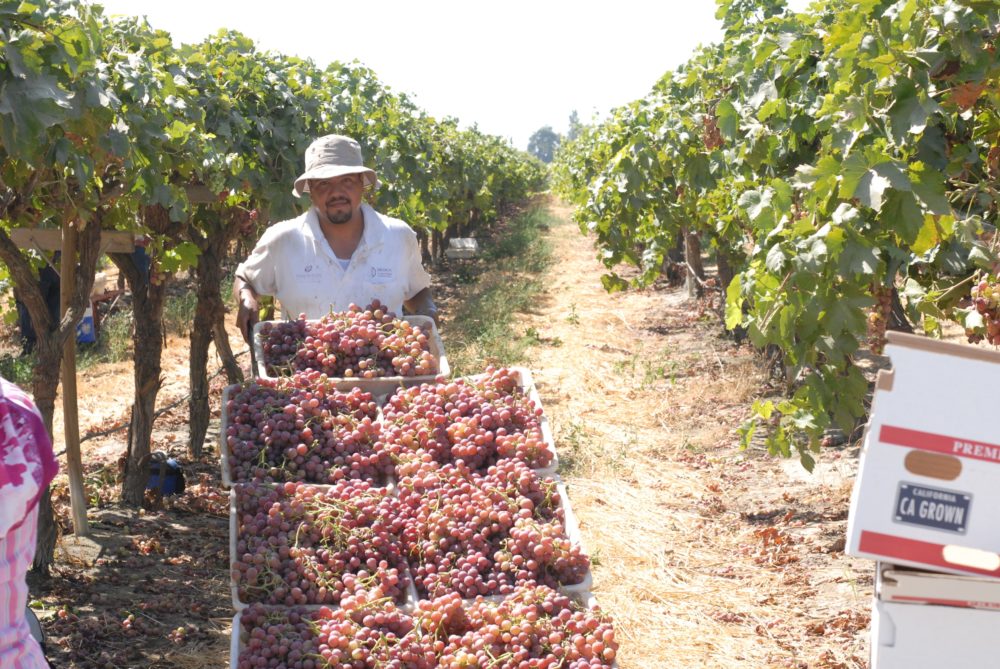
California table grapes are now being harvested. Kathleen Nave, president of the Fresno-based California Table Grape Commission told California Ag Today that fresh grapes are now available in local stores.

“California table grape growers began picking a couple of weeks ago, and consumers should be able to find California grapes in their stores today. And certainly, as the season progresses, grapes will be more and more available,” Nave said.

Kathleen Nave, California Table Grape Commission president

Kathleen Nave, California Table Grape Commission president

Consumers should be buying grapes for the taste as well as good health.

“Grapes contain about 1600 different phytonutrients—all kinds of things that are really good for us, and many important vitamins. There’s something magical in grapes that appears to have a lot of potential health benefits.”

Nave said she tells people that they need to be eating grapes basically every day because there’s something really good for us in the combination of things that are in grapes, and that’s grapes of all colors: red, green and black.

“They definitely taste great. Kids love them. So you know, they’re a healthy snack. They look beautiful when you add them to things like salads or you know, even pizza. You can even roast them. So they’re amazingly versatile and then they’re so good for us,” Nave said.

There are about 450 table grape operations in the state, from Southern California to Madera.

“There are vineyards in the Coachella Valley. We have long had a group of growers growing grapes in the desert,” Nave said. “Those are the earliest grapes that are available and are found in stores now, And then of course in the San Joaquin Valley, we have table grape growers from the Tehachapi Mounts North into the Madera area.”

2018-05-24T16:45:28-07:00May 24th, 2018|

Importance of Recall Insurance

Brokers Can help Growers Minimize Losses

By Jessica Theisman, Associate Editor

California Ag Today recently met with Caitlin McGrath, the national product recall and contamination risk consultant with Lockton Insurance Brokers. Insurance is needed for California growers in case of recalls and contaminations. Lockton feels the most important part of finding the right recall insurance is the consulting element.

Caitlin McGrath, Lockton Insurance Brokers

“Now, what I think is the most important part of insurance coverage is the consulting element,” McGrath said.

These are consulting services that are available if you are a recall or contamination insurance purchaser that allows you access to specialists during and before incidents. One of the struggles that McGrath is noticing is that the quality assurance folks she speaks to are not insurance buyers.

“They are the ones finding out the information about all these services that are available, and it’s not always getting down into the field,” she said.

Preparation in the case of recalls or contamination is important.

“Fan Favorite, as I call them, do a lot of really great work on behalf of a lot of our clients,” McGrath said.

Some of that work can be Hazard Analysis Critical Control Point (HACCP) training and mock recalls. Financial costs are rising due to the increasing number of recalls.

“We believe that that’s the effect of [the Federal Information Security Management Act or] FISMA. They are getting larger in financial cost, and that has to do with the amount that is being recalled and the implications in terms of publicity,” McGrath said.

Recall plans need to cover all of the elements, not just mock recalls.

“The internal message is just as important and knowing who is going to handle what within an organization. Planning and practicing that is really critical to help mitigate if there is a problem,” McGrath explained.

“Having directives around the use of social media as an employee of an organization is very important, but just one department not talking to another is going to have a huge part in this,” she said.

Buying product contamination insurance is expensive, but necessary. Since McGrath started, the number of brokers has nearly tripled.

“I think that not having insurance is now the outlier, so I think the majority of folks are still buying,” she said.

2018-05-23T16:37:56-07:00May 23rd, 2018|

Conventional or Organic Strawberries — All Safe to Eat

Strawberry Grower Says At PPB, Anything Can be Found

By Patrick Cavanaugh, Editor

David Peck is a longtime strawberry grower in Santa Maria. He objects to the Environmental Working Group’s (EWG) Dirty Dozen list, which had strawberries at the top of their list.

David Peck, COO and Farmer of Manzanita Berry Farms in Santa Maria

“If you take the data that the EWG is presenting, you can say, yeah, okay, that’s fair,” Peck said.

“Based on what they are presenting, they can find detectable amounts of whatever at however many parts per billion. I’ll buy that; but they’d have no perspective on the types of residues and what that means regarding human health, human safety, and human risk,” noted Peck, who grows both conventional and organic strawberries.

Peck said that even organic strawberries would have detectable amounts of residues.

“I tell people that I grow organic strawberries and that I do not put on the crop protection materials that the EWG is talking about,” he explained.

“At parts per billion (PPB), you can find dozens of carcinogens at minute levels. Where did they come from? Well, they are everywhere in such small quantities that no one should worry about it,” Peck said.

Peck said that the decision for consumers is not organic versus conventional, but to eat more strawberries and other fruits and vegetables.

“I say eating California produce in general is so much healthier than avoiding California fresh fruits and vegetables,” he said.

The Alliance for Food and Farming works hard to bring the truth to the EWG’s Dirty Dozen list. They report that all produce is healthy to eat and that consumers need to eat more every day. More Information at www.safefruitsandveggies.com

2021-05-12T11:05:11-07:00May 22nd, 2018|
Go to Top