About California Ag Today

This author has not yet filled in any details.
So far California Ag Today has created 2014 blog entries.

Rep. Josh Harder: Trade War With India Must End for Almond Industry

India is Top Export Destination for Almonds, Worth $650 Million Annually

News Release

Representative Josh Harder (CA-10) released the following statement after India imposed retaliatory tariffs up to 70 percent on American products, including almonds. Rep. Harder’s district is one of the largest producers of almonds in the country, and India is the top export destination for the product.

Josh Harder

Josh Harder

“This trade war has to end. The president is shooting from the hip on his trade policy and it’s Central Valley almond farmers that are left holding the bag. India is our top export partner and we just can’t afford to take this hit. I’m going to continue pushing the administration and the USDA to stop this devastating cycle of retaliatory tariffs. We need to be supporting our farmers, not cutting off our markets and depressing our economy.”

According to the United States Department of Agriculture (USDA), the United States exported over $650 million worth of almonds to India in 2018.


2019-06-18T20:59:02-07:00June 18th, 2019|

Solutions From The Land: Improving Soils for Increased Production

High Demands for Sustainability Call for Solutions from the Land

By Mikenzi Meyers, Associate Editor

With an increasing population and fewer resources, the agriculture industry is under increasing pressure to remain sustainable. Solutions from the Land is meeting this challenge head-on by examining more progressive ways to produce.

Solutions From The Land is a farmer-led platform that advocates for multiple solutions towards well-managed agricultural landscapes that can still meet the demands of an increasing population.

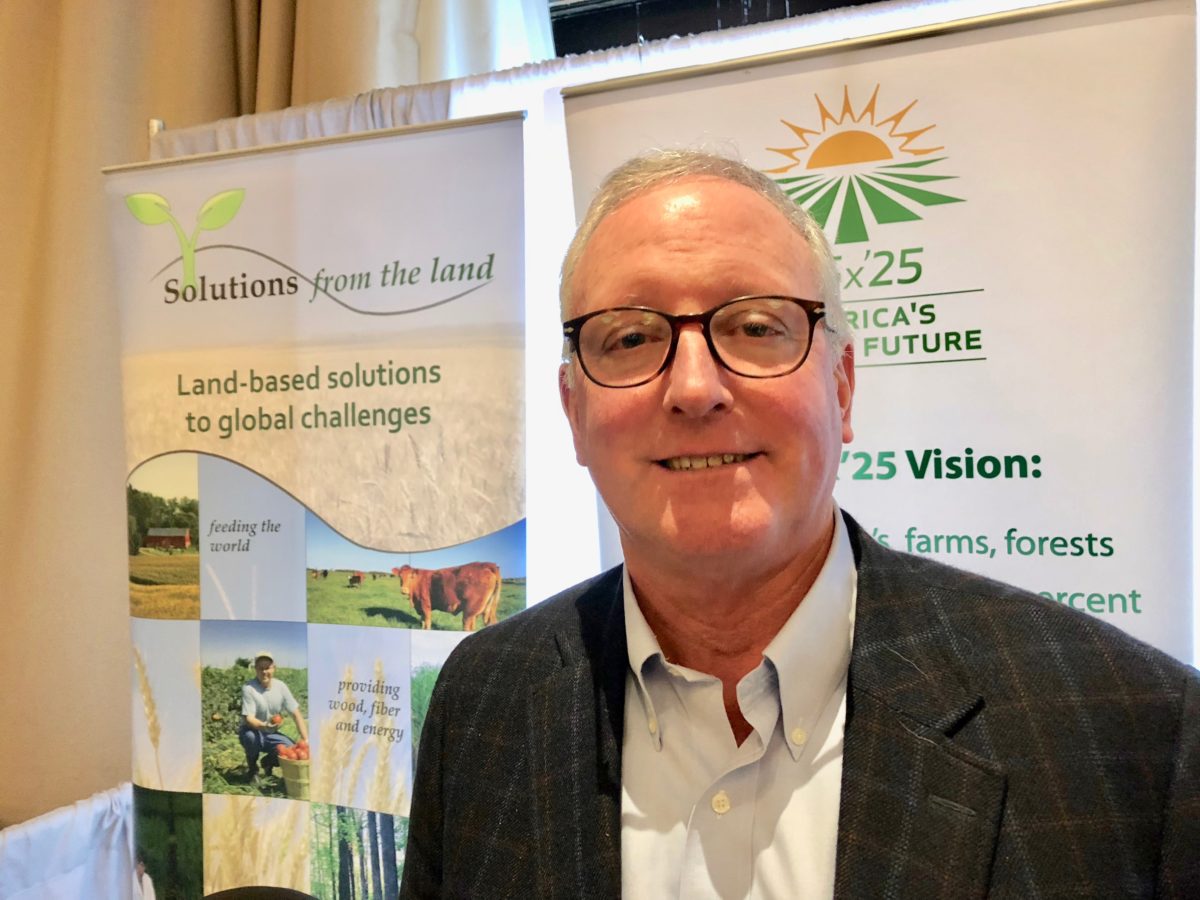
Ernie Shea, president of Solutions From The Land, is optimistic about California agriculture’s future.

“We’ve had significant investments in technology and infrastructure that have allowed the systems to deploy at a scale, but more than anything, we’ve had progressive leaders that have helped to champion this cause,” he said.

One of the pathways Solutions From The Land is working towards is soil health programming. Through this, farmers are improving the organic content in their soil and soaking up leached water.

“They’re sequestering greenhouse gases and delivering global solutions,” Shea explained.

The organization has partnered with the California Department of Food and Agriculture and encouraged government leaders to endorse soil health programming in hopes that they will help farmers adapt to changing climatic conditions.

“We hope someday we’ll add economic value to the carbon that we’re sinking and reward the producers for it,” Shea said

2021-05-12T11:05:03-07:00June 18th, 2019|

Organization is the Missing Link to Supply Chains

Grower Distribution Difficult

By Mikenzi Meyers, Contributing Editor

Creating a link between growers and the distributions of their commodities is becoming increasingly difficult. Aaron Magenheim with AgTech Insight based out of Salinas is helping to create a more efficient communication system to bring supply chains together.

Magenheim described a situation last year where Walmart required IBM technology in order to sell leafy greens, but when growers asked how to implement the technology, they could not get a clear answer. “We need to help move this industry forward and have the right people that work together and understand the right direction,” he said.

Another issue Magenheim has seen is the lack of data on failed trials. This is especially a problem in California, where there is a constant push to test new products. Whether it be hiring an analytics team or making sure growers record their ROI (return on investment), Magenheim said organization is the key to moving forward.

2021-05-12T11:05:03-07:00June 18th, 2019|

California Shows Decreased Use of Most-Hazardous Pesticides

There Was a Big Decline of Hazardous Material Used in 2017

News Release

The amount of pesticides used statewide declined in 2017 according to new data from the California Department of Pesticide Regulation.  This includes a drop in many of the most hazardous chemicals, including pesticides that are carcinogens, and those with the potential to contaminate groundwater and air.

According to the 2017 Pesticide Use Report, the overall amount of pesticides used in California dropped to about 205 million pounds in 2017. That was a decrease of 2 percent from the previous year.  Agriculture use, which accounts for the greatest pesticide use in California, dropped by 3.7 million pounds (1.9 percent) from 2016. Pesticide use in other applications, including landscaping and structural pest control, also decreased in 2017. 

“This report demonstrates that California’s farmers continue to lead the way when it comes to using more sustainable pest management tools and techniques,”said Val Dolcini, Acting Director of DPR. “DPR looks forward to continuing its collaboration with growers, community groups, and other interested citizens to ensure that these pesticides are used in the safest manner possible. “

California produces nearly half of American grown fruits and vegetables, and the amount of pesticides used varies annually depending upon pest problems, weather and other factors.

You can see a short video at https://youtu.be/QKgExqdRpNM

Other highlights of the 2017 Pesticide Use Report data include:

  • The use of carcinogenic pesticides decreased by 5.6 percent to 41.7 million pounds, compared to 44.2 million pounds in 2016.
  • The use of fumigant pesticides decreased by 5.8 percent to 39.5 million pounds, compared to 41.9 million pounds the previous year.
  • The use of pesticides that are toxic air contaminants decreased by 6.4 percent to 43 million pounds, compared to 45.9 million pounds in 2016.
  • The use of pesticides with the potential to contaminate ground water decreased by 25.3 percent to 0.4 million pounds compared to 0.5 million pounds in 2016.
  • The use of pesticides identified as cholinesterase inhibitors, which can affect the nervous system, decreased by 2.6 percent to 4.2 million pounds compared to 4.3 million pounds in 2016. The pesticide chlorpyrifos is included in this category. In 2017, the use of chlorpyrifos increased by 5 percent to 946,000 pounds, compared to 903,000 pounds in 2016. However, overall use of chlorpyrifos has been decreasing for the last decade, and last month, DPR announced plans to  cancel the registration of this pesticide.
  • The use of biopesticides, which have been identified as likely to be low risk to human health and the environment, increased to approximately 8.1 million pounds. This is a 5.5 percent increase from 7.7 million pounds used in 2016.

The pesticide-use data, which has become more comprehensive in the decades since such information started being collected in the 1950s, helps support DPR in its regulatory and enforcement mission.  It can be viewed online: http://www.cdpr.ca.gov/docs/pur/purmain.htm.

2021-05-12T11:01:47-07:00June 18th, 2019|

Proposed Legislation (SB1) Threatens Voluntary Agreements on Wate

Statement by Mike Wade, California Farm Water Coalition Executive Director:

SACRAMENTO, CA – Prior to last December’s State Water Board meeting, both Governor Brown and Governor Newsom took the bold step of supporting a completely new approach to water policy. With their encouragement as well as hard work on the part of scientists, farmers, environmentalists, and other stakeholders as well as the California Environmental Protection Agency and the California Natural Resources Agency, Voluntary Agreements are nearly complete. However, all the progress will be lost if SB1 goes into effect.

As written, SB1 locks California into our failed regulatory system that has not worked for anyone and has guaranteed nothing but lawsuits and delays.

And while the legislation gives lip service to supporting the VA process, make no mistake about it—SB1 would result in the colapse of the Newsom Administration’s voluntary approach to updating California water policy.

It’s hard to overstate the break-through represented by the VAs. A completely new approach to managing water, they require scientific studies and put the new science into practice. They provide an agreed-upon amount of water for river flows as well as new environmental projects and other improvements—paid for by farmers, water districts, and other users—that will help get maximum benefit from the water.

In addition, all water users will have more certainty of water flow that is simply not a part of our current system. And probably most important, because the VAs are the product of compromise and agreement on the part of all water users, we can move forward today, removing ourselves from the endless cycle of lawsuits that has dominated California water policy. Real results will be felt now, not 10 years from now.

We hope the Legislature can find a way to join the Governor in charting a new path to smarter water policy.

2019-06-17T16:37:59-07:00June 17th, 2019|

Ag Start Provides a Place to Start for Agriculture Innovations

California Ag Start Helps Startup Companies

By Mikenzi Meyers, Associate Editor

With the help of corporate sponsors, new agriculture technology companies are making strides to improve efficiency for growers. California Ag Start, a nonprofit incubator for startup companies in the food and agricultural technology sector, is helping to process these sponsors and support innovations throughout the industry.

“We have access to our corporate sponsors who are also in the Ag Technology space, and we can access some of their science and other professionals as mentors to these startup companies,” said John Selep, President of AgTech Innovation Alliance—the 501(c)3 non-profit behind Ag Start.

One of the ways Ag Start is helping to improve efficiency in the field comes from a company using hyperspectral imagery to check nutrients in soils. “They can actually do almost a continuous scan as a plow is going through the field and develop a continuous map of the nutrient profile within that soil,” Selep explained.

Typically, when a grower tests their soil, they pick two to three spots to sample from and will not receive data on it for a couple of days. According to Selep, hyperspectral scanning will not only help eliminate that wait time, but will provide a much more detailed analysis of the entire field.

“You’d be much more precise about where you put nutrients. Just enough in the places it’s needed as opposed to blanketing the field and pouring on gallons of fertilizer,” Selep said.

2021-05-12T11:05:03-07:00June 14th, 2019|

More People Interested in Ag at Food Safety of California Convention

Agriculture Is Noble Work

By Mikenzi Meyers, Contributing Editor

A panel at the recent Food Safety of California Convention gave viewers a glimpse of hope for a brighter future in the industry. The moderator of the panel was Tom Jones, senior director of analytic sciences with the Safe Food Alliance.

Although important topics like food safety and processing were discussed by the panel, Jones found himself most impressed by the audience.

“The number of young people that are interested in agriculture and the food industry really gives you hope for the future,” he said.

Jones also said he was also pleasantly surprised by the implied support from Capitol Hill in Washington. “They are actually quite excited to be involved with agriculture. They think it’s an important or noble thing to be doing that job for their representative in Congress, which is a real shift from even a few years ago,” he explained.

The Safe Food Alliance was founded in 2016 as a sister organization to the DFA of California, a nonprofit trade association that has expanded beyond quality inspections to servicing new commodities. To find out more about the Safe Food Alliance and their services, you can visit their website here.

2019-06-13T15:45:23-07:00June 13th, 2019|

Valley Water Management Ordered To Improve Facility

Valley Water Management May Be Putting Groundwater at Risk

News Release

The Central Valley Water Regional Quality Control Board has issued a Cease and Desist Order requiring Valley Water Management Co. (VWMC), an oil field wastewater disposal center, to either bring its McKittrick 1 and 1-3 Facility into compliance with water quality regulations or stop discharging wastewater at the facility.

“Valley Water provides a valuable service to the oil industry in Kern County, but discharges from the McKittrick facility must not put groundwater beneficial uses at risk,” said Patrick Pulupa, Executive Officer of the Central Valley Water Board.  “With this Cease and Desist Order (CDO), the Board has said that if this facility cannot be brought into compliance with current regulations, discharges at the facility must cease.”

In California, water and oil are co-mingled in underground oil-bearing geologic formations, and both oil and water are brought to the surface during production. That water is called “produced water,” which is known to have naturally occurring contaminants like salinity, chloride, and boron that make the water unsuitable for human consumption or to irrigate agricultural crops.

VWMC disposes of poor-quality produced water from the South Belridge, Cymric, and McKittrick oil fields at the Facility. The Facility has 163 acres of unlined disposal ponds where, according to the company’s recent reporting, 2.8 million gallons of produced water are discharged each day.

In issuing the CDO, the Board found that the cumulative effect of disposing produced water at the facility over many decades has created a highly saline wastewater plume that is migrating to the northeast, where it threatens higher-quality groundwater designated as supporting municipal and agricultural uses.

The CDO requires VWMC to complete a full characterization of the nature and extent of wastewater impacts, an important step toward protecting the beneficial uses of groundwater. If VWMC cannot demonstrate that its discharges at the facility are not causing pollution, the CDO requires VWMC to either upgrade the facility or cease discharging produced water.

For more details, visit the Central Valley Water Board’s agenda item.

The Central Valley Water Board is a state agency responsible for the preservation and enhancement of the quality of California’s water resources. For more information, visit the Board’s website, https://www.waterboards.ca.gov/centralvalley.

2019-06-12T17:03:37-07:00June 12th, 2019|

AgTech Insight Improving Business

Customer Satisfaction is Key in AgTech

By Jessica Theisman, Associate Editor

Working in the agricultural industry demands integrity and honesty. California Ag Today recently spoke with Aaron Magenheim with AgTech Insight, a global, full-spectrum agricultural and tech consulting firm based in Salinas.  They are currently tracking 3,000 digital ag companies around the globe, allowing them to work with real companies to make a huge impact on the world’s food supply.

Magenheim started by selling weather stations 10 years ago when people started asking if he could help aid in soil moisture, imagery, and tracking equipment.

“I got to the point that I wasn’t going to a farmer saying, ‘I’m selling you something.’ I’m going to them saying, ‘Let’s see how we can improve processes and where you’re going,’” he said.

Magenheim’s focus is to help positively impact business for farmers.

Customer satisfaction is the main focus for AgTech Insight.

“If proper customer support is not achieved, then that piece of equipment is in the trash, and you are classified as a company that did not follow through,” Magenheim said. “This would result in an area where you cannot do business anymore.”

2019-06-11T16:58:11-07:00June 11th, 2019|

American Agri-Women to Meet Today

Federal Land Policies Will Be Discussed

News Release

Today, the American Agri-Women (AAW) is hosting its 26th annual symposium in Washington, D.C., starting at 9 a.m. with the focus on private and public land use agreements.

“Federal Land Policies: The Good, the Bad and the Ugly” will be held at the Department of Interior’s Sidney Yates Auditorium, 1849 C Street NW, and is free and open to the public. Pre-registration is not required. The program may be viewed at https://americanagriwomen.org/wp-content/uploads/2019/06/2019-Symposium-Schedule.pdf.

The symposium is hosted each year by AAW’s Presidents’ Council, which is made up of the organization’s previous presidents. This year’s symposium will bring together prominent land use specialists and the Department of Interior’s directors for an open discussion.

The event’s keynote speaker is Myron Ebell, Director of the Center for Energy and Environment at the Competitive Enterprise Institute. Ebell also chairs the Cooler Heads Coalition, which comprises representatives from more than two dozen non-profit organizations based in the United States and abroad that challenge global warming alarmism and opposes energy rationing policies.

Other featured panelists include Brenda BurmanCommissioner of the Bureau of Reclamation; Harriet Hageman, Hageman Law P.C. in Cheyenne, Wyoming; and Dr. Andrea Travnicek, Principal Deputy Assistant Secretary of Wildlife and Parks. A Department of Interior “Welcome” will be given my Susan Combs, Senior Advisor to the Secretary of the Interior exercising the Authority of the Assistant Secretary for Fish and Wildlife and Parks and lead for DOI Reorganization.

2019-06-10T16:01:48-07:00June 10th, 2019|
Go to Top