About Patrick Cavanaugh

This author has not yet filled in any details.
So far Patrick Cavanaugh has created 1490 blog entries.

Agriculture Emerging: a progress report at CDFA

The following was written by California Agriculture Secretary Karen Ross…

Positive. Productive. Creative, collaborative, cooperative … CDFA staff, from scientists and veterinarians to inspectors and technicians, embody these characteristics as they undertake a variety of projects and programs on behalf of the agriculture industry and the people of the Golden State. A new report, Agriculture Emerging: Balanced Budgets, Big Decisions, Bright Future, is our opportunity to share our recent successes and provide updates on many ongoing efforts.

Agriculture has its share of challenges, starting with the drought. Looking ahead, though, global demand for California’s commodities is on the rise, and food and nutrition are front-and-center in the media and on the minds of consumers. Whether their crops, livestock and other products are headed for the produce aisle, the commodity exchange, international export or the local farmers’ market, California’s farmers are well-positioned to take advantage of these conditions.

Among the most significant changes at CDFA is the department’s addition this year to the governor’s Strategic Growth Council, which also includes agencies and departments within Business, Consumer Services and Housing, Transportation, Natural Resources, Health and Human Services, and Environmental Protection, along with the Governor’s Office of Planning and Research.

This core group provides local assistance grants and coordinates activities that support sustainable communities by emphasizing strong economies, social equity and environmental stewardship. When diverse agencies embrace these fundamental values and goals, the results are powerful. The inclusion of agriculture in this process is an important step as we embrace the challenges and opportunities of the 21st Century.

With Governor Brown’s leadership, the State of California is again on the rise. The budget is balanced. Businesses are getting back on track. Slowly but steadily, confidence is being restored. Throughout this recovery, agriculture has been a steady fixture in the state’s economy.

This report is by no means a full account of the department’s activities, but it does take stock of many of our efforts and achievements over the past few years. Like the farmers we support, CDFA has earned a reputation for innovation and effectiveness. I am proud of the people here who make that possible.
2016-05-31T19:32:12-07:00December 5th, 2014|

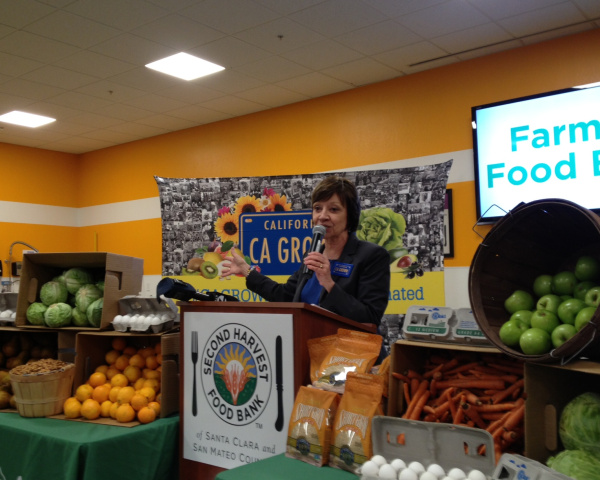
Farm to Food Bank Month

The following was written by Governor Brown…

California is America’s most robust and bountiful agricultural producer. With over 81,000 farms and approximately 400 crops, agriculture in the Golden State is responsible for feeding much of the nation and world.

As California’s economy recovers amidst one of the worst droughts on record, farmers and ranchers across the state are also doing their part to prevent the spread of hunger and expand access to affordable, nutritious food in their communities.

We owe those within the agricultural sector our gratitude during these challenging times. I urge all Californians to recognize the contributions of California’s agricultural community, as well as the food banks and partner organizations they work with to provide nourishment to the most vulnerable among us.

Farm to Food Bank Month


Celebrate Farm to Food Bank Month and team up with the California Association of Food Banks, the California Department of Food and Agriculture, & California Grown to help out! For more information http://www.cafoodbanks.org/ 


2016-05-31T19:32:12-07:00December 3rd, 2014|

CAPCA ANNOUNCES GARY SCHULZ NEXT CEO/PRESIDENT

The California Association of Pest Control Advisers (CAPCA) Chair, Jeremy Briscoe, has announced the hiring of Mr. Gary Schulz as the next Chief Executive Officer. Mr. Schulz succeeds retiring CEO Terry W. Stark, effective February 1, 2015.

Gary Schulz, next CAPCA CEO

Gary Schulz, next CAPCA CEO

Gary Schulz departs his current position as President/General Manager of the Raisin Federal and State Marketing Orders responsible for program research, marketing and compliance with the orders. Prior to his six years with raisins, Mr. Schulz managed the International Agri-Center, Inc. and the World AG Expo in Tulare from 1990-2005. The World AG Expo doubled in size under his leadership from 700 exhibitors to over 1,500 with over 2 million square feet of exhibits.

Established in 1975, CAPCA represents 75% of the 4,000 California EPA licensed pest control advisers (PCAs) that provide pest management consultation for the production of food, fiber, and ornamental industries of this state. CAPCA’s purpose is to serve as the leader in the evolution of the pest management industry through the communications of reliable information. CAPCA is dedicated to professional development and enhancement of our members’ education and stewardship which includes legislative, regulatory, continuing education and public outreach activities.

raisin characterCAPCA membership covers a broad spectrum of the industry including agricultural consulting firms, U.C. Cooperative Extension Service, city, county and state municipalities, public agencies, privately employed, forensic pest management firms, biological control suppliers, distributors, dealers of farm supplies, seed companies, laboratories, farming companies and manufacturers of pest management products.

The California Association of Pest Control Advisers (CAPCA) was established in 1975 to support and promote agricultural pest control advisers (PCAs).

2016-05-31T19:32:12-07:00December 2nd, 2014|

State employees donate 13 tons in Turkey Drop, Set record at Sacramento Food Bank

By: Monique Bienvenue; California Ag Today Social Media Manager/Reporter 

A partnership between California state employees and the Sacramento Food Bank has helped produce a record number of turkey donations via the 2014  Turkey Drop. The food bank accepted more than 9,300 turkeys for needy families in the Turkey Drop, with 1,760 of them–more than 26,000 pounds (13 tons!)–provided by state employees.Sacramento Food Bank

The Turkey Drop is one element in the ongoing State Employees Food Drive. Other ways to contribute include a rice donation program and a continuing effort to collect canned food and other items. State offices throughout the region have staged colorful bins to make donations easy.

The Sacramento Food Bank is Sacramento County’s largest direct food bank provider feeding approximately 40,000 food-insecure individuals a month, including 15,000 children and 8,000 senior citizens. In 2013, the food bank distributed over 6.5 million pounds of food, including 2 million pounds of fresh California-grown fruits and vegetables.

December is Farm to Food Bank Month . Help increase farm to food bank donations to 200 million pounds annually by making a product donation or future donation pledge today – contact Steve Linkhart, California Association of Food Bank at (510) 350-9916.

2016-05-31T19:32:12-07:00December 2nd, 2014|

USDA Disaster Assistance to Help Thousands of Honeybee, Livestock and Farm-Raised Fish Producers

The USDA announced that nearly 2,500 applicants will receive disaster assistance through the Emergency Assistance for Livestock, Honeybees, and Farm-Raised Fish Program (ELAP) for losses suffered from October 1, 2011, through September  30, 2013.

The program, re-authorized by the 2014 Farm Bill, provides disaster relief to livestock, honeybee, and farm-raised fish producers not covered by other agricultural disaster assistance programs. Eligible losses may include excessive heat or winds, flooding, blizzards, hail, wildfires, lightning strikes, volcanic eruptions, and diseases, or in the case of honeybees, losses due to colony collapse disorder. Beekeepers, most of whom suffered honeybee colony losses, represent more than half of ELAP recipients.

“As promised, we’re making sure that thousands of producers who suffered through two and a half difficult years without Farm Bill assistance, are getting some relief,” said Agriculture Secretary Tom Vilsack. “Once the Farm Bill was restored, not only did we implement the disaster assistance programs in record time, we’re issuing payments less than three months after the enrollment deadline. The funds will hopefully help producers with some of the financial losses they sustained during that time.”

The Farm Bill caps ELAP disaster funding at $20 million per federal fiscal year. To accommodate the number of requests, which exceeded funds available for each of the affected years, payments will be reduced to ensure that all eligible applicants receive a prorated share of assistance.

ELAP was made possible through the 2014 Farm Bill, which builds on historic economic gains in rural America over the past five years, while achieving meaningful reform and billions of dollars in savings for the taxpayer. Since enactment, USDA has made significant progress to implement each provision of this critical legislation, including providing disaster relief to farmers and ranchers; strengthening risk management tools; expanding access to rural credit; funding critical research; establishing innovative public-private conservation partnerships; developing new markets for rural-made products; and investing in infrastructure, housing and community facilities to help improve quality of life in rural America. For more information, visit  www.usda.gov/farmbill.

To learn more about USDA Farm Service Agency (FSA) disaster assistance programs, visit the FSA factsheet page at  www.fsa.usda.gov/factsheets or contact your local FSA office at http://go.usa.gov/pYV3.

2016-05-31T19:32:13-07:00December 1st, 2014|

Negative Outlook for California Dairies

Lower prices = troubling news for California’s Dairies

Rob Vandenhueval, manager of the Milk Producers Council, an organization of California dairy farmers, which advocates on federal, state and local issues on behalf of its members, noted that dairy prices are very low in the international markets—spelling problems in the near future for California dairies.

“We are looking at a future that includes significantly lower milk prices than we have been experiencing for much of 2014, and a large driver of that…the international market for dairy is down significantly from the highs of 6-9 months ago. In the months looking out into the future, we’re going to see milk prices in California, probably $17, $16, $15 spreads per hundredweight.

Vandenheuvel noted that dairymen and women can find some relief from the lower pricies: “Take look at this margin protection program that just came out of the 2014 Farm Bill, and it provides an opportunity to at least give yourself some safety net protection against falling milk prices. It’s going to cost you a premium as a dairy farmer, and you’ll have to sign up by December 5th, but at least it gives you some opportunity to get some relief directly from the government when these prices fall. Last time around, we only had the Milk Income Loss Contract (MILC ) program which was just not responsive to large Western-style dairies. So that’s the best tool you’ve got right now to fight volatility in the industry.”

Sign up today at your local County Farm Services Agency.

2016-05-31T19:32:13-07:00November 30th, 2014|

California Gas Tax to Affect Ag and All Residents

New gas tax threatens to eliminate benefit of lower fuel costs to California farmers and consumers

In an effort to reduce greenhouse gas emissions to 1990 levels by the year 2020, California state legislators passed a gas tax law known as AB 32. Starting in 2015, the law’s penalty on carbon emissions will apply to all cars and trucks in the state, meaning that everyone who fills up will pay more. Exactly how much more? Nobody knows yet. It could be as high as 50 cents per gallon with at least a 15-cent increase, beginning in 2015.

Joel Nelsen, president of California Citrus Mutual, keeps a sharp eye on legislation that hurts agriculture. He commented, “It’s scheduled, unfortunately, to be implemented, but at what level we don’t know. Assembly member Jim Patterson (R-23rd District) and Senator Andy Vidak (R-Hanford) are going to initiate some additional publicity on it, and they are going to introduce legislation in January to carefully analyze the California Environmental Protection Agency’s Air Resources Board (ARB) is implementation of the gas tax.”

“Both Patterson and Vidak recognize, as do we all, that the additional dollars in everyone’s pocket relative to lower fuel prices, help the economy. People have more disposable income, whether they are purchasing fresh fruits and vegetables or something for the holidays; lower fuel costs make consumers’ expenditures higher because they have more dollars,” noted Nelsen. “By implementing this gas tax, you’re going to stifle this economic spurt that we typically see in the last few months of the calendar year. Jim and Andy, I think, are aware of that.”

“It’s an adverse tax in that it just goes to the general fund, with no redeeming value. You know, we already pay a tax that on gasoline that goes to roads and transportation.  We pay a tax on cans and bottles that we buy at the supermarket that goes to recycling,” said Nelsen. “When we pay this gas tax, it’s just going to the general fund for a group of individuals to parse out–whether we reap any benefit or not. So this is not a healthy economic approach in my estimation, and this is why we’ll be supporting the Senator and Assemblyman in what they are doing.”

“The governor endorses it because it creates a larger fund for him to underwrite the high-speed rail program.The governor feels that high speed rail helps with cleaner air because it will take more cars off the road as more people ride the train,” Nelsen said. “The newly-generated gas tax dollars thus become a subsidy for high speed rail.”

Nelson said the the ARB has some leeway to decide the size of the gas tax.

“Here we are, all of the sudden we are reaping something positive, paying a whole heck of a lot less for our fuel, and the state wants to make it that much more expensive,” said Nelsen.


2016-05-31T19:32:13-07:00November 29th, 2014|

Westlands Water District Approves Emergency Water for Westside City of Huron

Edited by Laurie Greene, CalAgToday Reporter and Editor

During its monthly meeting yesterday, Westlands Water District Board of Directors unanimously approved making water available to the City of Huron, as the City struggles with a desperate situation of diminishing water resources in the face of the drought.

Westlands Water District Map

As the State of California experiences unprecedented water supply conditions, not only is the agricultural industry suffering, many rural communities are struggling to meet basic water needs. The City of Huron, in Fresno County, has experienced the same perilous situation, for its approximately 6,900 residents and additional temporary farm workers. With unemployment hovering just above 35%, Huron recently approached Westlands about acquiring water to enable it to meet the City’s water needs.

Westlands Water District Board President Don Peracchi stated, “We are very pleased to be able to assist one of our local, rural communities during this difficult situation. Every day we hear of another family or community succumbing to a dry well. Unfortunately, situations like these are becoming all too commonplace.”

The City of Huron welcomed the recent news ensuring they would receive water from the District. Mayor Sylvia Chavez said, “Our community continues to suffer with the effects of the drought. We take for granted that water will remain plentiful, but the drought has depleted our reserves. We are thankful that Westlands was willing to work with us during this difficult situation.”

Earlier this year, the United States Bureau of Reclamation (USBR) initially denied the City of Huron’s request for assistance; at which point, the City turned to Westlands as an additional source. The issue was brought before Westlands’ board members who agreed to help the City look for viable solutions.

The drought has caused irreparable harm not only to agriculture but also to families, businesses and communities with effects that are far-reaching beyond this year. This decision will provide limited relief to a much greater problem.

Westlands Water District, the largest agricultural water district in the United States, is made up of more than 1,000 square miles of prime farmland in western Fresno and Kings Counties. Westlands currently has a contract with USBR for its annual supply of water to properly irrigate the district, yet USBR determines the allocation percentage it will supply. For example, USBR’s allocation percentage to Westlands for 2013 was 20% and for 2014 was 0%.


Sources: Gayle Holman, Westlands Water District; Jack Castro, City of Huron, CA

2016-05-31T19:32:13-07:00November 27th, 2014|

Mann’s Snap Pea Sensations Kits Wins Award

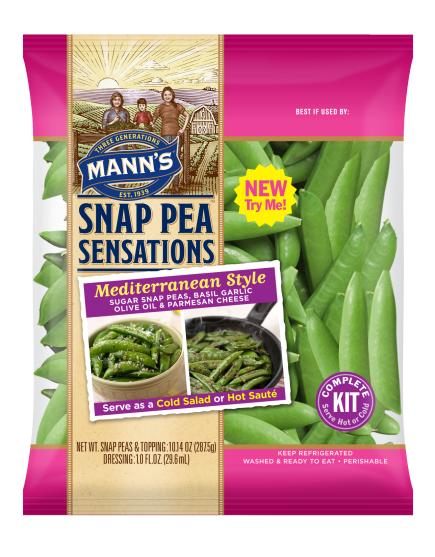
Mann’s Mediterranean Style Snap Pea Sensations™ Kit was named a Supermarket Star by Women’s Health Magazine and is featured in the November issue on newsstands now.

This is the second year in the row that a Mann product has been named a Supermarket Star by Women’s Health. The magazine is sold in the United States and Canada and has a circulation of 1.6 million. The magazine’s demographics match up well with Mann’s target market as the median reader age is 38, college educated and female.

“Mann’s snap peas outsell the competitors’ five to one; we know consumers love them and we also know time-starved parents are looking for creative and healthy meal solutions that are quick and easy to prepare for their families” said Kim St George, director of marketing and innovation. 

The kits are unique due their versatility—they can be prepared as a cold salad or a hot sauté; and served as a side dish, or as an entrée by adding protein.

“We’re very excited about these first-of-their-kind snap pea kits,” St George said. “There are no other vegetable kits on the market with this versatility.”

Mann’s 11-ounce Snap Pea Sensations kits are available in two flavors—Asian Sesame and Mediterranean Style. The Asian Sesame kit includes sesame seeds and an Asian-style dressing; the Mediterranean kit includes grated Parmesan cheese and a basil garlic-infused olive oil dressing. As with Mann’s value-added fresh-cut products, Snap Pea Sensations kits have a 16-day shelf life. The suggested retail price is $3.99 to $4.99.

Mann’s produced a video demonstrating the easy prep involved to produce a Snap Pea “Sensations” cold salad or sautéed dish.

Beginning Nov. 1, the company applied more than 125,000 instant redeemable coupons for $1 off purchase to packages of the Snap Pea Sensations kits throughout US and Canada. The offer will be good through December at stores nationwide.

For more information about Mann Packing, visit veggiesmadeeasy.com.

2016-05-31T19:32:13-07:00November 27th, 2014|

National Cattleman’s Foundation Offering Beef Industry Scholarships

Scholarships Available for Students Pursuing Careers in Beef Industry

Application Deadline is December 19, 2014

It was announced TODAY that applications for 2015-16 beef industry scholarships sponsored by the CME Group are now being accepted. Ten scholarships of $1,500 each will be awarded to outstanding students pursuing careers in the beef industry.

Students studying education, communication, production, research or other areas related to the beef industry should consider applying for the scholarship. Applicants must be a graduating high school senior or full-time undergraduate student enrolled at a two or four year college.

The National Cattlemen’s Foundation administers the scholarship program. Applicants for the 2015-16 beef industry scholarships will be required to write a one page letter expressing future career goals related to the beef industry. They also must write a 750 word essay describing an issue in the beef industry and offering solutions to this problem.

Applications should be submitted by December 19, 2014 and sent to National Cattlemen’s Foundation, 9110 E. Nichols Ave., Suite 300, Centennial, CO 80112. The winning recipients will be announced on January 15, 2015.

Click here for the winners of the 2014 National Cattleman’s Foundation beef industry scholarships.


According to their website, CME Group, is the world’s leading and most diverse derivatives marketplace and where the world comes to manage risk. CME Group exchanges offer a wide range of global benchmark products across all major asset classes, including futures and options based on interest rates, equity indexes, foreign exchange, energy, agricultural commodities, metals, weather and real estate.

The National Cattlemen’s Beef Association (NCBA) has represented America’s cattle producers since 1898, preserving the heritage and strength of the industry through education and public policy. As the largest association of cattle producers, NCBA works to create new markets and increase demand for beef. 

2016-05-31T19:32:13-07:00November 26th, 2014|
Go to Top