Trees and Vines

The Fight Against Food Misinformation

Kavin Senapathy: Correcting Food Misinformation and Alarmism

By Patrick Cavanaugh, Deputy Editor

Kavin Senapathy, science communicator/advocate and contributor to Forbes Magazine, among others, is tightly focused on her goal to debunk miscommunication about human health, as well as genomic, food, and genetic engineering. Senapathy stated, “There is this culture of alarmism,” about food safety and food misinformation versus the science-based reality of our food safety management. “The alarmism and fear is so amplified, people don’t realize how very safe we are right now.”

Senapathy gets her facts from the source, “I speak to as many scientists as possible, and I know how to read and dissect a scientific paper. I know there is a very important difference between cherry picking from one study to support a bias, and looking at the weight of scientific evidence,” she said.FDA, FSMA Food Safety

“I also talk to farmers and I’m learning more about the hands-on practices,” Senapathy said. “California farmers produce a wide variety of fruits and vegetables,” she said, “and we all should be eating more of them.”

“I think a lot of the fear and misinformation take away from the message of eating the right things,” continued Senapathy. “Thinking, ‘I should avoid MSG, I should avoid GMOs or xyz additive,’ really detracts from the most important message—that we should be eating less unhealthy things like sodium and saturated fat, and not too many calories,” noted Senapathy. “We should be eating lots of fruits and vegetables and whole grains.”

And though she lives in Wisconsin, Senapathy says she is amazed by how many fruits and vegetables are available, even in the wintertime. “I can go to the grocery store in February and come home with grapes, strawberries, bananas, and all kinds of fruits and vegetables,” Senapathy said. “You know, we should marvel at the bounty of this more often.”

She’s quick to thank farmers for feeding her family and those of everyone, everywhere. “We forgetwith all the fear and misinformation in social mediathat our food supply is more abundant and safer than it has ever been,” she noted. “We should all be appreciative and thankful for that.”

2021-05-12T11:00:54-07:00May 12th, 2016|

Union Advances Fair Market Access

National Farmers Union Advances Fair Market Access for Growers

By Brian German, Associate Editor

Chandler Goule

Chandler Goule, senior vice president of Programs for the National Farmers Union (NFU)

Chandler Goule, senior vice president of Programs for the National Farmers Union (NFU), introduced his organization,”The National Farmers Union is the second largest general farm organization in the United States. We represent about 200,000 family farmers and ranchers. We have membership in all 50 states, but we’re organized in 32.”

Goule described NFU membership, “We were founded in 1902 down in Point, Texas, so we represent everybody from row crops, to dairymen, to ranchers, to specialty crops, to those who are selling in Community Supported Agriculture (CSAs) . You name it, we’ve got somebody. Bee collectors and honey producers are also in our organization.”

Since its inception, the NFU has been an advocate for helping the family farmer address profitability issues and monopolistic practices by increasing cooperative rights along with advancing fair market access for growers. “We are a federation of states,” Goule said, “so we’re a grassroots organization. NFU could not exist without California Farmers Union and North Dakota Farmers Union and Minnesota Farmers Union. So when you bring all the state farmers union devisions together, that’s what makes up National Farmers Union. It’s a very bottom-up approach.CA Farmers Union

“Of course, with California being the bread basket for the United States and by far the largest in gross domestic product (GDP) in agriculture,” Gould stated, “California Farmers Union membership is very heavy in dairy, has a little bit of viticulture and then specialty crops.”

____________________________________

National Farmers Union is a grassroots, producer-driven organization that believes good opportunities in production agriculture are the foundation of strong farm and ranch families, and strong farm and ranch families are the basis for thriving rural communities. Vibrant rural communities, in turn, are vital to the health, security and economic well-being of our entire national economy.

2016-05-31T19:24:04-07:00May 9th, 2016|

New FFA State Stars Honored

Halley Lauchland Wins FFA Star State Degree in Agriscience Award

By Charmayne Hefley, Assistant Editor

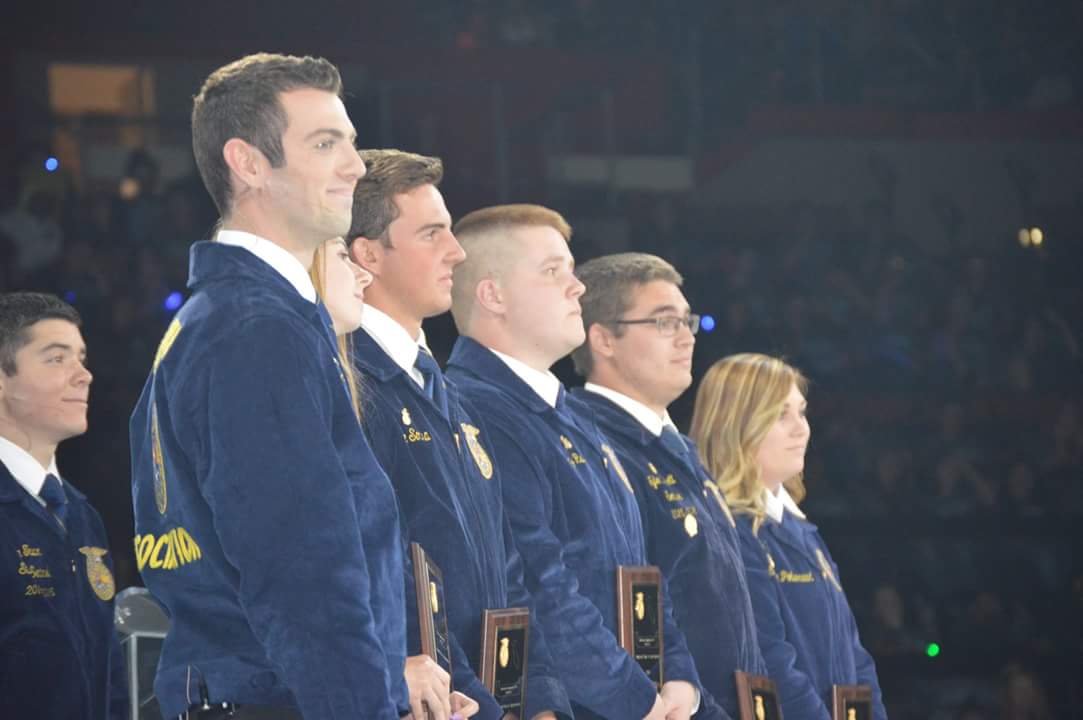
During the opening session of the 88th California Future Farmers of America (FFA) State Convention in Fresno last Saturday night, four California FFA members were honored with the top Star Awards during an onstage ceremony. As reported by the California FFA Association in a press release, each of them excelled in one of four areas:

Andrea Thomas from the Colusa FFA chapter was named the California Star Farmer state winner in recognition of proven leadership skills for an aspiring young farmer. Thomas raises and maintains hogs, cattle and hay.

Halley Lauchland, 2016 FFA Star State Degree in Agribusiness Award winner

Halley Lauchland, 2016 FFA Star State Degree in Agriscience Award winner (Photo Credit: California FFA)

Nitin Gupta from the Tulare FFA chapter was named the California Star in Agribusiness state winner, the highest achievement for a person pursuing a career in agribusiness. Gupta started the business Simple Sand three years ago in which he collects, markets and distributes sand from his family’s ranch to local businesses.

Paul Barcellos, also from the Tulare FFA chapter, was named the California Star in Agricultural Placement state winner, the highest recognition in the state for a young person excelling in job placement in the agricultural industry. Barcellos works alongside his dad at Cain Trucking as a Foreman in the Composting and Air Pollution Control Operations in recycling agriculture products and preventing air pollution.

Halley Lauchland, a high school junior from the Lodi FFA chapter received the 2016 FFA Star State Degree in Agriscience Award, the highest achievement for a person pursuing a career in agriscience.

“My project was cane pruning for the control of Eutypa Dieback in winegrapes,” A fifth-generation winegrape grower, Lauchland told CalAgToday, “The disease is commonly found in cabernet franc finds.”

Lauchland conducted her research in part to help her family’s 18-year-old vines with the Eutypa Dieback disease,  which she defined as “a fungal spore that enters the vine through pruning wounds. This will eventually kill the vine, causing the farmer to have to replant, which costs a lot of money and isn’t efficient.”

Lauchland tested cane pruning versus the commonly-used method of spur pruning to keep the disease at bay. “We tested two rows and found [cane pruning] was a more efficient way to do it, and it was going to save us more money in the long-run.” Spotting her research catching on in local vineyards, Lauchland said  “It seems people are going to the cane prune.”

Lauchland’s research was published in the Lodi District Grape Growers Association Update last year as, “Lodi High School Student to Compete in State FFA Agriscience Fair with Eutypa Dieback Research Project.” Lauchland stated, “That helped put out the word, what this [method] does and how it helps farmers.”

Overjoyed to have been selected to win the Star in Agriscience award, Lauchland said, “Words can’t really describe how I feel right now.”

The California Future Farmers of America (FFA) State Convention was sponsored by PG&E and the J.G. Boswell Foundation, as a special project of the California FFA Foundation.

2021-05-12T11:00:55-07:00April 27th, 2016|

Winegrape Quality In SJV

Nat DiBuduo: Valley Winegrape Growers Must Produce Quality

By Laurie Greene, Editor

Nat DiBuduo, president of Fresno-based Allied Grape Growers believes there are good opportunities for Central San Joaquin Valley winegrape growers. “I think the San Joaquin Valley [winegrape growing industry] will survive because growers are working at producing winegrapes at a higher quality and at a higher price,” said DiBuduo.

“Overall, I think the industry is doing well,” stated DiBuduo, “and we just have to work with our San Joaquin Valley growers to produce a better quality grape. It’s like a chicken and an egg; they’ve got to be able to get paid for that better quality. And of course, growers need a solid contract with a good price to make it worthwhile,” he noted.Allied Grape Growers logo

DiBuduo noted that the Bureau of Reclamation’s initial announcement at the beginning of this month that federal water users will receive merely a five percent water allocation, fortunately, does not affect many of his grower-members. “Most Allied growers are not Westside growers; but they will be severely affected by the groundwater regulations soon to be in place.”

DiBuduo explained the Sustainable Groundwater Management Act is predicted to create major issues for production agriculture. “Oh yes, we’ve got guys who have sold their property because they didn’t have enough groundwater,” he said.

2016-05-31T19:24:06-07:00April 21st, 2016|

Agriculture Science Recognition Awards, Part 1- Megen Morales

Agriculture Science Recognition Awards, Part 1 – Megen Morales

By Patrick Cavanaugh, Deputy Editor

Assemblyman Jim Patterson joined Dr. Sandra Witte, dean of the Jordan College of Agricultural Sciences and Technology at California State University, Fresno (Fresno State) and Lawrence Salinas, Fresno State’s executive director of Government Relations, at the 23rd Assembly District’s 2016 Agriculture Science Recognition Awards on March 17 at Fresno State.

California Ag Today will highlight each of four Fresno State students in the Fresno State Honoree series, Meghan Loper, Megen Morales, Elizabeth Mosqueda and Nick Wolfenden, who were selected from among several students nominated for their dedication to the future of agriculture in the Central Valley.

“These brilliant students represent the best of the best,” said Assemblyman Patterson. “Their devotion to making a difference in our agriculture science community is to be commended and I can’t wait to see what the future holds for them.”

______________________________________

Megen Morales, a senior at Fresno State majoring in enology and chemistry, was honored recently for leading the way in the study of mold in winegrapes. “She’s also helping others in agriculture measure and quantify the amount of mold,” noted Patterson.

After a grapevine-judging contest in high school, Morales knew she wanted to work in the viticulture industry. So for the past three years, she has worked with her enology professors to create a new standard for wineries to follow for the amount of mold that is acceptable in harvested wine grapes. “The current maximum of moldy grapes acceptable in wineries is two percent,” noted Patterson, “but there is no process that accurately determines the level of mold content.” Morales explained, “Right now, you simply look at the grapes and usually determine that it looks like 1.5 to two percent mold.”

“So Megen harvested White Zinfandel Grapes from 15 farms throughout the Central Valley, and brought them back to the lab to study the levels of several types of mold,” noted Patterson. “Morales compiled the data, and her results are now used by large-scale wineries to determine how much mold is in their harvested grapes.”

A member of Central Valley Women for Agriculture (CWA) and a volunteer at the Fresno State Winery, Morales has also helped promote agriculture at Valley Children’s Hospital. As current manager of the laboratory, she trains other students on how to use it.

In fact, Morales has dedicated much of her time to teaching young people about the important role agriculture plays in everyday life. She says her experiences at Fresno State will help her excel in her future as an empowered, humble person, with the skills and mindset to accomplish great things. She hopes to work as an enologist at a major winery and eventually plans to become a senior wine maker. Morales’ ultimate goal is to serve as a role model, a mentor to women in agriculture, and to advocate for agricultural education to preserve the agricultural world of tomorrow.

“My passion started with crop production and it evolved towards viticulture,” noted Morales. “I really enjoyed chemistry in high school. Combining the two fields [agriculture and chemistry] was a challenge, but then I found enology. It has been really exciting learning how to make wine.”

“The winegrape scan spectrum we are developing will enable wineries to scan one sample of grapes coming in and better quantify the amount of mold,” Morales elaborated. “Since wine is filtered before it goes into a bottle, mold has not been a big problem. However, [mold] does affect the sensory impact of wine, so once you get above five percent mold you start to smell a funky, sweet, almost vinegary smell. It doesn’t affect the palate, but it does affect the nose,” she stated.

 ______________________________________

2021-05-12T11:05:57-07:00March 24th, 2016|

Citrus Growers Form ACP Management Areas

Commercial Citrus Growers Form Local ACP Management Areas

By Charmayne Hefley, Associate Editor


Commercial citrus growers are banding together to prevent the spread of the citrus-deadly Huanglongbing (HLB) disease and the pest that spreads it—the Asian Citrus Pysllid (ACP). Beth Grafton-Cardwell, an IPM specialist and research entomologist at UC Riverside and Director of UC ANR Lindcove Research & Extension Center, said growers are forming ACP management areas to prevent ACP from spreading HLB.

Elizabeth E. Grafton-Cardwell

Elizabeth E. Grafton-Cardwell

“ACP management areas are being formed by the citrus industry and community,” Grafton-Cardwell said. “They’re basically saying, ‘Let’s get together. Let’s form these groups of growers—25 to 35 growers in an area. Let’s work together as neighbors to treat across a large area and get more of the psyllids killed than if we each treated individually at different times.’”

HLB is a serious concern to growers, according to Grafton-Cardwell; the disease has already devastated the citrus industry in Florida. “We want to prevent that from happening here,” shel said.

According to the California Department of Food and Agriculture, ACP notices posted thus far in the first quarter of 2016 include the following areas:

            COUNTY                                                                 CITY

   Fresno County    Fresno
   Kern County    Bakersfield, Shafter, Wasco
   Imperial County    Bard, Brawley area, Calipatria, Niland, Winterhaven, Zone 7
   Los Angeles County    La Puente, San Gabriel
   Riverside County    Hemet, Riverside, San Jacinto
   San Bernardino County    Cadiz
   San Diego County    De Luz, Escondido, Fallbrook, Ramona, San Diego
   San Joaquin County    Stockton
   Santa Barbara County    Areawide, Buellton, Casmalia, Garey, Orcutt, Santa Maria, Sisquoc
   Santa Clara County    Milpitas, San Jose
   Stanislaus County    Oakdale
   Tulare County    Porterville, Strathmore
2021-05-12T11:03:03-07:00March 17th, 2016|

Sandra Witte, New Ag Dean at Fresno State

Dr. Sandra Witte Named Dean of Jordan College at Fresno State

(March 16, 2016) – Dr. Sandra Witte, who has been serving as interim dean of the Jordan College of Agricultural Sciences and Technology at Fresno State, has been appointed permanent dean, effectively immediately.

Dr. Lynnette Zelezny, provost and vice president for Academic Affairs, said Witte’s exceptional work as interim dean made her the best person for the position.

“We conducted a yearlong national search for a dean but did not find the right candidate for this important position,” said Zelezny. “In the meantime, it became clear to me, the faculty, staff and our strong partners in the agriculture community that Dr. Witte was the right candidate. I’m pleased she agreed to stay at Fresno State as permanent dean.”

Zelezny added: “This is a critical time for the Jordan College as we prepare for the opening of the Jordan Agricultural Research Center this spring and continue our laser-focus on crucial issues related to water and sustainability. I am confident Dr. Witte will lead the college to increasing national prominence.”real JCAST Logo

Witte has taken an unconventional route to the dean’s position, starting her career as a registered dietitian and serving as a professor and chair of the Department of Food Science and Nutrition, one of seven departments in the Jordan College.

“In the Jordan College, we often talk about offering programs from farm to fork and all the business in between,” said Witte. “While most people think of agriculture from the farm end, my connection is clearly on the fork end. I have always had an appreciation for traditional agriculture, and in my time at Fresno State, that has bloomed into a passion. After all, where is the food without the farmer?” she said.

Witte joins a growing number of women in agricultural leadership positions that traditionally have been held by males in universities, industry and commodity groups in the U.S.

The Jordan College maintains an enrollment of approximately 2,400 undergraduate and 100 graduate students from diverse backgrounds from throughout California, the U.S. and the world. Undergraduate, graduate and continuing education programs are offered in the major areas of agricultural business; animal sciences and agricultural education; child, family and consumer sciences; food science and nutrition; industrial technology; plant science; and viticulture and enology.

Faculty and students conduct applied research and public service in selected areas of agriculture, food sciences, industrial technology and family sciences. Students engage in learning science, technology and management in the classroom and by experience on the 1,000-acre on-campus University Agricultural Laboratory.

Witte has served as interim dean since October 2014. Previously, she jointly held the positions of associate dean of the Jordan College and dean of the Division of Graduate Studies. She joined the Fresno State faculty in 1992 and took her first administrative assignment in 2007.

She completed her bachelor’s degree in foods and nutrition at California State Polytechnic University, Pomona; master’s degree in home economics, nutrition and dietetics option at Fresno State; and her Ph.D. in food systems management at Oregon State University, Corvallis.

____________________________

Photo: Sandra Witte, dean of Agricultural Sciences and Technology at Fresno State (source: Fresno State

2016-05-31T19:24:10-07:00March 16th, 2016|

National Days Celebrations at Fresno State Farm Market

Fresno State Farm Market Hosts National Day Events

By Charmayne Hefley, Associate Editor


Fresno State’s Rue and Gwen Gibson Farm Market hosted its Annual Pistachio Day on February 26 in honor of World Pistachio Day. Miles Robinson, a student market lead, said, “We’ve been working with American Pistachio Growers (APG) to market this campaign and give away pistachio samples, all courtesy of APG. We are also raffling a gift basket with several of our products and APG items as well.”12821589_10153999748978330_676533612082576193_n

Robinson said the Fresno State farm market plans to host monthly events to feature the store and student products, including that very fowl day, Poultry Day, on March 18, and National Raisin Day on April 29. “For Poultry Day,” Robinson said, “we’ll be sampling Foster Farms chicken in a couple of different recipes. We look forward to having people actually taste our chicken. We will also have a chicken dance contest. For National Raisin Day we’re partnering with the California Raisin Board to bring information, samples and have a fun time.”

Robinson said the student-run farm market, which specializes in student-made products, is in the process of creating new recipes for its coated nuts and raisins. “Over the past year, we’ve been slowly rolling out new recipes for our milk chocolate raisins, milk chocolate almonds, milk chocolate cabernet raisins and dark chocolate raisins,” Robinson said. “All of our products will have brand-new recipes, 100 percent Fresno State-done.”

2016-08-10T11:56:30-07:00March 11th, 2016|

Falcons Work in Agriculture, Too

Farmers’ Other Best FriendFalconsWork in Agriculture, Too

By Charmayne Hefley, Associate Editor

Charmayne Hefley, California Ag Today broadcaster and associate editor, and farmers’ other best friend – the falcon.

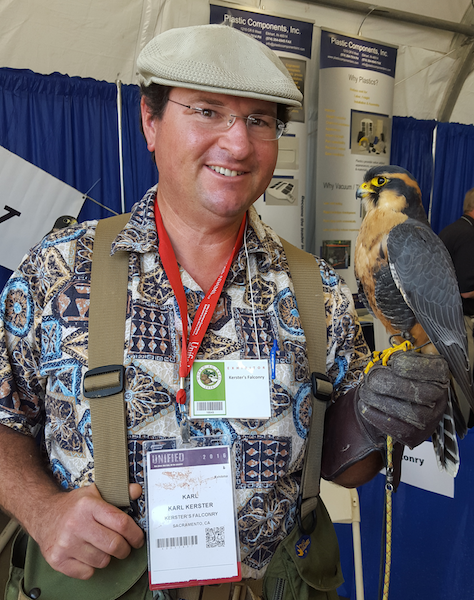
Agriculturalists have found ways to employ some animals to assist them in the fields. Karl Kerster, owner of Sacramento-based Kerster’s Falconry, employs farmers’ other best friend, falcons, to keep agricultural products safe before and during harvest. More specifically, Kerster’s five falcons perform bird abatement—removal of nuisance birdsto protect cherries, berries and grapes. Pest birds are defined as sparrows, swallows, finches, starlings, pigeons, blackbirds and more.

“We work to protect the farmer’s crop,” Kerster said, “and we really enjoy doing it—which is a plus when you’re having to do it for a hundred days straight to keep a crop safe. We start when the fruit starts to ripen enough that the birds are going to attack, until the crop has been substantially harvested. I work five birds, and I have several more in reserve, but the five that I work keep me very busy.”

Kerster, a master falconer, has been serving as a falconer since 1996, and his birds have a high success rate at keeping pest birds away from crops.“We are 99 percent successful in protecting a crop in most situations,” Kerster said. “We also take care of any other bird problems that may or may not be on the berries, cherries and grapes that we normally do. Any customer who wants us to dispose of a problem, we’re ready to help.”

______________________________________

Becoming a falconer is not an “overnight” achievement and is not for the meek. The first of the “up-front questions you need to be able to answer to yourself,” according to the California Hawking Club is, “Will you, can you, commit part of your waking hours to a creature who at the very best of times will merely tolerate your presence, is as affectionate as a stone, and at the worst of times will cause you heartache and puncture wounds? Can you commit to an average of a half-hour a day, every day, and two to four hours on a hunting day, regardless of school, family, or job – forever?

The eight steps required to become a falconer in the state of California are provided by the California Hawking Club.

Becoming a Master falconer, according to the North American Falconers Association, “takes at least seven years; finishing your apprenticeship alone will take at least two.”

______________________________________

Falconry is a heavily-regulated practice, governed by federal and state laws and regulations.  For more information, go to:

California Natural Resources Agency Department of Fish and Wildlife

California Hawking ClubCalifornia-Hawking-Club-logo

Kerster’s Falconry 

Electronic Code Of Federal Regulations

______________________________________

2021-05-12T11:03:03-07:00February 29th, 2016|

PCA Training At UC Davis

UC Davis Offers Pathway to PCA Training

By Laurie Greene, Editor


Frank Zalom, distinguished professor of entomology, agricultural experiment station entomologist, and extension specialist at UC Davis, teaches a class for students that forms a pathway to becoming a Pest Control Advisor (PCA). “It is the only class that a lot of them had ever taken in entomology,” said Zalom, “so we try to structure it to give them a good, solid background in entomology. Then we lead them through all the different pest management options. We even bring in someone from the California Association of Pest Control Advisors (CAPCA) Pathway to PCA program for the very last lecture.”

Zalom, whose research interests include integrated pest management (IPM), tree crops, small fruits and vegetable crop entomology, wants to provide a valuable education to his students. “Most of the kids taking my classes are interested in taking the PCA exams and there is a huge opportunity for those students out in the future.”

“We teach them about integrated pest management (IPM) and the pests,” Zalom noted. “Then we show them some of the many career opportunities for PCAs,”  he said, adding. “There will always be a big need for professional PCAs to help protect our crops from pests and diseases. They assist growers all over the state.”

________________________

Links:

California Association of Pest Control Advisors (CAPCA)

CAPCA Pathway to PCA

2021-05-12T11:03:03-07:00February 24th, 2016|
Go to Top