Dairyman Cuts Diesel Emissions 92%

Kings County Dairyman Cuts Diesel Emissions 92% With Electric Mixer

By Laurie Greene, Editor

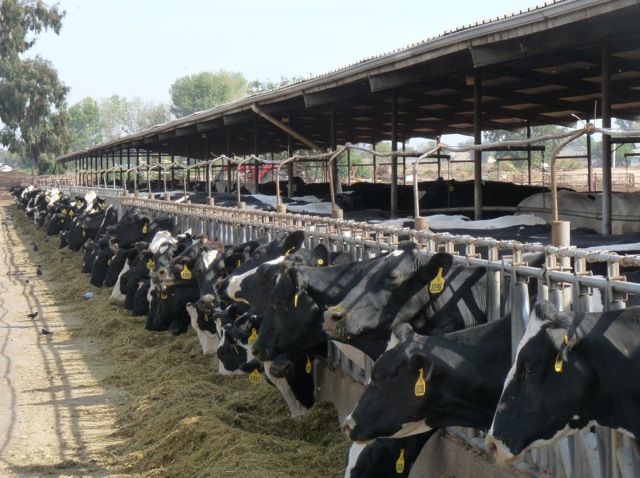
On his dairy in the Kings County town of Hanford, Philip Verway reduced his diesel consumption a remarkable 92% from 7,000 to 500 gallons in a given three-week period. His innovative secret to cutting diesel emissions is converting a diesel-powered commodity mixing machine to an electric mixer.

Kevin Abernathy, director of environmental services for the Milk Producers Council, said, “Rob VandenheuvelGeneral Manager for Milk Producers Council, Philip and I helped him get a grant from the San Joaquin Valley Air Pollution Control District, a state-appointed board which aims to minimize diesel exhaust output. We put together a proposal, submitted it, and their governing board actually approved the grant. What began as a concept on paper led to the reality of the processes being implemented on-farm. We had it up and running in about three months. Most importantly, the end results are not only meeting, but exceeding our expectations,” said Abernathy.

The entire operation dramatically reduces total nitrogen oxides (NOX gases), pollutants in the San Joaquin Valley, “Our initial expectation based on the modeling was 22 tons of NOX emissions.” The post-project NOX rates were about two tons—a major reduction.

Abernathy said Verway worked with contractors Duport and Supreme to engineer the electrification of the vertical mixers and built some fail-safe components into the system. Impressed, Abernathy said, “Based on what I have seen, they have done a remarkable job, particularly on the multiple fail-safes. Hats off to Duport and Supreme for coming up with technology that works day-in and day-out, 365 days of the year.”

Abernathy also admired the ingenuity in the California dairy industry, “They continue to come up with some of the most extraordinary ideas. It is an absolute blessing to work with them, and they make my job so much fun with projects like this!”
2016-05-31T19:27:05-07:00November 2nd, 2015|

Winegrape Rootstock Trials

Winegrape Rootstock Trials for Pest Resistance and Vine Productivity

By Patrick Cavanaugh, Deputy Editor

Larry Bettiga, a viticulture farm advisor with UC Cooperative Extension, Monterey County, is working with county growers on winegrape rootstock trials to increase vine productivity.

“Several things have happened,” noted Bettiga,“we are replanting vineyards on former vineyard lands, where a build-up of soil pests already exists. Farmers used to grow a lot of beans and tomatoes in the Valley, so we’ve had a lot of root-knot nematode populations from past cropping patterns.”

“We’ve recently seen ring nematode populations developing at multiple vineyard sites,” Bettiga continued. “With the loss of more effective fumigants, and then the loss of post-plant-type nematicides, the use of nematode-resistant roots is becoming more critical to the success of replanting these vineyards. We have hopes that Andy Walker, a UC Davis viticulture professor and grape breeder, is going to supply us with some better options than we currently have.”

“We have a site where we are comparing five new rootstocks that were released from UC Davis with a number of our standard rootstocks. We are just starting that work, so obviously we have to look at them for several years to get a good feel for how those stalks will fit in comparison to what we are now using,” he noted.

2016-05-31T19:27:05-07:00October 30th, 2015|

Health Benefits of Pomegranates

Dong Wang on Health Benefits of Pomegranates

By Charmayne Hefley, Associate Editor


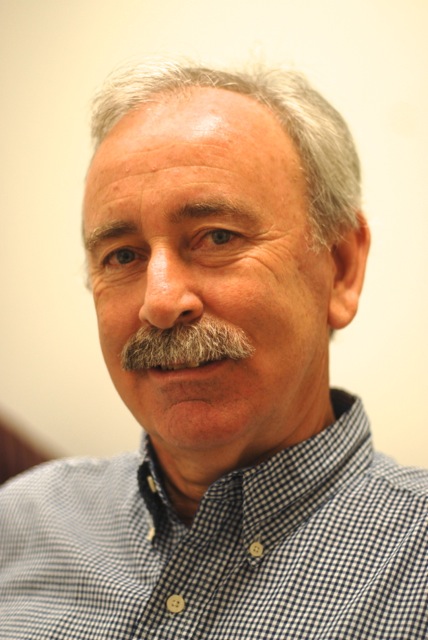
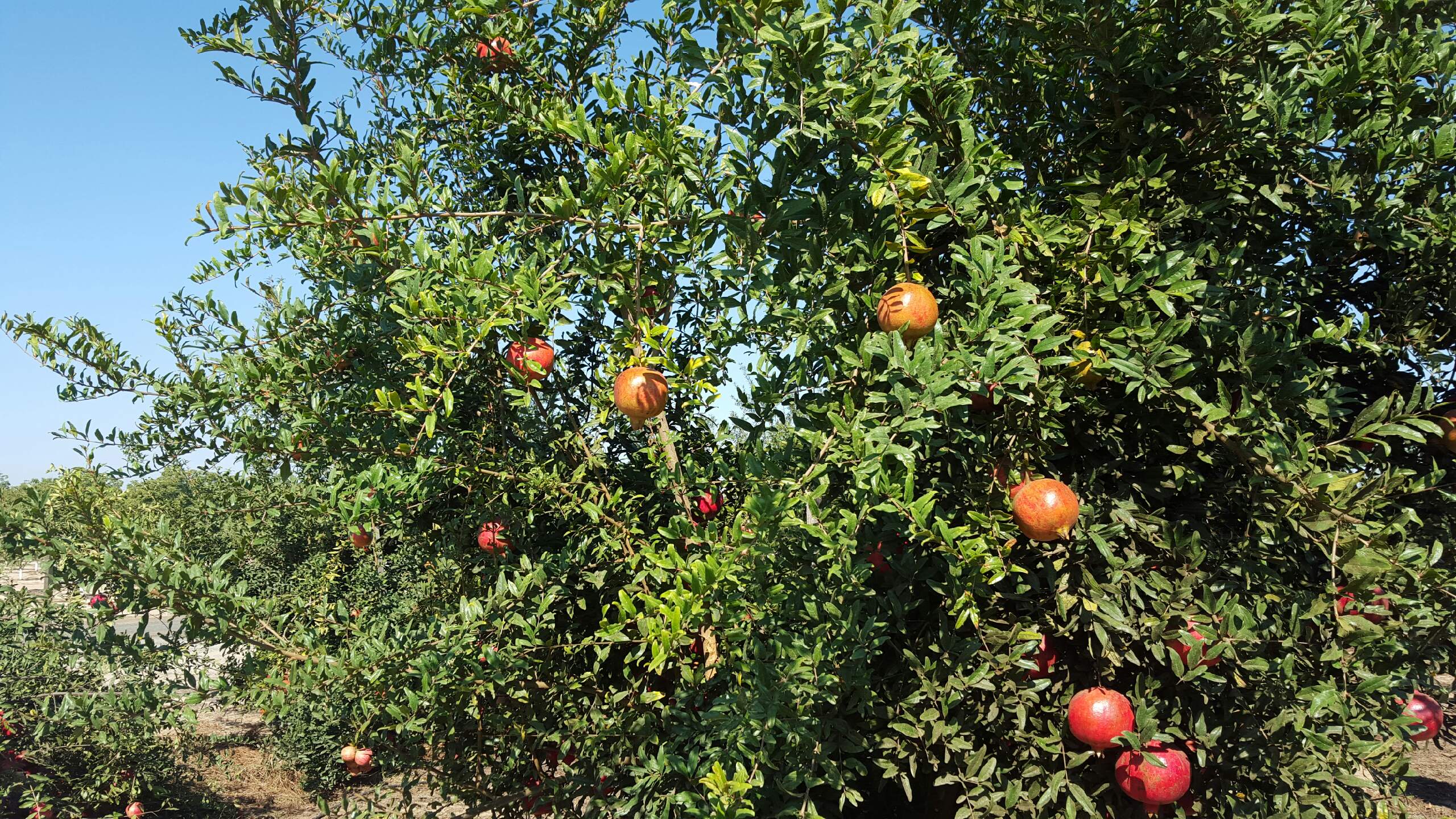
As the demand for healthy food items increases, farmers are choosing from among a larger diversity of crops to grow. Dong Wang, research leader with the United States Department of Agriculture Research Service in Parlier, spoke at the 2015 UC Kearney Ag Research and Extension Center (KARE) & USDA-ARS Pomegranate Field Day last week.

Wang said “the International Society of Horticultural Sciences[1] organized a conference in 2013 on pomegranates and other minor fruits. Attendees from about 20 countries presented their pomegranate research findings on crop production, yield, quality, and genetic aspects of different species, including cultivars. They also presented findings relating to health benefits and the biochemistry of pomegranate products.”

Researchers and experts in California and around the world continue to explore producing a plant variety with the genetic potential for higher yield. And while increased marketable yield is important, Wang said researching pomegranate health benefits and phenolics—compounds with antioxidant propertiesmay be more beneficial than the absolute yield, “so people are researching multiple aspects of the topic.”

Dong Wang, research leader with the USDA-Agriculture Research Service in Parlier

Dong Wang, research leader with the USDA-Agriculture Research Service in Parlier

While the U.S. has a relatively small market for fresh pomegranates, pomegranate juice and secondary products, which are more common in the U.S., help to increase the fruit’s marketable yield. Wang explained some Americans eat fresh arils atop salads and other dishes, but those not-so-perfect on-the-surface pomegranates will still be desirable for the fresh market because they still contain beneficial compounds when processed. This research on phenolics, vitamins, and other compounds found in the fruit has been performed not only on the juice and the arils, but also in high-concentrate peels.

The International Society of Horticultural Sciences organized a conference in 2013 on pomegranates and other minor fruits. Conference attendees from about 20 countries presented their pomegranate research findings on crop production, yield, quality, and genetic aspects of different species, including cultivars. They also presented findings relating to health benefits and the biochemistry of pomegranate products.”

As a result of the 2013 International Society of Horticultural Sciences Conference in 2013 on pomegranates, Wang co-authored a proceedings book published by the International Society of Horticultural Sciences in July 2015. Co-written with Zhaohe Yuan, Nanjing Forestry University and Erik Wilkins, Paramount Farming Company, the volume, “Proceedings of the Third International Symposium on Pomegranate and Minor Mediterranean Fruits,” covers the following major areas of research and state-of-the-art technology: Physiology and Biochemistry, Secondary Metabolism and Human Health, Integrated Pest Management and Disease Control, Marketing and Economics, Genetic Resources and Breeding, Cultivation Techniques, and Post-harvest Technology. According to the USDA, “The book serves as the largest collection of the most current knowledge on pomegranate science and technology in the world.”[2]

_____________________________________

[1] International Society of Horticultural Sciences

[2] USDA ARS


2016-05-31T19:27:05-07:00October 30th, 2015|

CEO Council on Sustainability and Innovation Launched

Agribusiness CEOs and Bipartisan Policy Center Launch CEO Council on Sustainability and Innovation


Washington, D.C. – Leading agribusiness CEOs announced TODAY they are joining together with the Bipartisan Policy Center (BPC) to launch the CEO Council on Sustainability and Innovation to improve agriculture and food production sustainability.

Leaders of DuPont, Elanco, Kellogg Company and Land O’ Lakes joined the Council, which will research, collect and amplify innovative approaches in the agribusiness industry, over the next several months, to combat and adapt to the realities of increasing climate volatility, a growing population, and other threats to a stable food supply.

“In the next 35 years, experts anticipate demand for animal protein will climb by 60 percent as the population grows in size and affluence. Already demand for milk, eggs and poultry is outpacing anticipated expectations,” said Jeff Simmons, president, Elanco. “We can’t just rely on the public sector to address these challenges. The private sector must deliver innovative solutions that can help farmers sustainably meet our global food needs.” 

“Achieving a sustainable future food supply and responding to the challenges posed by climate change are dependent on our collective actions,” said John Bryant, chairman and ceo, Kellogg Company. “Kellogg and others in our industry have a role to play in sharing innovative solutions and inspiring others to progress along their own sustainability journey.”

“To feed a growing global population, the food and agriculture industry must continue to increase agricultural productivity while facing climate variability and resource constraints,” said Chris Policinski, president and ceo of Land O’Lakes, Inc. “By working together, we can be more effective and efficient partners to enable a sustainable and productive supply chain.”

“The cost and availability of food is an issue of critical importance to all Americans,” said Jason Grumet, president, BPC. “The council will help kickstart a more robust national conversation about what’s already being done to promote sustainable food production and what more needs to be done.”

Although there is extensive industry research into various sustainability practices, there is little collective understanding of the strategies being deployed, nor is there public appreciation of adaptation challenges, mitigation opportunities, and the importance of agriculture in what must be a global conversation. The council will highlight and promote these innovative efforts.

The council’s work will culminate in a public report to be released in 2016.

2016-05-31T19:27:05-07:00October 29th, 2015|

Replanting Trees as Harvest Ends

David Doll on Replanting Trees

By Laurie Greene, Editor

As harvest comes to a close for many tree crops, the time for replanting trees is swiftly approaching. David Doll, a UC Cooperative Extension farm advisor in Merced County, said that if California receives significant rain this year, the replanting process in orchards would be more difficult.

“If we are potentially coming into a wet winter, it’s going to provide challenges in establishing new orchards,” Doll said. “In the case of heavy rainfall, it’s important to keep a few things in mind and plan accordingly. First, if we’re doing any type of soil modification, we need to get a little bit of moisture to help the soil settle.”

Doll said second step is ‘pulling’ berms—the small hills or walls of dirt or sand in an orchard created to divert rain and irrigation water from the tree trunk. He explained, “We want to pull them before the soil gets too wet. We don’t want to walk into a heavy soil field, such as clay or clay loam, and pull berms because in doing so do, we would actually slick that soil over and have to deal with compaction and future issues with the orchard.”

“Third, when we start planting our trees,” Doll said, “it’s important to make sure that we dig a proper hole with wet soils.” Doll warned if you don’t spend the time to dig a hole,  you can ‘glaze’ the soil or form a crust on the sides of the holes, particularly in clay soils, leaving a hard, compact surface that is impenetrable to young roots. He advised to fracture or scratch glazed soil on the sides of the hole with a shovel or rake before filling in to ensure proper root growth.

Doll also said that when planting, the graft union—the point on a plant where the graft is joined to the rootstock—needs to be kept aboveground. “Countless times I’ve seen people plant the graft union below the ground,” said Doll. “Or they’ll plant the tree, pull up a berm, and actually put the graft union below the ground. Keeping the graft union about one hand’s width above the soil line will ensure the graft union remains aboveground as the tree settles.”

“Lastly, if machine planting in very wet clay loam soil, clods [lumps] and air pockets may form,” Doll said. “That’s problematic. The same thing also may occur with hand planting. It’s important to make sure the planters are digging a properly-sized hole and the roots need to be sufficiently covered. The soil needs to be broken down and then replaced around the tree. Finally, to ‘tank’ the tree, apply about 4-5 gallons of water after replacing the dirt to reduce the air pockets and allow the tree to get a good, solid start.”

2016-05-31T19:27:05-07:00October 28th, 2015|

Rossi Tackles MRL Harmonization

Lois Rossi Tackles MRL Harmonization

By Patrick Cavanaugh, Deputy Editor

Lois Rossi, who signed off on nearly all crop protection products at the United States Environmental Protection Agency (EPA) for nearly 37 years, spoke to attendees at the recent Maximum Residue Levels (MRL) Harmonization Workshop in San Francisco. Rossi gave her thoughts on the need for MRL harmonization throughout the world.

Rossi was responsible not only for the registration of all conventional pesticides but also for the re-evaluation of approximately 400 active ingredients. Since 2004, she served on the Codex Committee on Pesticide Residues (CCPR) and was a member of the US delegation to the Organization for Economic Cooperation and Development (OECD) Working Group on Pesticides and the Registration Steering group.

“There are process challenges from Korea, Taiwan, the EU, and Japan,” said Rossi, adding some are so difficult that not much can be done because of policy and regulation challenges. “Of course,” she explained, “I will suggest some harmonization opportunities, of which there are a plethora, and there is even a new one now with the Crop Group MRL. Just as you think you nailed that MRL calculator, somebody comes up with a different way,” she noted.

Rossi said at some point the industry needs to figure out how to tackle more of its impediments. “We have tackled some, but I don’t think everyone is there yet.” Rossi suggests information is probably the hardest hurdle to manage because there are so many foreign journals and varieties of global websites. “Like I said,” she explained, “the global MRL database has certainly been a lifesaver for many of us. But to keep up with regulations and procedures from countries to which our growers export commodities is somewhat of a full-time job for many, let alone those whose livelihoods depend on exports or who are dealing with MRLs.”

Determining and understanding different data requirements are also challenging. Rossi noted registrants struggle to determine not only how many field trials a particular country requires, but whether they can be conducted within or outside of the country. Some countries require six, some four. Some regulations vary if it’s a minor crop or a major crop. Rossi said keeping up with these requirements, updated testing methods, NGOs doing their own testing, as well as improved technologies that measure smaller amounts of residues is difficult. So, going to one place to figure it all out would be great.

“And then there is the wonderful world of Codex*, particularly with its capacity limitations. Rossi believes the Codex process has improved, but not its capacity. “That’s pretty much as old as Codex is,” she said.

“Some countries have default MRLs that differ, and some have private standards, which will take hold if the public loses confidence in the public standards and the national processes,” Rossi said. “So countries are establishing their own MRLs because of public pressure; consumers want safe food and they want their government to guarantee them safe food. If that confidence is lost, you will probably still have standards, but you will probably have less control because you are going to have private standards.”

*”The Codex Alimentarius or “Food Code” was established by FAO and the World Health Organization in 1963 to develop harmonized international food standards, which protect consumer health and promote fair practices in food trade.”  Source: C O D E X  A L I M E N T A R I U S, http://www.codexalimentarius.org/)

2016-05-31T19:27:05-07:00October 27th, 2015|

Groundwater Recharge at Terranova Ranch

Major Groundwater Recharge Program at Terranova Ranch Progresses

By Patrick Cavanaugh, Deputy Editor

Don Cameron, manager of Fresno County-based Terranova Ranch has been working with the Kings River Conservation District (KRCD) on a groundwater recharge plan for nearly 20 years to convey floodwaters from the Kings River across Terranova Ranch and other properties in the area. “It has been a long, hard, committed struggle,” said Cameron, “but in 2011, we got Natural Resources Conservation Service (NRCS) involved.

“Once we submitted our grant application to the California Department of Water Resources (DWR), they reviewed it and awarded us a $5 million grant, which really got the project off the ground,” said Cameron.

“We are in the third year of work with the grant and we are currently doing the environmental studies with California Environmental Quality Act (CEQA). We are still very much involved in the engineering phase and we are putting a lot of agreements together with all the neighboring agencies that we have to work with,” Cameron said.

Logistically, Terranova Ranch is in an ideal location to capture potential floodwaters from the Kings River. Adjacent to the North Fork of the Kings River where floodwaters move though the James Bypass to the Mendota Pool, Terranova Ranch, provides the operation a unique opportunity in terms of groundwater recharge.

“We are taking farmland that is in production, and when the floods come, we will direct floodwaters across that land and neighboring land, to recharge the groundwater in our fields,” said Cameron. “We have proven that we can recharge in existing vineyards and tree-crop orchards, as well as in tomato, onion and carrot fields before we plant. We can use the floodwater across our farmland so that we do not need a dedicated basin dug out just for a recharge.”

“We know we can recharge anywhere on our land,” explained Cameron. “We can even turn off our pumps and use the water on the land to irrigate, through our drip systems. There are a lot of different ways to attack the problem. We think this is the best fit for our area, and we hope to be successful in rebuilding our groundwater supply,” said Cameron.

“The plan is to dedicate about 250 acres of ground for recharge,” said Cameron. Low levies will be built around the land when floodwaters are anticipated. We may have crops planted on the fields,” but Cameron hopes to be able to predict floods prior to planting a crop. Nevertheless, Cameron said, “We will flood crops if we need to.”

When the fields are flooded, the water may be as much as 2 to 3 feet deep, or as little as six inches deep. But the goal is to keep the water continuously on those fields to continue the recharge.

And since this is a large project involving state money, CEQA must be involved. Cameron emphasized, “We want to be sure that there is no environmental damage to any possible endangered species anywhere near our farm or near the project we are doing. There are state and federal laws that we have to abide by and so we need to jump through those hoops to get the project approved to completion,” said Cameron.

“We have been working with the project for a long time and we think its time has come,” said Cameron. “We are in the fourth year of a drought now and there is a lot of interest in putting water underground now, rather than building dams. We think dams are necessary as part of the overall water storage for irrigation, but we need both aboveground and below-ground storage.”

Cameron contends this groundwater recharge plan could improve groundwater quantity and quality fairly quickly, and be implemented faster than trying to build a large dam in the state. “We want to do our part here,” he said. “We would hate to see all the floodwater flow by during flood periods. It’s smarter to capture those stormwater flows on the land and into the ground water reservoir. We think it’s a real win for the whole state,” he said, adding there has been a lot of interest in duplicating this type of project throughout the state.

Cameron noted the project is perfect for the Sustainable Groundwater Management Act, which went into effect Jan. 1, 2015. “We are going to be ahead of the game on this, which is where we want to be,” he said.

Yet, not fast enough. Though a sizeable El Niño may pound California this fall and winter, bringing potential floodwaters to many rivers, the paperwork for the Terranova Ranch recharge program will not be completed in time. Cameron and the KRCD have been pushing to complete the project, but the agencies that need to sign off are numerous, including:

  • California Department of Transportation (Caltrans) – because floodwaters will be moving to additional landowners east of 145.
  • Pacific Gas and Electric Company (PG&E) – because water will need to flow under a natural gas pipeline.
  • U.S. Army Corps of Engineers – because a major cement structure with gate valves must be in place for the floodwater to be extracted from by-pass. “This will essentially mean that the levies will be breached,” said Cameron.

Again, the floodwaters will be flowing north and to the east, to several landowners in the region. Cameron and KRCD have been doing all the setup for everyone, not just themselves. “We hope, in long term, to expand the recharge project to 16,000 acres,” said Cameron.

2016-05-31T19:27:05-07:00October 26th, 2015|

Temperance Flat Dam Will Solve Sinking Soil

David Rogers: Temperance Flat Dam Will Solve Sinking Soil

By Charmayne Hefley, Associate Editor


Speaking at last week’s California Water Commission meeting in Clovis about the need for water storage, Madera County supervisor David Rogers voiced the solution to land subsidence caused by groundwater depletion:  the Temperance Flat Dam.

“We’re losing our groundwater so rapidly, the soil is sinking beneath us in a geological process called subsidence,” Rogers said. “Water is flowing out to the ocean from the San Joaquin River system, when in reality, that water needs to be delegated and allocated to farms so they don’t have to pump groundwater.”

“We’re losing the river and it’s a moot issue. We need surface water delivery; that has to happen. We cannot continue this way or we will lose the river, the communities, and the farms. There’s no question that Temperance Flat is the answer to this problem.”

Central Valley land subsidence is not new. In the mid-1900s, subsidence of the soil was occurring much like it is today. “Between 1937 and 1955,” Rogers explained, “the ground sank 28 feet in Mendota, Fresno and Madera Counties and similar regions.”

The federal Central Valley Project (CVP), which stretches 400 miles from north to south, was organized and built back then to solve the extreme and recurring water shortages, land subsidence and flooding. Operated by the U.S. Bureau of Reclamation, and considered one of the world’s largest water storage and transport systems, the CVP now consists of 20 dams and reservoirs, 11 power plants, and 500 miles of major canals, as well as conduits, tunnels, and related facilities.

“The very purpose of the CVP,” Rogers emphasized, “was to stop the ground from sinking beneath our feet. We are currently in the same situation, and the much-needed extra storage is going to be created by the Temperance Flat Dam. It is the solution. It is what this Valley needs. We need it now. We don’t need it tomorrow; we need it—yesterday!”


Categories

U.S. Bureau of Reclamation

2016-05-31T19:27:06-07:00October 22nd, 2015|

Record Walnut Crop

New Record Walnut Crop:  575,000 Tons

By Patrick Cavanaugh, Deputy Editor


In a recent interview with Dennis Balint, executive director and ceo of the California Walnut Board, Balint discussed the Board’s promotion efforts on what has become another record walnut crop, grown on approximately 300,000 acres in the state.

California Ag Today (CAT): Despite the drought, the valiant walnut growers of California have produced yet another record crop of 575,000 tons, up one percent from 2014’s crop, and crop quality is reported to be excellent. How does that relate to overall supply?

Balint: This increase represents 5,000 additional bearing acres. Last year, the world availability was up about 140,000 tons higher than the previous year. We knew that we could absorb incremental production of 20,000 or 30,000 tons a year; however, 140,000 tons was a bit of a surprise. Couple that with the fact that China’s economy isn’t today what it was a couple of years ago. That has hurt us a bit.Walnut trees

So at any rate, that means we are going to have a record total of availability this year, and I think we are going to see prices moderate. Now, the really good news is the industry had some foresight in approving a huge budget to market the product, so we’ll be having a serious marketing campaign in the 2015-2016-crop year.

CAT: Walnut consuming promotions?

Balint: The board will continue promoting walnuts with print and television campaigns, as well as public relations efforts through Edelman Public Relations. That will continue on two fronts; one is consumer appeal, like recipes, and just raising overall awareness regarding the versatility of walnuts; but second and most importantly, Edelman is in charged with promoting health. Health continues to be a very important card in promoting our product to consumers and health professionals as well.

CAT: It is always good that people think of health when they think of walnuts!

Balint: Yeah they do. It is amazing how that number has changed over the years.

CAT: Is eating more, better?

Balint: You know we have a daily range. When we do studies, researchers will always look at the composition of the product and, depending on what they are expecting, they will adjust accordingly. So we have studies that are based on 1 ounce, 1.5 ounces, and 2 ounces daily. So it really depends on the end points they choose to look at.

We try to never talk about compounds because we like to talk about the whole walnut, but occasionally researchers who are deconstructionists suspect a particular compound. Then we have to analyze it down to the nitty-gritty so somebody can put it in a pill. When that happens on occasion, researchers say, “Well, we really need to feed 2 ounces.” And in some cases, 2 ounces in the short-term works very well. In the long-term, being practical, 1 to 1.5 ounces is good.

CAT: Please go back to the advertising budget. Is it mainly domestic?

Balint: It is all domestic. The export program will remain intact—no changes there. We will still have good programs in a number of countries overseas, but all of the increased production is going into the domestic market.

CAT: Do we need to increase per capita consumption to handle the oversupply issue?

Balint: That is a good question. What we need is the following: We estimate, and we don’t have hard numbers, not much more than one in five households is purchasing and using walnuts on a regular basis. So that leaves a lot of room for growth. Our campaign has been designed to appeal to light and non-users, and not just the core consumer who is already loving walnuts and buying them on a regular basis, to expand our user base.  We are doing so by presenting walnuts as an ingredient in salads, vegetable side dishes, entrees, and of course as a snack. As a matter-of-fact, we are waiting on copy testing results in the next week or two.

CAT: Good. And walnuts make everything better and that’s what it is all about, isn’t it?

Balint: Absolutely. Walnuts are a little added touch that makes food not only more interesting because of the color, texture, and taste, but also because it is healthful. All of our ads are going to have the heart check logo. I want to reemphasize health research will still capture a lot of media on its own. That will continue, ‘no reduction there.

CAT: Are the ads in food or fitness magazines primarily?

Balint: Food magazines, primarily. We have four executions of print ads and two television commercials. We are waiting for the test results for the ads. The copy testing we have done also includes what the experts call rapid eye movement. By observing people’s eyes, we’ll know when consumers like or don’t like a word or a phrase, or think something is plausible or implausible. We will also know where their glance goes, how long it stays there and where it goes next.

This will help us structure the commercial to eliminate some of those “down spots” and focus on things that capture their attention. We will be reaching 95% of adults between the ages of 25 and 54 with this campaign on average 26 times per person over a period of about five months.

CAT: Wow, you are running it on some big television programs?

We’ll be going after different segments. For example, we have scheduled morning television segments like “Live with Kelly & Michael,” “Rachael” with Rachael Rae, and pillar events. A pillar event might be a broadcast on E! Network such as “From the Red Carpet at the Academy Awards” or an event in the sporting world. But that is not a focus. We will also include standard shows like “The Big Bang Theory” and so on.

Television will be in ten key markets, and I don’t have the list in front of me. But we will also continue our aggressive social media program. We have a couple of new ideas that I think will capture people’s interest.California Walnut Commission logo

CAT: Tell us about the campaign with the wrapped truck that looks like a walnut.

Balint: We converted a food truck to look like a walnut by wrapping it with walnut texture and contoured the boxy truck into a rounded walnut shape. So when it is parked in downtown Manhattan or Washington D.C., the truck with those affixed contours makes quite a spectacle.

CAT: So what were you doing with that truck? Did you hand out information?

Balint: We made information available, facilitated games, hosted walnut cracking, and most importantly, served an ice cream sandwich made out of yogurt, walnuts and chocolate graham crackers. We had samples of walnuts as well.

CAT: What is your health research strategy? Are you working with key researchers to compare eating walnuts with not eating any nuts?

Balint: Our health research strategy depends on the target. Remember, walnuts are the only good food source of Omega-3; most nuts have no Omega-3. We like to test the whole walnut in a lot of our studies. Sometimes we will find an indication that one compound is more important than another; but we recently finished a study with 27 scientists for our annual meeting. They look at what we have done, what we are doing, and what we should do next. So it is not just guesswork, it is a carefully thought-out program that focuses on areas of greatest interest to scientists.

One thing I will tell you is one day before the meeting began, we had six key scientists come in for what we call a “brainstorming session.” We asked them to tell us how to make our program better: the way we run our health research program, the way we run the conference and so on. The unanimous opinion of the six in attendance was not to change a thing. They said basically the program is a model for what should happen in health research, because we don’t go into research with a preconceived notion. We don’t go in and say, “Researcher, please raise your hand and provide us with a positive result on this disease.” We follow the science.

CAT: What are your biggest markets abroad?

Balint: China of course is huge. But other very strong markets include Germany, Japan, Korea, Spain and Turkey. China slipped this past year, of course, and we are all scratching our heads because we hear a lot about China. But their economy is a little soft. They had a crackdown on the gray market, which hurt business a little bit because some of the product that goes into China finds its way there through either Hong Kong or Vietnam. So China’s utilization this year was down. It is too early to tell whether they will return or continue at the same pace they experienced in 2014-15. We just don’t know yet.

CAT: Are you promoting the health message in these foreign countries?

Balint: Yes, and it is a really interesting situation. In countries that have a tradition of walnut-use like China, only about 40% of our messaging is health-related because they have known it is healthy for a thousand years. Whereas, in Japan, when a big story breaks accompanied by some television coverage, our sales will spike like you can’t even believe. So, it differs by market.

Here in the U.S., it is very high, as in Germany and Spain. Turkey is building and India as well, but slowly. We have some issues there; India is a market in which they too grow lots of walnuts, but we are slowly but surely making some headway.

The Korean market opened in 1994, but it was 2001 before we had any meaningful number of shipments. You have to be patient with some of these markets to be able to dismantle some of the trade barriers.

CAT: Are there any markets in South America?

Balint: Years ago, in the 90’s, there was an effort in Brazil and Argentina. Now, Chile grows walnuts, Argentina grows some, Brazil still grows a few. The Mercosur* pact down there (a special trading pack between South American countries) is a problem because the Mercosur countries trade duty-free. So we are at a disadvantage. We’re contra-seasonal. Last, but not least, we have a tariff burden. So we tried it for a couple of years, but decided there were better places to invest.

CAT: Well, it’s interesting. We don’t see South America being a big market for almonds or pistachios yet either.

Balint: It’s true; they grow Brazil nuts and, as I said, walnuts. Chile, as a matter-of-fact, is increasing their plantings. As their plantings increase, their initial sales will remain within the South American continent. When they get into the summer, especially late summer, they will sell what they have left into markets like Korea, and if they can, France and Germany. They basically go into our markets and try to sell in advance of our crop.

CAT: How are California growers doing? They are going through another year of drought, and I’m sure you are worried….

Balint: Everyone is, and we are all waiting for the other shoe to drop. Here we are with another record crop, and we know the reason for that. It’s because five or six years ago, somebody planted more walnuts, and they are coming online now. It appears as though we are trying to grow more walnuts in the middle of the drought, though the fact of the matter is those trees went in the ground long before water scarcity became as bad as it currently is.

CAT: Exactly, Fresno County just released their numbers last month and broke a record 7 billion dollars. Kern County and Tulare County broke records as well. In terms of ag value, we are not taking such a hit, mainly due to high nut prices.

Balint: Even before I was in the commodity business, I used to work for a company in Massachusetts called William Underwood Company. They had B&M (Burnham & Morrill Company) Baked Beans, Underwood Deviled Ham and other meat spreads. That is where I learned about commodities.

We had an economist on staff to predict the prices of navy beans, fatback**, sugar, ham hocks, and chicken. I learned it was much easier for the chicken guy year to year; he would just have more chickens to count! The bean people could have more beans. What about the walnut people? If the trees weren’t in the ground, they were not going to get more walnuts.

________________________________

*Mercosur or Mercosul (Spanish: Mercado Común del Sur, Portuguese: Mercado Comum do Sul, Guarani: Ñemby Ñemuha, Southern Common Market) is a sub-regional bloc. Its full members are Argentina, Bolivia, Brazil, Paraguay, Uruguay and Venezuela. Its associate countries are Chile, Peru, Colombia and Ecuador.

Source: Wikipedia, the free encyclopedia


**Fatbackthe fat, usually salted, from the upper part of a side of pork

Source:  Dictionary.com


2016-05-31T19:27:06-07:00October 21st, 2015|

Water Commission Meeting Delivers Passion and Controversy

Water Commission Meeting Delivers Passion and Controversy

By Charmayne Hefley, Associate Editor

[embedvideo id=”FVZ-wJkqjgI” website=”youtube”]


The California drought has become a hot topic, and even more so is the subject of how to solve the drought. Some advocates believe the solution is in long-term water storage, and as a result, the California Water Commission (Commission) has been drawing up a proposal to enact this potential solution.

On Wednesday, Oct. 14 in Clovis, the Commission held a public meeting to discuss their Water Storage Investment Program.

Joe Del Bosque, a commissioner on the California Water Commission, as well as a Westside farmer struggling with the zero water allocations, summarized the meeting, “It was very lively, especially at the beginning. A lot of folks are hurting—and rightly so. They have a lot of uncertainties about next year or the year after, or for who knows how many years.

We don’t know when some of these storage projects will be completed and ready to start helping us. A lot of folks have a lot on the line here in the San Joaquin Valley, and I appreciate hearing from them and listening to their concerns.”

Assemblyman Jim Patterson, in his opening remarks, said the governor, the commission and the California State Water Resources Control Board (Water Board) must realize what is driving the need for water storage. “We really need to look at the capacity to store water,” Patterson said. “If we have two river watersheds—both producing similar amounts of water, but one drops into a reservoir that’s half the size of the other, the water will overflow. And we know El Nino is coming, 95 percent.”

Many individuals spoke passionately about the plan during the comment period. Kings County Supervisor and walnut farmer, Doug Verboon, said, “We need storage. We’ve been complaining about it for years, and this is one chance in our lifetime to get more storage built. We need to get over our differences and get together and make this happen. We want to make sure the Water Commission fully understands the importance of adding more storage today.”

Another county supervisor, David Rogers, from Madera County, reminded the Commission that the need for water storage goes beyond reserving water for dry years.

“We’re losing our groundwater so rapidly that the soil is sinking beneath us and we have subsidence occurring,” Rogers said. “And all the while water is flowing out to the ocean from the San Joaquin river system when that water needs to be delegated and allocated to the farms that need it so they’re not pumping groundwater.

In reality we’re losing the river as a result of subsidence. The river, itself, is subsiding so it’s a moot issue whether or not we need surface water delivery. That has to happen. We cannot continue this way or we will lose the river, the communities and the farms. So there’s no question that Temperance Flat is the answer to that problem.”

During the meeting attendees learned that the Water Storage Improvement Plan includes a timeline that doesn’t allow for funds to be awarded to applicants wishing to build storage until 2017.

Greg Musson, president of GAR Tootelian, Inc., called the timeline unacceptable, adding the delay in the plan would lead to the loss of hundreds of thousands of jobs. “I don’t see how anyone can accept this as being standard for the way that America works,” he said. “Shame on you! Really, shame on you! You have to do better here. America needs you to do better; I need you to do better; the people in this room need you to do better than this. This is outrageous.”

Manuel Cunha, president of the Nisei Farmers League, spoke about the Joint Powers of Authority (JPA) that is being formed to apply for funding to build water storage. “We’re going to have to submit it as a large project,” Cunha said, “big storage—definitely Temperance Flat—plus all of these different irrigation districts, cities and tribes have projects that we’re going put together and submit in this large package. That’s the only way we’re going to get this money. Only then cab we start to deal with all the public benefits, environmental issues, and securing those dollars for this Valley.”

The California Water Commission consists of nine members appointed by the Governor and confirmed by the State Senate. Seven members are chosen for their general expertise related to the control, storage, and beneficial use of water and two are chosen for their knowledge of the environment. The Commission provides a public forum for discussing water issues, advises the Department of Water Resources (DWR), and takes appropriate statutory actions to further the development of policies that support integrated and sustainable water resource management and a healthy environment. Statutory duties include advising the Director of DWR, approving rules and regulations, and monitoring and reporting on the construction and operation of the State Water Project.

2016-05-31T19:27:06-07:00October 20th, 2015|
Go to Top