E.A.T. Foundation – Connects Us to Ag

Kelly Deming Giacomazzi on the E.A.T. Foundation

By Charmayne Hefley, Associate Editor

There is a disconnect between consumers and an understanding of where their food originates. Kelly Deming Giacomazzi is the executive coordinator for the Education and Agriculture Together Foundationbetter known as the E.A.T. Foundation—a Hanford-based nonprofit that bridges this disconnect by providing educators with hands-on learning tools to teaching their students how food and other agricultural products are produced.

“They teach their students that jeans don’t just come from Old Navy or Walmart,” Giacomazzi said, “and their daily food doesn’t come from the grocery store.”

Giacomazzi said the E.A.T. Foundation offers several workshops for educators, including a 3-day “Intro to Ag” program, during which educators from all over the state are hosted by local farm families. “This is where the hands-on learning takes place. For example, educators learn to drive a tractor, siphon-irrigate, spray for bugs with a Pest Control Advisor (PCA), and visit a dairy. In the past and occasionally now, we visit the UC Davis Veterinary Medicine Teaching and Research Center (VMTRC) and AgVentures! at the Heritage Complex, both of which are in Tulare County, to give teachers a brief overview of what agriculture is doing to provide food and clothes for people in the state and in the nation.”

Giacomazzi also said E.A.T. hosts a two-day workshop on water. “We tour a hydroelectric plant, a dam/reservoir area, and distribution centers,” Giacomazzi said. “We talk about water laws, environmental impacts, and farm efficiency as well.”

The Foundation also offers summer and fall harvest workshops, plus a career workshop. Giacomazzi stated, “Many scholarship funds are available for agriculture majors, yet there aren’t enough students majoring in this field.”

2016-05-31T19:28:04-07:00September 15th, 2015|

New UC IPM Program Director

Jim Farrar Named Director of UC Statewide IPM Management Program

By Pam Kan-Rice, UCANR Assistant Director, News and Information Outreach

Jim Farrar has been named director of the Statewide Integrated Pest Management Program for the University of California’s Division of Agriculture and Natural Resources. He will begin as new uc ipm program director on Oct. 1.

UC IPM works with growers and residents to protect human health and the environment by reducing risks caused by pests and pest management practices.

Farrar is currently director of the Western IPM Center, where he has served since 2013. He succeeds Kassim Al-Khatib, UC IPM director since 2009, who is transitioning to a UC Cooperative Extension specialist position located in the Department of Plant Sciences at UC Davis. There Al-Khatib will focus on his research in weed management.

“UC IPM is a widely recognized national leader in integrated pest management,” Farrar said. “I am excited to continue efforts to make IPM the standard practice for managing pests in agriculture, communities and natural areas in California.”

Prior to joining the Western IPM Center, Farrar was a professor of plant pathology in the Department of Plant Science at California State University, Fresno for 12 years.

At Fresno State, Farrar received three teaching awards. He taught courses in plant pathology, plant nematology, diagnosis and control of plant diseases, crop improvement, aspects of crop productivity, mycology, sustainable agriculture and advanced pest management. His research centered on fungal diseases of vegetable crops, including management strategies for cavity spot of carrot. During his Fresno State tenure, he served four years as chair of the Department of Plant Science and a year as interim chair of the Department of Food Science and Nutrition.

From 1995 to 1997, Farrar taught in the Botany Department at Weber State University in Ogden, Utah. At Weber State, he conducted research on rock cress plants infected with a rust fungus that causes false-flowers. This rust is closely related to a species that is a potential biological control agent for dyer’s woad (Isatis tinctoris), an invasive weed.

Farrar has published scientific papers, extension newsletter articles, and articles in agricultural industry magazines. He also wrote a chapter in the book Tomato Health Management and five disease descriptions in the book Compendium of Umbelliferous Crop Diseases. He recently completed a three-year term as senior editor for feature articles in the journal Plant Disease and was senior editor for the online journal Plant Health Progress for three years. Farrar is a member of the American Phytopathological Society and the Pacific Division of the American Phytopathological Society.

The Wisconsin native completed his Ph.D. in botany and B.S. in plant pathology at the University of Wisconsin, Madison, and his M.S. in plant pathology at UC Davis.


2016-05-31T19:28:05-07:00September 10th, 2015|

California Safe Soil Honored

California Safe Soil Honored By Forbes Reinventing America

By Patrick Cavanaugh, Associate Editor, California Ag Today

At the recent invitation-only Forbes Ag Tech Summit “Reinventing America: The AgTech Summit” in Salinas, California Safe Soil (CSS) was awarded the Thrive Accelerator Sustainability Award. The Thrive Accelerator program is a highly selective mentorship and investment program for technology-enabled startups in precision agriculture.

Mark Bauer, California Safe Soil

Mark Bauer, California Safe Soil

Mark Bauer, director of business development for CSS said, “Forbes just started this process over a year ago when they interviewed over 100 companies throughout the world. About three months ago they notified us we were among the top ten finalists, and today we found out we won the Sustainability Award! So we are extremely pleased and quite honored to receive that award, ” said Bauer.

California Safe Soil, based in West Sacramento, is a fresh food recycler that increases a farm’s productivity at a low cost, while helping to improve the environment. The company converts food that supermarkets cannot sell or donate into its Harvest to Harvest (H2H) fertilizer which promotes sustainable agriculture by returning nutrients to the soil and increasing plant vigor and crop yield.

“We think it is really important to find sustainable solutions in agriculture today,” Bauer explained. “We have partnered with Save Mart Supermarkets because Save Mart recognized the value of our process. We take all of the organic food waste that Save Mart can’t sell or donate, interrupt that trip to the landfill, and we put it through a three-hour enzymatic-digestion process that takes all the available food energy and forms it into small particles that growers apply to the roots of their crops through their existing drip lines.”

Bauer noted, “We are seeing terrific response in a number of crops, especially with strawberries, raspberries and processing tomatoes. We are growing thousands of acres of almond trees right now and seeing great results. We’ve been working in the areas of leafy greens as well growing broccoli, cabbage and lettuce crops,” he said.

California Safe Soil (CSS)

California Safe Soil (CSS)

“The H2H material moves with the irrigation water through the drip or micro-sprinklers and supercharges the soil microbes,” Bauer explained. “After it goes through our process, the H2H material is composed amino acids, fatty acids and simple sugars–not what plants eat, but what soil biology needs. H2H is the food for the microbiology of the soil; it makes the micronutrients and macronutrients in the soil more available to the plant,” he said.

CSS’s unique full-cycle process assists supermarket customers in recycling their organics, improving store hygiene, and reducing costs. In addition, H2H is a safe, low-cost, high-volume and high-quality liquid fertilizer that helps agricultural customers save money, increase crop yield, and reduce nitrate runoff. These benefits deliver improved quality in air, water, and soil environments, while employing safe, efficient, and effective solutions.

2016-05-31T19:28:09-07:00July 27th, 2015|

UC Cooperative Extension Farm Advisor in Ventura County

UC Cooperative Extension Farm Advisor in Ventura County

By Laurie Greene, Editor California Ag Today

Ben Faber, UC Cooperative Extension Farm Advisor in Ventura County, works with growers who farm a variety of different crops including blueberries, raspberries, blackberries and strawberries as well as lemons and avocados.

Faber is developing new approaches for better avocado pruning to increase yield. “We have not done a lot of pruning on avocados in the past,” Faber said, “because this plant species responds to pruning in a very rapid fashion with a lot of shoots and water sprouts, so people have been scared to prune avocados. Over time, we have learned how to prune avocados somewhat differently than other tree crops.”

Faber said the two pruning choices are a heading cut and a thinning cut. “A heading cut,” he explained, “is often what you see peach growers doing, indiscriminately cutting into a branch. Well, they are actually doing is selecting the branches that will be the fruiting branches for the next year. Whereas, if you do that in avocados, you just get a lot of wild regrowth.”

So Faber believes the strategy in avocados has to be a thinning cut, “where you prune back to a sub-tending branch or a crotch so the remaining branch continues growth. This method controls growth lower down in the branch. It has taken a long time to discover this, though it seems simple now.”

He added, “Thinning cuts are all about keeping the tree from ‘crowning out,’ which reduces yield. As neighboring trees start shading each other, the flowering and fruiting spreads to the very top of the tree.  This is where you see significant yield reduction because instead of having fruit form all over the tree’s canopy, fruit and flower production forms only on the very top of the canopy.” Faber said.

“Keeping the avocado fruit lower in the tree is better for harvesters to grab,” Faber commented. “So, growing fruit high in the tree presents not only yield loss, but a worker safety issue as well.”

2016-05-31T19:28:11-07:00July 9th, 2015|

Ag Stories for Wegmans Customers

Dave Corsi with Wegmans Encourages More Ag Stories to Bridge Gap with Consumers


By Laurie Greene, Editor, California Ag Today

Customers love stories and Agriculture sure has them. What could be better for the bag of broccoli florets, carrots or even pistachios and almonds to have an image of the farmer who grew them?

Ag needs to have this connection with consumers; ag stories help bridge the gap between the growers and consumers.

California Ag Today caught up with Dave Corsi at a recent meeting. Corsi knows something about customers connecting with agriculture; he’s vice president of Produce and Floral at Wegmans, a higher end east coast grocery store chain, which purchases a lot of product from California growers. He said it’s way bigger than farm local and buying local.

“The customer wants to know the face behind the name. It is important for the customer to know who the growers are, and what do they do? What is their food safety philosophy and food safety best practices? What kind of varieties are they growing? What are the flavor profiles of crops they are developing to provide a better experience for our customers?”

“All that is very meaningful. And it doesn’t matter if the farm is ten miles away, three thousand miles away, or even around the world. The customer wants to understand who the person is behind the product being grown,” said Corsi. “That’s the story we love sharing with our customers.”

He noted that customers are really interested in the knowledge learned from ag stories, “so they can feel more comfortable about their purchase because they know how dedicated our growers are to food safety, traceability, and food quality.  They even want to know about the social side of business, such as the growers themselves.”


2016-05-31T19:28:16-07:00May 18th, 2015|

Tasteful Selections Opens Cal Green Potato Facility

Tasteful Selections Opens Cal Green Potato Facility in Arvin, CA

By Patrick Cavanaugh, Associate Editor

Bob Bender, a partner with CSS Farms, in Watertown, South Dakota, came out to Kern County several years ago to grow many different crops including chip potatoes, garlic, onions and bell peppers, as well as black-eyed peas. “We were looking for an opportunity in California to diversify our company so that we were not so dependent on the chip potato income.”

Bender said he was always looking for crops in which he could diversify, and in 2007, he had the opportunity to grow some baby, bite-sized potatoes for a Canadian company. “This worked out well for a few years, and then we decided in 2009 to pack the baby potatoes under our own CSS Farms label,” Bender said.

“That business started taking off a lot bigger than we expected, and in 2010, we saw that the business was growing to be too much for us to handle. We needed some marketing help because we did not know  much about it,” said Bender. “Plus, we were packing everything in 50-pound cartons, and we knew there would have to be more margin to the product if we sold directly to retail.

Bob Bender, Tasteful Selections

Bob Bender, Tasteful Selections

“That’s when we teamed up with the Wysocki family, owners of the Bancroft, Wisconsin-based RPE Company and experts in packing and marketing,” said Bender. “The marketing took off, and they built our first packing shed in a leased facility in Bakersfield. They sold product in smaller mesh bags for the consumer retail market under the Tasteful Selection brand,” noted Bender, who is now president and general manager of Tasteful Selections.”

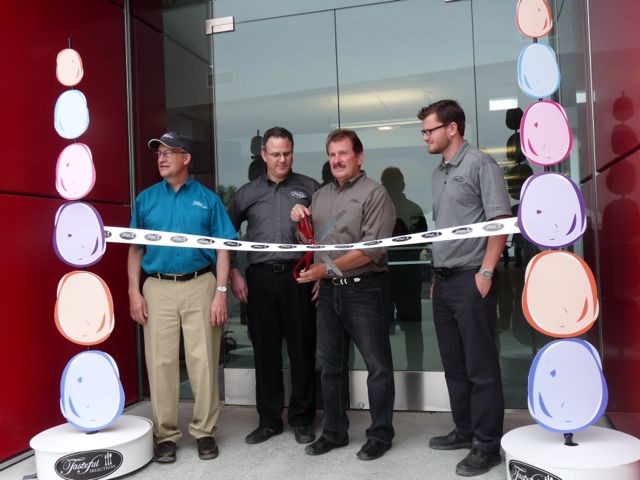
Fast forward to March. 18, 2015 when CSS, along with RPE, and Stevens Point, Wisconsin-based Plover River Farms Alliance, Inc. partnered together and opened a new, stainless steel, 200,000 square foot facility in Arvin, near Bakersfield—all dedicated to Tasteful Selections specialty potatoes.

The expansion increases Tasteful Selections’ production capacity from eight to 12 packaging lines, doubles the potato washing capacity and adds more shipping docks and improved refrigeration and storage to meet the company’s double digit growth (over the past five years), leading the specialty potato category.

In all, the company sells eight flavors of potatoes in one-, two- or three-bite sizes, plus offers a medley of flavors in each bite size. The potatoes have unique flavors, creamy textures and tender skins. The products are pre-washed, so consumers do not have to clean or peel the product. And the small sizes equate to faster cooking times.

“Fifty percent of our team is marketing, so we’re not just growing and packing the potatoes. RPE handles all of our marketing and sales, which has been so instrumental in our growth,” said Bender, who now oversees the day-to-day operations in California. RPE has been a tremendous asset to Tasteful Selections; the fact that we are in all fifty states, in 52 percent of all grocery stores, with growth in every store, says a lot about RPE,” Bender noted.

The fact that the facility was built with all stainless steel components is an invaluable addition to our operations and food safety protocols.  The facility’s design honors Cal Green Certification Standards. The Cal Green Certification ensures that we are maximizing our efficiency while reducing our environmental impact. Not only does this benefit us, it also helps the surrounding communities in promoting water savings, environmental responsibility, cost effectiveness and a healthier place to live and work for its currently 257 employees.

Tasteful Selections

Tasteful Selections

Milt Carter is CEO and President of CSS Farms, which grows all the potatoes for Tasteful Selections. “We are co-owner of the company, along with RPE, and the grand opening of our facility is a big day for us as we continue our journey to bring unique potatoes to the potato category and to the table,” said Carter.

“We particularly like the qualities of our baby potatoes, including unique flavors and better taste than the average potato. The uniform sizes we pack allow for uniform cooking times, making cooking easier for the consumer. And the growth we have seen reflects that consumers really like them.”

“When we started Tasteful Selections in 2010, we knew we had something amazing, and even we were surprised by the success that we had,” said Russell Wysocki, President and CEO of RPE. “The opening of this new plant shows that we are consistently investing in our future in specialty potatoes,” he said.

“The new plant will allow us to bring in new product lines, do a better job in precise-sizing, and maintain our high quality standard,” noted Wysocki. “On the farm, Bob and Milt bring us five separate crops a year; we have the ability to deliver the freshest potatoes with the best quality to our customers throughout the country and throughout the season.”

“The one-, two- or three-bite Tasteful Sections potatoes in the one pound or 1.5 pound bag are very popular with consumers.” said Wysocki. “It use to be that you would sell a lot of potatoes in a 10-pound bag, but that’s getting a lot harder to do. However, this product offers consumers a package from which they can get multiple meals, without taking five weeks to consume and perhaps resorting to the garbage can to get rid of them.”

“The baby potatoes are immature potatoes, before they grow bigger, but they still contain all the nutrients found in the larger potatoes,” said Wysocki.

Carter explained, “Our signature flavor Honey Gold baby potatoes are proprietary to Tasteful Selections, and they have a very unique flavor. A high percentage of people the taste distinctive in taste tests, and most like it very much.”

“It’s a great product,” noted Wysocki. “We basically took product that was being discarded in the market 10 years ago. We saw the quality of what was culled, and we felt it was something significant we could bring to the marketplace. So we considered the possibility, then brought it to market, and we have had phenomenal growth,” he said.

2016-05-31T19:30:24-07:00May 17th, 2015|

New IPM App

Surendra Dara UC IPM AdvisorFree Download of IPM Info App Now Available

Extending research information is a critical service of Cooperative Extension. Using modern technology and channels of communication is important to successfully convey that information to growers, PCAs, and other key players in the agriculture industry.

UC IPMInfo App Logo

UC IPMInfo App Logo

Smartphone usage has become widespread and smartphone applications are becoming popular in agriculture as they provide quick and easy access to information, help growers monitor a diverse set of variables, and facilitate decision making. However, there have been no such applications to assist California strawberry and vegetable growers.

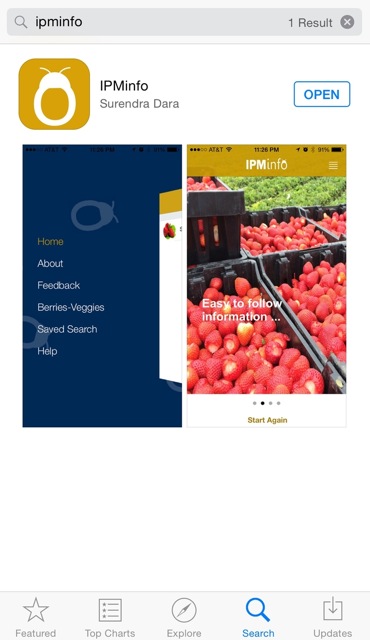
In an effort to provide simple access to important pest and disease information for various crops readily available to the agricultural industry , Surendra K. Dara, UC Cooperative Extension San Luis Obispo County, developed IPMinfo—the first IPM information app from University of California.

First released in December, 2014 and updated in April, 2015, this new IPM app is now available for free download for iPhones on App Store, featuring extensive pest and disease information generated by Dara’s strawberry and vegetable extension program. With one-touch access, agricultural professionals can learn the biology, symptoms of plant damage, and management options for pests and diseases.


2016-05-31T19:30:24-07:00May 15th, 2015|

FDA Update on Food Safety

FDA Announces Competitive Grant Program with NIFA to Fund Food Safety Training, Education and Technical Assistance

The U.S. Food and Drug Administration (FDA) today announced that it has joined with the U.S. Department of Agriculture’s National Institute of Food and Agriculture (NIFA) in a collaborative partnership to administer and manage the National Food Safety Training, Education, Extension, Outreach, and Technical Assistance Program.

Recognizing the importance of and need for food safety training for small farm owners and food processors, the FDA and USDA’s National Institute of Food and Agriculture (NIFA) are announcing a grant program that will provide funding so that these critical groups receive training, education and technical assistance consistent with standards being established under the FDA Food Safety Modernization Act (FSMA). This is one of several education and outreach efforts associated with the implementation of FSMA.

Priority will be given to those submitting grant applications to train owners and operators of small and medium-size farms; farmers just starting out in business; socially disadvantaged farmers; small food processors; small fruit and vegetable wholesalers; and farms that lack access to food safety training and other educational opportunities. A Federal, State, or local agency, State cooperative extension services, non-profit community based or non-governmental organizations, institutions of higher education, tribes and tribal stakeholders or a collaboration of two of more eligible entities are among the entities eligible for funding.

Education and technical assistance projects are an essential element in the FSMA implementation strategy. Such efforts will help ensure widespread voluntary compliance by encouraging greater understanding and adoption of established food safety standards, guidance, and protocols. They also facilitate the integration of these standards and guidance with a variety of agricultural production systems, encompassing conventional, sustainable, organic, and conservation and environmental practices.

Meeting the technical assistance needs for produce safety will require an investment well beyond what is being announcing today. This grant program underscores the commitment of both agencies to working with the grower community, Cooperative Extension Services (a nationwide education network), our state and tribal government partners, and institutions of higher education to more fully define the need and strategies for meeting it.

FDA is first issuing a request for applications for the establishment of a National Coordination Center (NCC) for Food Safety Training, Education, Extension, Outreach, and Technical Assistance Program. Once funding is available, separate requests for applications for the establishment of Regional Centers will be forthcoming.


This Request for Application can be found at: http://grants.nih.gov/grants/guide/rfa-files/RFA-FD-15-003.html

More information on the NIFA can be found at: http://www.nifa.usda.gov

You can find additional information on the FDA Food Safety Modernization Act at: http://www.fda.gov/Food/GuidanceRegulation/FSMA/default.htm

For more information on FDA’s Food Safety Modernization Act, visit http://www.fda.gov/fsma.


2016-05-31T19:30:34-07:00January 16th, 2015|

USDA Announces New Support to Help Schools Purchase More Food from Local Farmers

By: Monique Bienvenue; Cal Ag Today Social Media Manager/Reporter 

Agriculture Secretary Tom Vilsack announced that more than $5 million in grants will be given to 82 projects that support the U.S. Department of Agriculture’s (USDA) efforts to connect school cafeterias with local farmers and ranchers through its Farm to School Program. The program helps schools purchase more food from local farmers and ranchers in their communities, expanding access to healthy local food for school children and supporting local economies.

According to USDA’s first-ever  Farm to School Census released earlier this year, school districts participating in farm to school programs purchased and served over $385 million in local food in school year 2011-2012, with more than half of participating schools planning to increase their purchases of local food in the future.

“USDA is proud to support communities across the country as they plan and implement innovative farm to school projects,” said Vilsack. “These inspiring collaborations provide students with healthy, fresh food, while supporting healthy local economies. Through farm to school projects, community partners are coming together to ensure a bright future for students, and for local farmers and ranchers.”

Secretary Vilsack made this announcement at Common Market, a pioneering food hub in Philadelphia that connects wholesale customers to farmers in New Jersey, Pennsylvania and Delaware. Common Market is receiving a grant to support their “An Apple a Day” Program. The facility will act as a bridge between Pennsylvania Family Farms, a small Pennsylvania value-added processor, and public charter schools to provide food safety, product development, packaging, educational, marketing, planning, ordering and delivery support to farm and school food service partners.

Together, Common Market and the other selected projects will serve more than 4,800 schools and 2.8 million students, nearly 51 percent of whom live in rural communities.

2016-05-31T19:32:12-07:00December 8th, 2014|

Cost of Thanksgiving Dinner Rises, But is Still Under $50 For 10 People

Let’s All Remember and Give Thanks to Farmers and Farmworkers Who Provide Us with Food for our Thanksgiving Celebration

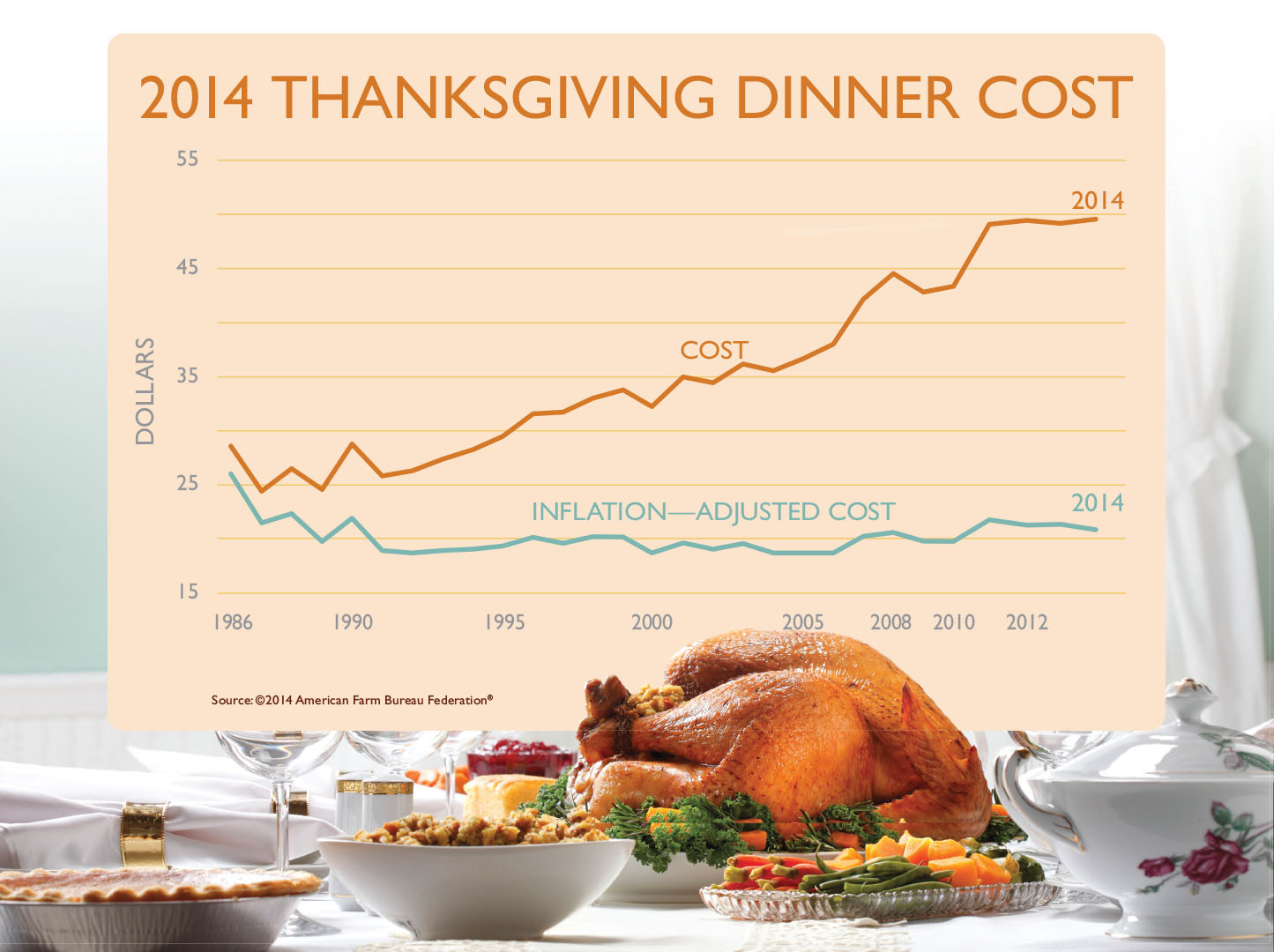
The American Farm Bureau Federation’s 29th annual informal price survey of classic items found on the Thanksgiving Day dinner table indicates the average cost of this year’s feast for 10 is $49.41, a 37-cent increase from last year’s average of $49.04.

The big ticket item – a 16-pound turkey – came in at $21.65 this year. That’s roughly $1.35 per pound, a decrease of less than 1 cent per pound, or a total of 11 cents per whole turkey, compared to 2013.

“Turkey production has been somewhat lower this year and wholesale prices are a little higher, but consumers should find an adequate supply of birds at their local grocery store,” AFBF Deputy Chief Economist John Anderson said. Some grocers may use turkeys as “loss leaders,” a common strategy deployed to entice shoppers to come through the doors and buy other popular Thanksgiving foods.

The AFBF survey shopping list includes turkey, bread stuffing, sweet potatoes, rolls with butter, peas, cranberries, a relish tray of carrots and celery, pumpkin pie with whipped cream, and beverages of coffee and milk, all in quantities sufficient to serve a family of 10. There is also plenty for leftovers.

Foods showing the largest increases this year were sweet potatoes, dairy products and pumpkin pie mix. Sweet potatoes came in at $3.56 for three pounds. A half pint of whipping cream was $2.00; one gallon of whole milk, $3.76; and a 30-ounce can of pumpkin pie mix, $3.12. A one-pound relish tray of carrots and celery ($.82) and one pound of green peas ($1.55) also increased in price. A combined group of miscellaneous items, including coffee and ingredients necessary to prepare the meal (butter, evaporated milk, onions, eggs, sugar and flour) rose to $3.48.

In addition to the turkey, other items that declined modestly in price included a 14-ounce package of cubed bread stuffing, $2.54; 12 ounces of fresh cranberries, $2.34; two nine-inch pie shells, $2.42; and a dozen brown-n-serve rolls, $2.17.

The average cost of the dinner has remained around $49 since 2011.

“America’s farmers and ranchers remain committed to continuously improving the way they grow food for our tables, both for everyday meals and special occasions like Thanksgiving dinner that many of us look forward to all year,” Anderson said. “We are blessed to be able to provide a special holiday meal for 10 people for about $5.00 per serving – less than the cost of most fast food meals.”

The stable average price reported this year by Farm Bureau for a classic Thanksgiving dinner tracks closely with the government’s Consumer Price Index for food eaten at home (available online at http://www.bls.gov/news.release/cpi.nr0.htm), which indicates a 3-percent increase compared to a year ago.

A total of 179 volunteer shoppers checked prices at grocery stores in 35 states. Farm Bureau volunteer shoppers are asked to look for the best possible prices, without taking advantage of special promotional coupons or purchase deals, such as spending $50 and receiving a free turkey.

Shoppers with an eye for bargains in all areas of the country should be able to purchase individual menu items at prices comparable to the Farm Bureau survey averages. Another option for busy families without a lot of time to cook is ready-to-eat Thanksgiving meals for up to 10 people, with all the trimmings, which are available at many supermarkets and take-out restaurants for around $50 to $75.

The AFBF survey was first conducted in 1986. While Farm Bureau does not make any scientific claims about the data, it is an informal gauge of price trends around the nation. Farm Bureau’s survey menu has remained unchanged since 1986 to allow for consistent price comparisons.

Source: Cyndie Sirekis,  AFBF Director of Internal Communications

2016-05-31T19:32:14-07:00November 20th, 2014|
Go to Top