50 Most Powerful People in 2014 Food World

Source: Colman Andrews

These men and women decide what and how you eat, whether you realize it or not.

The ability to make things happen, rewrite the rules, change the conversation and shift the paradigms; the people with power in the food world decide or influence what and how and where and why we eat.

Their power is economic, legislative, sometimes inspirational. They’re the agribusiness moguls who decide what crops to plant and how to harvest, process, and sell them.

They’re the heads of major food processing and distribution concerns and retail food outlets (that is, the people who actually put food on our tables).

They’re the scolds and nannies — and admirable consumer advocates — who tell us what we should and shouldn’t eat and why, sometimes upending whole industries in the process; the key figures in the governmental agencies concerned with the economics and the safety of our food supply; the media stars and public figures who sway our food opinions and stimulate our appetites; the chefs and restaurateurs who introduce us to flavors and culinary ideas, and establish and maintain standards for the preparation and presentation of food. They’re the journalists, in whatever medium, who report on all of the above.

Any catalogue of powerful people — and certainly any ranking of them in order of perceived power— is bound to be highly subjective. That doesn’t mean that it has to be arbitrary.

To come up with our list of The 50+ Most Powerful People in Food in America, our editors assembled an initial roster, based on research done gradually over many months, then added and subtracted, fine-tuned and developed.

We read news stories, annual statements, editorial analyses. We consulted with experts in the various fields we cover. We had endless discussions and occasionally strenuous debates.

Our ultimate criterion was simply this: Is each person on our list capable, whether by dint of corporate station, media access, moral authority, or sheer personality, of substantially changing, improving, and/or degrading the quality and variety of the American diet or the way we think about it?

Choosing which men and women in the American food world to include on our list was difficult enough; arranging them in order of power was a far greater challenge.

Here is the finalized list:

50. Danielle Nierenberg and Ellen Gustafson, Co-Founders, The Food Tank

49. Adam Rapoport, Editor in Chief, Bon Appetit

48. Matt Maloney, CEO, GrubHub Seamless

47. Bill Marler, Foodborne Illness Lawyer and Attorney

46. Steve Ells, Founder/ Co-CEO, Chairman, Chipotle Mexican Grill

45. Tom Colicchio, Chef-Restaurateur and TV Personality

44. Catherine Cassidy, Vice President and Editor-in-Chief, Taste of Home

43. Ingrid Newkirk, President and Co-Founder, People for the Ethical Treatment of Animals

42. Mark Bittman, Journalist and Author

41. Tracey Ryder, President and CEO, Edible Communities Publications

40. Dana Cowin, Editor-in-Chief, Food & Wine

39. Alice Waters, Chef-Restaurateur and Founder and Director, The Edible Schoolyard Project

38. Dawn Sweeney, President and CEO, National Restaurant Association

37. Thomas Keller, Chef-Restaurateur

36. Susan Ungaro, President, James Beard Foundation

35. Danny Meyer, Restaurateur

34. Michael Pollan, Author (just noteworthy)


33. Bill Shore, Founder and CEO, Share Our Strength

32. Dan Bane, Chairman and CEO, Trader Joe’s

31. Bob Aiken, President and CEO, Feeding America

30. Steve Spinner, CEO, President, and Director, United Natural Foods, Inc.

29. Julie Packard, Executive Director and Vice-Chairman, Monterey Bay Aquarium

28. John Mackey, Founder and Co-CEO, Whole Foods Market

27. David Kirchhoff, CEO, Weight Watchers International

26. Mario Batali and Joe Bastianich, Chef/ Restaurateurs

25. David Murdock, CEO, Dole Food Company

24. Kevin Systrom, Co-Founder and CEO, Instagram

23. Ben Silbermann, Founder and CEO, Pinterest

22. Michelle Obama, First Lady of the United States

21. Rodney McMullen, Chairman and CEO, The Kroger Co.

20. Fred DeLuca, Co-Founder and President, Subway

19. Bob Tuschman, General Manager and Senior Vice President, Food Network

18. José Andrés, Chef-Restaurateur

17. Pamela Bailey, President and CEO, Grocery Manufacturers Association

16.  Paul Grimwood, CEO and Chairman, Nestlé USA

15. Donald Thompson, Vice Chairman and CEO, McDonalds

14. Pete Wells, Restaurant Critic, The New York Times

13. Craig Jelinek, CEO, Costco

12. Donnie Smith, President and CEO, Tyson Foods

11. William J. Delaney III, CEO, Sysco

10. David MacLennan, Chairman and CEO, Cargill

9. Jeremy Stoppelman, Co-Founder and CEO, Yelp

8. Jack Menzel, Product Managing Director, and Dan Entin, Director of Digital Product Management, and their teams, Google

7. Patricia Woertz, Chairman, President, and CEO, Archer Daniels Midland

6. James P. Hoffa, General President, International Brotherhood of Teamsters

5. Indra Nooyi, Chairman and CEO, Pepsi

4. Michael R. Taylor, Deputy Commissioner for Food, Federal Drug Administration

3. Doug McMillion, President and CEO, Walmart

2. Hugh Grant, Chairman, President, and CEO, The Monsanto Company

1. Thomas Vilsack, Secretary, USDA


2016-05-31T19:38:07-07:00March 24th, 2014|

BREAKING NEWS: Medfly Infestation in Los Angeles

BREAKING NEWS: Medfly Infestation in Los Angeles


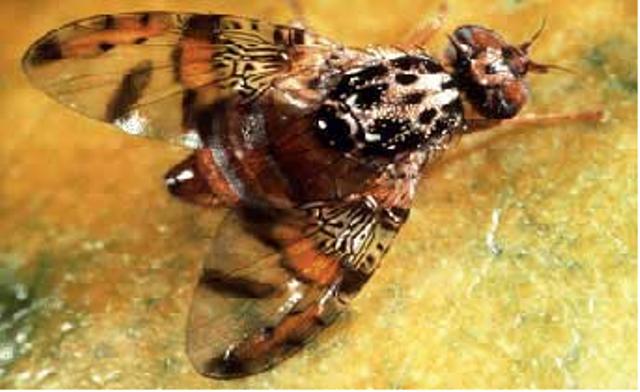
A quarantine has been declared due to a Mediterranean fruit fly (Medfly) infestation detected in the city of Los Angeles. One adult male and five unmated females were detected in five traps between March 3 and 12, 2014, and four larvae were discovered in backyard fruit on March 18.

The Medfly can infest more than 250 types of fruits and vegetables, causing severe impacts on California agricultural exports and backyard gardens alike. Residents who believe their fruits and vegetables are infested with fruit fly larvae are encouraged to call the state’s toll-free Pest Hotline at 1-800-491-1899.

The United States Department of Agriculture (USDA), the Los Angeles County Agricultural Commissioner, and the California Department of Food and Agriculture (CDFA) are working collaboratively on this project.

The 88-square mile quarantine is in central Los Angeles, near the University of Southern California. Additional information, including a map of the 88-square mile quarantine zone, is available at: http://www.cdfa.ca.gov/plant/medfly/regulation.html#index.

To eradicate the infestation, the increased release of sterile male Medflies began last week, at a rate of 250,000 flies per square mile per week, double the normal rate in that area.

The sterile male Medflies are brought to California by the joint CDFA/USDA sterile insect rearing facility in Los Alamitos, which prepares sterile flies for release everyday over the Los Angeles Basin.

The sterile release program has a proven track record of eradication in southern California. Sterile male flies mate with fertile female flies in the environment but produce no offspring.

The Medfly population decreases as the wild flies reach the end of their natural life span with no offspring to replace them, ultimately resulting in the eradication of the pest.

 The enhanced release area is approximately 25 square miles. In addition, properties within 200 meters of detections are being treated with an organic formulation of Spinosad, which originates from naturally-occurring bacteria, in order to eliminate any mated females and reduce the density of the population.

Finally, fruit removal will occur within 100 meters of the larval detection property in order to remove any fruit infested with eggs and larvae.

“Our pest prevention system to detect and respond to invasive species like the Mediterranean fruit fly is working well and according to design,” said CDFA Secretary Karen Ross. “The release of sterile Medflies is a proven method of eradicating an infestation. The key is to move swiftly and take action before the pests can cause widespread damage and become established.”

The quarantine will affect any growers, wholesalers, and retailers of susceptible fruit in the area as well as local residents – home gardeners are urged to consume homegrown produce on site and not move it from their property.

The eradication approach in the Los Angeles area is the standard Medfly program used by CDFA and it’s the safest, most effective and efficient response program available.

2016-05-31T19:38:07-07:00March 24th, 2014|

Tulare Water Rally Needs You on March 26th

finger-pointing

Water Rally in Tulare Needs You!

Mario Santoyo, Executive Director of California Latino Water Coalition, announced a Water Rally on Wednesday, March 26th in Tulare. We urge everyone with agricultural water interests to attend and advocate for increased water allocations!

Mario Santoyo

Mario Santoyo

Santoyo commented:

You all are very aware of the water crisis that has been plaguing the West Side farmers due to federal pumping restrictions, well now with this year’s historic drought combined with those same pumping restrictions the East Side farmers will be in the same crisis condition.

The only hope for farmers on both sides of this Valley to survive this year is a change in the Delta Operations by both the State and Federal governments in order to maximize the flexibilities they have under this crisis to deliver more water south of the Delta, so an upcoming rally is intended to send that message.

The initial event flyer for the rally along with a water supply update on the East Side farmers’ dire situation is below.

FWA Water Supply Information Meeting Flier No  1 (3-20-14) Final

2016-05-31T19:38:07-07:00March 22nd, 2014|

2014 AG Trends

 2014 Ag Trends and Land Values


By Patrick Cavanaugh, Editor

At the Outlook 2014 California Agriculture Thriving Through Change meeting about ag trends and land values, this week in Fresno, the crowd was upbeat despite the drought and regulations facing the farming industry.

Nat Dibuduo

Nat DiBuduo

Nat DiBuduo, President of the Allied Grape Growers is also an Accredited Farm Manager and President of the California chapter of American Society of Farm Managers and Rural Appraisers (ASFMRA), which hosted the conference.

“We talked about a lot of different commodities today starting out with citrus and ending with the dairy industry. And I am really happy to say that everyone, including the dairy industry are on a high,” DiBuduo said. “We do have our challenges; we have the drought issues and how that it is affecting things, but I would still say that California agriculture is positioned for a good future.”

“Granted, we have regulatory issues, drought issues, immigration issues to deal with, but the messages of the day’s meetings were positive,” noted DiBuduo.

It was also announced that ag land prices in all areas of the state and nearly all commodity prices are up.


2016-05-31T19:38:07-07:00March 22nd, 2014|

Q&A Drought Management For Almonds

Source: David Doll 

These questions and answers offer insightful advice for almond farmers coping with the drought.

Q. How should I plan to irrigate my trees?

A. As discussed before, this is dependent upon the amount of water that is available. If you have greater than 80-85% of the water that is typically applied to the orchard, deficits can be targeted (50% reduction in applied water) for the period after kernel fill but before hull split. If less than 80%, the water should be spread out at the relative percentage of water use. For example, if 30% of the seasons water is available, every irrigation would be 30% of normal. Keep in mind that in drought years it is often hotter than in “normal” years.

Q. When should I start irrigating?

A. Typically, irrigations should start when the trees are starting to “work” for water. Using a pressure bomb, this value is around 2 bars more negative than baseline. If baseline is -8, irrigation should begin at -10.  If facing a moderate curtailment, it may be best to let the trees stress a little more, perhaps -4 bars more than baseline. If facing a severe curtailment, a scenario in which we know less about, it might be best to hold off longer before applying the water (~6-8 bars more negative than baseline, perhaps?). Basically, the idea is to stress the trees, which then triggers a physiological response which makes the tree more drought resistant (less vegetative growth, fewer stomatal openings/leaf, etc).

Q.  What’s an easy way to calculate baseline?

A. To get in the ballpark, baseline can be estimated by taking one tenth of the temperature. If it is 85 degrees, baseline will be -8.5. Since it is measured as pressure applied, it is always read as a negative value. For more specific calculations, which take into account humidity and temperature, please see this UC Davis Baseline website.

Q. How much should I reduce my nitrogen if I am reducing my water?

A. Good question. Nitrogen rates should be reduced. Based upon some speculation from various trial results, our best guess is to reduce nitrogen rates by about 1/2 of the water curtailment. So, if taking a 50% water reduction, nitrogen should be reduced by a minimum of 25%. In-season estimate of crop may also determine that less N is needed. If in a second year of deficit irrigation (i.e. 2nd year of drought), the reduction of nitrogen should match the reduction in water (50% water reduction, 50% nitrogen reduction). Keep in mind that applying too much N will flush growth, increasing vegetation, which will require more water.

Q. I hear and saw stories about people pulling trees…should I?

A. If blocks were planned to be cycled out and removed within the next few years, water from these blocks should be considered to be diverted to other, younger blocks. This will help negate the effects on the developing block. Depending upon where the orchard is located, there may be some crop that is salvageable from the “dry-land” farmed block, but it will be of lower quality.

Q. Are there any other resources to help?

A. Yes – Please see UC Davis’s Drought Management Website for more drought management in multiple crops. To gain a little more help in scheduling irrigation, check out Fresno State’s Water Right Website. Farm Advisor Blake Sanden also has some good information at his Kern County Web Page. Also, feel free to contact your local farm advisor.


2016-05-31T19:38:07-07:00March 21st, 2014|

New Drought Fact Sheet Available

CATThe California Farm Water Coalition has a brand new fact sheet available on California’s 2014 drought.
The one-page information piece is intended for consumers and breaks down the drought into easy-to-understand sections.
Information includes an updated number of acres expected to be idled this year (800,000 acres), how lost farm production will impact the economy, what consumers can expect to see in stores in the way of food-related price increases and also what farmers have been doing over the years to improve water use efficiency.
The California Farm Water Coalition was formed in 1989 in the midst of a six-year drought. CFWC was formed to increase public awareness of agriculture’s efficient use of water and promote the industry’s environmental sensitivity regarding water.  
2016-05-31T19:38:07-07:00March 21st, 2014|

California Coming off Warmest Winter on Record

United States weather scientists have revealed California is coming off of its warmest winter on record, aggravating an enduring drought in the most populous US state.

The state had an average temperature of nine degrees Celsius for December, January and February, an increase from 5.8°C in 1980-81, the last hottest winter.

Reuters Newsagency reports that figure was more than four degrees Fahrenheit hotter than the 20th-century average in California, the National Oceanic and Atmospheric Administration (NOAA) said in a statement.

Warmer winters could make the already parched state even drier by making it less likely for snow to accumulate in the Sierra Nevada Mountains, NOAA spokesman Dr. Brady Phillips said.

“Winter is when states like California amass their main water budget, when snowpack is building,” said Dr Phillips, a marine biologist. “If you’re starting from a deficit and going into the dry season, it’s setting you up for a drier summer.”

Reuters reports California is in the grip of a three-year dry spell that threatens to have devastating effects on the state and beyond.

Farmers are considering idling 200,000 hectares of cropland, a loss of production that could cause billions of dollars in economic damage, and several small communities are at risk of running out of drinking water.

The state also recorded its driest winter to date by March, despite recent storms, with an average of 114mm of rainfall, compared to 297mm over the previous winter, NOAA said.

The agency is planning to release its spring outlook climate forecast tomorrow.

NOAA is an agency that enriches life through science. Their reach goes from the surface of the sun to the depths of the ocean floor as they work to keep citizens informed of the changing environment around them.

2016-05-31T19:38:07-07:00March 21st, 2014|

CDFA Honors UC Cooperative Extension Centennial

CDFA honors UC Cooperative Extension Centennial


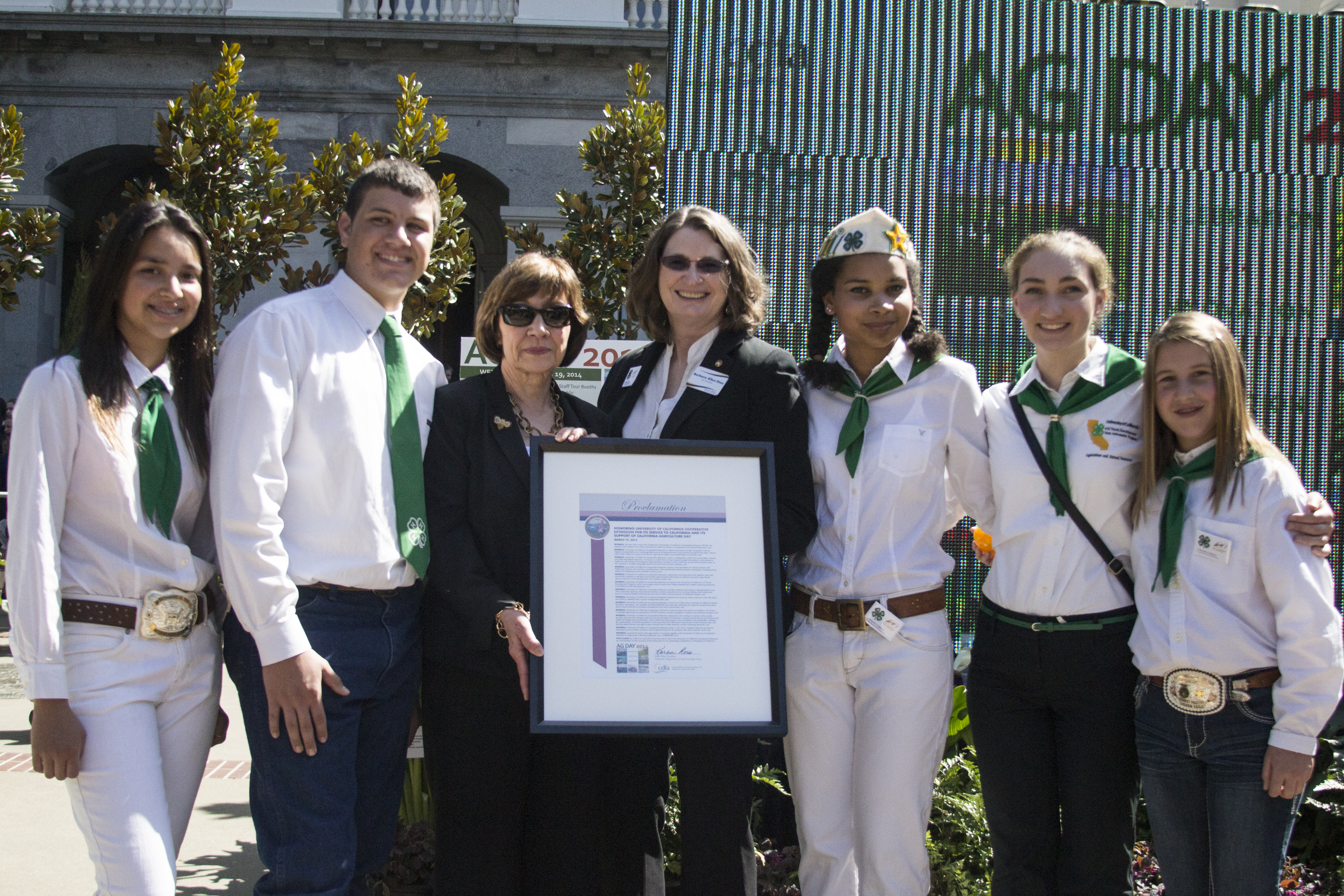
The annual Ag Day at the Capitol event yesterday (March 19) in Sacramento honored the University of California Cooperative Extension for its centennial. California Department of Food and Agriculture Secretary Karen Ross presented a proclamation to Barbara Allen-Diaz, UC vice president for Agriculture and Natural Resources, who oversees UC Cooperative Extension.

“I want to commend my good friend Barbara Allen-Diaz and Cooperative Extension,” said Ross. “You help us take all that great knowledge from the UC System and extend it directly to farmers and ranchers. It is a circle of innovation that sets us apart. It is absolutely crucial to our future and I’m really happy to be here to celebrate 100 years with you.”

UC Cooperative Extension, which has offices in counties throughout California, will be holding local celebrations throughout 2014. For more information about the UCCE centennial, visithttp://ucanr.edu/100.

2016-05-31T19:38:08-07:00March 21st, 2014|

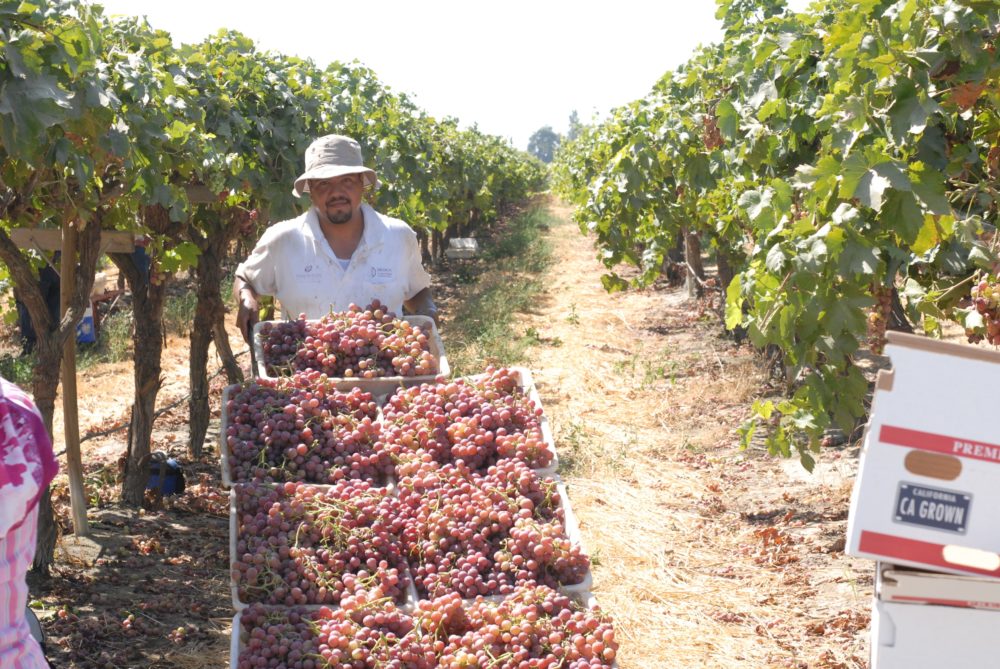
Record California Table Grape Shipments

117.4M Boxes of Grapes Shipped Surpasses the $100M Mark for Second Time in History

It was announced TODAY that California shipped a record volume of 117.4 million boxes (116.2 19-pound box equivalents) of fresh California grapes during the 2013 season, a total crop value of $1.7 billion.

The 2013 season started with shipments in early May and continued into February 2014. California produces 99 percent of the commercial fresh grapes grown in the United States.

“Over the past 10 years the volume has significantly increased,” said Kathleen Nave, president of the California Table Grape Commission. “In 2003 the crop was under 80 million boxes. In 2012 the 100 million box mark was crossed for the first time in history, and in 2013 another record was set with the crop totaling 117.4 million boxes.”

Exports also hit a new record in volume, with 48.6 million boxes shipped to export markets including Canada – a 17 percent increase over the previous year. The top export markets in volume included Canada at 11.9 million, followed by China/Hong Kong at 7.9 and Mexico at 6.6. The 48.6 million boxes exported represented 41 percent of the total crop volume.

With the 2014 season a little over a month away, the commission is gearing up its global campaign for Grapes from California which includes retail, consumer and foodservice programs.

2016-05-31T19:38:08-07:00March 20th, 2014|
Go to Top