
Friant Users Desperate For Alternative Water Supplies

A tiny amount of water has begun flowing in the Friant-Kern Canal as Friant Division contractors and users scramble to try to mitigate their looming losses and drought conditions by acquiring water through groundwater pump-ins, transfers and exchange programs. Friant Water Authority says that relief is a fraction of the need being felt by growers and communities alike. 
“Those programs are expensive and supplies are difficult to come by,” said Friant Water Authority General Manager Ronald D. Jacobsma. “While helping some, those programs fall far short of the critical water needs we have targeted as being 200,000 acre-feet. That is the amount upon which Friant barely got by in 1977. This year is wetter but the regulatory environment has left Friant with no project water at all. It’s incomprehensible.”

EXTREMELY LIMITED SUPPLIES

Among the extremely limited supplies of water that have been arranged are a few thousand acre-feet of water left unused when the San Joaquin River Restoration Program’sinterim fishery flows were suspended in early February. That emergency “health and safety” supply is being delivered, through a banking arrangement with the Fresno Irrigation District, to four East Side communities with no municipal water supply except the Friant-Kern Canal – Orange Cove, Lindsay, Strathmore and Terra Bella.

In addition, a total of several thousand acre-feet of water is being made available to Friant agricultural districts able to pay the higher costs associated with temporarily banking the unreleased restoration water. The City of Fresno has arranged to transfer 710 acre-feet of that water to the Orange Cove Irrigation District.
 Some carryover water still stored in Millerton Lake along with a small amount of “loss” water needed to operate the canal is sporadically being released into the Friant-Kern. A number of growers have received permission from the U.S. Bureau of Reclamation to pump local groundwater into the canal and transport it for use on other properties they own.

DROUGHT CONDITIONS

Continuing drought conditions, meanwhile, are beginning to be magnified as the typically hot and rainless valley summer begins. Despite a few mostly weak spring storms that fractionally improved runoff, the U.S. Department of Agriculture’s National Drought Mitigation Center continues to list all of California as drought impacted. The Friant Division is fully within the hardest hit drought region.

SUCCESS DAM

It doesn’t much matter in the midst of drought with Tule River runoff predicted to be just 10% of average during the current water year but full storage capacity has been restored in Lake Success east of Porterville, as reported by Friant Water Authority. Success Dam had been under a safety-of-dams storage restriction. For a time, the U.S. Army Corps of Engineers was considering construction of a new Success Dam to address the concerns. Corps officials last year announced that the dam’s safety was in reality not a problem, based on new studies of the structure’s strength and underlying geology.

Now, the capacity is back at more than 83,000 acre-feet although actual storage is 13,800 acre-feet because of the drought. In July, the Corps plans to release a baseline risk assessment report detailing the dam’s safety findings. That report could lead to a decision on whether or not to construct control facilities to further increase capacity.CaliforniaDroughtFriantArea

2016-05-31T19:35:30-07:00May 28th, 2014|

July 17th Sustainable Organic Production Seminar in Chico!

A seminar for growers and crop consultants focusing on the sustainable organic production of field crops, vegetables and orchards will be held on Thursday, July 17, 2014, 8:00 am – 3:00 pm. The seminar is presented by NorCal Chapter California Association of Pest Control Advisers, California Association of Pest Control Advisers and Organic Fertilizer Association of California. The seminar is being underwritten by Sierra Nevada Brewing Company, which is also hosting the event:

Sierra Nevada Brewing Co, The Big Room, 1075 20th Street, Chico, CA.

Subjects include:

  • Regulations
  • Almond production
  • Soil health
  • Rice weed control
  • Soil amendments
  • Micronutrient use

The program includes a grower panel discussing:

  • fertility and pest management
  • organic production challenges
  • exhibits by firms providing products acceptable for certified organic production.

CEUs are offered for:

  • Certified Crop Advisers (6 hours)
  • Licensed Pest Control Advisers 6 hours)

For more information, contact Steven Beckley, (916) 539-4107, sbeckley@aol.com.

2016-05-31T19:35:30-07:00May 28th, 2014|

Want to be happier? Eat your Fruits and Vegetables!

(Sources: Silver Lining Psychology blog and cited original research sources, all linked in the text; Photo credit)

When you were a kid, did your parents urge you to eat your vegetables? Did they reason that eating vegetables was part of a nutritious diet that would help to make you big and strong? What they didn’t know at the time, was that a well-balanced vegetable-rich diet also contributes to people feeling happier and attaining  greater emotional wellbeing, and research supports this finding.

***

The Psychology Department at the University of Otago in New Zealand asked 281 young people in 2013 to complete a 21-day online food diary. Head researcher, Dr. Tamlin Conner, said, ‘On days when people ate more fruits and vegetables, they reported feeling calmer, happier and more energetic than they normally did.’

Further analysis demonstrated that young people would need to consume approximately seven to eight total servings (the size that could fit in your palm, or half a cup) of fruits and vegetables per day to notice a meaningful positive change. Furthermore, eating fruits and vegetables predicted improvements in positive mood the next day, suggesting that healthy foods may improve mood. (Daily Mail Reporter)

***

In another study, in 2012, of 80,000 British adults found that high emotional wellbeing increased with the number of fruit and vegetables consumed daily. Like the previously-mentioned study, well-being peaked at approximately 7 portions per day.

***

A study of 5,731 Norwegian adults found that individuals who consumed a healthy diet were less likely to be depressed compared to those who ate a more typical Western diet filled with processed foods.

This study also found that a higher intake of processed and unhealthy foods is associated with increased incidence of anxiety.

***

In another study, these same researchers found in 2011 that a balanced and nutritious diet was associated with better mental health in a sample of 3040 Australian adolescents, compared to those who had a diet that was rich in processed foods.

***

The effects of nutrition on mental health may start in the womb, according to a study of the diets of Norwegian mothers during pregnancy and that of their children at various points during their first 5 years. Results showed that babies who were exposed to more unhealthy foods during pregnancy had more behavioral and emotional problems during early childhood.

***

Diet can also affect your cognitive abilities. Researchers provided twenty sedentary men a nutritionally balanced diet or a high-fat diet for seven days. Compared to the control group, the high-fat group showed decreased memory and attention.

***

The bottom line?  What you eat not only affects your body, it affects your mind.  Make the effort to eat a nutritionally-balanced diet that is filled with natural food sources and low on refined and processed foods.  Aim for 7-8 servings of fruits and vegetables a day.  Not only will it make you big and strong, it will also make you happier!

2016-05-31T19:35:30-07:00May 27th, 2014|

Fight For Water Film Can Now be Viewed and Rented On-Line

The Fight For Water Film, a farm workers Struggle– is now available to be viewed or rented on-line.

Juan Carlos Oseguera, an independent filmmaker who produced the Fight for Water Film, based on the 2009 California Water March protesting a reduced water allocation due to the Delta Smelt. He has received a lot of recognition regarding the film, which is now available on line if you have been able to see it at a screening.

Go to Fight for Water.com where you can view and rent the movie. Information is at the end of the trailer.

“If anyone has not been able to see the film at a screening or film festival, they can now go to the website to view the film which focuses on the a water situation that not only is effecting the valley but the entire state of California,” Oseguera said

Oseguera also noted that more schools and colleges are showing the film on their campuses. “We are seeing a lot of request to get the movie to colleges and universities. I am glad that they are responding because the film is an educational film about the water situation, about water rights, and about environmental rulings, which helps get the movie out there to more audiences.”


2016-05-31T19:35:30-07:00May 26th, 2014|

2013-14 Recipients of the UC ANR Distinguished Service Awards

Sources: Pamela Kan-Rice, ANR Assistant Director, News and Information Outreach; Kathy Keatley Garvey, Communications specialist (including photo credit)

This week, Barbara Allen-Diaz, vice president of UC ANR, announced the 2013-14 recipients of the ANR Distinguished Service Awards (DSA) which are given biennially for outstanding contributions to the teaching, research and public service mission of the Division of Agriculture and Natural resources.

Allen-Diaz thanked the DSA recipients for providing excellent service to the people of California.

Awards were given in six areas:

Extension apiculturist Eric Mussen in front of the apiary at the Harry H. Laidlaw J. Honey Bee Research Facility (Photo by Kathy Keatley Garbey)

Extension apiculturist Eric Mussen in front of the apiary at the Harry H. Laidlaw J. Honey Bee Research Facility (Photo by Kathy Keatley Garbey)

Outstanding Extension – Eric Mussen, UC Cooperative Extension apiculturist in the Department of Entomology and Nematology at UC Davis for bees.

Outstanding Research – Mark Battany, UC Cooperative Extension advisor in San Luis Obispo and Santa Barbara Counties for viticulture.

Outstanding New Academic – David Doll, UC Cooperative Extension advisor in Merced County for nut crops

Outstanding Team – Ken Tate, UC Cooperative Extension specialist in the Department of Plant Sciences at UC Davis, and Rob Atwill, director of Veterinary Medicine Extension at UC Davis, are the recipients of the Outstanding Team Award. Since 1994, Tate and Atwill have collaborated on a series of projects assessing the potential risk to rangeland surface-water quality and human health from livestock associated pollutants.

Outstanding Leader – Pamela Geisel, former director of the statewide UC Master Gardener Program. Although Pam retired recently,Master Gardenerssince this nomination package was very strong, I believe it’s appropriate and important to give Pam this much-deserved award.

Outstanding Staff – Michael Yang, UCCE agricultural assistant in Fresno County for small farms.

Each of the recipients will receive $2,000 and a certificate, except for the team award recipients, who will receive individual certificates and share $5,000.

2016-05-31T19:35:30-07:00May 25th, 2014|

Golden Rice Refusal Kills Millions

Source: Don Curlee, Hanford Sentinel

A University of California report has exposed the injustice that prohibits a genetically engineered additive to rice. Without it, the death of millions of children has occurred, notably in Africa and India.

The researcher opinion lays the blame for the international prohibition of producing golden rice through genetic engineering on powerful forces that hide behind environmentalism.

California, one of the world’s major rice producers, is ready to supply the vitamin enriched product, especially for export.

The UC report appears in the current issue of the university’s respected Update, a bi-monthly publication compiled by the Agriculture and Natural Resources Department.  The authors are Justus Wesseler, professor for Agriculture and Food Economics at Technical University, Munich; Scott Kaplan, research assistant at Energy Biosciences Institute at UC Berkeley, and David Zilberman, professor in the Agricultural and Research Economics department at UC Berkeley.

The GE process for folding vitamin A into rice, transforming it to golden rice, has been well understood since 2000, but efforts to gain approval have been opposed by powerful regulators, particularly in India and Bangladesh.

Both countries are known for the staggering incidence of disease, disabilities and lagging development resulting from a lack of vitamin A in the diets of their citizens.

The authors of the UC report point out that the creation of golden rice could have saved millions of lives and avoided blindness, vulnerability to childhood infections, anemia and poor growth in millions since the engineering process for adding the vitamin was discovered in 1999.

The researchers recall that the nearly worldwide objection to creating golden rice was led by Greenpeace.  It was perhaps the most notorious radical environmentalist group at the turn of the century, characterized by a series of risky, but widely reported escapades aimed at derailing broadly-accepted programs and activities that were in the news.

The movement’s objections were always based on what it perceived as dangers to the environment.

patrickmooreChairSpokesperson

Dr. Patrick Moore, Chair and Spokesperson, “Allow Golden Rice Society”.

A 2012 Greenpeace publication states, “If introduced on a large scale, golden rice can exacerbate malnutrition and ultimately undermine food security.” Authors of the UC report elaborate by saying that Greenpeace fears that golden rice may accelerate the adoption in developing countries of other GE crops perceived by Greenpeace and others to be very dangerous.

The report also refers to the 180-degree turnabout by former Greenpeace leader and co-founder Patrick Moore, who now promotes a group called “Allow Golden Rice Society.” He has recognized that the poor have paid the majority of the price of the fight against GE technologies. Dr. Moore published a book in 2011 called, “Confessions of a Greenpeace Dropout: The Making of a Sensible Environmentalist”.

The UC report says that a large and growing body of literature indicates that GE varieties have produced a significant amount of real benefit throughout the world.

Publication of the report seems to be an invitation to everyday environmentalists, often fans of radicals and extremists like Greenpeace, to back off a bit and realize the harm and human suffering that have resulted from blocking the humanitarian approval of golden rice.

“Even though GE has been introduced in few crops, its impact on agricultural production is immense because it has increased productivity substantially,” the UC report states. “Furthermore, its impact on productivity has been higher in developing versus developed countries … (but) … its potential has not been realized.”

The UC paper suggests that policies regulating GE technologies need to be reassessed. Perhaps that reassessment needs to begin with a bunch of hangers-on environmentalists in your community and mine who haven’t yet determined that many environmentalist beliefs and policies have nothing to do with human welfare.

2016-05-31T19:35:30-07:00May 23rd, 2014|

Lodi 10th Annual Zinfest a Celebration of Community

A message from Karen Ross; California Agriculture Secretary

I recently was invited to Lodi to join that region’s Winegrape Commission in celebrating the 10th annual “Zinfest.” It’s a great example of food and wine events that create local economic activity and foster direct communication between consumers and farmers.

Zinfest is very well done – a testament to the visionary leaders who created the Lodi Winegrape Commission, and to the outstanding farm families that have forged partnerships with the local community to make it known that Lodi is a premium grape-growing and wine-making region.

I’d like to thank the commission for its kind invitation and I hope I get to celebrate many more Zinfests!

2016-05-31T19:35:30-07:00May 23rd, 2014|

Senate Drought Bill Passes, Westlands Expresses Appreciation

This evening, the United States Senate passed, by unanimous consent, the Emergency Drought Relief Act, a bill to provide federal and state water agencies with additional flexibility to deliver water where it is most needed during California’s historic drought. The legislation, sponsored by Senators Dianne Feinstein and Barbara Boxer (both D-Calif.), Harry Reid (D-Nev.) and Dean Heller (R-Nev.), must now be reconciled with a separate bill passed by the House of Representatives.Dianne_Feinstein_official_Senate_photo_2

“Getting this bill passed was a true team effort.” Senator Feinstein credited the individuals above and added,  “Senator Murkowski, ranking member of the Committee on Energy and Natural Resources, displayed true bipartisanship in working across the aisle to address this disaster.”

Other cosponsors of the drought bill include Senators Robert Casey (D-Pa.), Dick Durbin (D-Ill.), Mazie Hirono (D-Hawaii), Jeff Merkley (D-Ore.), John Rockefeller (D-W.Va.), Debbie Stabenow (D-Mich.) and Ron Wyden (D-Ore.).

Senator Feinstein commented, “The drought in California is devastating and shows no signs of letting up. Snowpack is at 6 percent of its normal level and the state’s largest reservoirs are at or below half capacity. Congress must take immediate action to help alleviate the suffering of farmers, workers, businesses and communities throughout the state.”

Westlands Water District Round LogoWestlands Water District General Manager Thomas Birmingham issued the following statement on the drought bill passage:

“Passage of this legislation by the Senate marks an important milestone in the effort by members of California’s congressional delegation from both sides of the aisle to provide some relief from the disastrous human and economic impacts of drought and restrictions imposed on operations of the Central Valley Project and State Water Project under the Endangered Species Act and other federal regulations.

The fact that this bill passed by unanimous consent is a testament to the hard work of Senator Feinstein, with support from Senator Boxer and members of the House of Representatives, to explain to senators from other states the urgent need for and the importance of this legislation to the people of California.”

“Westlands Water District expresses its great appreciation for the hard work of Senator Feinstein and her colleagues in obtaining passage of this legislation. We look forward to working with Senator Feinstein and Members of the House in their efforts to reconcile this legislation with legislation that has already passed in the House.

It is Westlands’ hope that this process can begin quickly, and we are confident that Senator Feinstein and her colleagues in the House will be able to identify common sense solutions that will restore water supplies, while providing reasonable protections for fish.

The tens-of-thousands of people who otherwise will be unemployed and the welfare of people around the state depend on a meaningful compromise being reached quickly.”


Photo Credit: Westlands Water District Ranch on loopnet.com


2016-05-31T19:35:31-07:00May 23rd, 2014|

Stopgap Efforts Aim to Ease Water Shortages

Source: Kate Campbell; Ag Alert

Farmers and water agencies throughout California are turning to the “Three Ts”—water transfers, trades and treated wastewater—as they try to fill some of the supply gaps caused by drought and resulting water shortages.

In farming communities around the state, neighbors are helping each other, for example by running pipes from more productive wells to a neighbor’s farm.

Late-season rains improved the possibility for water transfers among water districts. More regions are delving into making treated municipal wastewater available for irrigation.

“It’s definitely an ‘all-hands-on-deck’ approach to an emergency situation,” California Farm Bureau Federation Water Resources Director Danny Merkley said. “Some of these stopgap efforts may help farmers prevent orchards or vineyards from dying. We have been encouraging state regulators to remove bureaucratic barriers to short-term water supply plans, while keeping ourselves focused on the continuing need for long-term water storage projects.”

In one new initiative, the Sonoma County city of Healdsburg has moved ahead with plans to make 1 million gallons a day of treated wastewater available for vineyard irrigation and construction uses.

Efforts to make the water available began in mid-February, and the first deliveries through two 6,600-foot pipelines began last week. A new, purple hydrant outside the city treatment facility offers free water to farmers who sign up to take supplies by tank truck.

The city estimates the current supply will augment irrigation for about 25,000 acres of vineyards.

Healdsburg Mayor Jim Wood told people gathered to celebrate the treatment plant’s first transfers to tank trucks that gaining the necessary permits for the project “turned out to be a lot harder than we thought.” Wood said officials worked hard to finalize the project “in an amazingly short amount of time.”

The chair of the State Water Resources Control Board, Felicia Marcus, praised the Healdsburg project as an example of local leadership backed up by the work of the regional water board.

“To make recycled water more readily and easily available for other appropriate agricultural and outdoor uses, the state board has proposed a general permit to allow recycled water projects to opt into, or enroll, in a pre-permit program,” Marcus said, adding that the new permit program is scheduled for adoption in the first week of June.

There currently are about 250 water recycling plants operating statewide, with more planned for the future. About half of all treated wastewater produced in the state is used for irrigating crops, with additional projects in the planning stages.

“Water recycling will certainly be part of the solution for California’s long-term water problems, but farmers who use recycled water should not forfeit their existing, long-term water rights,” Farm Bureau’s Merkley said, “and the state’s water portfolio must also include a commitment to build new storage facilities, both above and below ground, to add the flexibility our current water system lacks.”

Water transfers can add short-term flexibility to the system, he added, noting that some transfers appear to be underway this spring to bring partial supplies to certain water-short farming regions.

“People are doing the best they can with the limited water supplies this year, but it won’t be enough for many farmers and rural communities that will still face crop failures, job losses and severe economic hardship,” Merkley said. “This is going to be a tough year for many people in many parts of California. We hope we can avoid such severe water shortages in the future by investing now in new storage plus recycling, desalination and other strategies to move our water system into the 21st century.”

2016-05-31T19:35:31-07:00May 22nd, 2014|

Rescued Calf Gets New High-Tech Prosthetics

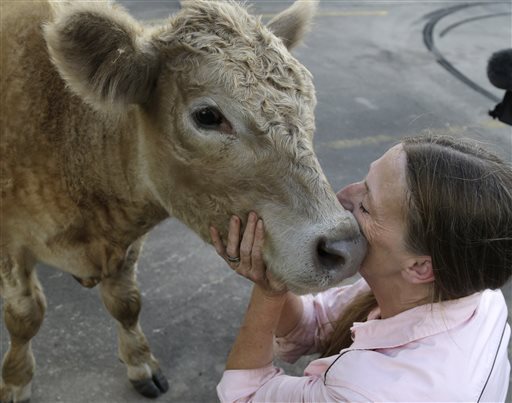
Hot and tired from a three-hour drive inside a trailer behind a pickup truck, the 600-pound English Charolais calf was content to lay on the grass behind a south Houston building while a team of technicians worked on its hind legs.

When the calf known as Hero heard its name called, the 15-month-old gingerly got up, unsteadily rocked a bit, then waddled away, tail wagging, eyes wide and tongue licking. It headed across a patch of concrete toward an appetizing snack of green shrubbery a few yards away.

Hero became what may be the nation’s only double-amputee calf with prosthetics on Wednesday when fitted for a new pair of high-tech devices attached to its back legs.

“I’m so proud,” Hero’s caretaker, Kitty Martin, exclaimed. “Look at you!”

It’s the latest step in a year-long effort that has taken Martin and the animal from Virginia, where she rescued it last year from an Augusta County farm where it succumbed to frostbite that claimed its hooves, to Texas.

Animal surgeons at Texas A&M University treated Hero for several months and affixed the initial prosthetics that the calf now had outgrown.

“This is our first cow,” Erin O’Brien, an orthotist and prosthetist for Hanger Inc., an Austin-based national firm that makes prosthetic limbs. She was among a team of about eight people working on the project for about two weeks.

“We did a lot of study of photos and video of cows just regular walking to see what it looks like and see if we can mimic that biomechanically,” O’Brien said. “It’s unusual, yes, but an opportunity.”

Surgeons at Texas A&M accepted Martin’s initial pleas for help, removing about two inches of bone to enable them to create a pad of tissue that would allow for prosthetics.

“Until I worked on him, I hadn’t ever done it before. And I’d not heard of (prosthetics) before in a bovine,” said Ashlee Watts, an equine orthopedic surgeon at the school.

Martin figures she has spent nearly $40,000 to save the calf.

“I don’t know how to explain it,” she said. “I’m an animal rescuer. And he had everything against him.”

Hero’s hooves are custom made of urethane and titanium, the connecting components are titanium and carbon fiber and the sockets that attach to his legs are carbon fiber and acrylic resin.

Martin and O’Brien declined to discuss the cost, but estimated that similar devices for humans go for between $4,000 and $8,000 apiece.

Hero’s sockets are painted with black and white cow spots. “Holstein legs,” O’Brien laughed.

“We like to customize legs to the person’s personality,” she said.

Martin, 53, a former veterinary technician and retired truck driver originally from Dalhart, in the Texas Panhandle, is moving with her husband from Greenville, Virginia, to Cameron in Central Texas.

She’s hoping Hero, who could grow to 1,500 pounds, can be a therapy animal for wounded veterans and special needs children.

“It makes my day,” Martin said. “He’s got a very bright future right now.”


2016-05-31T19:35:31-07:00May 22nd, 2014|
Go to Top