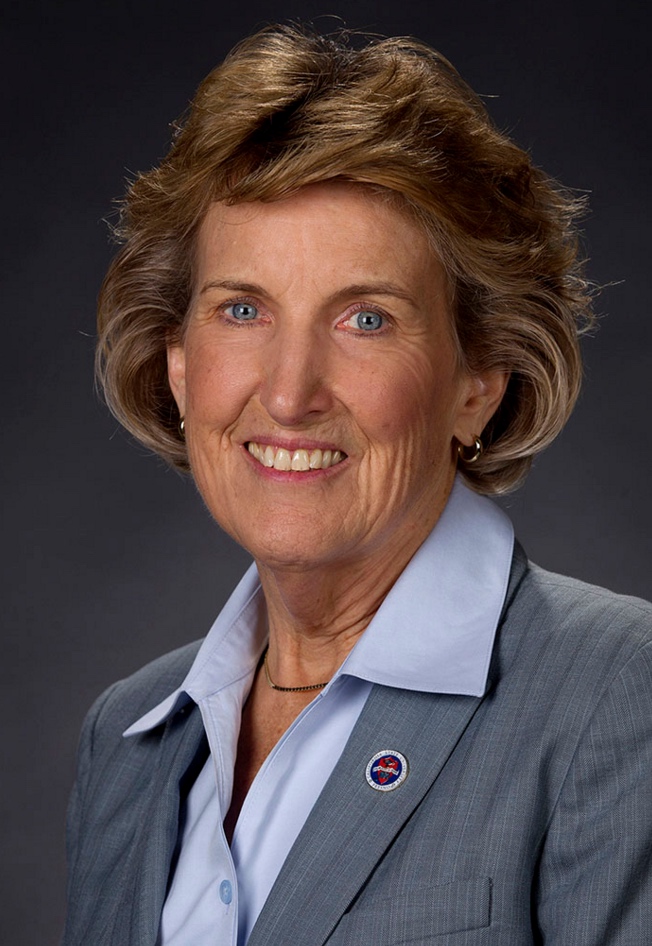
Sandra Witte, New Ag Dean at Fresno State

Dr. Sandra Witte Named Dean of Jordan College at Fresno State

(March 16, 2016) – Dr. Sandra Witte, who has been serving as interim dean of the Jordan College of Agricultural Sciences and Technology at Fresno State, has been appointed permanent dean, effectively immediately.

Dr. Lynnette Zelezny, provost and vice president for Academic Affairs, said Witte’s exceptional work as interim dean made her the best person for the position.

“We conducted a yearlong national search for a dean but did not find the right candidate for this important position,” said Zelezny. “In the meantime, it became clear to me, the faculty, staff and our strong partners in the agriculture community that Dr. Witte was the right candidate. I’m pleased she agreed to stay at Fresno State as permanent dean.”

Zelezny added: “This is a critical time for the Jordan College as we prepare for the opening of the Jordan Agricultural Research Center this spring and continue our laser-focus on crucial issues related to water and sustainability. I am confident Dr. Witte will lead the college to increasing national prominence.”real JCAST Logo

Witte has taken an unconventional route to the dean’s position, starting her career as a registered dietitian and serving as a professor and chair of the Department of Food Science and Nutrition, one of seven departments in the Jordan College.

“In the Jordan College, we often talk about offering programs from farm to fork and all the business in between,” said Witte. “While most people think of agriculture from the farm end, my connection is clearly on the fork end. I have always had an appreciation for traditional agriculture, and in my time at Fresno State, that has bloomed into a passion. After all, where is the food without the farmer?” she said.

Witte joins a growing number of women in agricultural leadership positions that traditionally have been held by males in universities, industry and commodity groups in the U.S.

The Jordan College maintains an enrollment of approximately 2,400 undergraduate and 100 graduate students from diverse backgrounds from throughout California, the U.S. and the world. Undergraduate, graduate and continuing education programs are offered in the major areas of agricultural business; animal sciences and agricultural education; child, family and consumer sciences; food science and nutrition; industrial technology; plant science; and viticulture and enology.

Faculty and students conduct applied research and public service in selected areas of agriculture, food sciences, industrial technology and family sciences. Students engage in learning science, technology and management in the classroom and by experience on the 1,000-acre on-campus University Agricultural Laboratory.

Witte has served as interim dean since October 2014. Previously, she jointly held the positions of associate dean of the Jordan College and dean of the Division of Graduate Studies. She joined the Fresno State faculty in 1992 and took her first administrative assignment in 2007.

She completed her bachelor’s degree in foods and nutrition at California State Polytechnic University, Pomona; master’s degree in home economics, nutrition and dietetics option at Fresno State; and her Ph.D. in food systems management at Oregon State University, Corvallis.

____________________________

Photo: Sandra Witte, dean of Agricultural Sciences and Technology at Fresno State (source: Fresno State

2016-05-31T19:24:10-07:00March 16th, 2016|

CA Farm Bureau Awards Ag Students

CA Farm Bureau Awards Young Farmers and Ranchers Program Students

Service to community and Farm Bureau earned awards for participants in the California Young Farmers and Ranchers program, and a student from California State University, Fresno, won the state’s annual Collegiate Discussion Meet. The awards were presented at the Feb. 27 annual California Young Farmers and Ranchers Leadership Conference in San Luis Obispo.

For a second straight year, the San Joaquin Farm Bureau Young Farmers and Ranchers Committee earned the YF&R Committee of the Year Award, for its activities during 2015. The committee, composed of 45 active members, volunteered at numerous Farm Bureau and agricultural education events; donated food to local food banks and toys to children of military service members; presented three college scholarships; and raised money for the scholarship program and for the California Farm Bureau Federation Fund to Protect the Family Farm.

Napa County Farm Bureau member Johnnie White received the Star YF&R Award, which recognizes a young farmer or rancher for service to agriculture. White, a sixth-generation farmer, works as operations supervisor for a vineyard-management company and as a volunteer firefighter in St. Helena. He has been an active YF&R volunteer since 2006, serves as first vice chair of the State YF&R Committee and is a member of the 2016 Leadership Farm Bureau class.

California Farm Bureau Federation Young Farmers and Ranchers 2016 Conference logo

California Farm Bureau Federation Young Farmers and Ranchers 2016 Conference

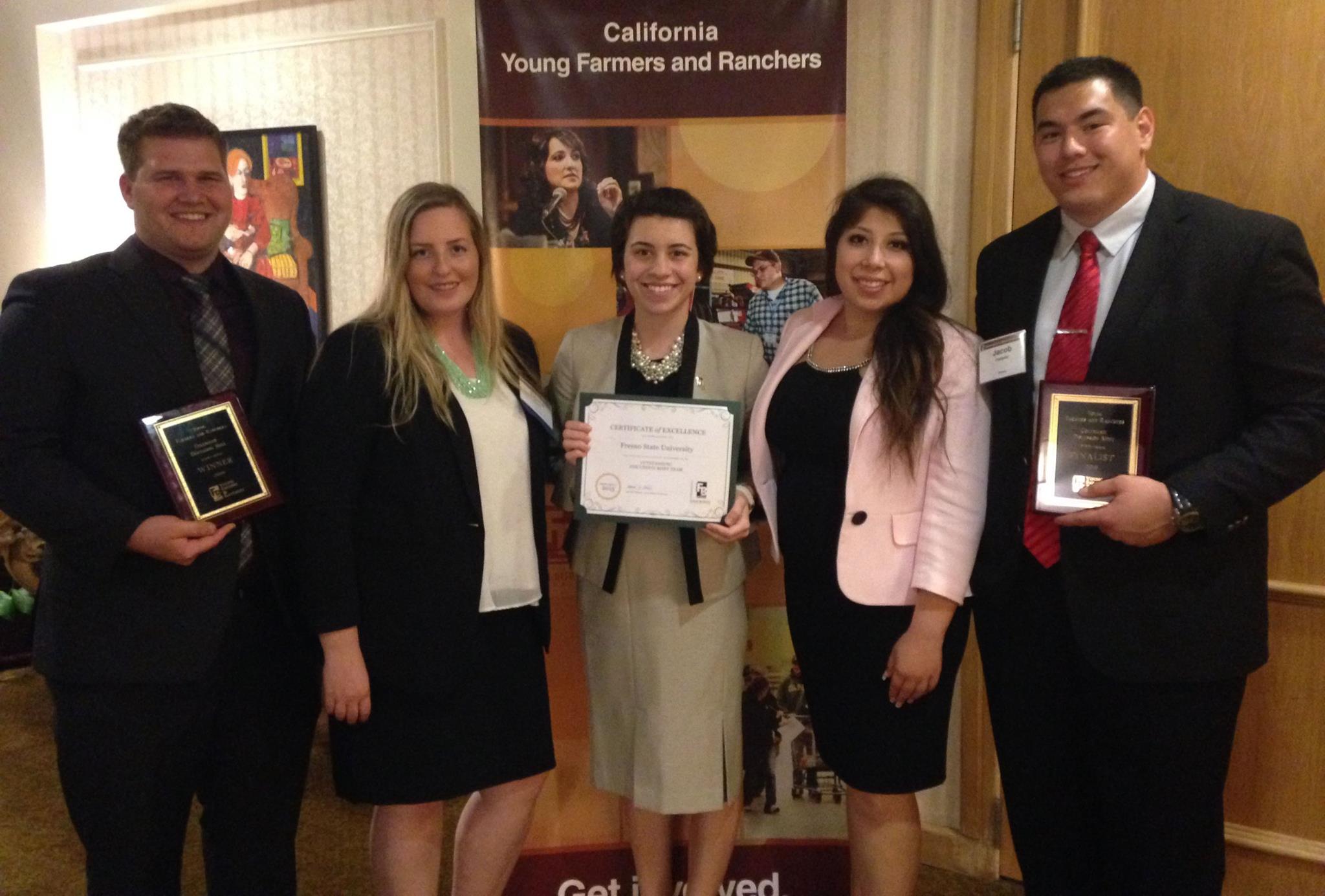
Fresno State junior Hunter Berry (San Jacinto), an agricultural business major, won the Collegiate Discussion Meet, which simulates a committee meeting with active participation and positive group discussion. Berry began his agricultural training in high school classes and FFA activities. At Fresno State, he is pursuing an accounting concentration and hopes to obtain a master’s degree on his banking or financial analysis career path. Next February, Berry will become the sixth Fresno State student to represent California at the American Farm Bureau’s Collegiate Discussion Meet national competition.

Riley Nilsen (Nipomo), an agricultural science student at Cal Poly San Luis Obispo, was first runner-up in the competition. The other finalists were Fresno State senior agricultural business student Jacob Vazquez (Cottonwood) and Cal Poly student Haley Warner (Angels Camp). Berry earned a $1,250 prize sponsored by AgroLiquid; Nilsen earned $750 and the other finalists each earned $500.

Fresno State won the collegiate team competition, the fifth team and individual titles for the group under the direction of adviser Dr. Steven Rocca, Fresno State agricultural education professor. Other team titles came in 2014, 2013, 2008 and 2006. Berry said. “Dr. Rocca did a great job of mentoring us before and during the competition, as well as arranging for guest speakers beforehand such as Ryan Jacobsen from the Fresno County Farm Bureau. Having four of our team members make the semifinals was especially rewarding.

In addition to Berry and Vazquez, Fresno State’s team included agricultural education-communication senior Dominique Germann (Ceres), animal science-livestock business management junior Emma Briggs (Santa Rosa) and animal science-pre-veterinary senior Ana Lopez Campos (Tulare).

________________________________________________

American Farm Bureau’s Young Farmers and Ranchers program serves agriculturalists between the ages of 18 and 35 who are actively involved in production and affiliated professions.

The California Farm Bureau Federation works to protect family farms and ranches on behalf of more than 53,000 members statewide and as part of a nationwide network of more than 6.2 million Farm Bureau members.

________________________________________________

Sources: 

California Farm Bureau Federation

California State University, Fresno, Jordan College of Agricultural Sciences and Teçhnology (Geoffrey Thurner).

Photo: Collegiate Team Award Winners (2016); source: California State University, Fresno, Jordan College of Agricultural Sciences and Technology

2016-05-31T19:24:10-07:00March 14th, 2016|

Semios Approved for Navel Orangeworm Control

Semios Aerosol Pheromone Approved for Navel Orangeworm Control


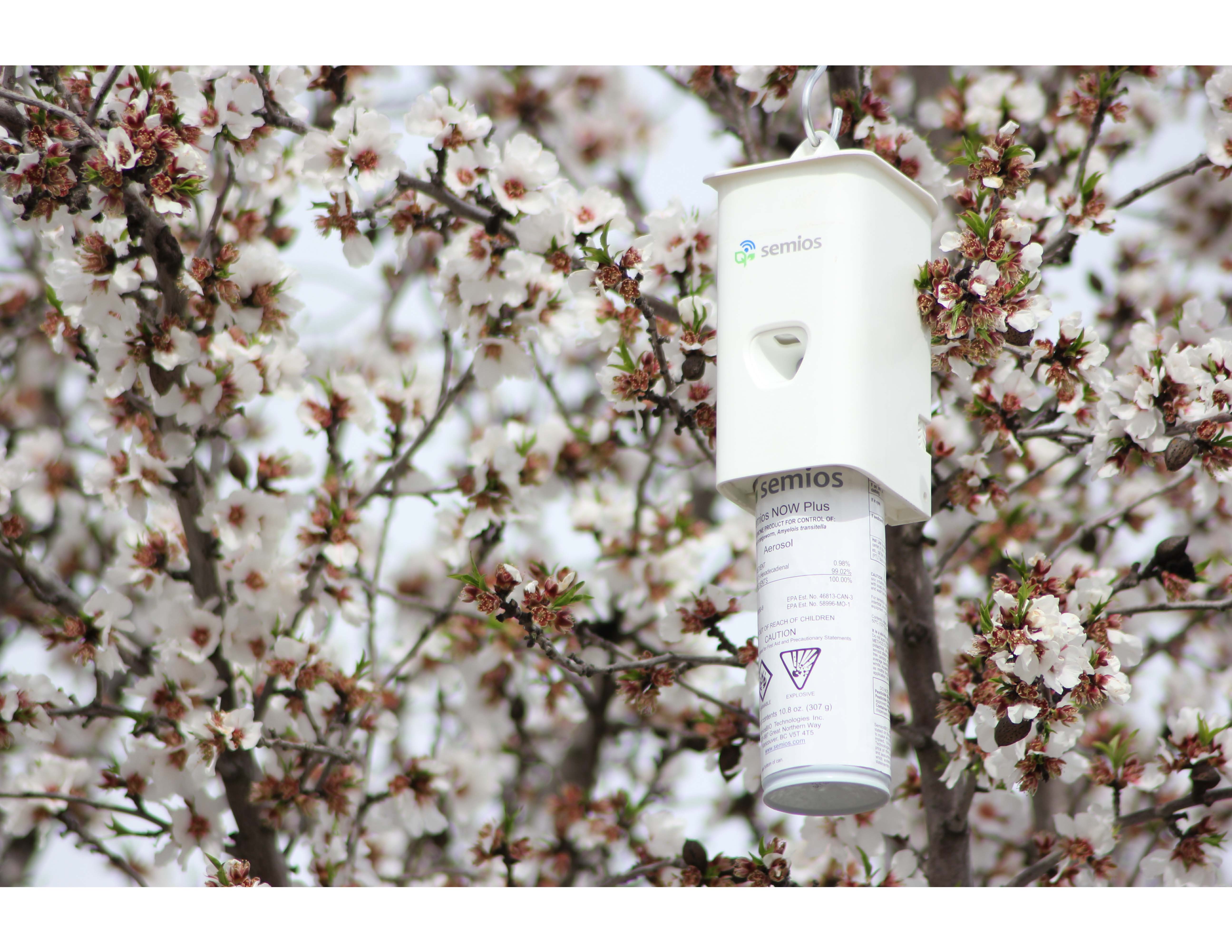
Announced TODAY, Semios, a leading provider of real-time agricultural information and precision pest management tools, has received US Environmental Protection Agency (EPA) approval and California Department of Pest Regulation (DPR) approval for aerosol pheromone biopesticide products that disrupt the mating of the Navel Orangeworm (NOW).  
Michael Gilbert, founder and CEO of Semios said, “The Navel Orangeworm pest causes significant loss of crop and revenue in the California almond and pistachio industries, and it’s getting worse every year.  The Semios NOW pheromone aerosol formulas give farmers the ability to reduce and control pest populations and, as a result, significantly reduce crop damage.  The Semios pheromone aerosol dispenser is part of a custom-designed controller and sensor network that gives farmers decision-making tools and remote access to the field conditions in real-time- all day, every day.”

Remote Control Makes it Highly Effective

The Semios platform includes in-field camera traps that monitor the number of pests and flight strength, which when combined with wind, temperature and other environmental conditions measured and reported by Semios, optimize pheromone deployment.  The combination of traps, pheromone dispensers and other sensors on the same network means farmers can deploy the right amount of pheromones where and when needed through a single interface.

A Destructive Pest for Many Crops

NOW is the most destructive pest of introduced nut crops. Semios NOW Plus and Semios NOW Standard (for organic growers) are available for control of NOW in orchards growing walnuts, pistachios, almonds, dates, figs, citrus, pome and stone fruits.


Sustainable Solution

Pheromones are a naturally occurring part of the communication systems used by insects.  Semios uses pheromones to disrupt the mating cycle of insects, thus diminishing pest populations and reducing crop damage.  Pheromones do not kill or damage the target insects and, as pheromones are species-specific and only target the specific pest, pollinators and other beneficial insect species are not affected.

_______________________________

About Semios

Semios is a leading precision farming platform that provides real-time information and pest management tools for the tree fruit, nut and grape growers.   Semios combines hardware with powerful secure online software that monitors field and weather conditions and allows remote pest monitoring and deployment of mating disruption pheromones. It’s easy to use, reduces labor and allows farmers to make decisions that preserve and increase crop value.
2021-05-12T11:03:03-07:00March 2nd, 2016|

Bayer AgVocacy Forum Connects Public with Food Production

Bayer Advocacy Forum Narrows Gap Between Public and Food Production

Food system, science and agriculture experts gather to discuss the convergence of food and the future of agriculture

NEW ORLEANS, La.  Advancing the conversation about the best ways to sustainably feed a growing population is the overarching theme for the 2016 AgVocacy Forum, sponsored by Bayer CropScience. Representatives from agriculture and consumer media will hear from thought leaders in science, nutrition and sustainable food production at the invitation-only event TODAY.

David Hollinrake, vice president, marketing & portfolio management, Bayer

David Hollinrake, vice president, marketing & portfolio management, Bayer

Formerly “Ag Issues Forum,” AgVocacy Forum continues a decade-long tradition of bringing together a diverse mix of people, experience and opinions to exchange ideas and philosophies that help shape and influence modern agriculture. This year’s event shines a spotlight on how being an “AgVocate” may help bridge the growing divide between consumers and those involved in food production.

“There are many challenges facing today’s food producer and perhaps none more important than building trust with consumers,” said David Hollinrake, vice president, marketing & portfolio management, Bayer. “We assembled experts at AgVocacy Forum to spark dialogue and bring focus to the steps needed to educate and engage a public that is increasingly detached from modern agriculture.”

Carolyn O'Neil, MS, RDN, former CNN correspondent

Carolyn O’Neil, MS, RDN, former CNN correspondent

Award-winning author and registered dietician, Carolyn O’Neil, kicked off the Forum last night with a keynote address sharing her insights on consumer preferences driving food trends. The program also featured 12-year-old Braeden Mannering who, while attending the “Kids’ State Dinner” at the White House, was challenged by First Lady Michelle Obama to “pay his experience forward.” Braeden’s response was to create Brae’s Brown Bags (3B), which battles food insecurity by providing healthy snacks to homeless and low-income individuals.

Braeden Mannering, founder Brae's Brown Bags (3B)

Braeden Mannering, founder Brae’s Brown Bags (3B)

Additional guest speakers include:

Kavin Senapathy, author of The Fear Babe: Shattering Vani Hari’s Glass House and regular contributor for Forbes.com

Dan Dye, CEO of Ardent Mills, a joint venture among Cargill, ConAgra Foods and CHS

Josiah Zayner, CEO of The ODIN and former NASA bioscientist

Charles Baron, co-founder and vice president of Farmers Business Network, a crowd-sourced program for data-driven agriculture

AgVocacy Forum is being skillfully moderated by Frank Sesno, director of the School of Media and Public Affairs at George Washington University and a former CNN correspondent, anchor and Washington D.C. Bureau Chief.

In conjunction with the event, the Bayer Foundation has made a $10,000 donation to the Orleans Parish 4-H chapter and will work with the chapter to install a Feed a Bee pollinator garden at Ben Franklin Elementary.

Watch a live stream of the AgVocacy Forum at www.agvocacyforum.com, and join the conversation by following @bayer4cropsus and using #AgVocate. Be sure to look for blog posts on the event at www.cropscience.bayer.us/news/blog.

________________________________

Bayer is committed to bringing new technology and solutions for agriculture and non-agricultural uses. For questions concerning the availability and use of products, contact a local Bayer representative, or visit Crop Science, a division of Bayer, online at www.CropScience.Bayer.us.

Visit the Bayer Connect – Social Hub for social media, recent news, blog posts, videos and more from Crop Science, a division of Bayer.

________________________________

Bayer: Science For A Better Life

Bayer is a global enterprise with core competencies in the Life Science fields of health care and agriculture. Its products and services are designed to benefit people and improve their quality of life. At the same time, the Group aims to create value through innovation, growth and high earning power. Bayer is committed to the principles of sustainable development and to its social and ethical responsibilities as a corporate citizen.

Forward-Looking Statements

This release may contain forward-looking statements based on current assumptions and forecasts made by Bayer Group or subgroup management. Various known and unknown risks, uncertainties and other factors could lead to material differences between the actual future results, financial situation, development or performance of the company and the estimates given here. These factors include those discussed in Bayer’s public reports which are available on the Bayer website at www.bayer.com. The company assumes no liability whatsoever to update these forward-looking statements or to conform them to future events or developments.

2016-06-03T09:32:30-07:00March 2nd, 2016|

REWARD for BEEHIVE THIEF CAPTURE

Reward for Beehive Thief Capture

California State Beekeepers Association, Inc. (CSBA) has reported two new beehive theft alerts and will provide a reward for beehive thief capture:

The CSBA offers up to $10,000 for information that leads to the arrest and conviction of persons responsible for stealing bees and/or beekeepers equipment. We take the issue of hive theft very seriously and are willing to generously reward those who help us stop this growing problem. Don’t hesitate to ask questions and check for brand numbers on frames, boxes, lids and pallets.

Additionally, the CSBA owners of stolen hives have given assurance that if a farmer reports he/she has stolen hives, they will allow the hives to stay for the remainder of the bloom. We do not want to punish farmers for doing the right thing by putting their crop at risk. We want all farmers to feel comfortable to report the hives without worrying about them being taken out from under them during a critical time.

Beehive Theft Alert 1Kern-County-Beehive Theft Alert 1

A beehive theft has occurred near Kern County within sight of I-5. The thieves are getting bolder and we all must be vigilant. The theft occurred around January 26-27th, 2016. The hives are branded with CA0330333H. This theft may or may not be related to the last major theft (see below).

Hive Description: All hives are 10 frames. The hives are made of a deep super with a 6 5/8 shallow on top. The hives are painted silver and have internal feeders and a mixture of wooden and plastic frames. The hives are on pallets with the entrances all facing the same direction. The lids, boxes and most of the frames are branded with CA0330333H. The bees are Italians with cordovan (light-colored and reddish) genetics. Pictures will soon follow.

If you are around any beehives you are unfamiliar with, don’t hesitate to look for brand numbers. Thieves often times switch the frames into different boxes to avoid being caught so be aware that the outside appearance of the hive may not match the description.

If you see any frames with the CA0330333H brand on them, they are from stolen hives and you should contact castatebeekeepers@hotmail.com immediately to report the information.

Beehive Theft Alert 2

stolen-beehives 2

240 hives were stolen near Colusa, CA around January 25-26th, 2016. All boxes, lids, frames and pallets are branded with 42-14. Please take a careful look at the picture and if you see hives that fit the description, don’t hesitate to check for brand numbers and call the Sheriff’s department. You can also email us at castatebeekeepers@hotmail.com and we can pass along the information for you.  These hives could easily be anywhere in California by now. It is very likely that the hives will be destroyed after pollination season to cover up the crime. In the interest of saving these bees, it is critical we all do our part to locate these hives.

Description: All the hives are 10-frame double deeps. The boxes are branded on the top cleats. The pallets have metal on the corners. Some of the feed cans and boxes were taken as well. The feed cans are painted green and slightly rusty. The feed can boxes are branded too and most of them hold 8 cans (some may hold 4). The bees are Italian and have Cordovan genetics (most will appear light colored and/or slightly reddish).

Location: The hives were taken from 2 yards, both located north of Colusa on the east side of the river. One yard was about 2 miles from the river and the other about 3 miles from the river.

Thief Description: Based on the tracks, it looks like a bee forklift was used to move the hives. The trucks appear to have dual tires. It is suspected that either 2 big trucks or 3 smaller trucks were used to move the hives.

Please share this information with your club, almond grower and in your community. Hive theft is a growing problem and we all need to keep an eye out for each other. Thank you for helping in this effort.

(Photo Source: California State Beekeepers Association)

2016-05-31T19:24:13-07:00February 4th, 2016|

Breaking News: New HLB Infected Tree in San Gabriel

Breaking News

Citrus Insider Reports New HLB Confirmed in San Gabriel

Today, two additional trees in have tested positive for Huanglongbing (HLB). The two trees, an orange and a kumquat, are on separate properties but are both within the core area in San Gabriel where 10 diseased trees were confirmed last summer. Given the close proximity, there will not be a quarantine expansion.

One of the HLB-positive trees has already been removed and California Department of Food and Agriculture (CDFA) officials are in the process of contacting the other homeowner to schedule tree removal. Agriculture officials are working quickly in the area.

Citrus trees in San Gabriel had already been treated for the Asian citrus psyllid (ACP) within the last few weeks as part of CDFA’s routine HLB response. ACP populations are closely monitored in areas where HLB has been detected and treatments occur if there is a noted increase in population size. Since trees have been recently protected, no additional treatments will take place at this time. Instead, CDFA will focus on sampling extensively in the area. Much of the area has already been sampled and CDFA’s lab has identified all samples from San Gabriel as high priority.

The Citrus Pest & Disease Prevention Program is working with the Los Angeles County Agricultural Commissioner’s office and CDFA to develop a multilingual informational flyer to notify residents of the significance of these finds and potential implications to other citrus trees in the area. CDFA staff will distribute this information as they go door-to-door sampling and surveying.

More information will be shared as it is available. In the meantime, the citrus industry is encouraged to keep a critical eye on all plant material moving into or out of your groves and recommends taking the following steps so collectively, as a team, we can all save our citrus trees.

-Remove all leaves and stems

-Shake out picking bags

-Inspect harvesting equipment

-Educate fieldworkers

-Get on board with area-wide treatments

__________________

Additional Links:

Citrus Insider

Save Our Citrus

California Citrus Mutual

2021-05-12T11:03:04-07:00February 3rd, 2016|

National Association of State Departments of Agriculture Celebrates 100th Anniversary

House Agriculture Committee Chairman Conaway recognizes the National Association of State Departments of Agriculture on its 100th Anniversary

House Agriculture Committee Chairman K. Michael Conaway submitted the following remarks for the Congressional Record recognizing the National Association of State Departments of Agriculture on its 100th Anniversary.

Remarks as prepared:

“Mr. Speaker, I rise today to honor the 100th anniversary of the National Association of State Departments of Agriculture (NASDA). NASDA is a non-profit, non-partisan organization which represents the commissioners, secretaries, and directors of agriculture from all fifty states and four U.S. territories. The State departments of agriculture have served not only the farmers and ranchers of America, but also American consumers for a significant portion of our nation’s history.CDFA LOGO

“NASDA is a highly effective association which serves to grow and enhance agriculture by forging partnerships and creating consensus to achieve sound policy outcomes between state departments of agriculture, the federal government, and stakeholders. These partnerships are apparent in the halls of almost every office building in the District of Columbia. I rely on the hard working men and woman in the Texas Department of Agriculture to provide me with perspectives on how federal policy is impacting boots on the ground agriculture. I’m sure my colleagues rely on their state department of agriculture in similar ways.

“NASDA is an active partner with the United States Department of Agriculture through a longstanding cooperative agreement to employ a nationwide network of enumerators in support of the mission of the National Agricultural Statistics Service (NASS). The data collected through this partnership informs a broad spectrum of legislative and regulatory initiatives, including farm programs under the jurisdiction of the Committee on Agriculture which I have the honor to chair.

“NASDA and its members likewise play a critical role informing Congress and the executive branch regarding the operation of federal and state programs covering everything from animal and plant health, food safety and marketing, nutrition, and literally hundreds of other consumer services.

“NASDA exists to amplify the unique voice of all state departments of agriculture. NASDA Members are able to amplify their national voice by achieving consensus on otherwise contentious issues such as threatened and endangered species, agriculture labor, and water quality.

“Mr. Speaker, I join the members and stakeholders of NASDA in celebrating their 100th year of advocating for American agriculture. I wish NASDA many more years of public service to American agriculture at the critical nexus of state and federal policy.”

2016-05-31T19:24:13-07:00February 2nd, 2016|

USDA, Microsoft Innovation Challenge Winners

Open Data from USDA, Microsoft Cloud Technology Strengthen Food Supply Through “Innovation Challenge” Winners


Agriculture Secretary Tom Vilsack and Microsoft officials announced the winners of the USDA, Microsoft Innovation Challenge late last month in which contestants used USDA agriculture production open data to develop online tools that can help make the American food supply more resilient in the face of climate change.

“In yet another example of how public and private resources can be leveraged together to address significant global concerns, the winners of the USDA-Microsoft Innovation Challenge have used open government data to create an impressive array of innovative tools to help food producers and our communities prepare for the impacts of climate change and ensure our nation’s ability to provide plentiful, affordable food,” said Agriculture Secretary Tom Vilsack. “For more than 100 years, USDA has compiled data on the farm economy, production, and the health of crops around the country, and it is exciting to see such modern, useful tools spring from these information sources.”

The Challenge was created in support of the President’s Climate Data Initiative, which aims to harness climate data in ways that will increase the resilience of America’s food system. USDA provided contestants with more than 100 years of crop and climate data through Microsoft Azure, Microsoft’s cloud computing platform.

“Combining the advantages of cloud computing resources with the government’s desire to provide open access to public data is likely to transform scientific research and business innovation,” said Dr. Daron G. Green, deputy managing director of Microsoft Research. “Microsoft’s partnership with the USDA evidences how public-private partnership can stimulate new applications, explore novel scenarios and, in this case, work towards a more resilient and sustainable food production.”

A total of $63,000 in cash and prizes were awarded, with winners selected from more than 346 registrants and 33 submissions from around the world.

The award recipients and their projects, are:FarmPlenty


  • Grand Prize, Open Source Application Award, and Best Visualization in Time or Space Award recipient: Farm Plenty, submitted by George Lee of San Francisco, Calif. This application allows farmers to analyze USDA data about crops grown within five kilometers of their farms to make informed decisions about their own crop choices.


  • Second Prize and Open Source Application Award recipient: Green Pastures, submitted by Khyati Majmudar of Mumbai, India. This comprehensive dashboard interface allows a farmer to visualize production, economic, livestock, and commodity data from NASS, ERS, ARMS, and other sources at scales from national to local, including information on farmers’ markets.


  • Third Prize recipient: What’s Local, submitted by Benjamin Wellington of Landscape Metrics LLC in Brooklyn, N.Y. This tool analyzes the resources that are required to produce agricultural outputs by using data from the Census of Agriculture in a way that allows urban population centers to connect with farmers in their area.


  • Honorable Mention: Open Source Application Award, and Best Student-Made Award recipient: Farm Profit Calculator, submitted by Fernando Napier and Matt Pedersen of Lincoln, Neb. Farmers can use this mobile phone application to compare their input costs (fertilizer, seed, fuel, etc.) to regional averages, and find financial efficiencies where their costs are above the norm.croptrends


  • Honorable Mention recipient: Croptrends, submitted by Chaiyawut Lertvichaivoravit and Ta Chiraphadhanakul of Thousand Eyes in San Francisco. This useful tool can be used for viewing spatial and temporal trends in crop production and yield by county for the entire United States by using NASS data.


  • Popular Choice Award recipient: VAIS, submitted by Ken Moini of Thallo Tech in Nashville, Tenn. This tool uses NASS data for the entire United States to provide a unique approach to visualizing crowd-sourced pricing data.


  • Large Organization Recognition Award recipient: Farmed, submitted by Bryan Tower of Applied Technical Systems in Silverdale, Wash. This tool allows farmers to view crop conditions in their area by using VegScape data from NASS combined with local weather data.


USDA is an active founding member of the Global Data Partnership through the memberships of both the U.S. Government Open Data and the Global Open Data for Agriculture and Nutrition (GODAN) initiatives. USDA is helping pave the way for coordinating global efforts to make agriculture and nutrition data open. USDA’s Open Data Catalog is the authoritative source of publicly available USDA data.

Since 2009, USDA has invested in and advanced innovative and transformative initiatives to solve societal challenges and ensure the long-term viability of agriculture. USDA’s integrated research, education, and extension programs, supporting the best and brightest scientists and extension personnel, have resulted user-inspired, groundbreaking discoveries that are combating childhood obesity, improving and sustaining rural economic growth, addressing water availability issues, increasing food production, finding new sources of energy, mitigating climate variability, and ensuring food safety. To learn more about USDA’s impact on agricultural science, visit www.usda.gov/results.

2016-05-31T19:24:13-07:00February 2nd, 2016|

California Water Priorities Ballot Measure

Petitioning for California Water Priorities Ballot Measure Kicks off Friday in Fresno


California Water Alliance (CalWA) executive director Aubrey Bettencourt announced TODAY that a petition drive for the California Water Priorities Ballot Measure will take place Friday, January 29, 2016, at KMJ Studios, 1071 W. Shaw Avenue in Fresno, from 2-6 pm.

Earlier this week, the proposed ballot measure was approved by Attorney General Kamala Harris, opening the door to begin signature-gathering efforts with initiative supporters. Since the measure’s approval, CalWA has received an overwhelming amount of support and requests for petitions to circulate.

Electronic copies of the petition are not available, as use of them would disqualify the signatures gathered. Requests for petitions may be made online at www.CaWater4All.com. CalWA will begin mailing petitions on Friday, January 29.

A second signature drive is being scheduled February 9-11, 2016, at the World Ag Expo in Tulare. More information on this event will be available on the CaWater4All website.

lineclear

The California Water Alliance is a statewide nonprofit organization dedicated to raising awareness about the nature of water and promoting long-term, sustainable solutions that meet the health and security needs of families, cities, businesses, farmers and the environment. 

The California Water Alliance Initiative Fund Committee (FPPC ID#1381113), sponsored by the California Water Alliance, a non-profit IRC §501(c)(4) organization, is a state primarily formed ballot measure recipient committee organized to qualify two or more state ballot measures for the November 2016 ballot. It is permitted to accept unlimited, non-tax-deductible donations from individuals, corporations, partnerships, nonprofit organizations, and any other lawfully permissible sources. For more information and restrictions, please visit http://cawater4all.com/.

lineclear

Resources:


The Water Priorities Constitutional Amendment and Bond Act Fact Sheet

California Water Explained

California Water Use Facts

California Water Polling Infographic

2016-05-31T19:24:14-07:00January 28th, 2016|

Biocontrols Conference & Expo

Biocontrols Conference & Expo, March 3-4, 2016, Monterey, California 

Learn everything you need to know about agricultural biocontrols from the experts.  


Join your peers, leading organizations and industry experts at the Biocontrols Conference & Expo for two days of hands-on education devoted solely to the use of biocontrols in agriculture presented by Meister Media Worldwide, a media solutions provider for worldwide specialized agriculture, in cooperation with the Biopesticides Industry Alliance (BPIA), and the California Association of Pest Control Advisers (CAPCA). The Biocontrols Conference offers educational sessions, continuing education credits (CEUs) for pest control advisers (PCAs), certified crop advisers (CCAs) and other state certification programs, and an expansive Expo with top suppliers of biocontrol products and related services.

New for 2016!  

Two optional, concurrent add-ons on the last afternoon of the event (additional fees may apply):

1.Tour of two leading Monterey-area specialty-crop growing operations that use biocontrols as part of their integrated pest management programs:

-Biocontrols USA Tour

-Pacific Plug and Liner,  Watsonville, CA

2.Hands-on workshop on the use of beneficial insects in a greenhouse environment

lineclear

Agenda Sampling:

-8 Tips To Get The Most Out of Your Biocontrols Program

-A look at the most common active ingredients and how to handle them to get the best results, Lance Osborn, UF IFAS

-What’s Next In Biocontrol?

-Regulatory Update, Bob McNally, EPA

-Pipeline Update – what types of new products are coming?

-The Future Isn’t Biocontrol. It’s IPM

-Understand The Value of Biopesticides – Do they Pencil Out for You?

-How To Evaluate/Field Test a New Research Biopesticide

-Biopesticides and Beneficials: Make Them Work Together, Frank Sances, Pacific Ag

-Fruit and Tree Nuts: Hands-on, How-To Topics

-Using Green Lacewings in almond and pistachio, Brad Higbee, The Wonderful Co.

-Vegetables: Hands-on, How-To TopicsMycorrhizae: Why it Makes Sense in Strawberries, Johan Pienaar, Mycorrhizal Applications.

Monterey Bay, the conference location, is in close proximity to the heart of major California specialty-crop production: vegetables, fruits, and ornamentals in Monterey County and the Salinas Valley, and affords you the opportunity to tie-in a long weekend in the Monterey Bay area.

lineclear

Meister Media Worldwide and its leading family of brands including American Vegetable Grower®, Western Fruit Grower® / American Fruit Grower® and Greenhouse Grower®, CropLife®,

lineclear

Having celebrated its 15th anniversary in September 2015, BPIA is dedicated to fostering adoption of biopesticide technology through increased awareness about their effectiveness and full range of benefits to a progressive pest management program.

lineclear

Dedicated to the professional development and enhancement of its members’ education and stewardship, the California Association of Pest Control Advisers (CAPCA) represents more than 75% of the nearly 4,000 California EPA licensed pest control advisers (PCAs) that provide pest management consultation for the production of food, fiber and ornamental industries of this state.

2021-05-12T11:05:58-07:00January 28th, 2016|
Go to Top