Calif. Profs Win Irrigation E3 Leader Awards

Irrigation E3 Leader Awards Go to Two California Faculty

The Irrigation Foundation has named 15 outstanding students and faculty as winners of the 2015 Irrigation E3 Program. The Foundation selected two faculty 2015 Irrigation E3 Leaders, both in California, Florence Cassel, Fresno State and Tim Ellsworth, West Hills College Coalinga.

This year’s class of faculty and students will receive an all-expenses-paid trip next week to the Irrigation Show & Education Conference, Nov. 9 – 13, in Long Beach, Calif.

Founded in 2012, the E3 program provides students and faculty with exposure, experience and education in the irrigation industry. Academics nominate outstanding students for consideration as E3 Learners and/or apply to become E3 Leaders themselves.

To qualify to apply for Irrigation E3 Leader status, an instructor must be teaching, or will be teaching within the next six months, irrigation-related coursework at a North American community college, university or similar institution of higher learning. Prior winners may not reapply.

Chosen faculty will have the opportunity to participate in education classes, industry sessions and networking events. Working with academics is essential to the Foundation’s mission of attracting people to careers in irrigation by supplying the irrigation industry with educated professionals. Faculty members help shape the future career paths of their students and keeping instructors up-to-date on the latest and greatest in the irrigation industry is a must. 

“This is the fourth year of the program, and the Foundation is sending a record number of students to the show,” said senior foundation manager Janine Sparrowgrove. “We are excited to give the students and faculty the opportunity to attend classes and gain exposure to industry companies and technologies.”

Florence Cassel Sharma, Assistant Professor Irrigation/Water Management, Jordan College of Agricultural Sciences and Technology, Department of Plant Science, California State University, Fresno researches optimizing water use efficiency through low and deficit irrigation practices, improving irrigation scheduling, and utilizing remote sensing techniques for water resources management, crop water use, and soil salinity assessment. Assistant director of research of the Center for Irrigation Technology, Sharma is a recipient of the 2009 Outstanding Research and Scholarly Activity Award for the Jordan College of Agricultural Sciences and Technology.

Tim Ellsworthagriculture technology instructor at West Hills College Coalinga, researches primarily soil science with a focus on precision agriculture and nutrient management. He currently serves on the advisory board for the Canadian Biochar Consortium.

Prior to West Hills, Ellsworth was a professor and faculty director of the online master’s program for the Department of Natural Resources and Environmental Science at University of Illinois, Urbana-Champaign, a soil scientist with the USDA U.S. Salinity Laboratory, a visiting faculty member at the Centre for Water Research, Department of Civil Engineering, University of Western Australia in Perth and a senior scientist performing hazard assessments and hazard evaluations for the U.S. Army with regard to management of the U.S. Army Chemical Weapon Stockpile.

This year’s Irrigation E3 Learners are:

  • Samia Amiri, Oklahoma State University
  • Garrett Banks, Colorado State University
  • Colton Craig, Oklahoma State University
  • Spencer Davies, Brigham Young University
  • Daniel Greenwell, Auburn University
  • John Hawkins, Alamance Community College
  • Tsz Him Lo, University of Nebraska, Lincoln
  • Michelle Mbia, Prairie View A&M University
  • Ryan McBride, Brigham Young University, Idaho
  • Alan Rourke, Kansas State University
  • Daniel Selman, Brigham Young University
  • Amandeep Vashisht, Colorado State University
  • Christopher Weathers, Mira Costa College

Toro Company is the lead sponsor and the Carolina’s Irrigation Association is a supporting sponsor for this year’s program. 

Links:

Irrigation E3 Program 

Irrigation Foundation

2016-05-31T19:27:04-07:00November 5th, 2015|

Fresno Ag Awards

Joe Del Bosque and Earl Hall Receive Ag Awards in Fresno

By Charmayne Hefley, Associate Editor

At the Fresno Chamber of Commerce’s Annual Ag Awards Luncheon on Oct. 28,  Westside farmer Joe Del Bosque and businessperson Earl Hall, owner of Hall Management Corp., a labor contracting company, received awards for their commitment to agriculture.

Honored as the Chamber’s 2015 Agriculturalist of the Year, Del Bosque, owner of Del Bosque Farms in Firebaugh, said, “It’s an honor to be here, and I’m so surprised to see not only my family here, but a lot of my friends as well as community leaders that I know. I’m just so pleased to have them attending and supporting. It really is an honor and I’m humbled. I mean, I saw the list of the folks who have been given this award; they’re some of the big leaders that I always look up to.”

Earl Hall

Earl Hall, owner of Hall Management Corp.

Del Bosque was honored for his open farm policy of allowing bloggers and city folks to visit his operation and observe what farming is all about. He also hosted President Obama on an historic visit on Feb. 14 2014. Del Bosque farms almonds, melons, cherries and asparagus and relies on his farm employees to get the crops harvested. He also is a governor-appointed member of the California Water Commission, a public forum to discuss water issues, advise the Department of Water Resources (DWR) on water policy and decides what storage projects to build with 2014 Water Bond funding.

Hall’s Kerman-based company, Hall Management Corp, received the Baker Peterson Franklin’s Ag Business Award. Hall said his company manages the farm production and all of the labor—all of whom work directly for his company—for several different agricultural companies across 500 thousand acres. “We do business in 26 counties around the state,” said Hall. “I’ve been doing this for 50 years, and it’s quite an honor that our company has been recognized today as the ag business company of the year. I have to give all the credit to my people.

____________________

Founded in 1917, Baker Peterson Franklin, CPA, LLP is a full-service, locally-owned accounting and consulting firm in Fresno, California with a 45+ person staff.

With a membership of more than 1,400 businesses and organizations, the Fresno Chamber of Commerce promotes and supports the success of the regional business community through effective advocacy, education and relationship building.

2016-05-31T19:27:04-07:00November 3rd, 2015|

Joe Marchini, Mr. Radicchio

Joe in truckJoe Marchini Brings Radicchio to California

By Patrick Cavanaugh, Deputy Editor

Joe Marchini, of J. Marchini Farms, was born in 1938 to Italian parents who farmed and packed tomatoes in Le Grand, Calif. Marchini has lived and worked in that locale for his whole life, exemplifying a high level of spirit and accomplishment.

His father, Florindo Marchini, brought his family over from Tuscany in 1920.” They settled in Le Grand because Florindo’s brother was already living there when Florindo first arrived. Before long, Florindo met a long time grower by the name of Carlo Giampaoli who invited Marchini to grow tomatoes and bell peppers with him. So Giampaoli took Florindo Marchini under his wing, and his brother as well, and established their farm, Giampaoli-Marchini Company. Together, they packaged tomatoes under the Live Oak brand because they actually packed the produce by hand in the shade of a live oak tree that still thrives there today!

Florindo’s son, Joe Marchini, was around seven when he began working at the packing shed stamping produce boxes. “I would sit on a box,” he said, “and as they came down the line, I used a little stamp pad to size tomatoes 6/6, 7/7, 7/8, 5/6, 4/4, 3/4. I only worked about 3-4 hours a day, and that was it. The older I got, the more I became involved in different things, from stamping, to packing, to wrapping tomatoes in cellophane paper and putting them in a box.”

The tomatoes were packed green and transported back east by train in ice cars. “They weren’t pink ones; no, they were dead green! They knew when to pick them, when the gel formed inside of the tomatoes,” Marchini said. “They could tell by the color and the shine of the tomatoes, and that’s what the pickers were supposed to pick. They were going to break soon. It took about a week, running day and night, to get to New York on steamer trains.”

“The early farming venture was comprised of 150 acres, which was a lot of acreage with horses,” said Marchini. “In the fall, we would travel to Gustine and cut tulles and bamboo for our tomato stakes.”

“My two brothers, Richard and Leonard Marchini, went to school with me. None of us could speak any English; we only spoke Italian,” Marchini said. So they all learned English in a small schoolhouse with two classrooms and one teacher.

“My dad grew tomatoes on that land for two years and then planted 40 acres of almond trees. The almonds were harvested green and then dried down by air.” Of course this was before mechanical shakers were used to harvest, so it was done with mallets and tarps. “It was very tough work,” noted Marchini, “and the price of almonds was less than 60 cents a pound.” Marchini credits Blue Diamond Growers, a cooperative he joined, with marketing the almonds so prices could increase.Radicchio


Mr. Radicchio

Not satisfied with growing only tomatoes and almonds, Joe Marchini was always looking for something new to grow. In 1962 on a trip to Italy, Joe noticed fields of radicchio, a leafy Italian chicory and relative of endive, in the Venice area and found the crop was selling well in Italian grocery stores. He said, “I liked the crop and thought it would grow well in California, so I smuggled in little packages of seeds.”

Unfortunately, the seeds he brought back did not grow well. “Radicchio production wasn’t perfected and the source I had in Italy did not tell me what season the seeds were for.” Marchini’s radicchio would grow and form green leaves but not make a head. So Marchini went back to Italy, 40 miles southeast of Venice, to talk to growers, but no one would talk. “I certainly could not tell the guys that I was going back to the U.S. to grow the crop,” he said.

Marchini finally found a couple of growers to ship a 100-pound sack of seeds to San Francisco for him. “I picked up the bag, planted the seed and the same thing happened—it didn’t grow.” He called the Italian growers and asked how many different radicchio varieties they were growing. They told him eight varieties. “I asked them why they sent me only one variety, why they did not tell me when to plant the seed, and if they wanted me to buy more seed, they had better tell me what varieties to grow,” he said.

“Since I spoke Italian, the growers started to open up. Eventually, I brought them to the U.S., and we partnered up to grow radicchio. I even sent them to Mexico because they thought they could produce an earlier crop than in California,” Marchini said. After reaching mediocre success for about four years in Mexico, they moved back to California to work with Marchini, now without a partnership.

The company now productively farms in Mexico with the right seed. “We farm in Mexico for the winter crop in February, March and April. But before we started growing in Mexico, in the late 1970s, we started in Salinas and then in the San Joaquin Valley. The Italian growers knew what to plant and we got all the varieties in the right mode that would do well. The Italians wanted to be partners again and I declined it because I had kids coming up, but I told them that I would buy all the seeds from them, and they were making good money. So they ended up disclosing the secret in the whole deal of growing radicchio. So without them, and me speaking Italian, we would have never gotten started. We are still friends today and I’m still buying seed from them,” Marchini said.

Over the years, Marchini has worked with his son Jeff to plant the right seed at the right time. They learned which varieties could handle different climates, such as going into the heat, and coming out of the heat, and they emerged with 6 or 7 dependable varieties.

“So we plant six varieties in the fall, one week after the other. We can have radicchio in the San Joaquin Valley from November until March, and we harvest seven days a week.

His processors want radicchio 12 months out of the year, so Marchini’s company manages harvesting to fill the sales pipeline 12 months a year. “And we never run out of it,” he said.

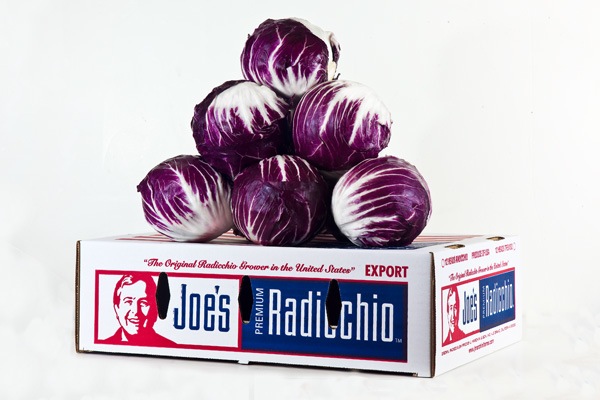
Joe's Premium LogoToday, Marchini uses about 12 different labels, including his own image on the ‘Joe’s Premium Radicchio’ box, for the domestic market and select export markets. “We let global importers pick their own labels. J. Marchini ships all over the world now, including Italy, and has a large percentage of the market in Japan, Korea and Taiwan. “They love the color of radicchio in a blend,” he said.

J. Marchini deals with nearly every processor in California including Taylor Farms, Apio, Fresh Express, Dole, Earth Bound, and Ready Pac, year-round, with production from Kern to Merced counties and Mexico.

Managing all this production with Joe and his son Jeff (the third generation), are grandchildren Marc and Nic and Francesca (fourth generation), with the fifth generation coming along with Gabriella, Maximus and little Giuseppe, named after his great-grandfather Joe (Giuseppe). Marc and Francesca work in the sales and post-harvest side of the business. Nic works in the farming operation side of the business. Jeff oversees the company as a whole.

Overseeing production, and especially the harvest of the radicchio throughout the growing regions, including Mexico, is Alejandro Calderon, Joe Marchini’s right hand since day one. Jenny MacAfee, a key person in the sales department, has been on board for the last 20 years.

Today Marchini farms three main radicchio varieties: Castelfranco (white head with red polka dot specks), Treviso (elongated red with white ribs), and Palo Rosa (red head type with white veins). “We do a three-pack deal in the wintertime with all three varieties together, but we also grow many other varieties,” said Marchini.

J. Marchini Farms’ production operation, based in Watsonville, a great climate for radicchio in the summer months, includes 2,000 acres spread between the Central Valley, the Coastal areas and Mexico.

The Central Valley fall and winter nighttime temperatures are cool, and radicchio production, five lines down the row on 80-inch beds, is about 20,000 pounds per acre, with most of it on drip or sprinkler.

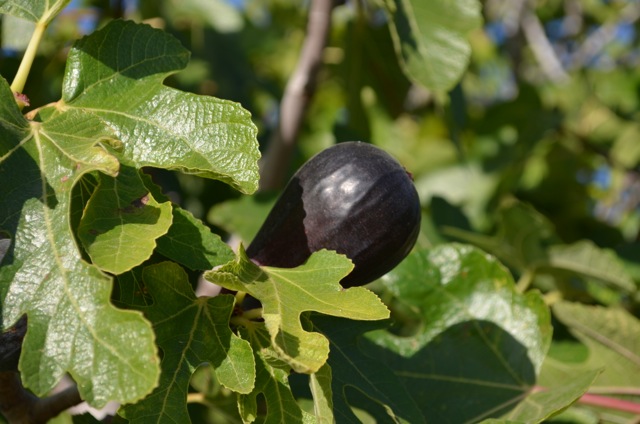
The operation also grows almonds, walnuts, fresh figs and other crops, “but radicchio has been a good ride,” said Marchini. “We have had ups and downs with the crop, but overall it has provided a good cash flow,” he said.


For the last three years, Joe Marchini has been dealing with Squamous Cell Carcinoma (the second most common form of skin cancer) and has undergone multiple surgeries and treatments. His love for his family and his incredible passion for farming keep him going.

_______________

J. Marchini Farms

2016-05-31T19:27:06-07:00October 16th, 2015|

Winegrape Grower Earns SIP Certification

Dana Merrill, Winegrape Grower Earns SIP Certification

By Patrick Cavanaugh, Deputy Editor


Dana Merrill is a seventh-generation farmer of an eighth-generation Californian farming family and president of Mesa Vineyard Management, a premium vineyard management service on the Central Coast. A graduate from Cal Poly with an Agriculture Business degree, He is a member of the Merrill Family Estates, an estate that produces premium winegrapes for its Pomar Junction Winery, and he’s extremely involved with the Paso Robles Wine Community.

Recently, his winegrape growing operation earned the Sustainability In Practice (SIP) certification.

“We worked very hard to attain this certification,” Merrill said. “Most of the changes were positive moves. It’s not meant to be a penalizing certification, but there are specific restrictions. For example, we don’t use any Class I restricted materials. If the US Environmental Protection Agency has commented about a substance, ‘Hey, that is Class I. It may be legal, but as an herbicide, it has a tendency to leach into the groundwater,’ then the SIP system won’t allow it. There are times when I’ve said, ‘Boy, I wish I could use a certain material,’ but there are some I simply cannot use in order to qualify for the certification.”SIP Certified

Merrill continues, “The SIP also takes into account how you treat your labor. For example, more ‘points’ are awarded if you offer a benefit program, continuing education support, a retirement program, or health insurance. These days, everybody has to offer health insurance, but points are awarded for that, even though some of us have offered it for over 20 years. Points are also earned for best-practice management whether it is fertility management, soil probes, or having water meters on all your wells and using the information to manage how you irrigate. The idea is to encourage folks to do more and raise the bar.”

“Being SIP-certified helps with marketing too,” noted Merrill. “If you get the SIP seal on a bottle of wine, a consumer can go be assured of the excellent quality of that product.”

“It is marketing in the sense that we are always selling ourselves to the consumer,” Merrill explained. “You know, the consumer may ask, ‘Why should I buy a bottle of SIP wine? Why should I buy California wine?’ I think that branding or labeling conveys a message to customers about what is important to them. Some consumers are very environment-oriented; others are looking primarily for quality. Your label conveys that message. There are customers to whom it is less important, but I see its significance growing. I would say 50% of the people who visit our tasting room find that label on an SIP-certified bottle of wine quite meaningful,” Merrill said.

_______________________

Links

Mesa Vineyard Management

Sustainability In Practice (SIP)

US Environmental Protection Agency

2016-05-31T19:27:07-07:00October 14th, 2015|

Monterey County Rules Lettuce Market

Diversity Keeps Monterey County Going Strong

By Patrick Cavanaugh, Deputy Editor

Monterey County Ag Commissioner Eric Lauritzen talked about the success of local farmers in setting new crop production records, “Despite the water and labor shortages, crop values were up in 11 commodities that exceeded $100 million and 26 that surpassed $10 million. So, the diversity of the economic engine here in Monterey County remains strong despite adversity.”Monterey County Ag Comm Logo

The overall agricultural value of Monterey County is nearly $4.5 billion. Lauritzen noted, “Commodity by commodity, among our top crops, we saw leaf-lettuce surpass strawberries as the number one commodity again. Strawberries are still over $709 million, and the lettuces combined were about $1.4 billion. It is pretty amazing to see those kinds of numbers coming out of one county.

In addition to water and labor shortages, Lauritzen noted, “We have dealt with the impact of food safety issues with spinach. And though production levels continue to climb back, they have not reached levels achieved since the E. Coli outbreak back in 2010. Anyway, we are still thrilled to see the numbers so strong and this speaks to the economic engine of the County.”

Other achievements include:

-$8.1 billion generated for the local economy, including:

-$5.7 billion in direct economic output, nearly 20% of the county’s total direct economic output.

-$2.4 billion in additional economic output in the form of expenditures by agriculture companies and their employees

-76,054 jobs in Monterey County, including:

-55,702 direct employees, or nearly one quarter of all jobs in the county

-20,352 additional jobs made possible through expenditures by agricultural companies and their employees

-investments in ambitious new technology.

2016-05-31T19:28:04-07:00September 15th, 2015|

New UC IPM Program Director

Jim Farrar Named Director of UC Statewide IPM Management Program

By Pam Kan-Rice, UCANR Assistant Director, News and Information Outreach

Jim Farrar has been named director of the Statewide Integrated Pest Management Program for the University of California’s Division of Agriculture and Natural Resources. He will begin as new uc ipm program director on Oct. 1.

UC IPM works with growers and residents to protect human health and the environment by reducing risks caused by pests and pest management practices.

Farrar is currently director of the Western IPM Center, where he has served since 2013. He succeeds Kassim Al-Khatib, UC IPM director since 2009, who is transitioning to a UC Cooperative Extension specialist position located in the Department of Plant Sciences at UC Davis. There Al-Khatib will focus on his research in weed management.

“UC IPM is a widely recognized national leader in integrated pest management,” Farrar said. “I am excited to continue efforts to make IPM the standard practice for managing pests in agriculture, communities and natural areas in California.”

Prior to joining the Western IPM Center, Farrar was a professor of plant pathology in the Department of Plant Science at California State University, Fresno for 12 years.

At Fresno State, Farrar received three teaching awards. He taught courses in plant pathology, plant nematology, diagnosis and control of plant diseases, crop improvement, aspects of crop productivity, mycology, sustainable agriculture and advanced pest management. His research centered on fungal diseases of vegetable crops, including management strategies for cavity spot of carrot. During his Fresno State tenure, he served four years as chair of the Department of Plant Science and a year as interim chair of the Department of Food Science and Nutrition.

From 1995 to 1997, Farrar taught in the Botany Department at Weber State University in Ogden, Utah. At Weber State, he conducted research on rock cress plants infected with a rust fungus that causes false-flowers. This rust is closely related to a species that is a potential biological control agent for dyer’s woad (Isatis tinctoris), an invasive weed.

Farrar has published scientific papers, extension newsletter articles, and articles in agricultural industry magazines. He also wrote a chapter in the book Tomato Health Management and five disease descriptions in the book Compendium of Umbelliferous Crop Diseases. He recently completed a three-year term as senior editor for feature articles in the journal Plant Disease and was senior editor for the online journal Plant Health Progress for three years. Farrar is a member of the American Phytopathological Society and the Pacific Division of the American Phytopathological Society.

The Wisconsin native completed his Ph.D. in botany and B.S. in plant pathology at the University of Wisconsin, Madison, and his M.S. in plant pathology at UC Davis.


2016-05-31T19:28:05-07:00September 10th, 2015|

A Thought on Sustainability

Scott Steinmaus on Getting the Sustainability Message Out

By Charmayne Hefley, Producer and Associate Broadcaster

When considering the longevity of a farmer’s land, the question of the sustainability of modern day farming practices is often raised. Scott Steinmaus, professor and department head of the Horticulture and Crop Science Department at Cal Poly San Luis Obispo, said that it is important to get the message out to consumers that farmers are sustainable because their land is the future for their own children.

“Farmers are sustainable,” Steinmaus said, “even when the general public might say that unsustainable activities might include pesticide applications. There’s no farmer out there who wants to spray pesticides—it costs money. And they don’t want to hand off their land having exposed it to something that’s not sustainable. They have a piece of land, something they value and cherish, and they want to hand it off to their sons or daughters.”

Steinmaus said it is important for consumers to realize that farmers are humans too, and they care about the health of the planet in a way that more directly relates to their careers.

Steinmaus believes it is important for consumers “to understand that direct connection farmers have with the earth, to realize that farmers are humans too, with kids of their own, and to acknowledge that farmers care about the planet more than a lot of urbanites might do themselves. There’s nothing more important than sustainability—minimizing all farm inputs for safe, acceptable food production.”

2016-05-31T19:28:06-07:00August 20th, 2015|

Appellations Beyond Napa . . .

Grower Andy Beckstoffer on Lake and Mendocino County Appellations

By Charmayne Hefly, Associate Editor

When people discuss California wine, they most commonly associate it as having been grown and produced in Napa. However, Napa isn’t the only northern county to grow grapes that become iconic California wines.Lake County Winegrape Commission

Andy Beckstoffer, owner of Rutherford-based Beckstoffer Vineyards, owns more than 3,000 acres of premium winegrapes. He began his own vineyard in the 1970s in Mendocino and Napa counties before expanding into Lake County as well.

Beckstoffer said that Lake and Mendocino counties were some of the most promising new wine districts in the new world of wine. He ought to know; the California Association of Winegrape Growers named Beckstoffer 2015 Grower of the Year last month.

“Mendocino County has consistently produced some of the best Chardonnay for years,” Beckstoffer said. “We started back in the 1970s, and they continue to do it in the Red Hills of Lake County. The appellation, Red Hills Lake County AVAis where we’re producing Cabernet at a reasonable price–North Coast Cabernet. It’s really the most promising new wine district in the new world of wine because it is encompassed by the vast North Coast AVA,” Beckstoffer said, “and the quality has been proven to be excellent.”

The North Coast AVA encompasses smaller appellations in six counties north of San Francisco: Lake, Marin, Mendocino, Napa, Sonoma, and Solano. Lake County AVAs


2016-05-31T19:28:07-07:00August 14th, 2015|

Fig Fest This Saturday!

Fig Fest This Saturday at Fresno State

Chef Fabio Viviani

Bravo TV’s Chef Fabio Viviani

The big annual Fig Fest is coming up this Saturday, August 15, from 9 am till 1 pm at California State University Fresno.

“It’s going to be bigger and better than ever,” said Karla Stockli, chief executive officer with the California Fig Advisory Board in Fresno. “Guests will be able to savor gourmet fig-inspired recipes, extraordinary wines and craft beer from California’s best chefs, food purveyors, wineries and breweries.”

CA Fig Fest Logo“And there will be an exciting new addition this year; celebrity chef Favio Viviani will headline the event. Viviani is a restaurateur (5 in U.S.) and a New York Times best selling cookbook author (3 successful cookbooks). But, he is best known as the Fans’ favorite in Bravo TV’s Top Chef and the winner of Cutthroat Kitchen with the Food Network.” Viviani also sells his own wine collection and popular line of cookware.

“Viviani will be center stage at a chef culinary demonstration and he will also tape an episode of his new PBS series, Global Bites,” said Stockli. “He will be interacting with people and signing books. And he is very passionate about all things fig and fresh ingredients.”

Tickets are available. Go to California Fig Fest for more information.

2016-05-31T19:28:08-07:00August 10th, 2015|

New APG Ambassadors Shine!

American Pistachio Growers Introduces New Ambassadors 

By Patrick Cavanaugh, Deputy Editor, California Ag Today

American Pistachio Growers (APG) held its annual summer luncheon late last week in Visalia, shared the organization’s marketing plans with a large crowd of growers, and introduced the newest APG ambassadors.

Richard Matoian, executive director of APG, framed the meeting, “We’re voting on our budget for the upcoming year, so it is a good opportunity to tell our growers what we are doing on their behalf to promote and to help sell pistachios.”

From Left, Sanya Jones, Cheryl Forberg and Judy Hirigoyen, APG

From Left, Sanya Jones, Cheryl Forberg and Judy Hirigoyen, APG

Bree Morse, recently crowned Miss California and now serving as an ambassador for American Pistachio Growers, effused, “We have so many once-in-a-lifetime opportunities being here today at the annual luncheon. It’s neat today because I get to meet and interact with the people in the industry, APG staff and the growers themselves, who are behind what I’m representing. We have amazing opportunities; I get to go to China in December to be Ambassador of American Pistachios abroad, and I’m just really excited to be the face of pistachios.”

Another great APG Ambassador introduced at the lunch was Sanya Jones, the recent Season 16 Biggest Loser television show runner-up, who lost 144 pounds. And guess what? Jones considers pistachios an important part of her success, “Well the funny thing is, I always loved pistachios. I would always get them for my dad as a kid and we would sit in front of the tv and eat them mindlessly.” Anecdotally, Jones shared that pistachios was the one food that her dad would put his teeth in to eat!

“But once I got to the ranch,” Jones continued, “Cheryl Forberg, chef and nutritionist for the tv show, got them on the menu for us. Pistachios are nice when you are a food-addict or a bulk-eater because they make you slow down. I can’t just inhale them; I have to slow down and crack them open. Plus, they are so nutritionally wonderful and keep me fuller longer.”

Who can argue with success?

Featured Photo: Bree Morse, Miss California

2016-05-31T19:28:09-07:00July 30th, 2015|
Go to Top