Brexit Hurts Wine Exports To U.S.

Brexit-Devalued Pound Hurts Wine Exports To U.S.


Jon Moramarco, managing partner of Bonded Winery 166 (BW 166 LLC), is a third-generation wine professional at the company that his grandfather, Giuseppe Moramarco, a tenth-generation wine professional émigré from Italy, acquired BW 166 LLC in Los Angeles from the Jesuits during Prohibition.


Moramarco explained the effects of Brexit on wine imports to the U.S. “The UK pound has dropped in value versus almost every currency,” he began. “The UK will not want to raise their price in British pounds, so it will probably drive them to become interested in any exports to the UK from the U.S. They will want to have a lower price in U.S. dollars, which will be tough for producers to do in the U.S.”

shutterstock_87596773 wine bottles

Continuing, “Now those [EU] European wine exporters are going to say, ‘Well, I don’t want to sell at that price to the UK. I’m gonna go try and sell more in the U.S.'” noted Moramarco. “So we will see more imports coming into the U.S. from Europe.”


“So you kind of have a double whammy for wine,” Moramarco concluded, “because they’ve kind of lost the margin in one of their key markets.” He anticipated “difficulty in exports with people wanting to drop price,” as well as a greater “increase in people wanting to import into the U.S.”
2016-08-31T13:10:33-07:00September 1st, 2016|

Frieda’s Karen Caplan Fears No Fruit

Frieda’s  – A Legacy of Introducing Americans to Exotic Fruits & Vegetables


By Laurie Greene, Editor


Karen Caplan, CEO and president, Frieda’s Inc., the 54 year old family business that first introduced kiwi fruit to America in 1962, recounted, “We’ve probably introduced close to 200 exotic fruits and vegetables to American consumers, mostly through supermarkets, but also through restaurants. We continue to introduce new and exotic fruits and vegetables. You’ve got the kiwi fruit; you’ve got sun-dried tomatoes; you’ve got habanero chilies, spaghetti squash, alfalfa sprouts, hothouse cucumbers, shallots, purple sweet potatoes, and purple potatoes.

PurpleKiwiBook_Karen Caplan


Caplan knows consumers love to try new products and new foods. “We really credit the TV Food Networks,” she explained. “If you’re watching ‘Chopped’ one night or any of the other food shows and you see these exotic fruits and vegetables like our purple snow peas as a secret ingredient, and you watch a couple of chefs cook with them, you say, ‘Wow that’s really exciting. I never would have picked that up at the grocery store.’ Consumers go to their local grocery store and find those products. It works in a synergistic way, but we continue to have new varieties of fruits and vegetables to introduce.”


Caplan continued, “It is wonderful that American supermarkets seem to realize consumers are passionate about trying these new foods. I think they realize that if they don’t offer the exotic fruits and vegetables, like tropical fruits, different varieties of citrus fruits and some of the peppers, consumers are going to go online and either order them as meals through Blue Apron or purchase the products on Amazon Fresh.”

Fear No Fruit, The Frieda Caplan Documentary

Fear No Fruit, The Frieda Caplan Documentary


At Frieda’s, we represent about 1,000 different suppliers, mostly farmers. About half of them are in California; the rest are outside of California and around the world. I think the biggest challenges shared by all our farmers, are first of all—water and how to use it efficiently, and then number two—how do we find the labor to pick our products.


When asked how farmers are doing, Caplan replied, “I in awe of farmers. I heard a peach and plum and grape grower speak this morning about his passion. He said, ‘I love this business. I could stop growing this product right now and make more money by putting in nuts, which I could harvest automatically.’”


Caplan continued, “I think what’s so admirable about farmers is they do have a passion for the land and for their products. We’re seeing resurgence in young people wanting to come into the business because everyone has to eat of course; but they love the lifestyle that goes along with it and the work-life balance.


Frieda Rapoport Caplan, Ph.D., founder & chair of the Board, Frieda’s Inc. established Frieda’s Finest/Produce Specialties Inc. in 1962, in the male-dominated Los Angeles Wholesale Produce Market. One of very few women in the produce industry at the time, and the first to own and operate a U.S. produce business, Frieda debuted with a purple sign, which later became the company’s signature color, and her premier product was fresh brown mushrooms – an unusual specialty at that time. She quickly developed a reputation for buying and selling new and unusual produce specialties.

Frieda’s two daughters, Karen Caplan and Jackie Caplan Wiggins, head up the family company and the third generation, Karen’s eldest daughter Alex Jackson, has linked in too. 


2016-08-25T12:32:20-07:00August 25th, 2016|

City of Mendota Recovers from Drought

Mendota Resilience and Pride

By Emily McKay Johnson, Associate Editor


For many small San Joaquin Valley cities that have relied on agriculture to support their local economies, the four-year drought in California has dramatically increased unemployment and decreased business revenue. Mendota, a city west of Fresno, hit hard with a 45% unemployment rate, has constructively made calculated adjustments by residents and farmers to recover to its pre-drought economic level, according to Robert Silva, mayor of this resilient city.mendota logo


“As we have been going through the drought the last four years,” Silva   explained, “Mendota [nicknamed Cantaloupe Center of the World] has been in the spotlight for its high unemployment, and a lot of our farmers are having a rough time. We have had a lot of bad publicity.”


“In the laMendota Muralst year or so we have weathered all this,” he stated, “and things are positive now. Our farmers are really understanding how to use every drop of water. We have a lot of new business coming into the community. We have a housing boom that continues to grow, so things are definitely on the rise and we’re standing very proud.”


“A few years ago, high unemployment forced many people to move away, suddenly creating school classrooms with very few students; however, that has changed too,” said Silva. “Student enrollment is growing and we have added on another school. It is very positive in Mendota; the doom and gloom of a few years ago has gone. Really, it’s gone.”


“Financially we’re in good shape and businesses are prospering,” Silva summarized. “It’s good for our city, good for our citizens, and good for business.”

2016-08-24T16:13:22-07:00August 24th, 2016|

CULTIVATING COMMON GROUND: Almond Board on Assessment Increase

Almond Board’s Response on Assessment Increase


Editor’s note: We thank Mike Mason for his contribution to California Ag Today’s CULTIVATING COMMON GROUND, in response to the letter submitted by John Harris.

By Mike Mason, chairman of the Board of Directors, Almond Board of California


Over the history of this [almond] marketing order, assessments have risen and fallen to meet changing business conditions. This increase was voted on by the Board of Directors after much input from growers and handlers.  After the vote, the industry had an opportunity to weigh in again during a USDA-administered comment period.  They will get another chance during a second comment period.

Only after growers have had all of these opportunities to voice their opinions will the USDA make a final decision on the assessment.

The Almond Board of Directors welcomes your feedback and is available to discuss any questions you may have about the critical investments and justification for this assessment increase.

Below you will see a memo I sent to the industry, dated April 14 2016.  It covers why and how the assessment is needed and will be used.

Sincerely,

Mike Mason                                                                                                               


Mike Mason is a first generation almond farmer and partner of Supreme Almonds of California, a family owned and operated almond handling operation in Shafter. He is also the Chairman of the Board of Directors of the Almond Board of California.


CA Almond Board Header


To: Almond Handlers and Growers

From: Mike Mason, Chairman of the Board of Directors, and

Kent Stenderup, Vice Chairman of the Board of Directors

Re: Almond Board of California FY 16/17 Budget and Assessment Increase

Date: April 14, 2016

On April 12, the Board of Directors met to review the program and budget recommendations coming forward as a result of the extensive strategic planning efforts which have taken place over the past year.

The Board unanimously agreed to recommend a budget for FY 16/17 with an increase of the assessment from 3 cents per pound to 4 cents for a three year period. The increase is limited to three years due to the expectation that almond production will increase significantly during that time period thereby providing additional funding. This decision was made after extensive dialog among Board members as well as outreach between Board members and Handlers and Growers in the almond community.

There are three principal reasons the Board determined an assessment increase was needed. They are:

  1. 30% increase in production anticipated by 2020. This estimated 600 million pound increase needs to be planned for now, to invest in global demand prior to the production hitting the market.

This substantial volume increase is nearly as much as our largest market currently consumes, and is more than the consumption of our four largest export markets combined. This will require doing more of what has been working, as well as implementing innovative new marketing programs.

  1. Strain on agricultural resources has never been higher. Almonds are currently California’s highest value agricultural crop and soon will be its largest acreage crop. With this leadership comes responsibility. Additional investment will allow us to take a leadership role by investing in and accelerating research which will enable us to address concerns, such as:
    • our changing water supply and quality system,
    • air quality as it relates to harvesting, pesticide and energy use,
    • bee health, which is critical to our success
  2. Transformation of the consumer landscape. The environment in which we are growing and marketing almonds is quickly changing. Consumers are more interested in where and how their food is made. In response to this, the industry needs to take a leading role in the world of sustainable farming, as we have done for so long in the world of nutrition, by transparent communications regarding our meaningful and measured sustainable improvements.

To plan for and address these challenges, your Board of Directors has worked across the Environmental, Production Research, Almond Quality, Technical and Regulatory, and Global Market Development Committees to develop a plan of action. This plan is a two pronged approach including investment in research, via the Accelerated Innovation Management or AIM program (launched at our annual conference), and global marketing:

  • AIM Program: Expand and Accelerate sustainability and production research in 9 areas:
  1. Irrigation and nutrient management
  2. Orchard and rootstock development
  3. Harvesting innovations
  4. Pest management tool development
  5. Pollination research and management practices
  6. Bio-mass and by-product innovation
  7. Food safety leadership
  8. Soil health research
  9. Energy Innovation
  • Global Marketing: Expand our programs to address production growth & changing consumer needs by:
  1. Accelerating programs and results in current markets
  2. Considering additional markets for investment
  3. Increasing communication transparency and trust
  4. Ensuring confidence in our sustainability efforts

Your Board of Directors welcomes your feedback and is available to discuss questions you may have about the critical investments and justification for this assessment increase. The assessment increase will be reviewed by the USDA and an opportunity for public comment will be provided before any change is implemented.


1150 Ninth St., Ste. 1500  *  Modesto, CA  95354  USA

T: +1.209.549.8262  *  F: +1.209.549.8267


To read the original post to which the Almond Board is responding, go to: CULTIVATING COMMON GROUND: Almond Growers on Assessment Increase, by John Harris.


The opinions, beliefs and viewpoints expressed by the various participants on CaliforniaAgToday.com do not necessarily reflect the opinions, beliefs, viewpoints or official policies of the California Ag Today, Inc.

2016-08-10T17:24:51-07:00August 10th, 2016|

Pecan Growers Excited about Federal Marketing Order

Calif. Pecan Growers Gather to Discuss Federal Marketing Order

By Patrick Cavanaugh, Farm News Director

On Wednesday, August 3, nearly 100 people attended the California Pecan Growers Association meeting at Linwood Nursery, the oldest supplier of pecan trees in the world, located in Le Grand in eastern Merced County.

Not all attendees were current pecan growers; many were contemplating planting pecan trees. New interest and excitement in pecan farming surrounds the newly approved (May 2016) and forthcoming Federal Marketing Order For Pecans (FMO) that will assess growers a few cents per pound to increase pecan marketing and awareness in California and other areas of the country.

Pecan growers and others interested in the crop gathered in Le Grand to discuss Federal Marketing Order for Pecans

“We want to model it after the Almond Board of California,” said Mark Hendrixson, president of the California Pecan Growers Association, whose members farm approximately 4,000 acres of the crop throughout the San Joaquin and Sacramento Valleys.

“We had a very a good turnout. Pecans are a growing industry in California; we have great weather for them,” said Hendrixson. “We do things a little bit differently because of our great weather, but we’re able to produce extremely good quality.”

CPGA-Logo“Pecans are extremely healthy,” said Hendrixson. “The research has been out there for quite some time, but the pecan industry has never had a unified marketing voice. Once we develop the Federal Marketing Order, we will be able to spread the message about health and other great benefits that will help drive interest in pecans and pecan consumption, and to deliver quality product to consumers around the world.

Hendrixson expects the Federal Marketing Order For Pecans to be in place very soon. The USDA will officially seat the Board of the American Pecan Council (APC), the new governing board of the FMO, by October 1, 2016 by calling for board member nominations, qualifying the candidates and issuing a ballot for qualified voters to vote on those nominations.

“Once those ballots are approved by the Secretary of Agriculture,” Hendrixson said, “we’ll have an elected Board that can begin to function and actually set the assessment, which in turn will be approved by the USDA going forward.”

2021-05-12T11:05:50-07:00August 4th, 2016|

WGA Conflicted on SCOTUS DACA Decision

Western Growers Association has Mixed Feelings on Recent Supreme Court DACA Decision

By Patrick Cavanaugh, Farm News Director

The 4-4 ruling on immigration reform last month by the Supreme Court of the United State’s (SCOTUS) affirmed the lower court’s injunction against President Obama’s executive order, which would have granted deportation deferrals and temporary legal work status to about five million undocumented immigrants. Tom Nassif, president and CEO of Western Growers Association (WGA), has been vocal about the need to establish some type of immigration reform.

Nassif compared the recent SCOTUS ruling to what happened when a 2013 U.S. Senate-endorsed bill that supported a pathway to citizenship was never passed in the U.S. House of Representatives. “The House did not want a pathway to citizenship,” said Nassif. “They were not even sure if they wanted a pathway to legalization. Most Republicans did not even want a border security bill in the House coming to the floor for a vote because they didn’t want any immigration reform—whatsoever.”

Western Growers logoNassif said, “The House was part of that Send-them-home! crowd that considered anything you did—even if it was putting them on probation—as amnesty. It is interesting that with the House doing nothing about immigration, what we have today is amnesty, because we’re not doing anything about it.”

Nassif expressed mixed feelings about the SCOTUS decision. “In a way, it disappointed us; in a way, it didn’t. It didn’t disappoint us because there was no requirement that people working in agriculture who might qualify for this Deferred Action For Childhood Arrivals (DACA) or Deferred Action for Parents of Americans (DAPA) would actually remain working in agriculture.”

To get a pathway under the Senate bill, farmworkers would have to stay in agriculture for a certain number of years, but they could eventually work in other industries. So if you have a choice of working in any industry, why would you go to work on the farm? But, in this instance, you would adversely affect other American jobs,” said Nassif.

Nassif said the motivation of the Obama administration is understandable due to the inability of Congress to compromise on immigration reform, yet Nassif maintains the Immigration Reform should not be done with Executive Orders as the President has done. Instead, Nassif stressed that Congress should take up Immigration Reform and pass it.

2016-08-04T15:40:15-07:00August 1st, 2016|

It Is California Cantaloupe Week!

California Cantaloupe Week Begins in Fresno County

By Lauren Dutra, NAFB Summer Intern


Established by the Fresno County Board of Supervisors for this week, Monday July 25 through Sunday, July 31,“California Cantaloupe Week,” recognizes Fresno County as the lead canteloupe-producing county in California, which currently produces 75% of all cantaloupes sold in the United States.

Steve Patricio, president and CEO of Westside Produce, a grower, packer and shipper in Firebaugh said, “The quality has been absolutely outstanding this year, with some of the highest sugar results we’ve seen in recent years.” Patricio has also observed great demand in the marketplace as well.  At this point, it’s time to eat those beautiful California cantaloupes,” he noted.

Tri Westside ProducePacked with nutrition, “Cantaloupes are one of the most outstanding things we can eat for our health,” Patricio affirmed. “That daily dose of cantaloupe can do wonders for a healthy lifestyle.”

The California Cantaloupe industry has been on the forefront of the food safety movement throughout the world, “You can be assured that every cantaloupe grown, packed and shipped from California meets the highest standard of food safety anywhere in the world,” Patricio stated.

The California Cantaloupe Advisory Board (CCAB) requires all California cantaloupe growers, packing operations, and cooling facilities undergo mandatory announced and unannounced government food safety audits. The audits are based on a set of food safety standards developed from 20 years of university research along with input from government, food safety and farming experts. CCAB food safety systems allow for science-based standards to be updated as new information or science becomes available.

You can review all of the safety checkpoints here.

2021-05-12T11:05:51-07:00July 27th, 2016|

Lt. Governor Newsom Supports Calif. Agriculture

Calif. Lt. Governor Newsom Says Ag is at a Hinge-Moment in History

By Patrick Cavanaugh, Farm News Director


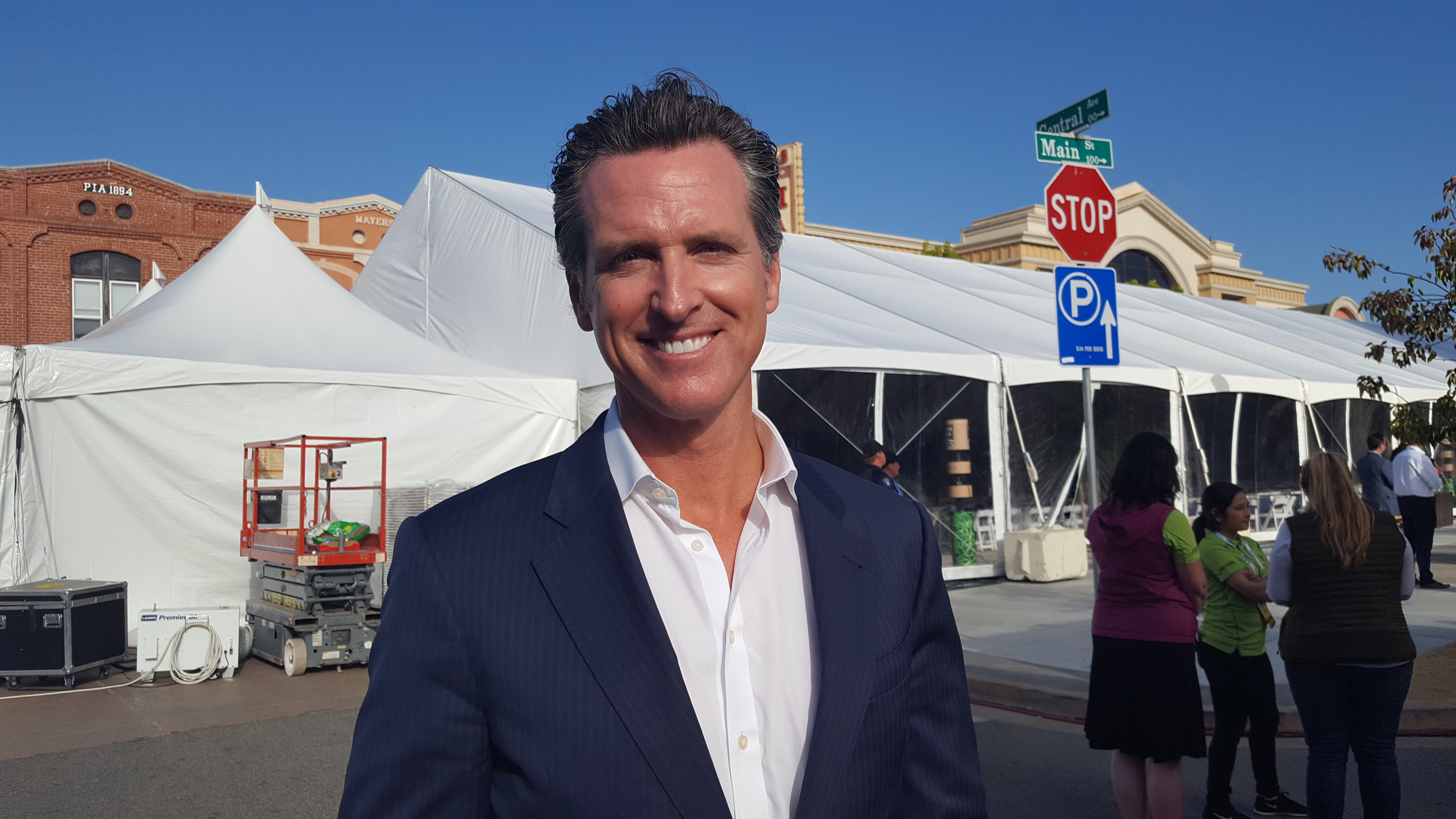
In an exclusive interview with Gavin NewsomLieutenant Governor of California, during the recent Forbes AgTech Summit in Salinas, Newsom declared, “It’s interesting about California—outside of Hollywood—no two more iconic industries exist than Silicon Valley’s technology, and the agricultural industry.

“It seems self-evident to everybody here that we have a unique opportunity to collaborate,” Newsom said about the event which joined the Silicon Valley high tech industry with the state’s farming industry to create digital solutions for agriculture. “We have the unique opportunity based on proximity and based on history. It is also a cultural opportunity as it relates to relationships that have been formed over the course of generations to begin to build bridges and connect some dots.”

Newsom said he believes in bottom-up inspiration, not top-down. “I don’t think you can sell down your vision from Sacramento. It’s about regions rising together and creating conditions for just these type of collaborations,” he said.

Newsom particularly appreciated comments about innovation. “I wrote a book, [“Citizenville”] and I’m not here to promote that book,” said Newsom, “but the whole idea was about platform thinking. The concept is the federal government, state government, and even local government cannot prescribe a federal, state or local pill for every problem,” he said.

“The point is,” he continued, “if we’re going to solve the big problems of the day, we have to create an environmenta platformto engage folks like yourselves to deliver the applications, literally and figuratively, to solve big problems. It’s self-evident to anyone who lives here in California, that we’ve got some big problems.”

Citizenville, by Gavin Newsom

Citizenville, by Gavin Newsom

“We have regulatory challenges in this state, and I say this as a business person with many businesses. I have a sense of kindred connection in spirit to the entrepreneurial ways that are here today,” he commented. Owner of three wineries, several restaurants and hotels, Newsom stated, “I am in the Ag business, of sorts. My point is, we could do a lot better to make a point that [agriculture] matters and we care,” he said.

“At the same time,” he added, “Silicon Valley is center-tip of the spear—all the innovation and discovery, and the change in the way we live, work and play,” Newsom said.

“We’re here on a hinge-moment in history where we are going from something old to something new, a world of mobile, local, and social; and cloud and crowd. It’s a moment of anxiety for a lot of people, a moment of mergerthe detonation of globalization and technology coming together. Again, there’s a lot of anxiety,” he noted.

Newsom suggested this is an opportune time to try to connect dots and address challenges, not just on the regulatory side and on the economic development side in this state, but also on the self-evident issues of water scarcity in this state. “You may have different opinions about climate change, global warming or violent disruption,” said Newsom, “but, as a guy who told me the other day up in Dutch Flat, Placer County, ‘I don’t care about all you folks from San Francisco talking about climate change, but something just ain’t right.’ Which is another way of describing a connection that things have changed,” Newsom explained.

Newsom said that kind of predictive nature, in terms of how we construct a water system for a world that no longer exists, and for a population that is twice the size; self-evidently, we have to do things differently. “We’ve got to be more creative and we’ve got to be more strategic,” he noted.

“It’s a long way of saying we are grateful for the work [California farmers] are doing. The goal for us in California is to make these conversations sustainable. ‘Not just situational and not just one annual conversation, but these are dialogs that must continue every day in this state,” Newsom said.

“I’m one of those people who believes in the combination of nature and technology, bringing cross-disciplines together,” Newsom said. “Cross-pollinating, literally and figuratively, ideas and people—values. “I think we have an incredible opportunity here in California, not just to survive in the agricultural industry but to truly thrive in a growing, competitive environment.”

2021-05-12T11:05:51-07:00July 20th, 2016|

Solving Central Valley Water Salinity

Mizuno on Water Salinity Solutions

By Laurie Greene, Editor


According to a Central Valley Salinity Alternatives for Long Term Sustainability (CV-SALTS) report, rising salt levels in the soil and groundwater threaten the potable water supply and agricultural productivity for the entire region. Walter Mizuno, longtime lecturer in mechanical engineering at Fresno State and director, Valley Industry Partnership for Cooperative Education (VIP) Program, researches increasing salinity conditions in Central Valley soil and groundwater, as well as methods of desalination.

Mizuno explained, “As the salt level rises, and if the soil salts aren’t leached out periodically, the ground becomes unsuitable for cultivating several crops. Growers either shift to high salt-tolerant crops or essentially idle that land.”CV Salts

Central Valley salinity conditions are serious, according to Mizuno. “Growers have already taken a lot of land out of production on the Westside,” he said, “and they’ll continue to do that until the salt mitigation measures have been implemented. Essentially, we need to get back to where we can currently sustain the amount of farming we have with the type of water that we have.”

“We are looking at desalination of agricultural drainage water,” Mizuno stated. “We’re trying to reclaim water that’s suitable for even human consumption; but right now, we’re looking at reclaiming water that is suitable for Ag use through a desalination process called vapor compression distillation, which takes drainage water from the Ag fields, distills it to make it pure and recovers some of the salts on the backside.”

Mizuno explained salt recovery would enhance the economic viability of this project by eliminating the cost of trucking or disposing the resulting brine and by possibly converting it into a revenue stream. “We’re trying concentrate that brine to a point, using solar evaporation, where we can find other uses for the highly concentrated form or maybe even sell it to a chemical processing company. We are also focusing on minimizing the energy cost to distill the water, to make the process more efficient.”

“We’re trying to combine multiple technologies, using ion exchange as our front end process,” Mizuno explained, “to get rid of some of the hardness in the water. We get rid of calcium and magnesium in the water, which helps the distillation process and protects the equipment for a longer period of time before requiring cleaning or eventual replacement. We’re using the brine stream of the distillation process to actually regenerate, upfront, the ion exchange units—similar to a home water softener.”

Pipe without waterMizuno explained, “When you look at the reasons why desal isn’t used more often—just the cost of energy makes the cost of the water expensive. So, we do a lot of energy recovery. Just take the basic process of distillation in which you heat up the water solution, boil it off, and condense the residue. A lot of that water you use, or a lot of the energy used to boil off the water, is lost; so we recover the heat from that steam to save energy. In other words, we don’t discard that energy; we try to reuse it.”

“We have been conducting studies on some Westside ranches,” he continued, “with our pilot plant that processes only one thousand gallons per hour. A series of ditches on those ranches collect the drainage water to be purified. Now, we have moved everything back to the Fresno State Center for Irrigation Technology (CIT),” said Mizuno, “because we’re building a brand new redesigned unit, which should be operating by the end of this year.

“The second phase of the project,” Mizuno commented, “is to move the unit out to Panoche, and conduct field testing out there. We will evaluate the energy efficacy and also the economics of the unit and process, and we will field-test to determine how rugged and dependable it is out in the actual service area.”

“This is actually a research project,” Mizuno clarified. “We’re still fairly far away from commercializing it. Basically, we will evaluate the scalability of these units so that depending on the size of the farm and everything else, you can either put multiple units out there or design a single-unit system very similar to ours. You could size the system to meet whatever the demands are, but you need a reservoir or holding area, and you’d like to be able to operate 24/7.”

“We are considering using solar to power this,” Mizuno mentioned. “The issue with solar is, obviously, it tends to work during the daylight hours but doesn’t do much during the evening hours. We’re looking at using batteries, electricity, natural gas or some other energy source to keep the process running when the sun goes down, but it’s a matter of economics.”

Mizuno said the research team is optimistiCIT Logoc about the process itself, but he does not anticipate it will be a cure-all. “It is a research project,” Mizuno reiterated, “and we’re trying to see if we can drop the energy cost, and lower the water cost. I think the economics will change though. Water will cost more for everybody in the next few years. As that changes, I think some of these technologies are going to become feasible from an economic standpoint.”

The entire state shoud be aware of these water issues, according to Mizuno. “I think there are still a lot of issues that the common person isn’t aware of and how they fit in, and Ag is no exception. I would like people to understand that we are working to stretch the available amount of water supplies we have and we are working on technologies that are yet unproven. But some of these technologies will require a few more years—to many years to solve. Others are not economically feasible today, but they may be in the future as water supplies get tighter.”

Mizuno has observed that farmers are already doing a lot to conserve water, particularly employing the use of new technologies such as drones to evaluate water stress and nutrient stress in plants. “Right now,” he offered, “we are looking at another piece of the puzzle; we’re trying to stretch the amount of water supply we have, utilize it in multiple-use scenarios, and use it more intelligently to make some waste streams into revenue streams.”

Mizuno urges the general population to just be aware. “Conservation is the first step for a lot of people,” he said. “That’s the easiest way to stretch water supplies, and so I think people need to understand that water is a finite resource in the state of California. The water situation is not likely to get better anytime soon, even if we have normal rainfall and so forth. We are in an overdraft situation with our water supply.”


CV-SALTS participants collaborate to develop a workable, comprehensive plan to address salinity, including nitrates, throughout the region in a comprehensive, consistent, and sustainable manner.

Center for Irrigation Technology (CIT) celebrates 35 years!


2021-05-12T11:05:52-07:00July 18th, 2016|

Historic Temperance Flat MOU Signing

Assemblymember Bigelow on Historic July 1 MOU Signing

By Patrick Cavanaugh, Farm News Director

East of Fresno at Friant Dam last Friday, July 1, the San Joaquin Valley Water Infrastructure Authority (SJVWIA) and the United States Department of the Interior, Bureau of Reclamation signed an historic Memorandum of Understanding to coordinate and complete feasibility studies of the proposed Temperance Flat Dam. 

Historic July 1, 2016 MOU Signing for Temperance Flat Dam

Historic July 1, 2016 MOU Signing for Temperance Flat Dam

State Assemblymember Frank Bigelow, 5th Assembly District (serving a large portion of Madera County, along with all the foothill and mountain communities north of Madera to the Sacramento area) noted the critical importance of getting Temperance Flat Dam built to store freshwater for the citizens and farmers of California.

Bigelow, a Madera rancher and farmer of pistachios, figs, and persimmons, said, “This is a huge event to enable us to have additional [water] storage. I just am so thankful to the people who put the water bond forward. Without the money that the people have made possible by voting to support the water bond, none of this would be possible; that’s a clear message.”

Friant Dam and Millerton Lake State Recreation Area

Friant Dam and Millerton Lake State Recreation Area (Source: U.S. Bureau of Reclamation)

“Without water,” Bigelow explained, “none of our communities would continue to survive in the way they have for years and years. Much of the water we see is being used in different ways; it is not all going to agriculture, and it is not all going to residential. It is going to the environment. So we’ve got to divide that up by the law now, and in equal proportional value.”

“Right now,” he detailed, “Millerton Lake captures 526,000 acre-feet of [fresh] water, but we have millions of lost acre-feet that flow past every year into the Delta, then ultimately to the ocean.” Upon completion, the Temperance Flat Dam would hold more than twice the amount of water that Friant Dam holds—”especially important for capturing freshwater during heavy rain and snow years,” noted Bigelow.


2016-07-07T10:05:08-07:00July 7th, 2016|
Go to Top