EPA Calls for Nominations for 20th Annual Presidential Green Chemistry Challenge Award

The U.S. Environmental Protection Agency (EPA) announced its call for nominations for the 2015 Presidential Green Chemistry Challenge Awards for companies or institutions that have developed a new process or product that helps protect public health and the environment.

“The Presidential Green Chemistry Challenge is an opportunity for EPA to recognize green solutions and help solve critical environmental problems,” said Jim Jones, EPA’s Assistant Administrator for Chemical Safety and Pollution Prevention. “Green chemistry is about designing products and processes that reduce energy, chemicals and water waste while cutting manufacturing costs, and sparking investments. Ultimately, these chemicals and products are safer for people’s health and the environment. This year, EPA is excited to be celebrating the 20th anniversary of the awards.”

Nominations for innovative technologies in six categories are due to the agency by December 31, 2014. The categories are: academic; small business; greener synthetic pathways; greener reaction conditions and designing greener chemicals; and a new category for climate change. The awardees will be honored at a ceremony in Washington D.C., in July 2015. 

Since the inception of the awards 20 years ago, EPA has received more than 1500 nominations and presented awards to 98 technologies. It has resulted in the reduction of more than 826 million pounds of hazardous chemicals and solvents, savings of 21 billion gallons of water, and elimination of 7.8 billion pounds of carbon dioxide releases to air.

More information on past award winners and how to submit entries may be found at: http://www2.epa.gov/green-chemistry .

2016-05-31T19:32:15-07:00November 15th, 2014|

U.S. Agriculture Secretary Makes Visit to AGRIscapes Facility

Source: Dan Lee; Cal Poly, Pomona

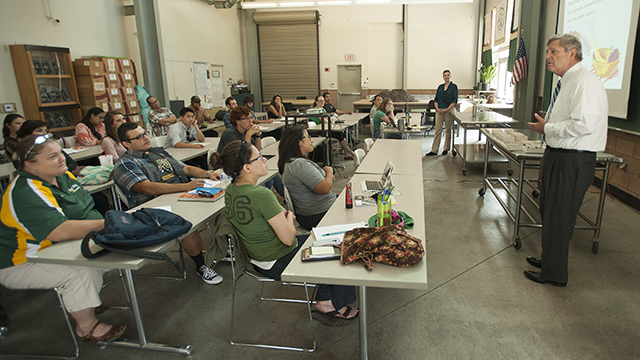
U.S. Agriculture Secretary Tom Vilsack toured the AGRIscapes facility, visiting the Farm Store and receiving presentations from students and faculty from the College of Agriculture.

It was the first time an agriculture secretary has visited Cal Poly Pomona, and Vilsack was greeted by President Michael Ortiz, Provost Marten denBoer, College of Agriculture Dean Mary Holz-Clause, the agriculture department chairs, and other university officials.

“The purpose here was to acquaint him with the resources we have, how we’re educating that next generation of agricultural students,” Holz-Clause said. “The USDA has been a funder of some of our research, so we wanted to highlight for him our discoveries. We had heard he was going to be in Southern California, so an invitation was extended.”

The secretary received a tour of the greenhouses at AGRIscapes, observing the orchids and lettuce that are grown there. He also heard presentations from faculty about USDA-funded research into fighting the citrus psyllid, an insect that has decimated citrus groves in the United States, and using drones to help manage water usage.

Vilsack spoke briefly with Associate Professor Eileen Cullen’s entomology class, which meets in the AGRIscapes complex.

Agriculture in the United States is so productive that the country does not need to rely on imports and spends less on food than most other countries, he told the students. The industry also is so efficient that it has allowed many people to leave farming, get an education and explore other careers, Vilsack added. A hundred years ago, many people would have had to stay and work on farms just to make sure their families had enough to eat, he said.

“We have this enormous capacity to do lots of different things in life because we have such great farms. We don’t appreciate that as much as we should,” Vilsack said. “As you learn, make sure you become an ambassador for agriculture and be proud of your connection to agriculture. You’ve got a good life here in America because of agriculture.”

Inside the Farm Store, Vilsack spoke with two students who have participated in Estudiante de Dietetica, a USDA-funded program  that helps students advise and educate the Latino community about diet and nutrition.

Stephanie Serpas Jacobo, a graduate student in nutrition who recently became a registered dietician through a Cal Poly Pomona internship program, said she spent time gaining clinical experience advising patients at San Bernardino Community Hospital and skilled nursing facilities in Los Angeles County.

“It’s a great honor to meet someone who has made it possible for someone like me through grant-funded programs to learn and to grow through dietetics,” Jacobo said of meeting Vilsack.

AGRIscapes is an educational and demonstration center at Cal Poly Pomona for food, agricultural and the urban environment that emphasizes economic and environmental sustainability.

It includes a building complex with meeting rooms, outdoor nursery, the Farm Store, theme gardens and agricultural research projects.

2016-05-31T19:32:15-07:00November 13th, 2014|

USDA’s Specialty Crop Block Grant Program Welcomes Proposals and Technical Committee Volunteers

By: Monique Bienvenue; Cal Ag Today Social Media Manager/Reporter

The California Department of Food and Agriculture (CDFA) is accepting proposals for the 2015 Specialty Crop Block Grant Program, which conducts an annual competitive solicitation process designed to enhance the competitiveness of California specialty crops–fruits and vegetables, tree nuts, dried fruits, horticulture, and nursery crops (including floriculture).

Grant awards will range from $50,000 to $450,000 per project with a duration of up to two years and nine months. Non-profit and for-profit organizations; local, state, federal, and tribal government entities; and public and private colleges and universities are eligible to apply.

Phase I of the competitive process begins with the submission of concept proposals. Concept proposals undergo both an administrative review conducted by CDFA as well as a technical review conducted by a volunteer panel of subject matter experts. Successful applicants will be invited to submit detailed grant proposals in Phase II of the process.

Details:  Applicants must access the 2015 Request for Concept Proposals at www.cdfa.ca.gov/grants for detailed application instructions. To streamline and expedite the application process, CDFA has partnered with the California State Water Resources Control Board to utilize their online application site, the Financial Assistance Application Submittal Tool (FAAST). Applicants must register for a FAAST account at https://faast.waterboards.ca.gov.

Concept proposals must be submitted electronically using FAAST by Friday, December 5, 2014, at 5 pm PST, and applications must include a letter of interest, short biography, and statement of qualifications identifying the Specialty Crop Block Grant Program funding category related to the applicant’s area of expertise. For a description of the funding categories, please reference the 2015 Request for Concept Proposals at www.cdfa.ca.gov/grants.

If selected, individuals will be required to complete the Form 700 Statement of Economic Interests and the Ethics Training Course. Prospective applicants may contact CDFA’s Federal Funds Management Office at (916) 657-3231 or grants@cdfa.ca.gov for additional information.

2016-05-31T19:32:15-07:00November 11th, 2014|

Fresno State Club Austral Welcomes All to November 13th Fight for Water Film Screening

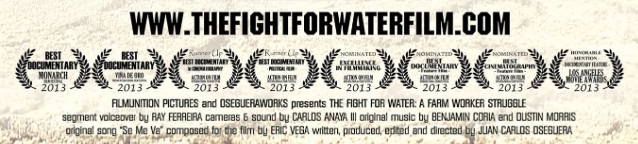
Fresno State Austral Hosts Fight For Water FilmFresno State Club Austral invites you to the film screening of The Fight for Water Film: A Farm Worker Struggle by filmmaker Juan Carlos Oseguera,at 8pm on November 13, 2014 at the Fresno State University Student Union, Room 308, 5241 N. Maple Ave, Fresno, CA.

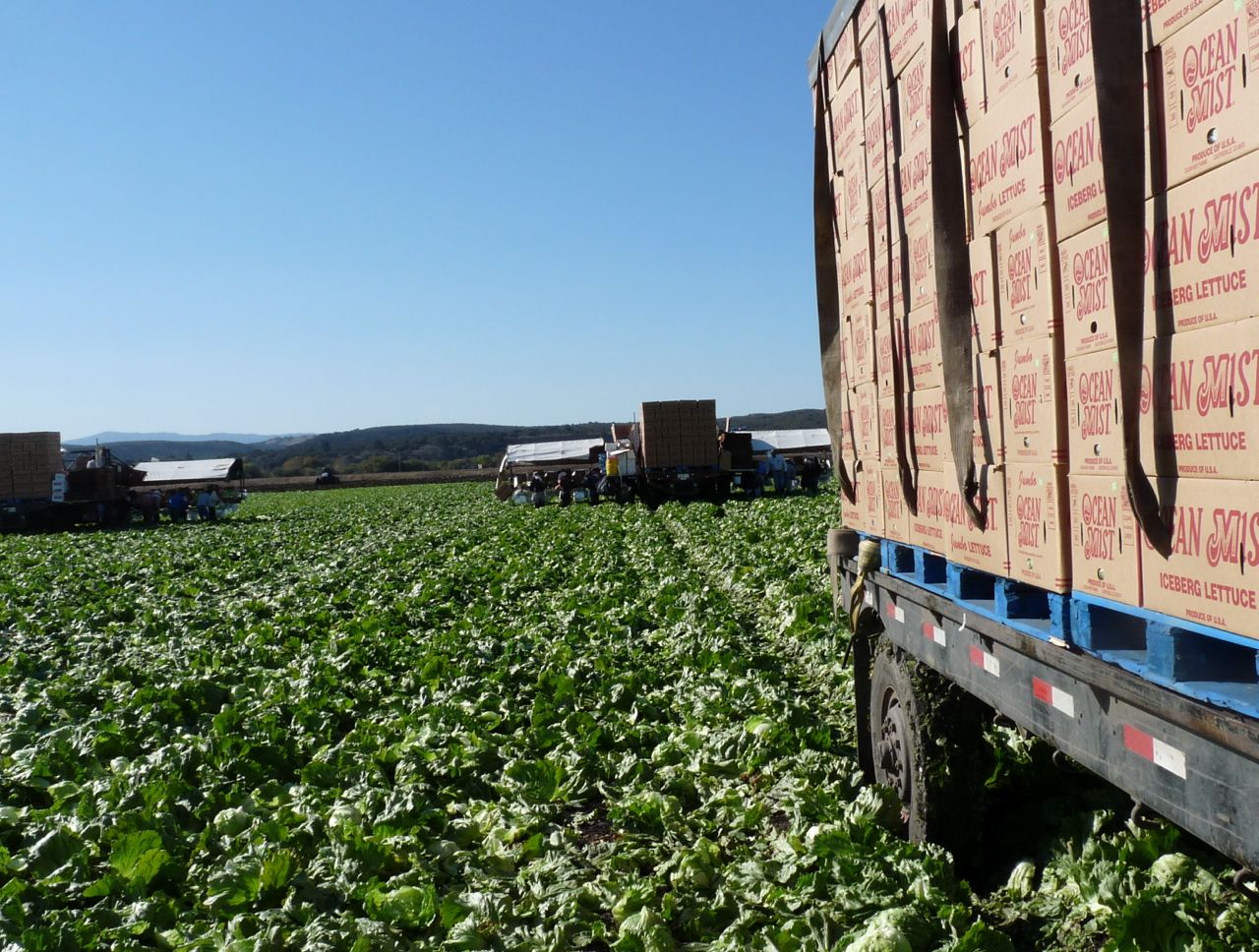
Set during the California Water Crisis of 2009, The Fight for Water highlights the human impact a federal ruling had on a migrant farming community when their water supply was shut off, and the march they staged in order to fight for their water. Oseguera, a California Central Valley filmmaker, filmed this event and documented their story. The film features Hollywood comedian turned activist Paul Rodriguez and former Gov. Arnold Schwarzenegger.

Club Austral is a Fresno State organization founded by Spanish majors in 2008. The purposes of the organization are: to promote cultural awareness at Fresno State about the Hispanic Culture; to strengthen the character and academic skills of all club members according to their area of expertise, ethically and professionally; to further promote academic, as well as, artistic projects that will allow club members to develop their personal strengths and exercise their creative abilities; and to foster academic alliances with Department of Modern and Classical Languages and Literatures (MCLL), in the effort to find professional guidance and academic support.

2016-05-31T19:32:15-07:00November 11th, 2014|

Veterans and Youth Projects Announced as part of Veterans Day Observance

By: Monique Bienvenue; Cal Ag Today Social Media Manager/Reporter

Today, as part of the observance of Veterans Day, the United States Department of Agriculture (USDA) and the Corporation for National and Community Service (CNCS) announced the partners and projects that will be funded in this fiscal year to provide job and training opportunities to veterans and youth.

“Our continuing work to support the 21st Century Conservation Service Corps  (21CSC) is not only in concert with the Obama Administration’s goal of reconnecting Americans to the outdoors, it also furthers crucial projects that improve forest health, watershed restoration and recreational opportunities,” said Secretary Tom Vilsack. “This landmark partnership with AmeriCorps to jointly support service opportunities for youth and veterans is an all-around win for our young people and our public lands.”Screen Shot 2014-11-10 at 10.12.02 PM

“This is a great example of an innovative partnership that expands economic opportunity for young people, taps the leadership skills of veterans, improves our national forests, and puts a new generation on a lifelong path of service,” said Wendy Spencer, chief executive officer for CNCS. “Young people and veterans bring extraordinary skill and passion to conservation service, and we are thrilled to join with USDA to expand service opportunities that strengthen our environment and build economic opportunity for those who serve.”

The projects will create opportunities for 300 youth and veterans who will serve through AmeriCorps and as part of the 21CSC, working to restore and conserve natural and historic resources on National Forests and Grasslands in more than 10 states. The $3.7 million in joint funding for this effort was announced earlier this year.

USDA partnered with CNCS to identify and jointly fund high-quality projects. In addition, funding was allocated to partner organizations whose work helps accomplish key Forest Service priorities, including hazardous fuels management, watershed protection, trail maintenance, and recreation and facilities management. The new partnership also reflects the spirit of the Presidential Task Force on Expanding National Service, which is charged with addressing national challenges by expanding national service opportunities through interagency and public-private partnerships.

The Corporation for National and Community Service is a federal agency that engages more than five million Americans in service through AmeriCorps, Senior Corps, Social Innovation Fund, and other programs, and leads President’s national call to service initiative, United We Serve. For more information, visit  NationalService.gov.

2016-05-31T19:32:15-07:00November 11th, 2014|

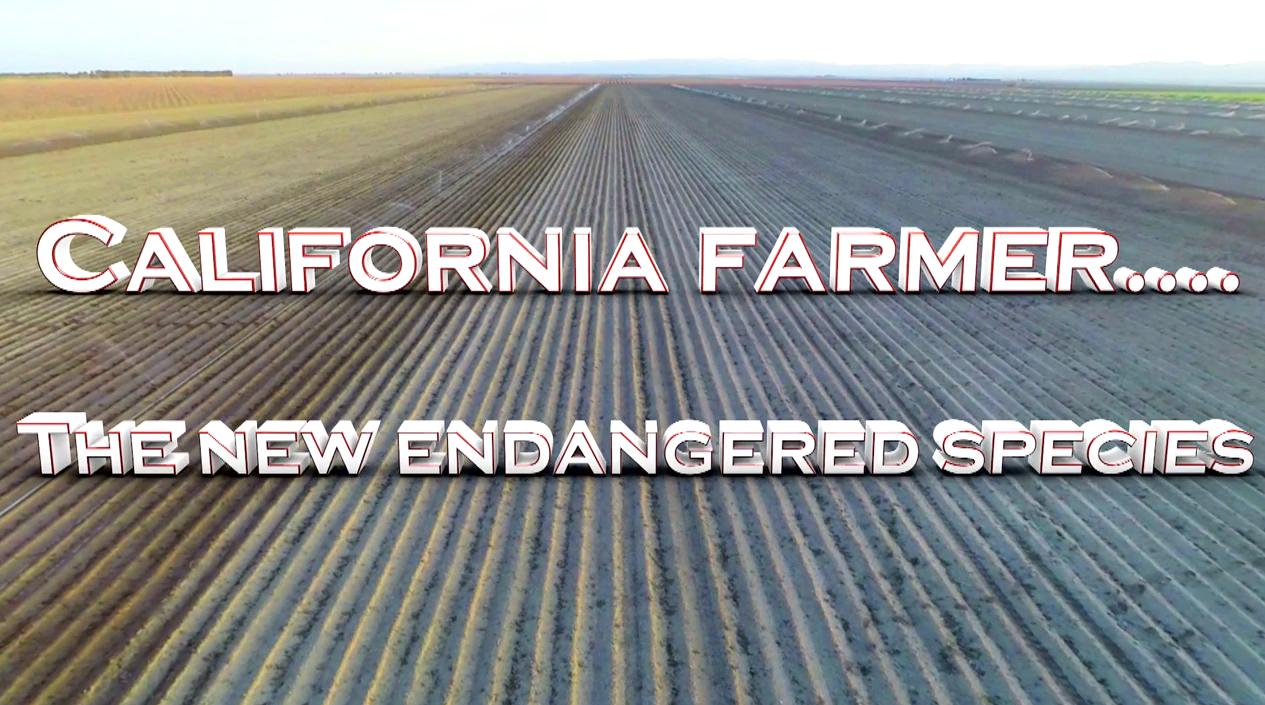
California Farmer… ‘The New Endangered Species’

Ambitious filmmaker documents plight of the California Farmer from a new perspective

Simba Temba Hove grew up on a farm in the rural area of Zimbabwe in Africa. “[Farming] is all we did in my childhood. My father had ten kids, and all we did in the morning was wake up, go to the fields, work the fields the whole day and into the evening, and then go home. Everyday we did this, every day except Sundays. So, farming is very close to me. That’s all we did. I was in the rural area of Africa, so we were all subsistence farmers.”

Simba Temba Hove

Simba Temba Hove

Hove is intimately aquainted with droughts, having lived through the devastating 1982 drought in his country: “When the drought hits, there is nothing that you can do. There is no water system, and everyone is on their own. The drought hits your livestock, your fields, your plantations, your wells, your rivers, everything is gone.” Soon after, Hove came to America, went to college and became a registered nurse in the Bay Area.

When this epic drought hit California, Mr. Hove decided to combine his interest and experience with drought with his passion for filming. “The drought is the worst in a hundred years. If it were not the worst in a hundred years, I probably wouldn’t have filmed it…I want to see how the American farmer survives.”

He spoke to several farmers including Joel and Todd Allen and Vaughn Von Allman of Firebaugh in western Fresno County.  Also prominent in the film is Gayle Holman, public affairs representative for Westlands Water District in Fresno.

Simba Temba Hove, left, with those in Movie

Simba Temba Hove, left, with individuals featured in movie

Hove used these interviews to let African farmers compare their experiences: “I wanted to do a documentary like this one so I could show African farmers. When I first talked to Joel, my idea was to show this to African farmers so they could see what an American farmer’s life is like through the drought, and how he survives.”

Hove was shocked that California adheres environmental restrictions to save an endangered species of fish, the Delta Smelt, even in one of the worst draughts on record: “Honestly it would be unthinkable in Africa—to protect an endangered species when the draught is that bad. In Africa it is all about survival, it’s all about human survival.”

He kept thinking how this situation would play out in Africa, “Everyone would think you’re are crazy. Everyone would think you were out of your mind to think of protecting an endangered species like a fish.”

“California Farmer… ‘The New Endangered Species'” is a riveting and powerful documentary film that illustrates the challengers and the struggles faced by Central California Farmers and their communities.

Check back here to find a screening near you. To see a trailer of the film go to You Tube: https://www.youtube.com/watch?v=LOk3PyOWT5M

2016-07-23T17:03:02-07:00November 10th, 2014|

Looking ahead – December is Farm to Food Bank Month

By: Monique Bienvenue; Social Media Manager/Reporter

California produces one half of the nation’s fruits, nuts and vegetables and is also the largest dairy producing state. Yet in California, the nation’s largest agricultural producer, one in four children and one in six adults regularly go hungry. Join the California Department of Food and Agriculture, the California Association of Food Banks, and CA Grown  in combating hunger.

This is why December is ‘Farm to Food Bank Month’. It is an opportunity to not only recognize the great work that is occurring on an ongoing basis – Ag Against HungerHidden HarvestYoung Farmers and Ranchers, and Farm to Family – but also provides a chance for California farm families to give back to their communities.

CDFA is working in collaboration with its State Board of Food and Agriculture to try to increase annual farm-to-food bank donations to 200 million pounds by next year.

Help join the cause and participate at our upcoming Farm to Food Bank event on Wednesday, December 3rdfrom 10 a.m. to 11 a.m. at the Second Harvest Food Bank in San Jose.  Let’s work to end hunger in California!

2016-05-31T19:32:16-07:00November 7th, 2014|

Student Inventors Take Grand Prize

Source: Pat Bailey; UC Davis

A student team composed of some of the best and brightest young minds at the University of California, Davis,  took the grand prize in the finals of the global iGEM (International Genetically Engineered Machines) competition in Boston. The team also won the Best Policy and Practices Advanced Presentation Award.

The UC Davis students, all undergraduates, placed tops in what is known as the “overgraduate division.” A team from the University of Heidelberg was awarded the grand prize in the “undergraduate division.”

The competition, which this year featured 245 teams from Asia, Europe, Latin America and North America, annually challenges student teams to design and build biological systems or machines and present their inventions in the international competition.

The UC Davis team spent several months building a high-tech, palm-sized biosensor to quickly evaluate the chemical profile of olive oil. Their creation provides a prototype for quickly and accurately detecting low-grade or adulterated olive oil.

The UC Davis team is composed of undergraduate students Lucas Murray, Brian Tamsut, James Lucas, Sarah Ritz, Aaron Cohen and Simon Staley, with student Yeonju Song serving as an alternate or “shadow” team member. A team of faculty advisers guided the students. For more on the innovative olive oil biosensor and the iGEM competition visit, click here.

2016-05-31T19:32:16-07:00November 4th, 2014|

Nut Yields May Be Reduced by Drought

Source: Christine Souza; Ag Alert

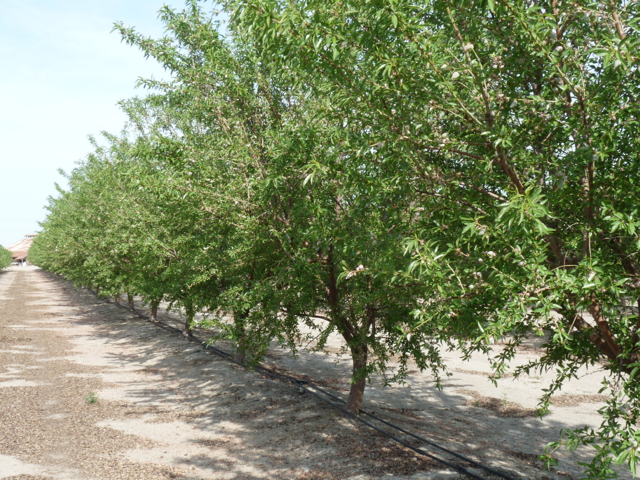
Enduring a drought that has lasted several years, growers of California’s primary nut crops—almonds, walnuts and pistachios—are finishing this year’s harvest and planning for what Mother Nature may or may not bring in the coming year.

“Location, location, location” proved critical to almond and pistachio crops in particular, and seemed to be the determining factor in whether trees had enough water and the required number of chilling hours.

Some farmers were luckier than others, including Larry Lowder of Madera. A grower of almonds and pistachios, Lowder said he was “very fortunate where we live and this year we were able to produce a crop, where others didn’t have that luxury.” He said his farm is located in a microclimate that received sufficient chilling hours during the winter, something that was lacking in other parts of the Central Valley.

Dealing with a surface water allocation of zero, Lowder said he had to rely on deep wells, and he saved as much water as possible by using drip irrigation, microsprinklers and upgraded wells.

Even with a relatively favorable situation, Lowder said his almond yields were down by about 10 percent, although pistachio yields were much better.

In some California pistachio and almond orchards, the drought resulted in a shorter crop and a higher incidence of “blanks,” when a shell lacks a viable nut or kernel.

“Some growers, who had the effect of poor pollinization as well as lack of water, their crops were significantly off and there will be crop insurance claims filed,” said Richard Matoian, executive director of Fresno-based American Pistachio Growers. “One grower said the orchard looked like it had 3,500 pounds per acre, but ended up with 800 pounds of nuts to the acre.”

The U.S. Department of Agriculture estimated this year’s California pistachio crop at between 485 million and 500 million pounds, Matoian said, which is smaller than expected because it was to be an “on year” for pistachios. New figures from the Administrative Committee for Pistachios have increased the estimate to 515 million pounds, which Matoian said was “larger than expected in midsummer but certainly lower than original expectations.”

Many pistachio growers purchased emergency supplies of water, Matoian said, paying as much as $3,000 per acre-foot. Reports from the almond sector showed some growers paid between $1,200 and $2,200 per acre-foot.

Reflecting on how almond growers negotiated the drought, Mel Machado, assistant director of member relations for Blue Diamond Growers, said some orchards were either removed or abandoned, and water was moved from older blocks of trees to younger blocks.

“Growers have learned a lot about how to manage the water they have, but even with good technology and good application, there are orchards that definitely had increased stress this year,” Machado said. “You can see it in the lack of growth of the trees.”

Farmer Stan Wilson of Shafter grows almonds and other crops, and said he made it through this season on well water, but had to reactivate old wells, add extensions to pumps and install an underground pipeline so that he could move water from one field to another.

“We made it through the year. We had no surface water at all, so the only water supply we had was from wells. It is the first year we had zero deliveries,” said Wilson, who fallowed about 160 acres of row crops as a result of the drought.

With harvest drawing to a close, Machado reported that this year’s almond crop is hovering at around 1.85 billion pounds, down from the earlier government estimate of 2.1 billion pounds. Machado said he has seen higher levels of rejects in the almonds produced, but there were problems in addition to drought that played a part, such as varying degrees of stress and salinity issues.

“Quite frankly, we needed the 2.1 billion pounds. A lot of people look at orchards planted over the past few years and say, ‘What are you going to do with those when they come into production?’ Well, we’re going to market them. There is demand out there for the product. We’re still in a demand-exceeds-supply situation,” Machado said.

With just a few more weeks left of harvest, California walnut growers expect a crop that is 545,000 tons, which would be a record, said Dennis Balint, CEO of the California Walnut Commission. No official production figure will be known until harvest is complete, but Balint attributed the expected increase to newly planted orchards and young orchards that are coming into production with higher yields.

He, too, reported continued strong demand.

“Traditionally, we’ve been the ingredient nut, but demand for walnuts is strong and health benefits are starting to drive demand for walnuts. We are seeing more snacking, which we are pleased with,” Balint said.

Marketers said the increasing demand for California nut crops in domestic and global markets is good news for growers. There are 200,000 bearing acres of pistachios in California, and 100,000 acres are non-bearing, Matoian said. For almonds, USDA reported there are 860,000 bearing acres, with 80,000 non-bearing acres. There are an estimated 280,000 bearing acres of walnuts in California, and 45,000 acres that are non-bearing.

For the almond business, Machado said, “the limitation on the crop is going to be water. Water is going to be the competing factor for the almond crop, just as it is for just about every other crop in the Central Valley.”

As winter approaches, nut growers said they are hopeful that the state’s water situation changes for the better, although, Matoian said, “Even if we have a good rain year, we are going to have a lack of water available to growers; that is inevitable. That is what we’re being told by water regulators.”

2016-05-31T19:32:17-07:00November 3rd, 2014|

USDA Extends Dairy Margin Protection Program Deadlines

USDA is extending the deadlines for the Dairy Margin Protection Program. Farmers now have until Dec. 5, 2014, to enroll in the voluntary program, established by the 2014 Farm Bill. Coverage election in subsequent years will take place from July 1 through September 30.

The program provides financial assistance to participating farmers when the margin – the difference between the price of milk and feed costs – falls below the coverage level selected by the farmer.

Producers are encouraged to use the online Margin Protection Program Decision tool at www.fsa.usda.gov/mpptool to calculate the best levels of coverage for their dairy operation. The secure website can be accessed via computer, smartphone or tablet.

The U.S. Department of Agriculture (USDA) also extended the opportunity for public comments on both the Margin Protection Program and the Dairy Product Donation Program until Dec. 15, 2014Comments can be submitted to USDA via the regulations.gov website at http://go.usa.gov/GJSA.

The Dairy Product Donation Program (DPDP), authorized by the 2014 Farm Bill through Dec. 31, 2018, addresses low margins for dairy operations by using Commodity Credit Corporation (CCC) funds to purchase dairy products for donation to public and private nonprofit organizations that provide nutrition assistance to low-income populations. Purchases are only made by USDA during periods of low margins. No enrollment is required for dairy operators to benefit from the DPDP. The Farm Service Agency (FSA) and the Food and Nutrition Service (FNS) will administer DPDP if ever triggered.

2016-05-31T19:32:17-07:00October 30th, 2014|
Go to Top