Invasive Giant African Snails Seized at LAX


By Veronica Rocha; Los Angeles Times 

Two picnic baskets packed with 67 live giant African snails were seized by federal authorities at Los Angeles International Airport (LAX), authorities said.

The snails, which weighed a total of more than 35 pounds and reportedly were intended for human consumption, was apparently the largest seizure at LAX of the mollusks, which are sometimes fried and served as a snack.

The snails were discovered July 1 in two picnic baskets, which weighed more than 35 pounds, said Lee Harty of U.S. Customs and Border Protection (CPB). The snails arrived from Lagos, Nigeria, and were headed to San Dimas.

In the past, federal inspectors have discovered one or two of the large snails hidden in luggage, but this marked “the first time this pest has been encountered in such large quantity and as a consumption entry” in LAX, said Todd C. Owen, director of field operations for the customs agency.

Giant African snails, also known as land snails, can live as long as 10 years and grow up to eight inches long. The snails can carry parasites harmful to humans.

The U.S. Department of Agriculture deems the large snails as a damaging species, consuming more than 500 types of plants, according to federal authorities.

But when the snails can’t find fruits and vegetables to eat, they will “eat paint and stucco off of houses,” the customs agency said in a statement.

The incident remains under investigation.
2021-05-12T11:03:06-07:00July 22nd, 2014|

UC Davis Drought Study Assesses Current Losses and Potential Future Impacts

Source: CDFA

A new report from the University of California, Davis, shows that California agriculture is weathering its worst drought in decades due to groundwater reserves, but the nation’s produce basket may come up dry in the future if it continues to treat those reserves like an unlimited savings account.

The UC Davis Center for Watershed Sciences study, released today at a press briefing in Washington, D.C., updates estimates on the drought’s effects on Central Valley farm production, presents new data on the state’s coastal and southern farm areas, and forecasts the drought’s economic fallout through 2016.

The study found that the drought — the third most severe on record — is responsible for the greatest water loss ever seen in California agriculture, with river water for Central Valley farms reduced by roughly one-third. Groundwater pumping is expected to replace most river water losses, with some areas more than doubling their pumping rate over the previous year, the study said. More than 80 percent of this replacement pumping occurs in the San Joaquin Valley and Tulare Basin.

The results highlight California agriculture’s economic resilience and vulnerabilities to drought and underscore the state’s reliance on groundwater to cope with droughts. “California’s agricultural economy overall is doing remarkably well, thanks mostly to groundwater reserves,” said Jay Lund, a co-author of the study and director of the university’s Center for Watershed Sciences. “But we expect substantial local and regional economic and employment impacts. We need to treat that groundwater well so it will be there for future droughts.”

Other key findings of the drought’s effects in 2014:

  • Direct costs to agriculture total $1.5 billion (revenue losses of $1 billion and $0.5 billion in additional pumping costs). This net revenue loss is about 3 percent of the state’s total agricultural value.
  • The total statewide economic cost of the 2014 drought is $2.2 billion.
  • The loss of 17,100 seasonal and part-time jobs related to agriculture represents 3.8 percent of farm unemployment.
  • 428,000 acres, or 5 percent, of irrigated cropland is going out of production in the Central Valley, Central Coast and Southern California due to the drought.
  • The Central Valley is hardest hit, particularly the Tulare Basin, with projected losses of $810 million, or 2.3 percent, in crop revenue; $203 million in dairy and livestock value; and $453 million in additional well-pumping costs.
  • Agriculture on the Central Coast and in Southern California will be less affected by this year’s drought, with about 19,150 acres fallowed, $10 million in lost crop revenue and $6.3 million in additional pumping costs.
  • Overdraft of groundwater is expected to cause additional wells in the Tulare Basin to run dry if the drought continues.
  • The drought is likely to continue through 2015, regardless of El Niño conditions.
  • Consumer food prices will be largely unaffected. Higher prices at the grocery store of high-value California crops like nuts, wine grapes and dairy foods are driven more by market demand than by the drought.

If the drought continues for two more years, groundwater reserves will continue to be used to replace surface water losses, the study said. Pumping ability will slowly decrease, while costs and losses will slowly increase due to groundwater depletion. California is the only state without a framework for groundwater management.

“We have to do a better job of managing groundwater basins to secure the future of agriculture in California,” said Karen Ross, Secretary of the California Department of Food and Agriculture, which largely funded the UC Davis study. “That’s why we’ve developed the California Water Action Plan and a proposal for local, sustainable groundwater management.”

Failure to replenish groundwater in wet years continues to reduce groundwater availability to sustain agriculture during drought — particularly more profitable permanent crops, like almonds and grapes — a situation lead author Richard Howitt of UC Davis called a “slow-moving train wreck.”

2016-05-31T19:34:15-07:00July 22nd, 2014|

Almond Growers Are Reminded to Send Back Survey Regarding Green Waste Use

UC Researchers are reminding almond growers to fill out the survey that they received  in the mail more than a month ago regarding their use of organic amendments to their soil.

Daniel Schellenberg is a postdoctoral scholar in the department of Plant sciences at UC Davis and  part of the research team.

“Each of the cover letters came with the user ID and were hoping to hear back from all of the growers who would be interested in replying to the survey,” said Schellenberg

“We’re looking into the use of what is collectively called,“Organic Matter Amendments” which can include manures, composts, and green wastes. And this survey is really targeted to all growers even though its organic matter and amendments, its not exclusively a study just for organic growers,” said Schellenberg.

And its not just for almond growers either. “We were targeting all almond growers, but growers of all permanent crops, including walnuts and pistachios are welcomed to take the survey online,” said Schellenberg.

The survey can be found at www.growersurvey.ucdavis.edu

Schellenberg said the researchers have got a good response so far. “Out of the total amount of mailings, we got about 800 responses. A number of them filled out the survey and some of the people opted out.

“So, if people are just not interested in taking the survey or they just couldn’t because maybe they have someone who manages their property and do it for them, we still like to hear from them so that way we at least know we are getting all the responses that we can. We’ve heard response from people who manage more than 175,000 acre of almonds, which is  almost 20 percent of the total almond acreage,” said Schellenberg.

Schellenberg said the goal is not to change the way farmers farm. “Our goal here is not to try to constrain farming practices. Our goal is try to understand these materials and how they are being used that way we can target research that would benefit growers in terms of allowing them more freedom,access, and the ability to use these materials,” said Schellenberg.

2016-05-31T19:34:15-07:00July 21st, 2014|

Fair food gets a TV show!

By: Nan Austin; The Modesto Bee

Some fairgoers came for the barbecue, washed down with beer floats. Others lined up for deep-fried, bacon-wrapped pickles, cheesecake on a stick or a dozen forms of fried potatoes.

But it’s lobster corn dogs, doughnut sandwiches, deep-fried frogs legs and a mega loaf of curly fries that will be the most memorable morsels of this year’s Stanislaus County Fair, thanks to a Food Network episode of “Carnival Eats” that filmed in Turlock.

“Vegas has its secrets. The fair has its calories. It’s the guilty place you go once a year,” said host Noah Cappe between takes Saturday. The show has crisscrossed the country since April, filming Cappe gamely learning to cook everything from gumbo in Louisiana to deep-fried rattlesnake in Oklahoma.

“I appear to be a slow learner. But I’m definitely getting comfortable around the friers,” Cappe said with a grin.

“It’s silly. The guy can barely slice an onion, but he loves to eat,” said show director Spencer Ramsay while his crew set up cameras at the Monster Grill.

“Setup takes a couple of hours,” he noted. “That’s always what takes the time.”

Outside, cameramen taped a black cloth hood around a window in front of the main cooking area to block reflections. One camera would be shooting there while two others stood inside with Ramsay to capture Cappe’s foray into monster corn dog and curly fries cooking. Each item is cooked at least twice, giving a variety of wide-angle and close-up views to be stitched together later.

“It’s a huge process,” said producer Topher McFarlane. The Monster Grill trailer, which has a second trailer attached with walk-in refrigerator and office space, is one of the larger venues they’ve filmed, he noted. Filming inside tents and tiny booths each take their own engineering for lighting, sound and camera angles.

During filming, Cappe’s slim, 6-foot-3-inch frame swiveled expertly to stay in the photo frame as owner Tom Stroud maneuvered bulky packages and oversize equipment in the small space. The booth can run through 14 tons of potatoes in one fair, Stroud said.

Stroud’s 18-inch corn dogs and 5-pound serving of curly fries, both $8 items, were the menu for his segment. It takes custom-built, extra-deep deep-fry bins to cook both. The corn dogs take custom-cut sticks because of their weight, Stroud said. Some people share the mega meal, others dive in alone, he said.

“You get people trying to outdo each other. It’s really comical,” he said.

On Saturday the crew also filmed Cappe making lobster corn dogs that sell for $10 at Sharky’s Fish Fry, owned by two generations of Delahoydes. Phillip Delahoyde said his dad invented the batter-fried lobster sausages and lobster fries to be featured on the show. Other quirky offerings include deep-fried avocado and, at another booth, a chicken sandwich made with raspberry-jelly-filled Krispy Kreme doughnuts.

“If we had to think about calories, that would be scary,” Delahoyde said with a laugh.

Sacramento’s Cal Expo and the Stanislaus fair will be the California contributions for the first season of “Carnival Eats,” due to start mid-August on the Cooking Channel and Great American Country in the United States, and the Food Network in Canada. The show will mix and match locations, making Turlock’s air date a toss-up right now, Ramsay said.

The fair has a week still to run, giving fairgoers a chance to taste the real thing and dozens of other only-at-the-fair foods.

At the Knights of Columbus booth, volunteers in red T-shirts that say “Keep Calm and Eat Linguica” will be fundraising for scholarships and extras for Sacred Heart School. After more than 60 years of selling linguica sandwiches, they’ve added a linguica corn dog, french fries and sweet potato fries this year, said volunteer Kevin Crivelli.

Rotary’s beer booth has $8 beer floats this year, said volunteer Don Gonsalves. One pairs a dark Guinness with chocolate and another adds orange cream soda to Blue Moon beer. Both come with ice cream and whipped cream.

“We’ve had people try it that don’t drink beer and love it,” Gonsalves said.

Doughnuts are big sellers throughout the fair, even showing up as stuffed toys winnable at games along the midway. Castle Mini-Donuts offers a doughnut sundae, eight doughnuts topped with whipped cream, chocolate or caramel sauce and a cherry on top, said worker Jackie Barrera.

Fried bread has been dubbed “elephant ears” at one booth offering a number of toppings. An Indian Fry Bread booth has s’mores bread, a fry bread dribbled with melted marshmallows and chocolate sauce.

The classic cinnamon rolls, a fair staple for 37 years, have added a cinnamon roll sundae – a few more irresistible fair calories.

2016-05-31T19:34:15-07:00July 21st, 2014|

Former Fresno State Ag Professor Honored by Alumni

Ben From Was Central California’s Most Influential Educator

Alumni of the Jordan College of Agricultural Sciences and Technology at Fresno State are raising money to support students in honor of Ben From, one of the region’s most influential agricultural educators.

From joined the faculty after teaching ag mechanics at Parlier and Fowler High Schools from 1954-1968. He spent 24 years at Fresno State training many of the region’s most well-known agricultural leaders including Leo Balakian, Leonard Hammer, Tad Kozuki, Jim Simonian and Tom Vadero.

Since June more than $12,000 has been raised in From’s name. Alcidia Freitas Gomes, senior director of development for the Jordan College, expects the fund to grow as word spreads about the effort. “From made a lasting impact on the lives of countless students and this effort is such a fitting way to celebrate his contributions by benefiting the next generation of leaders in agriculture.”

Former student Ken Bedrosian, co-founder of the National Raisin Company in Fowler, teamed up with others who were influenced by From to host an honorary dinner on his behalf, June 21 in Fresno. “He deserves this,” Bedrosian said to the media at the event. “He has been such an important part of so many people’s lives.”

From retired from Fresno State in 1992. Now 86-years-old, From continues to operate a ranch in Fowler. He remains humble about the attention he is receiving from former students. “I am by no means the most outstanding teacher out there,” From said. “I did a reasonable good job and I was just in some very fortunate situations.”

Funds raised in From’s name will go to support students and programs of the Jordan College. The college offers program in agriculture, food sciences, industrial technology and family sciences. Students receive a hands-on education experience, learning on the university’s more than 1,000 acre working farm adjacent to campus.

For more information contact Shannon Fast, associate director of development for the Jordan College, at 559.278.4266 or sfast@csufresno.edu.

2016-05-31T19:34:15-07:00July 21st, 2014|

Fresno State Plant Science Students Earn top Honors at UC Davis Weed Day

A team of four Fresno State plant science students took first place in the weed identification category at the 58th annual Weed Day seminar hosted by University of California, Davis.

Seniors Sarah Parry of Sonora, Isaac Giron of Terra Bella and Mala Tu of Cambodia and graduate student Rama Paudel of Nepal correctly identified 17 of 20 weeds to win the contest among almost 200 students on July 10.

Students were asked to identify different types of weeds during a tour of current weed research plots at UC Davis. The plots involved herbicide research in annual fruit and vegetables crops, crop safety and herbicide symptomology demonstrations, aquatic weeds and grassland weed invasion and restoration research.

The students were invited to a dinner after the seminar for one-on-one interaction with UC Davis weed science graduate and post-doctoral students, extension specialists and professors.

“It was a great experience that opened my eyes to new opportunities in weed science and it has encouraged me to pursue my master’s degree,” Perry said. “I’m excited to see what the future has in store.”

Each year, Weed Day brings together pest control advisors, farm advisors, chemical company cooperators, college faculty and students and regulatory officials to learn about current weed science research at UC Davis.

For more information, contact Steve Wright, farm advisor at sdwright@ucdavis.edu or 559.684.3315.

2016-05-31T19:34:15-07:00July 19th, 2014|

Scholarship Committee Member Minami Honored for 22 Years of Service

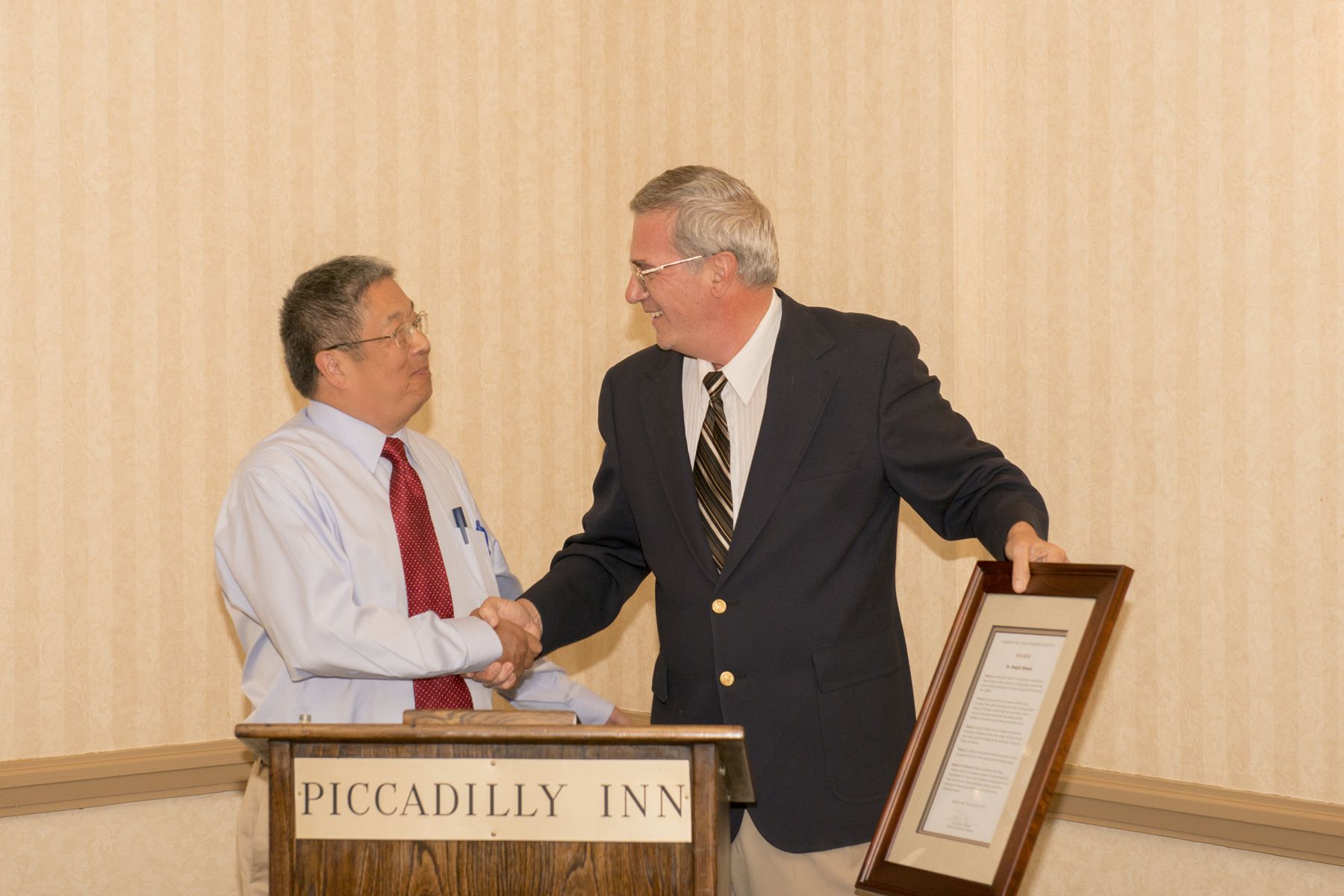
Photo: Chairman Louis Pandol (right) congratulates Dr. Dwight Minami (left) after presenting him with a board resolution thanking him for his service.


Dr. Dwight Minami’s Service on the Nation’s First Worker-Focused Scholarship Program

FRESNO, CA – Dr. Dwight Minami was honored on July 17 for his service on the committee of the California Table Grape Workers Scholarship Program.

For more than 20 years, Dr. Minami volunteered his time and energy to help evaluate over 1,000 applications that led to the award of college scholarships to California table grape field workers and their children. During his tenure, 76 students were awarded scholarships to attend universities, junior colleges and trade schools to study subjects such as accounting, nursing, engineering, culinary arts, biology and business.

“Dr. Minami’s involvement has been instrumental to the long-term success of the nation’s first worker-focused scholarship program,” said Kathleen Nave, president of the California Table Grape Commission. “Using his expertise as a professor at California State University, Fresno and his knowledge of the valley and the agricultural industry, Dr. Minami’s valuable insight and conscientious review of each year’s applications helped ensure that talented, qualified candidates were selected to receive the grower-funded awards.”

The California Table Grape Workers Scholarship Program was established in 1985 and has since awarded over 100 scholarships to field workers and their children from the table grape growing regions in California. Dr. Minami served on the committee from 1993-2014.

“On behalf of the California table grape industry, a heartfelt thanks is extended to Dr. Dwight Minami for his hard work, commitment and dedicated service to higher education, the California table grape industry, and the state’s table grape workers and their families through the field worker scholarship program,” said Nave.

2016-05-31T19:34:15-07:00July 18th, 2014|

USDA Secretary Brings Water Assistance on Valley Visit

USDA Provides Water Assistance Aid to 73,000 Rural Californians Impacted by Drought

FARMERSVILLE, Calif., July 18, 2014 -USDA Secretary Tom Vilsack today announced USDA is providing $9.7 million in emergency water assistance to 73,000 residents in 11 California counties experiencing the driest year on record.

“This drought is devastating those who live, work and raise their families in much of rural California,” Vilsack said. “It is threatening the survival of whole communities and livelihoods of folks throughout the state. From Siskiyou County in the north to Kern County in the south, this disaster is crippling communities up and down the 600-mile spine of California.

“The emergency water grants we are announcing today are triple the amount we committed to when President Obama and I visited the state earlier this year,” Vilsack added. “I am proud of the work USDA Rural Development staff in California and Washington, D.C., have done to get this funding to those in need and the work they have done with municipal leaders in these rural communities to help residents, businesses and agricultural producers.”

Agricultural Secretary Tom Vilsack

Agricultural Secretary Tom Vilsack

Extreme weather, such as the intense drought occurring in the western United States, is putting a strain on water supplies. The Obama Administration is committed to increasing investments in the nation’s water infrastructure to mitigate the impact of climate change and to ensure that all Americans have adequate, safe and reliable water supplies. The National Climate Assessment released earlier this year illustrates the impact of climate change across the country.

This announcement is part of broader Obama Administration efforts to help those impacted by the drought. Through the National Drought Resilience Partnership, launched as part of President Obama’s Climate Action Plan, federal agencies are working closely with states, local governments, agriculture and other partners on a coordinated response.

The 25 rural California communities are being helped by funding provided through USDA’s Emergency Community Water Assistance Grant (ECWAG) program. This program helps rural communities that have experienced a significant decline in the quantity or quality of drinking water due to an emergency. In January, USDA streamlined the program’s application process to expedite emergency water assistance to communities in need, particularly in drought-impacted areas.

In addition to support from the ECWAG program, USDA is helping rural communities meet their water needs through Water and Waste Disposal loans and grants and Special Evaluation Assistance for Rural Communities and Households (SEARCH) grants. USDA Rural Development has also approved grant funding to establish a revolving fund to provide low-interest loans to rural homeowners for household water wells.

For example, the small community of Cameron Creek Colony in Tulare County is struggling due to severe drought. About 10 percent of its residents have no access to water because their wells have run dry. Others have only intermittent access.

The city of Farmersville, Calif., is receiving a $500,000 ECWAG grant to construct pipelines connecting Cameron Creek Colony to the Farmersville water main and linking residents to the water system. This will provide much-needed relief throughout the community.

The grants announced today are contingent upon the recipients meeting the terms of the grant agreement.

Since the start of the Obama Administration, USDA Rural Development has invested more than $310 million to help 345,000 rural Californians receive improved water or wastewater services.

As California suffers through this drought, the Administration has taken action to help those struggling to cope with the hardships it has caused, including:

  • Designated 57 counties as disaster areas, making farmers and ranchers eligible for emergency loans.
  • Targeted $25 million from the Environmental Quality Incentives Program to help farmers and ranchers implement conservation practices to conserve water, protect fields from erosion and improve access to water for livestock.
  • Invested $5 million in emergency watershed protection.
  • Provided $7.6 million to livestock producers through the cost-sharing Emergency Conservation Program.
  • Invested $750,000 to reduce aquatic weeds clogging irrigation screens, pumps and canals in the Sacramento and San Joaquin River delta.
  • Set aside $3.3 million of a $30 million national investment to mitigate wildfire threats, protect water resources and provide habitat for at-risk species.
  • Made continuing research investments in water conservation and use efficiency, as well as capacity grants for the University of California’s Institute for Water Resources.
  • Established a network of climate hubs, including a sub-hub in Davis, for risk adaptation and mitigation to climate change.
  • President Obama’s plan for rural America has brought about historic investment and resulted in stronger rural communities. Under the President’s leadership, these investments in housing, community facilities, businesses and infrastructure have empowered rural America to continue leading the way – strengthening America’s economy, small towns and rural communities. USDA’s investments in rural communities support the rural way of life that stands as the backbone of our American values.

#

2016-05-31T19:34:15-07:00July 18th, 2014|

Debate Heats up on Proposed EPA Water-Quality Rule

Source: Kate Campbell; Ag Alert

Discussion has intensified about proposed changes to the Federal Clean Water Act. As farmers and ranchers express increasing concern about enhanced permitting requirements, land-use restrictions and legal liability that the proposal could cause, the U.S. Environmental Protection Agency launched its own campaign to defend the proposal.

Agricultural leaders want the EPA to scrap the proposed rule changes, terming them a poorly orchestrated attempt to expand agency jurisdiction. The proposed rule was published in April, and remains open to public comment until October.

County Farm Bureaus in California are joining the national push to have the proposed rule changes withdrawn, reaching out to members of the state’s congressional delegation and urging the proposal be stopped.

Meanwhile, the EPA called its proposals merely an effort to clarify regulatory jurisdiction, which was called for in two U.S. Supreme Court decisions that ruled against the agency’s attempt to expand its jurisdiction over “waters of the United States.” EPA said the proposed rule would have minimal economic impact and would not affect many acres—only about 1,300 acres nationwide.

The American Farm Bureau Federation called that assertion “laughable,” considering the amount of land nationwide that has the capacity to retain seasonal moisture, a condition covered by the proposed rule. Under the proposal, legal experts say, wet spots could be deemed “waters of the U.S.”

AFBF said the EPA effort to expand its jurisdictional authority over most types of waters and lands is regulatory overreach that has the potential to impose costly and time-consuming federal permit requirements, as well as place limits on routine farming practices, such as building a fence across a ditch or pulling weeds. Essentially, EPA has proposed regulations that fundamentally redefine “waters of the U.S.” and eliminate the term “navigable” from the law, AFBF said.

“We’re urging Congress to take a look at the proposed rules and we’re urging the agency to withdraw both of them,” California Farm Bureau Federation Federal Policy Manager Rayne Pegg said, referring to both the main EPA proposal redefining “waters of the U.S.” and an “interpretive rule” that focuses on agricultural activities.

Pegg stressed that farmers recognize the need to protect water quality, and already abide by a number of water-quality regulations.

“Adding another layer of regulation does not mean you will get better results,” she said. “Instead, the rule will create more paperwork. It’s a poorly conceived rule. EPA should meet with farmers and listen to its own Scientific Advisory Board to craft something that is practical.”

There are a number of things going on in Congress right now related to these rules, she said, and CFBF has been responding to questions from members of congressional committees—including the House Appropriations Committee, which is considering legislation to remove funding for implementation of the proposed waters of the U.S. rule.

In response to the uproar over the proposal, EPA Administrator Gina McCarthy took to the road last week—touring a Missouri farm and meeting with a number of Kansas farm groups. She acknowledged during a lunch discussion with agricultural leaders the waters of the U.S. proposal has “fallen flat on its face.”

But during a speech in Kansas City, she charged that the EPA proposal has been beset by “D.C. myths.”

“Misinformation is becoming the story, while the legitimate, serious issues that we need to talk about are taking the back seat,” McCarthy said.

At the same time McCarthy visited the Midwest, the Natural Resources Defense Council—an environmental organization—took out advertisements supporting the EPA proposal.

Confusion about what the proposed rule may actually cover and conflicting interpretations of the rule changes may leave political leaders with the impression the proposal is benign and that farmers don’t need to worry, said CFBF associate counsel Kari Fisher.

“EPA would like political leaders and the public to believe that all farmers need to do is go ahead with normal farming practices and not worry about the proposed changes,” she said. “Unfortunately, that’s incorrect.”

Fisher said the interpretive rule on agriculture would require certain farming practices—such as putting in a new fence or maintaining a ditch—to comply with U.S. Department of Agriculture standards administered by the Natural Resources Conservation Service. She noted that the interpretive rule would apply only to Section 404 of the Clean Water Act, which covers dredging and infilling land that could affect wetlands.

But the proposed rule to expand the definition of “navigable waters” applies to the entire Clean Water Act, she said, and would expand EPA jurisdiction over water.

“If the proposed rule redefining waters of the U.S. is adopted, farmers with land that features a depression or low spot that’s adjacent to a tributary flowing to navigable water could be brought under the rule’s jurisdiction,” Fisher said.

Although the interpretive rule might provide a limited layer of protection for farming and ranching activities from the need to obtain Section 404 permits, she said, “it will not provide protection from other necessary Clean Water Act permits, such as those for the discharge of pollutants.”

Farm Bureau leaders continue to urge members to help prevent the proposed rule from becoming final by commenting about the impact the proposal would have on their farms and ranches.

Information from EPA on the proposed changes to the CWA can be found online at www2.epa.gov/uswaters. Background information on the issue from AFBF is online at http://ditchtherule.fb.org/.

For information on arranging local farm tours, grower roundtables and informational meetings with members and staff of California’s congressional delegation, contact county Farm Bureau offices or the CFBF Federal Policy Division at 916-561-5610.

2016-08-03T21:07:42-07:00July 18th, 2014|

Psyllid Management Area Meetings in Tulare County

Developed by the top minds at University of California, California Citrus Mutual and Citrus Research Board, along with other industry leaders, a new area-wide treatment strategy is being introduced to citrus growers to organize the industry and allow for rapid communication if area-wide insecticide treatments are needed.

Coordinated treatments are the most effective way to manage the Asian citrus psyllid and thereby protect our state’s citrus from the incurable Huanglongbing disease, and this new strategy lays the framework for how neighboring growers should synchronize treatments to have the maximum impact on this pest. Right now, Tulare County is still in eradication mode, but the industry should plan for what may come next.

Industry leaders have divided Tulare County into “Psyllid Management Areas” in which neighbors can easily work together to time their treatments when the Asian citrus psyllid infests the area. Several meetings have been set up to introduce this strategy to growers, farm managers or PCA representatives from each area. Use the maps, dates, times and locations below to know which area you operate in and which meeting you should attend.

At each meeting growers will learn the details of this treatment strategy, when it should be implemented and how neighboring growers can work together. Growers will have an opportunity to get to know their neighbors and choose amongst themselves a Team Leader to help organize the group and flow communication about treatment timing. Growers working together will make this program successful and will save California citrus from the incurable HLB disease.

Click the link below to view a map to see the division of Psyllid Management Areas in Tulare County and learn which area you are in. The map is interactive – you can click the PMA labels on the map for a more detailed view of that area.

Tulare County PMA Map – http://www.citrusinsider.org/wp-content/uploads/2014/07/All-Tulare-County-PMAs-Grower-Access.pdf

To RSVP for a meeting, register using the links below or call 559-592-3790.

Many growers may have operations in multiple Psyllid Management Areas. In that case, growers are welcome to attend the meeting time and location that is most convenient for them or attend multiple meetings to get to know your neighbors in all areas.

July 22, 2014 – PMAs in Southern Tulare County
Porterville Veterans Memorial Building

8 a.m. – T-2, T-3, T-4, T-5, T-6, T-7
Register: http://citrusinsider.org/event-registration/?ee=4

9:30 a.m. – T-8, T-9, T-10, T-11, T-12, T-13
Register: http://citrusinsider.org/event-registration/?ee=6

11 a.m. – T-15, T-16, T-17, T-18, T-19, T-21
Register: http://citrusinsider.org/event-registration/?ee=5

1 p.m. – T-14, T-20, T-23, T-24, T-25, T-26
Register: http://citrusinsider.org/event-registration/?ee=7

2:30 p.m. – T-28, T-29, T-30, T-34, T-35, T-36
Register: http://citrusinsider.org/event-registration/?ee=8

4 p.m. – T-31, T-37, T-42, T-43
Register: http://citrusinsider.org/event-registration/?ee=9

July 24, 2014 – PMAs in Central Tulare County
Exeter Veterans Memorial Building

8 a.m. – T-22, T-27, T-32, T-33, T-38, T-39
Register: http://citrusinsider.org/event-registration/?ee=10

9:30 a.m. – T-40, T-41, T-44, T-45, T-46, T-48
Register: http://citrusinsider.org/event-registration/?ee=11

11 a.m. – T-47, T-50, T-51, T-52, T-53, T-54
Register: http://citrusinsider.org/event-registration/?ee=12

1 p.m. – T-49, T-55, T-56, T-57, T-59, T-70
Register: http://citrusinsider.org/event-registration/?ee=13

2:30 p.m. – T-58, T-60, T-61, T-62, T-63, T-76
Register: http://citrusinsider.org/event-registration/?ee=14

4 p.m. – T-64, T-65, T-66, T-67
Register: http://citrusinsider.org/event-registration/?ee=15

August 7, 2014 – PMAs in Northern Tulare County
Kearney Agricultural Center

8 a.m. – T-69, T-71, T-72, T-73, T-77, T-82
Register: http://citrusinsider.org/event-registration/?ee=16

9:30 a.m. – T-74, T-75, T-78, T-79, T-80, T-81
Register: http://citrusinsider.org/event-registration/?ee=17

11 a.m. – T-68, T-83, T-84, T-85, T-89, T-93
Register: http://citrusinsider.org/event-registration/?ee=18

1 p.m. – T-86, T-87, T-88, T-90, T-91, T-92
Register: http://citrusinsider.org/event-registration/?ee=19

2:30 p.m. – T-94, T-95, T-96, T-97, T-98, T-99
Register: http://citrusinsider.org/event-registration/?ee=20

4 p.m. – T-100, T-101, T-102, T-103
Register: http://citrusinsider.org/event-registration/?ee=21

2016-05-31T19:34:16-07:00July 18th, 2014|
Go to Top