Building Trust Between California Farmers and Consumers

William Clark, Harvard Professor, on Building Trust Between California Farmers and Consumers

By Courtney Steward, Assistant Editor

Social and conventional media are sharing widespread and varied opinions about California farmers and farming across the Central Valley and beyond, using soundbites in place of fact-based dialogue.

William Clark, Harvard Professor

William Clark, Harvey Brooks Professor of International Science, Public Policy and Human Development, John F. Kennedy School of Government, Harvard University

At a recent workshop called “Food for a Healthy World: Monitoring Progress Towards Food Security,” sponsored by the UC Davis World Food Center and the UC Agricultural Issues Center, William Clark, Harvey Brooks Professor of International Science, Public Policy and Human Development, John F. Kennedy School of Government, Harvard University, at first appeared to dodge giving his opinion. “It would be dumb beyond belief for me to have opinions about farmers in California,” explained Clark, “except I enjoy what they produce.”

The goal for the group of campus and visiting experts who attended the workshop was to reach agreement on the major factors that must be considered to sustainably feed the world’s population. “The reason I’m here,” he said, “is because I work on sustainable development issues broadly, and much of what is going on here in California in the farming sector as well as in the energy sector are some of the most fascinating and useful experiments anywhere—in grappling with these issues. And I come out fairly frequently to UC Davis because I find it a wonderful point of contact with the farming community here. I’ve borrowed some UC Davis students, and I learn a lot when I visit.”

Clark explained, “I think California is a state that obviously thinks hard about how it can be a productive, vibrant economy, while taking care of the environment and of the people,” evidenced by great creativity and ingenuity among California farmers and researchers. “My colleague, Tom Tomich, director of the Agricultural Sustainability Institute at UC Davis recently co-authored one of the first peer-reviewed articles* to emanate from the California Nitrogen Assessment (CNA), an ongoing project at UC Davis.”

Assessment research indicates that while there are many pathways through which nitrogen can enter the environment, inorganic fertilizer use is responsible for the largest fraction of new nitrogen introduced in California annually. Currently, over 600,000 tons of nitrogen fertilizer are sold in the state each year.

Tomich maintains that better nitrogen use information is indispensable for the collaborative development of effective solutions to increase nitrogen use efficiency and save farmers money. The article describes both how nitrogen flows in crop production, but also how farmers can limit the flows that create problems in the environment.  Also included are recommendations on how data could be better compiled to improve understanding of statewide trends in fertilizer use.

Clark claimed, “That’s the best nitrogen study that’s been done anywhere in the world in terms of showing how farmers are working and could be working to capture the benefits of fertilizer without offsite damages to the environment.”

Regarding these offsite flows, Clark emphasized, “I’ve almost never met a farmer who does not care deeply about the land, or the fisher about the health of the fishery or of the sea. And I think sometimes the debates that between the conservation and farm communities go completely nuts on this,” Clark explained. “I mean, you start with somebody who is making their living—has chosen a life—on the land. That’s where you start.”

“That said, all of us end up sometimes doing stuff that has some consequences we didn’t intend,” stated Clark. “I look to the science community to help all of us, including farmers, see some of the downsides of some of the practices that we do that are invisible. So, perhaps science discovers this chemical we thought was safe turns out not to be safe. Or the way we are turning over our crops has impacts on biodiversity that we didn’t know about.”

“But again,” Clark continued, “it’s the responsibility of my community, the science community, to bring those invisible but measurable discoveries into light in a conversation with farmers to reach a joint understanding of why one might want to use less of these applications and how one could use less of them while still turning out an attractive crop.”

Clark said it’s been his experience that most growers listen and try new approaches.

Clark concluded that trust between farmers, consumers, retailers, and health advocates is an all-time low. “I think  food is one of the most complicated personal issues there is. If I were trying to build trust in an arena, there’s none harder, except maybe nuclear energy, than food issues. I think we all know that we have had less dialog and more soundbite exchange, and I don’t think any side is blameless.”

“My pitch here,” Clark summarized, “is simply I don’t see how we can move forward without starting meaningful dialogues that aren’t soundbites.” Clarke wants to inspire people to ask themselves, “What am I worried about?” instead of throwing blurbs into the middle of a on-air radio conversation. He elaborated, “Whether I’m a consumer advocate, a farmer, or a retailer, ‘What am I worried about? What do I think you guys are doing that I wish you weren’t doing?’ We aren’t brain dead; we should be able to work together, as long as we can talk instead of yell.”


*Rosenstock T, Liptzin D, Six J, Tomich T. 2013. Nitrogen fertilizer use in California: Assessing the data, trends and a way forward. Cal Ag 67(1):68-79. DOI: 10.3733/ca.E.v067n01p68.
2016-05-31T19:28:14-07:00June 11th, 2015|

Recycled Wastewater Could Help Growers in Del Puerto Water District

Recycled Wastewater Could Help Growers of Permanent Crops

By Kyle Buchoff, CaliforniaAgToday.com

Jim Jasper

Jim Jasper, Owner/President, Stewart & Jasper OrchardsA recycled wastewater project from Modesto and Turlock wastewaster facilities may help provide 30,000 acre-feet to start with much more coming later if things work out. Jim Jasper, is a diversified grower with Stewart & Jasper Orchards in Newman, which is part of the Del Puerto Water District. “We hope to get about 30,000 acre-feet of water from the city of Modesto,” said Jasper, “and that would start in 2018 if we get it through the Del Puerto Water District which is 45,000 acres stretching from a little bit South of Tracy to just North of Los Banos, along the I-5 corridor.”

This would be enormously helpful for growers in the area, but Jasper said it hasn’t been easy. “We’ve been working on this for going on six years now,” stated Jasper.  “We’ve been back to Washington D.C. three or four times, and we are getting a lot of support. Del Puerto would pay to build a pipeline across the San Joaquin River to take recycled water from Modesto up to the middle of the canal. It would cost over 100 million dollars of farmers’ money to get it done, but it would give us a reliable source of approximately 30,000 acre-feet, which would be 1/3 of what our needs are to take care of our district.

And Jasper noted the supply would particularly help growers of permanent crops, “Of the 45,000 acres in our district, about 27-28,000 are permanent crops, mainly almonds, grapes, walnuts, and cherries. So it is very important that we have a dependable water supply. Obviously, 2015 is the second year that we have had a 0% allocation, so it has been extremely challenging to keep our crops alive.”

Jasper stated the Del Puerto Water District, “has 15,000 acres have been idled in 2015 of our 45,000 acres.”

He expounded, “On the Westside, along I-5, we just don’t have groundwater to substitute for our 0% allocation, so it has been very very difficult.”

Jasper said the only way to survive the 0% water allocation was to purchase water from someplace else. “We’re trying to purchase the water,” said Jasper. “Last year, one of the growers I work with in the almond business was successful at purchasing 1,000 acre-feet of water at $2100/acre-foot, so they were able to get through last year. But they sold their orchard because they could not continue that kind of expense. Another grower I do business with bought 1000 acre-feet of water at $2000/acre-foot, was not successful, and subsequently sold his orchard last year. So we see that as good as the almond industry seems to some people–where there is water, where there isn’t water, almond farmers are really hurting. They are pulling orchards–we pulled 400 acres of our 2,000 acres already–and water the younger trees, which have a better future. You just make these decisions. It’s been very challenging.”

And Jasper said that the recycling project gives them hope, “This recycled water will really help if if we can get it through. We’re in the process and are very, very hopeful.”

2016-07-05T03:28:23-07:00June 9th, 2015|

MY JOB DEPENDS ON AG Broadens Ag Community on Facebook

“My Job Depends on Ag” Facebook Campaign Goes Big

 By Patrick Cavanaugh, Associate Editor

It was a vision by Steve Malanca a tractor, salesman, and Erik Wilson, pest control operator and honeydew melon farmer, both working in around Dos Palos in Merced County.

Erik Wilson

Erik Wilson

“The fact that California agriculture is only 2 percent of the gross domestic product of the state was offensive to agriculture,” said Wilson. “because we all know it goes way beyond the gross receipts.”

Steve Malanca

Steve Malanca

Back in 2013 Malanca, an equipment salesman with Duetz Allis in Kerman, Calif., came up with a decal with the message: My Job Depends on Ag. He made a few for his friends who slapped them on their trucks.

“The phrase was inspired by a video done by Mike Wade, California Farm Water Coalition, in which he asked several people how they depended on ag for their job,” Malanca said.

Malanca was born and raised in Firebaugh, where his grandfather settled after emigrating from Italy. “My grandfather worked for Miller and Lux ranch, which was one of the largest ranches in the United States in the late 1800s,” he said.

“My father was born and raised on the West Side and was a cotton gin manager for Producers Cotton Oil Company. I have an older brother who is in the cantaloupe business longer than I have been in the farm equipment business. He is part owner of Westside Produce, and my younger brother is a shipping clerk there.

Producers Cotton Oil Company Plant Near Calwa, California

Producers Cotton Oil Company Plant Near Calwa, California

For the last 40 years, starting in Firebaugh, Malanca has been selling farm equipment. “That community has been tremendous to our family. Being involved in the equipment business, and talking to our customers about the trials and tribulations about water was an inspiration to put the ‘I Depend on Ag’ video together.

“There was a local Firebaugh farmer who made a brown ‘V’ decal that was a spinoff of the green ‘V’ of former Fresno State Bulldog coach Pat Hill, signifying the green valley. The brown V of course signified no water,” said Melena. “I expanded the idea and generated the ‘I Depend on Ag Decal’ about a month ago.

“Then Erik immediately suggested that we put it on Facebook, and the two ideas were married–and here we are,” said Malanca. As of the afternoon of June 6, the number of connections were close to 21,000 members!

“We did not want to have a Facebook with statistics on the importance of agriculture in California,” said Wilson. “I have a friend named Brian Ervin who is on Facebook, and he posted an item unrelated to the ‘I Depend on Ag’ concept. He wanted to know about other people’s California…Was it raining?…Was there hail on the ground? There was also an image of a guy loading a hay truck.”

“Instead of pushing out information, I got the idea of just letting everyone tell their own story,” Wilson said. “If people have a job that depends on ag, then we should let them tell their own story. Let people get involved. They own the page, and the stories have been wonderful. In fact, Steve and I have gotten choked up on some. People are saying are some things you’ve never heard of, and it’s really kind of historical,” he said.

“There are a lot of old methods of farming that have been forgotten that are now being introduced on the page,” said Wilson.

“Also, I have encouraged any group or person who disagrees with our philosophy and farming methods to open up the conversation, and not yell or get profane. This is what everyone America has been crying for from our politicians. So, we are going around them. This is how civilized adults get things done.”

“There have been comments from the organic crowd regarding images of sprayers working in fields. Now if they want organic food to eat, we will be happy to give it to them at a higher cost; organic production costs us more in time, money and trips across the field because the materials that we are permitted to use are not as affective,” said Wilson.

“We had a conversation with Western Growers on June 4 in which they asked if we were having to delete a lot of entries from people bashing the web page,” said Malanca. “And Erik, who moderates the page, said only three posts had to be deleted.”

“I may have deleted something prematurely because I thought a comment might go south too fast, but I just do not want the nastiness or personal attacks to take over, because it often happens if you do not moderate–even if it’s a friend–if they throw F-bombs, their entries will be deleted.”

“We are hearing from so many people who understand that ag is part of their job. We had a guy who works in the tortilla chip factory in Los Angeles who depends on ag for his job because all the corn that goes into the chips is grown in the San Joaquin Valley,” said Wilson.

“Flower shops are connecting in because flowers are agriculture. A lavender grower also posted a comment.”

Trucking companies are chiming as well. “If we can’t grow and sell it, then these boys can’t haul it,” noted Wilson. “And if we can get the trucking industry behind us since they do haul a lot of ag products, suddenly we are uniting an even larger segment of people who depend on agriculture,” said Malanca.

“I’d like to see these truckers and the guys on the docks get as passionate as we are, and maybe decide not to haul freight to areas that are complaining about farmers. They need to say, ‘if you want what we have, then turn the water on for the farmers.'”

“This is giving farmers a voice,” said Malanca. “And it’s something that has been missing.”

“Our wives have said that we are preaching to the choir, and I say that we need to rally and embolden every single person in the industry. I want to champion them as their story has not been told in the media–other than the agricultural media,” said Wilson.

“Many fragments have beentrying to get something done, but now we are seeing farmers really coming together on ‘I Depend on Ag.’ This is what we have been trying to do since the beginning of time,” said Malanca.

While the scope of the facebook page focuses on California, plans are germinating to roll out a national campaign. “After all, there are millions across the country who depend on agriculture,” said Wilson.

2016-05-31T19:28:15-07:00June 6th, 2015|

Navel Orangeworm Pressure

Joel Siegel: Beware of Navel Orangeworm Over Next Few Weeks

By Patrick Cavanaugh, Associate Editor

Joel Siegel, research entomologist with USDA Agricultural Research Service (ARS) in the Parlier office in Fresno County, is worried about Navel Orangeworm (NOW) pressure on almonds, pistachios and walnuts this season, “because we have this pattern of hotter winters, warmer springs. And, there is more than enough degree-day accumulation for an extra generation of NOW, compared to what people were dealing with four years ago. And with that, there’s the potential—if you are not on top of things—for it get out of hand.”

Those higher temperatures, he says, are what the worms desire, “Temperature—you can think of it as fuel—fuel for the fire. So the faster the generation time, the more they can start overlapping and possibly resulting in an extra generation, prolonged pressure, and at the tail-end, more NOW going into the next season as well. So you have this cycle that keeps on increasing,” says Siegel.

In describing the different monitoring and spray strategies for the each nut crop, Siegel says, “Well, with pistachios, hull split is not as predictable, so if you have hull integrity maintained, there is less NOW pressure because the nuts are not vulnerable. Navel Orangeworm seems to find pistachios once that hull begins to split. If hull break-down occurs earlier, you are dealing with more pressure.”

Joel Siegel

Joel Siegel, research entomologist with USDA ARS in the Parlier office, Fresno County

“On walnuts,” he explains, “people have been harvesting them later, going into September and October. So, if sun damage or anything else has damaged the hull in these late varieties, NOW will find these nuts as well. So, growers are experiencing higher pressure with late harvest walnuts.”

“NOW management timing is a bit more obvious for almonds,” Siegel explains. “That hull split spray is probably the most critical spray application, plus the new crop nuts are increasingly becoming more vulnerable to NOW. When that hull begins to open seems to be when this moth really notices the almonds.”

Siegel states, “One problem with almonds in particular, is that drought stress may cause prolonged hull-split that is not synchronous within an orchard. You’ll see NOW on the edges and the middle of the orchard, for example, just out of sync. So growers are having to apply an extra spray to treat all of their nuts the first time, and that is a relatively new phenomenon.”

“Second,” he says, “some people get burned in almonds, as they are used to the NOW pressure they encountered two to three years ago when they were not dealing with that extra generation. So they’ve only been applying this single spray; whereas, currently, many people need to do a hull-split spray followed by a post-hull-split spray.” And the way this season is progressing, growers may need to do this second spray over the next ten days.

“With  pistachios,” Siegel notes, “these NOW generations are building. And because of the high economic value of pistachios, people are doing a  second, or even a third shake. So if you have a scenario in which your crop is not synchronous in development, a lot of nuts become available late in the season, just when the NOW population is high as well. So that last 20% of the pistachio crop is where a great deal of damage is occurring.”

Navel Orangeworm does so much damage to the kernels that many processors are offering price premiums to growers for pistachios with  less than 1% damage. Siegel clarifies, “I’m assuming that is the goal of increased subsidies; to help offset either the cost of increased insecticide applications or to offset the cost of puffers for mating disruption.”

Siegel notes some unique NOW attributes, “They are very good at eating a lot of different things.  People don’t realize that although these different nut commodities—almonds, pistachios, and walnuts—have chemicals that help protect them from insects, this worm is very good at detoxifying or eliminating these protective chemicals. So, NOW is able to pressure many different crops and moldy fruit, so that any moldy mummies on the ground can serve as food for Navel Orangeworms. This is why sanitation is so critically important.”

Siegel says California tree nut growers are well-known for their high quality product, and this excellent reputation must be maintained. “Pistachios are a valuable crop,” Siegel says. “Growers must balance these advantages, talk with their processors, and look at how aggressive their pest management practices need to be.”

“The reality,” he continues, “is that a lot of people did quite well last year, and their damage was quite acceptable. So again, my advice is to stay the course; if you are happy with your results, continue to do the things that made you happy. If you got stung a little bit, consider adding sanitation or an additional spray.”

Finally, Siegel summarizes, “The California advantage is a quality nut crop that is high in demand. I assume that quality is never static; it always has to improve and respond to the market. As processors continue to pay premiums, they will expect nuts of a certain quality, and that will be the challenge for growers’ management strategies.”

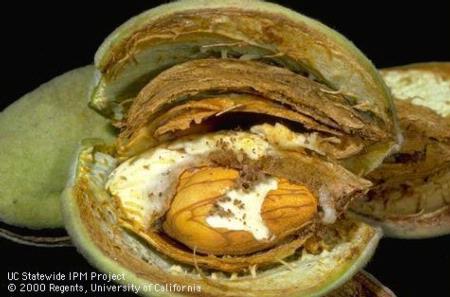
(Featured Photo: Almond damaged by navel orangeworm larvae, UC ANR)

2016-05-31T19:28:15-07:00June 5th, 2015|

Good News for Oakdale Irrigation District Farmers

Oakdale Irrigation District Farmers:
2015 Water Allotments Raised to 40 Inches

A couple of beneficial spring storms combined with cool weather and strong water conservation led to good news Tuesday morning for farmers in the Oakdale Irrigation District: A small bump in the amount of water they will receive in the fourth year of drought.

OID directors voted 4-0, with Al Bairos absent, to raise this year’s allocation to 40 inches from 36. When the irrigation season began in March, OID told irrigators to expect 30 inches this year – the first time in its 105-year history it has put limits in place.

Directors also declined to rescind a decision they made in April to deliver 10 inches of water to Tier 2 customers.

General Manager Steve Knell said small storms in April and May provided an unexpected bonus: enough water to keep soil moisture high in the valley, plus additional runoff into Sierra reservoirs. He told directors that 2.8 inches of rain fell above Donnells and Beardsley Lakes, which had plenty of room to capture it.

He said the rain comes on top of positive efforts by OID’s 2,900 agricultural customers to use less water. The combination has the district to easily meet its goal of pushing at least 10,000 acre-feet of “saved” water into New Melones Reservoir. OID is on target to conserve about 17,000 acre-feet, Knell said.

“When you ask constituents to step up in this district, they do it,” he said.

The 40 inches OID’s irrigators will receive compares to 36 inches for those in the South San Joaquin Irrigation District and is more than double what farmers in the Modesto and Turlock districts will get this summer.

“Forty inches is an abundance of water,” said Brian Lemons, who grows almonds and walnuts.

Still, the implications of the drought were on the minds of OID’s staff and board.

Knell said the district is discussing various 2016 water scenarios with the federal Bureau of Reclamation, which manages New Melones. And Director Frank Clark warned about the financial implications of the drought on the district, which has dug into its reserves to use $17 million to balance its budget the past two years.

“If these dry years continue and you have no income from hydro production and you have no excess water to sell and you keep drawing down from reserves, it looks bleak,” Clark said. “We could be looking at … raising irrigation rates.”

2016-05-31T19:28:15-07:00June 2nd, 2015|

Soil Health

Keeping Soils Healthy is a Top Priority

By Brian German, Associate Editor

Along with working on water issues, Jennifer Lester Moffitt, Deputy Secretary for the California Department of Food and Agriculture, addresses soil quality. Muffin said, “We need to do everything we can do increase water holding capacity so that when do irrigate, when it does rain, we are able to retain that water in the soil. And there are so many additional benefits, I need to look up the exact number, but roughly half the biodiversity of the earth is in the soil.”

While many research budgets have already been stretched thin to deal with the drought, soil research has been funded largely by the healthy soils initiative from the USDA.

Moffitt explained, “Potential state funding sources might be green house gas reduction revenue, but in order to use that money, we would have to show carbon offsets. If we were able to do that, we could show demonstration projects and develop incentives for farmers to sequester carbon, and the impact could be immense. I mean, we have 9 million acres of farmland in the state, and even if we get a small percentage of growers to adopt these practices, we could really make a huge impact.”

Moffitt stated, “You know, I think definitely there are benefits to managing the soil, studying the drought and looking at how we can be more resilient. Particularly for agriculture during drought, maintaining excellent soil health provides a huge benefit–I think a dual benefit–along with mitigating climate change. There’s a whole handful that healthy soils can do.”

Moffitt also mentioned other departments involved in the health soils initiative, “The Department of Conservation is working on this, especially with their Farmland Mapping and Monitoring Program (FMMP).” According to the The Department of Conservation’s Division of Land Resource Protection (DLRP) website, FMMP “produces maps and statistical data for analyzing impacts on California’s agricultural resources. Agricultural land is rated according to soil quality and irrigation status; the best quality land is called Prime Farmland. The maps are updated every two years with the use of a computer mapping system, aerial imagery, public review, and field reconnaissance.”

“CalRecycle,” continued Moffitt, “especially with regard to compost and their goal to reduce green waste in landfills by composting and applying it on agricultural land, is a win-win, all around. Also, the Water Board, Air Resources Board, Department of Water Resources and the land they manage, are really part of a holistic approach.”

2016-05-31T19:28:15-07:00May 30th, 2015|

Port of Oakland Praises Signing of Maritime Labor Contract

PMA Signs Five-Year Contract with ILWU Workers

The Pacific Maritime Association (PMA), which represents 29 ports along the West Coast from San Diego to Seattle, and the International Longshore and Warehouse Union (ILWU) have signed a new 5-year maritime labor contract. The coast-wide agreement between PMA and ILWU covers approximately 13,600 employees in ports that handle nearly half of all U.S. maritime trade and follows a massive labor dispute and port slowdown in January and February of this year that severely impacted agricultural exports.

Marilyn Sandifur, spokesperson for Port of Oakland

Marilyn Sandifur, spokesperson for Port of Oakland

Marilyn Sandifur, spokesperson for the Port of Oakland, said, “The port of Oakland is very pleased that this agreement has been signed; basically we thank both the PMA and ILWU for ratifying this new five-year labor contract. It’s important because now we can really focus on the work ahead of us.”

“One of the things we have to do is improve service to our shippers so that we can remain an important trade gateway for them,” Sandier stated. “You know after this big cargo slowdown, we really have to enhance the flow of cargo at the Oakland seaport. And I’m sure a lot of the other ports are feeling the same way—that we all have to improve cargo improvement and regain our shippers trust.

Sandifur commented, “Agriculture is really our biggest export category. It represents about 40 percent of the total value of exports through our seaport. Just to give you a few examples, think about the almonds grown in the Central Valley, citrus fruit or wine from northern California. Those are just a few of our major agriculture exports. So now that this contract has been ratified, we can all work on improving cargo flow through the seaport and getting agricultural goods moving again.”

2016-05-31T19:28:16-07:00May 25th, 2015|

Governor Brown targets Climate Change

Governor Brown Wants to be the World Leader in Climate Change

By Patrick Cavanaugh, Associate Editor

Because Governor Brown wants to be the world leader on climate change, he recently signed an Executive Order with the target of reducing green house gas emissions to 40 percent below 1990 levels by the year 2030, to be extended to 80 percent by the year 2050. Keep in mind the agricultural industry cannot get there without making significant changes to the transportation and energy systems.

Additional targets are short-lived climate pollutants, such as methane and black carbon, which is soot from stationary engines. So, we are talking about a major air quality and energy shift in this state. Governor Brown also aims to reduce petroleum use in half by 2030 and increase renewable energy mandates from one-third to one-half by 2030.

2016-05-31T19:28:16-07:00May 25th, 2015|

A Call for Common Sense Water Management

California Water Management Dilemma

By Lawrence H. Easterling, Jr.

Larry Easterling

Larry Easterling makes a comment at a recent pistachio growers meeting.

We are witnessing the dismantling of the California water conveyance system that supplies drinking water for 25 million California residents and four million acres of prime farmland in the San Joaquin Valley.

Our water resources are being “Withheld” from the very people of this state who have shown what “Free Enterprise” can do not only for the well-being of all in California, but the entire nation. Unfortunately, several major environmental groups and complacent politicians are killing the freedoms that have been the bulwark of success in California. Let me explain.

Water is our most valuable renewable resource and Mother Nature gives it to California in copious amounts during most years. What we do with that water—water management—is critical to the future of the Golden State.

On average, 200.0 million acre-feet of water a year blankets our state. One acre-foot is equal to 325,851 gallons of water. Of that precipitation, 75% originates north of the Sacramento River. The other 25% falls in central and southern California.

The water that is not manageable by us is 120.0 million acre-feet. Some of it evaporates, but most of it settles into the ground, fills lakes, and what remains heads for the Pacific Ocean. The balance of the water is called “directable” surface water (80,000,000 acre-feet) and this is where we have the opportunity to put it to its best and proper use.

By 2005, according to the Department of Water Resources, 48% of that directable water went to the environment, 41% to agriculture and the remaining 11% to rural areas. This balance of such a precious resource seemed at the time to be equitable to all parties, thanks to the ingenuity of our forefathers in the 20th century. Their foresight gave us a water conveyance system second to none in the entire world.


California’s water conveyance system had four major objectives:

  1. To provide reliable water deliveries to 25 million people to avoid water shortages that would otherwise exist and continually plague two-thirds of the California population.
  2. To support four million acres in central California of what the National Geographic Magazine proclaimed to be the most productive farmland in the world.
  3. To reinforce our natural environment.
  4. To recharge our groundwater supplies.

Some distinctions should be made here as to how much directable water we are actually concerned about. At full capacity, the two California water conveyance systems—the State Water Project (SWP) and the federal Central Valley Project (CVP)—deliver water from northern California to southern and central California. Each system, the CVP and the SWP, has the capacity to each deliver 4.0 million acre-feet water each year. However, this water delivery capacity has never been tested. The record shows that in the years prior to 2005, the average total delivery COMBINED for both projects was 5.4 million acre-feet per year. The ultimate users of this water went to agriculture (60%) and the rural population (40%).

The volume of water available, on average, from the Sacramento River, including the San Joaquin River, is 30.3 million acre-feet. It is from this volume of water that the 5.4 million acre-feet are sent south.

In 2007, several environmental organizations led by Natural Resources Defense Council took the Department of Water Resources to court to compel the court to enforce the Endangered Species Act (ESA). The court ruling to enforce this law declared that the giant water export pumps that raise the water from the Delta into the California Aqueduct were cut back because it was suspect that the pumps were killing too many delta smelt, an endangered species.

Even in flood years restricted pumping has reduced the water flow to a fraction of the contracted normal flow. Henceforth, since 2007, our water deliveries to urban and agricultural areas have been severely compromised.

The enforcement of these laws is now negating the four major functions of the giant California water conveyance system outlined with the possible exception of the natural environment. Now mind you, this water comes from northern California where 75% of the rain in California falls, averaging over 50 inches a year. Central and southern California “average” less than 15 inches a year.

During the seven years from 2007 through 2014, average deliveries to farms have been reduced to less than one acre-foot per year. Most agricultural crops require 3 ½ acre-feet of water per year. Today, without recourse, these farms are left with barely enough water to keep their plants alive. As for the hardship visited upon 25 million consumers, the Metropolitan Water District (MWD) in southern California is a good example.

The MWD services 19 million accounts, and prior to 2007, was receiving 40% of its water from the SWP. That water source has now only been able to supply approximately 10% of their needs. Consequently, due to seeking other sources to replace their water losses, rate increases to their customers over the years 2007 to 2014 have doubled. On top of all these setbacks, Mother Nature now has shown us her own drought versus our manufactured water crisis. All the way through this synthetic drought, the average rate of precipitation at the source of our water in northern California has been 45 inches each year.

In order to survive, those of us who must have an adequate supply of water to sustain us have been forced to pump more groundwater and/or purchase water from farmers who idle farmland and transfer their water to areas severely threatened with water shortages. For some of those lucky enough to find water for sale, the cost of water has become a severe financial burden. Where farms in the Central Valley were, prior to 2007, paying just under $100 per acre-foot, today if a willing seller can be found, the price can range anywhere from $1,000 to over $2,000 per acre-foot. In many such cases, water costs can exceed all other cultural costs combined. Likewise, the aquifer has dropped every year since 2007 due to frantic attempts by farmers to supplement the critical loss of surface water.


WHAT MUST BE DONE:

The effects of water deprivation over an eight-year period by a man-made drought capped by one of nature’s real droughts, is wrecking havoc with the nation’s food supply. The state of California is now in the grips of the Law of Diminishing Returns and is incapable of averting a disaster due to environmental regulations. Consequently, this country’s NATIONAL SECURITY is being compromised. CONGRESS MUST ACT NOW before further damage is done. These actions need to be taken:

1. The Endangered Species Act (ESA) must be excluded from jurisdiction over the pumps, which move northern water to central and southern California. The pumps are presently operating at about 15% of their capacity. This measure should be permanent and under the management of the Department of Water Resources (DWR).

2. The Endangered Species Act needs to be revised in order to “protect all species”, including humans, from collateral damage due to methods employed to save one species that results in severe damage to other species. This would be implemented through a biological opinion that would INCLUDE a list of all species that would be adversely affected by the METHOD employed to protect one specific species. This measure would make right just one of the irregularities in this flawed law, which attracts litigation like bees to honey. The law does not need to be struck down, simply rewritten to safeguard “all” species, including human beings.

3. California’s magnificent water distribution and conveyance system has no peer in this world. It is a remarkable feat of engineering admired by those who have come from far and near to marvel at its accomplishment. Yet, by environmental fiat, it has been reduced to a token of its capabilities. “Directable” water in California originally ceded one-third of its 80,000,000 acre-feet to the environment.

Today, according to the DWR, the environment now takes, not one-third, but 50% of the direct able water, leaving the rest to urban and farming communities. This is not what the original framers envisioned, but under the DWR, its control has been gradually diluted by federal agencies such as the Environmental Protection Agency (EPA), and one of its extensions known as the STATE WATER RESOURCES CONTROL BOARD (SWRCB). THIS FIVE PERSON-BOARD IS STAFFED WITH ENVIRONMENTALISTS, such as their chairwoman, Felicia Marcos, a Governor Brown-appointee, whose professional background includes eight years with the EPA and five years with the radical Natural Resources Defense Council.

The influence of these federal agencies, backed by political power brokers’ lobbyists, has tilted the water distribution of surface water away from its original intended users. In essence, the environmentalists now control California’s surface water; and now, with the passage of the recent 7.5 billion dollar Water Bond, they will control our groundwater as well. If the water agencies do not perform with the desired results, the bottom-line is that final control will go to the SWRCB.

The ship of state now needs to be righted; it is drifting far off course. First of all, the EPA must be brought to heel. For a federal agency, it exerts far too much power. And, in so doing, has completely distorted California’s surface water delivery system. Next, the SWRCB must either be eliminated with FULL CONTROL restored to the Department of Water Resources, or completely reorganized as an ADVISORY BOARD to the DWR where ALL recipients of the surface water system would be represented. A ten-board membership might be in order, with a director and the nine remaining seats divided into three equal parts by experienced personnel in agriculture, city water management, and the environment, i.e., three persons from each classification and residents of northern, central and southern California.

4. Finally, one in every ten workers in California is either directly, or indirectly dependent upon the health of our vast agricultural industry.

It is time to step forward and reveal, with facts and figures, the house of cards that water management in this state has become. Likewise, those 25 million people in southern California, such as the MWD’s 19 million users who once got 40% of their water from the giant conveyance system, deserve to get that water back.

With years of a man-made drought compounded by a natural drought now in the eighth year, there is ample information available through various farm county records to quantify in lost dollars the cumulative effect of, (1) lost production due to forced fallowing of land, (2) water costs that are now ten times what they were prior to 2007, and (3) the heavy burden economically of converting hardworking farm labor to the welfare roles where some Central Valley towns are now approaching 50% unemployment. Combined, these costs will be in the billions of dollars, bloating further our California deficit.

The goal of society has always been to improve the human condition and for one generation to leave a better world for the next. The visionaries of the 20th century got it right. They delivered in spades to us, the beneficiaries, a modern miracle. It is a water conveyance system like none other to serve all the people of California. Where are those visionaries now? Rather than embrace the gifts of a reliable source of precious water, they proceed to dismantle the entire system. It is because of the system that California feeds the nation. This is not just a California crisis. It is one that will affect the entire nation. Look upon it as a national security threat and demand that our leaders do what is right for the vast majority of this country’s people.

 Lawrence H. Easterling, Jr. Administrator, Kettleman Pistachio Growers and Director, American Pistachio Growers


2016-08-03T21:05:15-07:00May 18th, 2015|

Ag Stories for Wegmans Customers

Dave Corsi with Wegmans Encourages More Ag Stories to Bridge Gap with Consumers


By Laurie Greene, Editor, California Ag Today

Customers love stories and Agriculture sure has them. What could be better for the bag of broccoli florets, carrots or even pistachios and almonds to have an image of the farmer who grew them?

Ag needs to have this connection with consumers; ag stories help bridge the gap between the growers and consumers.

California Ag Today caught up with Dave Corsi at a recent meeting. Corsi knows something about customers connecting with agriculture; he’s vice president of Produce and Floral at Wegmans, a higher end east coast grocery store chain, which purchases a lot of product from California growers. He said it’s way bigger than farm local and buying local.

“The customer wants to know the face behind the name. It is important for the customer to know who the growers are, and what do they do? What is their food safety philosophy and food safety best practices? What kind of varieties are they growing? What are the flavor profiles of crops they are developing to provide a better experience for our customers?”

“All that is very meaningful. And it doesn’t matter if the farm is ten miles away, three thousand miles away, or even around the world. The customer wants to understand who the person is behind the product being grown,” said Corsi. “That’s the story we love sharing with our customers.”

He noted that customers are really interested in the knowledge learned from ag stories, “so they can feel more comfortable about their purchase because they know how dedicated our growers are to food safety, traceability, and food quality.  They even want to know about the social side of business, such as the growers themselves.”


2016-05-31T19:28:16-07:00May 18th, 2015|
Go to Top