New UCCE Advisors Bring Fresh Ideas to Protect Lettuce From INSV, Pythium Wilt

By Mike Hsu, UCANR

Salinas Valley lettuce growers lost about $150 million in 2022 due to diseases

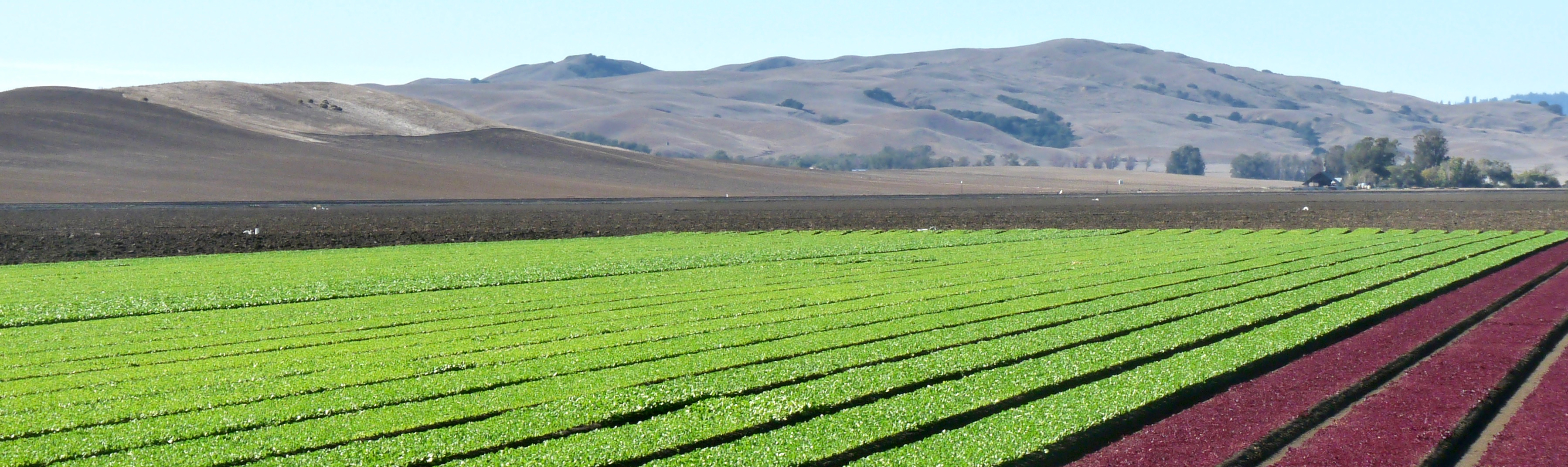
A stormy winter could portend another devastating year for the lettuce industry in the Salinas Valley, which saw approximately $150 million in lost gross revenue in 2022 due to INSV (impatiens necrotic spot virus) and associated diseases. Recent drenching rains might mean more weeds – overwintering “reservoirs” for the tiny insect, the Western flower thrips, that carries INSV.

Or the extreme precipitation could benefit growers, as thrips in the soil – during their intermediate stage of development – might be drowned in the waterlogged fields.

As with so many aspects of the INSV crisis, the ultimate effects of flooded fields on thrips populations remain unknown.

“We don’t know if thrips are just so persistent and so stable in that pupal stage that maybe they will emerge unaffected,” said Kirsten Pearsons, University of California Cooperative Extension integrated pest management farm advisor for Santa Cruz, Monterey and San Benito counties. “There’s just so much about their biology and ecology in the Salinas Valley that we just don’t know.”

The mystery of thrips, INSV and soilborne diseases (namely Pythium wilt) is why UC Agriculture and Natural Resources assigned Pearsons to the area last November and hired Yu-Chen Wang in October as UCCE plant pathology advisor for the three counties.

“They’re stepping in at a critical moment,” said Richard Smith, the region’s UCCE vegetable crop production and weed science advisor who retired in January after a 37-year career. “They’ve gotten grants funded already – and that’s just incredible. They’re hitting the ground running.”

Experienced in disease diagnosis and collaboration with growers and industry partners, Wang said her pathology background – paired with Pearsons’ entomology expertise – will be crucial in addressing INSV and other diseases.

“It is important for Kirsten and me to work together and provide different insights for the vector and the pathogen, respectively,” Wang said.

‘It’s going to take everything to get a crop’

One priority is untangling the dynamics of INSV and Pythium wilt co-occurrence – the subject of ongoing research by JP Dundore-Arias, a plant pathologist at California State University, Monterey Bay. While the vegetables may tolerate one disease or the other, their one-two punch often deals the lethal blow. 

“The challenge is – which is why it’s great to have Yu-Chen and Kirsten – is that we have so many problems now, whether it’s Fusarium (wilt), or Verticillium (wilt), or Pythium, or INSV,” said Mark Mason, pest control adviser for Nature’s Reward, which primarily grows lettuces on 5,000 acres across the Salinas Valley.

Mason said that co-infections on his crops (sometimes with three or four diagnosed diseases) make it difficult to assign monetary damages to a specific pathogen, but he noted he has seen fields with “100% loss.” According to the Grower-Shipper Association of Central California, about 11,500 acres were deemed not harvestable in 2022, representing 12% of lettuce industry acreage.

Given the gravity and complexity of the disease dilemma, Pearsons said she has been fielding calls from growers seeking new and better solutions – ways to improve existing tools, techniques borrowed from other crop systems, and additional biological or chemical means of control.

And although there are a couple of pesticides that manage the disease-carrying thrips reasonably well, growers and researchers are worried about their diminishing efficacy due to overuse. Plus, they only constitute a short-term fix.

“Managing the thrips will only reduce the amount of INSV that can get transmitted,” Pearsons explained. “You can kill 99.9% of the thrips, but you get one thrips that has INSV that enters a field, and now you have an infected lettuce plant. All of the thrips are going to come and they can spread it from there; pesticide slows things down, but it’s not going to eliminate it.”

Finding disease-tolerant lettuce cultivars is a more sustainable approach. Trials conducted last year by Smith, Wang and others identified several varieties that appeared to hold up well to Pythium and INSV. While additional research could maximize their potential benefit, Wang said even the hardier cultivars will lose their resistance over time, and a multi-layered INSV strategy with “integrated management tools” is crucial.

“We realized, when this thing started happening, that we cannot spray our way out of this problem,” Mason said. “We need varieties; we need management practices; we need pesticides…it just seems like it’s going to take everything to get a crop.”

Weeds key to disease control

An all-hands-on-deck approach helped control thrips-harboring weeds last winter. With fields drying out from January storms, Smith said communities must get back to weed management – with a focus on prominent weed hosts for INSV and neglected areas adjacent to farms. Hotspots of infection last year were traced to industrial lots that were overlooked during the weeding process.

“People can’t lose sight of the fact that we still need to be controlling the weeds in key areas, because that’s the reservoir of the virus during the winter,” Smith said. “We have to stay on task with that.”

Yet despite the diligent weed abatement, crop damage from INSV and Pythium was widespread in 2022, and Smith said it’s “very possible” that high heat during the summer was a contributing factor to especially prevalent disease in fall. Thrips populations tend to thrive in warmer weather, Smith said, but much more research needs to be done to understand the basic biology of the insect, including how they acquire the virus and how they spread it.

High hopes for future

Pearsons cited the work of Daniel Hasegawa, a research entomologist with the U.S. Department of Agriculture, who leads teams in monitoring thrips populations in several locations across the Salinas Valley. Currently the counting of thrips on sticky card traps is done manually, but Pearsons and Mason mentioned the possibility of using AI and machine learning to expedite that process.

Mason said that the grower community is excited about the new technologies and ideas that Pearsons and Wang are bringing to the region. As a participant in the search for candidates to fill the advisor positions, Mason said “they were, in my opinion, by far the best fit for what we were looking for.”

“I hope they stay here for 30 years,” he added.

The new advisors both noted the palpable energy and cooperative spirit in the Salinas Valley to proactively meet the challenge.

“Looking to the past, there have been other outbreaks and diseases that they’ve managed to overcome,” Pearsons said. “These farmers are resilient and creative and I fully believe that lettuce will still be growing here for years to come – it might look a little different, and it might take a little bit of a painful period to get to that point, but I think that we’re going to be able to come up with some solutions.”

And while there are concerns that some lettuce growers might decide to leave the region, Wang said she also believes in the industry’s strong roots and rich history.

“Salinas Valley has had a beautiful climate for lettuce for so many years; there are some undeniable advantages here,” she said. “This is still the best place in the United States – and maybe the world – to grow lettuce.”

2023-02-03T16:01:34-08:00February 3rd, 2023|

Caltrans Seeks Rural, Tribal Volunteers for Latest ‘Road Charge’ Study

Source: Caltrans

Participants can earn up to $250 for 7-month pilot

The California Department of Transportation (Caltrans) is recruiting volunteers who reside and travel in rural and tribal communities to participate in the latest testing phase of a “road charge” pilot. Up to 500 volunteers will participate in a seven-month simulated road charge system, which charges drivers based on the number of miles they travel rather than the amount of gas they use to support the state’s critical transportation infrastructure. There will be no cost to participate, and upon completion, volunteers will be eligible to receive an incentive of up to $250.

“Rural and tribal communities have unique travel needs and may interact with a road charge system in different ways,” said Caltrans Director Tony Tavares. “It is essential that Caltrans understands their needs as it develops an equitable and convenient alternative to the gas tax.”

Starting in March 2023, the California Road Charge Public-Private Roads Project will explore the technical aspects of reporting mileage, as well as engage rural and tribal communities in a conversation about their communities’ priorities in a potential road charge system to fund road and highway maintenance.

This pilot will simulate how participants interact with a road charge system by reporting mileage and “paying” mock invoices. The pilot will conduct surveys to gauge participants’ preferences and experience.

As vehicles become more fuel-efficient and the state’s transition to zero-emission vehicles accelerates, Caltrans is researching possible alternatives to the state gas tax, which California has historically relied on to build and maintain the state’s transportation system. Volatile oil prices and California’s phasing out the sale of new gas-powered cars by 2035 add increased urgency to research ways to bring long-term stability to transportation funding. For that reason, Caltrans is testing various methods to collect per-mile rather than per-gallon fees.

This demonstration is funded through a grant from the U.S. Department of Transportation’s Surface Transportation System Funding Alternatives Program and will build on Caltrans’ previous road charge pilots: California’s Road Charge Pilot in 2017, which introduced the road charge concept to Californians, and California’s Four-Phase

Demonstration, which tested the road charge concept across several platforms including pay-at-the-pump and electric vehicle charging station systems, usage-based insurance, transportation network company fleets, and automated vehicles.

Volunteers interested in participating in the pilot – and the incentive of up to $250 – may visit http://www.caroadcharge.com/projects/public-private-roads-project/ and complete the participant recruitment survey. Participants must be California residents over the age of 18. The pilot is employing the highest standards in data protection and safeguarding, ensuring that Caltrans will not receive any sensitive information from participants.

To learn more about the California Road Charge Project and the Road Charge Program, please visit www.caroadcharge.com.

2023-02-03T09:22:56-08:00February 3rd, 2023|

WPH Supports DPR Commitment to Reforming the CA Pesticide Registration Process and Bringing More Sustainable Alternative Products to Farmers

By Western Plant Health

Western Plant Health (WPH) released the following statement in response to the California Department of Pesticide Regulation’s (DPR) Sustainable Pest Management Roadmap. Please attribute to Renee Pinel, President & CEO of WPH.

Today, DPR released its Sustainable Pest Management Roadmap which will continue California’s commitment to lead the country in progressive agricultural systems.

Western Plant Health appreciates DPR’s commitment to implement reforms that will expedite the registration of new products, which DPR acknowledges in the report are all more sustainable. The recommendations also seek to assure greater departmental accountability to the registration process.

WPH supports these reforms, which we have recommended for years. We look forward to not only reading about needed reforms but seeing these reforms occur, and are committed to working with DPR to fulfill the recommendations that will implement a system that expedites the registration of all new products, and provide accountability to the registration program.

WPH also agrees that preventing the introduction of pests and advancing research for new pest control systems is important to all Californians. We support the administration’s commitment to these areas by increasing general fund allocations to not only fully funding CDFA’s Pest Prevention Division and the University of California’s Extension Services, but to expanding those services.

2023-01-27T11:09:38-08:00January 27th, 2023|

State Water Deliveries to Surge — Highest in 6 Years

By Alastair Bland, Cal Matters

State officials announced today that water deliveries from the state’s aqueduct will be increased to 30%, the highest amount for January that growers and Southern California cities have received in six years.

Less than two months ago, amid forecasts of a third consecutive drought year, the California Department of Water Resources announced an initial allocation of just 5% of the supplies requested from its State Water Project, which transports Northern California water south.

But recent storms have boosted the reservoirs, snowpack and river flows that feed the state aqueduct. Never in the 27 years of records has such a poor initial estimate been followed by such a rapid, dramatic jump.

About 27 million people, mostly in Southern California, and 750,000 acres of farmland depend on water provided by the State Water Project.

“Thanks to the water captured and stored from recent storms, the state is increasing deliveries to local agencies that support two-thirds of Californians – good news for communities and farms in the Bay Area, San Joaquin Valley and Southern California,” Gov. Gavin Newsom said in a statement. “We’ll keep pushing to modernize our water infrastructure to take advantage of these winter storms and prepare communities for the climate-driven extremes of wet and dry ahead.”

The first projection for 2023 water deliveries came on Dec. 1, when things looked very different in the dynamic interplay between California drought, water supplies and weather forecasting. At the time, Lake Oroville — the project’s largest reservoir — was 27% full, containing less than a million acre-feet of water. Weather experts were meanwhile predicting another winter of predominantly blue skies and light precipitation.

Things quickly changed when a series of powerful storms soaked the state for weeks early this year. The wet weather has boosted Oroville to 63% of its total capacity and 110% of its historical average for this date. The reservoir contained 2.19 million acre-feet of water as of Jan. 26, and, like others throughout the state, it continues to rise.

Department of Water Resources Director Karla Nemeth said the increased deliveries don’t mean the state will see a wet year.

“We are still early in the season,” she said, adding that “things have turned dry again.” She also said the increased deliveries are a result of more reservoir storage and doesn’t fully take into account increases in Sierra Nevada snowpack, which is now more than double its historic average for January.

Allocations for January often are revised up or down later in the year, after spring runoff is measured. Usually, the final allocation increases. For instance, in June 2019, water deliveries reached 75% after starting the year at 15%.

The last time that water deliveries so early in the year exceeded the 30% was before the current drought, back in 2017 — when a record-breaking, 5-year drought ended, rainfall almost broke state records, and deliveries reached 60%. The last three years were dismal, with allocations between 5 and 20%.  The last time the local agencies got 100% was in 2006.

For the Las Virgenes Water District, which serves about 75,000 people in northern Los Angeles County and gets all of its water from the state aqueduct, the new allocation recasts what was a very grim outlook on water supplies for 2023.

“Mother Nature is giving us a chance to catch our breath,” said Mike McNutt, a Las Virgenes spokesman.

The district enforced stiff regulations on outdoor watering last year, including the use of restrictors, which are small washers inserted into pipes, into the homes of repeat violators of water conservation rules.

Dave Pedersen, the district’s general manager, said the increased deliveries will “soften some of the harshest water restrictions.” But he added that water conservation will remain a long-term goal, with a focus on replacing lawns with drought-tolerant landscaping.

2023-01-27T11:00:06-08:00January 27th, 2023|

Biden-Harris Administration Launches New Efforts to Address the Wildfire Crisis

By USDA

Agriculture Secretary Tom Vilsack announced expanded efforts to reduce wildfire risk across the western U.S. These investments, made possible through President Biden’s landmark Bipartisan Infrastructure Law (BIL) and the Inflation Reduction Act (IRA), will directly protect at-risk communities and critical infrastructure across 11 additional landscapes in Arizona, California, Idaho, Nevada, Oregon, Utah and Washington.

“It is no longer a matter of if a wildfire will threaten many western communities in these landscapes, it is a matter of when,” said Secretary Vilsack. “The need to invest more and to move quickly is apparent. This is a crisis and President Biden is treating it as one. Today’s announcement will bring more than $490 million to 11 key landscapes across the western United States, and will be used to restore our national forests, including the restoration of resilient old-growth forest conditions.”

The Forest Service announced their original 10 landscape project areas last year as part of the agency’s broader strategy to protect communities, critical infrastructure and forest resources from catastrophic wildfire. Combined with these initial landscape investments, the additional efforts being announced today represent a total USDA investment of $930 million across 45 million acres.

This work spans 134 of the 250 high-risk “firesheds” identified in the Wildfire Crisis Strategy and will mitigate wildfire risk to around 200 communities in the western U.S. Firesheds are areas where wildfire is likely to pose the greatest risk to communities and resources.

The landscapes for these additional investments were selected based on the potential for wildfire to affect nearby communities and buildings, with a focus on protecting underserved communities, critical infrastructure, public water sources and Tribal lands. USDA also considered more than 3,000 comments from 11 roundtable meetings held in the first half of 2022, which included partners, industry, Tribes and other stakeholders.

“We are building on the investments announced last year and by expanding the Forest Service effort to cover 21 landscapes where communities, critical infrastructure and our natural resources are most in need of protection from the growing threat of wildfires,” said USDA Undersecretary for Natural Resources and the Environment (NRE), Dr. Homer Wilkes. “This is part of our agency wide focus to reduce wildfire risk across the country. We will use every tool we have to address this crisis and make your communities safer.”

Secretary Vilsack is also directing the Forest Service to use and prioritize a suite of provisions authorized in the Bipartisan Infrastructure Law to more quickly apply targeted treatments to the high-risk firesheds identified in the Wildfire Crisis Strategy, while opening up additional opportunities to pursue science-based reforestation, restoration of old growth forests and recovery of other areas impacted by wildfire.

These treatments are required to be ecologically appropriate, maximize the retention of large trees, protect old growth, and to consider possible effects on historically underserved communities and Tribes. Treatments are also to be carried out collaboratively alongside participating communities and partners.

“Doing this work in the right place, at the right time, and at the right scale, combined with the use of emergency authorities, will accelerate our planning, consultation, contracting, hiring and project work to reduce wildfire risk and improve forest health and resilience,” said Forest Service Chief Randy Moore. “Collaboration with Tribes, communities and partners will remain a priority, and we will continue to use the best available science when carrying out this important work.”

Background: The Forest Service Wildfire Crisis Strategy

This announcement comes on the anniversary of the launch of the Forest Service’s Wildfire Crisis Strategy, which debuted Jan. 18, 2022. A few months later, the agency introduced the initial 10 fire-prone landscapes that are now funded for the next five years through Bipartisan Infrastructure Law funds. In addition, President Biden’s Inflation Reduction Act will commit $1.8 billion to hazardous fuels reduction projects on national forests and grasslands.

Since releasing its Wildfire Crisis Strategy one year ago, the Forest Service and its partners have used the best available science and data to identify the highest risk landscapes for treatment projects. The Forest Service found that around 80% of the wildfire risk to communities is concentrated in less than 10% of firesheds. These targeted investments focus on firesheds of the highest risk, where projects are ready to begin or to expand.

The 10-year strategy calls for treating up to 20 million acres on national forests and grasslands and up to 30 million acres on other federal, state, Tribal, private and family lands to assure our forests are more resilient to wildfire and other effects of climate change, safer for communities, and remain key refuges for plants, fish and wildlife.

Over the past 20 years, many states have had record catastrophic wildfires, devastating communities, lives and livelihoods, and causing billions of dollars in damage. More than 10 million acres – more than twice the size of New Jersey – burned each year across the U.S. in 2020, 2017 and 2015.

The Wildfire Crisis Strategy builds on current work by leveraging congressional authorities and partnerships to support the department’s work to mitigate wildfire risk, and restores forest health over the next decade. In addition to State Forest Action Plans, the strategy also aligns with the Collaborative Forest Landscape Restoration ProgramTribal Forest Protection ActGood Neighbor AuthorityJoint Chiefs’ Landscape Restoration Partnership and Shared Stewardship agreements.

In June 2022, USDA released the Secretary’s Memorandum on Climate Resilience and Carbon Stewardship of America’s National Forests and Grasslands. The Secretary’s memo builds on previous actions on climate change, equity, and forest resilience, and provides more specific and time-bound actions to integrate into agency programs. The Forest Service used the guidance in the Secretary’s memo to better inform the selection criteria for projects under the Wildfire Crisis Strategy, including equity, source water protection, community infrastructure and wildlife corridors. Recognizing that insects, disease, and wildfire are among the most significant threats to mature and old growth forests, in alignment with the Biden-Harris Administration, the Forest Service will be targeting hazardous fuels reduction projects to address these threats to promote the protection and restoration of mature or old-growth forests.

USDA touches the lives of all Americans each day in so many positive ways. Under the Biden-Harris Administration, USDA is transforming America’s food system with a greater focus on more resilient local and regional food production, promoting competition and fairer markets for all producers, ensuring access to safe, healthy and nutritious food in all communities, building new markets and streams of income for farmers and producers using climate-smart food and forestry practices, making historic investments in infrastructure and clean energy capabilities in rural America, and committing to equity across the Department by removing systemic barriers and building a workforce more representative of America. To learn more, visit www.usda.gov.

2023-01-26T08:10:26-08:00January 26th, 2023|

Porse Named Director of California Institute for Water Resources

By Pam Kan-Rice, UCANR

Erik Porse joined the University of California Agriculture and Natural Resources on Jan. 11 as director of the California Institute for Water Resources.

Porse has built an outstanding career in water as a research engineer with the Office of Water Programs at California State University, Sacramento and an assistant adjunct professor with UCLA’s Institute of the Environment and Sustainability. His research focuses on urban and water resources management. He specializes in bringing together interdisciplinary teams to investigate complex environmental management questions.

Porse earned a Ph.D. in civil and environmental engineering (water resources) from UC Davis and a master’s degree in public policy (science and technology) from George Mason University. His professional experience includes international work and teaching in Mexico, Europe, Japan and East Africa. He has authored over 50 reports and peer-reviewed articles.

“UC ANR is fortunate to have a director with broad professional experience in science and policy at the United Nations, the U.S. government, private sector firms and research laboratories,” said Deanne Meyer, UC ANR interim associate vice president for programs and strategic initiatives. “Erik’s recent research has collaborated with scientists and projects addressing priority areas in the California Water Resilience Portfolio, including safe drinking water, efficient urban water use, sustainable groundwater management, water reuse, beneficial uses of stormwater, and environmental finance.”

The CIWR is the California hub of the national network of water research institutes supported by the federal Water Resources Research Act of 1964 and provides and communicates solutions to complex water issues and will serve a critical role to support applied water research that tackles large problems with systems approaches, including groundwater recharge, water rights, irrigation management, water finance, and drinking water access. The CIWR works with scientists throughout California as well as through the national network to bring defensible solutions and alternatives to California’s water management community.

“Water is a necessity for life and management of water is essential for California’s economy and prosperity,” Meyer said. “Porse’s leadership with multidisciplinary research teams, water policy research, and integrated systems modeling will serve the CIWR and ANR for years to come.”

Porse succeeds Doug Parker, who retired in 2022 after 11 years as CIWR director.

2023-01-11T14:22:57-08:00January 11th, 2023|

Update on Citrus Yellow Vein Clearing Virus

By Citrus Insider

Two new detections of citrus yellow vein clearing virus (CYVCV) have been confirmed in rural residential citrus trees in the city of Visalia in Tulare County. The detections resulted from an ongoing survey and sampling activities conducted by the California Department of Food and Agriculture (CDFA). CYVCV had previously been confirmed in the city of Tulare, also in Tulare County.

CDFA staff have been conducting survey and sampling activities of CYVCV host plants in Tulare County on residential properties throughout the area to determine the extent of the disease and potential impacts, and surveys will be ongoing for the near future. Survey results – along with CDFA’s robust pest prevention system that focuses on exclusion and monitoring, as well as CDFA and the U.S. Department of Agriculture’s (USDA) experience responding to other vectored disease threats – will be critical in developing an appropriate joint regulatory response.

CYVCV can be spread by vectors as they move from tree to tree, feeding on foliage. The vectors include citrus whitefly, green citrus aphid, melon or cotton aphid, and cowpea aphid, which are all known to be present in California. CYVCV can also be spread through the grafting and movement of infected propagative materials, rootstocks, or contaminated tools and equipment.

While there is no treatment for this disease, as of now, the best mitigation measure is to control the vector and sanitize tools and equipment. To the greatest extent possible, growers are encouraged to urge their field crews to clean and sanitize all their equipment thoroughly between jobs or when moving between groves.

For questions about CYVCV, please call the CDFA Pest Hotline at 1-800-491-1899 or contact your local Grower Liaison.

2023-01-10T10:04:26-08:00January 10th, 2023|

California Minimum Wage Increases for 2023

By Barsamian & Moody

In 2016, then Governor Jerry Brown signed Senate Bill 3, to provide a six step
statewide annual increase to California’s minimum wage. The new amended Labor Code
also provided that California employ a two-tiered minimum wage system, requiring “Large
Employers” (those with 26 or more employees) to pay a higher minimum wage than “Small
Employers” (those with 25 or fewer employees) until 2023.

According to the six-step increases, the minimum wage for both Large and Small
Employers should have been $15.00 on January 1, 2023. However, Senate Bill 3 also
required the California Director of Finance to adjust the minimum wage for inflation by
August 1, 2022 to be effective January 1, 2023, and then annually thereafter.

Therefore, effective January 1, 2023, all California employers, regardless of size,
will be required to meet the new minimum wage requirement of $15.50 per hour. The
minimum wage will be adjusted annually at the rate of inflation based on the national
consumer price index for urban wage earners and clerical workers (CPI-W). The
adjustment is capped at 3.5% per year and cannot be lowered if the inflation rate is
negative. The California Director of Finance will continue to adjust the minimum wage
based on inflation no later than August 1 of each year to be effective the following year
on January 1.

The increase to $15.50 affects non-exempt employees but also changes the
minimum annual salary requirements for exempt employees. Salaried employees who
are exempt from overtime compensation will have a new salary requirement of least
$64,480 on an annual basis ($5,373.34 per month).

What This Means for Employers:

Employers must adjust the pay rates for all employees earing less than $15.50 per
hour and for salaried exempt employees earning less than $64,480 annually. These
adjustments must be made before the first payroll run of the year which covers workdays
in 2023. If pay periods include 2022 and 2023, the hourly rate should be pro-rated
accordingly. Employers should also check their local minimum wage ordinances to
ensure there will not be a new minimum wage requirement which exceeds the new
California minimum wage.

2022-12-28T15:27:01-08:00December 28th, 2022|

Westlands Water District Names Jose Gutierrez as Interim General Manager

The Westlands Water District (District) Board of Directors named Jose Gutierrez as the District’s Interim General Manager starting January 1, 2023. Mr. Gutierrez has been with the District since 2012 and currently serves as the District’s Chief Operating Officer. Mr. Gutierrez is a registered civil engineer and holds a Bachelor of Science degree in civil engineering and Masters degree in civil/environmental engineering from the University of California, Berkeley.

“Gutierrez has the skillset and historical knowledge to help lead the District during this transition,” said Jeff Fortune, Board President, Westlands Water District.

“I’m honored the Board entrusted me to serve as Interim General Manager and will work diligently to ensure Westlands continues to deliver reliable water and high-quality service to our water users so they can continue to grow the crops that feed the nation and the world,” said Jose Gutierrez.

Mr. Gutierrez will share responsibility for managing the District activities with Jon Rubin, the District’s Assistant General Manager & General Counsel. Both Mr. Gutierrez and Mr. Rubin will work closely with the Board.

As the Interim General Manager, Mr. Gutierrez will be responsible for the operations and administration of the District and will manage efforts intended to improve storage and conveyance of the District’s surface and groundwater supplies.

Mr. Rubin, in his capacity as the Assistant General Manager, will be responsible for the District’s policy efforts, external engagement, and strategic water initiatives for the Sacramento-San Joaquin Bay Delta. Mr. Rubin, in his capacity as General Counsel, will continue to be responsible for the District’s legal affairs. Shelley Cartwright, the District’s Deputy General Manager- External Affairs, will continue to engage in the District’s policy efforts and oversee the District’s Federal & State legislative affairs, public affairs, and outreach and education efforts.

The District will begin a formal search for a regular General Manager at the start of the new year.

2022-12-21T10:13:55-08:00December 21st, 2022|

Almond Sector Assesses Toll After its ‘Toughest’ Year

By Christine Souza, California Farm Bureau

With the ongoing multiyear drought, global logistical challenges and inflationary impacts affecting California’s $5 billion almond crop, leaders in the almond sector say they are hopeful for a return to a more profitable outlook in 2023, with a more orderly supply chain and lower production costs.

Almond Board of California President and CEO Richard Waycott told several thousand attendees at the organization’s 50th annual conference, held Dec. 6-8 in Sacramento, that “the past year is probably the toughest we’ve had as an industry.”

As part of the state of the industry address, Waycott, joined by Almond Board Chair Alexi Rodriguez of Campos Brothers Farms in Fresno County, cited challenges affecting the almond sector. These include limited water supply, logistical and supply-chain issues, rising interest rates, inflation and the war in Ukraine.

“This combination has created this perfect storm that has had a profound impact on our industry,” Rodriguez said. “This industry has been through challenging times before, and with great challenges come great opportunities for growth and innovation.”

She added, “We are a resilient industry, and together we’re going to get through it.”

In presenting the economic outlook for California almonds, David Magaña, a Rabobank vice president and senior analyst based in Fresno, said the state’s almond acreage decreased this year for the first time in more than 25 years. The decrease was first reported in a Land IQ report commissioned by the Almond Board.

Total standing acreage as of Aug. 31 was estimated at 1.64 million, compared to 1.66 million acres at the same time in 2021, the report stated. Bearing acres—orchards producing almonds and planted in 2019 or earlier—increased slightly to 1.34 million from 1.31 million last year. Nonbearing acres—new plantings going back to 2020 but not yet bearing almonds—dropped to 294,000 acres from 353,000 acres in 2021.

“On the supply side, we expect to continue to see large volumes of almonds—depending on the weather and depending on water—in the next few years,” Magaña said. “The most optimistic view I have is the global middle class will continue to demand food that we grow here in California, including almonds.”

California growers this year are expected to produce 2.6 billion pounds of almonds. This is less than the amount shipped in each of the past two years, which were the two largest production and shipment years since record keeping began. Waycott said, “Hopefully we can see things come into a better equilibrium.”

Looking ahead, Waycott told attendees that the Almond Board plans to drive global demand through marketing programs and new product development, such as consumption of almonds to promote skin health and use of almond hulls as a food ingredient.

In addition, Waycott said, the Almond Board is halfway to achieving its 2025 almond orchard goals to achieve zero waste, increase environmentally friendly pest management, reduce dust and increase water efficiency.

In a panel session on managing less water, farmers and water leaders discussed approaches such as use of more groundwater recharge and development of regional strategies.

“It’s a little difficult to talk about groundwater recharge in a drought year,” said Daniel Mountjoy, director of resource stewardship at Sustainable Conservation. He said the state, growers and water districts must be prepared to Aapply water to the land when it does arrive.

“The most economical way to store water in the state right now is putting water back on the ground and into the aquifer,” Mountjoy said.

Groundwater sustainability agencies are exploring incentives to encourage farmers to recharge in optimal locations, he said.

Fresno County farmer Stuart Woolf of Woolf Farming, which is an irrigator in the Westlands Water District, discussed his response to water shortages.

“Years ago, we started running all of our budgets based the return per acre-foot of water, and that really drove a lot of our plantings,” Woolf said. “I never contemplated that I would ever consider taking out almonds so I could grow more row crops, but fortunately, we’re in a position to do that.”

Woolf said he expects to fallow 1,100 acres of almonds and plant 1,500 acres of row crops.

“We’re losing money,” Woolf said. “They (almonds) use over 4 acre-feet, and I can turn around and grow row crops and actually make a lot more money. I would encourage everybody in the room to be looking at these numbers and looking at your alternatives.”

Searching for solutions, Woolf said, he farms ground in other counties and is looking into growing drought-tolerant crops, including agave for tequila.

“We’re going to give it a try. I have a test plot with about 4,000 plants, so we’re trying to think about these things creatively,” Woolf said.

During a panel discussion on almond pollination, Elina Niño, an entomologist who specializes in honeybees at the University of California, Davis, discussed research related to self-pollinating almond varieties.

Niño said UC research shows yields are higher when honeybee colonies are used for pollinating these varieties. In response to a question about the number of hives needed per acre to pollinate almonds—usually two hives per acre—Niño said, “That is still the question that remains to be answered. This is something that is going to have to be an individual decision for growers.”

The Almond Board conference began 50 years ago as a half-day meeting to share research findings with growers.

Since then, said Stanislaus County almond grower and processor Jim Jasper of Stewart & Jasper, the annual event has become “the Super Bowl of the industry.”

2022-12-14T09:30:19-08:00December 14th, 2022|
Go to Top