Legislative Pressure on Agriculture

Legislative Pressure Builds for Agriculture

By Jessica Theisman, Associate Editor

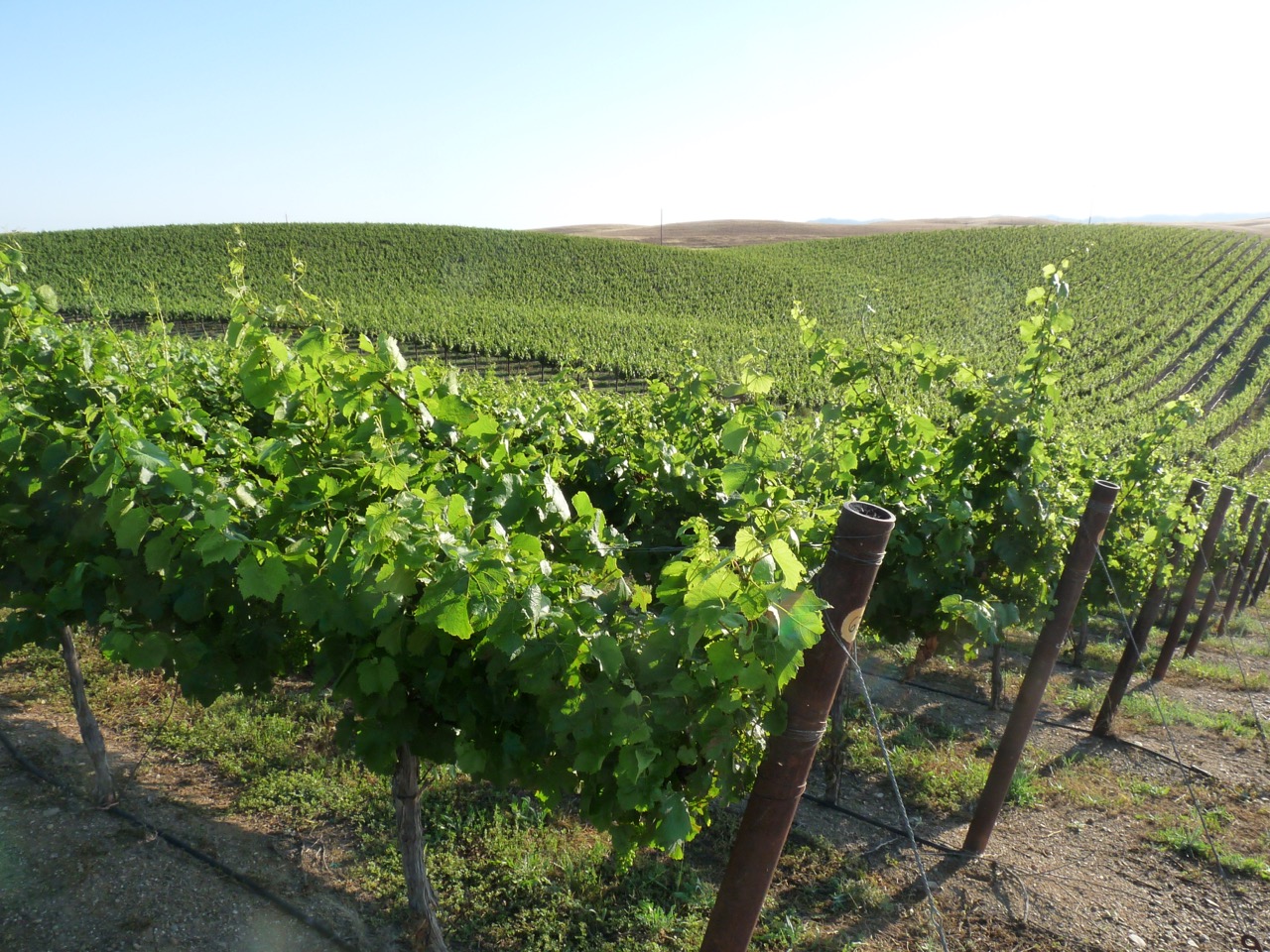
Dennis Albiani is a lobbyist with California Advocates based in Sacramento. California Ag Today met with him at the recent Almond Alliance meeting in Santa Barbara, where he discussed the legislative pressure on agriculture. California’s agricultural interests have had a challenging past couple of years on the subjects of overtime, minimum wage and some of the regulatory compliance areas.

“As we work with legislators, legislative process and the administration, we need to definitely find opportunities to advance the arguments on how the regulations are impacting agriculture,” Albiani said.

What also needs to be realized is that there might be some opportunities. We may be able to benefit from in the climate contained, constrained economy. We also must keep in mind the possible challenges.

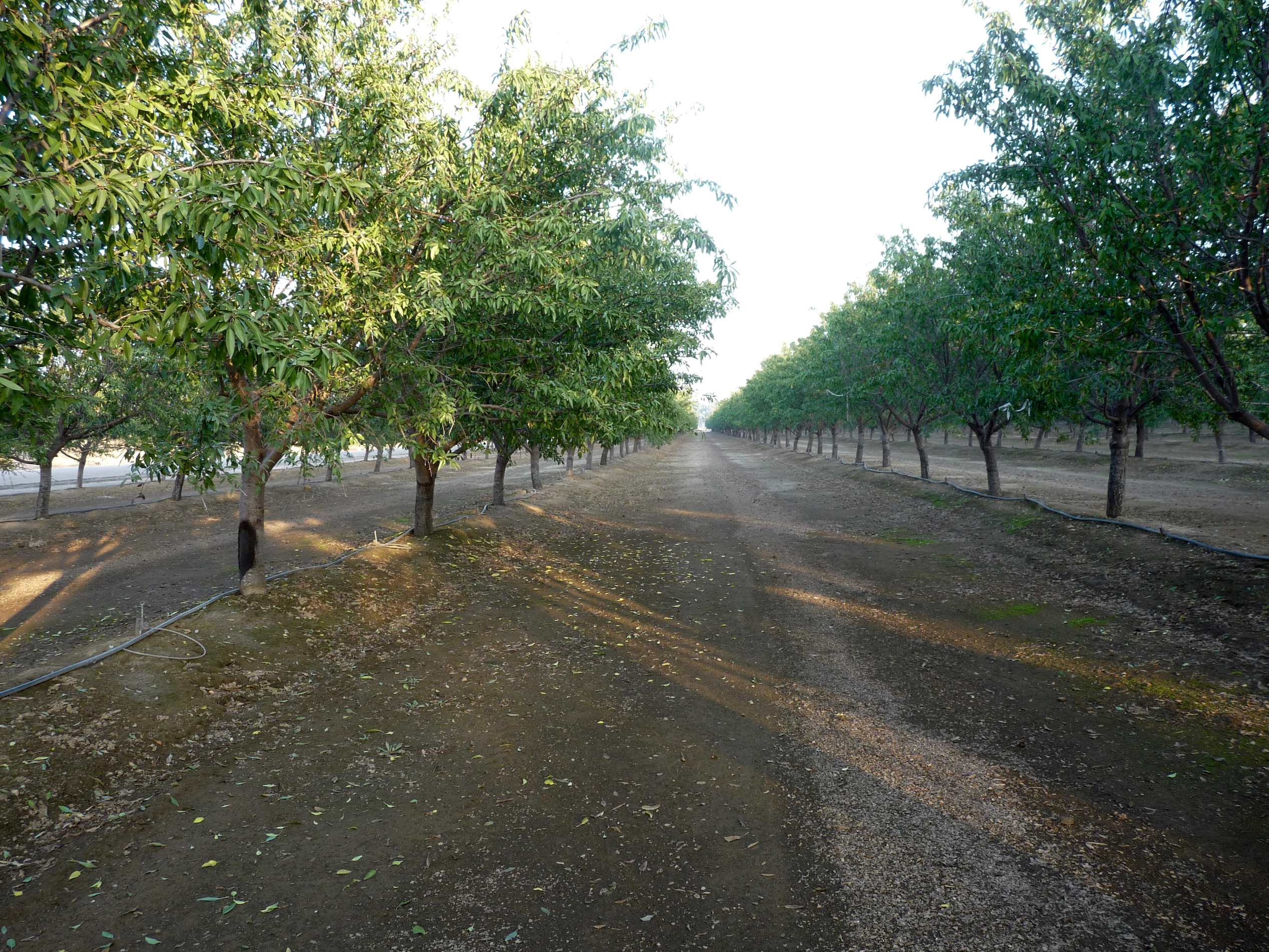
Albiani looked at the almond industry as an example. “We have three crops per the drop for nuts. You have the nut, the bio-massed product, and the tree is a carbon sink,” he said. All of those are options that need to be further explored and also continue to pushed back on the regulatory constraints that they are inflicting.
2017-06-23T18:13:31-07:00May 22nd, 2017|

Safeguarding CA Farm Workers Rights – Part 2

Updates on California Farm Workers’ Rights 

By Laurie Greene, Founding Editor
Our ongoing coverage of developments among United Farm Workers (UFW), Agricultural Labor Relations Board (ALRB), Gerawan Farming, Inc. and California farm workers chronicles the continuing, increasingly complex quagmire that masquerades as protecting California farm workers’ rights.

UFW Underpaid Employees – UPDATE

As previously reported, on March 26, Monterey County Superior Court Judge Thomas Wills ruled that the UFW underpaid their own employees and mandated the UFW to pay a $1.2 million award that covers former employees, organizers, and other members of the class action suit, as well as penalties for California Labor Code Violations.

On April 27, Judge Wills added $772,000 to UFW’s court expenses for attorney fees incurred by Noland, Hamerly, Etienne & Hoss (NHEH), the law firm that represented former UFW employee Francisco Cerritos in the class action and Private Attorney General Act lawsuit on behalf of himself and other current and former UFW employees.

In issuing the additional costs to the UFW, according to a May 3 NHEH press release, Judge Wills stated that, “The Court has not placed an amount to destroy someone, and the union does serve a socially laudable purpose, but (the union) has to follow the law; and when it doesn’t do so at the expense of others and that results in drawn out, protracted and complex litigation, it cannot expect the Court to turn a blind eye to what the consequences of what that conduct are.”

Gerawan Violated Labor Law by Negotiating “in bad faith”— UPDATE

As previously published, ALRB Administrative Law Judge William L. Schmidt issued a decision on April 14 in favor of the UFW, finding Gerawan violated labor law by negotiating a collective-bargaining agreement with UFW “in bad faith—commonly called “surface bargaining”—in the eight-month period from January 2013 through August 2013.

In an April 17 news release, Gerawan Farming called the April 14 decision of the Administrative Law Judge “erroneous” in that Gerawan did bargain in good faith. Further, Gerawan maintains that imposed mandatory mediation and conciliation does not constitute volitional negotiations. Gerawan will appeal this decision. The following are excerpts from this press release:

This unprecedented ruling would punish an employer for failing to “negotiate” the terms of a “contract” dictated and imposed by the ALRB. This is an in-house judge who is not independent; he is an employee of the ALRB. He criticizes Gerawan’s positions and second-guesses how it participated in what was supposed to be a confidential mediation and trial-like arbitration, but he never asked the only relevant question: How does this forced contracting process resemble a “negotiation”?

The so-called “mandatory mediation and conciliation” procedures (MMC) are neither consensual nor voluntary. It is forced contracting. The ALRB tells the employer what wages to pay, what employees to hire or fire or promote, and what portion of the employees’ salary will be turned over to the union. The employer may not opt out, and the employees are not given the choice to ratify or reject the so-called contract that will be forced on them, even if there are provisions detrimental to them.

Gerawan had no choice but to submit to this coercive process.

…The UFW did not bargain; it asked the ALRB to impose terms, based on a forced contracting process the California Court of Appeal has since ruled to be unconstitutional (and is now under review before the California Supreme Court).

To date, UFW’s unexplained 17-year disappearance from the Gerawan farm workers remains unexplained. During its absence, the UFW never negotiated a single wage increase for any Gerawan employee, nor did it attempt to bargain for a contract, collect dues, or file a single grievance on behalf of the employees. Meanwhile, Gerawan claims its workers are among the highest paid in the industry.

Yet, the ALRB’s controversial 2002 MMC provision appears to allow this AWOL union to force current Gerawan farm workers to choose between paying union dues or losing their jobs. The majority of Gerawan employees twice asked ALRB for an election to decertify the UFW. At the ALRB’s request, the Fresno Superior Court intervened and supervised the decertification petition and election process. This was the first time in the history of the ALRB that a court oversaw an ALRB election.

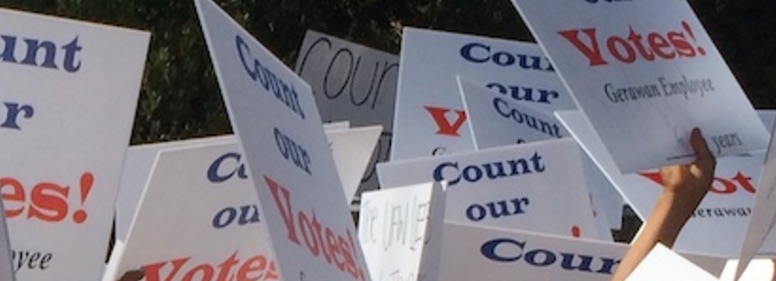
As yet, ballots cast by Gerawan farm workers in the sanctioned November 2013 election to decertify the UFW have never been counted, are being stored in an undisclosed and possibly an insecure location, and are the target of legal attempts by the ALRB and UFW to be destroyed.

The Court of Appeal is preparing to decide whether the ALRB may deny employees the right to choose who will represent them at the bargaining table—a seemingly basic American democratic right. The California Supreme Court is preparing to decide whether the UFW’s longstanding abandonment of Gerawan’s employees justifies this forced contracting process. California farm workers deserve a full and fair hearing on these issues.


Who Safeguards California Farm Workers’ Rights? Part 3 – Bargaining in Bad Faith


Resources:

Gerawan February 27, 2017 press release, Gerawan Farming Asks Court to Order Disclosure of Information Related to ALRB ‘Whistleblower’ Allegations: A 30-year ALRB Employee Alleges Corruption Inside ALRB.”

2018-05-07T01:00:56-07:00May 17th, 2017|

Working on Nematode Resistant California Commercial Carrot

Nematode Resistant California Commercial Carrot On Its Way?

By Jessica Theisman, Associate Editor

Phil Simon is a carrot breeder and geneticist with the USDA Ag Research Service based at the University of Wisconsin. He produces the vast majority of carrots for the consumers throughout the nation. A big goal is to find a commercial carrot variety that is root-knot nematode resistant. Nematodes are a soil-borne, microscope, worm-like organism destroying production in some fields. Through lots of research, the carrot industry is getting closer to a resistant variety.

The first resistance gene was first discovered in 1992 in a Brazilian variety that may have some genetic resistance. The resistance was discovered by using derivatives from the Brazilian variety crossed with California-adapted carrots. This is all being done with, “the idea of moving that resistance gene into a carrot that’s suitable for California in terms of shape, size, flavor, and productivity,” Simon said.

The Brazilian variety is not suited to California because it is shorter and wider. It does not look like a California carrot, and it bolts very easy, which means it flowers and goes to seed. But with the Brazilian carrot having nematode resistance, it is also heat-tolerant, which is great news for us in California, especially with the rising temperatures.

It is said that California is getting closer and closer to getting its own commercial variety. “We’ve also found genes for resistance in other carrots from around the world, from Syria, China, Europe, and we intercrossed those also into California, so we’re putting a couple of genes in,” he said.

With all of these genes, this makes for an even stronger and durable resistance to nematodes.

2021-05-12T11:05:16-07:00May 16th, 2017|

SB-1 Is Yet Another Tax Grab

SB-1 Gas Tax Will Severely Hurt Ag

By Melissa Moe, Associate Editor

Governor Jerry Brown recently signed SB-1 into law. This bill will affect everyone in the state and increases several taxes and fees to raise the equivalent of roughly $52.4 billion over 10 years in new transportation revenues. We spoke with Anja Raudabaugh, CEO of the Western United Dairymen, about how this bill will affect California agriculture.

Anja Raudabaugh, CEO of Western United Dairymen

“A twenty-percent increase on fuel taxes is something that we can hardly, especially in dairy industry, afford. As you know, we cannot pass on our costs to our consumers, so adding another regulatory cost of production is incredibly hurtful and harmful,” Raudabaugh said.

SB-1 increases the excise tax on gasoline by 12 cents per gallon and the tax on diesel fuel by 20 cents per gallon starting November 1, 2017. SB-1 also creates a new annual transportation improvement fee (or TIF) starting January 1, 2018. This is based on the market value of your vehicle. This fee will range from $25 to $175.

SB-1 isn’t just targeting people who drive gas and diesel vehicles. Electric vehicles will also be targeted and will receive new fees. SB-1 also creates the road improvement fee of $100 per vehicle for zero emission vehicles starting in 2020 for model year 2020 and later.

“Everyone should be outraged over this. What’s more outrageous is that there are no guarantees that it will actually fix our roads. None whatsoever,” Raudabaugh said.

“There is actually a ballot measure that was called a lock box that was negotiated as a result of SB-1 so that several key Silicon Valley Assembly members could vote for the bill that says the public must award this transportation fund to go toward road repairs,” Raudabaugh said.

“It was sold to the Legislature as actually fixing roads and creating repairs where badly needed. To actually suggest that you would need a ballot measure to ensure that the funds do that, at least 20 percent of funds, seems really ironic,” she said.

2017-05-10T22:29:43-07:00May 7th, 2017|

Rice Weed Meeting Taking Place on Sept. 15

Second Annual UC Rice Weed Course Scheduled For Sept. 15

News Release

This year will mark the second annual rice-specific weed course at the Hamilton Road Field and the Rice Experiment Station in Biggs, CA, on Friday, Sept. 15. The day will begin with an interactive field tour of the research plots (Hamilton Road Field), where attendees can get up close to the weeds and rice (bring your boots)! The course will include a hands-on weed identification session on emerging and mature weeds. In the afternoon, speakers will address several pertinent topics in California rice, including weedy red rice, regulatory update and how to constructor a weed management program.

The course is a collaborative effort between UC Cooperative Extension (UCCE), UC Davis and the California Cooperative Rice Research Foundation (CCRRF.)

Whitney Brim-Deforest

“Weed management in California rice is becoming increasingly complex. This course provides growers and pest control advisers with the latest research and management strategies for the California rice system” said Whitney Brim-DeForest, UCCE Rice Farm Advisor. The event is a great opportunity for pest control advisers, growers, industry, extension and interested students to gain a deeper understanding of topics that affect rice weed management.

The cost is $70 if received by 8/1/2017, $80 if received by 9/1/2017, and $90 if received after 9/1/2017 (if there is space.) The cost for students with a valid student ID is $40/$45/$50. For more details or to register, visit http://wric.ucdavis.edu and click on RICE WEED COURSE.

If you have questions, contact Whitney Brim-DeForest [wbrimdeforest@ucanr.edu or (530) 822-7515.]

2021-05-12T11:01:59-07:00May 7th, 2017|

New Nematicide Available

New Velum One Nematicide Registered For Use in California

By Patrick Cavanaugh, Farm News Director

Horticulture crops in California and Arizona can now be protected by Velum One nematicide, a wide-spectrum nematicide that increases root health and suppresses key diseases.

“We’re excited to see Velum One go to work for growers in the key horticultural areas of California and Arizona,” Bayer Product Manager Joel Lipsitch said. “It’s another example of the innovation that our growers have come to expect from Bayer.”

Velum One suppresses nematodes below ground but also works by moving upward from the roots into the leaves of the plant to suppress key diseases and promote early season crop establishment. This activity has been shown to protect roots and establish the crop by limiting damage from a wide range of nematodes and key diseases, such as powdery mildew.

Trials have shown that Velum One aids in increasing yields as it protects plants from nematodes and disease.

“In tomatoes, for example, we’re seeing significant yield increases both from Velum One versus untreated and more importantly when Velum is added to grower-standard programs” Lipsitch said. “The combination of nematode and disease control really gives growers confidence that they are maximizing their yields and return on investment.”

Velum One is applied early in the growing season via drip chemigation. While it’s not meant to replace a fumigant, Velum One is most effective when used as part of a complete nematode management program.


2021-05-12T11:01:59-07:00May 7th, 2017|

Heat Illness Prevention for Workers

Training is Key to Heat Illness Prevention

(Part One of a Series)

By Patrick Cavanaugh, Farm News Director

Temperatures heating up throughout Central California are a reminder of the critical importance of heat illness prevention for farm employees working in the luminous fields.

Scott Peters farms peaches and nectarines in the Reedley and Dinuba areas of Fresno County. He carefully watches his workers. “During the high heat periods, we have to be very careful so the guys don’t get heat illness, heat stroke types of symptoms. So we have shade and cold water readily available. We’re working on portable toilets now that have covers over them so they’re not as warm, for summer use.”

Scott Peters

Peters maintains that prevention is always the best way to keep workers safe. “It comes down to regular training,” he said.

“We also conduct heat illness training with all the field workers. We go over proper clothing light-colored clothing, cool clothing, hats, bandanas and sunscreento help prevent issues,” Peters said. “If the field worker is safe and happy, he does a better job. It’s better performance and, all the way around, everybody benefits.”

And Cal/OSHA rules require certain provisions to ensure workers’ safety as the days warm up. “We have postings,” Peters said. “Our crew bosses have binders with all the heat illness information, emergency contact numbers – both company and medical – such as 911 and the local hospital. [These postings] are with them in their vans and [affixed] to our restroom units in the field.”

2017-05-10T22:35:56-07:00May 5th, 2017|

Labor Issues in Sweet Potatoes

Sweet Potato Season Under Way: Labor Issues Are Big Concern

By Patrick Cavanaugh, Farm News Director

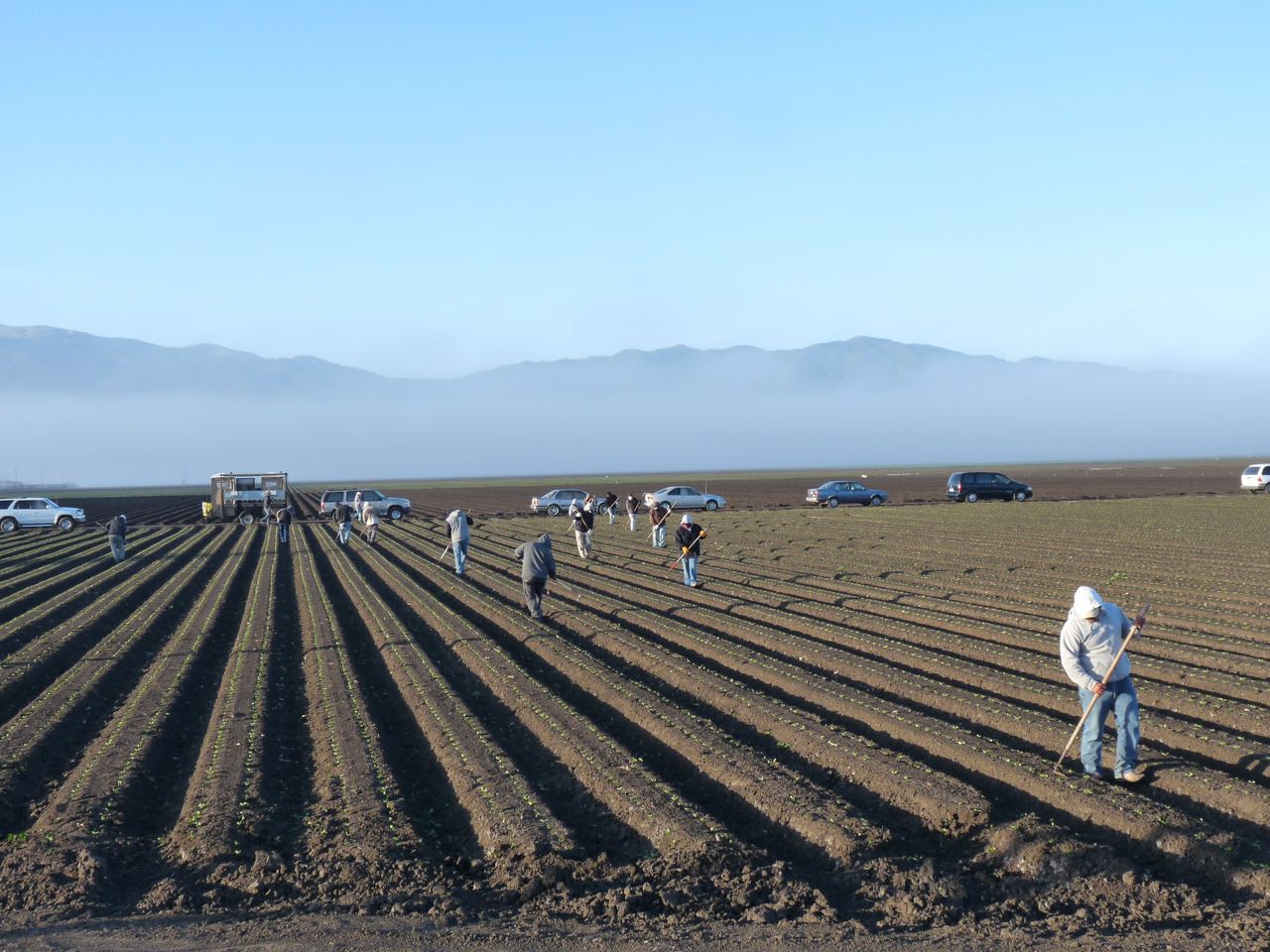
With the 2017 sweet potato season getting under way, there are major concerns about the cost of labor – in particular, the new overtime law.

“It is a high-labor crop, which makes it a very expensive crop to farm. It use to be that fumigation challenges were the biggest concern, but now it’s the overtime law,” said Scott Stoddard, a Merced County vegetable crops farm advisor with UC Cooperative Extension.

“Before the new law, workers often put in a 10-hour day during harvest. So I think in order for growers to survive, they will be forced to change the harvest methods. We have to figure out how to make the harvest less expensive,” Stoddard said.

Stoddard has had a conversation with growers about figuring out a way to increase harvest efficiency.

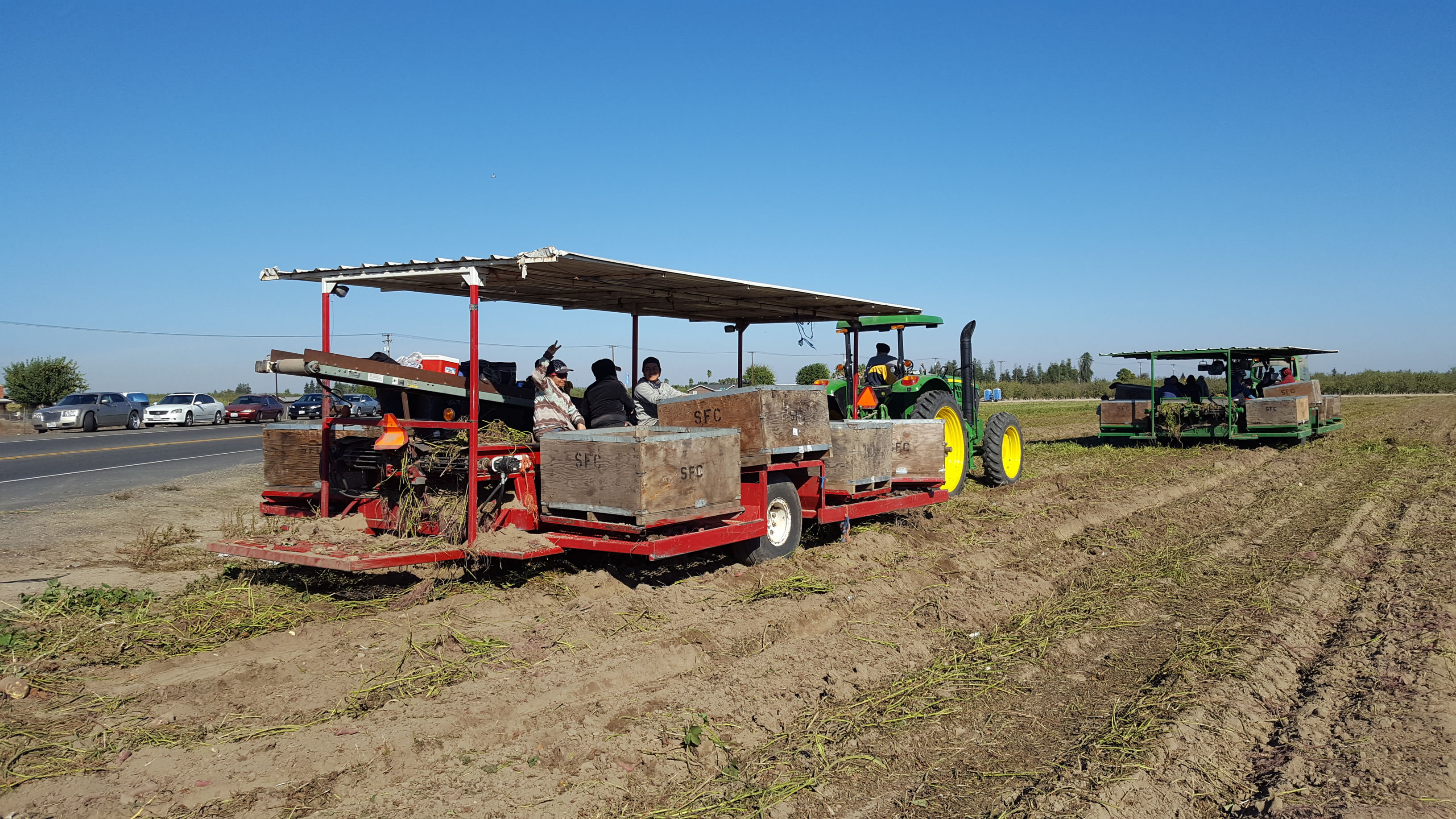
“Again, the expensive part of the operation is the fact that harvesting is a very slow operation,” Stoddard explained. “You’re going to have a tractor and a driver, and you’re going to have five or six people on this piece of equipment. And in a 10-hour day, this harvester might do one acre of ground.”

Right there alone, there are six employees that are making at or more than minimum wage: $12 to $15 an hour. After workman’s comp and social security are factored in, farmers are looking at six people at $12 an hour or combined $72 dollars an hour. Multiply that by 8 hours – that’s $576 dollars – and that’s only for the labor.

“And if you have to go overtime, which is needed at harvest, then labor cost rise very steeply,” Stoddard said.

Then you have to throw in everything else: the equipment costs, diesel and maintenance. And you also have the driver of the harvester. And then you have the forklifts out in the field and the portable bathroom rentals. All of a sudden, costs are up around $1,500 an acre just for harvest.

We have to ask, is it really profitable to grow sweet potatoes?

“They continue to do it, so it must be,” Stoddard said. “However, the changes in both the overtime law as well as the increase in the minimum wage are increasing the labor by 50 percent. So that means growers will need to increase their efficiency an additional 50 percent. And that’s what the industry is working on.”


2017-05-02T15:46:45-07:00May 2nd, 2017|

Who Safeguards California Farm Workers’ Rights?

Mudslinging in the Field

By Laurie Greene, Founding Editor

In his 1984 Address to the Commonwealth Club of California, American labor leader and civil rights activist Cesar Chavez explained that he cofounded the National Farm Workers Association, the forerunner to UFW, in 1962 “to overthrow a farm labor system in this nation which treats farm workers as if they were not important human beings.” Yet recent developments among United Farm Workers (UFW), Agricultural Labor Relations Board (ALRB), Gerawan Farming, Inc. and farm workers illustrate the continuing, increasingly complex quagmire that masquerades as protecting California farm workers’ rights.

ALRB Chairman William B. Gould IV, who resigned on January 13, wrote to Governor Jerry Brown that the Agricultural Labor Relations Act (ALRA) is irrelevant to farm workers because they are unaware of the law’s provisions, procedures and rights.

“The instances of unfair labor practice charges and invocation of the Mandatory Mediation and Conciliation Act (MMC) are few and far between,” Gould explained. “There is no union organizing which might make workers aware of the [ALRA].” He added that only one union representation petition was filed during his 3-year tenure.

Nevertheless, under Gould’s watch, the ALRB doubled both its staff and taxpayer-funded budget to harass Gerawan and its farm workers.

Remarkably, on March 26, Monterey County Superior Court Judge Thomas Wills ruled that the UFW underpaid their own employees. Consequently, UFW must pay a $1.2 million award that includes funds to plaintiff former UFW employee Francisco Cerritos and other internal organizers, sums to other members of the class action suit for pay stub violations and penalties for California Labor Code Violations.

“It’s unfortunate that a union asks for laws to be respected,” plaintiff Cerritos said, “but [the union does] not respect them.” The UFW, Cesar Chavez’s legacy, has shortchanged its own workers.

Furthermore, ALRB whistleblower Pauline Alvarez, a 30-year former ALRB field examiner, filed a retaliation lawsuit in 2015 against the ALRB, which is still pending in Sacramento Superior Court. According to a February 27 Gerawan press release, Alvarez alleges that she recommended to former ALRB chief counsel Sylvia Torres-Guillén the dismissal of cases in which the UFW failed to cooperate and provide witnesses and evidence to support its allegations. Alvarez claims Torres-Guillén directed her and other field examiners “to dredge up witnesses that would assist the UFW’s position.”

Alvarez also asserts that she protested the settlement of farm worker cases against the UFW that contained sufficient evidence to establish UFW violations of the law. Stunningly, she affirms that the ALRB refused “to notify workers of their rights to file charges against the UFW when the UFW violated the workers’ rights,” and the “ghostwriting” of the UFW legal brief by the ALRB staff.

Perhaps most astonishing, the ALRB withheld this whistleblower’s report from ongoing legal proceedings with Gerawan and Gerawan farm workers for seven months.

Most recently, ALRB Administrative Law Judge William L. Schmidt issued a decision on April 14 in favor of the UFW, finding Gerawan violated labor law by negotiating a collective-bargaining agreement with UFW “in bad faith”— commonly called “surface bargaining”— in the eight-month period from January 2013 through August 2013.

To explain this decision in context, the UFW was voted in by Gerawan farmworkers in a runoff election in 1990 and certified by the ALRB in 1992. Significantly, UFW never reached a contract to represent Gerawan farm workers in wage negotiations with their employer. Neither did the UFW collect dues from or provide services for the farm workers, reportedly among the highest-paid in the industry.

The UFW effectively abandoned the Gerawan farm workers – that is, until 2012, after the California State Legislature amended the Agricultural Labor Relations Act to allow and accelerate an imposed mandatory mediation and conciliation process for union contracts. Thus, UFW offered a new contract proposal, via imposed mandatory mediation, to Gerawan farm workers.

Meanwhile, during the same time period in which Gerawan supposedly negotiated with UFW in bad faith, Gerawan farm workers were actively collecting signatures to petition the decertification of the UFW as their bargaining representative. The ballots cast in the ALRB-certified election in November 2013 have never been counted, to this day. Rather, they were sealed and stored in an undisclosed location, allegedly in ALRB custody.

Who is safeguarding California farm workers’ rights?

An ongoing conversation.


Safeguarding CA Farm Workers Rights – Part 2


Resources

Chavez, Cesar. “Address to the Commonwealth Club of California,” San Francisco, CA, November 9, 1984.

Cloud, Tal and Matt Patterson, “The ALRB and UFW: Partners in Crime,” The Fresno Bee, 4/24/17.

Gould’s January 13, 2017 Resignation Letter provided by the LA Times.

Grimes, Katy, “ALRB Spent $10 Million To Prevent Gerawan Workers’ Ballots From Being Counted,” FlashReport, March 22, 2016.

Mohan, Geoffrey, “California Farm Labor Board Chairman Quits in Anger,” LA Times, January 13, 2017, http://www.latimes.com/business/la-fi-alrb-resignation-20170112-story.html 

Sheehan,Tim, “Rising expenses, accusations of bias confront state agency in Gerawan farm-labor conflict,” Fresno Bee, July 31, 2015.

State of California Agricultural Labor Relations Board Decision And Recommended Order, signed by William L. Schmidt, ALRB Administrative Law Judge, on April 14, 2017.

Wu, Amy, “UFW ordered to pay $1.2M in wages, OT,” The Californian, March 29, 2017, updated March 31, 2017.

2018-11-16T12:45:16-08:00May 1st, 2017|

Huanglongbing is causing concern in California

Increase of Huanglongbing in California Causes Concern

 By Brian German, Associate Broadcaster

Southern California has seen a concerning increase in the amount of trees that are infected with Huanglongbing, or citrus greening disease. California Ag Today discussed the news with Beth Grafton-Cardwell, an IPM Specialist and Research Entomologist for the UC Riverside Entomology Department stationed in the San Joaquin Valley.  She agreed that there is an increased concern surrounding HLB.

“It kind of exploded this fall, and it’s kind of continuing. And, that’s not unexpected. The Department of Food and Ag removes only the trees that are polymerase chain reaction – positive. And sometimes, it takes one to two years for a tree for you to be able to detect the bacteria using that method,” Grafton-Cardwell said.

Beth Grafton-Cardwell

There is no cure currently available for HLB, so once a tree is infected, it will eventually die.  Researchers continue working to find a possible cure for HLB, or at the very least, a more effective means of diagnosing infected trees. “Most of the techniques that are going to help us cure or prevent the disease from being transmitted are five to ten years away. Yet, I think we’re going to see a rapid expansion of the disease in Southern California in this coming year,” Grafton-Cardwell said.

Early detection is one of the most important things.  Grafton-Cardwell noted that many farmers are “helping to get the research accomplished and, for example, helping to get early detection techniques tested, and things like that so that we can try and stay on top of the disease.”

In California, production trees are not required to be screened, but many nurseries are now shifting towards putting all of their trees under screening in an effort to be more proactive in guarding against the spread of HLB.

Biological controls like Tamarixia are used as a means to reduce the number Asian citrus psyllids, which cause HLB, but that type of control method is not designed to completely eradicate insects.

“They’re starting to release the Tamarixia Wasps in Bakersfield. So we’re getting them up into the San Joaquin Valley so they can help out in those urban areas,” Grafton-Cardwell said.

Dogs are also used as a means to detect infected trees, but there is still a need for more effective techniques.  “A large team of dogs can do maybe 1,000 acres a day, and we’ve got 300,000 acres of commercial citrus. So I think we need a multitude of techniques,” Grafton-Cardwell said.

2021-05-12T11:01:59-07:00April 27th, 2017|
Go to Top