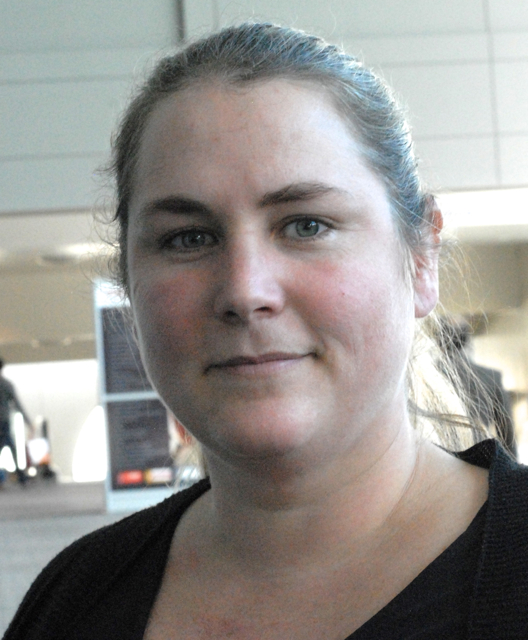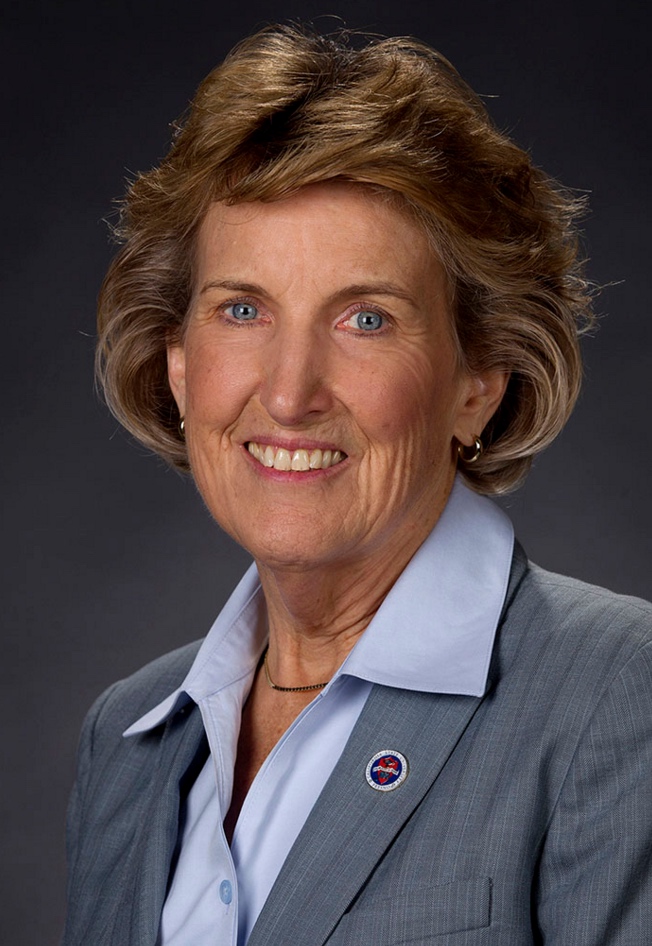
Sandra Witte, New Ag Dean at Fresno State

Dr. Sandra Witte Named Dean of Jordan College at Fresno State

(March 16, 2016) – Dr. Sandra Witte, who has been serving as interim dean of the Jordan College of Agricultural Sciences and Technology at Fresno State, has been appointed permanent dean, effectively immediately.

Dr. Lynnette Zelezny, provost and vice president for Academic Affairs, said Witte’s exceptional work as interim dean made her the best person for the position.

“We conducted a yearlong national search for a dean but did not find the right candidate for this important position,” said Zelezny. “In the meantime, it became clear to me, the faculty, staff and our strong partners in the agriculture community that Dr. Witte was the right candidate. I’m pleased she agreed to stay at Fresno State as permanent dean.”

Zelezny added: “This is a critical time for the Jordan College as we prepare for the opening of the Jordan Agricultural Research Center this spring and continue our laser-focus on crucial issues related to water and sustainability. I am confident Dr. Witte will lead the college to increasing national prominence.”real JCAST Logo

Witte has taken an unconventional route to the dean’s position, starting her career as a registered dietitian and serving as a professor and chair of the Department of Food Science and Nutrition, one of seven departments in the Jordan College.

“In the Jordan College, we often talk about offering programs from farm to fork and all the business in between,” said Witte. “While most people think of agriculture from the farm end, my connection is clearly on the fork end. I have always had an appreciation for traditional agriculture, and in my time at Fresno State, that has bloomed into a passion. After all, where is the food without the farmer?” she said.

Witte joins a growing number of women in agricultural leadership positions that traditionally have been held by males in universities, industry and commodity groups in the U.S.

The Jordan College maintains an enrollment of approximately 2,400 undergraduate and 100 graduate students from diverse backgrounds from throughout California, the U.S. and the world. Undergraduate, graduate and continuing education programs are offered in the major areas of agricultural business; animal sciences and agricultural education; child, family and consumer sciences; food science and nutrition; industrial technology; plant science; and viticulture and enology.

Faculty and students conduct applied research and public service in selected areas of agriculture, food sciences, industrial technology and family sciences. Students engage in learning science, technology and management in the classroom and by experience on the 1,000-acre on-campus University Agricultural Laboratory.

Witte has served as interim dean since October 2014. Previously, she jointly held the positions of associate dean of the Jordan College and dean of the Division of Graduate Studies. She joined the Fresno State faculty in 1992 and took her first administrative assignment in 2007.

She completed her bachelor’s degree in foods and nutrition at California State Polytechnic University, Pomona; master’s degree in home economics, nutrition and dietetics option at Fresno State; and her Ph.D. in food systems management at Oregon State University, Corvallis.

____________________________

Photo: Sandra Witte, dean of Agricultural Sciences and Technology at Fresno State (source: Fresno State

2016-05-31T19:24:10-07:00March 16th, 2016|

Ag Day at the Capitol

Ag Day Celebration at the Capitol

By Charmayne Hefley, Associate Editor


In honor of National Agriculture Week, the California Department of Food and Agriculture (CDFA) will partner with the California Women for Agriculture and the California Foundation for Agriculture in the Classroom to host the state’s annual celebration of agriculture, California Ag Day at the Capitol in Sacramento tomorrow, Wednesday, March 16, 2016. Karen Ross, secretary of the CDFA, said she is excited for the event, which highlights the diversity of California’s agriculture.

National ag day logo“Our theme for this year’s Annual Ag Day at the Capitol is ‘Golden State on Your Plate,'” said Ross, “to honor our farmers and ranchers and all they provide. Legislators, staffers and the public will have the opportunity to shake a farmer’s hand and advance our shared understanding of the importance of our food supply. In addition to approximately 40 agricultural booths and exhibits, Buttercup the electronic cow, a favorite of children, will return to the Capitol for robotic milking demonstrations.  
“We’ve been watching the weather,” Ross said, cautiously. “We would not mind being in the rain, but it looks like we’re going to have a day of sunshine and 70-degree weather.”

Sheila Bowen, president of the California CattleWomen (CCW), said CCW and California Women for Agriculture members will attend tomorrow’s Ag Day at the Capitol, alongside many other agriculture organizations. “In addition to giving out our brochures,” Bowen said, “we’ll be giving out tri-tip sliders to the guests who come to the Capitol.”

The celebration will be held on Wednesday, March 16, 2016, from 10:30 a.m. to 11:30 a.m. for legislators and staff, and from 11:30 a.m. to 1:30 p.m. for the public at the California State Capitol grounds, west steps.

2016-06-03T09:27:56-07:00March 15th, 2016|

Duarte Farmland Under Siege

Duarte Farmland Under Seige By Army Corps of Engineers

By Brian German, Associate Editor

The Duarte family has been in a lengthy court battle with the federal government regarding the right to farm their own property.

John Duarte, a fourth generation California farmer and president of the family-owned nursery in Hughson, commented on how this dispute began, “My family owns a piece of property up in Tehama County that we purchased in 2012 and planted wheat that fall. The property is in some slightly rolling grasslands, and has some minor wetlands on it, vernal pools, vernal swales. Like most grasslands, wheat areas and wheat plantings, we had a local contractor go out and plow the field for us, 4-7 inches deep, and we flew on some wheat seed for a winter wheat crop in 2012.

“The U.S. Army Corp of Engineers called us and told us we were deep-ripping the property. I think they were under the misunderstanding that we were getting ready to plant orchards or vineyards there. They looked at it and assumed we were deep-ripping, three feet deep, which we were not,” Duarte said.

“They sent us a cease and desist notice in early 2013, then refused to tell us what their evidence was or how they had drawn their conclusion that we were deep-ripping. We sent two letters from an attorney, under the Freedom of Information Act, requesting evidence we had deep-ripped, the assumption that apparently warranting a cease and desist notice.”

“They refused to answer the first letter. They kicked the matter up to enforcement and then sustained the cease-and-desist notice without ever giving us a hearing and without ever giving us specific cause for their action. They obstructed our farming operations indefinitely,” Duarte noted.

As their request for the evidePacific Legal Foundationnce against them continued to be ignored, Duarte said, “We went to the Pacific Legal Foundation, where they filed a due process suit against the Army Corps of Engineers on behalf of a farmer’s right to farm their ground. The Army Corps of Engineers now claims that our 4-7 inch tillage through ground that has been tilled 18-24 inches in the past destroyed wetlands.”

“They are making extremely spurious claims that the small plowing furrows through some of the minor vernal pools are now mini mountain ranges and the valleys of those furrows are still wetlands. But the top of the furrow, maybe five inches higher than the bottom of the valley, is now a converted upland and therefore we have destroyed wetlands across the property and are subject to a destruction of wetlands lawsuit filed by the Army Corps of Engineers against Duarte Nursery.”

Nevertheless, Duarte doesn’t think this was strictly in the interest of habitat preservation, “We believe this lawsuit is completely vindictive and retaliatory because we are challenging the Army Corps of Engineers’ ability to simply drive by farms and send cease and desist notices to farmers for very little cause, and then refuse to give any information as to what their cause for the cease-and-desist notice was.”

Duarte believes the lawsuit filed by the Army Corp of Engineers is a somewhat arbitrary enforcement of wetland destruction laws, “Lately, under the new WOTUS Rule, federal administrations [designate that] everything we farm as a wetland. We’ve had experts on both sides out in the field. Everyone agrees that wetlands are still there; the wetlands are still the same size; the wetlands have the same hydrology; the wetlands still have the same pocket water when it rains; the wetlands still have wetland vegetation; the wetlands are all still there by all the parameters one would measure a wetland’s presence by.”

Duarte noted where they are in the process, and why they chose to standup for their rights, “We filed motions for summary judgement, had a motion for summary judgement hearing back in, I think it was early December, we are waiting for the judges rulings on those, so we can proceed to trial on any unsettled matters in the case. We see these types of things happening to our customers all over the state, and that is one reason we wanted to bring this suit. We’re willing to bring this suit and defend our customers, our growers’ ability to take our products and farm their land. Duarte Nursery cannot exist without our growers being able to farm.”

This situation has come at a heavy price for the Duarte family. “This has cost our company over $1 million just to stand up for everyone’s right to farm their property. In a number of important ways, there is a noose tightening around the neck of agriculture everyday, and unless we stand up and fight back, in the courts, where it is appropriate, we are going to lose our ability to farm without federal government permission to do so,” Duarte said.

________________________________

Links:

Duarte Nursery

Pacific Legal Foundation

U.S. Army Corp of Engineers

2016-07-23T17:25:28-07:00March 11th, 2016|

National Days Celebrations at Fresno State Farm Market

Fresno State Farm Market Hosts National Day Events

By Charmayne Hefley, Associate Editor


Fresno State’s Rue and Gwen Gibson Farm Market hosted its Annual Pistachio Day on February 26 in honor of World Pistachio Day. Miles Robinson, a student market lead, said, “We’ve been working with American Pistachio Growers (APG) to market this campaign and give away pistachio samples, all courtesy of APG. We are also raffling a gift basket with several of our products and APG items as well.”12821589_10153999748978330_676533612082576193_n

Robinson said the Fresno State farm market plans to host monthly events to feature the store and student products, including that very fowl day, Poultry Day, on March 18, and National Raisin Day on April 29. “For Poultry Day,” Robinson said, “we’ll be sampling Foster Farms chicken in a couple of different recipes. We look forward to having people actually taste our chicken. We will also have a chicken dance contest. For National Raisin Day we’re partnering with the California Raisin Board to bring information, samples and have a fun time.”

Robinson said the student-run farm market, which specializes in student-made products, is in the process of creating new recipes for its coated nuts and raisins. “Over the past year, we’ve been slowly rolling out new recipes for our milk chocolate raisins, milk chocolate almonds, milk chocolate cabernet raisins and dark chocolate raisins,” Robinson said. “All of our products will have brand-new recipes, 100 percent Fresno State-done.”

2016-08-10T11:56:30-07:00March 11th, 2016|

Falcons Work in Agriculture, Too

Farmers’ Other Best FriendFalconsWork in Agriculture, Too

By Charmayne Hefley, Associate Editor

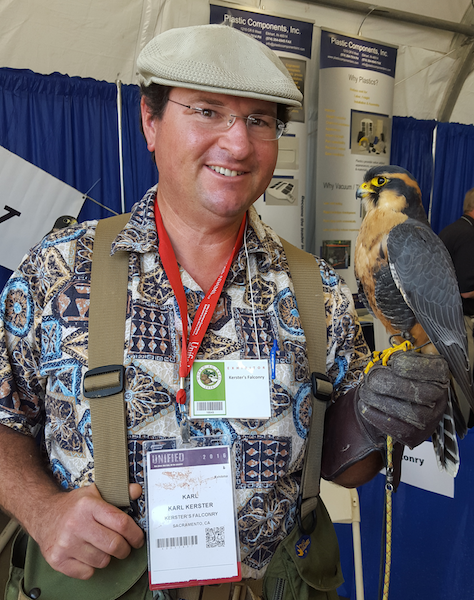
Charmayne Hefley, California Ag Today broadcaster and associate editor, and farmers’ other best friend – the falcon.

Agriculturalists have found ways to employ some animals to assist them in the fields. Karl Kerster, owner of Sacramento-based Kerster’s Falconry, employs farmers’ other best friend, falcons, to keep agricultural products safe before and during harvest. More specifically, Kerster’s five falcons perform bird abatement—removal of nuisance birdsto protect cherries, berries and grapes. Pest birds are defined as sparrows, swallows, finches, starlings, pigeons, blackbirds and more.

“We work to protect the farmer’s crop,” Kerster said, “and we really enjoy doing it—which is a plus when you’re having to do it for a hundred days straight to keep a crop safe. We start when the fruit starts to ripen enough that the birds are going to attack, until the crop has been substantially harvested. I work five birds, and I have several more in reserve, but the five that I work keep me very busy.”

Kerster, a master falconer, has been serving as a falconer since 1996, and his birds have a high success rate at keeping pest birds away from crops.“We are 99 percent successful in protecting a crop in most situations,” Kerster said. “We also take care of any other bird problems that may or may not be on the berries, cherries and grapes that we normally do. Any customer who wants us to dispose of a problem, we’re ready to help.”

______________________________________

Becoming a falconer is not an “overnight” achievement and is not for the meek. The first of the “up-front questions you need to be able to answer to yourself,” according to the California Hawking Club is, “Will you, can you, commit part of your waking hours to a creature who at the very best of times will merely tolerate your presence, is as affectionate as a stone, and at the worst of times will cause you heartache and puncture wounds? Can you commit to an average of a half-hour a day, every day, and two to four hours on a hunting day, regardless of school, family, or job – forever?

The eight steps required to become a falconer in the state of California are provided by the California Hawking Club.

Becoming a Master falconer, according to the North American Falconers Association, “takes at least seven years; finishing your apprenticeship alone will take at least two.”

______________________________________

Falconry is a heavily-regulated practice, governed by federal and state laws and regulations.  For more information, go to:

California Natural Resources Agency Department of Fish and Wildlife

California Hawking ClubCalifornia-Hawking-Club-logo

Kerster’s Falconry 

Electronic Code Of Federal Regulations

______________________________________

2021-05-12T11:03:03-07:00February 29th, 2016|

PCA Training At UC Davis

UC Davis Offers Pathway to PCA Training

By Laurie Greene, Editor


Frank Zalom, distinguished professor of entomology, agricultural experiment station entomologist, and extension specialist at UC Davis, teaches a class for students that forms a pathway to becoming a Pest Control Advisor (PCA). “It is the only class that a lot of them had ever taken in entomology,” said Zalom, “so we try to structure it to give them a good, solid background in entomology. Then we lead them through all the different pest management options. We even bring in someone from the California Association of Pest Control Advisors (CAPCA) Pathway to PCA program for the very last lecture.”

Zalom, whose research interests include integrated pest management (IPM), tree crops, small fruits and vegetable crop entomology, wants to provide a valuable education to his students. “Most of the kids taking my classes are interested in taking the PCA exams and there is a huge opportunity for those students out in the future.”

“We teach them about integrated pest management (IPM) and the pests,” Zalom noted. “Then we show them some of the many career opportunities for PCAs,”  he said, adding. “There will always be a big need for professional PCAs to help protect our crops from pests and diseases. They assist growers all over the state.”

________________________

Links:

California Association of Pest Control Advisors (CAPCA)

CAPCA Pathway to PCA

2021-05-12T11:03:03-07:00February 24th, 2016|

Lorsban Under Scrutiny

Chlorpyriphos (Lorsban) Must be Used More Carefully

By Patrick Cavanaugh, Deputy Editor

California Department of Pesticide Regulation (DPR) reports an important, broad-spectrum organophosphate insecticide known as Chlorpyriphos, or Lorsban, may be further restricted due to evidence of potential human health and environmental risks, presence (parts per billion) in some California waterways, and pressure from the EPA. Brian Leahy, director of the California Department of Pesticide Regulation, said, “Chlorpyriphos is an important tool and we know there are important times when you have to use it.”

Registered and widely used in agriculture across the nation for more than 40 years, DPR has made it a restricted-use material. Leahy said, “We are trying to work with the grower community to improve how they use it. We are also working with UC IPM to look at essential needs, but we know that as we look at Chlorpyriphos, we are going to have to put additional restrictions on it.”

“We simply need for it to stay on target, and not be getting into the human body. We are seeing that it is, and we are going to continue to make sure that people use it thoughtfully and wisely,” he said.

And Leahy is very confident that growers can use this material and keep it on target, “I have seen farms that use it only when they really need it, and that is what we want. We can’t lose this tool and we are going to keep it only by showing we can greatly reduce off-site movement to the human body and watersheds,” he noted.

___________________________

Resources:

According to the University of California Agriculture and Natural Resources 2014 Chlorpyrifos Report entitled, “Identifying and Managing Critical Uses of Chlorpyrifos Against Key Pests of Alfalfa, Almonds, Citrus and Cotton“:

Chlorpyrifos plays a critical role in many IPM programs for controlling pests that threaten the productivity and economic well-being of California producers and in maintaining the high quality standards required by consumers and international export markets. This active ingredient also allows production of animal feed to support the important dairy industry in California. For some pests, chlorpyrifos is one of the last effective organophosphate insecticides available and may provide an important alternative mode of action for insecticide rotations to prevent the development of resistance to newer insecticide products. For others, this product is one of very few products with international registrations with established maximum residue limits (MRLs) that allow unhampered trade. Chlorpyrifos may also be a key tool for controlling invasive pests as well as endemic pests occasionally found in extremely high population densities. 

The California Department of Pesticide Regulation reports that the combined use of chlorpyrifos in alfalfa, almonds, citrus, and cotton has decreased since 2006. 

Although newer insecticides are also available to manage some pests in these four crops, there is a continued need to preserve the availability of chlorpyrifos for specific situations.

Assessing the Health Risk of Pesticides,” California Department of Pesticide Regulation

2021-05-12T11:03:04-07:00February 16th, 2016|

Greg Douhan is New Citrus Farm Advisor

UCCE Tulare Welcomes New Citrus Farm Advisor

By Brian German, Associate Director

The UC Cooperative Extension Program has served Tulare County since 1918 and continues to meet the ever-changing needs of the community. UC Cooperative Extension, Tulare County is preparing to welcome their new citrus farm advisor, Greg Douhan, on March 1, 2016. Douhan, who noted his excitement for the opportunity, will be taking the reins from the recently retired Neil O’Connell who gave over 34 years of faithful service advising Tulare County citrus growers.

Douhan shared that his relatives inspired him to focus his career in agriculture. “I had an uncle who was an almond grower when I was a kid. And my grandfather was an avid horticulturalist; he used to graft different trees and I always found that fascinating.”

“As I got older, I decided I was interested in plants, so I went to Humboldt State University. I also got interested in fungi, so I decided to fuse my interests in fungi and in plants and go into plant pathology,” Douhan said.

“I earned my Master’s and Ph.D. at Washington State University, and then completed a post-doc assignment at UC Davis for 3-4 years. I moved to UC Riverside for about 6 years. Now I am here in Tulare County!” 

Cooperative Extension advisors serve as conduits of information from various UC campuses. Subject matter specialists, along with local research centers, collaborate with local advisors to identify and solve local problems through research and educational programs. The mission of the program is to serve California through the creation, development and application of knowledge, in agriculture, natural and human resources. Farm advisors then apply this knowledge to improve our agriculture and food systems along with our natural resources and environment.

“I’ve been working for the UC system basically since I was a post-doc,” Douhan said, “so it has been for many years. I think Cooperative Extension was the best system for working with both the growers and everybody else to better California agriculture,” Douhan said. “This was just an incredible opportunity. I was doing science and looking for another career move, and this was a perfect opportunity to have a next chapter in doing something different.”

_______________________

Link:

Tulare County Cooperative Extension

2016-05-31T19:24:14-07:00February 1st, 2016|

Biocontrols Conference & Expo

Biocontrols Conference & Expo, March 3-4, 2016, Monterey, California 

Learn everything you need to know about agricultural biocontrols from the experts.  


Join your peers, leading organizations and industry experts at the Biocontrols Conference & Expo for two days of hands-on education devoted solely to the use of biocontrols in agriculture presented by Meister Media Worldwide, a media solutions provider for worldwide specialized agriculture, in cooperation with the Biopesticides Industry Alliance (BPIA), and the California Association of Pest Control Advisers (CAPCA). The Biocontrols Conference offers educational sessions, continuing education credits (CEUs) for pest control advisers (PCAs), certified crop advisers (CCAs) and other state certification programs, and an expansive Expo with top suppliers of biocontrol products and related services.

New for 2016!  

Two optional, concurrent add-ons on the last afternoon of the event (additional fees may apply):

1.Tour of two leading Monterey-area specialty-crop growing operations that use biocontrols as part of their integrated pest management programs:

-Biocontrols USA Tour

-Pacific Plug and Liner,  Watsonville, CA

2.Hands-on workshop on the use of beneficial insects in a greenhouse environment

lineclear

Agenda Sampling:

-8 Tips To Get The Most Out of Your Biocontrols Program

-A look at the most common active ingredients and how to handle them to get the best results, Lance Osborn, UF IFAS

-What’s Next In Biocontrol?

-Regulatory Update, Bob McNally, EPA

-Pipeline Update – what types of new products are coming?

-The Future Isn’t Biocontrol. It’s IPM

-Understand The Value of Biopesticides – Do they Pencil Out for You?

-How To Evaluate/Field Test a New Research Biopesticide

-Biopesticides and Beneficials: Make Them Work Together, Frank Sances, Pacific Ag

-Fruit and Tree Nuts: Hands-on, How-To Topics

-Using Green Lacewings in almond and pistachio, Brad Higbee, The Wonderful Co.

-Vegetables: Hands-on, How-To TopicsMycorrhizae: Why it Makes Sense in Strawberries, Johan Pienaar, Mycorrhizal Applications.

Monterey Bay, the conference location, is in close proximity to the heart of major California specialty-crop production: vegetables, fruits, and ornamentals in Monterey County and the Salinas Valley, and affords you the opportunity to tie-in a long weekend in the Monterey Bay area.

lineclear

Meister Media Worldwide and its leading family of brands including American Vegetable Grower®, Western Fruit Grower® / American Fruit Grower® and Greenhouse Grower®, CropLife®,

lineclear

Having celebrated its 15th anniversary in September 2015, BPIA is dedicated to fostering adoption of biopesticide technology through increased awareness about their effectiveness and full range of benefits to a progressive pest management program.

lineclear

Dedicated to the professional development and enhancement of its members’ education and stewardship, the California Association of Pest Control Advisers (CAPCA) represents more than 75% of the nearly 4,000 California EPA licensed pest control advisers (PCAs) that provide pest management consultation for the production of food, fiber and ornamental industries of this state.

2021-05-12T11:05:58-07:00January 28th, 2016|

Grower-PCA Communication is Critical

Grower-PCA Communication is Critical

By Laurie Greene, Editor

Emily Symmes, UC Cooperative Extension Integrated Pest Management Advisor, Butte County, is amazed at the professionalism of growers and Pest Control Advisors (PCAs). “I deal directly with growers and land managers, as well as crop advisors and pest control consultants” said Symmes, “and everyone has so much to do out there, so grower-PCA communication is critical. Sometimes it is amazing how they get it all done. I feel lucky, as I get to focus on the pest management and other production activities throughout the season,” she noted.

Symmes maintains there has to be a lot of communication back and forth between the growers and PCAs and herself. “And within each question there is a deeper conversation,” she elaborated, “but it can get lost in the shuffle of running from one thing to the next. Everything is very time sensitive in agriculture; we don’t have control over weather and things that tend to drive pest population cycles.”

“So within each of those key pest management questions, there is a subset of questions:

  • How do we know that it is time?
  • Are we doing the right thing at the right time?
  • Are we using the right materials?
  • Are we considering the big picture?’”

“The other big key ingredient is follow-up—evaluating:

  • How did we do?
  • Did the treatment work?
  • Did it cause any potentially negative impacts that we weren’t aware of?
  • Did we have to come back and do something additional (after-the-fact)?
  • More questions about the treatment, time, and material.”

    PCA Responsibilities (CA DPR)

    PCA Responsibilities (CA DPR)

And on any California Department of Pesticide Regulation (DPR) recommendation, there is a question before the last signature line, ‘Have you thought of any other alternatives before you make this application?’ IPM practitioners sometimes misunderstand this to mean, ‘Well they don’t want us to treat.’ But it is really an acknowledgement that we know how important all of our management tactics are,” Symmes noted.

“Cultural practices are important, pesticides are important, but knowledge is really the key ingredient. Growers and PCAs are knowledgeable, have explored the alternatives and know what is going on in this particular orchard block they are signing this legal document for. Honestly, I think we do a great job.”

“I think California has done a fantastic job with this,” said Symmes,”but is there room for improvement? I think there always is.”

2021-05-12T11:05:59-07:00January 7th, 2016|
Go to Top