Environment

Red Scale Challenges Citrus

Besides HLB, Red Scale Challenges Citrus

By Charmayne Hefley, Associate Editor

While much of the talk in the citrus industry is about how to fend off Huanglongbing (HLB) disease, one of the most devastating citrus diseases, Dr. Beth Grafton-Cardwell, director of the University of California Agriculture and Natural Resources Lindcove Research and Extension Center, reinforced that HLB isn’t the only pest that can overtake California’s citrus orchards.

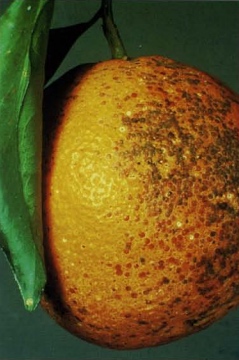
Grafton-Cardwell explained how last year’s warm winter led to an increase in the California red scale, Aonidiella aurantii, population. “Normally we have cold conditions that kill off the younger instars of the scales and [basically] restarts the system. But we didn’t really have any low temperatures last year, so the scales didn’t go into their usual hibernating phase. They just kept cranking out crawlers and adding in an extra generation or two of production. So the higher number of scales on the trees made it much more difficult for the growers to control.”

Grafton-Cardwell explained while it is difficult to speculate whether this coming year will yield another large population of the CaSave Our Citruslifornia red scale, “We have already received more moisture as a result of seasonal rainfall, which should help hinder the pest. Hopefully we’ll get some cooler weather conditions too–not freezing because citrus groves don’t like freezing temperatures–but cold enough to knock out some of the scales and get the population back under a manageable level,” she said.

Nevertheless, despite the challenges that California red scale can cause, Grafton-Cardwell said, overall, citrus growers need to keep their focus on the fight against the Asian Citrus Pysllid (ACP), Diaphorina citri, and its ability to spread HLB. “Growers need to start thinking in terms of: California has the [HLB] disease and it’s going to start spreading in southern California soon,” Grafton-Cardwell said. “What do we do to prevent it from spreading up here into the San Joaquin Valley?”

Photo source: “Life Stages of California Red Scale and Its Parasitoids,” UC ANR Publication #21529, by Forster, Lisa D.; Robert F. Luck; and Elizabeth E. Grafton-Cardwell; with photos by L. Forster and M. Badgley)
2021-05-12T11:03:04-07:00January 20th, 2016|

Project Apis m. Helps Almond Growers Empower Bees

Project Apis m. Helps Almond Growers Empower Bees

With Free Flowering Forage

By Patrick Cavanaugh, Deputy Editor


Christi Heintz, executive director for Project Apis m. (PAm), elaborated on the message she presented at the annual Almond Conference last month in Sacramento, “Our purpose at the Almond Industry Conference was to meet growers and talk to them about planting additional forage before and after almond pollination. These are times of dearth when honey bees are not getting the nutrition they need and beekeepers have to feed tremendous amounts of sugar syrup or high-fructose corn syrup to keep the bees alive,” Heintz said.

Project Apis m.Established as a non-profit organization in 2006, PAm has the goal of funding and directing research to enhance the health and vitality of honey bee colonies while improving crop production. Heintz explained PAm.—named after Apis mellifera, the scientific name for the European honey bee—offers farmers free mustard mix for pre-almond bloom or clover mix for post-almond bloom to extend the season of nutrition availability for bees when they are most vulnerable. The increase in forage also benefits bees by providing additional natural and more diverse sources of nutrition resulting in better pollination and increased crop yields.

Heintz wants more growers to take part in the program. She reemphasized, “Honey bees love almonds, but we worry about those times just before and just after bloom. If you can get something going before bloom, you’ll get bee colonies that want to go out and forage for pollen, and they will be in great shape for almond pollination,”Heintz said.

Heintz enthusiastically urges growers to get involved by contacting PAm at ProjectApis@gmail.com and ask about forage seed mix to plant for honeybees. Growers can also go to the Project Apis m. website and to their web page For the Almond Grower.

Heintz has managed research, including pollination research since 1979, and has focused on honey bees since 2006. She also manages the Environmental Sustainability Program and production research for the Almond Board of California.

2021-05-12T11:05:58-07:00January 14th, 2016|

USDA Pesticide Data Program Report Confirms Food Safety

USDA Pesticide Data Program Report Confirms Food Safety:

More than 99 percent of sampled food tested below allowable pesticide residue levels!

The U.S. Department of Agriculture (USDA) has confirmed again in its annual report that American consumers can focus on the nutritional benefits of conventional and organic produce without concern for pesticide residues. Over 99 percent of fresh and processed food available to consumers tested below allowable pesticide residue levels, as detailed in the 24th Pesticide Data Program (PDP) Annual Report released on January 11, 2016 by the USDA Agricultural Marketing Service (AMS). Only .36 percent [0.36%] of the products sampled through the PDP had residues above the U.S. Environmental Protection Agency (EPA) established tolerances, giving consumers plentiful options to meet their daily nutritional needs.crop life america logo

“Today’s consumers can choose from food produced with a variety of farming methods and necessary crop protection strategies and be confident that it will sustain and enrich their families’ lives,” stated Jay Vroom, president and CEO of CropLife America (CLA). “Across the nation, our growers continue to use the most advanced crop protection technology available to target specific crop threats. From precision agriculture to integrated pest management, farmers in the heartland, the plains, coastal areas and everywhere in between are pushing forward with the best ways to produce food for their communities and for the country.”

PDP researchers tested a total of 10,619 samples of fresh and processed fruit and vegetables (8,582 samples), oats (314 samples), rice (314 samples), infant formula (1,055 samples), and salmon (354 samples). To ensure the samples were representative of the U.S., researchers collected data in a variety of states throughout different times of the year. The findings support the Dietary Guidelines for Americans 2015-2020, recently released by USDA and the U.S. Department of Health, which encourage consumers to eat more fruits and vegetables.ChooseMyPlate.gov

“With rapid advancements in computing technology, the space for developing new ways to fight agricultural threats is increasing exponentially,” stated Dr. Janet E. Collins, senior vice president of science and regulatory affairs at CLA. “Consumers have a number of options at the grocery store, thanks in large part to the work of the scientific community involved in research and development, the companies that are manufacturing products, and America’s farmers and ranchers. The 2014 PDP report demonstrates again that, with the sound science-based regulation of pesticides and commitment from the industry, farmers and other stakeholders, we can reach toward making sure that every American, no matter their wallet size or geographic location, can access healthy food.”

A 2012 report from CLA demonstrates that crop protection has made healthy food more financially accessible to the American consumer, providing a 47.92 percent savings in overall grocery bills for a family of four in the U.S.1 In addition, increased agricultural production, due to advanced pesticides, has created an additional 1,040,661 jobs generating more than $33 billion in wages—all while decreasing the need for tillage operations, thereby reducing fossil fuel use by 558 million gallons per year.

Recent reports from the United Nations also show that an increasing number of people worldwide have gained access to healthy food. Over the past 25 years, the number of people worldwide who are hungry has declined from one billion to about 795 million, or about one person out of nine—which means that 2 billion people have avoided a “likely state of hunger” given the global population increase of 1.9 billion people since 1990-92.2 Multiple factors have contributed to the decrease in global hunger, including the integration of family farmers and small holders in rural areas into well-functioning markets for food, inputs and labor.

The PDP was established in 1991 for the purpose of collecting data on pesticide residues found in food. Information collected by the PDP is sent to the EPA to help the agency conduct important dietary risk assessments. The USDA also uses this data in the development of integrated pest management objectives. Since the PDP program was initiated, 109 different commodities have undergone testing. A complete version of the 2014 Annual Summary is available at www.ams.usda.gov/pdp.


1 CropLife America. The Contributions of Crop Protection Products to the United States Economy.

2 Food and Agriculture Organization of the United Nations, the International Fund for Agricultural Development and the World Food Program. State of Food Insecurity in the World 2015.


Established in 1933, CropLife America (www.croplifeamerica.org) represents the developers, manufacturers, formulators and distributors of plant science solutions for agriculture and pest management in the United States. CropLife America’s member companies produce, sell and distribute virtually all the crop protection and biotechnology products used by American farmers. CLA can be found on Twitter at @CropLifeAmerica. CLA supports CropLife StewardshipFirst.

2021-05-12T11:03:05-07:00January 13th, 2016|

Protecting California Citrus from ACP

Protecting California Citrus from ACP

By Charmayne Hefley, Associate Editor

[embedvideo id=”ZWgOOjpxwE8″ website=”youtube”]


California’s $2.2 billion fresh citrus industry that supplies 85 percent of the nation’s fresh citrus is currently healthy and vibrant despite the background threat of the Asian Citrus Psyllid (ACP), according to Kevin Severns, a citrus grower in Sanger, CA; general manager of the Orange Cove-Sanger Citrus Association, a cooperative citrus packing house in eastern Fresno County; and  chairman of California Citrus Mutual.

“We’re quite concerned about it,” Severns said about the ACPa tiny bug that is a known carrier or vector of “huanglongbing” (HLB), a devastating, incurable disease of citrus trees  that has already demolished the citrus industry in Florida. “We’ve been able to keep the bug at bay to this point,” Severins continued, “at least here in the Central Valley, but we’re very concerned about it. There are a lot of issues to be concerned about with this bug.”

Save Our CitrusCalifornia has taken note of the devastation of Florida’s industry, Severns said, and is taking steps to ensure the safety of California’s citrus. “Having gone to Florida with many of our citrus growers,” Severns explained, “I heard Florida growers tell we must control the bug. So we’re trying to keep this bug at bay and not allow [the infestation] to expand. We’ve had varied success in different areas of California, but so far, we’ve been able to keep the bug’s expansion here in the Central Valley to a minimum. We continue to have finds from time to time, but we haven’t yet had an explosion of the population of the ACP.”

Severns said, “We have a very successful partnership with the California Department of Food and Agriculture (CDFA).” While trapping ACP is critical, he emphasized the importance of enlisting the help of residential folks with citrus in their backyards to get involved in the conversation, to look for this pest, and to join in the fight. “The trap is very limited in its ability to pick up ACP, so it’s very important that we have visual surveys in which growers and homeowners actually go out and look at their trees for the bug.”

Severns said current measures against the spread of the ACP is helping to buy time for researchers to find a cure for HLB. “We realize every place on earth where the ACP has gone, eventually has been followed by HLB,” Severns said, “so we’re trying very hard to buy time and give our researchers and scientists a chance to come up with a solution to this disease—whether it is a resistant type of citrus variety or a cure for the trees.”

Preventing the spread of ACP and HLB, from commercial citrus growers to residential citrus growers, will require that everyone works together. To learn more, go to CaliforniaCitrusThreat.org or contact your local Ag Commissioner.

_________________

Did you know, the historical time period establishing the California citrus industry is known as the “other” California Gold Rush? (Source: California Citrus Mutual)

_________________

2021-05-12T11:05:58-07:00January 12th, 2016|

Irrigation Uniformity in Almonds

Attaining Irrigation Uniformity in Almond Orchards

By Patrick Cavanaugh, Deputy Editor

Terry Prichard, a water management specialist with UC Cooperative Extension at UC Davis for 35 years whe he retired five years ago, is still at work. Prichard is currently collaborating with Almond Board of California to improve water management in almonds, especially irrigation uniformity. “I am still researching nitrogen management for all crops through a grant through the UC from CDFA, and I am helping the Almond Board with their irrigation initiative and their Irrigation Improvement Continuum,” Prichard said.

Prichard explained, “We try to apply water in order to get an average amount of water throughout the field and do that very uniformly. When it is done non-uniformly, farmers are using extra water to reach all parts of the field. So improving irrigation uniformity allows us to apply less total water, but still meet the crop’s water demands,” Prichard noted.

Dormant almond trees with micro-sprinkers

Dormant almond trees with micro-sprinkers

Improvements to irrigation uniformity can be done in any field, according to Prichard. He suggests your designer should strive for good irrigation uniformity when creating your irrigation design. “However,” he clarified, “if you design a less expensive minimal system which uses minimal size piping, you end up using extra energy to drive the pressure through the system to deliver water to the end. Driving that pressure causes friction loss in the pipe—pressure differentials from the top of the system near the pump to the end of the system on the last sprinkler or dripper. These pressure differentials deliver different volumes of water out of each sprinkler, micro-sprinkler or drip emitter, and that is what drives non-uniformity.”

Also important is irrigation maintenance—making sure the system is flushed out and emitters are changed when needed. “Improving uniformity with large orifice-type sprinklers or even larger micro-sprinklers,” stated Prichard, “tends to be a little easier because the holes are larger and don’t plug as easily. In smaller orifice-type systems such as drip irrigation, emitters easily become clogged with physical particulates or biological particulates like slime and algae. Most commonly, lime or manganese forms inside the emitter, clogs it up and reduces the flow, so maintenance of those systems is very important to maximize your designed-in uniformity,” he said.

Continuum irrigation is an important concept because there is a whole array of current grower practices, some at the minimum level for what we consider for most growers, some are transitioning to more sophisticated methods, and others are already there. I think this continuum will reassure people who are at the minimum level and encourage them to adopt more technological solutions to irrigation scheduling.”

Prichard said the Almond Board’s Almond Irrigation Improvement Continuum doesn’t have a set timeframe. ”It has more accomplishment phases and so what we hope to do is provide each grower with information that they can use on their farm to improve their efficient use of water to produce almonds.”

“And the Almond Board is making these strategies and new technology systems web-based,” noted Prichard. “It is very easy with a web-based system to input new things. The current continuum on the website conceptualizes the basic visual measurements and practices, and you can click on a specific practice for more information on how to incorporate it to accomplish your goals. Then there is a link to a specific discussion such as how to accomplish these efficiencies using drip irrigation, for example,” said Prichard.

Double drip irrigation on Almond Trees

Double drip irrigation on almond trees

”Almond growers have made tremendous strides in improving their efficient use of water, primarily from changing older flood-type irrigation systems to the newer pressure systems. This progress has been tremendous for the industry and for growers in terms of producing more crop using less resources.”

“However, we are now at the next level of using these methods, such as weather-based irrigation scheduling estimates, followed by soil- and plant-based checks, to ensure that you are delivering just the right amount of water,” explained Prichard. “The continuum has generated a lot of grower interest. We have several ways to go and many more tools now than we did ten or twenty years ago.”

__________________________

Introduced at The Almond Conference in December, the full Irrigation Improvement Continuum and comprehensive background materials will be posted on the Almond Board’s website by March 1, 2016, providing “one-stop shopping” for almond irrigation management at all levels.

According to Almond Board’s January 2016 Outlook newsletter, the continuum describes three proficiency levels and provides a comprehensive program of irrigation management and scheduling practices in five key areas, and also explains how these practices can be effectively integrated at each level. The five key areas include:

  1. Measuring irrigation system performance and efficiency;
  2. Estimating orchard water requirements based on evapotranspiration;
  3. Determining the amount of water applied;
  4. Evaluating soil moisture; and
  5. Evaluating plant water status.

Proficiency level 1.0 (minimum) outlines research-based irrigation management practices that are within reach of all California Almond growers. Proficiency levels 2.0 (intermediate) and 3.0 (advanced) enhance practices to more sophisticated levels to attain even more “crop per drop.”

The goal is to assist all almond growers in meeting level 1.0 proficiency. Beyond this, Almond Board will work with growers to help them progress along the continuum to proficiency levels 2.0 and 3.0, in partnership with technical experts and resources available to California Almond growers, such as through University of California Cooperative Extension.

__________________________

Link:  Almond Board of California

2021-05-12T11:05:59-07:00January 11th, 2016|

Grower-PCA Communication is Critical

Grower-PCA Communication is Critical

By Laurie Greene, Editor

Emily Symmes, UC Cooperative Extension Integrated Pest Management Advisor, Butte County, is amazed at the professionalism of growers and Pest Control Advisors (PCAs). “I deal directly with growers and land managers, as well as crop advisors and pest control consultants” said Symmes, “and everyone has so much to do out there, so grower-PCA communication is critical. Sometimes it is amazing how they get it all done. I feel lucky, as I get to focus on the pest management and other production activities throughout the season,” she noted.

Symmes maintains there has to be a lot of communication back and forth between the growers and PCAs and herself. “And within each question there is a deeper conversation,” she elaborated, “but it can get lost in the shuffle of running from one thing to the next. Everything is very time sensitive in agriculture; we don’t have control over weather and things that tend to drive pest population cycles.”

“So within each of those key pest management questions, there is a subset of questions:

  • How do we know that it is time?
  • Are we doing the right thing at the right time?
  • Are we using the right materials?
  • Are we considering the big picture?’”

“The other big key ingredient is follow-up—evaluating:

  • How did we do?
  • Did the treatment work?
  • Did it cause any potentially negative impacts that we weren’t aware of?
  • Did we have to come back and do something additional (after-the-fact)?
  • More questions about the treatment, time, and material.”

    PCA Responsibilities (CA DPR)

    PCA Responsibilities (CA DPR)

And on any California Department of Pesticide Regulation (DPR) recommendation, there is a question before the last signature line, ‘Have you thought of any other alternatives before you make this application?’ IPM practitioners sometimes misunderstand this to mean, ‘Well they don’t want us to treat.’ But it is really an acknowledgement that we know how important all of our management tactics are,” Symmes noted.

“Cultural practices are important, pesticides are important, but knowledge is really the key ingredient. Growers and PCAs are knowledgeable, have explored the alternatives and know what is going on in this particular orchard block they are signing this legal document for. Honestly, I think we do a great job.”

“I think California has done a fantastic job with this,” said Symmes,”but is there room for improvement? I think there always is.”

2021-05-12T11:05:59-07:00January 7th, 2016|

Farmers are Asset Managers

Farmers are Asset Managers

By Brian German, Associate Editor

Richard Casias, principal scientist and managing member at RCC Group, LLC, an environmental management consulting company based in Davis, expressed his deep respect for the Valley’s local farmers’ positive outlook, “What I really appreciate about these individuals is farmers are true asset managers. Their goal is to work efficiently, effectively and bring a good investment off the land they are managing.”

RCC Group’s primary customer base of almond, walnut and pistachio growers approach Casias by introducing their asset, emphasizing ongoing preservation of that asset, and making certain that the inputs are positive, and losses are minimized, like any company. With over 30 years of experience in earth science and environmental management, Casias attributes his expertise to this ongoing learning process.

Casias has traveled nationwide, including Hawaii, Nevada, Utah, New Mexico and Texas, promoting environmental management systems and conducting environmental and water resource investigations. “I’ve been advocating for an environmental management system for farming operations. Australia and other countries have been doing it, and it is completely applicable here in Central Valley farming operations.”

Casias continued, “So many of the farming practices that are being done are not getting farmers the positive feedback and validation as good land and water stewards. That is part of my motivation—to make sure growers recognize and take credit for all the extra work that they do to make their farming operations successful.”

When it comes to increasing water regulations on farming, Casias commented, “I try to remind growers that public scrutiny is not solely focused on agriculture as the villain; there are a number of people [and industries] using these natural resources.”

2016-05-31T19:26:59-07:00January 7th, 2016|

Farmers Generous to Food Banks

Farmers Generous to Food Banks

By Laurie Greene, Editor

California farmers are stepping up to supply fresh fruits, vegetables and meat products to the state’s network of food banks as part of the Farm to Family program. Jim Bates, chief financial officer of Fowler Packing in Fresno County, said “It’s a program we’ve been supporting for 20 years, starting with donations of peaches, plums and nectarines.”

“Unfortunately, 20 to 50 percent of the product we grow doesn’t make it to the marketplace,” Bates explained, “sometimes because of a very small cosmetic blemish. Bates says farmers like him really want to take advantage of these unmarketable crops and help the working poor in the Valley. “We don’t want to dump this product; we definitely want to donate it. So, we have developed contacts with the food banks and found ways to transport our products in cardboard bins, plastic bins—whatever they can take—and get it to them.”

Jim Bates, chief financial officer, Fowler Packing

Bates noted that Fowler Packing, which farms and ships tree fruit, including mandarins, and table grapes, is doing well, and the company would like to pay it back. “We have made big investments over the years; we’ve retooled our packing house, our mandarin and table grape operations are doing well, and we’ve had good times. We want to give back to the local community that has been so good in supporting us year in and year out.”

Andy Souza, president and CEO of the Community Food Bank in Fresno, noted the dramatically increased produce and meat donations from farming companies, “from almost 19 million pounds a year to almost 40 million pounds in the last three years. And yet, in our service area, we are only meeting about two-thirds of the need. We serve all five counties from the southern end of Kern County, including Tulare, Kings, and Fresno Counties, all the way to Madera County, and the need just continues to grow. We have seen the drought; we have seen the effect of changing commodities; and the impact on farm labor is a very natural part of an economy.”

Souza said Community Food Bank’s connection with those in need is critically important. “It is not just doubling the amount of pounds,” he elaborated, “it is the fact that for so many of the families we serve, we are the only source of fresh produce for them. And the result of not getting fresh produce is what we have seen in each of our five counties: childhood obesity rates over 40 percent.”

“It is rewarding for us to be the vehicle that actually touches the lives that these farming families are supporting. Without their support and donations, it would be an empty warehouse. We, in turn, provide the connection to our families in need. Our staff knows, on a very personal basis, the opportunity to hand fresh food, fresh produce, to families knowing it will be on their tables that evening,” Souza noted.

Souza said quite candidly, he has learned over the last five years, all he has to do is ask the farming industry for help. “The farming community, the ranching community—agriculture in general—is very giving if we ask. We have also learned you don’t ask the packing shed in August. By the time August rolls around, first, they are just incredibly busy; and secondly, they made those decisions in February. So we are learning and looking to the industry for great support and great help. We have been able to make an incredible partnership with the agricultural community here in the Valley.”

Souza said cash donations from companies and from the general public also help immensely because “the ability we have to stretch financial donations is incredible. For every dollar that is donated, we can provide seven meals for a family. If folks would love to come alongside us, we can be reached at communityfoodbank.net. There is a “Donate Now” button there, and we would love the opportunity for folks to partner with us. Right now we have just over 8,000 partners each year and we would love to see that number grow to 10-, 12- or even 15,000.”

_____________________

Links

California Association of Food Banks (CAFB)

Community Food Bank

Farm to Family

Fowler Packing

2021-05-12T11:17:15-07:00January 6th, 2016|

Drought Lessons from Israel, Part 2

Drought Lessons from Israel, Part 2

Drought-Stricken Israel has Plenty of Water

By Patrick Cavanaugh, Deputy Editor

Israel is a drought-stricken country, yet they have plenty of water for farming and for their cities. What can California learn from these drought lessons from Israel?

Uri Shani, a Hebrew University of Jerusalem, Faculty of Agricultural, Food and Environmental Quality Sciences, professor and former director of the Israel Water Authority during the high-stress drought six years ago, said Israel reached its current water-secure status using recycled water from cities and commissioning seven desalination plants along the Mediterranean Sea. Shani said, “Clean, desal water is used by everybody, even the farmers; however, they mostly use the recycled water from the cities. The advantage of desalinated water over recycled water is improved quality because it comes from natural water that is cleaner and less salty.”

“Of course the desal water that goes to the cities is then recycled,” explained Shani, “which goes to the farmers. We’ve solved the water quality problem in irrigation by generating more desal water, as it is not expensive anymore.”

Shani summarized, “In the competition between the cities and the farmers, the farmers will lose by definition because you must supply drinking water. So, when water is limited, the farmers will lose; there is no question about it. Now, the possibility of getting more water will always favor the farmer,” he said.

_______________________

Links

Israel Water Authority

Hebrew University of Jerusalem, Faculty of Agricultural, Food and Environmental Quality Sciences


2021-05-12T11:05:59-07:00December 31st, 2015|

Are EDF and Farmers on Same Page?

Are EDF and California Farmers on Same Page?

By Patrick Cavanaugh, Deputy Editor

The Environmental Defense Fund (EDF) wants clean air and water, abundant fish and water life, a stable climate. California farmers want clean air and water, abundant wildlife, a stable climate with enough rain and snow for everyone, plus a good harvest so they can provide the nutritious food everyone needs to thrive. Are EDF and California farmers on the same page?

Meet Sara Kroopf, agriculture project manager with the Environmental Defense Fund’s San Francisco office. Kroopf’s expertise in agriculture economics, sustainable agriculture systems and corporate social responsibility, combined with her emphasis on building relationships with agricultural producers places her not only on the same page with California farmers, but on the same side of science.

Kroopf became interested in agriculture at an early age. “My best friend was the Dairy Princess,” she explained, “who has a thousand-head dairy facility in upstate New York. I think she is really the inspiration for my education and why I want to work in food and ag.”

Kroopf is amazed by California agriculture because it is very different. “The diversity,” she stated, “over 400 specially crops—is incredible! “I went to grad school at UC Davis because I had heard of the wonderful things that were out here, and I’ve stayed because I know there is a lot of innovation in California agriculture. It is the place to be.”

“I also spent some time working with a biopesticide company and learned about Asian Citrus Psyllid. So being in Kern County, learning about realities on the ground and the fight against the invasive Asian Citrus Psyllid, I think that was a good experience for me.”

Commenting on California farmers, Kroopf said, “I think we are doing a great job in California, and people don’t see that enough. I find myself in my urban community, now that I live in Oakland, California, trying to communicate about the realities of drought, the harsh realities that some farmers are seeing, but also the success and resilience of those communities. It is critical to have that dialogue at these times.”

Kroopf knows that farming should continue uninterrupted, “not only here, but in other places as well. Otherwise, we are not going to have a successful 2050 and feed the population. I mean, America has done a great job, historically; we have been feeding the world. But now it will become more challenging. I think we are up for the opportunity and like I said, California is leading the way.”

Kroopf commented about the flexibility of the California farmer to learn new things, such as a new way to apply fertilizer or conserve water, and the adaptability to take them on. “Having access to information is key. Historically, farmers didn’t necessarily know how much nitrogen to apply. And farmers always want to reduce the input application costs as much as possible. I know growers are not being fast and loose with their nitrogen, but there is always an opportunity to improve, and I see that in my own life. I think that is in all professions; farmers are not the only ones.”

Kroopf is quite bullish on California agriculture, even with the drought years. “Absolutely, I do hope farming continues here. The climate is right, and I want to be here, so I hope the drought doesn’t last too long.”

When asked about California farmers, Kroopf replied, “They are the smartest business people that I know. Someone once said, and I don’t know whom to quote, ‘farming is not rocket science, it is harder than rocket science.’ I honestly believe that. So of course, they are extremely intelligent. They deal with more variables in their work than pretty much anyone else.”

_____________________

LINKS:

Environmental Defense Fund (EDF)

2021-05-12T11:06:00-07:00December 29th, 2015|
Go to Top