World Ag Expo Offers $3,000 Grand Prize for Video Contest

By: Monique Bienvenue; Cal Ag Today Social Media Manager/Reporter

World Ag Expo is calling for video submissions to tell the story of agriculture for a chance to win $3,000. The contest will focus on the theme, “Where Would We Be Without Farmers?”

Entrants are asked to tell the story of agriculture and the people who work to provide the products we enjoy. Entries will be evaluated by a panel of judges. The top videos will be posted at www.WorldAgExpo.org and the public will vote for their favorites beginning in December 2014.

“Farmers play an integral role in every part of our lives,” said Jerry Sinift, chief executive officer of the International Agri-Center. “We’re asking for talented individuals to portray the connection between farmers and the world they feed and clothe.”

The winner will be announced on January 30, 2015 and awarded the $3,000 cash prize. The top video will be posted on World Ag Expo’s website; will play during the show, February 10-12, 2015 in Tulare, California and the winner will be recognized at World Ag Expo.

To enter, upload your video to your own YouTube or Vimeo account and complete the online entry form on the World Ag Expo website. Videos must be at least 30 seconds long and may not exceed six minutes. Anyone of any age is eligible to enter. All videos must be submitted by December 1, 2014. Visit www.worldagexpo.org/video-contest for full rules and online entry form.

2016-05-31T19:32:18-07:00October 25th, 2014|

New Farm Bill Program to Help Provide Relief to Farmers Affected by Severe Weather

By: Monique Bienvenue; Cal Ag Today Social Media Manager/Reporter

U.S. Agriculture Secretary Tom Vilsack announced the implementation of a new Farm Bill initiative that will provide relief to farmers affected by severe weather, including drought. The Actual Production History (APH) Yield Exclusion, available nationwide for farmers of select crops starting next spring, allows eligible producers who have been hit with severe weather to receive a higher approved yield on their insurance policies through the federal crop insurance program.

Spring crops eligible for APH Yield Exclusion include corn, soybeans, wheat, cotton, grain sorghum, rice, barley, canola, sunflowers, peanuts, and popcorn. Nearly three-fourths of all acres and liability in the federal crop insurance program will be covered under APH Yield Exclusion.

“Key programs launched or extended as part of the 2014 Farm Bill are essential to USDA’s commitment to help rural communities grow. These efforts give farmers, ranchers and their families better security as they work to ensure Americans have safe and affordable food,” said Vilsack. “By getting other 2014 Farm Bill programs implemented efficiently, we are now able to offer yield exclusion for Spring 2015 crops, providing relief to farmers impacted by severe weather.”

The APH Yield Exclusion allows farmers to exclude yields in exceptionally bad years (such as a year in which a natural disaster or other extreme weather occurs) from their production history when calculating yields used to establish their crop insurance coverage.

The level of insurance coverage available to a farmer is based on the farmer’s average recent yields. By excluding unusually bad years, farmers will not have to worry that a natural disaster will reduce their insurance coverage for years to come.

Under the new Farm Bill program, yields can be excluded from farm actual production history when the county average yield for that crop year is at least 50 percent below the 10 previous consecutive crop years’ average yield.

Federal crop insurance, which is sold through private crop insurance agents, offers a variety of options that may impact coverage and premium costs. Producers are encouraged to work with their crop insurance agent to determine the coverage that best meets their risk management needs. Farmers can find a crop insurance agent in their area at: www.rma.usda.gov/tools/agent.html.


2016-05-31T19:32:19-07:00October 22nd, 2014|

USDA report outlines opportunities in the emerging bioeconomy

Source: Monique Bienvenue – Cal Ag Today Social Media Manager/Reporter

Agriculture Secretary Tom Vilsack announced that the U.S. Department of Agriculture (USDA) has released a comprehensive report synthesizing current literature that explores opportunities in the emerging bioeconomy. The report, entitled Why Biobased?, was created as a precursor for a more comprehensive economic study to be released in the coming months by the USDA BioPreferred program on the economic impacts of the biobased products industry.

“This new report presents the opportunities U.S. agriculture and forests have in the emerging bioeconomy,” said Vilsack. “The recent inclusion of mature market products into the BioPreferred program strengthens our commitment to the U.S. biobased economy and brings together two of the most important economic engines for rural America: agriculture and manufacturing.”

Synthesizing findings from existing government, academia, and non-governmental organizations, the new report explores how government policies and industry business-to-business sustainability programs are driving the biobased economy. The report further demonstrates that the biobased economy is, in fact, growing and it offers great potential for increased job creation in numerous sectors across the U.S.

For instance, one report cited concludes that biobased chemicals are expected to constitute over 10 percent of the chemical market by 2015. Another report in the study concludes that there is a potential to produce two-thirds of the total volume of chemicals from biobased materials, representing over 50,000 products, a $1 trillion annual global market.

On the heels of this completed study, the USDA BioPreferred program has awarded a contract for a more in-depth economic study of biobased products and economic impacts, including research on job creation and economic value. It will be the first federally-sponsored economic report of its kind targeting the biobased products industry in the U.S. Congress mandated the upcoming study in the 2014 Farm Bill.

The USDA BioPreferred program works to increase the purchase and use of designated biobased products through a preferred procurement initiative for federal agencies. Designated products may also carry the voluntary consumer label.

The voluntary “USDA Certified Biobased Product” label is designed to promote the broad-scale marketing of biobased products to consumers. As of September 2014, USDA has certified over 1,940 biobased products in more than 187 product categories for the label. Certified and designated products include construction, janitorial, and grounds keeping products purchased by Federal agencies, to personal care and packaging products used by consumers every day.

The Biotechnology Industry Organization (BIO) has estimated that U.S.-based jobs for the renewable chemicals sector will rise from approximately 40,000 jobs in 2011, which represents 3%-4% of all chemical sales, to over 237,000 jobs by 2025. This employment level would represent approximately 20% of total chemical sales.

2016-05-31T19:33:22-07:00October 9th, 2014|

Fingerprint of climate change on California drought

Source: Angela Fritz; The Washington Post 

Researchers studying the fingerprint of human-caused climate change on extreme weather events in 2013 have found that it played a role in half of the events that they looked at, including the California drought and extreme heat events.

Climate change attribution — figuring out what role climate change is playing in our weather events — is a very difficult science. There are so many moving parts: ground-level weather conditions, large-scale atmospheric patterns, and global teleconnections, like El Nino, that influence weather worldwide. And a changing climate can influence all of them (or none of them) in any given moment.

Nonetheless, given how costly weather disasters have become, the question of how extreme events could be changing is possibly the most important question to ask in climate change. So each year, scientists take a look back at the way change change could have impacted a few notable extreme events, and publish their findings in the Bulletin of the American Meteorological Society.

One study in the report, which was released on Monday, concluded that “global warming has very likely increased the probability” of the large-scale atmospheric patterns that have played a role the current, historic California drought – a strong, persistent ridge of high pressure over the western U.S. has essentially blocked the region from being impacted by storms coming off the Pacific.

That ridging pattern, which lead to few precipitation events, was made more likely by the presence of human greenhouse gas emissions, the study says.

Two other studies that dug in to similar aspects of California drought were less eager to point the finger at human-caused climate change.  Both studies looked at the role of warm ocean waters in the Pacific, and its relationship to California precipitation. While warm sea surface temperatures in the northeast Pacific would cause the dry ridging pattern over the western U.S., it would also act to cause heavier precipitation events over California by increasing the humidity.

While that’s not the outcome California saw in 2013 and the beginning of 2014, scientists say its enough of a question mark to remain uncertain on whether or not this event would have occurred without global warming.

However, it’s important to note that these studies looked at very specific, individual factors of the drought. California could be looking at its warmest year on record in 2014, but heat — which has a much more clear link with climate change, and acts to intensify and prolong a drought – was not considered in any of the studies looking at the California dry spell.

While drought remains somewhat of a question mark, scientists are most confident that the risk of 2013′s extreme heat events was made larger by human-caused climate change. All of the studies that looked at the extremely hot summers or heat waves around the globe concluded that climate change played some role in dialing up the temperature.

Australia, in particular, was severely impacted by heat extremes in the southern hemisphere summer of 2012-2013. The year was the hottest on record for the country, and subjected Australians to numerous heat waves and a drought that cost the government approximately $300 million USD. All of the studies that examined Australia’s summer temperatures found that climate change played a significant role in the heat, with one study even concluding that it has increased the risk of the event by two to three-fold.

“The results from the Australia studies are rather striking,” said Peter Stott of the Met Office Hadley Center in the U.K., and an editor in the report compilation in a press briefing. “It’s almost impossible, it’s very hard to imagine, those temperatures in a world without climate change.”

Hot summers and heat waves in New Zealand, Korea, China, and Japan were also examined, and determined to be influenced by climate change, and one group suggested that the Korea summer heat wave was made 10 times more likely by human-driven climate change.

The link between heavy precipitation events and human-caused climate change in 2013 appear to be more ambiguous.

Researchers who looked at the extreme precipitation events of 2013 found varying results — two studies found that human-caused climate change increased the likelihood of heavy precipitation events in the U.S. and India, while another two found no discernible link between the extreme precipitation events in Europe and climate change. One study, which addressed the extreme flooding event in Colorado in September 2013, found that the probability of such an event has even decreased in climate change.

Unsurprisingly, scientists found that the occurrence of cold waves — long periods of abnormally cold weather — have become much less likely in the presence of global warming. In particular, scientists looked at the extremely cold winter of 2013 in the U.K., finding that the probability of that event has dropped 30-fold.

2016-05-31T19:33:22-07:00October 7th, 2014|

IR-4 on Process and Trends of Biopesticides

Michael Braverman manages biopesticides for Rutgers University’s IR-4 Project in Princeton, New Jersey. The IR- 4 Project helps with research to get these safe and effective pest management products registered for use in specialty crops, the cornerstone of California agriculture.

“We have two main objectives,” said Braverman. “We have an efficacy grant program, where we fund researchers all across the United States to conduct field or greenhouse trials involving biopesticides to see how they can fit into real-world production systems. The other part of our program is a regulatory assistance program.  Biopesticides, like any crop protection products on the market, require EPA registration.  We work with university researchers who may have discovered a new organism, a plant extract or whatever it may be, and we help guide them through the EPA registration process,” said Braverman.

“There is certainly a trend towards use of biopesticides,” Braverman observed. “If you notice, major manufacturers—all the biggest companies—are now investing in research or purchasing smaller companies that are involved in the biopesticide market. So it’s really expanding very rapidly,” said Braverman.

2016-05-31T19:33:22-07:00October 3rd, 2014|

California Citrus Mutual to Contribute $150k to Water Bond Campaign; $50k to Latino Outreach

California Citrus Mutual (CCM) will directly contribute $150,000 to the campaign to pass Proposition 1, the water bond measure.

The CCM Board of Directors voted unanimously to support the measure in order to secure a reliable and sustainable water supply for California agriculture and communities across the state.

“We are in a state of unprecedented crisis in terms of water supply,” says CCM President Joel Nelsen.  “CCM worked closely with members of the legislature to create a long term solution path for the State’s water infrastructure and sustainability needs.  It is essential to the future of agriculture in California that voters approve Proposition 1 this November.”

Proposition 1 includes $2.7 billion to build additional water storage that will alleviate pressure upon Millerton Reservoir and water users on the Friant-Kern Canal in critical drought years such as this.  Approximately 58% of U.S. fresh citrus is grown by farmers in the Friant service area who received zero surface water allocation from the Central Valley Project for the first time in the project’s history this year.

“CCM’s contribution of $150,000 is an investment in our future, and the future of California,” says CCM Board Chairman Kevin Severns.  “It is critical that voters understand the importance of the issue and vote to pass Proposition 1.”

Additionally, CCM has committed $50,000 to the “El Agua es Asunto de Todos” (Water is Everybody’s Business) outreach campaign to raise awareness among the Latino community about the importance of a reliable water supply for California’s economy and jobs.

“CCM is proud to support the ‘El Augua’ campaign in its effort to empower the Latino community to support policy that creates water for California,” concludes Nelsen.

2016-05-31T19:33:23-07:00September 29th, 2014|

Biopesticides Play a Bigger Role in Pest and Disease Control

By Colby Tibbet, California Ag Today Reporter


Pam Marrone, founder and CEO of Davis-based Marrone Bio Innovations, says biopesticides, a new frontier of pest control, works better when combined with conventional methods. “In the past, these biological products were standalone—like you see at your land grant colleges,” said Marrone.

“They would test standalone against the best cocktail chemicals. But where you see the best result is when they are incorporated into the mix,” said Marrone. “Likewise, nearly all the time, you see better results when biologicals are incorporated into the program than chemical-only programs, and you can validate that over and over again with on-farm demos,” added Marrone.

Marrone noted that biopesticides are price-competitive with traditional pesticides. “When you compare, dollar-for-dollar, today’s biopesticides are actually very cost-competitive. I think that’s a holdover from the past. There are high-priced and low-priced products—just like chemicals; you have sulfur and copper on the low end and chemical fungicides on the high-end.”

“It’s the same with biologicals. So, in our company, we looked at the full range of competitive products and priced in the middle-of-the-block to be competitive,” said Marrone.

“Historically the penetration has been in high-value fruits, nuts and vegetables,” Marrone said, “because of the issues of resistance, residues and worker re-entry. And that’s where the predominant use of these products remains, but there is now an interest is using them in the large-acre crops as well,” said Marrone.

2016-05-31T19:33:24-07:00September 24th, 2014|

Three UC Davis students named Switzer environmental fellows

Source: John Stumbos University of California, Davis

Three UC Davis graduate students—Angela Doerr, Sarah Moffitt, and Meredith Niles—have been awarded prestigious fellowships for outstanding environmental scholarship from the Robert and Patricia Switzer Foundation. Twenty-two such awards were made this year to students from New England and California.

“We are very grateful to the Switzer Foundation for again choosing UC Davis students for its highly regarded fellowship program,” said Jan W. Hopmans, associate dean in the UC Davis College of Agricultural and Environmental Sciences. “It is worth noting that all three awardees are conducting research on sustainable management practices for natural or agricultural ecosystems. These students recognize that informed policymaking demands a working knowledge of interdisciplinary science and that our top-ranked graduate groups are the best place in the world to get that education.”

“Today’s environmental issues are increasingly complex and require an ability to translate scientific, ecological, and social knowledge across disciplines and apply it in real-world settings,” said Lissa Widoff, the Switzer Foundation’s executive director. “The 2013 Switzer Environmental Fellows are at the cutting edge of science and policy and will be supported with funding, professional coaching, and a network of leaders to help them achieve results. Their problem-solving abilities and innovation will make a difference.”

The program began in 1986 and now has a network of more than 530 fellows. Each student will receive $15,000 to help them complete their degrees and advance skills and expertise needed to address critical environmental challenges. Their work covers a broad range of studies, including environmental policy, economics, conservation, public health, journalism, architecture, environmental justice, and business law, as well as traditional environmental science such as biology, chemistry and engineering. This year’s fellowship recipients from UC Davis are:

Marine scientist Angee Doerr studies lobster fishery in Bahamas

Angela “Angee” Doerr, a doctoral student in the Ecology Graduate Group, focuses on the sustainable use of natural resources. Her thesis work examines the intersection of policy, resource economics, and marine ecology in the Bahamian spiny lobster fishery. She is one of the first scientists working to develop a baseline of the use of small artificial habitats—locally known as “lobster condos—in the fishery there. She also serves as a subject matter expert for the U.S. Navy Civil Affairs Command, travelling internationally to both teach and present on aquaculture and sustainable fishing practices. Doerr earned her MBA while in the Navy through American Military University and holds a Bachelor of Science in Environmental Science from Duke University.

“Angee was a rising star in the Navy before coming to UC Davis to study natural resource policy and I know her commanding officer was not happy to lose her to graduate school,” said Doerr’s faculty adviser, environmental science and policy professor James Sanchirico. “Since coming to UC Davis, Angee has continued her trajectory. She is a natural leader and I have no doubt that Angee will make important contributions to the management of natural resources during her career.”

Coral reef studies lead Sarah Moffitt to climate science

Sarah Moffitt, a doctoral student in the Ecology Graduate Group, is working at the interface between oceanography, earth science, and ecology. Her dissertation research is focused on rapid environmental change in upper ocean ecosystems, specifically the western continental margin of North America. Her goal as an ocean and climate scientist is to improve communication among climate scientists, policymakers, and citizens. She graduated from Western Washington University with a Bachelor of Science in Biology, during which time she worked on coral reefs in the Caribbean region of Costa Rica and in Bermuda. She then spent two years working for NOAA’s Coral Reef Ecosystem Division in Hawaii as a coral reef specialist and scientific diver.

“Sarah truly embodies the word ‘interdisciplinary’ when she approaches a scientific problem,” said Moffitt’s faculty adviser, UC Davis geology professor Tessa Hill. “She sees things from the perspective of an ecologist, an oceanographer, and a climate scientist. With her dissertation work, she is trying to accomplish an admirable task—trying to extract lessons from the recent ‘paleoclimate’ record to understand what future, anthropogenic climate change holds for marine ecosystems.”

Farmer perceptions on climate drive Meredith Niles’ research

Meredith Niles, a doctoral student in the Ecology Graduate Group, examines the variables that cause farmers to adopt climate mitigation and adaptation techniques, and farmer perceptions of climate change and environmental policy. Her research is centered on New Zealand and Yolo County, Calif. She worked with a New Zealand research institute, participated in the Climate Action Reserve workgroup, and served as a board member of the UC Davis Agricultural Sustainability Institute. Her ambition is to work in public service at the interface of science and environmental policy. Niles is a summa cum laude and Phi Beta Kappa graduate in political science and environmental studies from the Catholic University of America.

“Meredith’s research focuses on public policy and decision-making in the context of agriculture and food systems,” said Niles’ faculty adviser, environmental science and policy professor Mark Lubell. “She has completed important empirical research on how farmers perceive and respond to climate change in New Zealand and California. As a Switzer fellow, Meredith is a proven leader with a deep commitment to doing research at the interface between science and policy.”

This is the 27th year of the Switzer Environmental Fellowship Program of the Robert and Patricia Switzer Foundation.

Fellowships are merit-based and rigorously competitive. Candidates must be recognized for their leadership capacity by their academic institution or by environmental experts. Applications are evaluated based on demonstration of environmental problem-solving, critical analysis and communication skills, relevant work and volunteer experience, necessary scientific or technical background for their field of study, the applicant’s career goals, and the potential of the candidate to initiate and effect positive environmental change.


2016-05-31T19:33:25-07:00September 18th, 2014|

Bayer CropScience’s New West Sacramento Facility to Focus on Biopesticides

Biopesticides Are Valuable Part of Pest and Disease Control


By Colby Tibbett

Bill Stoneman is the executive director of the Biopesticide Industry Alliance, which is dedicated to fostering adoption of biopesticide technologies through increased awareness about their effectiveness and full range of benefits to a progressive pest management program.

“These are very important tools in terms of resistance management because they allow us to target alternative modes of action against pests. Biopesticide technologies are tools in the quiver, as well as the chemistries we are currently using and developing,” said Stoneman.

Biopesticides offer many other benefits, such as no maximum residue level (MRL) issues, reduced preharvest intervals and decreased reentry intervals.

Bill Stoneman, Biopesticide Industry Alliance Executive Director

Bill Stoneman, Biopesticide Industry Alliance Executive Director

“What you’re going to find, is that they will be used in rotation with the chemical pesticides or other cultural methods to prevent plant diseases and insects. I think you’re going to see more development in the seed treatment area. Again, seed is a good delivery mode to get things to the plant’s roots, and that’s where a lot of these materials are effective, from the plant-disease perspective,” said Stoneman.

With regard to insect control, Stoneman said, “We’re going to see new things coming into the marketplace. Some insect-specific viruses are going to be expanding in the U.S. soon, with applications on a variety of crops—but very insect specific—so in other woBill Stoneman Bayer Crop Science West Sacramentords, they kill only that insect, so there is no harm to pollinators or beneficials,” said Stoneman.

This will be more common in the future, according to Stoneman, “I think we will see as a trend going forward more reliance on the biologicals, pollinators, tailored pest control programs and IPM approaches to preventing any damage to those natural control forces in agriculture,” said Stoneman.

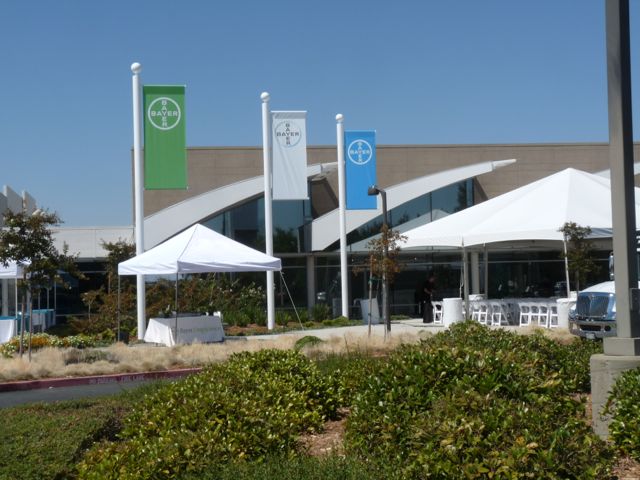
A big step for Biopesticides in California was the recent grand opening of the Bayer CropScience’s $80 million investment in their biologics and seed business in West Sacramento. It will focus on this new frontier of pest and disease control.


Adrian Percy, Bayer CropScience Global Research and Development (Source: www.bayercropscience.com)

Adrian Percy, Bayer CropScience Global Research and Development (Source: www.bayercropscience.com)

Adrian Percy, global head of research & development (R&D) with Bayer CropScience, explained Bayer’s decision for the West Sacramento location, “First and foremost, California is an amazing hub of agricultural innovation. We have UC Davis just down the road, which we have close ties to. In 2012, we purchased AgraQuest, which was based in Davis, so basically we’re moving them into this new facility which is much bigger and more state-of-the-art than what they were using previously,” said Percy.

“We’re really excited because here we will be researching brand-new applications based on bacterial-based products, fungicides, insecticides, etc. In addition, we will be developing new vegetable seed varieties,” said Percy.

Among the advantages of these new biologic tools for growers is avoidance of MRLs, a big boon for vegetable growers. “We see a lot of advantages for these types of products. And this is one of the fastest growing sectors both for us as a company, but also in general. What we are seeking to do now is bring next generation products to the marketplace which are even better than the ones we have today,” said Percy.

“These kinds of products, I think from a stewardship and management perspective, are very advantageous to the grower,” he added.

2016-05-31T19:33:25-07:00September 17th, 2014|

FY 2014 Conservation Innovation Grant National Awardee

California Dairy Research Foundation (CA) $73,000

Improving Conservation Practice Adoption and Nutrient Management Plan Implementation through Utilization of Adapted Decision Support Tree eLearning Methods

California is home to 1.8 million dairy cattle, over 80 percent of which reside in the state’s Central Valley, an area rich in agriculture and responsible for nearly 20 percent of the nation’s milk supply. Central Valley dairy farms produce much of the forage necessary to feed their cows by utilizing manure nutrients to grow crops year-round. Cow manure is an important renewable resource used to fertilize crops, replenish soil nutrients and enhance soil quality.

Utilizing manure effectively is paramount to sustainable dairying and agriculture, but has been regulated since 2007. Regulatory requirements include the maintenance and implementation of both waste management and nutrient management plans.

The industry’s regulatory and environmental success depends on individual dairy producer ability to identify and adopt conservation practices and implement superior nutrient management to protect scarce surface and ground water resources. Multiple potential challenges exist which may prevent full implementation of all aspects of nutrient management and available conservation practices within a given operation.

Barriers are most often site-specific and require individual assessment of current systems, equipment and practices to determine optimal farm solutions. This project will develop, field-test and demonstrate the use of an electronically available teaching and learning (eLearning) system as an innovative approach to conservation practice adoption and nutrient management implementation. A proven decision tree support system will be adapted into an eLearning format to enable individual farm nutrient management needs assessment.

Its guiding principles will be communicating scientifically-proven yet practical, cost-effective options at various nutrient management system critical control points (decision tree nodes) to assist producers in identifying site-specific solutions for full nutrient management plan implementation. 

2016-05-31T19:33:25-07:00September 16th, 2014|
Go to Top