Federal Milk Marketing Order in California in Effect Nov. 1

Questions Arise Regarding Milk Quota

Edited by Patrick Cavanaugh

Dairymen and women throughout California are working hard to provide milk and other dairy products for consumers in California and the world. Because the industry has struggled over the past decade with price swings that have often landed dairies in red, many dairies have gone out of business. Still, other operations relocated to others states where regulations are a fraction of what they are in California.

In June 2018, California dairy producers voted to establish a new Federal Milk Marketing Order (FMMO) for the state. The vote was a paramount step in a long process that would culminate with the new order taking effect on November 1. The order will adopt the same dairy product classification and pricing provisions currently used throughout the FMMO system.

California accounts for more than 18 percent of U.S. milk production and is currently regulated by a state milk marketing order administered by the California Department of Agriculture (CDFA). Once this new FMMO takes effect, more than 80 percent of the U.S. milk supply will fall under the FMMO regulatory framework.

Western United Dairymen is a trade association based in Modesto. Annie AcMoody is the Director of Economic Analysis. She explained that there have been questions from the industry regarding the upcoming FMMO.

Among the often asked question revolves around when the state switches to FMMO in November, what will happen to their quota if a dairy ships milk out of state?

Annie AcMoody: When our California state system goes away to make way for the Federal Milk Marketing Order (FMMO) in November, the Quota Implementation Plan (QIP) will be the language in place to ensure the quota system’s smooth transition into the FMMO system.

When we enter that new world, all market milk received from California producers at a California plant will be assessed for quota. By “received”, the language defines “to convey milk physically into a milk plant where it is utilized within the plant, or stored within such milk plant and transferred to another plant for utilization. This means that a milk truck driver cannot drive by a plant, wave hello to an operator, and keep on going out of state and still call this milk received in California. Basically, if your California milk leaves the state, you will not be assessed for quota.

But you also will not be paid for it. But, if your milk is 60% quota and only 40% of your milk goes out of state, you will be assessed on 60% of your milk and get paid quota on that same 60%. If your quota covers 100% of your milk and 40% of your milk goes out of state you will be assessed on 60% of your milk and get paid quota on that same 60%. In this instance, one could wonder if it makes much sense to keep your quota.

While it may not make much economic sense to hold on to quota you are not paid for, some reasons may validate that decision (perhaps it is expected milk will be shipped to a California plant in the near future). If you were to decide to hold on to that quota, it is important to keep in mind that “if quota is not made active by shipments of market milk to a California plant or cooperative association or is not transferred within the 60-day period, such quota shall revert to the Department”.

This excerpt from the QIP means that if your quota milk is not paid on for over 60 days, you will lose it, so you better sell it. This is likely going to be an issue if you ship to a proprietary plant and all your milk goes out of state. If you ship milk to a cooperative, there is more flexibility because that coop has the ability to combine quotas assigned to it by its members.

So as long as the quota total within the coop is not larger than the total amount of market milk produced and received in California, then there should be no issue for you as a quota holder.

What 
is 
defined 
as 
market 
milk?


Answer:
 Grade A milk.

If your milk is Grade B, you cannot have quota now and will not be able to under the QIP. You will not be assessed for it either. Currently, only around 3% of the milk in California is Grade B. WUD will keep an eye out on this topic to ensure that percentage does not deviate significantly. As a reassurance, this is not something that could grow from 3% to 50% in a month since fluid milk is not allowed to take in Grade B milk and the three largest coops in the state (CDI, DFA and LOL) committed to not taking in any more Grade B milk after the transition to the FMMO.
2021-05-12T11:17:09-07:00September 23rd, 2018|

$102.7 Million Available to Help Expand Specialty Crops

USDA Funding Program to Help Support Local Projects

News Release Edited By Patrick Cavanaugh

Specialty crop growers in California may be able to use part of the $102.7 million available to support local projects and to help expand markets for specialty crops.

“Every state has agricultural priorities that contribute to the well-being of farm families, consumers and the economic health of rural America,” said Under Secretary Greg Ibach in a recent press release. “These programs target resources to the state, local and regional level where the people who understand the issues best can find solutions that help everyone.”

Resources to be apportioned include:
  • $72.15 million is directed to state departments of agriculture in 50 states, the District of Columbia and five U.S. territories through the Specialty Crop Block Grant Program to support farmers growing specialty crops, including fruits, vegetables, tree nuts, and nursery crops. States use the grant to fund research, agricultural extension activities and programs to increase demand for agricultural goods of value to farmers in the state or territory.
  • $13.35 million is directed to 49 projects supporting direct producer-to-consumer marketing projects such as farmers markets, community-supported agriculture programs, roadside stands, and agri-tourism through the Farmers Market Promotion Program.
  • $13.45 million is directed to 44 projects to support the development and expansion of local and regional food businesses to increase domestic consumption of, and access to, locally and regionally produced agricultural products, and to develop new market opportunities for farm and ranch operations serving local markets through the Local Food Promotion Program.
  • $1.1 million is awarded for nine projects through the Federal-State Marketing Improvement Program to assist in exploring new market opportunities for U.S. food and agricultural products and to encourage research and innovation aimed at improving the efficiency and performance of the marketing system.

For more information about these programs, visit www.ams.usda.gov

2018-09-21T15:24:22-07:00September 21st, 2018|

2017 Tulare County Crop Report Tops $7 Billion

Tulare Crop Report Shows 10 Percent Growth in Single Year

By Patrick Cavanaugh, Editor

Big numbers announced today from Tulare County Ag Commissioner Marilyn Wright on the 2017 crop year.

“Our value is 10.5 percent up from last year, at 7,039,929,000. So, that’s 669 million more than the previous year,” Wright said.

Marilyn Kinoshita, Tulare County Ag Commissioner

Marilyn Wright, Tulare County Ag Commissioner

And, of course, more water in the system probably helped, as it did in Fresno County, which announced $7.028 billion in its 2017 Crop Report, released earlier this month.

The dairy industry, which is prominent in Tulare County, came in number one again, representing 25 percent of the total value.

“Milk prices were stronger in early 2017, but they went down later in the year. And they continue to go down, but still it was a big part of the Tulare County ag receipts in 2017,” Wright said.

Following dairy were grape products—including juice grapes, raisins, and table grapes. Table grapes had a stellar year.

Navel and Valencia oranges were next. Cattle and calves ranked fourth, down from category number three in 2016, because cattle prices were off last year.

Tangerines, also known as mandarins, were number five, followed by almonds, cling peaches, and freestone peaches.

Lemons, were ninth on the crop list.

We only have just over 10,000 acres of lemons in the County, Wright said.

Wright said the value of this year’s crop report, $7.39 billion, is the third highest value Tulare County has ever reported.

2018-09-18T16:39:21-07:00September 18th, 2018|

Calmer Minds Must Prevail for Trade Talks

California Growers in a World Market

By Patrick Cavanaugh, Editor

Paul Wenger, a Stanislaus County almond and walnut grower told California Ag Today recently  that California growers have often suffered with tariffs. “The proposed trade agreements such as TTIP and TPP along with NAFTA would have helped solve tariff problems,” he said. “But TTIP and TPP are gone.”

“The Trump administration may try to negotiate a bilateral agreement with other countries, and he seems to be working on NAFTA with Mexico,” noted Wenger, who is also the past president of the California Farm Bureau Federation.

At the end of the day, Wenger hopes that calmer minds will persevere and we’ll see these trade negotiations get done and we’ll move forward.

“Because we are in a world market,” Wenger explained. “As much as President Trump puts tariffs on steel and aluminum … saying that we’re going to bring back our rust belt, well, we’re not, because it’s not the market that has killed the steel industry, it has been the regulations. Our steel industry can’t produce at a level that people are willing to pay.”

There are a lot of crops that can only be grown in a Mediterranean climate. There are only five Mediterranean climates in the world; California is one of them and the largest producer of specialty crops.

The central part of Chile can produce a lot of the crops that we have today. But other than that, it’s the south tip of Australia and South Africa and the Mediterranean region itself.

“When you really think about who can produce, as long as we have the water, not only do we have to worry about marketing our product, we have to also fight for our water so we can produce those crops. And long-term, people are going to find a path to California for the crops that we grow here,” Wenger said.

2018-09-11T15:59:43-07:00September 11th, 2018|

Food Bloggers, Dietitians Learn More About Produce Safety in Salinas

“Facts Not Fear” Educates Participants on Vegetable Production

News Release Edited By Patrick Cavanaugh

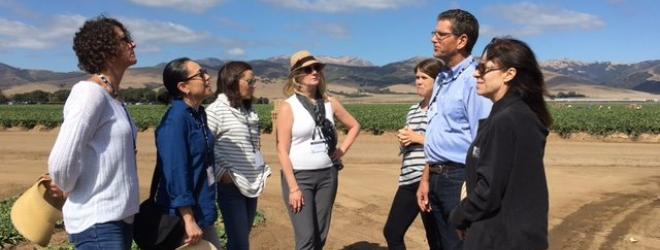
The Alliance for Food and Farming, in conjunction with Markon Cooperative, hosted its second “Facts Not Fear” Produce Safety Media tour last week in the Salinas Valley.

“Our goal is for … [registered dieticians], health and nutrition writers and bloggers to see firsthand the care and commitment farmers have for producing safe and wholesome foods.  We believe we met that goal.  But, what we learn from our tour guests continues to be just as valuable,” said Teresa Thorne, Executive Director of the Alliance for Food and Farming, based in Watsonville.

In addition to farm and facility tours, the AFF and Markon facilitated a round table meeting where tour guests were joined by farmers and farming companies, scientists, regulators and chefs for a free-flowing discussion that encompassed food safety, farming practices, food waste, pesticide use, food safety regulations, new technologies, health and nutrition, and consumer outreach.

The RDs, bloggers, and writers attending the tour reported they enjoyed the chance to tour the farms one day and then discuss what they saw with these experts.  They also appreciated the opportunity to share their information needs and concerns directly during the round table discussion.

And, what were some of our key takeaways from guests?  Consumers want transparent and honest communication regarding food safety and food production practices.  The RDs, bloggers, and writers share The Alliance for Food and Farming’s concerns about produce safety misinformation and appreciate and need access to scientists and experts that can assist them when addressing consumer questions and correcting misconceptions.

“And, they were very impressed with the technological advancements they saw in the harvesting and processing of produce,” said Thorne.

“While the importance of seeing the fields and harvest and touring processing facilities cannot be underscored enough, meeting and connecting with the people growing our food, directly sharing concerns with farmers and scientists in a group and one-on-one setting and the expansion of their produce industry network is of equal importance for our guests,” Thorne explained.

“Our sincere thanks to everyone who allowed us to visit their farms, watch the harvest, view their processing facilities as well as joined us for the round table discussion,” Thorne said.  “And, our thanks and appreciation to our tour partner, Markon Cooperative, for making this tour possible as well as our tour sponsors Cal-Giant Berry Farms, the California Strawberry Commission and the Produce Marketing Association.”

Thorne also praised the 2017 and 2018 tour alumni.

“We will keep the conversation going and look forward to learning more from the attendees as we all work toward our shared goal of increasing daily consumption of organic and conventional fruits and veggies,” she said.

The host, The Markon Cooperative, supplies the food service industry fresh fruits and vegetables.

2018-09-06T16:01:40-07:00September 6th, 2018|

Lessening Negative Feelings Over Trade War

Walnut Processors Maintain Optimism

By Patrick Cavanaugh, Editor

California Ag Today recently spoke with Paul Wenger, past president of the California Farm Bureau Federation. He farms 700 acres of almonds and walnuts in Stanislaus County. He said that California Farmers and other stakeholders of the industry need to be less negative about the current trade war with China.

Almond and Walnut Grower Paul Wenger

“The more we talk negatively, the more that negative things are going to happen,” he said. “As I talked to walnut processors. They’re optimistic. That’s good news. I’ve talked to some walnut processors and said, ‘Well, what’s going to happen this year?’ We shouldn’t expect much as far as prices.”

“Marketing is always a self-fulfilling prophecy and it’s more psychology than it is anything,” Wenger said. “We are one of the largest producers now. Certainly, China is the largest producer. But China had a terrible crop and so they need walnuts, and so strange things can happen and the Chinese are always one that can bend the rules when they need.”

“We know that’s why President Trump has been going after China supposedly over some of these intellectual properties. Certainly, those aren’t the things that hurt agriculture, but we in agriculture are paying the price as we look at these countervailing tariffs that are coming on,” Wenger said.

Wenger explained that the Chinese know that, throughout the Midwest, it was the farm vote that helped and the rural states that helped bring home a victory for the president, so they’re going to go after President Trump.

A large amount of product was sold last season at a low price.

“We just go through the Affordable Care Act and then the port slowdown on the 2015 crop, which went into the 2016 crop, which was a little better We got a little bit better than 2017 crop was a good year for us,” Wenger said. ‘So you’re looking at a pretty good ’18 and now this happens.”

2018-09-04T13:42:28-07:00September 4th, 2018|

Tariffs Causing Problems for U.S. Trade

Long-Term Problems May Be Ahead

By Jessica Theisman, Associate Editor

If a market is lost, it takes time to get it back. California Ag Today recently spoke with Brian Kuehl, executive director of Farmers for Free Trade, about the topic. A concern is that competitors are entering the markets that we currently occupy.

“No farmers invest huge amounts of time and energy trying to open markets or trying to develop trade relationships, and they’re being torn up in a matter of months,” Kuehl said.

Tariffs will cause long-term problems. One major issue is that when tariffs are established, other countries will begin put to put tariffs on our food. Those countries then begin to plant more crops to adjust. Soon, those countries become their own producers instead of relying on the U.S. Those countries then look to other countries that are more dependable, which in turn becomes a competitor to the United States.

The renewal of NAFTA will help.

“If this is not resolved soon, we certainly are doing lasting damage to agriculture. It could trigger the next farm crisis,” Kuehl said.

It looks like the U.S. is moving toward a deal with Mexico on a renewal of NAFTA.

“Hopefully that would quickly lead to a deal with Canada,” Kuehl explained. Mexico and Canada are our biggest trading partners.

For many of our products, China is one our largest trading partners, and certainly one of the ones that is growing the fastest in terms of population.

“We do not want to squeeze ourselves out of the Chinese market for a decade to come; that that would be a colossal error,” Kuehl said.

The U.S. has routed products in the past. Some countries including Vietnam and Hong Kong route products into China.

“There might be a tariff on product going into China directly, but we know some of our growers are able to avoid the product that tariff by selling first to Vietnam and then Vietnam shifts into China,” Kuehl said. That same tactic with Hong Kong is being shut down. China is getting much smarter at saying you can not circumvent our tariff, so we are going to hold you to these tariff rates.”


2018-08-24T17:05:06-07:00August 24th, 2018|

2017 Fresno County Crop Report Totals $7 Billion

Fresno County’s Ag Value Increases Significantly in 2017 Crop and Livestock Report


The Fresno County Department of Agriculture’s 2017 Crop and Livestock Report (Crop Report) was presented to the Fresno County Board of Supervisors Tuesday. Overall, the 2017 agricultural production value in Fresno County totaled $7.028 billion, showing a 13.58 percent increase from 2016’s $6.18 billion.

“Once again, Fresno County farmers and ranchers have produced an agricultural bounty for the world,” stated Fresno County Agricultural Commissioner Les Wright. “While much of this food and fiber goes towards feeding and supplying our nation, the Fresno County Department of Agriculture also issued 18,604 phytosanitary certificates for 133 commodities destined for 97 countries around the globe in 2017.”

“This Crop Report is comprised of nearly 400 commodities, of which 73 crops exceed $1 million in value,” Commissioner Wright continued. “Crop values may vary year-to-year based on production, markets and weather conditions, but our farmers and ranchers, their employees and all those who support their efforts work tirelessly year-around to bring in the harvest.”

With the great diversity of crops in Fresno County and the many variables in agriculture, it’s a given that some crops will be up in value while others are down. Increases were seen in a majority of the Crop Report segments, including field crops, seed crops, fruit and nut crops, livestock and poultry, livestock and poultry products, apiary products and pollination services, and industrial crops. Decreases were seen in vegetables and nursery. Surface water supplies were significantly better in 2017, although many Westside federal water contractors received much of that good news too late to benefit them with additional annual plantings.

Fresno County’s Top 10 Crops in 2017 (Source: 2017 Fresno County Agricultural Crop and Livestock Report)

Too often, the Crop Report gets summarized down to just a single overall number, but it yields a significant amount of information, such as the ability to examine changes and trends in crop acreage and yields. Amounts in the report reflect the gross income values only (income before expenses) and not the net return to producers.

“The San Joaquin Valley is the food capital of the World, and Fresno County is the region’s heart,” said Fresno County Farm Bureau (FCFB) CEO Ryan Jacobsen. “Daily, millions of food servings unceremoniously originate within our backyard, the result of generations of families and agricultural infrastructure that has been built to furnish an unbelievably productive, wholesome and affordable food supply.”

“The annual Crop Reports are more than numbers,” Jacobsen continued. “They provide the industry, the public and policymakers, regardless of the overall number, the opportunity to salute local agriculture and give thanks for the food and fiber, jobs and economic benefits, agriculture provides Fresno County.”

One popular component of the report is the review of the county’s “Top 10 Crops” that offers a quick glimpse of the diversity of products grown here. In 2017, these crops accounted for three-fourths of the report’s value. Almonds continue to lead the way as Fresno County’s only billion-dollar crop in 2017, representing 17.4 percent of the total gross value of the Crop Report. Added to this year’s list was mandarins at number six. Dropping out of the “Top 10 Crops” was garlic.

This year’s Crop Report was a salute to the Fresno-Kings Cattlemen’s Association. The organization is one of 38 affiliates of the California Cattlemen’s Association, a non-profit trade association that represents ranchers and beef producers in legislative and regulatory affairs.

2021-05-12T11:17:09-07:00August 21st, 2018|

Bee Sweet Citrus Joins National Campaign to Support Healthy Eating

Bee Sweet Creates Everyday Healthy Eating Habits

News Release Edited By Patrick Cavanaugh

For the third consecutive year, Bee Sweet Citrus is eager to help kick off the Power Your Lunchbox Promise with Produce for Kids. The Power Your Lunchbox Promise, a national campaign, aims to encourage families and their children to eat healthier lunches, afterschool snacks and everyday dinners.

“Bee Sweet Citrus is very excited to take part in such an amazing, health-oriented campaign,” said Bee Sweet Citrus Director of Communications Monique Bienvenue. “For the past five years, Produce for Kids has done an amazing job of sharing healthy tips and recipes with families and educators. We’re eager to see how our combined efforts can help encourage healthy habits at home and in the classroom.”

The Power Your Lunchbox campaign  ends on September 23rd. Throughout the campaign, families will be encouraged to take an online promise that supports healthy eating at home and at school. For every promise made, sponsors of the Power Your Lunchbox Promise will make a collective $1 donation to Feeding America programs that support families and children.

In addition to the online promotion, Produce for Kids will be marketing register dietitian-approved recipes and nutrition tips on their online and social media platforms. Supporters are encouraged to use the #PowerYourLunchbox hashtag throughout the campaign to help spread awareness on their own social media accounts as well.

“As we celebrate the 5th year of the Power Your Lunchbox Promise, and over 1 million meals donated to Feeding America through the program, we could not have made such an impact without the support of passionate partners like Bee Sweet Citrus,” said Amber Bloom, the digital marketing manager for Produce for Kids. “Together, we’re creating a healthier generation one promise, lunchbox and meal donated at a time.”

2018-08-20T16:31:29-07:00August 20th, 2018|

Agriculture Struggles Unnecessarily, According to Steve Forbes

Forbes Chairman Has Suggestions to Help

By Jessica Theisman, Associate Editor

Water and labor are major agricultural issues in California. California Ag Today recently spoke with Steve Forbes, chairman and editor in chief of Forbes Media, about the topics.

“I think that the more people are realizing the enormous opportunities of technology in agriculture. They think that it is going to get better and better in the future,” Forbes said.Everything from reservoirs to desalination plants should be modeled after Israel. They have been building desalination plants because Israel is in a desert where they have been getting rainfall.

Steve Forbes

“This is a very sophisticated use of water in agriculture where they are a real global power,” Forbes said.

Today, Israel uses 10 percent less water as a whole, not per capita, than they did 70 years ago despite the economy being 60 times larger.

Forbes thinks labor is also an issue.

“We are hurting ourselves, our food production, not just in agriculture but construction as well,” he said.

Forbes said we should recycle the programs that we once had, programs where returning people come in for specific time periods for specific jobs. This would help prevent the illegal immigrant problem because workers know they can come back.

On another note, he discussed the current trade war that the U.S. is in with China.

“If you hear 10 percent tariff on aluminum, that’s a 10 percent sales tax; put it that way and people’s eyes go up and they get it right away,” Forbes said.

Putting sales taxes on American consumers, agriculture, farmers, and businesses is not the best way to resolve very real trade abuses.

“Everyone knows from the disaster and the depression of the 1930s what trade wars can lead to,” Forbes said.

Forbes also explained that GMOs greatly benefit producers and should not be attacked as harmful to consumers.

“GMOs have been studied fairly well, and they are making food more plentiful. It makes food a safer in terms that you don’t have to use as many pesticides,” he said. “GMOs make a better use of water, and there is a lot less loss to diseases and insects. We are using human ingenuity to make the human condition better.”

2021-05-12T11:05:10-07:00August 13th, 2018|
Go to Top