California gets $22 million from USDA for conservation programs

Source: CDFA

Agriculture Secretary Tom Vilsack announced that $328 million in conservation funding (more than $22 million to California) is being invested to help landowners protect and restore key farmlands, grasslands and wetlands across the nation. The USDA initiative will benefit wildlife and promote outdoor recreation and related sectors of the economy.

“Conservation easements help farmers and ranchers protect valuable agricultural lands from development, restore lands that are best suited for grazing, and return wetlands to their natural conditions,” Vilsack said. “These easements are making a dramatic and positive impact for our food supply, rural communities and species habitat.”

The funding is provided through the Agricultural Conservation Easement Program (ACEP), which was created in the 2014 Farm Bill to protect critical wetlands and encourage producers to keep lands in farming and ranching. Approximately 380 projects nationwide were selected to protect and restore 32,000 acres of prime farmland, 45,000 acres of grasslands and 52,000 acres of wetlands. A summary of ACEP funding provided to each state can be found online.

In addition to protecting cropland and critical habitats, conservation strengthens outdoor recreation and helps boost the economy. According to the National Fish and Wildlife Federation, annual United States conservation spending totals $38.8 billion, but it produces $93.2 billion of economic output throughout the economy – 2.4 times more than what is put in. This output takes the form of more than 660,500 jobs, $41.6 billion in income and a $59.7 billion contribution to national Gross Domestic Product, or GDP.

Through ACEP, private or tribal landowners and eligible conservation partners working with landowners can request assistance from USDA to protect and enhance agricultural land through an agricultural or wetland easement.

These easements deliver many long-term benefits. For example, this year’s projects will:

  • Improve water quality and wetland storage capacity in the California Bay Delta region;
  • Reduce flooding along the Mississippi and Red rivers;
  • Provide and protect habitat for threatened, endangered and at-risk species including sage grouse, bog turtles, Florida panthers, Louisiana black bear, and whooping cranes to recover populations and reduce regulatory burdens; and
  • Protect prime agricultural land under high risk of development in urban areas to help secure the nation’s food supply and jobs in the agricultural sector.

ACEP consolidates three former Natural Resources Conservation Service (NRCS) easement programs – Farm and Ranch Lands Protection Program, Grasslands Reserve Program and Wetlands Reserve Program – into two components. One component protects farmlands and grasslands, and the other protects and restores agricultural wetlands.
2016-05-31T19:33:26-07:00September 12th, 2014|

Got ice cream! (Thanks to UC Davis)

By Trina Wood

Chances are when you’re scooping that vanilla bean ice cream into your bowl for dessert, you’re focused on the flavor about to hit your taste buds, not on whether it may give you a foodborne illness.

That confidence in the safety of California’s dairy products  — the state’s top agricultural commodity, valued at nearly $7 billion in annual retail sales — results in part from the efforts of the San Bernardino branch of the California Animal Health and Food Safety laboratory system.

This network of laboratories, headquartered at UC Davis and administered by the UC Davis School of Veterinary Medicine on behalf of the California Department of Food and Agriculture, performs surveillance and diagnostic testing for livestock and poultry.

The San Bernardino laboratory carries out such work on milk and dairy products that are submitted by the state’s Milk and Dairy Foods Safety Branch. The lab’s on-site bacteriology section tests for a variety of disease-causing microbes including  ListeriaBrucellaSalmonellaCampylobacter and E. coli O157:H7 — all of which can cause severe illness and even death.

Protecting against foodborne diseases

The U.S. Centers for Disease Control and Prevention estimates that each year roughly one in six Americans (or 48 million people) get sick with a foodborne disease.  Of these, 128,000 are hospitalized and 3,000 die from these illnesses.

However, such diseases have almost been eliminated from licensed milk and dairy products, thanks, in large part, to a strong regulatory framework, including adherence to pasteurization and laboratory standards.

Approximately 1,500 samples of milk, dairy products and water arrive monthly at the San Bernardino lab resulting in approximately 4,200 tests conducted by a team of eight technicians. These microbiological assessments monitor bacteria populations and the effectiveness of pasteurization in destroying harmful bacteria.

Partnering with California

“The laboratory system has been a successful partnership between the state and UC Davis since 1987,” said its director, Richard Breitmeyer.

He noted that it was natural in the 1990s to expand the lab’s statewide regulatory testing services to include milk products. Before then testing was limited to samples from only Southern California.

In 2000, the California Department of Food and Agriculture was so impressed with the accuracy and timeliness of the California Animal Health and Food Safety laboratory system that it placed all such statewide regulatory compliance testing in the network of labs, in a move that  enabled the state to cut costs, speed analysis and consolidate testing.

The San Bernardino lab

Three years ago, the state asked the laboratory system to also begin testing  milk and dairy products for chemical components such as fat and protein content. The San Bernardino lab now provides this service.

“I’m proud of our efficiency,” says Jose Gallegos, the San Bernardino lab’s supervising dairy analyst, who has been with the laboratory system for 20 years and oversees the milk quality testing lab. “Results are rapid and consistent, and reduce the number of people who become ill in the event of an outbreak.”

The San Bernardino laboratory is considered the state reference lab for California and holds the distinction of being the only veterinary facility in the nation set up as a regulatory testing facility. In addition to running tests for the state, the laboratory also is certified by the U.S. Food and Drug administration, under the National Conference of Interstate Shippers program guidelines to run microbiological tests.

Testing dairy products

As part of this testing program, the state sends samples from three sources: the farm, processing plants and retail establishments where the finished product is sold. The lab also tests some exports such as ice cream for microbiological components and dry goods such as powdered milk.

State milk and dairy officials may submit samples from a location if a report comes in that someone has become ill after eating or drinking at a particular business. State and federal investigators also routinely check farmers markets and small establishments for raw or illegally processed milk and dairy products that could pose a serious health risk. Those products are sent to the San Bernardino lab to be tested for the presence of bacteria or improper pasteurization.

Samples sent to the lab must be transported at the proper temperature, arrive within 60 hours of collection and be properly packaged before they are tested for general bacteria populations. If the testing criteria aren’t met, those samples are rejected for testing and reported to the state for recollection. Any test results indicating the products were not produced in compliance with state regulations are reported to the California Department of Food and Agriculture, which is authorized to enforce the regulations.

After milk samples have been analyzed for bacteria and other indicators of improper sanitation at a facility, they move on to be tested for drug residue and other unwanted substances such as antibiotics, which may have been used to treat sick cows.

Farmers are required to keep milk out of the supply line until the medication has cleared from the cow’s system and the milk meets strict requirements established by the FDA. Other testing, such as checking for proper pasteurization and possible water contamination, complements the tools used by state officials to ensure the quality and safety of the milk supply.

“We’re always looking at developing better tests and working with our partners to provide the highest level of service,” Gallegos says. “Knowing all the quality testing processes in place, I feel great about drinking milk!”

About CAHFS

CAHFS is a public service program of the university. The primary objectives of the CAHFS are to provide appropriate and timely diagnostic support to safeguard the health of California’s dairy, livestock and poultry industries and to protect the public health from animal disease.


2016-05-31T19:33:26-07:00September 11th, 2014|

9/11 Memorial Plaza at California State Fairgrounds to open for September 11 anniversary

Source: CDFA

In observance of the September 11 attack of the World Trade Center in 2001, the 9/11 Memorial Plaza at the California State Fairgrounds at Cal Expo will open to the general public on September 11, 2014 from 8:00 a.m. – 6:00 p.m. The memorial honors the victims lost 13 years ago.

At 9:00 a.m., the Sacramento Young Marines will present colors at the Memorial, which is located inside the main gate near the Expo Center buildings. Admission and parking are free.

Central to the exhibit is a beautiful fountain including a granite ball inscribed with all of the names of the September 11 victims. There are also replicas of the World Trade Center buildings and memorials to American Airlines Flight 77–which crashed into the Pentagon–and United Airlines Flight 93, which crashed in a field in Pennsylvania.

Construction of the Cal Expo memorial began a year after the attack, when Cal Expo board member Larry Davis personally acquired and donated 125,000 pounds of wreckage from the World Trade Center. A massive I-beam extracted from Ground Zero was among the debris. Davis personally arranged for the wreckage to be shipped via rail to California. Through private donations to the California State Fair Memorial Plaza Foundation, the exhibit has been expanded to include additional elements.

2016-05-31T19:33:27-07:00September 9th, 2014|

Atwater High’s agriculture department getting national recognition

Source: Doane Yawger; The Merced Sun-Star

Atwater High School’s agriculture program is in the running to be named the top such endeavor in the nation.

By virtue of being named the top ag program in the state this year by the California Agricultural Teachers Association, the Atwater program was nominated for the national award and should be notified soon, Principal Alan Peterson said.

“They’re getting the recognition they deserve,” Peterson said. “They deserve it. They are a hardworking staff with a lot of motivated students.”

The national ag teachers association holds its annual conference Nov. 18 in Nashville, Tenn.

Dave Gossman, AHS agriculture department chairman, said at least half of the school’s 1,800 students have taken one or more agricultural courses. Last year it became the largest single high school ag program in the nation.

“We’re excited,” Gossman said. “We’ve got a supportive school, district, community and ag industry. The credit should go to all.”

There are five directions ag students can take. They can take pathways in agricultural mechanics, which includes welding, engines and woodworking. Or they can take agricultural science, ag biology and life science courses. Then there is floriculture; animal science and veterinary skills; and leadership and agribusiness, Gossman said.

Makala Navarro, a senior and an ag student, said she didn’t have many expectations when she took agriculture as a freshman.

“I was quiet and shy. I had no ag background,” Navarro said. “Through the past three-plus years, I have gained confidence and direction in life, and my goal is to enter a four-year university and major in agriculture education with the desire to be an agriculture teacher.

Natalie Borba, ag instructor, said the reason so many students get involved in agriculture education and Future Farmers of America is because it has personal value, it’s fun, and gets them participating in activities and events that extend beyond the classroom.

“For the parents and guardians, ag ed serves as a vehicle toward academic interest and success. For the community and ag industry, it keeps kids focused on something positive and provides a future pipeline of leaders and industry employment,” Borba said.

Gossman said if Atwater High is selected as the Region 1 winner of the State Outstanding Middle/Secondary School Agricultural Education Program Award, a teacher from its agriculture program will receive an expense-paid trip to attend the 2014 NAAE convention, where the program will be recognized during a general session. The Atwater program also received the top state award four years ago.

The Outstanding Middle/Secondary School Agricultural Education Program award is partially sponsored by Monsanto as a special project of the National FFA Foundation. Applicants are judged on teaching philosophy, effective classroom and experiential instruction, development of partnerships, and professional growth.

“The award and recognition is something we take pride in. However, it reflects the positive difference agricultural education makes on young people in terms of personal growth, academic success and career exploration,” Gossman said. “It is a proven education model that is for all kids. It provides value to both agriculture and non-agriculture-directed students.”

Gossman said the same success stories can be found in all high school agriculture programs throughout the state.

“It’s all about making a positive difference in the lives of young people,” Gossman said. “Ag ed is a great vehicle to accomplish this task.”

The National Association of Agricultural Educators, the professional organization in the United States for agricultural educators, provides its nearly 8,000 members with professional networking and development opportunities, professional liability coverage, and extensive awards and recognition programs.


2016-05-31T19:33:27-07:00September 9th, 2014|

CA Grown Releases New “Growing California” Video

The California Department of Food and Agriculture released a new segment in their “Growing California” video series. This installment, “Water Wise,” focuses on one of the most pressing and contentious issues facing the state, efficient water use while also producing crops.

In the words of CDFA Secretary Karen Ross, the video series is a way to connect people to the food they eat and the tremendous bounty of California agriculture. “I just see this yearning for people to make a connection,” Secretary Ross said. “In an era when people want to know more than ever about the origins of their food, we wanted to do our part in sharing these important, compelling stories.”

Total viewership on CDFA’s Planting Seeds Blog for a tracked period in 2013 (February through September) was 59,071 – a 22,384 viewer increase from the previous year. Of the increased viewership – the video series is representative of approximately 44 percent of this total. Average viewership per video, as of September 2013, is estimated at 346 views.

Growing California is a partnership between CDFA and the Buy California Marketing Agreement, which is behind the “California Grown” campaign. The videos, which have won a total of six Telly Awards, were produced in association with the Creative Services department at California State University, Sacramento (CSUS).

You can see more videos in the series here at http://www.californiagrown.org/growing-california/.

2016-05-31T19:33:27-07:00September 8th, 2014|

Slant Well to Address Water Shortage Without Harming Environment

By Valerie King; National Driller*

History is unfolding along the coast of California, according to Dennis Williams, president of GEOSCIENCE Support Services Inc.

His groundwater consulting firm has designed something like 1,000 municipal water supply wells in almost 40 years. But those were typical wells, vertical wells. What he’s working on now he’s only done once before.

“Necessity is the mother of invention,” he said, alluding to a well technology his firm is designing for California’s Monterey Peninsula. It’s called a slant well or subsurface intake, and while the technology has been used in Europe and tested in the United States, he says it’s still a very rare method.

“The evolution of the subsurface slant well technology,” as Williams calls it, is an outcome of California state regulators and environmental groups that prefer an environmentally friendly approach to desalination. Their goal is to avoid harming marine life like more traditional ocean pipelines tend to.

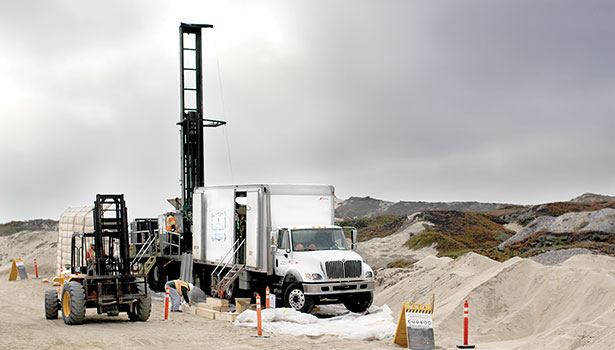
The slant well will be drilled close to the coastline at a diagonal and collect enough ocean water to produce about 100 million gallons of drinkable water daily.

That’s what California American Water hopes, according to Rich Svindland, vice president of engineering. California American Water is a subsidiary of American Water Works Company Inc., the largest publicly traded U.S. water and wastewater utility company. They proposed the idea after California ordered reductions to the Monterey Peninsula’s current water sources, a local river and aquifer that are expected to lose more than half of their current supply in the next decade.

“The idea is that we’re trying to launch a well field out under the ocean floor to basically ensure that we capture ocean water as opposed to inland ground freshwater,” Svindland said. The local groundwater basin he’s referring to is protected and cannot be exported to residents across the peninsula.

*This article was originally published in National Driller, Copyright 2014.  The entire article can be found at National Driller.

2016-05-31T19:33:27-07:00September 3rd, 2014|

California Grown gets new chairwoman

By Mike Hornick; The Packer

Cherie Watte, executive director of the California Asparagus Commission, is the new board chairwoman of California Grown, succeeding Kasey Cronquist, chief executive officer of the California Cut Flower Commission.

The Buy California Marketing Agreement manages the California Grown campaign.

Executive committee members on the California Grown board include vice chair Spencer Halsey, associate director of the California Association of Gardens and Nurseries; and secretary treasurer Karla Stockli, chief executive officer of the California Fig Advisory Board.

Before becoming executive director of the California Asparagus Commission, Watte was director of international trade policy at the California Department of Food and Agriculture. She was also appointed manager of the department’s agricultural export program by then-Gov. Pete Wilson.

Prior to her CDFA appointment, Watte was the director of national affairs and research for the California Farm Bureau Federation. Other roles included legislative assistant to congressman Tony Coelho on the U.S. House of Representatives committee on agriculture. She is a former member of the U.S. Department of Agriculture’s agricultural trade advisory committee on fruits and vegetables.

“(Cherie) knows firsthand what it takes to be an active farmer in California, since she is the fourth generation of her family to farm in the Imperial Valley,” Nick Matteis, executive director of California Grown, said in a news release.

“We have a lot going on with consumer promotions and newly formed retail and foodservice partnerships,” Watte said. “Farmers and ranchers in California face many challenges, and this program is a bright spot for them.”

Cronquist guided the campaign through the revamping of its promotions program and membership expansion.

2016-05-31T19:33:28-07:00September 2nd, 2014|

Californian kiwifruit industry forecasts good fruit quality

Source: Fresh Fruit Portal

The upcoming season looks as though it should be a relatively positive one for Californian kiwifruit growers, with normal production, good fruit quality, and strong domestic market conditions.

California Kiwifruit Administrative Committee assistant director Nick Matteis said that as of the board’s latest meeting in July, the industry was anticipating a production of around 6.8 – 7 million seven-pound tray equivalents.

“That’s about average, based on producing acreage and what our growers are able to get produced per acre. It’s about a normal size crop, and the distribution of sizes will be pretty normal as well,” Matteis told www.freshfruitportal.com.

“It’s not lopsided towards larger sizes necessarily nor smaller sizes – there should be a good variation in size profile. The quality looks to be good as well, though at this juncture of course we still have a month and a half of growing season left.”

The board of directors will hold another meeting in September to take one last look at the estimates and see if anything dramatic has occurred.

Matteis said although it didn’t sound like growers have had serious problems with the state-wide drought, he could not be sure due to the vast area they covered.

“It’s hard to generalize how people are going to be affected because we have growing regions closer to the northern area and some further to the south with a couple of hundred miles in between,” he said.

“Most folks are pumping groundwater because there’s zero allocation from the state and federal water resources departments.

“So I think everybody’s going to make it just fine this year – I guess I could summate – but there is some pretty significant groundwater pumping that’s going on now to keep flows where they need to be to get to harvest.”

He added demand looked like it would be strong going into the season, with the first harvest expected to take place around six or seven days earlier than last year.

“Probably at the end of September we’ll start seeing some of the first fruit harvested, but the harvest being in full swing is usually around the first or second week of October,” Matteis said.

“The actual harvest will go till the end of November and then the marketing season will run from October all the way to April.”

Generally around 70-75% of the fruit is sold to the North America market, with Canada and Mexico being the two biggest importers.

2016-05-31T19:33:28-07:00September 1st, 2014|

Ag Alert update: Milk-pricing bill withdrawn

Source: Ag Alert

California Department of Food and Agriculture Secretary Karen Ross announced Wednesday that milk-pricing legislation will not be pursued during this legislative session.

In a statement, she acknowledged that timing on Assembly Bill 2730 “was not ideal,” but that she was “compelled to see if we could get something done this year.”

“Since the August 13th Task Force meeting, a tremendous amount of progress has been made, but not enough,” she said.

Ross did not say whether the department will pursue reform legislation again next year or discuss the future role of the Dairy Task Force.

Watch for further coverage in the Sept. 3 issue of Ag Alert. 

2016-05-31T19:33:28-07:00September 1st, 2014|

Commentary: Russian ban shows the folly of using food as a weapon

By Stewart Truelsen; AgAlert

We can only guess how the decision was made for Russia to ban food imports from most of the Western world, but perhaps it went something like this: President Vladimir Putin was sitting with some of his old pals from his KGB days. Putin was desperate for a way to retaliate against the West for its economic sanctions leveled against Russia for intervening to help the rebels in Ukraine. He asked for suggestions.

“Why not a boycott of their food?” suggested a former Soviet general, remembering the grain embargoes of the 1980s. “The Americans, they hate food boycotts and embargoes.”

That much is true—American farmers and ranchers hate the use of food as a weapon. In January 1980, President Jimmy Carter announced a U.S. embargo of grain and oilseed shipments to the Soviet Union because of its invasion of Afghanistan. The American Farm Bureau Federation thought it was unwise to single out American farmers by using food as a weapon of foreign policy. If sanctions were needed, AFBF preferred they be across the board, not just on food.

The grain embargo of 1980 proved to be a failure. It stimulated more grain and oilseed production in South America to fill the void left by the U.S. Fifteen months later, when President Reagan ended the Carter embargo, it had cost American farmers around $1 billion in lost export business.

This time, the biggest losers will not be American farmers.

“This is clearly a political move,” said AFBF President Bob Stallman of Putin’s ban on food imports. “It is unfortunate that the biggest losers will be the Russian consumers, who will pay more for their food now as well as in the long run.”

The old Soviet Union was dependent on American grain and oilseeds in the 1970s and ’80s, to make up for harvest shortfalls that were common under the communist system. Beginning in the 2000s, the three major grain-producing regions of the former USSR—Russia, Ukraine and Kazakhstan—became major grain exporters.

In 2013, Russia was the 20th largest market for U.S. agricultural and related product exports, accounting for less than 1 percent of total U.S. agricultural exports. Approximately 55 percent of these export products will be affected by the ban.

(For California, Russia ranked as the 15th largest export market in 2012, with shipments totaling $144.7 million, or about 1 percent of the state’s total agricultural exports. Almond shipments accounted for roughly 70 percent of the Russian purchases, but the Almond Board of California estimated Russia represented only about 3 percent of the export market for California almonds.)

Neither side, therefore, is as dependent on the other as they were in the past. Soviet grain deals once provided a huge stimulus to the American grain market. Nothing like that exists between Russia and the U.S. On the other hand, Europe supplies 40 percent of Russia’s agricultural market and will feel the sanctions more.

The idea to use food as a weapon is a bad one. American farmers could have told Putin that. Whoever suggested it to him should be put on the next train to Siberia. The Russian people have been turned into unwilling locavores, having to rely much more on locally produced food and paying more for it.


2016-05-31T19:33:28-07:00August 29th, 2014|
Go to Top