California Leopold Conservation Award® Seeks Nominees

SAN FRANCISCO, Calif. – (April 28, 2015), the California Farm Bureau Federation and Sustainable Conservation are accepting applications for the $10,000 California Leopold Conservation Award. The award honors California farmers, ranchers and other private landowners who demonstrate outstanding stewardship and management of natural resources.

“The Leopold Conservation Award celebrates the people and places where innovative and creative thinking and experimentation are taking place,” said Judith Redmond of Full Belly Farm, recipient of the 2014 Leopold Conservation Award. “If you or a friend include conservation in your daily decision making – I hope you’ll submit a nomination. It’s okay to brag about good land stewardship.”

“Good intentions and luck take no farmer down the road to profitability and improved land health. Leopold Conservation Award recipients epitomize the creativity, drive and heartfelt conservation commitment it takes,” said Sand County Foundation President Brent Haglund.

Given in honor of renowned conservationist Aldo Leopold, the Leopold Conservation Award inspires other landowners by example and provides a visible forum where farmers, ranchers and other private landowners are recognized as conservation leaders. In his influential 1949 book, “A Sand County Almanac,” Leopold called for an ethical relationship between people and the land they own and manage, which he called “an evolutionary possibility and an ecological necessity.”

“California’s future gets brighter only if we all do our part,” said Sustainable Conservation Executive Director Ashley Boren. “The Leopold Conservation Award celebrates those deserving, but often overlooked, landowner heroes who do their part every day to steward our environment in ways that benefit people and the planet. The Leopold Conservation Award is proud to have recognized a diverse range of agricultural operations over nearly a decade – including CSA, dairy, rice, vegetable and tree crop farmers, as well as cattle ranchers.”

“The Leopold Conservation Award recognizes unique yet replicable strategies a farmer or rancher has developed in managing their land, to be the best steward of the natural resources on their farm or ranch. California farmers and ranchers are the most productive in the world and are trendsetters at maximizing the fullest potential of their land to produce food and other agricultural products with the least environmental impacts,” said California Farm Bureau Federation President Paul Wenger.

Nominations must be postmarked by July 10, 2015, and mailed to Leopold Conservation Award c/o Sustainable Conservation, 98 Battery Street, Suite 302, San Francisco, CA 94111. The 2015 California Leopold Conservation Award will be presented in December at the California Farm Bureau Federation’s Annual Meeting in Reno.

The California Leopold Conservation Award is possible thanks to generous contributions from many organizations, including The Nature Conservancy, American AgCredit, the Lynde and Harry Bradley Foundation, DuPont Pioneer and The Mosaic Company.

ABOUT THE LEOPOLD CONSERVATION AWARD

The Leopold Conservation Award is a competitive award that recognizes landowner achievement in voluntary conservation. The award consists of a crystal award depicting Aldo Leopold and $10,000. Sand County Foundation presents Leopold Conservation Awards in California, Colorado, Kansas, Kentucky, Nebraska, South Dakota, Texas, Utah, Wisconsin and Wyoming.

ABOUT SAND COUNTY FOUNDATION

Sand County Foundation is a non-profit conservation organization dedicated to working with private landowners to advance the use of ethical and scientifically sound land management practices that benefit the environment. www.sandcounty.net

ABOUT CALIFORNIA FARM BUREAU FEDERATION

The California Farm Bureau Federation works to protect family farms and ranches on behalf of more than 74,000 members statewide and as part of a nationwide network of more than 6.2 million Farm Bureau members.

ABOUT SUSTAINABLE CONSERVATION

Sustainable Conservation helps California thrive by uniting people to solve the toughest challenges facing our land, air and water. Since 1993, it has brought together business, landowners and government to steward the resources that we all depend on in ways that make economic sense. Sustainable Conservation believes common ground is California’s most important resource.—-

Mana Mostatabi | Digital Marketing & Communications Strategist

98 Battery Street, Suite 302 | San Francisco, CA 94111

(415) 977-0380 x350 | http://www.suscon.org

2021-05-12T11:06:01-07:00May 5th, 2015|

Ag Day 2015: A beautiful day to be a farmer

California’s agricultural community gathered yesterday on the west steps of the State Capitol to show, see and share the bounty of our state’s farmers and ranchers. It was a perfect day for such a celebration (although to be perfectly honest, the farmers would have preferred rain). In keeping with the United Nations’ declaration of 2015 as the International Year of Soils, the theme for Ag Day this year was “Breaking New Ground.”

Special thanks to the California Department of Food and Agriculture’s partners in organizing Ag Day, the California Women for Agriculture and the California Foundation for Agriculture in the Classroom.  Thanks also go to our emcee, Kitty O’Neal of KFBK Newsradio, as well as event sponsors the California Egg Farmers, the California Alpaca Breeders Association, the California Farm Bureau Federation, California Grown, the California State Board of Equalization, the California Strawberry Commission, the Farmer Veteran Coalition, Got Milk?, John Deere, the Kubota Tractor Company-California, and the University of California Division of Agriculture and Natural Resources.


2016-05-31T19:30:26-07:00March 19th, 2015|

National Agriculture Week is Here

Each year, more than one-million students learn about the importance of agriculture through the efforts of California Foundation for Agriculture in the Classroom. This spring, Agriculture in the Classroom will partner with CDFA and the California Women for Agriculture to host California Ag Day 2015 as part of National Ag Week (March 15-21).

On March 18, the State Capitol will come alive with farm animals, educational displays, and entertainment all celebrating California’s great agricultural bounty during California Agriculture Day. The theme for the 2015 event is “California Agriculture: Breaking new Ground.” A focus will be the importance of soil health to our food supply and all of agriculture.

Ag Day is the agricultural community’s annual opportunity to educate and inspire the farmers and ranchers of tomorrow, showcase new technologies, and highlight the diversity of California agriculture.

California Department of Food and Agriculture (CDFA) Secretary Karen Ross, along with 12 other industry leaders, are members of the National Agriculture Week host committee. The host committee helps plan and promote special events throughout the state.

“Please join me and other leaders in agriculture as we support the education of our next generation of consumers and voters,” said Secretary Ross. “National Agriculture Week gives us the opportunity to celebrate agriculture, an industry that provides a safe, abundant, and affordable food supply, a strong economy, and a world of job opportunities.”

An additional Ag Week event will be held on March 19 at the Sacramento Kings’ Experience Center in Sacramento, to recognize student winners of Ag in the Classroom’s Imagine this… Story Writing Contest. Student authors will attend and read their stories from the newly published Imagine this… books to the audience. A southern California event will be held aboard The Queen Mary on April 2.

Since 1986, The California Foundation for Agriculture in the Classroom, a non-profit organization, has worked to promote a greater awareness of agriculture’s role in our daily lives to California’s teachers and students. The Foundation delivers exciting, standards-based curriculum that builds students’ knowledge of the farmers and ranchers who produce the food, clothing, and shelter they use every day. Agriculture in the Classroom programs reach far beyond the classroom walls and into the lives of California’s students and their families.

2016-05-31T19:30:26-07:00March 17th, 2015|

BOLING AIRSHIP Alex SOARS, DEMANDS ATTENTION

BOLING AIRSHIP ENTERTAINS VIEWERS

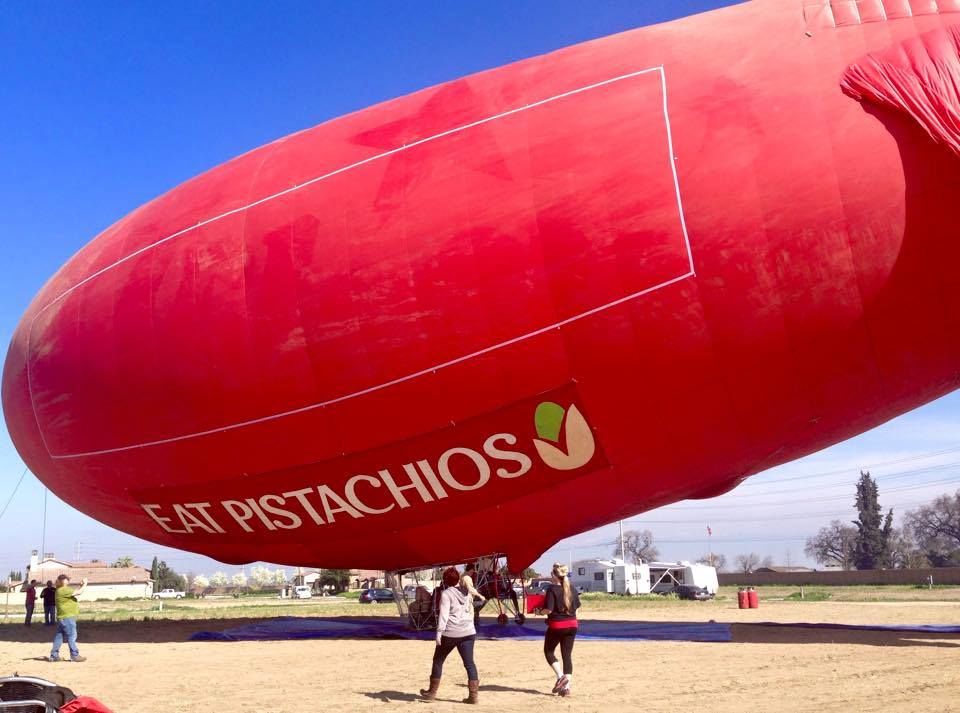
The Boling Air Media thermal airship, ALEX, made its maiden flight in conjunction with the 2015 World Ag Expo in Tulare, taking to the air above the event on February 10, 11 and 12. Alex now works with clients to deliver advertising messages to major outdoor venue audiences.

Boling air in flightThe 150’ long x 65’ tall ship flies approximately 1000’ above the ground and is clearly visible to observers up to 2 miles away. The first advertising banners in Tulare, “Eat Pistachios”, flanked each side of the bright red 105,000 cubic feet aircraft. The client was American Pistachio Growers.

“The thermal airship is similar to a helium blimp in size and structure,” says Boling Air Media President, Chris Boling. “However, our airship uses propane-heated hot air instead of helium. It’s environmentally friendly and is definitely a ‘green’ way to fly.”

VIP guests and members of the press were invited to board the Boling airship for short orientation flights in Tulare. Passengers’ responses were unanimous: flying in a “blimp” is an once-in-a-lifetime experience. Although the airship is capable of carrying up to four passengers, the true thrust behind its operation is as a mobile advertising platform. Due to its size, custom banners featuring corporate logos or advertising messages can be as large as the equivalent of six highway billboards.

Always popular, blimps measure an incredible 92% likeability rating among the public and virtually guarantee extensive viewership and brand retention for the advertiser.

Chris Boling may be reached at 559-244-5741 or at chris@bolingassociates.com. Additional information is available at www.bolingairmedia.com.

2016-05-31T19:30:27-07:00March 13th, 2015|

Slowdown at West Coast Ports Stops, Restarts at Port of Oakland, and Stops. . .

Port of Oakland Work Stoppage Ends

By Laurie Greene, CalAgToday reporter

Despite the tentative 5-year coast-wide contract agreement reached on February 20, 2015, between the International Longshore and Warehouse Union (ILWU) and its 20,000 members at 29 West Coast ports, and the Pacific Maritime Association (PMA) , which represents management for the ports and shipping lines there, ILWU Local 10 has repeatedly engaged in illegal work stoppages at the Port of Oakland, according to PMA, and brought operations to a standstill yesterday at Oakland International Container Terminal, the largest terminal in the Port.

PMA reports that ILWU Local 10 has repeatedly refused to allow yard crane operators to work as directed, reports PMA. These workers are essential to the movement of cargo in and out of the port. The terminal in question follows standard industry practice of hiring two workers for every yard crane – the same as at every other terminal at the port. Yet, ILWU Local 10 refused to allow yard cranes to operate unless that number was increased to three. This is a demand that Local 10 made and dropped during negotiations that led to the tentative agreement.

PMA also claims that Local 10 also refused to allow longshore utility workers to lock and unlock connecting devices between chassis and containers. The use of steady utility workers to perform this work is a longstanding practice at every terminal in the port. And while Local 10 made a demand in bargaining to change this practice, they dropped it in the tentative agreement.

“These repeated work stoppages by Local 10 – which run counter to the tentative agreement reached after more than nine months of negotiations – are the sort of counterproductive activity,” according to PMA, “that has become commonplace in Oakland over the years. Local 10’s current actions are damaging to the PMA member companies, to the shippers whose containers are idled, and to the reputation and future of the Port of Oakland.”

According to a CNN Money report TODAYMelvin Mackay, president of the ILWU Local 10 at Oakland, denied the union was engaged in the job action and blamed the shutdown on the Pacific Maritime Association (PMA) sending workers home.

“It’s a ploy by the PMA. These members come to go to work,” said Mackay. “But the companies are telling the members to operate the machine with no safety man on the ground. The members want safety. That’s the bottom line.”

An arbitrator ruled the union was engaged in an illegal strike that shut down most of the Oakland operations yesterday, affecting the container terminal — the key operation at the port.

The Oakland port handles the third greatest volume of containers of all West Coast ports–linchpins to trade between the U.S. and Asia– after only the ports of Los Angeles and Long Beach, which are the nation’s largest ports. It is the sixth largest container port nationwide.

American Shipper reported TODAY, “U.S. container imports are down more than 5 percent in 2015, with the nearly the entire drop attributable to West Coast ports, according to statistics released Wednesday by the trade data firm Zepol Corp.”

2016-05-31T19:30:27-07:00March 12th, 2015|

Bipartisan Group of Former Agriculture Secretaries Urges Congress to Pass Trade Promotion Authority

A bipartisan group of former U.S. Agriculture Secretaries, representing all past Administrations from those of President Jimmy Carter to President George W. Bush, issued the following open letter urging Congress to pass Trade Promotion Authority.

The former secretaries note that boosting trade and exports is highly beneficial to America’s agriculture economy and that Trade Promotion Authority—which has been given to all previous presidents since Gerald Ford (with similar authority granted to all presidents since Franklin Delano Roosevelt)—is critical for successfully negotiating new trade partnerships that boost exports and create jobs. Congress could begin consideration of legislation to grant President Obama Trade Promotion Authority as early as next week.

The letter from the former Secretaries follows:

As former U.S. Secretaries of Agriculture, we know firsthand the importance of trade to America’s farm and ranch families. Access to export markets is vital for increasing sales and supporting farm income at home. Recognizing the importance of exports, we worked hard to open foreign markets, including negotiating new or expanded trade agreements with other countries. Trade agreements lead to expanded agricultural exports by promoting economic growth, removing trade barriers and import duties and developing mutually beneficial trade rules.

Key to our ability to negotiate and implement market-opening agreements has been enactment of trade negotiating authority. This authority, now called Trade Promotion Authority (TPA), ensures that the U.S. has the credibility to conclude the best deal possible at the negotiating table. TPA also ensures common negotiating objectives between the President and the Congress, and a continuous consultation process prior to final Congressional approval or disapproval of a trade agreement.

Every President since Gerald Ford has received TPA. Thanks to opportunities created by trade agreements, U.S. agricultural exports in fiscal year 2014 soared to a new record of $152.5 billion propelling farm income also to new highs. Trade helps farmers, their suppliers, distributors and customers. Exports support rural economies and the U.S. economy as a whole through agricultural processing, ancillary services and a host of related businesses. This was true when each of us served as US Secretary of Agriculture, and it is true now.

We are excited about new opportunities for U.S. agriculture in foreign markets. Opening markets helps farm families and their communities prosper. Other governments also recognize this and are actively forging their own trade agreements. If the United States stands still, other countries will quickly move ahead of us.

For us, the choice is clear: we encourage Congress to enact Trade Promotion Authority and support trade agreements that help U.S. farmers, ranchers, and producers thrive.

Signed,

Secretary Ed Schafer (2008–2009)

Secretary Mike Johanns (2005–2007)

Secretary Ann Veneman (2001–2005)

Secretary Dan Glickman (1995–2001)

Secretary Mike Espy (1993–1994)

Secretary Clayton K. Yeutter (1989–1991)

Secretary John R. Block (1981–1986)

Secretary Robert Bergland (1977–1981)

2016-07-31T22:33:35-07:00March 6th, 2015|

California Exports: The Future of the Agriculture Industry

In 2013, California’s agriculture exports totaled to approximately $19.5 billion dollars. Those exports not only helped to boost farm prices and income, it also supported the existence of approximately 147,700 jobs both on and off the farm.

“Every one billion dollars in agricultural exports generates another 1.2 dollars in economic activity outside the agriculture sector,” said USDA Foreign Agriculture Service Associate Administrator Janet Nuzum. “When we help promote agricultural exports – it’s not just agriculture that benefits.”

According the USDA, U.S. agriculture producers rely heavily on foreign markets to sell their products. Approximately 70% of nuts, 75% of cotton and 40% of grapes are exported internationally, and California agriculture greatly contributes to those statistics.

Ninety-five percent of the world’s food consumers live outside of the United States, and only 1% of U.S. companies actually export.

“Export opportunities for those involved with agriculture are immense,” said California Center for International Trade Development Director Alicia Rios. “Most growers don’t realize that there are many programs out there to help them learn about the industry and can help them to market their product to international food buyers.”

At an Agricultural Trade Roundtable event, Nuzum met with and discussed the implications of international trade with key agribusiness representatives from California’s Central Valley. Nuzum noted that American producers actually benefit from trade agreements. The goal is to have them eliminate foreign tarrifs, unscientific regulatory barriers and bureaucratic administrative procedures that are designed to block trade.

With the world’s population growing, and with income fluctuations in developing countries, there are many opportunities for the U.S. ag industry to market its products.

“2015 is going to be a key year in setting the stage on the future conditions that the U.S. agriculture industry will face,” said Nuzum. “If we don’t take advantage of international opportunities, somebody else will.”

For more information about export programs, click on the links below.

http://www.fas.usda.gov

http://fresnocitd.org

2016-05-31T19:30:28-07:00March 4th, 2015|

CalAgX Training Set to Begin in April

10th Annual CalAgX Training Seminar


The California Centers for International Trade Development (CITD) at State Center Community College District has announced the launch of their 10th annual California Agricultural Export (CalAgX) training seminar. A comprehensive export training program, CalAgX was designed to give California agribusiness leaders the tools to market their specialty crops in the food industry.

“CalAgX can provide businesses with the skills they need to become an international phenomenon,” said CITD Director Alicia Rios. “Not only do the sessions provide real life case studies and examples, the sessions are taught by some of the most esteemed professionals in the export industry.”

Held over a span of six weeks at three different locations, CalAgX is an all-inclusive export training program covering topics such as export logistics, terms of sale, legal and cultural aspects of the exporting industry, export payments and finance and credit insurance. CalAgX participants are well prepared to bring their specialty crops to the global market.

This year, CalAgX is set to take place in Clovis, Salinas and Sacramento. Companies that participate should be at least one year old and have less than two years’ worth of export experience.

For more information about CalAgX and registration opportunities, click here: http://fresnocitd.org/services/calagx/.

2016-09-20T13:19:49-07:00March 2nd, 2015|

American Pistachio Growers Celebrate World Pistachio Day with Good News

Just a week after the Dietary Guidelines Advisory Committee released its report to the Secretary of Health and Human Services and the Secretary of the U.S. Department of Agriculture (USDA), American Pistachio Growers, the trade association representing more than 625 pistachio grower members in California, Arizona and New Mexico is celebrating the good news today – on World Pistachio Day.

People who eat tree nuts on a daily basis, including pistachios, are making healthy choices, according to the report. The recommended guidelines emphasize a diet higher in plant-based foods including vegetables, fruits, whole grains, nuts and seafood to lower the risk of chronic diseases, particularly those associated with obesity. These recommendations are consistent with the findings of numerous science-based studies on the role of tree nuts, including pistachios, in preventing obesity and providing other health benefits. The report provides the scientific evidence for the next edition of the Dietary Guidelines for Americans, which are expected to be published by the end of 2015.

About two-thirds of U.S. adults are overweight or obese and about half of adults have one or more preventable chronic diseases. Poor dietary and physical activity patterns are associated with these conditions. Pistachios have been shown to play a positive role in weight management, blood sugar management, heart health and as a post exercise snack.

“It’s no wonder that more than 1/3 of Americans are obese. We’re eating too much salt, saturated fat, refined grains and added sugar resulting in excess weight, unhealthy blood sugar levels and deficiencies in calcium, fiber, folate, magnesium, potassium and vitamins A, D, E, and C,” says Cheryl Forberg, Nutrition Ambassador to American Pistachio Growers.

Forberg continues, “Thankfully, the new guidelines suggest more whole foods: vegetables, fruits, whole grains, dairy, nuts, such as pistachios, and seeds to offset our nutrient needs and promote healthier weights and blood sugar levels.” One of the nation’s leading advisors on health and nutrition, Cheryl is a New York Times bestselling author, James Beard award-winning chef and the nutritionist for NBC’s “The Biggest Loser.”

Pistachios a Source of Important Shortfall Nutrients

Pistachios can help consumers meet a minimum of shortfall nutrients identified by the Dietary Guidelines Advisory Committee while limiting overconsumption of sodium and saturated fatty acids. These nutrients include vitamins A, D & C, folate, calcium, magnesium, fiber, potassium, and iron for adolescent and premenopausal women. Of these, calcium, vitamin D, fiber, potassium and iron are considered of public health concern.

A 1-ounce 160 calorie serving of pistachios provides:

  • 290 mg potassium (8% Daily Value)
  • 3 g total fiber (12 % Daily Value) making pistachios a “good” source of fiber
  • 6% Daily Value of iron
  • 8% Daily Value for magnesium

In addition, unsalted pistachios are a sodium-free food. Pistachios provide 13 g of total fat primarily monounsaturated fatty acids (7 g) and polyunsaturated fatty acids (4 g) with about 1.5 g saturated fatty acids.

Three USDA-Recognized Healthy Diet Patterns Include Nuts

The Committee encouraged consumers to adopt dietary patterns low in saturated fat, added sugars and sodium. These include Healthy U.S.-Style, Healthy Vegetarian and Healthy Mediterranean diets. Such patterns are:

  • Rich in vegetables, fruits, whole grains, seafood, legumes, and nuts such as pistachios
  • Moderate in low- and non-fat dairy products
  • Lower in red and processed meat
  • Low in sugar sweetened foods and beverages and refined grains


About American Pistachio Growers

            American Pistachio Growers (APG) is a non-profit voluntary agricultural trade association representing more than 625 grower members in California, Arizona and New Mexico. APG is governed by a democratically-elected board of directors and is funded by growers and independent processors with the shared goal of increasing global awareness of nutritious American-grown pistachios. For more information, visit AmericanPistachios.org.

2016-05-31T19:30:29-07:00February 26th, 2015|

AFT Research Shows Farmland Conservation can Reduce Greenhouse Gases

A new study from American Farmland Trust’s California Office, titled A New Comparison of Greenhouse Gas Emissions from California Agricultural and Urban Land Use [PDF], shows that urban land uses generate an average of 58 times more greenhouse gases per acre than the production of California’s leading crops.

This means that conserving farmland by preventing its development is an effective strategy for alleviating climate change. The AFT research, spearheaded by Steve Shaffer, AFT’s principal environmental consultant in California, found that emissions from seven crops grown on four million acres of the state’s farmland – including rice, tomatoes, lettuce, almonds, winegrapes, corn and alfalfa – averaged 0.89 tons of CO2 equivalent per acre, while those from residential, commercial and industrial land uses in 13 California cities averaged 51 tons per acre.

“If California farmland conversion could be reduced by half (from 39,500 to 19,750 acres per year), within a decade we would avoid the emission of 55 million metric tons of greenhouse gases,” said Shaffer, “That’s equivalent to taking almost 200,000 cars off the road or driving around the Earth’s equator 5 million times,” he added, noting, “Of course, AFT would like to do even better than that.”

2016-05-31T19:30:29-07:00February 25th, 2015|
Go to Top