Harris Farms Prepares For the Future

A Conversation with Steve Hamm, Controller of Harris Farms, Coalinga

CaliforniaAgToday: How long have you been working with Harris Farms?

Steve Hamm: I’ve been with Harris since December of 2013, so a year and a half. I have the freshest face on the farm!

CAT: That was the first year with zero water allocation; could that have been the worst time to start?

Hamm: I do not think it was a bad time to come in–even though 2013-2014 definitely was a hard hit, now look at 2015. I think it is an important time for me to be here. There are a lot of ways we used to do business that probably made sense under different scenarios. Now, whether we are looking at cost allocation or geographical diversification, we are thinking differently than before and challenging a lot of old assumptions, such as how much to plant, and how much water to carry over, and what are normal prices. A few years ago, people would laugh at $400-500/acre-foot of water; now you are paying triple that price.

CAT: Makes you think differently, doesn’t it?

Hamm: Everything is being challenged. I think when I started, it was a good time to ask questions–just within Harris Farms. Why do we do it this way, why do we do it that way? Have we considered this? And sometimes there is nothing you can really do to change, but other times, all it takes is really challenging old assumptions.

We are getting into some things we probably would not have considered a few years ago–just kind of the new reality. I really think about the future and making financial plans. Luckily, we are diversified, so if we don’t get Westside water, we’ll be OK. We’ve got the beef operation, plus hospitality with the Harris Ranch Inn & Restaurant in Coalinga, and other ranches for farming, so corporate will be OK. But looking at this farm here on the Westside, we’re all hoping next year the rains will come.

It reminds me of that old Jewish saying, “Next year…. in Jerusalem.” How many centuries did they say that before it happened? I wonder will the rains will come 2016? What if it is 2018? Are we preparing ourselves for that?
2016-05-31T19:28:14-07:00June 11th, 2015|

Building Trust Between California Farmers and Consumers

William Clark, Harvard Professor, on Building Trust Between California Farmers and Consumers

By Courtney Steward, Assistant Editor

Social and conventional media are sharing widespread and varied opinions about California farmers and farming across the Central Valley and beyond, using soundbites in place of fact-based dialogue.

William Clark, Harvard Professor

William Clark, Harvey Brooks Professor of International Science, Public Policy and Human Development, John F. Kennedy School of Government, Harvard University

At a recent workshop called “Food for a Healthy World: Monitoring Progress Towards Food Security,” sponsored by the UC Davis World Food Center and the UC Agricultural Issues Center, William Clark, Harvey Brooks Professor of International Science, Public Policy and Human Development, John F. Kennedy School of Government, Harvard University, at first appeared to dodge giving his opinion. “It would be dumb beyond belief for me to have opinions about farmers in California,” explained Clark, “except I enjoy what they produce.”

The goal for the group of campus and visiting experts who attended the workshop was to reach agreement on the major factors that must be considered to sustainably feed the world’s population. “The reason I’m here,” he said, “is because I work on sustainable development issues broadly, and much of what is going on here in California in the farming sector as well as in the energy sector are some of the most fascinating and useful experiments anywhere—in grappling with these issues. And I come out fairly frequently to UC Davis because I find it a wonderful point of contact with the farming community here. I’ve borrowed some UC Davis students, and I learn a lot when I visit.”

Clark explained, “I think California is a state that obviously thinks hard about how it can be a productive, vibrant economy, while taking care of the environment and of the people,” evidenced by great creativity and ingenuity among California farmers and researchers. “My colleague, Tom Tomich, director of the Agricultural Sustainability Institute at UC Davis recently co-authored one of the first peer-reviewed articles* to emanate from the California Nitrogen Assessment (CNA), an ongoing project at UC Davis.”

Assessment research indicates that while there are many pathways through which nitrogen can enter the environment, inorganic fertilizer use is responsible for the largest fraction of new nitrogen introduced in California annually. Currently, over 600,000 tons of nitrogen fertilizer are sold in the state each year.

Tomich maintains that better nitrogen use information is indispensable for the collaborative development of effective solutions to increase nitrogen use efficiency and save farmers money. The article describes both how nitrogen flows in crop production, but also how farmers can limit the flows that create problems in the environment.  Also included are recommendations on how data could be better compiled to improve understanding of statewide trends in fertilizer use.

Clark claimed, “That’s the best nitrogen study that’s been done anywhere in the world in terms of showing how farmers are working and could be working to capture the benefits of fertilizer without offsite damages to the environment.”

Regarding these offsite flows, Clark emphasized, “I’ve almost never met a farmer who does not care deeply about the land, or the fisher about the health of the fishery or of the sea. And I think sometimes the debates that between the conservation and farm communities go completely nuts on this,” Clark explained. “I mean, you start with somebody who is making their living—has chosen a life—on the land. That’s where you start.”

“That said, all of us end up sometimes doing stuff that has some consequences we didn’t intend,” stated Clark. “I look to the science community to help all of us, including farmers, see some of the downsides of some of the practices that we do that are invisible. So, perhaps science discovers this chemical we thought was safe turns out not to be safe. Or the way we are turning over our crops has impacts on biodiversity that we didn’t know about.”

“But again,” Clark continued, “it’s the responsibility of my community, the science community, to bring those invisible but measurable discoveries into light in a conversation with farmers to reach a joint understanding of why one might want to use less of these applications and how one could use less of them while still turning out an attractive crop.”

Clark said it’s been his experience that most growers listen and try new approaches.

Clark concluded that trust between farmers, consumers, retailers, and health advocates is an all-time low. “I think  food is one of the most complicated personal issues there is. If I were trying to build trust in an arena, there’s none harder, except maybe nuclear energy, than food issues. I think we all know that we have had less dialog and more soundbite exchange, and I don’t think any side is blameless.”

“My pitch here,” Clark summarized, “is simply I don’t see how we can move forward without starting meaningful dialogues that aren’t soundbites.” Clarke wants to inspire people to ask themselves, “What am I worried about?” instead of throwing blurbs into the middle of a on-air radio conversation. He elaborated, “Whether I’m a consumer advocate, a farmer, or a retailer, ‘What am I worried about? What do I think you guys are doing that I wish you weren’t doing?’ We aren’t brain dead; we should be able to work together, as long as we can talk instead of yell.”


*Rosenstock T, Liptzin D, Six J, Tomich T. 2013. Nitrogen fertilizer use in California: Assessing the data, trends and a way forward. Cal Ag 67(1):68-79. DOI: 10.3733/ca.E.v067n01p68.

2016-05-31T19:28:14-07:00June 11th, 2015|

Navel Orangeworm Pressure

Joel Siegel: Beware of Navel Orangeworm Over Next Few Weeks

By Patrick Cavanaugh, Associate Editor

Joel Siegel, research entomologist with USDA Agricultural Research Service (ARS) in the Parlier office in Fresno County, is worried about Navel Orangeworm (NOW) pressure on almonds, pistachios and walnuts this season, “because we have this pattern of hotter winters, warmer springs. And, there is more than enough degree-day accumulation for an extra generation of NOW, compared to what people were dealing with four years ago. And with that, there’s the potential—if you are not on top of things—for it get out of hand.”

Those higher temperatures, he says, are what the worms desire, “Temperature—you can think of it as fuel—fuel for the fire. So the faster the generation time, the more they can start overlapping and possibly resulting in an extra generation, prolonged pressure, and at the tail-end, more NOW going into the next season as well. So you have this cycle that keeps on increasing,” says Siegel.

In describing the different monitoring and spray strategies for the each nut crop, Siegel says, “Well, with pistachios, hull split is not as predictable, so if you have hull integrity maintained, there is less NOW pressure because the nuts are not vulnerable. Navel Orangeworm seems to find pistachios once that hull begins to split. If hull break-down occurs earlier, you are dealing with more pressure.”

Joel Siegel

Joel Siegel, research entomologist with USDA ARS in the Parlier office, Fresno County

“On walnuts,” he explains, “people have been harvesting them later, going into September and October. So, if sun damage or anything else has damaged the hull in these late varieties, NOW will find these nuts as well. So, growers are experiencing higher pressure with late harvest walnuts.”

“NOW management timing is a bit more obvious for almonds,” Siegel explains. “That hull split spray is probably the most critical spray application, plus the new crop nuts are increasingly becoming more vulnerable to NOW. When that hull begins to open seems to be when this moth really notices the almonds.”

Siegel states, “One problem with almonds in particular, is that drought stress may cause prolonged hull-split that is not synchronous within an orchard. You’ll see NOW on the edges and the middle of the orchard, for example, just out of sync. So growers are having to apply an extra spray to treat all of their nuts the first time, and that is a relatively new phenomenon.”

“Second,” he says, “some people get burned in almonds, as they are used to the NOW pressure they encountered two to three years ago when they were not dealing with that extra generation. So they’ve only been applying this single spray; whereas, currently, many people need to do a hull-split spray followed by a post-hull-split spray.” And the way this season is progressing, growers may need to do this second spray over the next ten days.

“With  pistachios,” Siegel notes, “these NOW generations are building. And because of the high economic value of pistachios, people are doing a  second, or even a third shake. So if you have a scenario in which your crop is not synchronous in development, a lot of nuts become available late in the season, just when the NOW population is high as well. So that last 20% of the pistachio crop is where a great deal of damage is occurring.”

Navel Orangeworm does so much damage to the kernels that many processors are offering price premiums to growers for pistachios with  less than 1% damage. Siegel clarifies, “I’m assuming that is the goal of increased subsidies; to help offset either the cost of increased insecticide applications or to offset the cost of puffers for mating disruption.”

Siegel notes some unique NOW attributes, “They are very good at eating a lot of different things.  People don’t realize that although these different nut commodities—almonds, pistachios, and walnuts—have chemicals that help protect them from insects, this worm is very good at detoxifying or eliminating these protective chemicals. So, NOW is able to pressure many different crops and moldy fruit, so that any moldy mummies on the ground can serve as food for Navel Orangeworms. This is why sanitation is so critically important.”

Siegel says California tree nut growers are well-known for their high quality product, and this excellent reputation must be maintained. “Pistachios are a valuable crop,” Siegel says. “Growers must balance these advantages, talk with their processors, and look at how aggressive their pest management practices need to be.”

“The reality,” he continues, “is that a lot of people did quite well last year, and their damage was quite acceptable. So again, my advice is to stay the course; if you are happy with your results, continue to do the things that made you happy. If you got stung a little bit, consider adding sanitation or an additional spray.”

Finally, Siegel summarizes, “The California advantage is a quality nut crop that is high in demand. I assume that quality is never static; it always has to improve and respond to the market. As processors continue to pay premiums, they will expect nuts of a certain quality, and that will be the challenge for growers’ management strategies.”

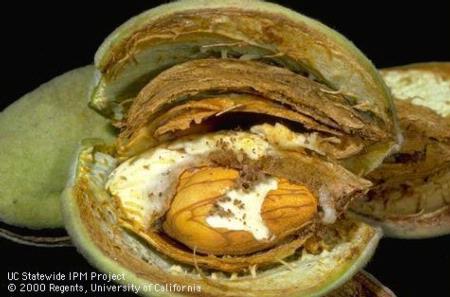
(Featured Photo: Almond damaged by navel orangeworm larvae, UC ANR)

2016-05-31T19:28:15-07:00June 5th, 2015|

Op-ed: California Agriculture Is Worth the Water

California agriculture is worth the water

Op-ed co-authored by Secretary Ross and Daniel Sumner in the LA Times

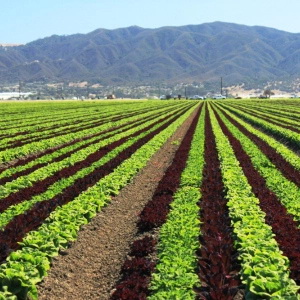
SalinasLettuce1000

By Karen Ross and Daniel Sumner

Pundits here in drought-stricken California have become fond of proclaiming that farms consume 80% of the state’s water and generate only about 2% of its gross domestic product. “Why devote so much of our water to an industry that contributes so little fuel to our economic engine?” they ask.

Both of those figures are deceptive. It’s only possible to arrive at 80% by not accounting for the amount of water dedicated to environmental uses. (For example, the water in rivers that flows into the sea.) And the 2% figure grossly undersells the importance of food grown in California.

California’s economy is incredibly diverse, much like its topography, its climate and its population. That’s a significant benefit when you’re the eighth-largest economy in the world. And agriculture is a key part of that diversity.

Of course, many aggregate sectors constitute a larger share of our economy than agriculture. Finance, insurance and real estate tops the list at 21%. Professional services and government follow at 13% and 12%, respectively.

Beyond those sectors, we have a broad, flat grouping of several categories, each representing just a few percent of the state’s GDP. That’s a remarkably balanced profile that lends resilience and dynamism to our economy.

Let’s look more closely at that data, though. Is agriculture really just 2.1%? As is so often the case with statistics, what’s not in that number is more significant than what is.

Take the “utilities” category, for instance. It includes power generated for farms and for processing and marketing crops once they’re harvested. The “real estate” piece includes sales and leasing of agricultural acreage and processing facilities. “Non-durable goods manufacturing” includes food and beverage processing. “Wholesale trade” and “retail trade” does not just mean the shopping mall; it includes the supermarket, the food court and the regional produce hub.

Categories such as “transportation and warehousing” and “finance and insurance” are linked into every one of our 78,000 farms, each of which needs trucks, banks and insurance coverage to bring in the harvest.

“Accommodation and food services” not only runs on food but also is fond of promoting the fact that many of the most healthful and desirable foods and beverages grow on California farms and ranches. California, after all, helped start the farm-to-plate movement, and it’s not an exaggeration to say that agriculture is tied to the state’s identity from harvest (Cesar Chavez) to table (Alice Waters).

Granted, all economic sectors have ripple effects and multipliers. But unlike most other segments, California’s agricultural productivity and diversity are not readily duplicated elsewhere. Our soils and climate are what have made it possible for us to supply so much of our nation’s and the world’s food.

Food is central to California in more than just the nutritional sense. It contributes to nearly every aspect of our economy and our lives, an important point to keep in mind as we weigh what our water is worth during this drought, and the next one.

Karen Ross is California agriculture secretary. Daniel Sumner is a professor of agricultural and resource economics at UC Davis.

2016-05-31T19:28:15-07:00June 3rd, 2015|

International Trade Tariffs Must Be Lowered

For California Ag Especially, International Trade Tariffs Must Be Lowered


By Laurie Greene, Editor, CaliforniaAgToday.com

USDA Foreign Agriculture Service Associate Administrator Janet Nuzum recently met with agricultural commodity representatives at the California Center for International Trade Development (CITD) in Fresno.

Nuzum spoke about both the opportunities California agricultural groups face as well as key problems they encounter in international trade. She said, “The strength of California agriculture can sometimes appear to be its weakness, in this sense: California is, of course, the largest agricultural state in the United States. It’s also incredibly diverse compared to other parts of the United States. And, because of that diversity, it faces a wider variety of challenges and problems in global trading.

“If there were less diversity, there might be fewer problems,” said Nuzum. “But, with greater presence in the marketplace, having a wider diversity of products or types of products, and whether their product is fresh or processed, California growers and exporters and government officials and regulators face a very challenging set of circumstances, particularly with international trade tariffs.”

Nuzum said that is both the good news and challenging news—all in one. “You’ve got a rich agricultural economy,” she elaborated, and you’ve got a lot of natural resources which are not necessarily found in other parts of the United States. This enables the industry to offer a very rich plate of different kinds of agricultural products. There are some products, and I am thinking about tree nuts now, in which California represents the majority of world production or world trade. So, other consumers around the world are dependent on having that American product, that Californian product, out there in the marketplace,” she said.

Nuzum said because California’s diverse produce is exported around the world, international trade discussions need to come to fruition to lower foreign trade barriers. “Our tariffs, both agricultural and non-agricultural, are much lower than other countries we trade with. That is one reason it is so important to negotiate these trade agreements—to reduce these other tariffs to zero, or at least to our levels,” she said.

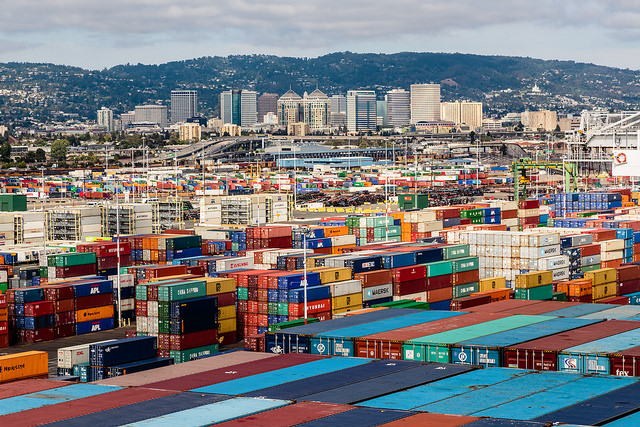
(Photo credit: The Busy Port of Oakland, Flickr)
2016-05-31T19:28:15-07:00June 2nd, 2015|

Here’s a deal: Tour the Port of Oakland for Free

Summer Port of Oakland Excursions Aboard Former FDR Vessel Open to the Public

Here’s summer’s biggest travel bargain: free boat tours at the Port of Oakland. The Port today introduced no-charge, 90-minute harbor excursions available to the public. The narrated port tours will be conducted aboard the USS Potomac, the former presidential vessel of Franklin D. Roosevelt.

“We’re proud of our Port and of the relationship we have with our communities,” Executive Director Chris Lytle said today before embarking on the maiden harbor tour. “Inviting our neighbors to these tours gives them a way to know us even better.”

More than 200 Oakland school children boarded the Potomac today for the first two of 12 free summer tours. Oakland Mayor Libby Schaaf and School Superintendent Antwan Wilson were there as the Port welcomed youngsters aboard.

The Port said it has scheduled two tours each month on designated Friday afternoons and evenings through October. The 165-foot Potomac, berthed at the Port’s Jack London Square, can carry 120 passengers per excursion. Schedules and registration for the tours will be open to the public beginning June 1 at the Port’s website, www.portofoakland.com.

Tour organizers said the excursions are a cost-effective way to give neighbors a close-up look at how the Oakland seaport works. Passengers will transit the Oakland Estuary and Outer Harbor. They’ll see all five Oakland marine terminals and pass within yards of massive container ships, some 1,200-feet long. The tours will also provide close-up views of San Francisco’s waterfront and skyline.

Port of Oakland Harbor Tours

Port of Oakland Harbor Tours

2016-05-31T19:28:16-07:00May 30th, 2015|

Port of Oakland Praises Signing of Maritime Labor Contract

PMA Signs Five-Year Contract with ILWU Workers

The Pacific Maritime Association (PMA), which represents 29 ports along the West Coast from San Diego to Seattle, and the International Longshore and Warehouse Union (ILWU) have signed a new 5-year maritime labor contract. The coast-wide agreement between PMA and ILWU covers approximately 13,600 employees in ports that handle nearly half of all U.S. maritime trade and follows a massive labor dispute and port slowdown in January and February of this year that severely impacted agricultural exports.

Marilyn Sandifur, spokesperson for Port of Oakland

Marilyn Sandifur, spokesperson for Port of Oakland

Marilyn Sandifur, spokesperson for the Port of Oakland, said, “The port of Oakland is very pleased that this agreement has been signed; basically we thank both the PMA and ILWU for ratifying this new five-year labor contract. It’s important because now we can really focus on the work ahead of us.”

“One of the things we have to do is improve service to our shippers so that we can remain an important trade gateway for them,” Sandier stated. “You know after this big cargo slowdown, we really have to enhance the flow of cargo at the Oakland seaport. And I’m sure a lot of the other ports are feeling the same way—that we all have to improve cargo improvement and regain our shippers trust.

Sandifur commented, “Agriculture is really our biggest export category. It represents about 40 percent of the total value of exports through our seaport. Just to give you a few examples, think about the almonds grown in the Central Valley, citrus fruit or wine from northern California. Those are just a few of our major agriculture exports. So now that this contract has been ratified, we can all work on improving cargo flow through the seaport and getting agricultural goods moving again.”

2016-05-31T19:28:16-07:00May 25th, 2015|

A Call for Common Sense Water Management

California Water Management Dilemma

By Lawrence H. Easterling, Jr.

Larry Easterling

Larry Easterling makes a comment at a recent pistachio growers meeting.

We are witnessing the dismantling of the California water conveyance system that supplies drinking water for 25 million California residents and four million acres of prime farmland in the San Joaquin Valley.

Our water resources are being “Withheld” from the very people of this state who have shown what “Free Enterprise” can do not only for the well-being of all in California, but the entire nation. Unfortunately, several major environmental groups and complacent politicians are killing the freedoms that have been the bulwark of success in California. Let me explain.

Water is our most valuable renewable resource and Mother Nature gives it to California in copious amounts during most years. What we do with that water—water management—is critical to the future of the Golden State.

On average, 200.0 million acre-feet of water a year blankets our state. One acre-foot is equal to 325,851 gallons of water. Of that precipitation, 75% originates north of the Sacramento River. The other 25% falls in central and southern California.

The water that is not manageable by us is 120.0 million acre-feet. Some of it evaporates, but most of it settles into the ground, fills lakes, and what remains heads for the Pacific Ocean. The balance of the water is called “directable” surface water (80,000,000 acre-feet) and this is where we have the opportunity to put it to its best and proper use.

By 2005, according to the Department of Water Resources, 48% of that directable water went to the environment, 41% to agriculture and the remaining 11% to rural areas. This balance of such a precious resource seemed at the time to be equitable to all parties, thanks to the ingenuity of our forefathers in the 20th century. Their foresight gave us a water conveyance system second to none in the entire world.


California’s water conveyance system had four major objectives:

  1. To provide reliable water deliveries to 25 million people to avoid water shortages that would otherwise exist and continually plague two-thirds of the California population.
  2. To support four million acres in central California of what the National Geographic Magazine proclaimed to be the most productive farmland in the world.
  3. To reinforce our natural environment.
  4. To recharge our groundwater supplies.

Some distinctions should be made here as to how much directable water we are actually concerned about. At full capacity, the two California water conveyance systems—the State Water Project (SWP) and the federal Central Valley Project (CVP)—deliver water from northern California to southern and central California. Each system, the CVP and the SWP, has the capacity to each deliver 4.0 million acre-feet water each year. However, this water delivery capacity has never been tested. The record shows that in the years prior to 2005, the average total delivery COMBINED for both projects was 5.4 million acre-feet per year. The ultimate users of this water went to agriculture (60%) and the rural population (40%).

The volume of water available, on average, from the Sacramento River, including the San Joaquin River, is 30.3 million acre-feet. It is from this volume of water that the 5.4 million acre-feet are sent south.

In 2007, several environmental organizations led by Natural Resources Defense Council took the Department of Water Resources to court to compel the court to enforce the Endangered Species Act (ESA). The court ruling to enforce this law declared that the giant water export pumps that raise the water from the Delta into the California Aqueduct were cut back because it was suspect that the pumps were killing too many delta smelt, an endangered species.

Even in flood years restricted pumping has reduced the water flow to a fraction of the contracted normal flow. Henceforth, since 2007, our water deliveries to urban and agricultural areas have been severely compromised.

The enforcement of these laws is now negating the four major functions of the giant California water conveyance system outlined with the possible exception of the natural environment. Now mind you, this water comes from northern California where 75% of the rain in California falls, averaging over 50 inches a year. Central and southern California “average” less than 15 inches a year.

During the seven years from 2007 through 2014, average deliveries to farms have been reduced to less than one acre-foot per year. Most agricultural crops require 3 ½ acre-feet of water per year. Today, without recourse, these farms are left with barely enough water to keep their plants alive. As for the hardship visited upon 25 million consumers, the Metropolitan Water District (MWD) in southern California is a good example.

The MWD services 19 million accounts, and prior to 2007, was receiving 40% of its water from the SWP. That water source has now only been able to supply approximately 10% of their needs. Consequently, due to seeking other sources to replace their water losses, rate increases to their customers over the years 2007 to 2014 have doubled. On top of all these setbacks, Mother Nature now has shown us her own drought versus our manufactured water crisis. All the way through this synthetic drought, the average rate of precipitation at the source of our water in northern California has been 45 inches each year.

In order to survive, those of us who must have an adequate supply of water to sustain us have been forced to pump more groundwater and/or purchase water from farmers who idle farmland and transfer their water to areas severely threatened with water shortages. For some of those lucky enough to find water for sale, the cost of water has become a severe financial burden. Where farms in the Central Valley were, prior to 2007, paying just under $100 per acre-foot, today if a willing seller can be found, the price can range anywhere from $1,000 to over $2,000 per acre-foot. In many such cases, water costs can exceed all other cultural costs combined. Likewise, the aquifer has dropped every year since 2007 due to frantic attempts by farmers to supplement the critical loss of surface water.


WHAT MUST BE DONE:

The effects of water deprivation over an eight-year period by a man-made drought capped by one of nature’s real droughts, is wrecking havoc with the nation’s food supply. The state of California is now in the grips of the Law of Diminishing Returns and is incapable of averting a disaster due to environmental regulations. Consequently, this country’s NATIONAL SECURITY is being compromised. CONGRESS MUST ACT NOW before further damage is done. These actions need to be taken:

1. The Endangered Species Act (ESA) must be excluded from jurisdiction over the pumps, which move northern water to central and southern California. The pumps are presently operating at about 15% of their capacity. This measure should be permanent and under the management of the Department of Water Resources (DWR).

2. The Endangered Species Act needs to be revised in order to “protect all species”, including humans, from collateral damage due to methods employed to save one species that results in severe damage to other species. This would be implemented through a biological opinion that would INCLUDE a list of all species that would be adversely affected by the METHOD employed to protect one specific species. This measure would make right just one of the irregularities in this flawed law, which attracts litigation like bees to honey. The law does not need to be struck down, simply rewritten to safeguard “all” species, including human beings.

3. California’s magnificent water distribution and conveyance system has no peer in this world. It is a remarkable feat of engineering admired by those who have come from far and near to marvel at its accomplishment. Yet, by environmental fiat, it has been reduced to a token of its capabilities. “Directable” water in California originally ceded one-third of its 80,000,000 acre-feet to the environment.

Today, according to the DWR, the environment now takes, not one-third, but 50% of the direct able water, leaving the rest to urban and farming communities. This is not what the original framers envisioned, but under the DWR, its control has been gradually diluted by federal agencies such as the Environmental Protection Agency (EPA), and one of its extensions known as the STATE WATER RESOURCES CONTROL BOARD (SWRCB). THIS FIVE PERSON-BOARD IS STAFFED WITH ENVIRONMENTALISTS, such as their chairwoman, Felicia Marcos, a Governor Brown-appointee, whose professional background includes eight years with the EPA and five years with the radical Natural Resources Defense Council.

The influence of these federal agencies, backed by political power brokers’ lobbyists, has tilted the water distribution of surface water away from its original intended users. In essence, the environmentalists now control California’s surface water; and now, with the passage of the recent 7.5 billion dollar Water Bond, they will control our groundwater as well. If the water agencies do not perform with the desired results, the bottom-line is that final control will go to the SWRCB.

The ship of state now needs to be righted; it is drifting far off course. First of all, the EPA must be brought to heel. For a federal agency, it exerts far too much power. And, in so doing, has completely distorted California’s surface water delivery system. Next, the SWRCB must either be eliminated with FULL CONTROL restored to the Department of Water Resources, or completely reorganized as an ADVISORY BOARD to the DWR where ALL recipients of the surface water system would be represented. A ten-board membership might be in order, with a director and the nine remaining seats divided into three equal parts by experienced personnel in agriculture, city water management, and the environment, i.e., three persons from each classification and residents of northern, central and southern California.

4. Finally, one in every ten workers in California is either directly, or indirectly dependent upon the health of our vast agricultural industry.

It is time to step forward and reveal, with facts and figures, the house of cards that water management in this state has become. Likewise, those 25 million people in southern California, such as the MWD’s 19 million users who once got 40% of their water from the giant conveyance system, deserve to get that water back.

With years of a man-made drought compounded by a natural drought now in the eighth year, there is ample information available through various farm county records to quantify in lost dollars the cumulative effect of, (1) lost production due to forced fallowing of land, (2) water costs that are now ten times what they were prior to 2007, and (3) the heavy burden economically of converting hardworking farm labor to the welfare roles where some Central Valley towns are now approaching 50% unemployment. Combined, these costs will be in the billions of dollars, bloating further our California deficit.

The goal of society has always been to improve the human condition and for one generation to leave a better world for the next. The visionaries of the 20th century got it right. They delivered in spades to us, the beneficiaries, a modern miracle. It is a water conveyance system like none other to serve all the people of California. Where are those visionaries now? Rather than embrace the gifts of a reliable source of precious water, they proceed to dismantle the entire system. It is because of the system that California feeds the nation. This is not just a California crisis. It is one that will affect the entire nation. Look upon it as a national security threat and demand that our leaders do what is right for the vast majority of this country’s people.

 Lawrence H. Easterling, Jr. Administrator, Kettleman Pistachio Growers and Director, American Pistachio Growers


2016-08-03T21:05:15-07:00May 18th, 2015|

Ag Stories for Wegmans Customers

Dave Corsi with Wegmans Encourages More Ag Stories to Bridge Gap with Consumers


By Laurie Greene, Editor, California Ag Today

Customers love stories and Agriculture sure has them. What could be better for the bag of broccoli florets, carrots or even pistachios and almonds to have an image of the farmer who grew them?

Ag needs to have this connection with consumers; ag stories help bridge the gap between the growers and consumers.

California Ag Today caught up with Dave Corsi at a recent meeting. Corsi knows something about customers connecting with agriculture; he’s vice president of Produce and Floral at Wegmans, a higher end east coast grocery store chain, which purchases a lot of product from California growers. He said it’s way bigger than farm local and buying local.

“The customer wants to know the face behind the name. It is important for the customer to know who the growers are, and what do they do? What is their food safety philosophy and food safety best practices? What kind of varieties are they growing? What are the flavor profiles of crops they are developing to provide a better experience for our customers?”

“All that is very meaningful. And it doesn’t matter if the farm is ten miles away, three thousand miles away, or even around the world. The customer wants to understand who the person is behind the product being grown,” said Corsi. “That’s the story we love sharing with our customers.”

He noted that customers are really interested in the knowledge learned from ag stories, “so they can feel more comfortable about their purchase because they know how dedicated our growers are to food safety, traceability, and food quality.  They even want to know about the social side of business, such as the growers themselves.”


2016-05-31T19:28:16-07:00May 18th, 2015|

Tasteful Selections Opens Cal Green Potato Facility

Tasteful Selections Opens Cal Green Potato Facility in Arvin, CA

By Patrick Cavanaugh, Associate Editor

Bob Bender, a partner with CSS Farms, in Watertown, South Dakota, came out to Kern County several years ago to grow many different crops including chip potatoes, garlic, onions and bell peppers, as well as black-eyed peas. “We were looking for an opportunity in California to diversify our company so that we were not so dependent on the chip potato income.”

Bender said he was always looking for crops in which he could diversify, and in 2007, he had the opportunity to grow some baby, bite-sized potatoes for a Canadian company. “This worked out well for a few years, and then we decided in 2009 to pack the baby potatoes under our own CSS Farms label,” Bender said.

“That business started taking off a lot bigger than we expected, and in 2010, we saw that the business was growing to be too much for us to handle. We needed some marketing help because we did not know  much about it,” said Bender. “Plus, we were packing everything in 50-pound cartons, and we knew there would have to be more margin to the product if we sold directly to retail.

Bob Bender, Tasteful Selections

Bob Bender, Tasteful Selections

“That’s when we teamed up with the Wysocki family, owners of the Bancroft, Wisconsin-based RPE Company and experts in packing and marketing,” said Bender. “The marketing took off, and they built our first packing shed in a leased facility in Bakersfield. They sold product in smaller mesh bags for the consumer retail market under the Tasteful Selection brand,” noted Bender, who is now president and general manager of Tasteful Selections.”

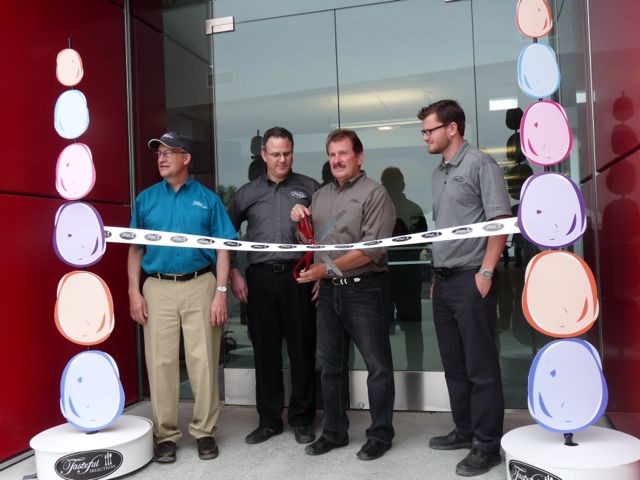
Fast forward to March. 18, 2015 when CSS, along with RPE, and Stevens Point, Wisconsin-based Plover River Farms Alliance, Inc. partnered together and opened a new, stainless steel, 200,000 square foot facility in Arvin, near Bakersfield—all dedicated to Tasteful Selections specialty potatoes.

The expansion increases Tasteful Selections’ production capacity from eight to 12 packaging lines, doubles the potato washing capacity and adds more shipping docks and improved refrigeration and storage to meet the company’s double digit growth (over the past five years), leading the specialty potato category.

In all, the company sells eight flavors of potatoes in one-, two- or three-bite sizes, plus offers a medley of flavors in each bite size. The potatoes have unique flavors, creamy textures and tender skins. The products are pre-washed, so consumers do not have to clean or peel the product. And the small sizes equate to faster cooking times.

“Fifty percent of our team is marketing, so we’re not just growing and packing the potatoes. RPE handles all of our marketing and sales, which has been so instrumental in our growth,” said Bender, who now oversees the day-to-day operations in California. RPE has been a tremendous asset to Tasteful Selections; the fact that we are in all fifty states, in 52 percent of all grocery stores, with growth in every store, says a lot about RPE,” Bender noted.

The fact that the facility was built with all stainless steel components is an invaluable addition to our operations and food safety protocols.  The facility’s design honors Cal Green Certification Standards. The Cal Green Certification ensures that we are maximizing our efficiency while reducing our environmental impact. Not only does this benefit us, it also helps the surrounding communities in promoting water savings, environmental responsibility, cost effectiveness and a healthier place to live and work for its currently 257 employees.

Tasteful Selections

Tasteful Selections

Milt Carter is CEO and President of CSS Farms, which grows all the potatoes for Tasteful Selections. “We are co-owner of the company, along with RPE, and the grand opening of our facility is a big day for us as we continue our journey to bring unique potatoes to the potato category and to the table,” said Carter.

“We particularly like the qualities of our baby potatoes, including unique flavors and better taste than the average potato. The uniform sizes we pack allow for uniform cooking times, making cooking easier for the consumer. And the growth we have seen reflects that consumers really like them.”

“When we started Tasteful Selections in 2010, we knew we had something amazing, and even we were surprised by the success that we had,” said Russell Wysocki, President and CEO of RPE. “The opening of this new plant shows that we are consistently investing in our future in specialty potatoes,” he said.

“The new plant will allow us to bring in new product lines, do a better job in precise-sizing, and maintain our high quality standard,” noted Wysocki. “On the farm, Bob and Milt bring us five separate crops a year; we have the ability to deliver the freshest potatoes with the best quality to our customers throughout the country and throughout the season.”

“The one-, two- or three-bite Tasteful Sections potatoes in the one pound or 1.5 pound bag are very popular with consumers.” said Wysocki. “It use to be that you would sell a lot of potatoes in a 10-pound bag, but that’s getting a lot harder to do. However, this product offers consumers a package from which they can get multiple meals, without taking five weeks to consume and perhaps resorting to the garbage can to get rid of them.”

“The baby potatoes are immature potatoes, before they grow bigger, but they still contain all the nutrients found in the larger potatoes,” said Wysocki.

Carter explained, “Our signature flavor Honey Gold baby potatoes are proprietary to Tasteful Selections, and they have a very unique flavor. A high percentage of people the taste distinctive in taste tests, and most like it very much.”

“It’s a great product,” noted Wysocki. “We basically took product that was being discarded in the market 10 years ago. We saw the quality of what was culled, and we felt it was something significant we could bring to the marketplace. So we considered the possibility, then brought it to market, and we have had phenomenal growth,” he said.

2016-05-31T19:30:24-07:00May 17th, 2015|
Go to Top