CDFA UPDATE: ACP QUARANTINE EXPANDS IN CA

BREAKING NEWS
Asian Citrus Psyllid Quarantine Expansion in Tulare and Kern Counties


Today, an additional portion of Tulare County and a portion of Kern County have been placed under quarantine for the Asian citrus psyllid (ACP) following the detections of psyllids in Dinuba, Tulare County, and Wasco, Kern County.


In Tulare County, the quarantine zone measures 90 square miles, bordered on the north by E. South Avenue; on the east by Road 128; on the south by Avenue 368; and on the west by Road 48. This area is in addition to an existing quarantine in the Porterville area.


In Kern County, the quarantine zone measures 88 square miles, bordered on the north by Hanawalt Avenue; on the east by Beech Avenue; on the south by Fresno Avenue and W. Lerdo Highway; and on the west by Wildwood Road.


Maps of these new quarantine zones may be found at: www.cdfa.ca.gov/plant/pe/interiorexclusion/acp_quarantine_sjv.html


The quarantine prohibits the movement of host nursery stock out of the quarantine area and requires that all commercial citrus fruit be cleaned of leaves and stems prior to moving out of the area. A permit may be obtained to move nursery stock and budwood out of the area if grown in USDA-approved structures designed to keep ACP out. Residents with backyard citrus trees in the quarantine area are asked not to remove fruit from the area.


In addition to Kern and Tulare Counties, ACP quarantines are now in place in Ventura, Santa Barbara, San Diego, Imperial, Orange, Los Angeles, San Bernardino and Riverside Counties.


The ACP is of grave concern because it can carry the disease huanglongbing (HLB), also known as citrus greening. All citrus and closely related species are susceptible hosts for both the insect and the disease. There is no cure once a tree becomes infected. The diseased tree will decline in health until it dies. HLB has been detected just once in California – last year on a single residential property in Hacienda Heights, Los Angeles County.


HLB is known to be present in Mexico and in parts of the southern U.S.  Florida first detected the pest in 1998 and the disease in 2005, and the two have been detected in all 30 citrus-producing counties in that state. The University of Florida estimates the disease has tallied more than 6,600 lost jobs, $1.3 billion in lost revenue to growers and $3.6 billion in lost economic activity. The disease is present in Texas, Louisiana, Georgia and South Carolina. The states of Hawaii, Arizona, Mississippi and Alabama have detected the pest but not the disease.


Residents in the area who think they may have seen the Asian citrus psyllid are urged to call CDFA’s Pest Hotline at 1-800-491-1899. For more information on the Asian citrus psyllid and huanglongbing disease please visit: www.cdfa.ca.gov/go/acp.
2016-05-31T19:44:28-07:00September 24th, 2013|

ACP FOUND NEAR EXETER

Another ACP is Trapped in Tulare County
The Tulare County Agricultural Commissioner’s office is announced TODAY that one additional Asian citrus psyllid (ACP) has been detected on a trap south of the city of Exeter. The latest interception was confirmed by the California Department of Agriculture (CDFA). Maps and current information are available on the Agricultural Commissioner’s website by visiting: http://agcomm.co.tulare.ca.us/default/.

CDFA has already begun to survey the affected area in order to determine the extent of any infestation. The United States Department of Agriculture’s Animal and Plant Health Inspection Service (USDA-APHIS) and CDFA will work collaboratively to determine what steps are taken next.  


“CDFA is already considering a five-mile radius quarantine,” said Gavin Iacono, Tulare County Deputy Ag Commissioner. “There is also a discussion on the table whether or not to quarantine the entire county, following detection of ACP in traps in Porterville, trapped and live ACP adults and nymphs in Dinuba, and now a find in Exeter,” noted Iacono.

“This latest find is in the heart of our citrus belt, so it is very disappointing to hear that psyllids are being moved into a new part of our county,” said Tulare County Agricultural Commissioner Marilyn Kinoshita.

The Asian citrus psyllid is an invasive species of grave concern because it can carry the disease huanglongbing (HLB), also known as citrus greening.  All citrus and closely related species are susceptible hosts for both the insect and the disease.  There is no cure once a tree becomes infected. The diseased tree will decline in health, producing bitter, misshaped fruit until it dies. To date, HLB has been detected on just one residential property in the Hacienda Heights neighborhood of Los Angeles.

Kinoshita points out that her staff will support the efforts of our $750 million citrus industry, as well as our residential citrus owners. “I want to emphasize that every citizen of our county plays a role in assuring that ACP is not spread from other parts of the state”.

Residents in the area who think they may have seen the pest are urged to call CDFA’s Pest Hotline at 1-800-491-1899 or the Tulare County Agricultural Commissioner. Media inquiries related to technical questions about Asian citrus psyllid and huanglongbing disease are encouraged to contact Katie Rowland, Account Coordinator for Nuffer, Smith, Tucker Inc. at (661)817-3638. 


2016-05-31T19:44:28-07:00September 24th, 2013|

CDFA’S TRADE MISSION FINDS VIETNAM EAGER TO COOPERATE

Vietnam Holds Great Prospects for California


TODAY, CDFA Secretary Karen Ross issued the following summary of the Vietnam segment of CDFA’s Asian trade mission:

In returning to California after three days in Vietnam, I’m greatly impressed by the potential the market has for California as well as the commitment of the Vietnamese government to farmers; trade; and climate change, mitigation and adaptation.

During my short visit, I had the opportunity to visit the nation’s largest dairy processor – Vinamilk – whose state-of-the-art facility in Binh Duong Province underscores the market potential that Vietnam holds. Not only is Vinamilk committed to product innovation and environmental sustainability, the new facility is a world-class operation dedicated to meeting the future growth of the country. In addition, Vinamilk’s management is very eager to learn and partner with California to improve the prospects and potential for the dairy industry in both countries.

CDFA Secretary Karen Ross (fourth from right) at a trade meeting in Vietnam.   Richard Matoian of the American Pistachio Growers is two spots to her right

The eagerness for cooperation was consistent in all my interactions with the Vietnamese people – business and government alike. In my governmental meetings with the ministries of agriculture and trade, I underscored our commitment to trade and our appreciation for the continued progress on the Trans-Pacific Partnership (TPP) negotiations. California and the United States can benefit significantly from increased market access and a reduction in tariff barriers to region. Vietnam is a $200 million market for California agricultural products – our 12th largest export destination – and it increased 43 percent from the previous year.

I was very thankful to be joined on this trip by a great group of small businesses that are eager to expand their business and California exports. Of the 11 companies that participated, we had trading companies, winery exporters, growers and a even a small seasoning company from Calaveras County. I was pleased to have Richard Matoian of American Pistachio Growers join me on my governmental meetings and visits.

Trade missions like this are an excellent opportunity for companies to expand business relationships and the Fresno Center for International Trade Development is a great partner in making activities like this possible.

I look forward to visiting more markets in the future to promote the California brand and support our farmers and ranchers.

Secretary Ross was in Asia as part of a trade mission facilitated by the Fresno Center for International Trade Development and funded by a grant from the U.S. Small Business Administration.
2016-05-31T19:44:28-07:00September 24th, 2013|

SHANGHAI "CALIFORNIA WEEK" PROMOTES AG

California Dreaming in Shanghai

from Shanghai Daily.com


CDFA’s Office of Public Affairs issued an announcement today, that California Week was opened in Shanghai last week at which there is an exhibit at the city’s downtown Yandang Road of the best agricultural and lifestyle products from the state.


As reported on Shanghai Daily.com, to further bolster business ties between China and California in the United States, the event was planned when California Governor Jerry Brown visited Shanghai in April as he joined a celebration of setting up a trade and investment office in the city to enhance economic cooperation.


“We hope to bring Shanghai people a real taste of California,” said Karen Ross, secretary of California Department of Food and Agriculture.

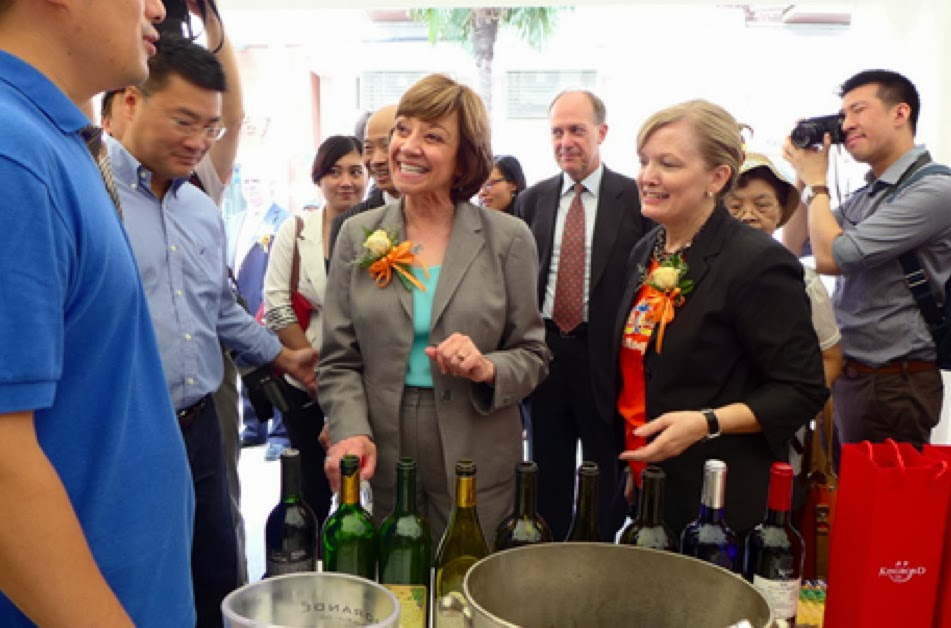
CDFA Secretary Karen Ross chats with an exhibitor at the first
California Week. The US Consul General in Shanghai Robert Griffiths
 (behind Secretary Ross) was also present.


California is a gateway of the United States to the Asia Pacific. It is home to 53 companies in the Fortune Global 500 list and also a major producer of agricultural products.


Last year, more than 584,000 Chinese tourists visited California, where over 25,000 Chinese students studied.


The four-day event, which showcased many things California — from wine, soft drinks, fruit and snacks to culture and attractions, aimed at building up a “California brand.”
As a major exporter in the US to Asia, California sold US$13.6 billion in goods to China last year.


In June, Chinese President Xi Jinping and his American counterpart Barack Obama had a summit in California, which was an historic meeting to build up a closer bilateral relationship between the world’s two biggest economies.

Last month, China’s National Development and Reform Commission signed an agreement with California to strengthen collaboration in the areas of climate change and low-carbon development.

2016-05-31T19:44:28-07:00September 24th, 2013|

DWR ISSUES IWM PROCEEDINGS: “WATER 360” LAUNCHED

“Water 360” to Strengthen Integrated Water Management 

TODAY, DWR issued “A Commitment to Action,” proceedings from California’s first integrated water management (IWM) summit held recently. “Water 360,” a campaign designed to use IWM to strengthen the efforts of California’s water management community, was launched at the summit

“Water 360” will help refocus and strengthen the water management community by advancing integrated water management, a framework for planning and implementation that melds the objectives of improving public safety, fostering environmental stewardship and supporting economic stability to lead to sustainable water resource management.


Integrated water management is not a new concept in California, and great strides have been made in the last decade to utilize the approach, particularly at the regional level. The Water 360 Campaign builds on these early successes and calls for broader application across the entire state.


DWR is prepared and committed to lead this effort in close partnership with other water leaders, particularly State, federal, and local agencies; and in collaboration with all stakeholders.
2016-05-31T19:44:29-07:00September 23rd, 2013|

WATER IS THE KEY TO OUR FUTURE

A Free Spirit With a Dire Message About Water

Yoreme Alma Grande on Lassen Ave. in Huron, CA
Yoreme Alma Grande is an activist and an advocate for farm workers’ rights, and he is from the Yuma Valley.  

Grande mentioned that companies from Yuma will not come to this area next year because there will be no lettuce to harvest.  

The pot in the lower left of the photo is a pot with a dry plant representing the water shortage that is coming.

Maria Hernandez, who works for Los Gatos Tomato Products, lives in Huron. She found Yorema walking through town. 

Maria Hernandez

Hernandez shot the photo.

2016-05-31T19:45:14-07:00September 23rd, 2013|

IRRIGATION NOZZLE REBATES AVAILABLE FROM PG&E

PG&E Rebates:
Low-Pressure Sprinkler Nozzles Are Recommended

Replacing high-pressure sprinkler nozzles with low- pressure sprinkler nozzles enables you to reduce your irrigation system’s operating pressure, thus reducing the energy it takes to run the pumps—yet still distribute the same volume of water your crops need, with fewer line breaks and less maintenance.
Requirements:

      •      Must convert from a high-pressure, sprinkler system nozzle (50 psi operating pressure or more at the sprinkler head) to a low-pressure sprinkler system nozzle. Low-pressure sprinkler system nozzles must replace high-pressure sprinkler system nozzles one-for-one.

     •      A pumping plant analysis must be completed after the replacement to ensure reasonable pumping efficiency. Must have 45% overall pumping efficiency or above.

     •        Hand move or permanent (solid set) systems apply. Application Process: 
• To qualify for this rebate, invoice must include the number of nozzles. 
• Must also include a pumping analysis, completed after installation, in order to show overall pumping efficiency.

Sprinkler-to-Drip Irrigation

Replacing a high-pressure sprinkler system with
drip irrigation reduces water, energy costs and maintenance costs and increases yields and revenue. Switching to drip irrigation also enables you to continue crop production in those areas where water supplies are depleted or restricted.

Requirements:

To qualify for this rebate, system must be converted from a high-pressure, impact-type sprinkler irrigation system (50 PSI operating pressure or more at the sprinkler head) to a micro-irrigation system.

Exclusions:

• Not applicable to new plantings of vineyards or orchards unless a vineyard or         orchard was the previous crop on the field.

• Drip tape systems are not eligible.

Visit www.pge.com/ag  or call Agriculture Customer Service

at 1-877-311-FARM (3276)

2016-05-31T19:45:14-07:00September 23rd, 2013|

REINKE MANUFACTURING DONATES CENTER PIVOT FOR STUDY

Deficit Irrigation Project Underway

Project Data Should be Big Help To Growers

By Patrick Cavanaugh, Editor

A new and important research project is underway at the UC West Side Research and Education Center in Five Points, which could eventually point the way for growers of annual crops to stay in business with limited water.

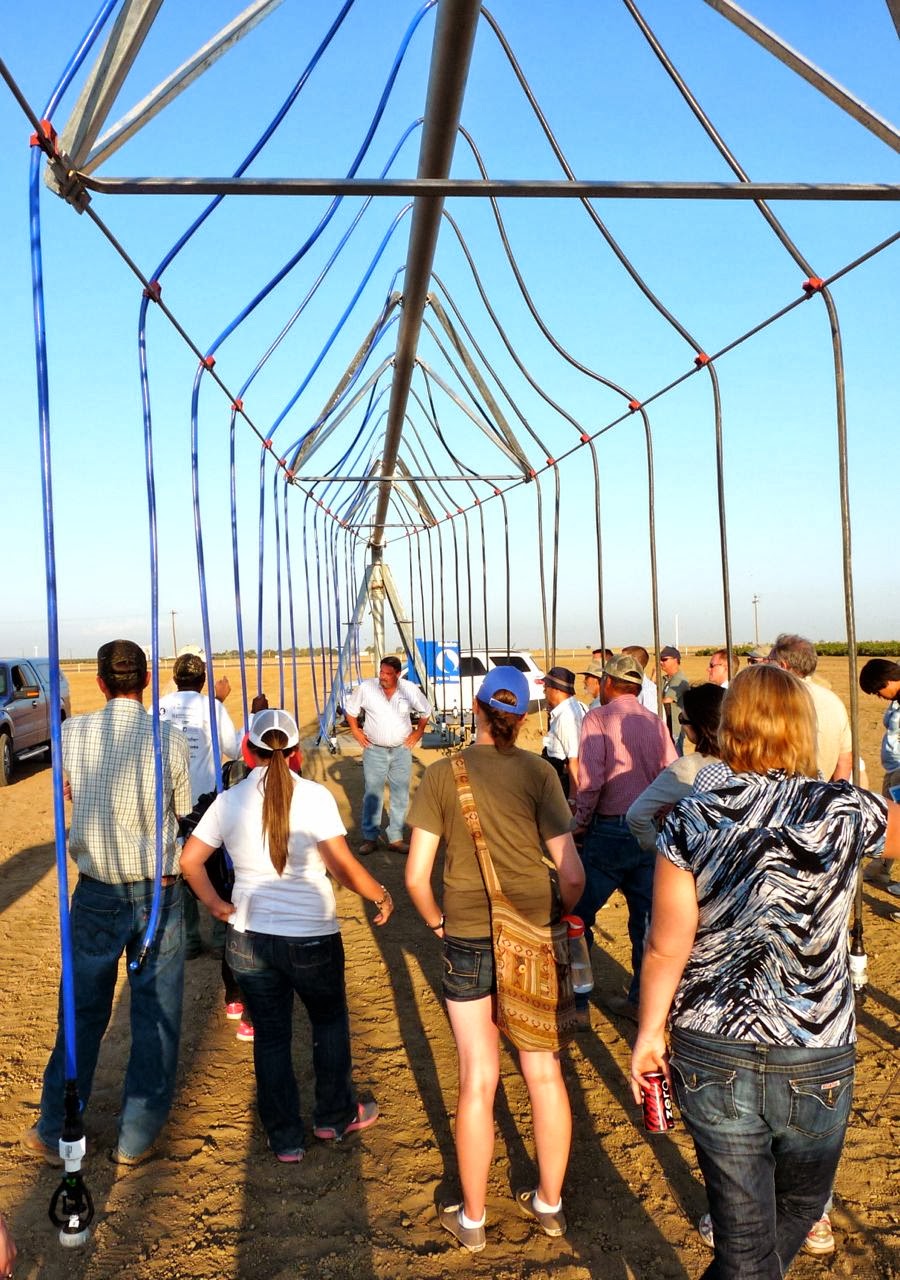
The research features a $100,000 center pivot machine donated by Reinke Manufacturing.

Crowd listens to Rich Hanshew with Reinke Mfg.
The plots will be pie-shaped. Different nozzles on the machine will handle distinct irrigation regimes. The trial will be replicated with various types of treatments within the circular system.

To begin with, the center pivot will irrigate an 8-acre half-circle of alfalfa and an 8-acre half-circle of cotton. All aspects of production – including irrigation system performance, weed control, fertilization, soil salinity and economic viability – will be monitored by a diverse team of researchers from UC Cooperative Extension, Fresno State University and UC Davis, plus farmer cooperators and industry members.

 “By controlling the speed of the pivot, pie-shaped segments will get either full irrigation, three-quarters of the full amount or about half of the full irrigation quantity,” said Jeff Mitchell UC Cooperative Extension specialist in the Department of Plant Sciences at UC Davis.

Dan Schueler with Senninger Irrigtion
Dan Schueler, southwest district manager for Senninger Irrigation (who has donated the nozzles) spoke about the increased nozzle drops on the machine with many different flow rates. “This is a three span machine, and it has nearly 400 drop nozzles. Many of these nozzles have been used since the early 1980s in Texas and other areas that are chronically water-short,” Schueler said. “And we have some data that can be pulled from those areas.”

“We hope to learn from this machine that we can disseminate back to growers. We can quickly change out sprinkler packages to get the data we may need as the machine is moving around the field,” Schueler said. “We are going to be able to show growers different nozzles to get different things done, and we are thankful that UC has stepped up with this project and opened up the space for us to do it.”

“This machine will give us a tremendous amount of flexibility from a sprinkler package and application rate point of view,” Schueler said. “We know that we need to put on as much water as we can without exceeding the intake rate of a particular soil type. Whether you are irrigating a light or heavy soil, we need to gather the information more quickly in California.”

“Unless we get an unbelievable rain year, next year is going to be a big deficit irrigation year, and it will be ugly,” said Schueler. “So we need double or triple nozzle packages to allow us to start the year with a certain amount of water and finish with much less water available,” Schueler said.

“Growers in other areas of the country, such as the mid-west and Texas, are farming with deficit irrigation and getting good crops,” Schueler noted. “With our serious water situation, growers in California will have to turn to reduced irrigation and still produce a profitable crop.  And we want to bring this information to the grower through the University of California.”

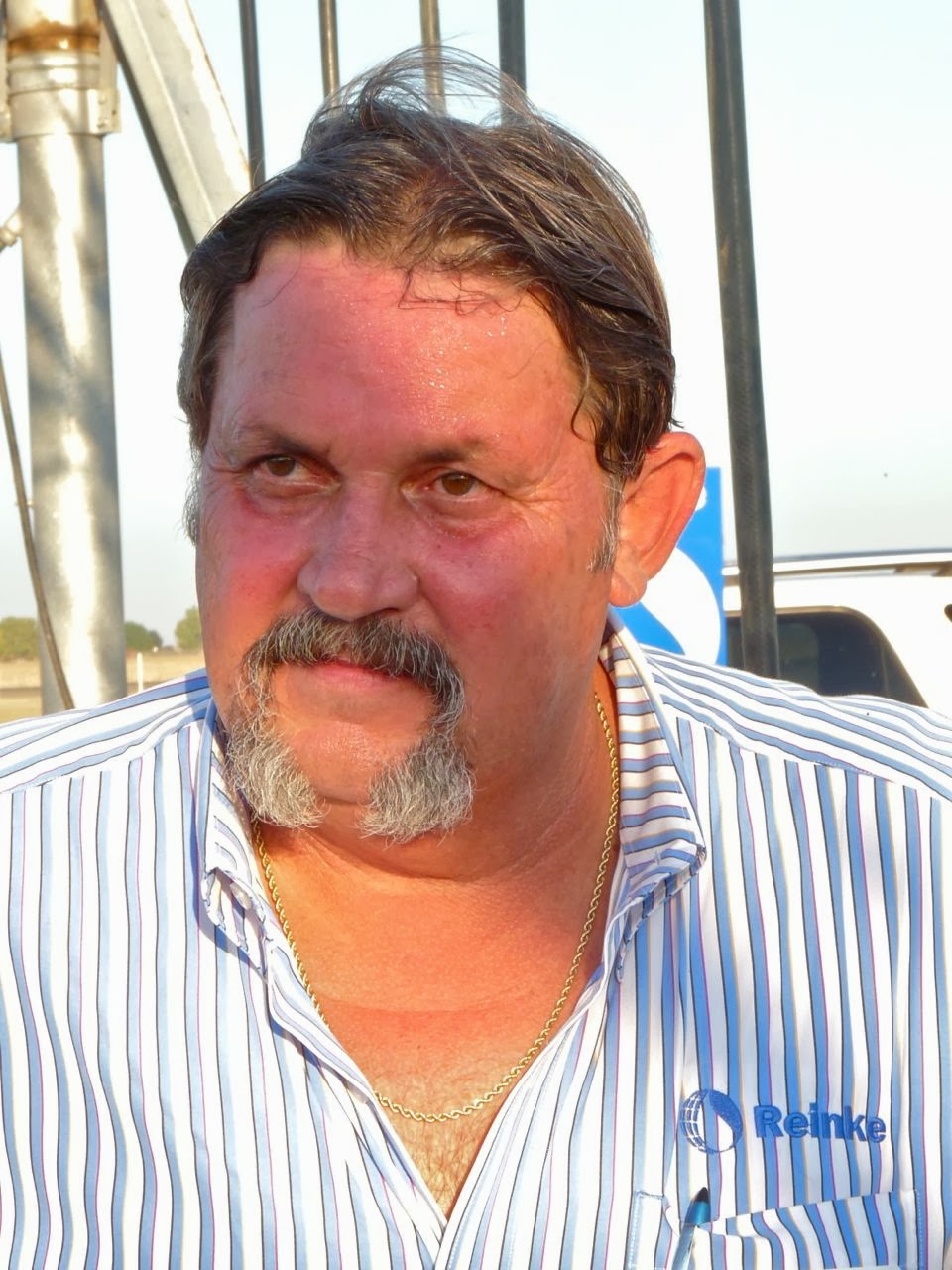
Rick  Hanshew with Reinke Mfg.
Rick Hanshew, southwest territory manager for Reinke Manufacturing. “The equipment has the most up-to-date technology available. It will have a touch screen panel and the Ontrac system on the unit. Ontrac features a remote communications control, so it’s easy to view the machine’s operation on a computer.  Ontrac can also send an alert to a smart phone in case the machine were to shut down,” said Hanshew. “The machine, as it moves through the field can be sped up or slowed down and with different nozzles we can run some good deficit irrigation studies.”

“We are looking toward the future here,” said Hanshew. “I have been selling pivots for 15 years, the last six, I have been a manufacturer rep for Reinke, and have sold pivots to growers from Lancaster to Merced. One of the first things growers ask is to show them some data from California. We have a lot of data from the Mid-West but not much from California, and I so happy to have this research in place at the West Side Research and Education Center.”

“Hopefully we are going to get some great information from this research,” said Hanshew. “These pivots are very versatile and can be used in many different crops, such as cotton and many forage crops  We have tomato growers that have been able to get a decent crop off of the system. Even the processor said it was very acceptable,” Hanshew noted. “So it is possible.”

Hanshew said his target is all the acres on flood irrigation in California. “When you use a pivot versus flood you use only 60 percent of the water,” he noted.

2016-05-31T19:45:14-07:00September 23rd, 2013|

Food Tank…The Food Think Tank

Food Tank: There is Big Food Waste, But Solutions are Emerging

According to Food Tank there is far too much food waste in the world, and it’s happening in areas where people go hungry every day. 

According to the U.N. Food and Agriculture Organization, 1.3 billion tons of food is wasted globally each year.

California Farmers Are Helping with Solutions

Throughout the United States, farmers are harnessing the power of social media to get unsold produce onto plates. In California, one farmer grew tired of discarding produce that came back from farmers markets and chose to advertise the leftovers on Facebook.

The response was so enthusiastic, that the idea developed into a website called CropMobster, where farmers can connect with restaurants, hunger relief organizations, and other companies to make use of food that would otherwise be wasted.

But Food waste is truly a global problem.

According to recent U.S. Department of Agriculture estimates, roughly 133 billion pounds of food from stores, restaurants, and homes is wasted in the U.S. each year. 

In the U.K., up to 30 percent of vegetables never leave the farm because they don’t meet the aesthetic standards of supermarkets.

In Latin America, average food waste amounts to more than 200 kilograms per person per year.

Over 60 percent of the carbon footprint of food waste can be attributed to Asia and North Africa.

Australian consumers throw away up to 20 percent of all food that they buy.

With an annual value of approximately US$4 billion, 10-20 percent of Africa’s grain harvest is lost after the harvest – and that amount is enough to feed 48 million people.

The good news, however, is that in each of these regions, farmers are developing, scaling up, and incorporating innovations in infrastructure, technology, and farming practices that are reducing food waste on their farms – or using it to nourish their crops.


In sub-Saharan Africa, farmers are implementing both sophisticated and simple technologies to reduce post-harvest food waste, and keep food fresh and presentable for market. In Tanzania, a SEED-awarded project undertaken by Rift Valley Foods is using solar drying technologies to preserve produce through dehydration at low cost, allowing farmers to sell once time-sensitive produce when the market presents a better price. In Nigeria, a local teacher developed a simple evaporative cooler to reduce spoilage by preserving harvested crops at lower temperatures. And in Kenya, small metal silos without added pesticides experience crop losses of only 1.4 percent, compared with polypropylene bags with added pesticides that experience crop losses of 24 percent after six months.

In Asia, new research on best practices is helping small-scale farmers limit food loss and repurpose on-farm waste. In the Philippines, the use of plastic crates for transportation – instead of bags, sacks, and bamboo baskets – has been shown to prevent food loss during transport due to compression, puncture, and impact. In Central Asia, anaerobic digesters are creating a valuable fertilizer from decomposed organic waste. According to a publication by IEA Bioenergy, some 8 million small-scale digesters are being used in China, and 50,000 digesters are being used in rural communities in Nepal.

In Latin America, consumers’ food waste is being composted as fertilizer for local farms. Maria Rodriguez, an entrepreneur in Guatemala City, has helped women living near city dumps use earthworms to compost waste and sell it as fertilizer under her ByoEarth initiative. On her own farm, she uses pulp from coffee beans as feedstock for worms.

In Australia, the initiative SecondBite collects surplus food that is safe and edible from farmers to donate to community groups, which then distributes it to households. SecondBite has, to date, rescued nearly 8 million kilograms of food that would have been otherwise wasted.

In Europe, initiatives like Tristram Stuart’s Feeding the 5000are helping farmers connect with food pantries to repurpose safe and nutritious, but “wonky”-looking, produce to nourish people in need. Volunteers visit farms to glean crops that don’t meet the aesthetic standards of produce buyers and supermarkets, so that they can be used for charity.

Each of these initiatives and inventions are examples of innovative action that is helping farmers, eaters, and businesses contribute to a better food system.

Food Tank is organization for farmers and producers, policy makers and government leaders, researchers and scientists, academics and journalists, and the funding and donor communities to collaborate on providing sustainable solutions for our most pressing environmental and social problems. 

2016-05-31T19:45:14-07:00September 22nd, 2013|

Sonoma County Grapes are Excellent Quality

 Sonoma County In Middle of Big Harvest
Sonoma County’s 2013 harvest season has seen a flurry of activity both in the vineyards and wineries these past few weeks as grapes have ripened at the optimal pace due to moderate temperatures that have allowed phenolic maturity to catch up with Brix levels.

Reports throughout the county show most fruit is being picked, on average, 2-3 weeks ahead of schedule with winegrowers and winemakers pleased with quality and flavors, with some calling it “beautiful,” “gorgeous,” “spectacular,” “inspiring,” and “excellent.” 

To date, Sonoma County has harvested between 30%-40% of the total crop, with winegrowers and winemakers anticipating the fast pace to continue over the next three to four weeks to ensure all fruit left on the vines is picked before the arrival of cooler temperatures or rain this fall.

Harvest is well underway and up to three weeks early for many growers here in the County.  The cooler weather in August allowed the flavors to develop, and from all accounts, we are hearing that grape quality is excellent. This has been a very compacted harvest and we’re seeing Pinot Noir, Chardonnay, Sauvignon Blanc and Merlot all coming in at the same time, which is pretty atypical. This compacted harvest has winegrowers and winemakers working hard day and night to make sure they’re picking fruit at just the right time for flavor development and to manage the timing of fruit coming into the winery. Things are coming in above average in terms of quantity and everyone seems enthusiastic about the vintage.”   – Karissa Kruse, President of the Sonoma County Winegrowers

Here are some quotes from the “front vines” of several of the American Viticulture Areas (AVAs) of the county

Alexander Valley

Powerful flavors developing early, good yields, great quality, I’m loving the concentration in this year’s fruit.  I think our vineyard manager Tom Gore said it best when talking about the flavors in a cab vineyard as being off the Richter scale.” – Susan Lueker, Director of Winemaking at Simi Winery

The heat spike in late August, early September pushed brix levels on everything up sharply. Where we usually have 3-4 degrees difference from the north end of Alexander valley to the south we now have 0-2 degrees difference between the ranches. While the brix levels shot up the maturity hasn’t moved as quickly so we’re tasting sweet fruit that still has some vegetative characters to it. We have only picked about 40% so far. The Sauvignon Blanc in Russian R River Valley is done as well as some Sangiovese in Alexander Valley for a Rose program. Last week we began to pick some Zinfandel and Cabernet Sauvignon from Alexander Valley. Weather looks a little threatening for the next week but predicted rainfall amounts are still very low if any.” – Brad Petersen, ‎Vineyard Manager at Silver Oak Cellars & Twomey Cellars, and Sonoma County Winegrowers Chairman

Dry Creek Valley

The 2013 vintage is going to be a great year for Sonoma County wines. Our first zinfandel from Rockpile arrived this week and the flavors are incredible. A long and relatively mild summer has allowed for steady ripening across all of our varietals. Fruit is ripening and gaining sugar but still holding on to some nice acidity. Overall, we expect it to be an excellent year. The threat of rain is always on our mind but for now, we power on and remain upbeat. To date, we have harvested around 62.5 tons out of 165 tons of planned production. About 38% of all our fruit is in tank and all of our whites are off the vine. Reds in tank thus far are Rockpile Zinfandel, Dry Creek Syrah, Dry Creek Grenache, and Maple Vineyard Petite Sirah. The last of Chardonnays from Alexander Valley came in last Friday. The only challenge we currently face, is the possibility of rain at the end of next week. Should the rain materialize we will have to accelerate our time line to ensure only the best quality fruit makes it in to a Dutcher Crossing bottle.”- Matt Ward, Winemaker’s Assistant at Dutcher Crossing Winery.

Fort Ross-Seaview

In the steep ridges overlooking the Pacific Ocean, we have been very cautious about our picking decisions.  We have picked about a third of the Pinot Noir and should complete the remaining blocks by the end of the weekend.  Waiting a few extra days for flavors to develop has delivered great dividends despite the temptation to get the crop harvested before the rain – forecast for the end of the week.  The Chardonnay still needs more time to hang as does the Pinotage.  We generally harvest these varieties a few weeks after the Pinot Noir but this year they will be ready by the time all the Pinot Noir is picked.  As we did last year, we will be making some Late Harvest dessert Chardonnay – if the weather obliges.” – Linda Schwartz, Owner at Fort Ross Vineyard & Winery

Knights Valley

“2013 is turning out to be a fantastic year for Knights Valley.  On the heels of 2012, it is inspiring to see another extraordinary vintage.  At Knights Bridge we strive for excellence and this vintage makes our job easy.” – Tim Carl, Managing Partner at Knights Bridge Winery.

Sonoma Valley

As of Sept 12th, we have 340 tons total harvested from all our AVA sources. So far so good. With a heat spell over the first weekend of September, I am seeing sugars develop quickly, but often times faster than flavors can catch up. I am looking forward to more moderate temps to get things back in balance.” – Chris Louton, Winemaker at St. Francis Winery & Vineyards

Russian River Valley/Green Valley

“Crop yield is comparable to 2012.  We picked before the heat spike on Sept. 7 – 9 and our fruit tasted and smelled fresh fruity during de-stemming. Our harvest is complete since we only grow Pinot Noir” – Pamela Gunsalus, Owner at Gunsalus Vineyard

“We’re blessed with another great year in the Russian River Valley. Looks like another year where everyone is extremely happy. Winemakers are happy because quality looks great again. Fruit is terrific. Flavors developing nicely with wonderful balance of pH & bright acidity. As of Monday, September 23rd we are about 60% thru Pinot Noir & 40% thru Chardonnay. The warm weather last weekend caused very little damage. In fact it helped to push harvest along. The weather the rest of this week & into next looks perfect.” – Mick Schroeter, Sonoma-Cutrer Winemaking Director


About Sonoma County Winegrowers 
Sonoma County Winegrape Commission, dba Sonoma County Winegrowers (SCW), was established in 2006 as a non-profit marketing and educational organization dedicated to the promotion and preservation of Sonoma County as one of the world’s premier grape growing regions. With more than 1,800 growers, SCW’s goal is to increase awareness and recognition of the quality and diversity of Sonoma County’s grapes and wines through dynamic marketing and educational programs targeted to wine consumers around the world. For more information about SCWC and its programs, visit www.sonomawinegrape.org  

About Sonoma County Vintners
 
Sonoma County Vintners (SCV) is the leading voice of Sonoma County wine, dedicated to raising awareness and building understanding of Sonoma County as one of the world’s premier wine regions, noted for its heritage of artisan winemaking, distinct growing regions, and extraordinary quality. Founded in 1944, SCV represents more than 200 wineries and affiliates of all sizes throughout the county. Learn more about SCV at www.sonomawine.com

2016-05-31T19:45:14-07:00September 22nd, 2013|
Go to Top