CropManage May Move into Permanent Crops

CropManage, Successful in Vegetables, May Work in Permanent Crops


By Kyle Buchoff, California Ag Today Reporter


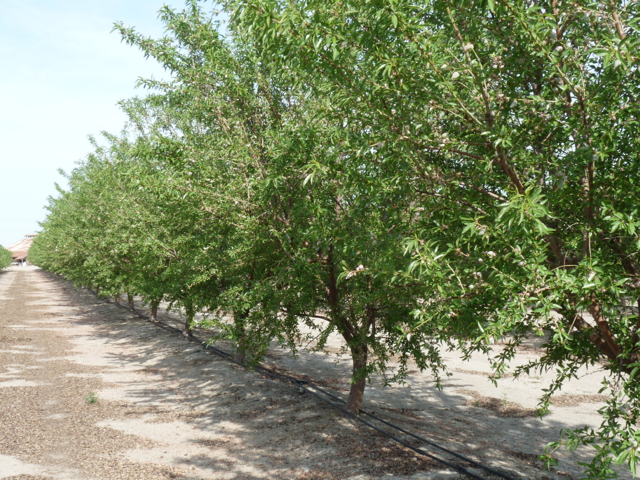
Could CropManage, already successful in vegetable crops be utilized by almond and walnut growers?

CropManage, run by the University of California, is an online database-driven tool that assists growers and farm managers in determining water and nitrogen fertilizer applications on a field-by-field basis.  The software works primarily by automating steps to calculate crop water needs.

The web application also helps growers track irrigation schedules and nitrogen fertilizer applications on multiple fields and allows users from the same farming operation to view and share data.

Michael Cahn had a leading role in the development of CropManage. Cahn is an irrigation farm advisor at UC Cooperative Extension of Monterrey County. Thanks to his work, the tool is now being used extensively on vegetable crops throughout the Salinas Valley.

Allan Fulton is UC Cooperative Extension Irrigation and Water Resources farm advisor based in Red Bluff, Tehama County. He also works in Colusa, Glenn and Shasta Counties. He noted that soon, CropManage might be developed around permanent crops such as walnuts and almonds.

He summarized  that the goal, “is [to provide] information to plan and feedback to adjust.”

He added that CropManage can crunch data and provide information beyond what the grower has asked in order to assist future planning.

Fulton explained that the program would estimate water use in a field or orchard for any given time frame. “Then the grower can add his or her knowledge of the irrigation system in that particular area. For example, entering water use per hour can generate feedback to schedule watering for a week or any other timeframe,” he said

The system can also can incorporate variables such as slow moisture data, and determine the effectiveness of the ET schedule. They are currently working on incorporating pressure chamber and crop stress feedback.

He added that Michael Cahn has made progress on the nitrogen track, and produces lots of aeration for short season annual vegetation crops. The next step is to link his work with research from other UC scientists and incorporate models from their work.

For more information, please go to: https://ucanr.edu/cropmanage/


2016-05-31T19:33:21-07:00October 13th, 2014|

Dealing with Food Waste—Make Energy and Other Products!

Recycling Food Waste is Big Business

 By Monique Bienvenue, California Ag Today, Social Media Manager


With food waste being a serious problem in today’s society, researchers at Greenbelt Resources Corporation are working to perfect new technology that can convert food waste into usable energy and byproducts.

“Ideally, within the next 3-5 years, we’ll have a system that can take, for example, a city like Santa Monica, with a population of about 100,000 people, that would generate about 35 thousand tons of waste per year,” said Chief Executive Officer and President of Greenbelt Resources Corporation Darren Eng. “That 35 thousand tons could be converted with our technology, combined with a couple of others, into 1 million gallons of ethanol per year and power a 2 mega-watt heat and power system.

According to the Environmental Protection Agency, over 36 million tons of food waste was generated in 2012. Two years have since gone by and that number has only increased.

Eng has high hopes for Greenbelt’s new technology. He wants to take food and beverage waste and convert it into what he calls the four F’s: fuel, fertilizer, animal feed and filtered water.

According to Eng, both the agriculture and beverage industries are good candidates for Greenbelt’s technology. Greek-yogurt plants are especially being targeted; acid-whey waste is a common byproduct, and with Greenbelt’s new technology that acid could be converted into alcohol and the whey waste can be converted into high protein animal feed.

That’s not all. Greenbelt’s new technology is also being credited for being able to produce ethanol.

“Most fuel today has ethanol in it as an oxygenator,” said Eng. “But most people don’t realize that the hand sanitizers such as Purell are 65% ethanol; or if you go to a banquet or a wedding reception, those little Sterno containers in heating food is gelatinized ethanol.”

Is Greenbelt’s new technology the answer to America’s food waste issue? Only time will tell.

2016-05-31T19:33:21-07:00October 13th, 2014|

USDA report outlines opportunities in the emerging bioeconomy

Source: Monique Bienvenue – Cal Ag Today Social Media Manager/Reporter

Agriculture Secretary Tom Vilsack announced that the U.S. Department of Agriculture (USDA) has released a comprehensive report synthesizing current literature that explores opportunities in the emerging bioeconomy. The report, entitled Why Biobased?, was created as a precursor for a more comprehensive economic study to be released in the coming months by the USDA BioPreferred program on the economic impacts of the biobased products industry.

“This new report presents the opportunities U.S. agriculture and forests have in the emerging bioeconomy,” said Vilsack. “The recent inclusion of mature market products into the BioPreferred program strengthens our commitment to the U.S. biobased economy and brings together two of the most important economic engines for rural America: agriculture and manufacturing.”

Synthesizing findings from existing government, academia, and non-governmental organizations, the new report explores how government policies and industry business-to-business sustainability programs are driving the biobased economy. The report further demonstrates that the biobased economy is, in fact, growing and it offers great potential for increased job creation in numerous sectors across the U.S.

For instance, one report cited concludes that biobased chemicals are expected to constitute over 10 percent of the chemical market by 2015. Another report in the study concludes that there is a potential to produce two-thirds of the total volume of chemicals from biobased materials, representing over 50,000 products, a $1 trillion annual global market.

On the heels of this completed study, the USDA BioPreferred program has awarded a contract for a more in-depth economic study of biobased products and economic impacts, including research on job creation and economic value. It will be the first federally-sponsored economic report of its kind targeting the biobased products industry in the U.S. Congress mandated the upcoming study in the 2014 Farm Bill.

The USDA BioPreferred program works to increase the purchase and use of designated biobased products through a preferred procurement initiative for federal agencies. Designated products may also carry the voluntary consumer label.

The voluntary “USDA Certified Biobased Product” label is designed to promote the broad-scale marketing of biobased products to consumers. As of September 2014, USDA has certified over 1,940 biobased products in more than 187 product categories for the label. Certified and designated products include construction, janitorial, and grounds keeping products purchased by Federal agencies, to personal care and packaging products used by consumers every day.

The Biotechnology Industry Organization (BIO) has estimated that U.S.-based jobs for the renewable chemicals sector will rise from approximately 40,000 jobs in 2011, which represents 3%-4% of all chemical sales, to over 237,000 jobs by 2025. This employment level would represent approximately 20% of total chemical sales.

2016-05-31T19:33:22-07:00October 9th, 2014|

Fingerprint of climate change on California drought

Source: Angela Fritz; The Washington Post 

Researchers studying the fingerprint of human-caused climate change on extreme weather events in 2013 have found that it played a role in half of the events that they looked at, including the California drought and extreme heat events.

Climate change attribution — figuring out what role climate change is playing in our weather events — is a very difficult science. There are so many moving parts: ground-level weather conditions, large-scale atmospheric patterns, and global teleconnections, like El Nino, that influence weather worldwide. And a changing climate can influence all of them (or none of them) in any given moment.

Nonetheless, given how costly weather disasters have become, the question of how extreme events could be changing is possibly the most important question to ask in climate change. So each year, scientists take a look back at the way change change could have impacted a few notable extreme events, and publish their findings in the Bulletin of the American Meteorological Society.

One study in the report, which was released on Monday, concluded that “global warming has very likely increased the probability” of the large-scale atmospheric patterns that have played a role the current, historic California drought – a strong, persistent ridge of high pressure over the western U.S. has essentially blocked the region from being impacted by storms coming off the Pacific.

That ridging pattern, which lead to few precipitation events, was made more likely by the presence of human greenhouse gas emissions, the study says.

Two other studies that dug in to similar aspects of California drought were less eager to point the finger at human-caused climate change.  Both studies looked at the role of warm ocean waters in the Pacific, and its relationship to California precipitation. While warm sea surface temperatures in the northeast Pacific would cause the dry ridging pattern over the western U.S., it would also act to cause heavier precipitation events over California by increasing the humidity.

While that’s not the outcome California saw in 2013 and the beginning of 2014, scientists say its enough of a question mark to remain uncertain on whether or not this event would have occurred without global warming.

However, it’s important to note that these studies looked at very specific, individual factors of the drought. California could be looking at its warmest year on record in 2014, but heat — which has a much more clear link with climate change, and acts to intensify and prolong a drought – was not considered in any of the studies looking at the California dry spell.

While drought remains somewhat of a question mark, scientists are most confident that the risk of 2013′s extreme heat events was made larger by human-caused climate change. All of the studies that looked at the extremely hot summers or heat waves around the globe concluded that climate change played some role in dialing up the temperature.

Australia, in particular, was severely impacted by heat extremes in the southern hemisphere summer of 2012-2013. The year was the hottest on record for the country, and subjected Australians to numerous heat waves and a drought that cost the government approximately $300 million USD. All of the studies that examined Australia’s summer temperatures found that climate change played a significant role in the heat, with one study even concluding that it has increased the risk of the event by two to three-fold.

“The results from the Australia studies are rather striking,” said Peter Stott of the Met Office Hadley Center in the U.K., and an editor in the report compilation in a press briefing. “It’s almost impossible, it’s very hard to imagine, those temperatures in a world without climate change.”

Hot summers and heat waves in New Zealand, Korea, China, and Japan were also examined, and determined to be influenced by climate change, and one group suggested that the Korea summer heat wave was made 10 times more likely by human-driven climate change.

The link between heavy precipitation events and human-caused climate change in 2013 appear to be more ambiguous.

Researchers who looked at the extreme precipitation events of 2013 found varying results — two studies found that human-caused climate change increased the likelihood of heavy precipitation events in the U.S. and India, while another two found no discernible link between the extreme precipitation events in Europe and climate change. One study, which addressed the extreme flooding event in Colorado in September 2013, found that the probability of such an event has even decreased in climate change.

Unsurprisingly, scientists found that the occurrence of cold waves — long periods of abnormally cold weather — have become much less likely in the presence of global warming. In particular, scientists looked at the extremely cold winter of 2013 in the U.K., finding that the probability of that event has dropped 30-fold.

2016-05-31T19:33:22-07:00October 7th, 2014|

Hartnell College Hosts Agroterrorism Training

UC Davis has announced that Hartnell College, in the Salinas Valley, is hosting a series of six agroterrorism training courses. David Goldenberg from the UC Davis, Western Institute for Food Safety and Security will be at the helm of these U.S. Department of Homeland Security (DHS) courses.

Goldenberg, Acting Program Manager and Coordinator for Field Training at WIFSS, pointed out that the Agricultural Business and Technology Institute at Hartnell is partnering with WIFSS to conduct the agroterrorism training courses, which kicked off on September 5. These courses emphasize the importance of awareness of and preparedness for disasters that can affect the agricultural industry. Preparedness includes having a response action plan in which all community members and organizations have a coordinated disaster response strategy.

The remaining classes are:

• Oct. 10, AWR 155: Principles of Frontline Response to Agroterrorism and Food System Disasters, 8 a.m. to 3 p.m.

• Oct. 17, AWR 156: Principles of Planning and Implementing Recovery (6 hours), 8 a.m. to 3 p.m.

These agroterrorism courses delivered at Hartnell are geared toward traditional first responders as well as community emergency planners, public health officials, and members of the agricultural community including county officials, local farmers and ranchers who are interested in training addressing potential threats to food safety and food security.

2016-05-31T19:33:22-07:00October 6th, 2014|

Imperial County Breaks Ag Production Record in 2013

The big Imperial County Region had a record year of Ag production value in 2013 of more than 2 billion dollars.

“It’s the first time that we ever hit the 2 billion dollar mark. We hit 2.158 billion dollars this year in production value,” said Linsey Dale, Executive Director of the Imperial County Farm Bureau.  Dale is based in El Centro—the county seat of Imperial County.

“We had a bump in price of cattle last year, we had a bump in the price of some of our forage crops last year, and our onion market went up a bit, broccoli market went up a bit, so there were several different crops that had an increase in price in 2013 over 2012,” said Dale.

Dale says that agriculture drives the economy in Imperial County. “We are the single biggest private employer in Imperial County, agriculture is. It has been since day one and will continue to be. If we lose agriculture here in Imperial county we lost Imperial Valley. We have thousands and thousands of jobs in farm services providers and right in production agriculture, its a tremendous impact,” said Dale.

Dale noted that Imperial County, through the Imperial Irrigation District, has some of the strongest water rights in the state. “We do have a very strong water rights. Water is a key issue for us here, we have very little rainfall, less than 2 inches per year. All of our water comes from the Colorado river, so with drought conditions here in California currently, areas are looking at us to produce that the fruits and vegetables need for the nation, especially for the winter months,” Dale said.

“We produce crops 365 days a year, some of our fields actually have 3 crop rotations. We get cuttings on alfalfa year-round, and again we have that strong water right that is necessary to be able to grow these crops,” said Dale.

2016-05-31T19:33:22-07:00October 3rd, 2014|

Nation’s Ag Co-Ops Set Record for Annual Sales and Income

Source: USDA

Agriculture Secretary Tom Vilsack announced that the nation’s farmer, rancher and fishery cooperatives set a new sales record in 2013, with total business volume of more than $246 billion. That surpasses the previous record, set in 2012, by $8 billion, a 4 percent gain. U.S. co-ops also enjoyed robust job growth over the previous year.

This third consecutive year of record sales by ag cooperatives reflects increased sales in the overall farm economy in 2013. U.S. crop production and livestock sales both increased 6 percent in 2013, while production input (farm supply) sales increased 2 percent.

“These sales and net income records for ag cooperatives, combined with strong gains in employees for 2013, underscore the strength and productivity of the nation’s farmer- and rancher-owned cooperatives. These co-ops play a vital and growing role in the nation’s economy,” Vilsack said.

Secretary Vilsack made the announcement to mark the start of National Cooperative Month in October. He also signed a Cooperative Month proclamation that salutes the nation’s entire cooperative business sector, which includes about 30,000 co-ops. In addition to agriculture, the nation’s co-ops play a major role in electricity and telecommunications services, credit and financial services, housing and in many other sectors of the economy.

Ag co-ops also enjoyed record net income (before taxes) of $6.2 billion, besting the previous high of $6.1 billion, set in 2012. Co-op income is either reinvested in the co-op for needed improvements or returned to the member-owners. It then circulates in local communities.

The number of full-time employees working for ag co-ops climbed by almost 7,000 in 2013, to 136,000, up 5 percent from 2012. Counting seasonal employees, ag co-ops employ 191,000 people.

In addition to marketing and processing their members’ crops and livestock, co-ops are also major players in the farm supply market. Co-op sales of petroleum, feed, seed and crop protectants were all up in 2013. Fertilizer sales declined, the only major farm supply to see sales drop in 2013.

With grain and oilseed prices generally lower in 2014, it appears unlikely that co-ops will set a fourth consecutive sales record when the results are tallied next year. However, livestock, poultry and dairy producers and their co-ops will benefit from lower feed costs, which should offset at least some of the decline in revenue from grain and oilseed sales.

While 33 ag cooperatives recorded more than $1 billion in sales in 2013, 33 percent (726 co-ops) had less than $5 million in sales.

The value of cooperative assets fell in 2013 by almost $1 billion, with liabilities decreasing by $5.3 billion and owner equity gaining $4.5 billion. Equity capital still remains low but is clearly showing an upward trend, with a 15 percent increase over the previous year.

Patronage income (refunds from other cooperatives due to sales between cooperatives) increased by almost 33 percent, to $1.2 billion, up from $900 million in 2012.

U.S. farm numbers remained about the same in 2013 as in 2012, with USDA counting 2.1 million in both years. There are now 2,186 farmer, rancher and fishery cooperatives, down from 2,236 in 2012. Mergers account for most of the drop, resulting in larger cooperatives.

Producers held 2 million memberships in cooperatives in 2013, down about 7 percent from 2012. The number of cooperative memberships is slightly less than the number of U.S. farms, but this does not mean that every producer is a member of an agricultural cooperative. Previous studies have found that many farmers and ranchers are members of up to three cooperatives, so farm numbers and cooperative memberships are not strictly comparable.


2016-05-31T19:33:23-07:00October 3rd, 2014|

CALIFORNIA AGRICULTURE LEADS THE NATION IN FUNDING FOR SPECIALTY CROPS CDFA

State receives more than $19 million in federal grant funds

SACRAMENTO, October 2, 2014 – The United States Department of Agriculture  announced Today funding for the 2014 Specialty Crop Block Grant Program (SCBGP). California received $19.8 million out of approximately $66 million awarded nationwide.

The SCBGP provides grants to state departments of agriculture to enhance the competitiveness of specialty crops, defined as fruits, vegetables, tree nuts, dried fruits, horticulture and nursery crops, including floriculture.

The 60 projects funded under the 2014 SCBGP reflect the diversity of California’s specialty crops across the state. This year’s projects include but are not limited to: creating economic opportunities for specialty crop producers through market development activities; increasing nutrition knowledge; developing local and regional food systems; and improving food access in underserved communities. Other area of focus include developing and implementing beneficial practices on the farm; training and equipping the next generation of beginning farmers; and preventing and managing pests and diseases to minimize threats to specialty crops.

In addition, the California Department of Food and Agriculture partnered with the Center for Produce Safety in the evaluation and recommendation of food safety related projects. These projects represent an ongoing effort to address food safety practices and minimize outbreaks of foodborne illness by proactive research.

2016-05-31T19:33:23-07:00October 3rd, 2014|

WIFSS Animals in Disasters Courses Piloted in Sonoma

2015 WIFSS Animals in Disaster Course Series

Source: Chris Brunner; UC Davis Western Institute for Food Safety and Security


Without coordinated response, awareness and resources, those animals left behind in a natural or man-made disaster most often do not survive. The Western Institute for Food Safety and Security (WIFSS) offers a series of Animals in Disasters courses that help prepare first responders and community members for animal-related emergencies.

WIFSS instructors, Tracey Stevens, deputy director, Animals in Disasters Project, and Dr. Michael Payne, dairy Ooutreach coordinator, piloted two new Department of Homeland Security Animals in Disasters courses this summer in Sonoma, California.

Class participants in “Emergency Animal Sheltering: Veterinary Considerations” learned skills and knowledge on how to establish an emergency animal shelter, and how to safely shelter and reunify animals that have been displaced during a disaster. In the “First Responder Guidelines for All Hazards Large Animal Emergency Evacuation” class, emergency personnel were provided instruction on safe approaches to emergency evacuation of large animals.

First responders, county officials, animal services personnel, veterinarians and other individuals can look forward to the 2015 WIFSS Animals in Disaster Course series which, in addition to the two courses above, will include:

  • Guidelines for Establishing an Emergency Animal Shelter: Veterinary Considerations – CE approved
  • Loose Livestock, Injured Wildlife and Humane Euthanasia of Animals for First Responders
  • First Responder Guidelines for Equine Emergencies – Level 1
  • Veterinarian Integration into Multi-Agency Emergency Equine Rescue and Disaster Response – CE approved

View WIFSS Animals in Disasters for announcements of course dates and registration information.

2021-05-12T11:17:15-07:00October 1st, 2014|

California Citrus Mutual to Contribute $150k to Water Bond Campaign; $50k to Latino Outreach

California Citrus Mutual (CCM) will directly contribute $150,000 to the campaign to pass Proposition 1, the water bond measure.

The CCM Board of Directors voted unanimously to support the measure in order to secure a reliable and sustainable water supply for California agriculture and communities across the state.

“We are in a state of unprecedented crisis in terms of water supply,” says CCM President Joel Nelsen.  “CCM worked closely with members of the legislature to create a long term solution path for the State’s water infrastructure and sustainability needs.  It is essential to the future of agriculture in California that voters approve Proposition 1 this November.”

Proposition 1 includes $2.7 billion to build additional water storage that will alleviate pressure upon Millerton Reservoir and water users on the Friant-Kern Canal in critical drought years such as this.  Approximately 58% of U.S. fresh citrus is grown by farmers in the Friant service area who received zero surface water allocation from the Central Valley Project for the first time in the project’s history this year.

“CCM’s contribution of $150,000 is an investment in our future, and the future of California,” says CCM Board Chairman Kevin Severns.  “It is critical that voters understand the importance of the issue and vote to pass Proposition 1.”

Additionally, CCM has committed $50,000 to the “El Agua es Asunto de Todos” (Water is Everybody’s Business) outreach campaign to raise awareness among the Latino community about the importance of a reliable water supply for California’s economy and jobs.

“CCM is proud to support the ‘El Augua’ campaign in its effort to empower the Latino community to support policy that creates water for California,” concludes Nelsen.

2016-05-31T19:33:23-07:00September 29th, 2014|
Go to Top