Joe Marchini, Mr. Radicchio

Joe in truckJoe Marchini Brings Radicchio to California

By Patrick Cavanaugh, Deputy Editor

Joe Marchini, of J. Marchini Farms, was born in 1938 to Italian parents who farmed and packed tomatoes in Le Grand, Calif. Marchini has lived and worked in that locale for his whole life, exemplifying a high level of spirit and accomplishment.

His father, Florindo Marchini, brought his family over from Tuscany in 1920.” They settled in Le Grand because Florindo’s brother was already living there when Florindo first arrived. Before long, Florindo met a long time grower by the name of Carlo Giampaoli who invited Marchini to grow tomatoes and bell peppers with him. So Giampaoli took Florindo Marchini under his wing, and his brother as well, and established their farm, Giampaoli-Marchini Company. Together, they packaged tomatoes under the Live Oak brand because they actually packed the produce by hand in the shade of a live oak tree that still thrives there today!

Florindo’s son, Joe Marchini, was around seven when he began working at the packing shed stamping produce boxes. “I would sit on a box,” he said, “and as they came down the line, I used a little stamp pad to size tomatoes 6/6, 7/7, 7/8, 5/6, 4/4, 3/4. I only worked about 3-4 hours a day, and that was it. The older I got, the more I became involved in different things, from stamping, to packing, to wrapping tomatoes in cellophane paper and putting them in a box.”

The tomatoes were packed green and transported back east by train in ice cars. “They weren’t pink ones; no, they were dead green! They knew when to pick them, when the gel formed inside of the tomatoes,” Marchini said. “They could tell by the color and the shine of the tomatoes, and that’s what the pickers were supposed to pick. They were going to break soon. It took about a week, running day and night, to get to New York on steamer trains.”

“The early farming venture was comprised of 150 acres, which was a lot of acreage with horses,” said Marchini. “In the fall, we would travel to Gustine and cut tulles and bamboo for our tomato stakes.”

“My two brothers, Richard and Leonard Marchini, went to school with me. None of us could speak any English; we only spoke Italian,” Marchini said. So they all learned English in a small schoolhouse with two classrooms and one teacher.

“My dad grew tomatoes on that land for two years and then planted 40 acres of almond trees. The almonds were harvested green and then dried down by air.” Of course this was before mechanical shakers were used to harvest, so it was done with mallets and tarps. “It was very tough work,” noted Marchini, “and the price of almonds was less than 60 cents a pound.” Marchini credits Blue Diamond Growers, a cooperative he joined, with marketing the almonds so prices could increase.Radicchio


Mr. Radicchio

Not satisfied with growing only tomatoes and almonds, Joe Marchini was always looking for something new to grow. In 1962 on a trip to Italy, Joe noticed fields of radicchio, a leafy Italian chicory and relative of endive, in the Venice area and found the crop was selling well in Italian grocery stores. He said, “I liked the crop and thought it would grow well in California, so I smuggled in little packages of seeds.”

Unfortunately, the seeds he brought back did not grow well. “Radicchio production wasn’t perfected and the source I had in Italy did not tell me what season the seeds were for.” Marchini’s radicchio would grow and form green leaves but not make a head. So Marchini went back to Italy, 40 miles southeast of Venice, to talk to growers, but no one would talk. “I certainly could not tell the guys that I was going back to the U.S. to grow the crop,” he said.

Marchini finally found a couple of growers to ship a 100-pound sack of seeds to San Francisco for him. “I picked up the bag, planted the seed and the same thing happened—it didn’t grow.” He called the Italian growers and asked how many different radicchio varieties they were growing. They told him eight varieties. “I asked them why they sent me only one variety, why they did not tell me when to plant the seed, and if they wanted me to buy more seed, they had better tell me what varieties to grow,” he said.

“Since I spoke Italian, the growers started to open up. Eventually, I brought them to the U.S., and we partnered up to grow radicchio. I even sent them to Mexico because they thought they could produce an earlier crop than in California,” Marchini said. After reaching mediocre success for about four years in Mexico, they moved back to California to work with Marchini, now without a partnership.

The company now productively farms in Mexico with the right seed. “We farm in Mexico for the winter crop in February, March and April. But before we started growing in Mexico, in the late 1970s, we started in Salinas and then in the San Joaquin Valley. The Italian growers knew what to plant and we got all the varieties in the right mode that would do well. The Italians wanted to be partners again and I declined it because I had kids coming up, but I told them that I would buy all the seeds from them, and they were making good money. So they ended up disclosing the secret in the whole deal of growing radicchio. So without them, and me speaking Italian, we would have never gotten started. We are still friends today and I’m still buying seed from them,” Marchini said.

Over the years, Marchini has worked with his son Jeff to plant the right seed at the right time. They learned which varieties could handle different climates, such as going into the heat, and coming out of the heat, and they emerged with 6 or 7 dependable varieties.

“So we plant six varieties in the fall, one week after the other. We can have radicchio in the San Joaquin Valley from November until March, and we harvest seven days a week.

His processors want radicchio 12 months out of the year, so Marchini’s company manages harvesting to fill the sales pipeline 12 months a year. “And we never run out of it,” he said.

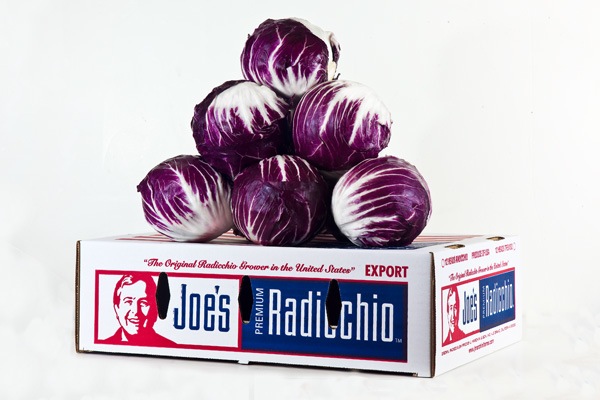
Joe's Premium LogoToday, Marchini uses about 12 different labels, including his own image on the ‘Joe’s Premium Radicchio’ box, for the domestic market and select export markets. “We let global importers pick their own labels. J. Marchini ships all over the world now, including Italy, and has a large percentage of the market in Japan, Korea and Taiwan. “They love the color of radicchio in a blend,” he said.

J. Marchini deals with nearly every processor in California including Taylor Farms, Apio, Fresh Express, Dole, Earth Bound, and Ready Pac, year-round, with production from Kern to Merced counties and Mexico.

Managing all this production with Joe and his son Jeff (the third generation), are grandchildren Marc and Nic and Francesca (fourth generation), with the fifth generation coming along with Gabriella, Maximus and little Giuseppe, named after his great-grandfather Joe (Giuseppe). Marc and Francesca work in the sales and post-harvest side of the business. Nic works in the farming operation side of the business. Jeff oversees the company as a whole.

Overseeing production, and especially the harvest of the radicchio throughout the growing regions, including Mexico, is Alejandro Calderon, Joe Marchini’s right hand since day one. Jenny MacAfee, a key person in the sales department, has been on board for the last 20 years.

Today Marchini farms three main radicchio varieties: Castelfranco (white head with red polka dot specks), Treviso (elongated red with white ribs), and Palo Rosa (red head type with white veins). “We do a three-pack deal in the wintertime with all three varieties together, but we also grow many other varieties,” said Marchini.

J. Marchini Farms’ production operation, based in Watsonville, a great climate for radicchio in the summer months, includes 2,000 acres spread between the Central Valley, the Coastal areas and Mexico.

The Central Valley fall and winter nighttime temperatures are cool, and radicchio production, five lines down the row on 80-inch beds, is about 20,000 pounds per acre, with most of it on drip or sprinkler.

The operation also grows almonds, walnuts, fresh figs and other crops, “but radicchio has been a good ride,” said Marchini. “We have had ups and downs with the crop, but overall it has provided a good cash flow,” he said.


For the last three years, Joe Marchini has been dealing with Squamous Cell Carcinoma (the second most common form of skin cancer) and has undergone multiple surgeries and treatments. His love for his family and his incredible passion for farming keep him going.

_______________
J. Marchini Farms

2016-05-31T19:27:06-07:00October 16th, 2015|

ALRB on Entering Private Property

ALRB on Entering Private Property to Educate Workers:  Is the ALRB going too far?

By Patrick Cavanaugh, Deputy Editor

The California Agricultural Labor Relations Board (ALRB) wants to enter private property farmland for the purpose of educating farmworkers on their rights as farm laborers in California. Of course, farmers want their workers to be happy and content with their work and that means knowing and understanding their rights as farmworkers.

“But the ALRB is going too far,” said attorney Ron Barsamian of Barsamian & Moody in Fresno, which represents many agricultural businesses throughout California in labor and  employment law.

“I wanted to get into some pragmatic issues that I feel have not been considered. For instance, the lack of efficiency in trying to get access to all these different ranches is just not going to work,” said Barsamian. “You are going to have staff tied up forever. I don’t think they have taken into account the different geographical areas, the different ag sectors. For instance, are you going to spend as much time educating two or three people working at a dairy as you would a crew of 50-60 people?”

2016-05-31T19:27:06-07:00October 15th, 2015|

Winegrape Grower Earns SIP Certification

Dana Merrill, Winegrape Grower Earns SIP Certification

By Patrick Cavanaugh, Deputy Editor


Dana Merrill is a seventh-generation farmer of an eighth-generation Californian farming family and president of Mesa Vineyard Management, a premium vineyard management service on the Central Coast. A graduate from Cal Poly with an Agriculture Business degree, He is a member of the Merrill Family Estates, an estate that produces premium winegrapes for its Pomar Junction Winery, and he’s extremely involved with the Paso Robles Wine Community.

Recently, his winegrape growing operation earned the Sustainability In Practice (SIP) certification.

“We worked very hard to attain this certification,” Merrill said. “Most of the changes were positive moves. It’s not meant to be a penalizing certification, but there are specific restrictions. For example, we don’t use any Class I restricted materials. If the US Environmental Protection Agency has commented about a substance, ‘Hey, that is Class I. It may be legal, but as an herbicide, it has a tendency to leach into the groundwater,’ then the SIP system won’t allow it. There are times when I’ve said, ‘Boy, I wish I could use a certain material,’ but there are some I simply cannot use in order to qualify for the certification.”SIP Certified

Merrill continues, “The SIP also takes into account how you treat your labor. For example, more ‘points’ are awarded if you offer a benefit program, continuing education support, a retirement program, or health insurance. These days, everybody has to offer health insurance, but points are awarded for that, even though some of us have offered it for over 20 years. Points are also earned for best-practice management whether it is fertility management, soil probes, or having water meters on all your wells and using the information to manage how you irrigate. The idea is to encourage folks to do more and raise the bar.”

“Being SIP-certified helps with marketing too,” noted Merrill. “If you get the SIP seal on a bottle of wine, a consumer can go be assured of the excellent quality of that product.”

“It is marketing in the sense that we are always selling ourselves to the consumer,” Merrill explained. “You know, the consumer may ask, ‘Why should I buy a bottle of SIP wine? Why should I buy California wine?’ I think that branding or labeling conveys a message to customers about what is important to them. Some consumers are very environment-oriented; others are looking primarily for quality. Your label conveys that message. There are customers to whom it is less important, but I see its significance growing. I would say 50% of the people who visit our tasting room find that label on an SIP-certified bottle of wine quite meaningful,” Merrill said.

_______________________

Links

Mesa Vineyard Management

Sustainability In Practice (SIP)

US Environmental Protection Agency

2016-05-31T19:27:07-07:00October 14th, 2015|

More on Federal Milk Marketing Order

Continued Coverage on Federal Milk Hearing in Clovis

More on Federal Milk Marketing Order: Let the Market Sort it Out

By Patrick Cavanaugh, Deputy Editor


Bill Verboort is the General Manager for AgriTech Analytics (ATA), a national company based in Visalia Calif. Owned by the Holstein Association USA, AgriTech is part of the U.S. Dairy Herd Improvement Association System, and provides data to dairy producers for management, genetic improvement and pedigree purposes. Verboort has been attending the USDA Federal Milk Marketing Order (FMMO) hearing in Clovis, Calif., which is gathering testimony from milk industry people who want, or do not want to abandon the California Milk Marketing Order and adopt the FMMO.

“I think it is a very historic day, because I think California is one of the only major markets outside the FMMO,” said Verboort. “When the Federal system came in the 1930s, there were good reasons for us to be on a state order due to geographic isolation, etc. Today, I don’t see us as geographically isolated as we once were. So why not be part of the FMMO?”

Verboort noted that the FMMO should put California producers on par with the rest of the country when it comes to milk and cheese prices. “That is the intended and anticipated effect,” he said.

Of course there are many against adopting the FMMO. “Some are saying if the California producer is going to get more money for his milk, he is going to produce more,” said Verboort. “If you look at the industry over decades, when the price of milk has gone up, producers have produced more. You’ve got to make hay when the sun shines, so to speak. And when prices are down, the cash flows are down, so a producer needs to get more cash. What is the solution to that? Produce more milk!”

“So the California producers are going to produce more milk whether the FMMO system is in place or not; at least that’s the way I see it,” Verboort explained. “But if our producers in California are at a disadvantage to producers in other parts of the country, we need to make an equitable situation here.”

“And the market will shake it out. It is as simple as that,” he said. “We can produce milk products more efficiently in California and I think that is good for the U.S. and for the consumer. If the producer can produce it here more efficiently by getting on the right strategy with the FMMO rather than the California milk order, then we are on the right track.”

“California producers have been on the short end of the stick for a long time,” Verboort said. “Even though last year was a very good year for most producers throughout the country, and for California producers as well, they still sold their milk for several dollars per hundred weight less than the rest of the country,” Verboort said.

As for the hearing taking place in Clovis, Verboort said it seems that the momentum is going in a good direction. “But we will find out; that is what these hearings are about,” he added.


AgriTech Analytics (ATA) is a certified Dairy Records Processing Center.   

Part of the U.S. DHIA System, AgriTech Analytics provides data to dairy producers for management, genetic improvement and pedigree purposes.  

By utilizing the reports and herd analysis made available by AgriTech Analytics, Herd owners are able to maximize profitability and better position themselves in today’s competitive dairy industry.

________________________________________

Links:

AgriTech Analytics

U.S. Dairy Herd Improvement Association System


2016-05-31T19:27:07-07:00October 14th, 2015|

Table Grape Ads Feature Growers

California Table Grape Ads Feature Growers

By Charmayne Hefley, Associate Editor

Kathleen Nave, California Table Grape Commission president

Kathleen Nave, California Table Grape Commission president

In an effort to shed a more positive light on agriculture and the growers who cultivate the food we eat, some advertising campaigns are focusing on bringing growers to the forefront. Kathleen Nave, president of the California Table Grape Commission, said this is exactly what the Commission’s campaign has been doing, and it has been receiving positive feedback. “The heart of the global campaign the Commission is fielding,” Nave said, “is very much about California table grapes and the heritage that growers bring to the table—the years of understanding the art and the science that go into growing table grapes.”

The California Table Grape Commission has generated commercials that focus on the family aspect of California’s grape growers and can be seen on Food Network television. “The heart of the campaign of table grape ads,” said Nave, “is basically branding California and the growers of California table grapes. We’ve portrayed our brand this way, in this particular campaign, for about eight years, and it really resonates. A National Consumer research study of the four advertising commercials we are currently fielding on the Food Network revealed very high marks.”

Nave explained the commercials help to create trust between consumers and growers by showing consumers the faces behind their food. “The two commercials that feature growers’ families interacting with one another, one set in a vineyard and another at home, resonated the highest with consumers,” Nave said. “Consumers have a huge amount of trust for growers. There is a hunger among consumers—not only in the U.S., but in other parts of the world as well—to understand who is growing the food they bring home to their own families. So showing consumers a California table grape ad that features the grower, the grower’s family, and their vineyard, really resonates. So the campaign is working well. I think it’s a campaign that we will be continuing.”

_____________________________

Links:

California Table Grape Commission

Grapes from California “Family Dinner” tv commercial

Grapes from California “Generations” tv commercial

2016-05-31T19:27:07-07:00October 13th, 2015|

3rd in a Series on Mental Health on Farm

Part 3 Mental Health on the Farm:

Isolation in Farm Country

Resources are provided at the end of this post.

In light of Mental Illness Awareness Week last week, Karen Markland, Division Manager for the Fresno County Department of Behavioral Healths Planning, Prevention and Supportive Services, talked extensively with California Ag Today Editor, Laurie Greene, about members of the local agricultural industry who could be going through significant emotional suffering due to the drought and environmental water restrictions impacting their livelihoods.

Editor: Is there anything unique about how farmers and farmworkers suffer from stress?

Markland: In our experience with farm-working populations, they have a couple of strikes against them. They are geographically isolated in rural areas; they are probably linguistically isolated as well, as their native language is typically not English; and, they are culturally isolated in that many of our cultures believe in not talking about sick minds or sick feelings. Plus there is transportation barriers. Our county is so large that it is very difficult for rural workers to receive any services. And so, we think it is a combination of things that discourage people from reaching out for help.

Editor: Are there financial issues or constraints?

Markland: What we have found is anytime we we use Mental Services Act dollars, we have to do it based on what the community wants. The stakeholders have brought up not a financial barrier, per se, but a transportation barrier. They tell us, “I can’t afford a car. I can’t afford the taxi from Kerman to Fresno or Parlier to Fresno.” They see it as a transportation barrier.

Editor: Is this population at risk?

Markland: There have at least two suicides in the agricultural community, a landowner and a farmworker. That is too many. It is unacceptable, but it has brought to light some uncomfortable subjects that we have to try to make more comfortable. When individuals feel that stressors become more difficult to manage, thoughts of wanting to harm themselves and not wanting to continue or to fight through, become stronger.

Editor: What can you do for people who feel this way?

 Markland: We are concerned about the farmworker who wakes up to such serious depression or anxiety and who has to fight through their day. That is no quality of life. So, we have a couple of resources. One that we are proud of right here in Fresno is the Central Valley Prevention Suicide Hotline 1-888-506-5991. This is a 24/7 hotline that has all language capabilities. So no matter what your language, we are here for you. This is a local number. The reason I keep saying local is that the person who picks up that phone call understands the culture of our valley—that we we have farmworkers facing dire drought conditions that others in California do not encounter with the same potential catastrophic loss; and the anxiety behind that, and the longevity of that—that it is not a one-week problem. This isn’t a breakup with a person; this is a long-term problem. So having local people manage the hotline is a wonderful resource.

Editor: Of course, farmers and farmworkers outside of Fresno County may have a similar resource in their counties. (Please refer to resources listed at the end of this article.) Could you tell us how successful has the Fresno County hotline been?

Markland: They are a crisis hotline; plus they are there just to help talk to people who are depressed or anxious. We do “talk-down” calls and rescue calls. This hotline has saved over 53 lives in active rescues in the last 12 months. Individuals have called the hotline as their last resort, and we’ve been able to activate emergency medical services and save their lives. In addition, we do follow-up calls.

Editor: What about follow-up calls?

Markland: If a person calls our hotline, and they have a safely plan, and the staff on the call feels they are safe, they’ll do a follow-up call in two days. Staff will ask if they have stuck with their safety plan, how they are feeling, and if they accessed the support systems they wanted to, because we really are dedicated to having a healthy community.

The Fresno Department of Behavioral Health is dedicated to supporting the wellness of individuals, families, and communities in Fresno County who are affected by, or at risk of, mental illness and/or substance use disorders through cultivation of strengths toward promoting recovery in the least restrictive environment.County of Fresno Logo

The Fresno Department of Behavioral Health provides mental health and substance abuse services to adults within the County of Fresno. The programs within our department focus on delivering the highest quality of service. There are over 300 professionals and staff dedicated to providing services in both metropolitan and rural areas. The diversity of our staff has helped us create a department that is sensitive to cultural differences and attempts to bridge the language barriers with our consumers. 

2016-05-31T19:27:07-07:00October 12th, 2015|

Outlook on California Poultry

Bill Mattos: Outlook for California Poultry Industry

By Charmayne Hefley, Associate Editor

California’s poultry industry has a positive outlook for the coming year despite the recent outbreak of the highly pathogenic avian influenza plaguing the rest of the nation’s poultry industry. Bill Mattos, president of the California Poultry Federation, said the coming year will see chicken overtaking beef.

“We’re learning from a lot of economists that we are going to have an exciting year for poultry next year and into the future,” Mattos said. “It looks like chicken is taking over beef next year, and all of poultry will be ahead of the red meats. We love our beef and pork friends, but we’re passing them. It looks like the healthfulness of chicken and the capacity to grow locally—everything in California—is looking good for the poultry industry. And we’re excited. We think the chicken and turkey industries will have a good year coming up.”

And although the price of corn is still higher in California versus nationally, Mattos said this industry is still doing well. “We still pay about a dollar or more a bushel for corn in California. But prices are outstanding compared to what they were two or three years ago, so our companies are making some money.”

With the flyways, or bird migration, coming back this fall, Mattos said the California poultry industry is prepared with increased biosecurity on their farms and ranches to prevent an avian influenza outbreak. Mattos said, “It’s very important that we make sure our companies are locking down their facilities—keeping visitors off and maintaining a biosecurity that’s first in the nation—because any type of bird flu that could invade here and spread would devastate the marketplace.”

____________________

California Poultry Federation

2016-05-31T19:27:07-07:00October 9th, 2015|

Cornell Kasbergen On Federal Milk Marketing Order

Continued Coverage of Milk Hearing

Dairyman Cornell Kasbergen: We Need Federal Milk Marketing Order

By Patrick Cavanaugh, Deputy Editor

Cornell Kasbergen, a dairyman in Tulare County, is fed up with the flawed California State Milk Marketing Order. So much so, that he and other dairymen and women have a great desire to switch to the Federal Marketing Order.

This idea is presently front-and-center in Clovis, CA as USDA officials are holding an historic hearing that may extend into early November.

“It started three to four years ago when our milk prices were dramatically less than those in the rest of the country, and we wanted to get our industry on a level playing field. It has been a lot of work getting the co-ops together, but we are just at the beginning of this whole process.”

Having the USDA here is, in itself, a big beginning,

Kasbergen has worked hard to drum up interest in the idea. “When I was a co-op board member at Land O’Lakes, Inc. [a national, farmer-owned food and agricultural cooperative milk cooperative], we worked with other dairy co-ops and their members to get educated.  We discovered, for the last three to four years, California’s whey value in its milk pricing formula deviated from national prices, and California producers were losing money. Once we realized we were leaving a lot of money on the table—over a million dollars a day—it opened people’s eyes. That’s why we are having this hearing.”

“The California Department of Food and Agriculture intentionally left the state’s whey prices lower than the rest of the nation, and though we’ve been petitioning them over and over again to rectify the issue, they have failed,” said Kasbergen. “That’s why we have gone this route in getting our milk prices formulated by the federal government rather than by the state. Our state has really let us down.”

“The CDFA has taken hundreds of millions of dollars out of the dairy farmers’ pockets, the loss is killing the dairy industry in California,” said Kasbergen.

2016-05-31T19:27:07-07:00October 9th, 2015|

UC Davis Water Policy for Food Security

UC Davis Water Policy for Food Security Global Conference

By Laurie Greene, Editor

A Global Conference for Water Policy for Food Security was held at UC Davis earlier this week to focus on global ground water supplies. Many speakers came from around the world to talk about water supplies in their own countries.

The take-home message:  Supplies are limited, but growers are being very efficient and groundwater recharge is a priority.

Josette Lewis, associate director of the World Food Center at UC Davis said, “When I joined UC Davis, it was very clear that water is something in which this campus has enormous technical expertise and has expertise to inform and engage in state water policy,” she said.

“We are working with everything from farmers to state agencies that manage water resources. Part of the vision of the World Food Center is, how do we expand that impact? How can UC Davis have an impact on national and international issues? How do we get more benefit for society from what we do? It became very obvious that leveraging the expertise we had here in California to an international discussion of issues made a lot of sense.”

Lewis noted that the conversations during the two-day conference were an exchange of ideas on groundwater sustainability, “I think the quality of the discussion over the last few days exceeded our expectations,” she said.

“We really brought in some of the world’s leading experts in these areas. From talking to the participants some of them are walking away with a new and energized way of thinking about how we can create solutions to address the sustainability of our water supply and ensure that we have water available for food production globally,” Lewis said.

World Food Center at the University of California, Davis

International Food Policy Research Institute

Twitter  Join the conversation on Twitter at #WaterSecurity

2016-05-31T19:27:07-07:00October 8th, 2015|

2nd in Series: Mental Health on the Farm

Part 2  Mental Health on the Farm:  Destigmatizing Mental Health

October 4th – 10th is National Mental Illness Awareness week, and National Depression Screening Day is tomorrow, October 8, 2015.

Resources are provided at the end of this post.

Karen Markland, Division Manager for the Fresno County Department of Behavioral Healths Planning, Prevention and Supportive Services. spoke with California Ag Today Editor Laurie Greene about mental health and the state’s farmers and farmworkers who have experienced increased stress due to the drought and environmental water restrictions impacting their livelihoods.

Editor: Back in April, your department partnered with the Fresno Economic Opportunities Commission (EOC) and the USDA to receive a grant specifically to host a conference called “The Drought Emergency and Preparedness Conference,” (DEAP). DEAP was a full-day event for farmers to discuss the drought and water, but also included representatives from mental health?

Markland: Here was the Department of Behavioral Health, a mental health partner, at an agricultural event. It was fascinating to see the curious looks that implied, “I kind of want to go up there, but I don’t want to go up there.” And by the end of the day, we had attendees and farmers approaching our table. We created an agricultural theme with plants and live videos of our gardening projects to destigmatize and show that mental health and mental wellness speak all languages. So we were pleased to be there.

Editor: We understand the Fresno County Farm Bureau participated?

Markland:   Yes, the meeting with the EOC and USDA was actually initiated by the Fresno County Farm Bureau, which is is very interested in the wellbeing of its community. Ryan Jacobson, Farm Bureau ceo/executive director, had received some communication indicating our farmers were feeling stress and that some had lost their lives based on the anxiety and depression brought on by these drought conditions. It was time for us to activate and come together to talk about a very uncomfortable subject.

Our Farm Bureau and the USDA partnered to talk to workers and farmers who aren’t just happy; rather, they are depressed and anxious, and we are worried about them. The collaboration among the Farm Bureau, USDA and mental health was wonderful.  It was an amazing dialogue to jointly say, “This is such a stigmatizing topic for a group of individuals who are typically adult male farmers who don’t want to share or hear these words. Yet, we’ve lost lives, so it is time to make a difference.”

The Fresno Department of Behavioral Health is dedicated to supporting the wellness of individuals, families, and communities in Fresno County who are affected by, or at risk of, mental illness and/or substance use disorders through cultivation of strengths toward promoting recovery in the least restrictive environment.County of Fresno Logo

The Fresno Department of Behavioral Health provides mental health and substance abuse services to adults within the County of Fresno. The programs within our department focus on delivering the highest quality of service. There are over 300 professionals and staff dedicated to providing services in both metropolitan and rural areas. The diversity of our staff has helped us create a department that is sensitive to cultural differences and attempts to bridge the language barriers with our consumers. 

2016-05-31T19:27:08-07:00October 8th, 2015|
Go to Top