Important Cotton Grower Webinars Scheduled

U.S. Cotton Trust Protocol Announces NEW DATES for Regional Grower webinars

Growers should join to learn how they can benefit and how collectively this will help increase demand for U.S. cotton globally.  

The U.S. Cotton Trust Protocol, which aims to give brands and retails the critical assurances that they need to source U.S. cotton, has announced a new slate of regional-focused webinars from November 9th through the end of 2020. These additional webinars were added following strong demand during the September and October sessions. Grower enrollment is now open to all U.S. cotton growers.

Starting November 5th, growers who have not yet had the opportunity will get to learn about the benefits of the U.S. Cotton Trust Protocol and ask questions with our team. While the sessions are divided by region, interested growers are free to join any session that fits in their schedule. Participants can enroll at https://trustuscotton.org/enrollment-webinar-live-sessions/.

“There’s more scrutiny on the global cotton supply chain than ever before. At the U.S. Cotton Trust Protocol, we aim to raise demand for U.S. cotton as a sustainably-grown fiber and meet the needs of brands and retailers as they work to lower their impact on the environment,” said Gary Adams, President of the U.S. Cotton Trust Protocol. “Joining the Trust Protocol will also provide producers with data that will help them to improve their growing practices.”

A recent study from the U.S. Cotton Trust Protocol and the Economist Intelligence Unit found that 60% of fashion, apparel, and textile business leaders said implementing sustainability measures was a main strategic objective for their organization. The top sustainability measure businesses are implementing is establishing a sustainability strategy with measurable targets, which 58% of respondents said they were doing. In second, 53% said they were working on collecting data from across the business and in the supply chain to measure performance.

The next slate of webinar sessions will begin on November 9th – growers can access the full schedule of webinars here.

For those interested in enrolling, please visit: TrustUSCotton.org


2020-11-09T14:17:43-08:00November 9th, 2020|

Tim York is Cal Leafy Greens New CEO

California Leafy Greens Marketing Agreement Announces Tim York As New CEO

Tim York was named as the new Chief Executive Officer of the California Leafy Greens Marketing Agreement (LGMA) during today’s Board of Directors meeting.   York will replace Scott Horsfall who is retiring in early 2021.

“Tim has been an influential presence when it comes to advancing continuous improvement in  food safety in the produce industry,” says Dan Sutton, Chair of the LGMA. “He is a staunch advocate for protecting consumers and public health and we are fortunate to have Tim to guide LGMA into this new era.”

York was formerly the President of Markon Cooperative, a produce procurement operation with members throughout North America and Canada. Throughout his tenure as a produce industry leader, he has held several prominent positions including serving as chair of the Alliance for Food and Farming, the Produce Marketing Association Board and twice as the chair of the Center for Produce Safety.  He continues to serve on the Board of the Center for Produce Safety as well Co-Chair of the Produce Traceability Initiative.

York also represented the buyer community on the Romaine Task Force in 2019 serving on the Steering Committee as well as Chair of the Traceability Sub-Committee.

York has been honored with numerous awards including The Packer’s Foodservice Achievement Award and Produce Marketer of the Year, the Perishable Pundit’s Single Step Award, and the Produce Marketing Association’s Bryan Silbermann Collaboration Award. He was also the recipient of the LGMA’s Golden Checkmark award in 2009.

“Food safety is both a priority and a passion for me,” says York. “I look forward to focusing on food safety on a full-time basis, to serving the industry and consumers as well as working collaboratively with our industry partners to advance goals and objectives that protect public health.”

The Board of Directors also recognized Scott Horsfall, who has been CEO of the LGMA since it was established in 2007.  “The Board thanks Scott for his foundational leadership and excellent work over the past 13 years,” Sutton says.

“This job has been both rewarding and heartbreaking,” said Horsfall.  “While we have accomplished a great deal, food safety and protecting public health must be a continuing process with a continuing commitment to do better every day,” he says. “I respect this industry immensely and under the leadership of Tim, the farmers that make up the LGMA and our dedicated staff, I’m confident this industry will work diligently to advance continuous improvement.”

York will begin his work with the LGMA on December 1.

2020-11-05T11:48:38-08:00November 5th, 2020|

Western Growers Has New Innovation VP

Western Growers Hires Walt Duflock as
Vice President, Innovation


Increasing its industry-leading efforts to quicken the pace of technology solutions for the fresh produce industry, Western Growers has added Walt Duflock as Vice President, Innovation. In this role, Duflock will be singularly focused on accelerating agtech for Western Growers (WG) member companies, including expanding the footprint of the Western Growers Center for Innovation & Technology (WGCIT), a premier agtech incubator located in Salinas, Calif.


“The need for innovative technology in our members’ fields and facilities has never been more urgent,” said WG President and CEO Dave Puglia. “Walt Duflock has guided many technology entrepreneurs and brings a demonstrated ability to propel growth in the agriculture technology sector. I am thrilled that Walt will now join WGCIT Director Dennis Donohue, who is driving tangible progress on key agtech initiatives such as automation and food safety enhancement. Together, Walt and Dennis will further strengthen our ability to drive rapid commercialization of the technologies our members need to thrive into the next generation.”

Duflock brings over 25 years of experience in the agriculture and technology sectors, with an emphasis on startup development. In addition to his involvement in his fifth-generation family ranch in Monterey County, Duflock has dedicated his career to building programs and strategies at high-growth Silicon Valley startups, including eBay, MerchantCircle (now Reply) and APTARE (now Veritas). In his most recent role, Duflock served as Executive Innovation Leader for SVG Ventures THRIVE.

“I am excited to be joining the WG team and look forward to working with farmers and startups to increase the speed and scale of solutions, especially for food safety and labor automation,” said Duflock. “My decades of experience in agriculture and working with Silicon Valley startups, along with building a successful agtech accelerator, give me the right set of skills to lead WG’s innovation initiative.”

Duflock earned a B.S. degree in Business from Cal Poly San Luis Obispo and a law degree from Santa Clara University. He is active in his local community and serves on several volunteer boards, including the Los Gatos United Soccer League and Rancho Cielo, which aims to transform the lives of at-risk youth. In 2019, Duflock launched SAGE, a 501(c)(6) that focuses on sustainable ag and energy and vibrant rural economies.

2020-10-29T14:06:49-07:00October 29th, 2020|

Natural Habitats Help With Pest Control

How Surrounding Natural Habitats Can Shape Pest Outbreaks and Pesticide Use in Vineyards


Photo at top is Daniel “Dani” Paredes

Natural landscapes surrounding vineyards can decrease pest outbreaks and depress pesticide use, according to a UC Davis paper published in the current edition of the journal Ecology Letters.

A five-member team led by postdoctoral researcher Daniel “Dani” Paredes of the Daniel Karp lab, UC Davis Department of Wildlife, Fish and Conservation Biology (WFCB), analyzed a 13-year government database to assess how the landscapes surrounding 400 Spanish vineyards influenced European grapevine moth (Lobesia botrana) outbreaks and insecticides application rates.

The article, “Landscape Simplification Increases Vineyard Pest Outbreaks and Insecticide Use,” is now online.

“At harvest, we found pest outbreaks increased four-fold in simplified, vineyard-dominated landscapes compared to complex landscapes in which vineyards are surrounded by semi-natural habitats,” said lead author Paredes, who holds a doctorate in environmental sciences (2014) from the University of Granada, Spain.  “Overall, our results suggest that simplified landscapes increase vineyard pest outbreaks and escalate insecticide spray frequencies. In contrast, vineyards surrounded by more productive habitats and more shrubland area are less likely to apply insecticides.”

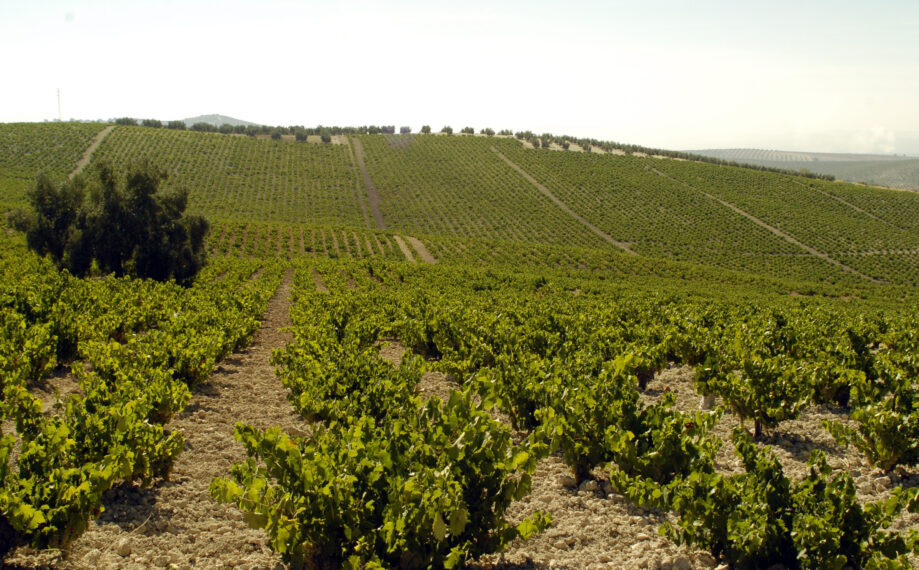
Vineyard in Montilla Spain

Landscapes around farms are rarely managed to suppress damaging crop pests, partially because researchers rarely measure the key variables that drive farming decisions. This paper, however “shows how using really huge datasets—in this case generated by government employees working with farmers in Spain–can reveal how natural habitats surrounding agriculture can shape pest outbreaks and pesticide use in vineyards,” said co-author Jay Rosenheim, distinguished professor in the UC Davis Department of Entomology and Nematology.

Their results suggest that landscape simplification could affect not only farm yields, but also  environmental and human health. They noted that insecticide applications doubled in vineyard-dominated landscapes but declined in vineyards surrounded by shrubland. “Habitat conservation thus represents an economically and environmentally sound approach for achieving sustainable grape production in Spain,” said Karp.

Why might pests be more of a problem on vineyards surrounded by more vineyards? One possibility is that vast stretches of vineyards allow pest populations to build up quickly. Another possibility is that simple vineyard landscapes may not contain enough resources to support predatory insects that natural control vineyard pests. Whatever the reason, it seems clear that “cultivating crops in monoculture creates the perfect conditions for specialist pest outbreaks,” they related, so “farmers have consistently turned to insecticides to maintain high yields under constant pest pressure.”

A solution? At an individual level, farmers may better control L. botrana populations through planting native vegetation in and around their farm. Ideally, they would coordinate with each other to maintain and/or restore large patches of productive, shrubland habitats in the surrounding landscape.

Other co-authors are Rebecca Chaplin-Kramer, Natural Capital Project, Stanford University; and Silvia Winter, Institute of Plant Protection, University of Natural Resources and Life Sciences, Vienna, Austria.

Their work was financed by the research project SECBIVIT, or “scenarios for providing multiple ecosystem services and biodiversity in viticultural landscapes,” and a National Science Foundation/USA grant.


2020-10-26T10:52:39-07:00October 26th, 2020|

Stewart and Jasper Grew With the Almond Industry

How An Almond Grower Expanded His Operation

By Patrick Cavanaugh, with the Ag Information Network

Jim Jasper heads up Stewart and Jasper orchards, with almond growing hulling and shelling operations in the Stanislaus County area of Newman.

“In the mid-eighties as the almond industry continued to grow, some of our neighbors wanted to use our huller. So we put a sheller in, and by the late eighties, like a lot of them are doing, we were a Blue Diamond growers from 1960 until 1990, sending our almonds to Blue Diamond. But then we decided, well, we’ll try putting them into a box,” noted Jasper.

By putting them in a box Jasper means he’s going to be processing and shipping to customers.

“We started a little processing business that evolved. And our neighbors wanted to follow suit. And so by the mid 1990s, we’re probably up to about 2% of the total industry boxing processing, marketing almonds. We’ve continued about that same 2% to this day. Things just kind of evolved,” Jasper said.

Jasper said they just grew with the industry, they n ever wanted to outgrow that industry.

“But as you know, by the 2002 or so, the industry hit a billion pounds. And then about 2012 the industry had reached 2 billion pounds. And now we’re looking at a crop today of 3 billion pounds,” noted Jasper.

2020-10-22T12:45:00-07:00October 22nd, 2020|

Smoke Taint May Impact 2020 Vintage


2020 Winegrape Vintage May be Impacted by Smoke Taint

By Tim Hammerich with the AgInformation Network

As the 2020 grape finishes up , so do concerns about how smoke-tainted grapes might impact wine quality. Growers are getting samples tested, but labs are inundated.

“The backlog at labs are now like around anything from 5-30 days, depending on what lab you’re sending it to,” said  Dr. Anita Oberholster a cooperative extension specialist in enology.

She says many of the results are falling into a grey area which can really limit a grower’s options.

“What sometimes happens is because there’s this huge gray area a winery would say: Okay, I will accept your fruit. However, if the wine ends up being impacted, I will pay you only this percentage of the value of your fruit. Or I will send you the fruit back and you need to pay me for my processing costs,” said Oberholster.

That grey area is due to the fact that there are not industry standards for how much of these compounds are tolerable in the fruit. In some cases growers have insurance that can help recoup some of their costs.

“If you have a higher end contract, some insurance contracts will give you some money for decrease in quality. So if it gets rejected down the line, you can potentially still put a claim in, but it really depends on your specific insurance,” Oberholster said.

2020-10-21T12:51:52-07:00October 21st, 2020|

New Reporting Obligations For COVID-10

Employer’s New Notice and Reporting Obligations for COVID-19 Workplace Exposure


Written by The Saqui Law Group and Jorge Lopez Espindola


In response to the Coronavirus Pandemic, the California Legislature passed Assembly Bill (“AB”) 685, requiring employers to notify every employee of potential COVID-19 exposure at the workplace. Governor Newsom signed AB 685 into law and it will go into effect on January 1, 2021. AB 685 will bring the following changes to employers in California:

Expand Cal/OSHA’s Power to Issue Stop Work Orders
AB 685 expands Cal/OSHA’s authority to issue Stop Work Orders for workplaces that pose risk of an “imminent hazard” in relation to COVID-19. This “imminent hazard” is a hazard that threatens immediate and serious physical harm. This allows Cal/OSHA to prohibit entry into a section of a business or place of employment where there is an imminent risk of COVID-19 exposure and requires the immediate area where the imminent hazard exists to be prohibited. Violation of this law order is considered a criminal offense.

Employers Must Notify Employees of COVID-19 Exposures
AB 685 establishes a comprehensive notice procedure that employers must follow, within one (1) business day, when they receive notice of potential exposure to COVID-19:

  1. Provide written notice in a manner typically used to communicate to all employees, employers of subcontracted employees, and employee-representatives (e.g., unions), where they may have been exposed to the virus. Employers may send a letter, email, or text message, but only if employees anticipate receiving communication from the employer in this manner. The notification must be in writing and a phone call will not satisfy this requirement. Also, written communication should be in English, and the language understood by the majority of the employees;
  2. Provide written notice to all employees and employee representatives regarding COVID-19 related benefits that employees may receive, including paid sick leave, workers’ compensation, and anti-retaliation protections;
  3. Notify all employees regarding the Company’s disinfection protocols and safety plan to eliminate any further exposures;
  4. Notify California’s Department of Public Health if there are sufficient COVID-19 positive cases that meet the definition of a COVID-19 outbreak.

Fast-Tracks Cal/OSHA’s Citation Procedure
Normally, when Cal/OSHA intends to issue a serious citation, they give an employer some notice of the imminent citation to allow the employer to defend itself before the issuance of the formal citation. AB 685 disperses with the employer’s opportunity to defend itself before the formal issuance of a COVID-19 related-serious citation. Therefore, if Cal/OSHA issues a serious citation, employers should closely monitor the statute of limitations to respond to the citation in a timely manner. Employers should also contact counsel to evaluate the citation since penalties can be shocking.

COUNSEL TO MANAGEMENT
Employers should have a COVID-19 preparedness plan. Employers should develop a plan NOW on how to comply with AB 685—January 1st is looming near. If you have any questions about how this new law will affect your company, contact the experts at The Saqui Law Group.


2020-10-20T11:02:43-07:00October 20th, 2020|

Covid-19 Workplace Exposure Notification

EMPLOYER’S NEW NOTICE AND REPORTING OBLIGATIONS FOR COVID-19 WORKPLACE EXPOSURE


Written by The Saqui Law Group and Jorge Lopez Espindola


In response to the Coronavirus Pandemic, the California Legislature passed Assembly Bill (“AB”) 685, requiring employers to notify every employee of potential COVID-19 exposure at the workplace. Governor Newsom signed AB 685 into law and it will go into effect on January 1, 2021. AB 685 will bring the following changes to employers in California:

Expand Cal/OSHA’s Power to Issue Stop Work Orders
AB 685 expands Cal/OSHA’s authority to issue Stop Work Orders for workplaces that pose risk of an “imminent hazard” in relation to COVID-19. This “imminent hazard” is a hazard that threatens immediate and serious physical harm. This allows Cal/OSHA to prohibit entry into a section of a business or place of employment where there is an imminent risk of COVID-19 exposure and requires the immediate area where the imminent hazard exists to be prohibited. Violation of this law order is considered a criminal offense.

Employers Must Notify Employees of COVID-19 Exposures
AB 685 establishes a comprehensive notice procedure that employers must follow, within one (1) business day, when they receive notice of potential exposure to COVID-19:

  1. Provide written notice in a manner typically used to communicate to all employees, employers of subcontracted employees, and employee-representatives (e.g., unions), where they may have been exposed to the virus. Employers may send a letter, email, or text message, but only if employees anticipate receiving communication from the employer in this manner. The notification must be in writing and a phone call will not satisfy this requirement. Also, written communication should be in English, and the language understood by the majority of the employees;
  2. Provide written notice to all employees and employee representatives regarding COVID-19 related benefits that employees may receive, including paid sick leave, workers’ compensation, and anti-retaliation protections;
  3. Notify all employees regarding the Company’s disinfection protocols and safety plan to eliminate any further exposures;
  4. Notify California’s Department of Public Health if there are sufficient COVID-19 positive cases that meet the definition of a COVID-19 outbreak.

Fast-Tracks Cal/OSHA’s Citation Procedure
Normally, when Cal/OSHA intends to issue a serious citation, they give an employer some notice of the imminent citation to allow the employer to defend itself before the issuance of the formal citation. AB 685 disperses with the employer’s opportunity to defend itself before the formal issuance of a COVID-19 related-serious citation. Therefore, if Cal/OSHA issues a serious citation, employers should closely monitor the statute of limitations to respond to the citation in a timely manner. Employers should also contact counsel to evaluate the citation since penalties can be shocking.

COUNSEL TO MANAGEMENT
Employers should have a COVID-19 preparedness plan. Employers should develop a plan NOW on how to comply with AB 685—January 1st is looming near. If you have any questions about how this new law will affect your company, contact the experts at The Saqui Law Group.


2020-10-19T14:26:15-07:00October 19th, 2020|

Fiscalini Dairy Produces Power

Dairy Produces Electricity to Power 300 Homes


By Tim Hammerich, with the Ag Information Network

A lot of great things come from your local dairy: milk, cheese, and ice cream, just to name a few. But some dairy producers like Modesto-based Brian Fiscalini are also supplying their community with electricity.

“What we do is we collect the waste from our farm. So we collect all of the cow manure, we collect any spoiled feed, and then we also bring in a few waste streams from other industries that would normally either go into a landfill or would have to travel quite far for someone to be able to process,”Fiscalini  said.

This waste is stored in concrete tanks and the lid captures methane gas.

“Then what we do is we convert that methane gas, with the help of an internal combustion engine, into electricity. So that electricity is used to power our facility as well as selling electricity to our local utility, which equates to enough power to take care of 300 homes in our community,” noted Fisalini.

This is one more way that our California farmers are providing us with delicious food, and a whole lot more.

2020-10-14T09:42:18-07:00October 14th, 2020|

Farm Labor Data Incomplete

Data Has Been Delayed from Counties

By Tim Hammerich, with the Ag Information Network

Reports of farm labor being down dramatically may be using data that is incomplete, according to UC Davis Agricultural Economist Dr. Dan Sumner.

“It turns out the California government data on labor markets is usually quite good. But this year they get reports from counties and the counties are delayed or only partial reports. So what might look in the official data, like a lot fewer workers in agriculture, frankly it’s just not true,” said Sumner

Instead, Dr. Sumner says indications are that the farm workforce is at consistent levels or higher from previous years, based on the number of farm shipments.

“What I do know because I’ve been looking at it a lot, is that produce shipments are at normal levels or higher. And they all require lots of hired farm labor, whether it’s strawberries or lettuce or celery. And you couldn’t possibly have the normal shipments, including things like avocados that are very labor-intensive, if we had 30% or 40% less labor, which is what the official data still show. It’s subject to revision, and I think if they’re able to get the revisions done, we’ll see we have a normal labor supply,” said Sumner.

Dr. Sumner said the farm labor workforce has been especially vulnerable during the COVID-19 outbreak, but we may also be seeing some workers return to farmwork from other jobs, which is rare.

2020-10-13T11:01:21-07:00October 13th, 2020|
Go to Top