Reservoir Critically Low

Dry Signs of the Times

The San Luis Reservoir is at nearly record lows; the photo was taken on August 2, 2013. This water deficit is due, in part, to less than average rainfall and snow during the last winter, but also because of an environmental release to the ocean of 800,000 acre-feet of water also during the winter.

The total capacity of San Luis Reservoir is 2,041,000 acre-feet.


2016-05-31T19:47:05-07:00August 5th, 2013|

Merced County Farm Bureau Co-Hosts Event

Fight For Water Film Aug. 21 at UC Merced
Merced County residents will have the opportunity to view “The Fight for Water: A Farm Worker Struggle” a documentary based on the historic 2009 march across the Westside of the Central Valley to the San Luis Reservoir by farmers and farm workers. 

On Wednesday, August 21, 2013, the filmmaker, Juan Carlos Oseguera will be screening his film at the University of California Merced Lakireddy Theater at 6:30 p.m. Admission is Free.

Juan Carlos Oseguera,  Filmmaker
This film interviews people who were facing economic perils, and united themselves to demand that irrigation restrictions be lifted and water supplies be returned for the betterment of the community. The film, which has been screening at film festivals, won an “Honorable Mention Award” for Best Documentary Feature at the Los Angeles Movie Awards. It was recently chosen as an Official Selection to the Action on Film International Film Festival, which will be held August 16-24 2013 in Monrovia, California.

This special screening is being co-sponsored by the University of California Merced; Merced Irrigation District; the California Farm Water Coalition; the Merced County Farm Bureau Federation; and Yosemite Farm Credit.  The Lakireddy Theater is located at 5200 N. Lake Road, Merced, Classroom and Office Building (COB) 102.  The film will begin at 6:30 p.m. and will be followed by a panel discussion featuring film participants and local stakeholders.

The film features Joe Del Bosque, and George Delgado, both Westside farmers with operations in Fresno and Merced Counties. During the film these local farmers share their personal experiences about how a federal court ruling designed to protect the Delta smelt contributed to fields going dry throughout portions of the Westside. The frustration in the community peaked in 2009 when farmers received only 10 percent of their water allocations, while refuges that protect threatened fish received all of the water designated to them.  Oseguera’s work gives a voice to people who were most affected by the man-made drought and shows the resulting unified story of survival.

As news reports continue to address the water shortages, Filmmaker Oseguera said he hopes the film provides a voice to farm laborers and their rural communities which have been overlooked in recent years. “My parents were migrant farmworkers and many of my relatives are still working in the fields,” he said. “This is lending a voice to that.”


Thanks to Amanda Carvajal Executive Director of the Merced County Farm Bureau, for administrating  this post!

2016-05-31T19:47:05-07:00August 4th, 2013|

BIG CROWD AT DELTA WATER SUMMIT

Delta Water Summit Elicits Many Questions

Part 1
Big Crowd Attends Summit


By Patrick Cavanaugh, Editor
And Laurie Greene, Associate Editor
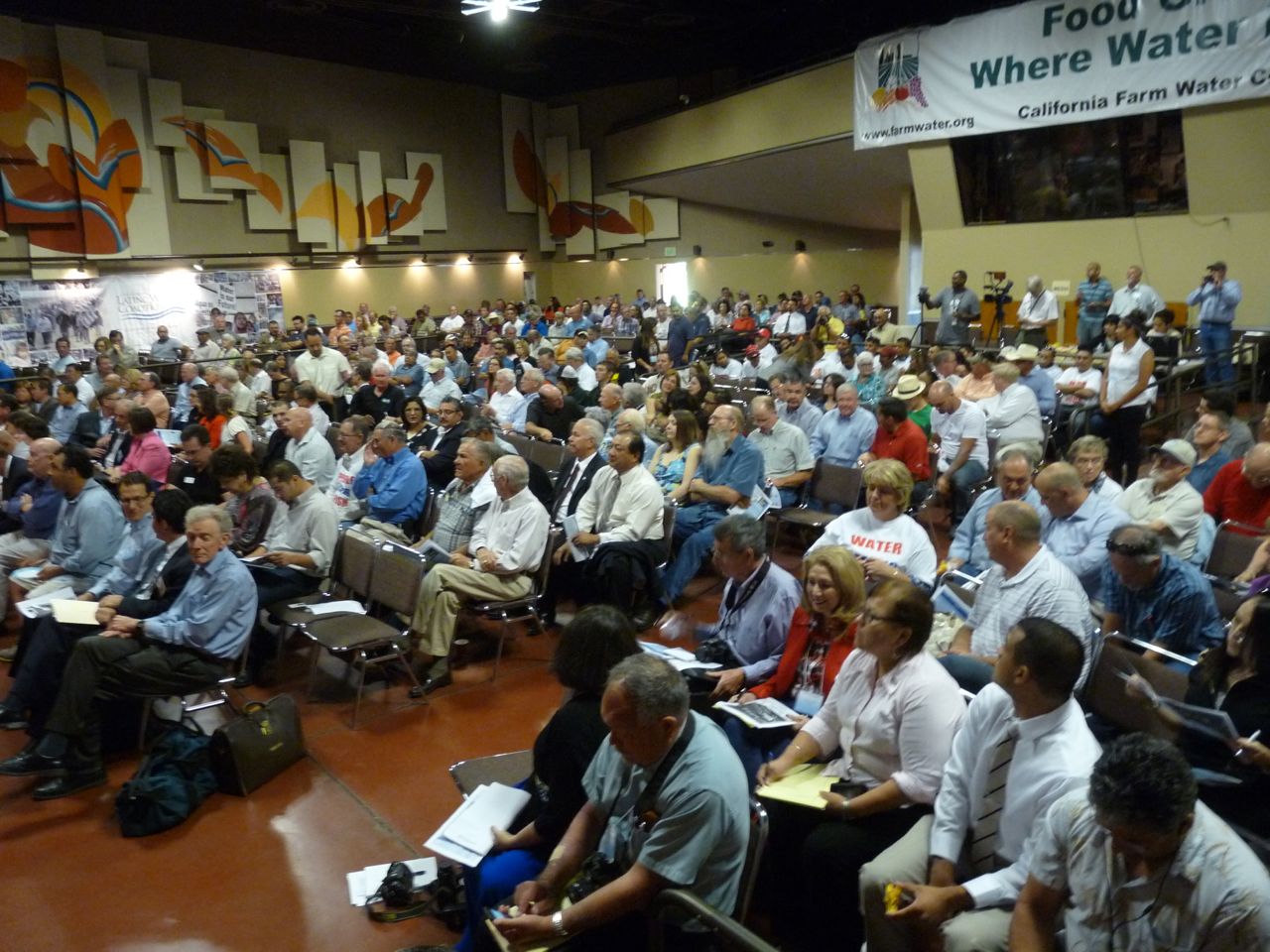
A serious and vocal crowd of about 700 people representing farmers, farmworkers, others who derive their income from farming and Central Valley citizens who wanted to know more about Delta and water availability, packed the Satellite Student Union today, at California State University Fresno for the Delta Water Summit.

Mario Santoyo

The Delta Water Summit, organized by Mario Santoyo, Executive Director of the Latino Water Coalition, brought invited local and national elected officials, and representatives of California Water Agencies to answer questions from moderators and the public.

Here are some highlights of the three-hour summit.

The first panel, moderate by Ray Appleton, talk show host of KMJ, focused on the roles of water agencies regarding the challenges and expectations of the Bay Delta Conservation Plan (BDCP).

John Coleman
John Coleman, Vice President, Association of California Water Agencies (ACWA), said everyone in the room would agree that the water system in California is failing and we need to take responsibility for BDCP. And hopefully, the Water Bond to help fund BDCP will be on the ballot in 2014 such that we can fix the broken system so future generations will benefit.

Tom Birmingham, General Manager, Westlands Water District, spoke about the stressors in the Delta that are being blamed on farmers south of the Delta. Birmingham said, “I do not want to suggest that the operation of existing water projects are not affecting the species in the Delta. But there are numerous factors that are affecting the abundance of those species.”

Tom Birmingham
Birmingham noted that a few years ago, the Public Policy Institute of California issued a report stating: If you were to shut the two major water projects down entirely, quit diverting water upstream, quit pumping water out of the Delta, there is still more than a 50 percent chance that the species in the Delta which are currently at risk, would still go extinct.

“To suggest that what we have done over the course of the last 30 years in trying to protect these species is working, is absolutely nuts, as the species have continued to decline,” said Birmingham. “And the whole purpose of the BDCP is to take a different approach. Rather than focusing on species-by-species restrictions or regulations, some of which conflict with one another. The purpose of the BDCP is to take a more holistic approach, take an ecosystem approach, to try something different in protecting the species. All the studies that have been done to date suggest that if we are going to save species in the Delta, and if we are going to preserve the economy of California, we have got to do this project,” he said.

Brent Walthall

Brent Walthall, Assistant General Manager of the Kern County Water Agency, based in Bakersfield, spoke about the stressors in the Delta and how the BDCP may help to fix these. “When the BDCP first started, it looked only at the flow of the water and how the operations of the state and federal projects worked,” Walthall said. “But there are a lot of stressors in the Delta, and we do not handle them well—or at all. And the reason is that the regulatory agencies are charged with enforcing the Endangered Species Act (ESA) on a project-by-project basis.”

“The regulatory agencies do not get to look at the ecosystem as a whole and decide what is wrong. They only get to look at the permits for a specific project and decide how to operate that one project, whether it’s a Federal Project, or a State Water Project,” Walthall said. “One of the unique aspects of the BDCP is that it can look at all the other stressors, and again, there are a lot of them. The conservation measures in the BDCP have 22 suggestions. Only one focuses on pumping; the other 21 address all the other stressors.”

“Biologists think these stressors are all significant,” Wathall continued, “but we do not have a high level of understanding; however, we are learning that they are quite important. For example, one important stressor is predation of non-native fish on native species. As a particularly impactful example, the non-native bass species are predators on the Delta Smelt and the out-migrating salmon after spawning. Apparently salmon is the favorite food of the bass species. And we have seen on the San Joaquin River side of the Delta, that as much as 90 percent of the salmon travelling on their way to the ocean are eaten before they get there, and we have done nothing to address this.”

“Neither the state nor the federal water projects have ever even come close to that kind of percentage,” said Wathall. “Our percentages are often only 12 to 15 percent.”

“If we can identify these other stressors, we can go a long way to solving the environmental problem and free up the water system to operate more as it was designed to do,” Wathall said.
Ron Jacobsma
On the question of how the BDCP would impact additional storage south of the Delta, Ron Jacobsma, General Manager, Friant Water Authority, noted that one of the projects that he and others have been following closely for more than a decade, is the Temperance Flat Reservoir, which would constructed behind Friant Dam and upriver on the San Joaquin. This would allow us to take advantage of the flood flows we periodically get. And when they come, they come big. In 2010/2011, we had close to one million acre-feet of floodwaters released over the Friant Dam into the San Joaquin River, and we could have really used some of that water. In the last two years we have been at 40 percent of adequate supply.

Jacobsma said, “The Friant Water Authority manages 1.8 million acre-feet with a 520,000 acre-foot-reservoir (Millerton Lake), and we are looking at how we can pull additional yields from that project. If you build a million-plus acre-foot-reservoir, the yield is about 150,000 acre-feet. That’s a key water supply because that’s essentially what we commit to environment through our restoration program downriver.”

“But the $2-3 billion cost of Temperance Flat water diverted for agricultural use does not work too well by itself,” Jacobsma continued. “But if we could get the Delta reliability back, the situation would change. Moving vast amounts of wet-year water and running out of storage south of the Delta, in the case of Temperance Flat, would be more feasible. In this way, we could integrate that storage facility through ground water. Exchanges which could potentially double the yield offer greater flexibility and provide water quality benefits to urban agencies, suddenly make the whole big monetary gulp for a little sip of benefits works a lot better. You must take advantage of the wet year flows.”

Plus there is the benefit to PG&E, to investing in the hydroelectric potential of the dam that could be produced cheaply.

Appleton then asked Jacobsma if the Temperance Flat would ever get built.

Jacobsma replied, “What we need to assess immediately, and the Bureau of Reclamation is on track to do so a year from now, is determine if the construction of Temperance Flat is even feasible. That will signal whether the project can be built. Then we have to figure out what the BDCP looks like. Both of these projects realistically, with litigation and other issues, are most likely 10-15 years out. But if we do not start taking steps now, then they never will happen.”

John Colemanwith ACWA noted that the BDCP is an evolving process and his agency wants it to be successful. “And increased storage is a very important part of the BDCP. But what would be the value of adding the additional storage?”

“If you were to look at the last 20 years, including wet years, we have not been able to take advantage of the existing storage,” Coleman said. “We could build a reservoir and flood the Sacramento Valley, and we could build all sorts of dams in the San Joaquin Valley for surface storage. But if you look at the history of the last two decades, there have been many wet years when the San Luis Reservoir did not fill. Unless we have the ability to move water from the Sacramento River system, across the Delta, and to the pumps, there is no additional value of storage south of the Delta. With the BDCP, new storage will be incredibly important. In November and December of 2012, there was a lot of water in the system, but we could not pump it because of restrictions imposed by the biological opinion for the protection of the Delta Smelt.

What do Next Year?

In the minds of most people at the Summit was what will happen next year.

Federal water districts such as Westlands, San Luis, Panoche and many other water service contractors south of the Delta have sustained a lot of damage from reduced water allocations. These districts span from Tracy all the way to Kettleman City, and they are all under the pressure of possible zero water allocations.

In terms of what to do next year if adequate rain does not happen, Birmingham predicted that the allocation could be zero, even if there is average rainfall across California. “It’s very likely that the final allocation may be very low, anywhere from zero to 10 percent, maybe 15 percent, which would be a repeat of what we saw in 2009,” Birmingham said. “Other than praying for heavy precipitation and snowfall, particularly in the San Joaquin River watershed, so that we can offset restrictions and biological opinions, I just do not know what can be done.

Over the course of time, we have utilized all the mechanisms available, so that today, there is very little flexibility concerning how we can get water to farmers on the West Side of the San Joaquin Valley.

Public Comments:

Manual Cunha, with Charlie Waters 
In the audience, Charlie Waters, with FFA Farm Labor Services Inc., asked the big question:  “At some point, we must make a realistic decision. Will it be man or fish? We can both exist, but we need farming to survive, and we need the water to farm,” Waters noted.


Waters then commented on the sewage flowing into the Delta from Sacramento and Stockton. “Their excuse in not cleaning up is that it’s too expensive. Come on now, we need to get tough. We need that water for farming and everything else.”

Phil Larson
Phil Larson, Fresno County Board of Supervisor, District One, commented, “We need to go to the top to deal with the biological opinion. In March, I went to Washington, D.C. and visited with U.S. Fish and Wildlife, and they stated to our California Association of Wine Grape Growers group that they were ‘tweaking the Endangered Species Act so it will be better for you in California’,” Larson said. “And I told them that the biggest stressor we have in California is the ESA, and problem is when you start tweaking it in D.C., it can become more of a problem. We all need to work with our legislators to explain that to them.”

We’ll post more coverage on the Summit over the next two days.

2016-05-31T19:47:05-07:00August 4th, 2013|

FLORAL DIVERSITY BUILDS HONEY BEE SUPPLY

Extra Forage for Bees?

The Almond Board of California and Project Apis m. (PAm) are doing research on solutions for core honeybee pressures. A range of factors affect the honey bee population, including colony collapse disorder, Varroa mites, lack of pollen and nectar food sources, pesticides, pathogens andthe changing landscape for honey bee forage.
Could floral diversity such as this improve honey bee pollination?

The Almond Board of California almond growers can contribute to a better bee supply by providing forage in or near their orchards before and/or after almond bloom. PAm has identified four bee forage seed mixtures for the 2013 planting season. These mixtures provide floral diversity prior to and after the almond bloom for the nearly 1.6 million colonies that are delivered to the state. With proper nutrition, bees can fend off many of their stresses. 
 
A secondary benefit to providing bees with an alternative food source, planting these cover crops provides increased soil fertility, better water infiltration, weed suppression and reduced soil erosion and potentially decreased colony rental fees for the orchard.
For best germination, growers should plant bee pastures in September, ahead of fall rains. Almond growers should consider their pesticide practices before deciding where to plant the forage crop. PAm provides the seed and guidance to those growers who are willing to enroll in the program.
To enroll in the pollinator forage project, email PAm.
2016-05-31T19:47:05-07:00August 3rd, 2013|

FIELD DAY TARGETS INCREASED CORN YIELD

Project Symphony To Raise Corn Yield for Increasing Population

On Tuesday, August 20, from 10 a.m. to noon, Project Symphony Field Day will take place at:


Double Diamond Dairy

782 West Washington Road or

the NW corner of Highway 59 and Washington Road, El Nido

Sponsored by Wilbur-Ellis Co. and BASF


The Project Symphony Field Day will focus on the research conducted on silage corn grown in the California Central Valley.


What is Project Symphony?


Consider this: Adding to our current global population of 7 billion people, an additional two billion people are expected by 2050. Sadly, 14% of the world’s population today is undernourished; how will we prepare ourselves to feed an increasing population on dwindling land, with complexities such as climate change, accumulating regulations, water availability and quality, political corruption, crop waste, and distribution challenges?


To begin to address the increasing demand for food, Wilbur-Ellis and BASF have jointly initiated Project Symphony to test solutions using tools such as excellent seed, biotechnology advances, soil fertility, plant nutrition programs, crop protection treatments, water management, satellite imagery and handheld devices.


Project Symphony is a three-year undertaking of corn trials on a dozen or so sites across the country with the goal of raising the current corn yield of 150 bushels to 300 bushels per acre. Scientists project that corn is biologically capable of yielding 500 bushels per acre.

For additional information about the field day and project, contact Tom Prata Seed Technology Specialist, Wilbur-Ellis, at (559) 304-1353 or tprata@wilburellis.com

2016-05-31T19:47:06-07:00August 2nd, 2013|

NEW FRESNO AG COMMISSIONER

Wright Is New Fresno County 
Ag Commissioner

New Fresno County Ag Commissioner,
Les Wright.
Les Wright was appointed to serve as the agricultural commissioner for Fresno County, the top agricultural county in the nation.  He was formally appointed by the Fresno County Board of Supervisors this morning. 

Wright has been serving as interim Ag Commissioner ever since former Ag Commissioner Carol Hafner retired last year. He said he looks forward to strengthening his relationship with Fresno County farmers and ranchers.


In the summer of 1976, Wright began his first government job, working for a border inspection station in northern California. 


During this time, he was attending a junior college and working on farms in Modoc County.  “You had to become a jack of all trades of living in northern California,” said Wright. He also worked in construction, drove trucks and was a ranch hand in the area.  


“At one point along the way, I took one of the state license tests,” said Wright.  He eventually decided to work for the government full-time, mostly to receive a steady paycheck and insurance for his family. 


From there, he moved up the ranks, eventually becoming agricultural commissioner in Modoc County.  “I learned what was necessary to accomplish what needed to be done and done right,” said Wright.


In 1999, Wright moved to Kings County, and worked as a deputy agricultural commissioner.  In 2010, Wright joined the team in Fresno County, and became chief deputy.


Although he has always favored livestock, he has done almost every job in the business, from inspecting bee hives to pesticide applications, said Wright.  Even before moving to the Central Valley, he had some familiarity with row crops where he grew up.  Throughout the years, he has gained a well-rounded experience.  


The California agricultural commissioner system is necessary because of the state’s diversity.  “There are big differences throughout the state in the type of agriculture and issues facing growers,” said Wright.

“I wear a lot of different hats throughout the day,” said Wright, who is constantly connected to technology.  On a daily basis, he will receive hundreds of emails and oversee 82 full time employees working in the diverse agriculture programs and deal with local regulatory issues. A Commissioner has dozens of programs and many issues to deal with, from Asian Citrus Psyllid to an incorrectly computing gas pump.

“Agriculture has always been my love,” said Wright.  “I’ve always been involved in agriculture and don’t see myself doing anything else.”

2016-05-31T19:47:06-07:00August 2nd, 2013|

GROUP URGES IMMIGRATION REFORM

Additional Appeal for

Immigration Reform

This week, a group of about 430 organizations sent a letter to House Speaker Boehner and Minority Leader Pelosi urging Congress to enact legislation to reform our nation’s immigration system.

Undersigned organizations include: Paramount Farms, Adobe,California Chamber of Commerce, California Cotton Ginners Association, California Farm Bureau Federation, Sweet Potato Council of California, California Grape and Tree Fruit League, Oracle, California Strawberry Commission, Intel Corporation, Grower-Shipper Association of Central California, and Sun-Maid Growers of California

The letter reads, “Reform of an outdated, broken immigration system is essential if we are to achieve a fully revitalized economy that provides and accelerates rewarding and lasting jobs and opportunities for all Americans.” . . . “We deal with an immigration system that is now in its third decade and completely incapable of being responsive to an ever-changing national economy and hypercompetitive global marketplace.”

Leaders urge reform at a critical time when U.S. economic growth has struggled to recover. “Done right, reform will also serve to protect and complement our U.S. workforce, generating greater productivity and economic activity that will lead to new innovations, products, businesses, and jobs in communities across the U.S.”

“Problems with our immigration system have grown and multiplied to become an emerging threat to the current and future productivity, ingenuity, and competitiveness of key sectors of our economy, including

agriculture,” among others.

The letter urges Congress NOT to watch a generation-old immigration system work against the overall national interest. Rather it calls for Congress to recognize the clear benefits of immigration reform to the economy’s success and to collaborate to achieve pro-growth reform.

As stated in the letter, “Failure to act is not an option.”

2016-05-31T19:47:06-07:00August 1st, 2013|

Get to the Summit!

Reminder:

Delta Water Summit, Saturday August 3

California State University, Student Union

The Delta Water Summit brings together high level policy, technical and legislative representatives from the state and federal governments, along with officials from key water agencies to present, discuss and answer questions. The Summit features a series of three moderated panels. Half of each panel discussion will be devoted to questions and answers.

An update on one of the speakers: USBR Commissioner Michael Connor, who will be participating at the Delta Water Summit, was recently nominated by President Obama to Deputy Secretary of the Department of the Interior.

Doors open at 8:30am.  Event starts at 9am.

It’s critically important to fill the Student Union to standing room only!

The event and parking are free! (Please park in lots A or J)

2016-05-31T19:47:06-07:00August 1st, 2013|

Family Tree Farms

Tree Fruit Season Coasting


By Patrick Cavanaugh, Editor

Despite some isolated rainstorms that passed through the Central Valley in mid-July, California tree fruit growers are having a great season.

Daniel Jackson with Family Tree Farms in Reedley noted that it rained for nearly a half hour across some of their acreage, which caused some damage on their white peaches in the tops of the trees.  “But all the other tree fruits on the ranch look fine. In fact, that weather issue was a little blip on the screen of a great year,” Jackson said.

“We have had record-breaking pack-out reports, which means a lot of boxes per acre are going to market,” he said. “And depending on the commodity, prices are up too. We did a comparison with last year, another great year, and we are up 10 cents a pound.”

“As an industry, there has been a lot more fruit on the market and there have been some challenges in the yellow peach and nectarine markets,” Jackson noted. “However, all the other commodities including plumcots, apriums, apricots, white peaches, and white nectarines, have seem to run very smoothly through the market this season.”

2016-05-31T19:47:06-07:00August 1st, 2013|

IMMIGRATION REFORM IS AGENDA

Strawberry Growers In D.C. This Week

By Laurie Greene, Associate Editor
The California Strawberry Commission (CSC) has sent a delegation with the Silicon Valley Leadership Group to Washington, D.C. to explain the crucial need for immigration reform. The delegation intends to raise awareness of the critical role of immigrant labor in the success of California’s high-tech and agriculture industries and future job growth, as well as the overall health of the national economy. Finding a way to get a workforce here legally is of paramount importance.

According to Carolyn O’Donald, Communications Director of the CSC, the delegation members, representing the state’s two largest industries, are getting a positive response this week, thus far, from their meetings with congress people from both sides of the aisle. The group has had a number of meetings yesterday and today, and will brief White House staff tomorrow morning.

The CSC delegation has taken four strawberry growers who are between 1st-and 3rd-generation in this country from Watsonville, Salinas, Santa Maria and Orange County. They will press the need for comprehensive immigration reform, guest worker programs, and the workforce needed for the California agriculture and hi-tech industries.

“It may seem like an odd partnership between strawberries and hi tech,” O’Donald said, “but we have built a partnership with the Silicon Valley Leadership Group because we have a lot of characteristics in common. Immigrants play an integral part in both industries at the work level and at the leadership level in the running of the company.”

“About 65% of our strawberry farmers are Hispanic; some of multi-generational in this country,” explained O’Donald. “Our economy is built on immigrants. They worked in coalmines, oil refineries, and steel mills, and they built this country’s infrastructure. We are still building technology and working the land, so immigrants are major lynchpins in the California economy.”

“We’ve been letting this issue fall by the wayside for a long time; since the mid-1980s we have not had any kind of immigration reform. So, we are trying to see as many people in Washington, D.C. as possible–-the dealmakers–before their August recess,” O’Donald remarked. “We are also trying to show the California delegation, particularly the republican delegation, how important it is to get this done, this year we hope.”

2016-05-31T19:47:06-07:00August 1st, 2013|
Go to Top