Alfalfa Event in Firebaugh Shows Economics

Industry Gathers In Alfalfa Field to

Show Why We Need Water

By Patrick Cavanaugh, Editor, and Laurie Greene, Associate Editor

A crowd gathers for what was a dramatic aerial photo.
Showing the economics behind a single crop grown in the San Joaquin Valley was the vision of Steve Malanca, General Manager of Thomason Tractor Co, in Firebaugh. With the help of Gayle Holman, Public Affairs Representative with Westland Water District, more than 200 came together in an alfalfa field, west of Firebaugh, filled with the equipment and services necessary to grow the crop.
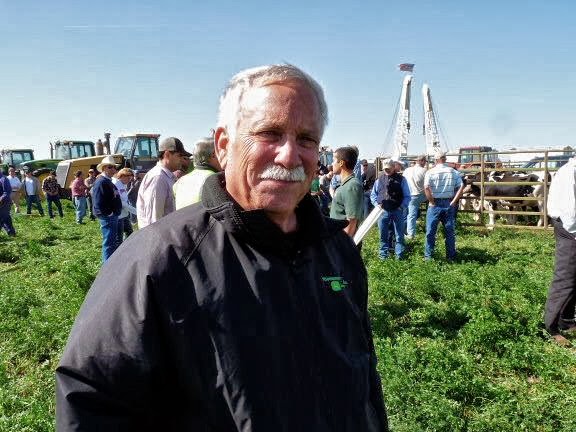
Steve Malanca, GM of Thomason Tractor Co, Firebaugh
It was a demonstration on how, without the alfalfa, due to reduced water allocations, there are major impacts on business and humans. The gathering of equipment, suppliers and even cows became an aerial photo, and video that will be publicized on different websites, YouTube and in other print and electronic mediums. “It is our responsibility to tell our story so that this information goes on record in the form of a unique photograph, which we hope to turn into billboard messaging,” said Holman.
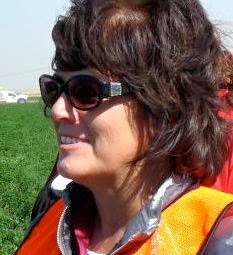
Westlands Water District’s Gayle Holman
“What we are faced with in 2013 is a limited amount of surface water deliveries throughout the Central San Joaquin Valley. There was probably no irrigation district in the valley that was able to deliver enough water for a full season for the farmers, and we are praying that we get abundant rain and snow this winter,” said Malanca.

Malanca continued, “I think we all know the challenge we have in front of us to get people to understand the importance of the ag economy in Central California. We hope this message will be a way to convey a visual for people to understand what we do out here. Central California grows some of the safest food in the world. As you know, without water here, it can’t happen.”

“We plan on utilizing this video as many places as we can,” Malanca stated. “We hope Firebaugh High School FFA takes this as a challenge with their young social media skills to get this out on the Internet, Facebook and twitter. We would also like to challenge the FFA to share this with every FFA department from Tracy to Bakersfield, Dinuba To Mendota.”

Ken McDonald, Firebaugh City Manager
“This is a regional thing; it is not a Westside thing anymore,” declared Malanca. “We all are majorly dependent on water. And hopefully, with this event, we can convince people that storage and other means to keep the water flowing to the south is going to have to happen. And, I hope we can convince people that we need water storage.”

Thanks went to Doug Brittonfor offering his field for all the gathers to get their message across.

Ken McDonald, City Manager of Firebaugh, said, “There is no doubt that Firebaugh is one small part of this big Regional effort, and without water and without farming, Firebaugh would be wouldn’t be in existence.”
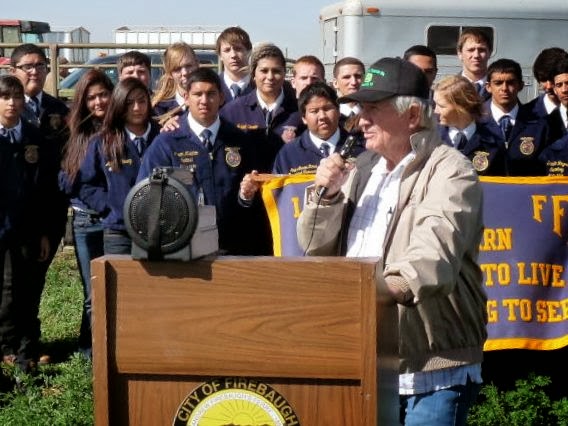
Firebaugh Area Farmer Chris Herd addresses the crowd.
Chris Herd, a Firebaugh farmer, “to my fellow farmers, our families, our workers, our friends, and those in our communities, the state—300 commodities produced—42 billion dollars farm gate value—and it is all at stake, not just the Westside, but the entire state.”
Below are the detailed items mentioned for alfalfa production. Most of these items were at the alfalfa field event.

Step/Process

Equipment

Company

Point of Contact

Alfalfa field

20 acres

Prep the field for planting

Tillage tractor – Disk equipment

Soil

Soil amendments needs to prep soil

Prep Border

Tractor

Irrigation

Irrigation crew – need X workers plus X of equipment – pipes, hoses, sprinklers, etc. 

Water

How much water is needed to grow this crop

Seed

Bags of seed for planting

Bees

Bee hive boxes for Pollinating the flowering plant;

Fertilizer

Tanks and equipment for liquid,

Weeds – 
Opt. 1

Sprayers and appropriate product to handle weeds

Weeds – 
Opt. 2

Crop duster

Cutting

Swather to cut; mower-conditioner to cut

Baler

Baler and pick up bales

Loading Bales

Truck to pick up bales

Stringers

String company that supplies bale ties

Auto Parts Store

Provide various parts for vehicles/equipment associated with movable equipment

Tires

Tires for equipment

Petroleum

Fuel trucks to move the product

Vehicle Repair Shop

Repairs on various pieces of vehicles

Crop Insurance

Insurance Company

Insurance Company

Insurance Company for vehicles, equipment, dwellings

Banking

Financial institution for loans

Accountants

Provide financial/tax services for respective businesses

Phone Service

Provide cellular, land and computer service for business lines

Office Supply Store

Office supplies for the business portion of businesses

Cows

End user of alfalfa

Milk

Stainless steel tanks for milk storage

Children

Drinking milk

2016-05-31T19:44:24-07:00October 4th, 2013|

UFW ACTION UPDATE #2

Western Growers Advise
Western Growers released the following post:
One hundred of the largest farms in California have been sent this letter dated September 27, 2013.

According to the letter, the UFW intends to file Notices of Intent to Take Access with the Agricultural Labor Relations Board to take access on October 3, 4 and 5, 2013. 
The alleged purpose of the access will be to advise workers of the pending bipartisan federal legislation to reform national immigration policy in Washington and to mobilize workers to join a national “Day of Dignity and Respect” according to a second flyer received from the UFCW Local 5 out of Salinas. 
There will be mobilizations in over 90 cities and workers are requested to attend one of the over 100 events being planned across the state and nationally.
Should the Union serve your company with a Notice of Intent to Take Access, please note that the Union will not be allowed to take access until such time that you receive notification from the Regional Director of the ALRB that the Access Petition has been filed.
Secondly, once properly filed, the UFW may take access to your agricultural operations three times daily: One hour in the morning before the start of work; one hour, which shall encompass the meal period; and one hour after the end of work.  Two organizers per crew up to 30 workers may take access; and one additional organizer for every 15 additional workers. Organizers must wear a badge identifying themselves by name and name of the union; and must identify themselves upon request.
While on the premises, please have your supervisory employees vacate the immediate area where organizers may be talking to workers or distributing literature.  Supervisors should be out of eyeshot and earshot –a safe distance is at least 100 yards. Additionally, please inform your supervisors not to interrogate workers about what the UFW has said or gave to them when the Union organizers leave.  This would constitute an unfair labor practice.
If you use farm labor contractors, their employees will be deemed your employees for purposes of the Agricultural Labor Relations Act.  Therefore, please contact your labor contractor concerning access by Union organizers beforethey begin access.  Be sure that the same rules that apply for your supervisory employees also apply for those of the farm labor contractor.
If you have on-farm rules (e.g., signing in at a gate before accessing the ranch, food safety, speed limits) it is appropriate to consistently enforce these rules with union representatives. 
Finally, workers should be advised that they are not required to sign union authorization cards nor are they required to provide their home addresses and telephone numbers if they are requested by UFW organizers as part of this process.
WG members are advised to inform their workers that through various local, state and national agricultural organizations, your companies, individually and through the Association, have been actively involved in securing immigration reform, including obtaining legalization for current agricultural workers.  The U.S. agricultural industry has partnered with the UFW for this express purpose.  CLICK HERE if you wish to understand the requirements of the ALRB’s access regulation.
If you have any questions, please do not hesitate to contact WG’S Vice President and General Counsel, Jason Resnick
Special thanks to Rob Roy, who authored the original article from which this piece was adapted with permission of VCAA.
2016-05-31T19:44:24-07:00October 3rd, 2013|

Yuba Sutter Farm Day Oct. 4

Yuba-Sutter Farm Bureau Prepare Big Farm Day
Yuba City Calif.— Yuba-Sutter Farm Bureau’s seventh annual Farm Day is shaping up to be the largest ever, with over 2,000 third grade students from Yuba and Sutter counties taking advantage of this free day of fun agricultural learning.

 Farm Day will take place Friday, October 4, from 8:30 a.m. to 12:30 p.m. at the Yuba-Sutter Fairgrounds in Yuba City. There will be over 35 educational and interactive stations students and their teachers can visit to learn about farm living, livestock, equipment and wildlife.
Returning are the stand-out favorites from last year: an aerial application helicopter, a giant John Deere tractor and a stock dog demonstration.

The many noses to pet and activities to take part in are what make Farm Day so special and valuable to Yuba and Sutter county third graders. All third grade classes in both counties are invited to attend, and there is never a charge. In addition, each student receives a Farm Day t-shirt to wear and a healthy walnut snack pack during the event.

For teachers, Yuba-Sutter Farm Bureau provides each with a free tote bag full of fun agriculturally educational resources that follow California curriculum. Tools include lesson plans, activity books, stories and more.

Farm Day would not be possible without dedicated volunteers. This year, over 120 local FFA students will be on hand to showcase their animals and assist students and teachers in navigating the exhibits. Yuba-Sutter Farm Bureau board directors and community members also play a significant role in making the event run smoothly.

Yuba-Sutter Farm Bureau’s Farm Day is made possible by generous donations from PG&E, Umpqua Bank, Farm Credit West, Pacific Coast Producers, Diamond Foods, Gridley Ben Toilet Rental and Yuba-Sutter Farm Bureau members.

2016-07-26T12:36:43-07:00October 3rd, 2013|

UFW ACTION UPDATE

Advice for Farm Employers

The use of the “Notice of Intent to Take Access” mechanism of the ALRB regulations opens agricultural employers to possible allegations of unfair labor practices.  

To avoid problems, farm employers should remember some basic rules about dealing with UFW staff and volunteers: 

·       UFW agents are lawfully entitled to take access only after the union has filed with the regional ALRB office a Notice of Intent to Take Access and has served a copy of that notice on the employer.
·       UFW agents may take access only for one hour in the morning before work begins, one hour at the meal period, and one hour at the end of work.
·       While UFW organizers are on site, have supervisory personnel stay away from the area where workers and organizers are talking or distributing literature.
·       Make sure supervisors do not interrogate workers about what was said or what UFW organizers gave them; this opens you up to a potential unfair labor practice charge. 
·       Inform any farm labor contractors working on site about the situation; the FLC’s workers are considered your employees under the Agricultural Labor Relations Act.
·       If you require access through a specific gate and require visitors to sign in, you can insist that UFW visitors do so.  You can limit them from entering actual rows where crops are produced; limit the speed of vehicles to 1 to 2 miles per hour; document the names of organizers even if you don’t require visitors to sign in.
·       If you have fences with gates, it is advisable to keep them locked and direct visitors to the main gate.

Click here for further useful information on What Should an Ag Employer Do?

If you have further questions or concerns, please contact FELS at 800-753-9073 or info@fels.net.

2016-05-31T19:44:24-07:00October 3rd, 2013|

UFW INVADING CALIFORNIA FIELDS

UFW Trespassing in Monterey County 

Monterey County Farm Bureau TODAY has received information that United Farm Worker (UFW) personnel are taking access on local agricultural fields withoutfiling proper notice of access with the Agricultural Labor Relations Board (ALRB) in Sacramento. 

While a number of notices of access have been filed for agricultural fields all over the State this week, fields in northern Monterey County have thus far NOT been included in these notices, nor have growers and farm operations received official notice from ALRB of the intent to take access and converse with field laborers.

The laws are very specific on how access must be noticed to growers and farm operations.  It appears that UFW personnel are not following these procedural steps.  Access, when properly noticed, is only available at specific hours during the work day; UFW personnel appear to be ignoring these rules also. 

Growers and farm operations will comply with access for any labor union personnel when proper notice has been filed with ALRB and, in turn, that notice is certified and sent to the grower or farm operation.

These UFW personnel are currently trespassing on private agricultural fields and taking illegal access.

The reports that we have received here also indicate that reporters are following the UFW personnel as they travel from field to field.  These reporters are also trespassing on private lands if they do not have specific permission from the grower or farm operator.  MCFB sent a media advisory out notifying that these access activities are illegal under ALRB rules and any stories published should reflect that the UFW did not follow proper notification filing procedures.

In a press release, the UFW announced it will use the Access Regulation of the Agricultural Labor Relations Board (ALRB) so that UFW staff and volunteers can visit 100 of the largest farms in California. The stated purpose is to “energize and inspire farm workers and send a clear message to Congress: We want immigration reform today, not tomorrow,” a campaign UFW characterizes as “the National Day of Dignity and Respect” launching the “Harvesting the American Dream” campaign. The announcement is posted online here.

According to the press release, on Oct. 3-5, UFW “will be marching to the fields of Monterey, Ventura, Kern, Tulare, Fresno, Madera and Merced counties” with the stated goal of having workers sign postcards urging Bakersfield CongressmanKevin McCarthy (who holds a leadership position in the House) to push for a vote on comprehensive immigration reform legislation.

2016-05-31T19:44:24-07:00October 3rd, 2013|

AG CRIME ALERT

TULARE COUNTY SHERIFF’S
DEPARTMENT

Agricultural Crimes Unit
Stolen Property Bulletin


Similar to the above photograph 
Item: 2007 CAT P6000 forklift
Serial# AT14E10161
Between September 28th2013 and Monday, September 30, 2013, the suspects entered the victim’s property in the New London area and removed a 2007 CAT P6000 forklift.

Anyone with information in regards to the possible location item or the subjects responsible for this theft are encouraged to contact Det. T. Shaw the T.C.S.D.  AG Crimes office 559-735-1858 or 24 hours 559-733-6218.
2016-05-31T19:44:24-07:00October 3rd, 2013|

ACP QUARANTINE EXPANDS

Update on ACP Finds Announced Today
Asian Citrus Psyllid Quarantine Expands
In Tulare County

An additional portion of Tulare County has been placed under quarantine TODAY for the Asian citrus psyllid (ACP) following the detection of one psyllid near the City of Exeter in Tulare County. 

The new quarantine zone measures 86 square miles in Tulare County, bordered on the north by Yokohl Creek; on the east by Road 244; on the south by Avenue 220; and on the west by Road 156.  This area is in addition to the existing quarantines in the Porterville and Dinuba areas of Tulare County.  A link to the map may be found at: www.cdfa.ca.gov/plant/go/acp-quarantine-sjv

The quarantine prohibits the movement of host nursery stock out of the quarantine area; however, under the terms of a compliance agreement, nursery stock and budwood may move out of the area if grown in USDA-approved structures designed to keep ACP out.  

Also, under the terms of a compliance agreement, citrus fruit may move out of the area if cleaned of leaves and stems, or if from a grove that was treated prior to harvest.  Residents with backyard citrus trees in the quarantine area are asked not to remove fruit from the area.

In addition to the quarantine in Tulare County, ACP quarantines are now in place in Fresno, Imperial, Kern, Los Angeles, Orange, Riverside, San Bernardino, San Diego, Santa Barbara, and Ventura counties.

The ACP is an invasive species of grave concern because it can carry the disease huanglongbing (HLB), also known as citrus greening.  All citrus and closely related species are susceptible hosts for both the insect and the disease. There is no cure once a tree becomes infected; the diseased tree will decline in health until it dies.  

HLB has been detected just once in California – last year on a single residential property in Hacienda Heights, Los Angeles County.  HLB is known to be present in Mexico and in parts of the southern U.S.   Florida first detected the pest in 1998 and the disease in 2005, and the two have been detected in all 30 citrus-producing counties in that state.  

The University of Florida estimates the disease is responsible for Florida’s more than 6,600 lost jobs, $1.3 billion in lost revenue to growers, and $3.6 billion in lost economic activity.  The disease is also present in Georgia, Louisiana, South Carolina and Texas.  The states of Alabama, Arizona, Hawaii, and Mississippi have detected the pest but not the disease.

Residents in the Tulare area who think they may have seen the Asian citrus psyllid are urged to call CDFA’s Pest Hotline at 1-800-491-1899.  

For more information on the Asian citrus psyllid and huanglongbing disease please visit: www.cdfa.ca.gov/go/acp.

2016-05-31T19:44:24-07:00October 3rd, 2013|

CROPLIFE AMERICA MEETS

CropLife America Celebrates 80 Years

CropLife America (CLA) celebrated its 80th anniversary as the national association representing the crop protection industry during its Annual Meeting in West Virginia. The theme of this year’s meeting was “The Great Progression of Agriculture” and included presentations on modern agriculture’s past, present and future.

In a panel discussion moderated by Jay Vroom, CLA’s president and CEO, former U.S. Secretaries of Agriculture John Block, Michael Espy, John Knebeland Ed Schafer shared memories from their respective terms in office and reflected on U.S. farm policy, including a five-year farm bill that is currently under deliberation in the House and Senate.

“We were delighted that four former Secretaries of Agriculture were able to participate in an open dialogue at this year’s Annual Meeting,” said Vroom. “It was a truly unique opportunity for attendees to learn more about U.S. farm policy from the leaders who have seen it evolve so much in recent decades. The panel discussion embodied our Annual Meeting theme of looking back on agriculture’s past while still concentrating on the future.”

Pollinator health, the focus of the next panel presentation, included panelist Gabriele Ludwig, associate director of environmental affairs for the Almond Board of California. Panelists stressed a need for increased collaboration among the crop protection industry, beekeepers, crop farmers and regulatory agencies including the U.S. Environmental Protection Agency (EPA). 

Keynote presenter Dr. Cary Fowler, special advisor and former executive director of the Global Crop Diversity Trust, was instrumental in the development of the Svalbard Global Seed Vault, which provides security for seed samples of more than 750,000 unique crop varieties. Fowler focused on the continual preservation and security of seed diversity in order to sustain global food demands.

Brennan Costello, central region vice president of the National FFA Organization, and Caroline Weihl of Agriculture Future of America (AFA), challenged attendees to imagine what agriculture and the crop protection industry might look like in the next 30 years.

“Throughout this year’s Annual Meeting, we celebrated the work of those ‘agricultural giants’ that came before us and worked so steadily on advancing modern agriculture from the time of CLA’s founding until today,” Vroom noted. “At all times, however, we must continue looking forward. Our industry is dependent on students like Brennan and Caroline, who represent the future of agriculture.”      

2016-05-31T19:44:25-07:00October 3rd, 2013|

SHUTDOWN AFFECTS CALIFORNIA AG

Shutdown on Ag,  Part 2

We all know the U.S. federal government has shut down. California Ag Today covers the continued unfolding of the situation and its effect on California agriculture.

First, the shutdown may mean costly delays for Delta Tunnel Plan, according to the California Water Alliance.

USDA

Western Growers Association (WGA) reports that the USDA Agricultural Marketing Service (AMS) will continue to run the Perishable Agricultural Commodities Act (PACA) Program and provide for Specialty Crop Inspections uninterruptedly.

USDA will discontinue other services such as: Country of Origin Labeling, Market News, Marketing Orders and Agreements, Pesticide Data Program, Pesticide Recordkeeping, and Specialty Crop Block Grant Administration.

APHIS
The Animal and Plant Health Inspection Service (APHIS) will continue to provide services for:

  • Inspecting fruits, vegetables, and nursery products to be imported
  • Providing agricultural quarantine services for imports, including agricultural emergencies involving invasive pests and diseases
  • Responding to several agricultural emergencies involving invasive pests and diseases. Mandatory CCC funding sufficiently covers the salaries and benefits for employees working on these activities into FY 2014
  • Issuing phytosanitary certificates for domestic plant materials for export
  • Continuous rearing of sterile or biological-control insects in order to retard the spread or eliminate harmful insect infestations in the U.S. or prevent them from reaching our borders. Among these research facilities is in Los Alamitos, California.
  • Conducting Farm Bill (Section 10201) activities related to plant pest and disease management, and disaster prevention
  • Protecting (maintenance and security) of federal lands, buildings, waterways, equipment and other property, including Center for Plant Health Science and Technology and National Centers for Animal Health, among others.

NRCS
The Natural Resources and Conservation Service (NRCS) will monitor, with minimal excepted staffing, essential programs such as Emergency Watershed Protection Program,  Dam safety and rehab and critical plant stock viability.
REE
Research, Education, and Economics (REE) – which includes the Agricultural Research Service (ARS), Economic Research Service (ERS), National Agricultural Statistics Service (NASS), and National Institute of Food and Agriculture (NIFA) – will discontinue most of its activities, including market news reports, NASS statistics, and other agricultural economic and statistical reports and projections, according to Western Growers. Additionally, research facilities will be closed except for the care of animals, plants and associated infrastructure to preserve agricultural research.
RMA
The Risk Management Agency (RMA), which oversees the crop insurance program, will discontinue all activities. (Western Growers)

HHS/FDA
The Department of Health and Human Services (HHS) furloughed 52% of employees; however, HHS’s Food and Drug Administration (FDA) will continue select vital activities such as handling emergencies, high-risk recalls, civil and criminal investigations, and import inspections.
HHS/FDA will discontinue most of its food safety and nutrition activities,  routine establishment inspections, some compliance and enforcement activities, import monitoring, notification programs and much of the laboratory research.
CDC
Due to staff furloughs at the U.S. Centers for Disease Control & Prevention (CDC), which works jointly with the FDA during an outbreak, federal response to food recalls and outbreaks could be delayed.

The Department of the Interior, Environmental Protection Agency, and U.S. Internal and International Trade Administrations will also furlough all but essential personnel.

2016-05-31T19:44:25-07:00October 2nd, 2013|

CALIFORNIA’S AGRICULTURAL RESEARCH NEEDS

Ag Research Critical for Future

The California State Board of Food and Agriculture announced TODAY they will focus on agricultural research needs at its upcoming meeting on October 8th in Sacramento, from 10:00 a.m. to 2:30 p.m. at the California Department of Food and Agriculture, 1220 ‘N’ Street – Main Auditorium, Sacramento, CA 95814.

“Agricultural research is essential to ensuring a highly productive, continuously innovative, and safe food supply,” said CDFA Secretary Karen Ross. “Our national investment in agricultural research is critical if we are to meet the challenge of increasing agricultural productivity to meet the food and fiber needs of a growing world population while adapting to a changing climate.”

Agricultural research has an everyday presence in consumers’ lives. From the diversity of food products on grocery shelves, to safe drinking water, and climate adaptation– agricultural research is at the forefront of improving and innovating on-farm practices and food production. Promoting agricultural research that anticipates 21st century challenges is crucial to keep California’s agriculture productive, profitable, and environmentally sound.
Invited speakers include: Chancellor Linda P.B. Katehi, University of California, Davis; President Jeffrey Armstrong, California Polytechnic State University, San Luis Obispo; Vice President Barbara H. Allen-Diaz, University of California, Agricultural and Natural Resources; Maureen Whalen, Assistant Area Director – Pacific West Area, USDA Agricultural Research Service; Paul Wenger, California Farm Bureau; Richard Waycott, Almond Board of California; Bonnie Fernandez-Fenaroli, Center for Produce Safety; and Ken Keck, California Citrus Research Board.
“Agricultural research needs to be readily available, relevant to what we need as growers, and responsive to overall industry needs,” said Craig McNamara, president of the California State Board of Food and Agriculture. “This meeting is an opportunity for farmers to have an open dialogue with our research institutions and help us frame the priorities our state needs.”
The California State Board of Food and Agriculture advises the governor and the CDFA secretary on agricultural issues and consumer needs. The state board conducts forums that bring together local, state and federal government officials, agricultural representative and citizens to discuss current issues of concern to California agriculture.
2016-05-31T19:44:25-07:00October 2nd, 2013|
Go to Top