Tons of Rain Needed

Fresno County Tomato Grower

Plans on Crop


By Patrick Cavanaugh, Editor
Bill Diedrich a Firebaugh-based famer with farming operations in Firebaugh, Madera, and the I-5 Corridor west of Firebaugh, is planning for next year on some of his land.
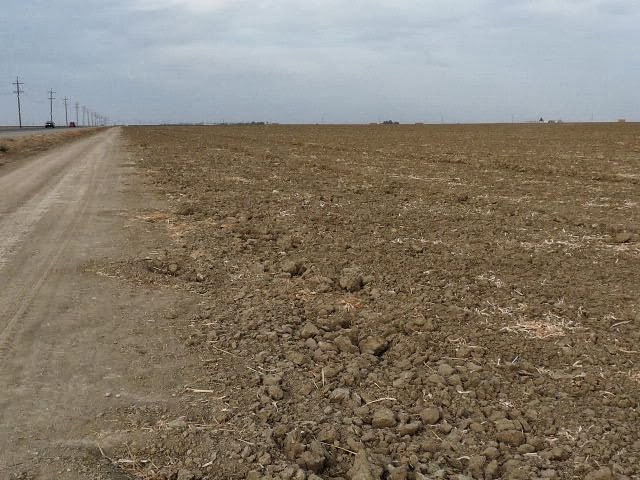
Prime Westside farm land left fallow due to lack of  water.
“Right now all my almonds are in, and if you have any water, you may be putting on a post harvest irrigation. We are getting fields ready for the dormant period and hopefully tons and tons of rain,” Diedrich said.

He also farms tomatoes, pomegranates, prunes, wine grapes, cotton, walnuts and alfalfa.

Diedrich is among the few growers who will plant tomatoes next season. His tomatoes are grown in Firebaugh, in the Firebaugh Canal District with Exchange Contractor water, “so we are in good shape,” Diedrich said.

“For growers who farm tomatoes in Westlands, Panoche or San Luis Federal Water Districts, they are all in jeopardy because who will use water on tomatoes when their almonds are drying up?” he asked. “There will be very few tomatoes planted on land served by Federal Water, except in areas where growers may have decent ground water; but that’s even in jeopardy because the ground water is being so over-pumped, because of surface water cut backs due to environmental restrictions.”

“The real ecological disaster that is taking place is the one no one sees. It’s the underground aquifer that is being drained because of severe reductions in surface water. And what is really sad is that this is a true ecological disaster, instead of an invented one, regarding the smelt in the Delta. Once you lose that source base down below, which happens due to settling, it doesn’t come back.”

A large part of Dietrich’s investment is on the I-5 corridor with 600 acres of almonds, and that is all in jeopardy. “We have been lucky in securing enough surface water and have not had to use well water. If well water is used, there is definitely a salt problem.

Diedrich noted that there are some growers on the Westside who are only on Federal Water deliveries and have no wells. “These guys will be catastrophically affected if we do not get enough water delivered next season,” he said. “And it’s all so unjustified,” Diedrich noted. “Exporting the water is not the problem. It’s the predator fish and the pollution coming down the river from Sacramento.”

Diedrich is active with water management as he serves on the Board of the San Luis Water District and has served two two-year terms on the State’s Association of California Water Agencies (ACWA). Diedrich noted that he would soon step down from the ACWA Board to take a break and focus more on his business. He noted that the ACWA has a few farmers on the board, but it could certainly use more grower representation.

He noted that his 35 acres of pomegranates are just starting to be harvested. He said, while the juice market is not good, he has a deal with a packer for arils and the fresh market. “The quality is just super this year so we expect a good fresh pack out. We are not altogether sure of how much money we will make with the pomegranates; we’re just hoping that we lose less than we lost last year. So many people have taken their pomegranates out because it was definitely over done.”

“We are going to sit with them a year or two and see how this year’s pack out goes,” Diedrich said. 

2016-05-31T19:44:21-07:00October 10th, 2013|

FOSTER FARMS MAY HAVE TO CLOSE PLANTS

USDA: Poultry Plants Must Correct Salmonella Problem

The U.S. Department of Agriculture gave Foster Farms until TODAY (72 hours) to correct problems at its California facilities that led to a salmonella outbreak in 18 states, as reported by Fresno Bee and other news sources, or the USDA Food Safety and Inspection Service (FSIS) would withdraw its inspectors. 

As poultry plants are not permitted to operate without these inspectors, the California poultry processing plants, including two in Fresno and one in Livingston, would essentially be forced to shut down.

Nearly 300 cases of salmonella have been reported, most of them in California (including five in Fresno County). 

USDA sampling in September showed that raw chicken processed by Foster Farms’ California facilities included strains of salmonella that were linked to the outbreak. But the company has not recalled any of its products. 

In the letter to Foster Farms, USDA those samples, coupled with illnesses, suggest that the sanitary conditions at the facility “could pose a serious ongoing threat to public health.” 

The outbreak, with the first illnesses reported last March, has had a high rate (42% of the victims) of hospitalizations. The federal CDC described this as about double the normal rate. This strain is resistant to many antibiotics, making it a more dangerous outbreak.
 
The letter said that Foster Farms failed to demonstrate that it has adequate controls in place to address the salmonella issue; in one of the facilities, 25% of the samples were positive for salmonella. In addition, prior to the outbreak, USDA inspectors had documented “fecal material on carcasses” along with “poor sanitary dressing practices, insanitary food contact surfaces, insanitary nonfood contact surfaces and direct product contamination.”
 
Despite other evidence they have gathered, USDA and CDC inspectors have not been able to definitively link the illnesses to a specific Foster Farms product.
 
Inspectors in Washington State found outbreak strains of salmonella in a leftover sample of raw Foster Farms chicken in an ill person’s home; however, USDA officials were not able to decipher the label on the chicken, so they could not prove which of Foster Farms’ specific products caused the illnesses.
 
The CDC said the salmonella illnesses appear to be linked to another Foster Farms outbreak last year and earlier this year, when 134 people in 13 states were sickened with one of the same strains of salmonella that has made people ill in the current outbreak.
 
Salmonella is a pathogen that contaminates meat during slaughter and processing, is especially common in raw chicken. The pathogen can be life threatening to those with weakened immune systems and causes diarrhea, abdominal cramps and fever within a few days of eating a contaminated product.
 
Remarkably, these infections can be avoided with proper handling and cooking of raw poultry.
 
Consumer advocates have petitioned the USDA to declare Salmonella to be illegal, as is E. coli, but the USDA is reluctant to do so. Thus, salmonella outbreaks in poultry can take longer to discover and recalls don’t happen as quickly.
 
Given the evidence, officials said that withdrawing meat inspectors and shutting down the plant are the best regulatory measures. If USDA were to force a recall, it would likely have to go through the courts.
 
Given similar scenarios, many companies have conducted voluntary recalls. And, even though the meat hasn’t been recalled, some grocery stores are taking it off their shelves anyway.
 
USDA inspectors are considered essential government employees, so they have continued to work during the federal government shutdown. Dozens of inspectors work at the Foster Farms plant in Livingston, one of the largest in the country.

Nevertheless, the shutdown has hampered the government’s response to food safety issues. While USDA’s meat inspectors are on the job, the CDC furloughed many of its investigators. But the agency recalled many of those workers Tuesday to work on the salmonella outbreak.
 
In a statement Monday, Foster Farms said the company regretted any illnesses, was taking steps on its own to ensure food safety, and is working with the USDA Food Safety Inspection Service and the Centers for Disease Control and Prevention to reduce the incidence of salmonella at its California plants.
 
“Foster Farms has instituted a number of additional food safety practices, processes and technology throughout company facilities that have already proven effective in controlling salmonella in its Pacific Northwest operations earlier this year,” the company said.
 
Foster Farms employs about 11,000 people in chicken and turkey operations in California, the Pacific Northwest and the South. About 3,000 work at the processing plant in Livingston, and more than 1,000 work in its Fresno County facilities, including poultry processing and hatcheries.

2016-05-31T19:44:21-07:00October 10th, 2013|

Rainstorm in Kern County

Kern County Grower Talks About Harvest

With a Rain Storm in the Late Afternoon

By Patrick Cavanaugh, Editor

TODAY,  Ed Camp a third generation farmer in Kern County was on his last day of his almond harvest. And he was feeling good about it. But was feeling any better was the rainstorm that came up at the end of the day. “It’s a reminder of what can happen and hopefully we will get a lot of rain in near future,” he said.

He noted that he was also in the middle of mechanical wine grape harvest, which mainly consists of Muscat of Alexandria, which is destined to fill the Moscato wine demand. “We have had them forever and it has been interesting to see what has happened with the Moscato craze,” said Camp, whose family has been farming the area since 1936.

He’s also in the middle of table grape harvest with  late varieties such as Red Globe and Autumn Royal.

Camp also has carrots in the ground with harvests scheduled for December, January and February and they all for the local Kern County packers. He is also about to start planting garlic for harvest next year.

He farms in several water district that bank wet year water, so he is optimistic of his water needs being met next season.

“Labor this year was noticeably tighter especially if you did not have your crews set and kept busy,” said Camp. “Trying to get back crews with any kind of a lull has been extremely difficult.”

2016-05-31T19:44:22-07:00October 10th, 2013|

CALIFORNIA CITRUS ABANDONED BY GOVERNOR

CCM Clarifies Response to AB 571 Veto

The very first navel orange tree was planted in Riverside over 120 years ago, and today, Californians enjoy a myriad of citrus varieties year round. Over 85% of the U.S. fresh citrus crop is produced in California, and brand names such as Sunkist and Cuties are household names throughout the world. But this iconic California industry, according to California Citrus Mutual (CCM) today, has been left for destruction as a result of Governor Brown’s veto of Assembly Bill (AB) 571.

In a follow-up statement to the one issued on October 7 (and reported on CaliforniaAg Today), CCM President Joel Nelsonreports, “I believe the Governor was not accurately informed about the industry’s efforts to partner with his Administration.”

As background, the Asian citrus psyllid (ACP) is an invasive and relentless insect that can carry a deadly and incurable citrus plant disease called Huanglongbing (HLB) that has become endemic in Southern California, where the number of citrus trees in backyards is greater than in commercial production in the entire state.

In Florida, the disease has caused significant financial losses for both the industry and the state economy. California citrus growers knew a proactive approach was necessary to prevent the same disastrous outcome in California. In 2009, industry leaders designed a program funded through grower assessments to stop the ACP. Over four years, growers have assessed themselves $60 million, which has been augmented by $40 million from the USDA.

Citrus industries and governments have spent millions of dollars worldwide on research seeking a cure for the disease. But, until a cure is discovered, the best hope of preventing the disease is to control its vector, ACP.

The California citrus industry has funded research at UC Riverside, where scientists have identified a natural predator of the ACP, a beneficial insect native to Pakistan called Tamarixia radiata.

Pilot projects have proven Tamarixia can be a viable treatment option in urban areas, but additional funding is necessary to get the program running at sufficient levels. In the meantime, the pest marches on into major citrus producing areas such as Ventura, Riverside and San Diego Counties, plus in the backyards of homes throughout Southern California. Now it is being discovered in the largest citrus producing area of the state, the San Joaquin Valley.

“AB 571 (Gatto – Los Angeles) would have allowed a one-time appropriation of $5 million from the State General Fund to supplement research and necessary programs to stop this insect before it can spread the disease in California,” says Nelsen. “Assemblyman Gatto recognizes that the state’s current level of support, which is zero, is inadequate.”

However, Governor Brown vetoed the bill Monday incorrectly stating, “This bill would appropriate $5 million annually from the General Fund,” and suggested working through the budget process.

“I believe the Governor was not accurately informed about the industry’s efforts to partner with his Administration,” states Nelsen. “AB 571 was meant to provide a one-time appropriation, yet the Governor incorrectly stated in his veto message that the bill provided an annual budget amendment.”

“He suggested we work through the budget process. We did that, and members of the legislature, led by Senator Kevin DeLeon (D-Los Angeles), approved a one million dollar augmentation to the Department of Food and Agriculture for pest eradication. The Department of Finance has refused to release those dollars,” continued Nelsen.

AB 571 was heard in four committees and on the floors of the State Senate and Assembly. In total, 150 votes were cast by members of the Legislature, all in support of AB 571.

Furthermore, the legislation includes the following statement:


“The Legislature finds and declares that the California citrus industry creates one billion eight hundred million dollars ($1,800,000,000) in citrus fruit, another one billion two hundred million dollars ($1,200,000,000) in economic activity, and employs an estimated 25,000 people in the state.”


Nelsen concludes, “This bill was an investment to protect the production of California’s iconic commodity—citrus. We did what the Governor suggested, and it was ignored. By vetoing AB 571, the Governor has responded that California citrus does not have a future.”
2016-05-31T19:44:22-07:00October 9th, 2013|

UPDATED MITE SAMPLING FOR AVOCADO ORCHARDS

Center for Invasive Species Researches the Mighty Mite

[dropcap size=big]E[/dropcap]very 60 days, California gains a new and potentially damaging invasive species. (UC Riverside)

This rate of invasion, on average, results in six new species establishing in California each year. Economic loses to California from invasive species are estimated at $3 billion per year.
The unique climate and geography of California provides diverse ecosytems that are perfect for the establishment of a diverse variety of new pests. UC Riverside’s Center for Invasive Species Research (CISR) researchers lead the way to determine how pests enter California, where invading populations came from and why these pests are successful in establishing California as their home.
Ricky Lara
Ricky Lara, a UC Riverside graduate student researcher with Mark Hoddle, Ph.D., Biological Control Specialist and Principal Investigator, is focusing on updating and reinforcing the integrated pest control program against the non-native persea mite that infests Southern California avocado orchards.
“High persea mite populations cause premature leaf drop and defoliation. Defoliation leads to sunburned bark and fruit, aborted or dropped fruit, and severely stressed trees, which ultimately reduces yields,” said Lara.
My first objective,” began Lara, “is to further develop a presence/absence sampling plan for growers so they can make keep track of pest densities throughout the growing season to guide spray application decisions. This sampling method will prevent misuse of pesticides and for PCAs to be able to provide growers with better information.”
“Because counting mites on avocado leaves is so difficult, we use a presence/absence method, or binomial sampling, by choosing 30 random leaves per tree, on orchard trees located where the mites prefer.” The sampling simply requires the numbers of avocado leaves infested with the persea mite and the numbers of clean leaves with no persea mites. This ratio of infested leaves to clean leaves is used to estimate the average number of persea mites per avocado leaf. Thus, binomial (presence vs. absence) sampling is fast and simple, and allows large areas of orchards to be surveyed quickly.

Persea Mite (UC Riverside)
“Next, I will figure out where the persea mite comes from and find and examine its natural enemies,” explained Lara. “The logic is that if a pest is not native to the area, its natural predators aren’t here either.”
Lara remarked, “Furthermore, I plan on assessing the risk that novel pesticides being developed for persea mite control pose to beneficial predatory mite populations that attack persea mite. By reducing pesticide use and conserving the presence of predators, we expect to enhance the avocado orchard ecosystem’s capacity for self-regulation of persea mite by making better use of natural enemies for pest control.”
The persea mite infests 99% of avocado acreage in California (There are no records of this pest in the San Joaquin Valley but it has been reported from avocados growing in San Francisco.) This mite is sensitive to high temperatures (>95oF) and low humidity when experienced over several consecutive days, and abrupt population crashes in the field have been observed under these conditions. The persea mite most likely originated from Mexico and arrived in California on smuggled plants.
Scientists at UCR have investigated the efficacy of releases of predatory mites for persea mite control. A highly effective natural enemy, Neoseiulus californicus,is commercially available and has been shown to be very effective, but is cost prohibitive. Seven commercial cultivars of avocado have been screened for resistance to persea mite feeding, and a new cultivar, Lamb Hass, is quite resistant to this pest.
Several species of predators occur naturally in California avocado orchards, and they have been observed to feed on persea mites. Yet, none of these natural enemies provides effective control of the mite. Nonetheless, their presence in orchards is desirable because they probably lessen the severity of persea mite infestations and will feed on other pest species.
Work is currently in progress monitoring persea mite populations, assessing predator quality after an imported shipment arrives, and refining release methodology, rates and timings of these predators.
2021-05-12T11:03:07-07:00October 9th, 2013|

PUBLIC-PRIVATE PARTNERSHIP PRESERVES FOOD SAFETY

LGMA Audits Continue During Shutdown

Scott Horsfall, CEO of the California Leafy Green Products Handler Marketing Agreement (LGMA), blogged that in light of the current federal government shut-down, “We want to ensure our customers and consumers that government food safety audits on leafy greens farms continue uninterrupted.”

LGMA auditors are not direct employees of the federal government; rather they are certified and licensed by the United States Department of Food and Agriculture, and they operate with oversight from the state department of agriculture in California. The audit program is fully funded by the leafy greens community through mandatory government assessments and is not reliant on tax dollars.  

This public-private partnership is, according to LGMA, the best model for food safety because it is a system in which industry and government work together to ensure safe food. The leafy greens industry works with scientists and food safety experts in a transparent process to develop science-based food safety standards, or metrics. The government then works independently to ensure these practices are followed on farms.

The program requires handlers to be 100 percent in compliance with required standards.  The handlers must correct any issued citations or face decertification from the program, resulting in loss of business. The end result is a system that drives continuous improvement with real penalties for non-compliance, provided at approximately 1 cent per box for leafy greens handlers.

As federal government agencies continue to struggle with funding the Food Safety Modernization Act, consumers continue to enjoy leafy greens grown under a system of mandatory government inspection. And the LGMA will continue to operate through the shutdown as it has since 2007.      

Source: Scott Horsfall, CEO, LGMA

2016-05-31T19:44:22-07:00October 9th, 2013|

AG CRIME DURING HARVEST

Report Every Crop Theft During Harvest

On Tuesday, the Yuba-Sutter Farm Bureau’s Ag Crime Committee met with Yuba County Sheriff’s Department Sergeant Thomas Oakes to discuss crop theft this harvest season.

Sergeant Oakes would like to urge all growers to report every single theft, no matter how small. He emphasized that more reports will help his department identify hot spots in Yuba County and provide the information needed to deploy more deputies.

“Technically, the data right now says there were only 800 pounds of walnuts stolen last month, and we caught the guys that did it,” Oakes said. He added he knows there are more thefts taking place and his department needs to hear about them from growers. “Even if you don’t want to file a report, you can call in to say, ‘This happened, and I just want you to know,’” Oakes said.

The Yuba County Sheriff’s Department non-emergency line is (530) 749-7777The Sutter County Sheriff’s Department non-emergency line is (530) 822-7307.

Of course this would apply to all farming areas in the state. Growers should notify their local Sheriff to report any thefts that they notice.

2016-05-31T19:44:22-07:00October 9th, 2013|

BONE HEALTH LINKED TO GRAPES

Better Bones with Grapes


The California Table Grape Commission announced TODAY that consuming grapes may help protect bone health, according to research presented this week at the American Society for Bone and Mineral Research annual meeting in Baltimore, Maryland. Natural components found in grapes are thought to be responsible for these beneficial effects.

Purdue University’s eight-week study investigated the long-term benefits of grape consumption on bone health using an animal model for menopause. An earlier study had demonstrated short-term benefits with grape intake in these animals.

Research results showed that animals consuming a grape-enriched diet had improved bone calcium retention compared to those fed the control diet without grapes. Additionally, the grape-fed group had greater femur (thigh bone) thickness and strength, a detection that could indicate risk for hip fracture.

Approximately 57 million Americans are affected by osteoporosis or low bone mass, the effects of which can be debilitating. Until the age of thirty, our bones naturally rebuild themselves on a daily basis, but as we age, we begin to lose bone density.

For women, this loss is accelerated during the transition to menopause. Bone mineral density loss during menopause – once attributed solely to the loss of estrogen – actually depends on a combination of factors.

“These results suggest that grapes can improve yet another important aspect of health – our bones,” said Dr. Connie Weaver, lead investigator of the study. “This is an exciting new area of grape research that merits additional focus and study.”

The American Society for Bone and Mineral Research is a professional, scientific and medical society established to bring together clinical and experimental scientists involved in the study of bone and mineral metabolism.

2016-05-31T19:44:22-07:00October 9th, 2013|

WELL PICT BERRIES’ 20TH YEAR AT PMA’S FRESH SUMMIT

Well Pict to Introduce New Strawberry Variety


For more than 40 years, Well Pict Berries, in Watsonville, has been carrying on a tradition of growing premium, proprietary strawberries and raspberries, offering their customers the very best Mother Nature has to offer. 
This year marks Well Pict Berries’ 20thyear exhibiting at the Produce Marketing Association’s Fresh Summit Trade Show, hosted this year on October 19 and 20 in New Orleans. On the show floor, the Well Pict team will be discussing an exciting new variety of strawberry that will be available in the 2014 growing season, as well as their well-received and ever-growing raspberry program.

“Fresh Summit is always the center of our exhibiting year,” says Vice President of Sales and Marketing, Dan Crowley. “It’s a fantastic chance to keep up with our valued customers, reach out to potential clients, and provide buyers with information on what sets us apart.”


In 1969, Founder Tim Miyasaka and a team of experienced growers began their quest to develop and market the best berry possible. Through time-tested cross-pollination and sustainable farming practices, Well-Pict has become the industry standard with their full line of premium, proprietary non-GMO berries.


For more information on Well Pict berries, please visit www.wellpict.com
2016-05-31T19:44:22-07:00October 9th, 2013|

CITRUS GROWERS HAVE CHALLENGES

Citrus Growers Unhappy

With Governor Veto of AB 571


By Patrick Cavanaugh, Editor


Allen Ishida
Allen Ishida, Tulare County Supervisor, District 1, said it appears that High Speed Rail is more important than California’s $2 billion dollar citrus industry. “I think everyone in the citrus industry supports California Citrus Mutual President Joel Nelson’s position on his disappointment of Governor Brown’s vetoing of AB 571,” said Ishida. (See Monday’s post below.)


“The citrus industry is not only important for the Central Valley, but also for the Port of Oakland and the Port of Long Beach with the export shipments,” said Ishida.


“The navel citrus crop that’s maturing on the trees looks very good,” noted Ishida. “The Valencia orange season is just getting wrapped up.”


Ishida addressed other citrus news:


Like most growers, Ishida is worried about Federal water deliveries in the Friant Water District that he farms in. “We have no idea of how much water will be delivered next year,” he said.


Regarding Asian Citrus Psyllid finds in his county, Ishida is not sure what the industry is going to do, long term. “I have already sprayed some of my groves twice, as required. And it is decimating the organic citrus industry. They are forced to spray and will lose their organic status for one year. And if growers do not have to spray again, their farms can go back to an organic status,” Ishida said.


“With the wide range of ACP finds in Tulare County, I think we are always going to find the pest and will have to spray, and that would mean that organic industry may be over in the quarantine areas,” Ishida said.


As far as the new regulation from the regional water boards requiring nitrogen budgets, Ishida noted that if growers did not do anything, the high nitrates in the ground water would clear up on their own. “For the last 20 years we have not wasted nitrogen and we use soil and leaf analysis, which they did not have in the 1960s.”

2016-05-31T19:44:22-07:00October 8th, 2013|
Go to Top