Webinar to lean about Criminal Liability Regarding Food Safety

WGA Webinar:

Criminal Liability On Food Safety


Date:  Wednesday, December 4, 2013
Time: 11:00 AM – 12:00 PM PST

After registering you will receive a email containing information about joining the Webinar.
Western Growers invites you to participate in a webinar on December 4, 2013, at 11 a.m. PST on the repercussions the Jensen Farms case will have on future food safety criminal prosecutions.  WG’s Jason Resnick will moderate the discussion and Sarah L. Brew, Partner, Faegre Baker Daniels LLP will present on the subject.  
Background and Invite

In early 2010, FDA told Congress that it might increase misdemeanor prosecutions of food industry executives for violations of the federal Food Drug & Cosmetic Act (FDCA).  Consistent with that, on September 26, 2013, Eric and Ryan Jensen, the owners of Jensen Farms, were charged with violating the FDCA by introducing adulterated cantaloupe into interstate commerce, which the government alleges led to a listeria outbreak and 33 deaths. 

The misdemeanor charges do not allege any criminal “intent.”   Rather, under the long-standing Park doctrine, FDCA violations alone are sufficient to charge a responsible corporate officer with a misdemeanor, with a potential fine up to $250,000 and a year in federal prison.

This Webinar discusses the current landscape of criminal prosecutions for food safety violations, including:

• The history and evolution of the Park Doctrine

• The latest application of Park in the Jensen Farms case

• How Jensen Farms differs from Peanut Corporation of America and other felony FDCA cases

• How to prepare for the current FDCA enforcement climate

Presenter: Sarah L. Brew, Partner, Faegre Baker Daniels LLP

Moderator: Jason Resnick, Vice President and General Counsel, Western Growers

Title: Criminal Liability for Food Safety Violations: Jensen Farms and the FDA’s Heightened Enforcement Efforts

Space is limited.  RESERVE YOUR WEBINAR SEAT NOW!

System Requirements

PC-based attendees

Required: Windows® 8, 7, Vista, XP or 2003 Server

Mac®-based attendees

Required: Mac OS® X 10.6 or newer

Mobile attendees

Required: iPhone®, iPad®, Android™ phone or Android tablet

2016-05-31T19:43:05-07:00November 29th, 2013|

SOIL MEETING DEC. 10-11 AT WSFS

Soil Health Experts To Speak To

Calif. Farmers Dec. 10 – 11

Innovative soil enhancement practices are being researched and implemented around the world, but haven’t caught on yet in most of California. Free workshops at UC Davis and Five Points will feature new ways of managing soil that promise long-term sustainability, better crop quality and reduced use of chemical fertilizers and pesticides.

The Davis workshop is at 11 a.m. Dec. 10 in the Plant and Environmental Sciences Building 3001; the Five Points workshop is at 11 a.m. Dec. 11 at the UC West Side Research and Extension Center, 17353 W. Oakland Ave., Five Points.

The UC Conservation Agriculture Systems Innovation program (CASI) has invited nationally known proponents of soil health to share their experiences and knowledge about soil-supporting practices. Brendon Rockey of Rockey Farms in Center, Colo., will be talking about practices for which he has coined the term “biotic farming systems.”

“My presentation will revolve around the idea of biotic farming, which to me means looking at all living things, not just the crop being grown,” Rockey said. “Once you recognize the biotic system, you then have two paths from which to choose, antibiotic or probiotic.”

Jeff Mitchell, UC Cooperative Extension specialist in the Department of Plant Sciences at UC Davis, said Rockey is not an “organic” farmer, but an “extremely innovative” farmer.  Rockey and his uncle grow 30 varieties of potatoes on 250 acres in the San Luis Valley of Colorado.

“He’s somebody who is questioning and challenging the way things have always been done,” Mitchell said. “Rather than relying on heavy hammers like herbicides, fungicides, tillage and other inputs to solve problems, Rockey is helping people realize that there might be a more integrated, biological way to address problems and reduce inputs.” For example, Rockey advocates the use of multi-species green manure, either as a winter cover crop or, in the case of his own farm, right alongside the crop during the growing season.

“We know that … diverse plant populations bring life to the soil,” Rockey shares on his website Soilguys.com. “They create an ideal environment for a variety of microbial populations, increase water uptake and retention, fix nitrogen and cycle nutrients and attract predatory insects to the field.”

Rockey will be joined by Jay Fuhrer, district conservationist with the USDA Natural Resources Conservation Services, Bismark, N.D., who has addressed soil health in speaking engagements around the U.S., in Canada, France and Russia.

“The principles of building healthy soils are the same everywhere — you have to stop tilling the soil and switch from a monoculture crop to a diversity of crops and rotations,” Fuhrer said. “But the path to soil health is different on each farm. Cover crop and cash crop selections and sequences are chosen to fit the farmer’s resource concerns and priorities, and the means available at that farm.”

2016-05-31T19:43:05-07:00November 27th, 2013|

NEW ACP QUARANTINE ESTABLISHED

ACP Quarantine Expands
In Tulare And Kern Counties
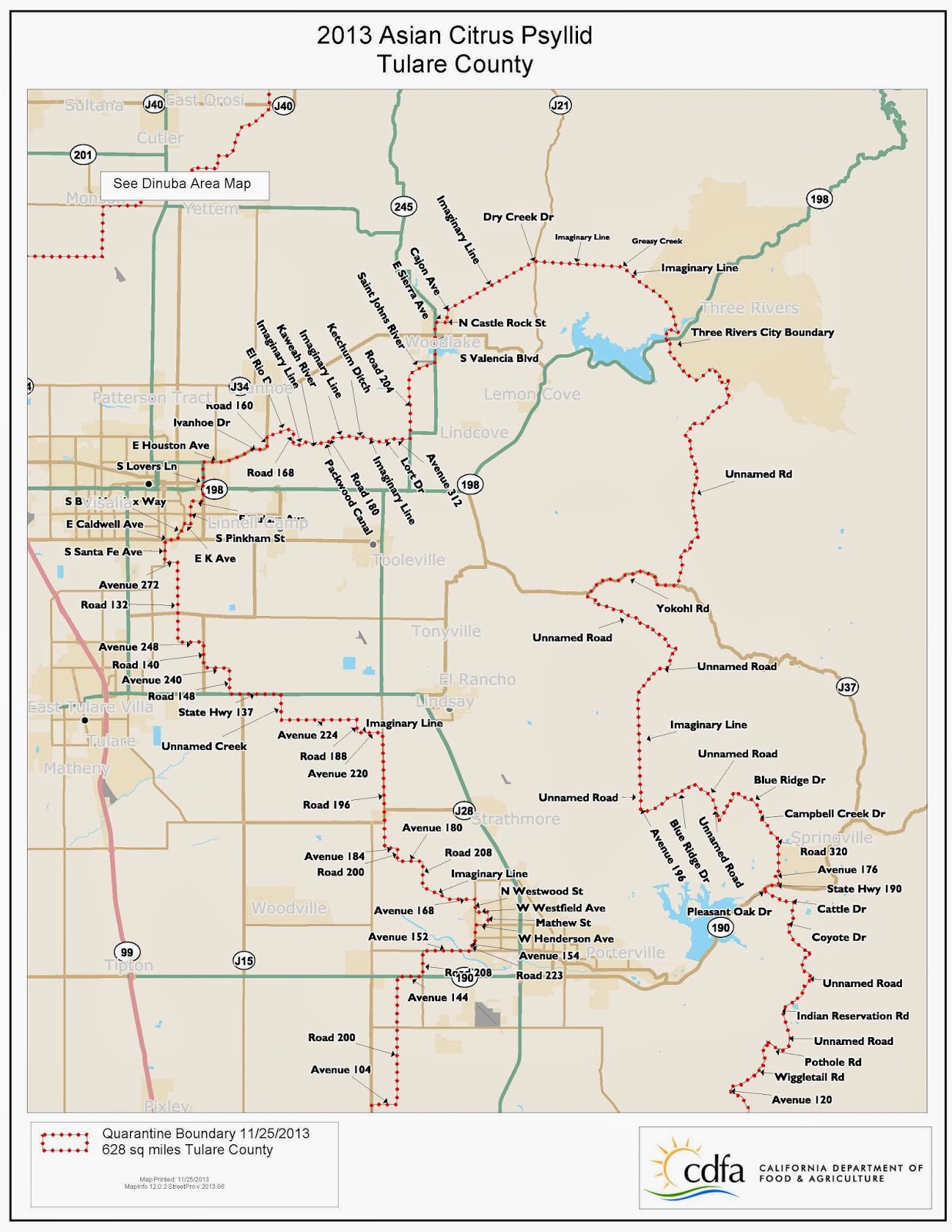
An additional 234 square miles in Tulare and Kern Counties have been placed under quarantine TODAY for the Asian citrus psyllid (ACP) following the detection of three psyllids near Exeter, Lemon Cove and the unincorporated area southeast of Porterville in Tulare county.  This brings the total quarantined area in the region to 888 square miles.

The quarantine zone expanded approximately 197 square miles in Tulare County in the Exeter and Lemon Cove areas and in the unincorporated area southeast of Porterville. The detection in the Porterville area also expanded that quarantine area into Kern County by approximately 37 square miles. These areas are in addition to the previously announced quarantine areas in Tulare and Kern Counties. 

In addition to the quarantines in these portions of Tulare and Kern Counties and nearby portions of Fresno County, ACP quarantines are in place in Imperial, Los Angeles, Orange, Riverside, San Bernardino, San Diego, Santa Barbara, and Ventura Counties.

The ACP is an invasive species of grave concern because it can carry the disease huanglongbing (HLB), also known as citrus greening. All citrus and closely related species are susceptible hosts for both the insect and the disease.  There is no cure once a tree becomes infected.  The diseased tree will decline in health until it dies. 

HLB has been detected just once in California – last year on a single residential property in Hacienda Heights, Los Angeles County. HLB is known to be present in Mexico and in parts of the southern U.S. Florida first detected the pest in 1998 and the disease in 2005, and the two have been detected in all 30 citrus-producing counties in that state. The University of Florida estimates the disease has tallied more than 6,600 lost jobs, $1.3 billion in lost revenue to growers and $3.6 billion in lost economic activity. The disease is present in Georgia, Louisiana, South Carolina and Texas. The states of Alabama, Arizona, Hawaii, and Mississippi have detected the pest but not the disease.

Residents with backyard citrus trees in the quarantine area are asked to not remove fruit from the area.  Residents in the area who think they may have seen the Asian citrus psyllid are urged to call CDFA’s Pest Hotline at 1-800-491-1899. For more information on the Asian citrus psyllid and huanglongbing disease please visit: www.cdfa.ca.gov/go/acp.

2016-05-31T19:43:05-07:00November 27th, 2013|

After Tough Negotiation, Raisin Price Decided

Raisin Price Set At $1650  Per Ton


More Thompson Seedless Vineyards To Be Pushed


The Raisin Bargaining Association (RBA) announced that it has reached agreement with its signatory packers on the 2013-14 Natural Seedless raisin harvest announced field price.  The price will be one thousand six hundred fifty dollars ($1,650.00) per ton or eighty-two and one half cents ($0.825) per pound.  The price is calculated using the following formula:

         Base price                                $1,457.00                      $0.7285

         Moisture @ 10%                             80.00                          .04

         Maturity @ 75%                              50.00                          .025

         Container rental                              21.00                          .0105

         Transportation (minimum)              15.00                           .0075

         RAC assessment                            14.00                          .007

         USDA inspection                            13.00                          .0065

         2013 Announced RBA field price     $1,650.00 per ton  $0.825 per lb.

Raisin growers have sent a strong message to the industry that they prefer selling raisins on a 100% basis now and into the future.  With that in mind, the Board of Directors of the Association worked diligently toward a compromise with their signatory packers to establish a fair price that reflects the additional California raisin production for this season. 

The Raisin Administrative Committee (RAC) recently estimated the 2013 Natural Seedless raisin crop at 348,437 tons in comparison to deliveries of 311,090 tons last year.  The $1,650 per ton price for the 2013 Natural Seedless raisin crop is a 13% reduction to last year but takes into account the additional crop that is estimated for production as well as the challenging market conditions that the industry will be facing.

The agreement calls for growers to be paid in three installments this year as opposed to four installments last season.  65% of the payment will be due fifteen (15) days after completion of delivery, 20% will be due to growers on or before February 28, 2014, and the final 15% will be payable on or before April 30, 2014.

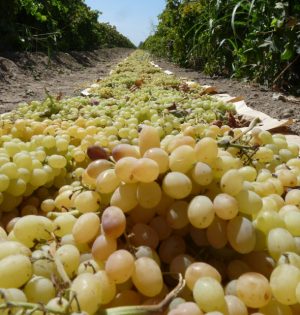
raisin character

In the past, grower reserve raisins generated funds to assist the industry in marketing additional production into world markets.  The effort to sell this year’s additional production without reserve programs and the temporary elimination of state marketing and promotion funding are two reasons why the RAC assessment of fourteen dollars ($14) per ton has been included in the pricing formula.  This will provide an opportunity for the industry to work together through the RAC in support of efforts to market 100% of each year’s crop without reserves.

As reported from the International Dried Grape Producing Countries Conference in October, there continue to be strong indicators that Turkey has a significantly smaller dried grape crop to market this coming season.  California and Turkey are the two largest producers of dried grapes in the world.  It was also reported that South Africa, Chile, and Argentina have suffered tremendous frost damage in their vineyards, which will severely limit their harvest, which begins in January. The ability to take full advantage of what appears to be a tremendous sales opportunity requires an announced field price.

The Raisin Bargaining Association Board of Directors understood the importance of establishing this important benchmark in a timely manner to sell the maximum amount of raisins this year.  However, they are also well aware of the impact it has on the grower community.  Labor, water, and energy costs have significantly increased for growers over the past twelve months further squeezing their bottom line margins.  As agricultural resources in California are depleted, vineyard owners will continue to seek the best utilization of their land. 

California Ag Today editors spoke with Steven Spate, an RBA Grower representative, and a raisin grower. He said: “We are witnessing a large amount of raisin grape vineyards being removed (between 8,000 and 15,000 acres) from production this year in favor of more mechanized and profitable crops such as almonds, walnuts, and citrus.” 

“Time will tell what impact this acreage reduction will have on the future of the California raisin industry but taking the necessary steps to market this year’s crop was extremely important for the Raisin Bargaining Association to accomplish.  We are now counting on the California raisin packers to sell this crop to provide a better future for the remaining growers in our industry,” Spate said.

Spate added that processors thought the price should have been lower, but growers generally thought that shortages in Turkey and other areas should have boosted the price. “But still, there are excess raisins on the market and it has created a downswing in price.

Growers who are pushing out vineyards say that the lower price is only one factor that is in play. Chronic labor shortages are also encouraging growers to plant a less labor-intensive crop.

2016-08-25T21:49:44-07:00November 26th, 2013|

2014 –INTERNATIONAL YEAR OF FAMILY FARMING

American Farmland Trust Participates on National Committee

The United Nations officially kicked off its 2014 International Year of Family Farming (IYFF) campaign on Friday. The 2014 IYFF is an initiative that seeks to raise the profile of family farming and promote broad discussion and cooperation at the national, regional and global levels.


The United Nations officially kicked off its 2014 International Year of Family Farming (IYFF) campaign on Friday. The 2014 IYFF is an initiative that seeks to raise the profile of family farming and promote broad discussion and cooperation at the national, regional and global levels.

The 2014 is promoted by the World Rural Forum (WRF) and supported by over 360 civil society and farmers’ organizations. One supportive association is the U.S. National Committee, whose member organizations include: National Farmers Union, U.S. Department of Agriculture (advisory member), Alliance to End Hunger, American Farmland Trust (AFT), Consumer Federation of America, and the National Cooperative Business Association.

Because family farmers are key to continued stewardship and protection of farmland for future generations, AFT’s participation will further serve our mission of protecting farmland, promoting sound farming practices and keeping farmers on the land.

All this work is being made from the perspective of effectively combating poverty and hunger and searching for rural development based on the respect for environment and biodiversity.
AFT has been invited to serve on the U.S. national committee that will be conducting events and outreach in the next year to showcase family farming. 

Additional information on the 2014 IYFF U.S. national committee is available at: http://www.yearoffamilyfarming.com/ 

2016-05-31T19:43:06-07:00November 24th, 2013|

AFBF’S 28TH ANNUAL INFORMAL PRICE SURVEY OF THE THANKSGIVING MEAL

The Gobbler Is Cheaper This Year
The American Farm Bureau Federation’s 28th annual informal price survey of classic items found on the Thanksgiving Day dinner table indicates the average cost of this year’s feast for 10 is $49.04, a 44¢ decrease from last year’s average of $49.48.
While not adjusted for inflation, the first price survey was $28.74 (1986), the lowest was $24.51 (1987), and the highest was $49.20 (2011).
The cost of this year’s meal, at less than $5 per serving, remains an excellent value for consumers,” said AFBF President Bob Stallman, a rice and cattle producer from Texas.
The AFBF survey shopping list includes turkey, bread stuffing, sweet potatoes, rolls with butter, peas, cranberries, a relish tray of carrots and celery, pumpkin pie with whipped cream, and beverages of coffee and milk, all in quantities sufficient to serve a family of 10. There is also plenty for leftovers.

The big-ticket item, a 16-lb. turkey, came in at $21.76 this year. That was roughly $1.36/lb., a decrease of about 3¢/lb., or a total of 47¢ per whole turkey, compared to 2012. The whole bird was the biggest contributor to the final total, showing the largest price decrease compared to last year.
Sadly, calories have not decreased.
While Farm Bureau does not make any scientific claims about the data, it is an informal gauge of price trends around the nation. Farm Bureau’s survey menu has remained unchanged since 1986 to allow for consistent price comparisons.
2016-05-31T19:43:06-07:00November 24th, 2013|

EPA HEAD LAMENTS LACK OF CLEAN WATER IN SAN JOAQUIN VALLEY

EPA Leader Criticizes Government Efforts To Improve Rural Water Infrastructure


U.S. Environmental Protection Agency (EPA) Administrator Gina McCarthy said Thursday that she was disappointed by the slow progress state, federal and local governments have made in bringing potable drinking water to small towns in the San Joaquin Valley.
“We’ve got rural communities that don’t have clean water and there’s no plan on how to get it to them,” said in a meeting with Los Angeles Times editors and reporters.
McCarthy’s comments follow the federal government’s threat this spring to cut off clean drinking water funding because state officials have been sitting on more than $455 million in unspent federal money. The EPA also faulted the state Department of Public Health for a lack of financial accountability with the funds.
Residents and activists in small communities across the state said they were forced to pay for bottled water while remedies to the non-potable water that came out of their pipes were delayed year after year because of red tape.
The state public health agency issued a 16-page plan this summer to improve the distribution of federal money, including a pledge to distribute more than $800 million over the next three fiscal years — four times as much as in the last three.
McCarthy’s visit included stops in San Francisco and the Fresno area, where she met with farmers and activists about water and air quality concerns. 
**********
 
The EPA also announced this week that it has awarded California $174 million in federal funding to invest in water infrastructure projects, including $79 million to the California Department of Public Health for the its Drinking Water State Revolving Fundand $95 million to the California State Water Resources Control Board for its Clean Water State Revolving Fund.
“In the last 26 years, EPA has provided more than $4 billion in funding for California water projects alone,” said Jared Blumenfeld, Regional Administrator of EPA’s Pacific Southwest Region. “Without this investment at the federal level, many communities would not be able to satisfy Californians’ basic needs for clean and safe drinking water.”
Nevertheless, earlier this year, the state’s public health agency estimated that 200,000 Californians at any one time are served by a water system that violates state health standards. But some legislators say the number is as high as 2.1 million when communities not served by publicly regulated water systems are counted.

Sources:
U.S. Environmental Protection Agency and Los Angeles Times
2016-05-31T19:43:06-07:00November 24th, 2013|

Ethanol Rules Hurt California Dairies

WUD: EPA Ethanol Mandate Impacting

California Dairy Families

“If you eat, if you utilize any type of motorized transportation, if you care about the environment, the renewable fuel standard that utilizes corn-based ethanol is contrary to your interests.”

That was the message delivered first-hand Wednesday to USEPA Administrator Gina McCarthy by Western United Dairymen CEO Michael Marsh. Marsh was part of a small group discussion with Administrator McCarthy sponsored by the CDFA and the Fresno County Farm Bureau at the Efird Ranch in Fresno County. McCarthy was spending time in the valley getting a feel for the breadth of California agriculture.

The agency last week lowered the amount of corn-based ethanol that must be blended into U.S. fuel supplies from 16.55 billion gallons in 2013 to 15.21 billion gallons in 2014. Marsh applauded that decision but indicated that using food for fuel was folly and that the man-date must be repealed. “Our dairymen are just one Midwestern drought away from an-other economic calamity so long as the mandate remains,” related Marsh.

Administrator McCarthy responded that she was keenly aware of the challenges faced by livestock producers as a result of the mandate. She also expressed disappointment that other types of ethanol technologies utilizing waste products had been slow to evolve. She indicated the Agency would be looking to find additional incentives to stimulate more in-vestment in things such as cellulosic ethanol that would not be so harmful to California dairy operations.

WUD is supportive of a bill that Sens. Dianne Feinstein (D-Calif.) and Tom Coburn (R-Okla.) plan to introduce which would strip the conventional ethanol portion of the renew-able fuel standard while keeping the standard’s targets for advanced biofuels intact. In the house, WUD is supporting HR 1462, the Renewable Fuel Standard reform Act of 2013.

2016-05-31T19:43:06-07:00November 24th, 2013|

New QR Code Video Is Part of Merchandising Program

Pretty Lady Grapes Available

Through Holidays

The holidays are here!  Sunlight International is kicking off the season with the introduction of a brand new QR code video as part of their Pretty Lady for the Holidays Point-of-Sale Merchandising Program, shipping now. 

The new video, viewed by scanning the Pretty Lady QR code found on all holiday packaging, features “Santa’s Little Helper” cooking up an easy-to-make, delicious Mini Cheese Ball appetizer featuring Dulcich & Sons Premium California Table Grapes. 

The holiday video also contains other helpful tips for enjoying Pretty Lady Table Grapes throughout the season.  Joining the other P.O.S. materials that currently make up this highly successful and proven program, the holiday video is both fun and informative, with initial feedback being incredibly positive from viewers. 

In addition to the video, the full program is comprised of easy-to-rinse colander bags, free standing bins, display cards and posters. 

Just two years old, and already popular with customers thanks to the charming and colorful illustrated design, the full Pretty Lady for the Holidays Merchandising Kit allows retailers to easily deck their aisles with Pretty Lady Grapes, thus dramatically increasing sales.

“We’re really excited to expand our Pretty Lady for the Holidays Merchandising Program again this year,” says Nick Dulcich, Sunlight International Owner and Director of Sales.  “The Holiday QR Code Video is just one more way to let people know that Pretty Lady Grapes can help make the holidays more festive.  It’s our way of saying Happy Holidays to our valued customers and retailers!”

To order your Pretty Lady for the Holidays P.O.S. Kits, which are currently being shipped to retailers across the country, call Nick Dulcich at (661) 792-6360 or email at sales@dulcich.com.

ABOUT SUNLIGHT INTERNATIONAL

Home of the Pretty Lady brand, Sunlight International — the sales and marketing arm for Dulcich & Sons — is a progressive grower, packer and shipper of Premium California Table Grapes. 


Grown on 6,000 acres in California’s San Joaquin Valley, Dulcich & Sons’ vineyards produce a variety of red, green, and black grapes that are shipped worldwide.
2016-05-31T19:43:06-07:00November 24th, 2013|

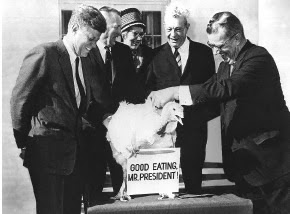
Rare Photo Released Today of President Kennedy with Calif. Turkey

Photo Released Today of President Kennedy with Calif. Turkey


A photo was just released today on the 50th Anniversary of President John F. Kennedy’s assassination. The photo depicts the President along with other officials gathered around a California Turkey that was given to him a few days before the president was killed.


Leo Pearlstein, of Lee and Associates in Los Angeles handled the logistics of the turkey delivery to the President. California Ag Today interviewed Mr. Pearlstein today and you can hear the story about the turkey in the audio below.


Of course, Lee and Associates along with the nation were stunned to learn that President Kennedy had been killed, and the photo was never released.  Today, Lee and Associates decided that it would be released.


2016-05-31T19:43:06-07:00November 22nd, 2013|
Go to Top