About Patrick Cavanaugh

This author has not yet filled in any details.
So far Patrick Cavanaugh has created 1490 blog entries.

A Grateful Word from Karen Ross

The following was written by California Agriculture Secretary Karen Ross…

What’s on the table for the Thanksgiving feast is often a matter of household tradition. In my family, that means turkey with all the fixings! Maybe your traditional Thanksgiving is much the same, but it’s good to know that here in California our bountiful crops and agricultural products make the options pretty inspiring. Whatever is on your family’s table – including flowers – Californians are blessed to live in this beautiful, productive and diverse place, and consumers all over the world are thankful for what our farmers provide.

Protecting the long-term viability of our agricultural systems and the people who make up California’s farm communities is part of our job here at CDFA, and we are so proud to be a part of that effort. It takes a lot of hands to bring a crop to harvest, starting with the ranchers, farmers and farmworkers themselves. It has been heartening in recent years to see so many consumers paying more attention to where their food comes from and who grows it. Our farmers deserve our thanks for the care and attention they devote to our food supply. Let me also express my thanks for all of the other agencies, stakeholders, scientists, educators and representatives who, along with CDFA, play supporting roles in the achievements of our farmers and ranchers.

I feel fortunate to have been given such vital work to do, and such wonderful employees and colleagues to work with. Ranchers, farmers and farmworkers don’t shy away from hard work, and they have entrusted us at CDFA to be a partner in their efforts. Gratitude for what we have in-hand and what we have accomplished together is an essential part of the Thanksgiving spirit, but it is also important to be thankful for the anticipation of worthwhile work that remains.

I wish you and your loved ones a very happy Thanksgiving and a joyous holiday season!
2016-05-31T19:32:13-07:00November 26th, 2014|

U.S. Water Receives the California Game Changer Company of the Year Award

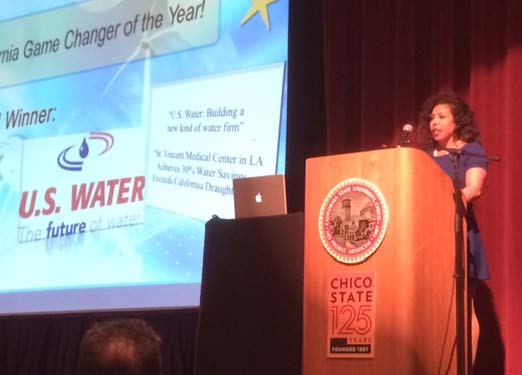
U.S. Water Services, Inc., the leading national provider of integrated solutions for water treatment, has received the California Game Changer Company of the Year Award.

From left to right are U.S. Water representatives Don Garrett, Alexandra Causey (holding Award) and Jamie Shaw, who are working throughout the state to meet and exceed California’s water reduction requirements of 20% by the year 2020, utilize greener chemistries and improve operational efficiencies.

From left to right are U.S. Water representatives Don Garrett, Alexandra Causey (holding Award) and Jamie Shaw, who are working throughout the state to meet and exceed California’s water reduction requirements of 20% by the year 2020, utilize greener chemistries and improve operational efficiencies.

The honor was presented by the California Governor’s Office of Business and Economic Development, Oliver Rosenbloom, and accepted by U.S. Water’s Alexandra Causey at the 100th Annual Vanguard Awards Dinner on November 20 at Chico State University.

In an effort to conserve freshwater resources, California facilities are actively working to reduce water use 20% by the year 2020. U.S. Water has been working with California agriculture, medical centers and businesses throughout the state using integrated solutions that combine chemical, equipment, engineering, automation and service to help facilities achieve this goal. The California Game Changer of the Year Award recognizes individuals and companies who have made a significant statewide impact either economically or regarding key issues within the State of California.

On receiving this award, U.S. Water Founder & CEO Allan Bly stated, “U.S. Water is proud to be recognized for our record of achievement in the State of California. Our people and integrated water solutions approach are working very effectively to reduce water use and improve business and plant efficiency not only in California, but throughout the United States.”


U.S. Water seeks to identify and eliminate the root cause of problems, finding optimal solutions for each customer’s individual water treatment needs based on the best combination of chemistry, equipment, engineering and technical services.

Featured photo: U.S. Water’s Alexandra Causey accepting the 2014 California Game Changer Company of the Year Award.

2016-05-31T19:32:13-07:00November 24th, 2014|

California Turkey Industry Enjoys Excellent Year

California Turkey Producers and Processors Offer Wide Variety to Consumers and Benefit From Steady High Prices

For the last two weeks, grocery store meat departments have been catering to consumers looking for the perfect turkey.

According to Bill Mattos, President of the Modesto-based California Poultry Federation, it has been a great year for California turkey producers:

“This is probably one of the best years for turkey in many, many years for the farmer and the processor. The consumer still gets a bargain every Thanksgiving even though prices this year are higher [as] there are less turkeys in the nation. California fresh turkey was sold out from our processors two weeks before Thanksgiving. So, we were urging everyone who wanted California fresh turkey to get their order in early, and they may still be able to do that. The California farmer is offering everything from fresh and natural to organic to free range; you can find just about everything in your supermarket. It will be a very good year for turkey, and it will be a good year for chickens coming up as well. We look forward to 2015 because we think it will be even better than 2014.”

Mattos said that the turkey industry was careful to avoid oversupply, “The turkey industry didn’t grow crazy, and prices stayed at a pretty good level. They didn’t all start growing like farmers do sometimes as they all get into the business when prices are good. Turkey farmers held back and kept their supply even; however,  with very high beef, pork and other meat prices at this time of year, people look at turkey and even chicken as a bargain.”

As we all sit around the table with friends and family this Thanksgiving, we can be thankful for the California turkey producers and processors, as well as the farmers and farm workers who provide so much for the seasonal meals.

2016-05-31T19:32:13-07:00November 24th, 2014|

Silicon Valley Needs Farmers Too – Farm to Food Bank Month Spotlight

Second Harvest Food Bank of Santa Clara and San Mateo Counties is centered in one of America’s wealthiest regions. But as the cost of living soars, nutritious food has become a luxury for the nearly 250,000 people who depend on us for food every month. A recent article in USA Today highlights this disparity.Second Harvest

More than two-thirds of our clients purchase unhealthy food. They know the food is unhealthy, but it’s what they can afford. We’re on a mission to not only end local hunger, but to provide everyone with access to the nutritious food they need to thrive.  Local farmers are some of our strongest allies.

Thanks to generous growers throughout our region, Second Harvest was able to distribute nearly 30 million pounds of fresh produce last fiscal year, more than any other food bank in the nation. Much of this food was donated from family farms, demonstrating the deep connection that farmers have to local community.

Together, farmers and the food bank community can ensure that anyone who needs a meal—especially a healthy meal—can get one.


Kathy Jackson was named a “Woman of Influence” by the Silicon Valley Business Journal in 2010 and currently serves on the boards of the California Association of Food Banks and Feeding America, the nation’s largest domestic hunger-relief charity. In 2014 she was honored as Network Leader of the Year across the 202 food banks within Feeding America.

2016-05-31T19:32:13-07:00November 24th, 2014|

CCGGA and WAPA Not Happy with Abrupt Ending of Water Negotiations

What Happened is Unknown, But Ending Water Negotiations In a Year Like This is Unconscionable


On Friday, California Cotton Ginners and Growers Associations (CCGGA)/Western Agricultural Processors Association (WAPA) President /CEO Roger Isom reacted to the withdrawal of water negotiations on federal drought legislation by stating:

Roger A. Isom, CCGGA/WAPA President/CEO

Roger A. Isom, CCGGA/WAPA President/CEO

It is unconscionable to walk away from talks at this point in time. In a year where hundreds of thousands of acres of productive farmland received zero surface water, this delay is unacceptable. Thousands of acres lay fallow and productive orchards were ripped out – this is unacceptable.

The jobs that are associated with this acreage go far beyond the individual farmer and his family. It affects farm workers and their families, the fuel delivery personnel and their families, the custom harvesters and their families, the bankers and their families, the insurance companies and their families, the equipment dealers and their families. The list goes on and one thing remains the same. The lack of water is devastating. There are cities in the San Joaquin Valley that are without water for even the basic necessities. This is not a time when politics should come before the needs of the people.

While we applaud the bipartisanship that went into the serious negotiations that were undertaken, the fact remains that there will be no legislation this year. Despite assurances that this will be taken up early in the next session it is simply too late. Another planting season will have gone by. Without a miracle winter, more acreage will be removed. Consequently, more farmworkers will be laid off or simply not hired. There will be even less work for the fuel suppliers, harvesters, banks, chemical supply companies, equipment dealers, and others that rely upon a viable agricultural industry.

We don’t know what happened or why the negotiations were discontinued, but it doesn’t matter. Simply put, something has to be done to provide more water at these critical times. Farmers have done their part by investing billions converting irrigation systems to automated, high-efficiency, low water use systems, such as buried drip on cotton. It’s time for Congress to do theirs.“

The California Cotton Ginners and Growers Associations are trade organizations representing cotton growers and cotton gins throughout California. The Western Agricultural Processors Association is a trade organization representing tree nut hullers and processors of almonds, pecans, pistachios and walnuts. All three organizations are operated and managed in the same offices in Fresno, California.


2016-05-31T19:32:14-07:00November 24th, 2014|

Western United Dairymen Statement on Executive Immigration Action

 State Needs Immigration Action for Year-Round Labor


Yesterday, President Obama announced a series of executive immigration actions intended to provide relief from deportation and work authority to certain individuals who are not legally present in the U.S. The specific implications for agriculture are difficult to assess, but it is clear President Obama’s executive action is limited and only proposes temporary relief.

WUD firmly believes that Congressional action is the only true path to a comprehensive solution for the current broken immigration system. For example, farmers with year-round labor needs are ineligible to participate in any existing program because the law requires the job to be seasonal and the worker to be temporary. Legislation appears to be the only way to eliminate this challenge to our country’s food security.

The consequences of labor instability and Congressional inaction to address it have been severe.  We are committed to achieving a fair legislative solution that most importantly, legalizes the current workforce and provides a stable, legal, year-round workforce moving forward. Our dairy families depend on these experienced employees who understand the needs of our dairy farms and herds.

WUD is a voluntary membership organization representing more than 60% of the milk produced in California. Membership benefits include resources in labor law, environmental regulations and pricing issues. Members decide the direction of state and federal legislative efforts affecting the dairy industry.


2016-05-31T19:32:14-07:00November 22nd, 2014|

USDA Helps Open and Expand Export Markets for U.S. Agriculture

By: Monique Bienvenue; Cal Ag Today Social Media Manager/Reporter

Agriculture Secretary Tom Vilsack today announced that the U.S. Department of Agriculture’s (USDA) Foreign Agricultural Service has awarded funding to more than 60 U.S. agricultural organizations to help expand commercial export markets for American products.

“The Market Access and Foreign Market Development Programs help agricultural organizations representing thousands of producers and businesses open and grow markets for American products around the world,” Vilsack said. “Exports create jobs and foster growth that is critically important for rural communities and our entire nation’s economy.”

Through the Market Access Program (MAP), Foreign Agricultural Service partners with U.S. agricultural trade associations, cooperatives, state regional trade groups and small businesses to share the costs of overseas marketing and promotional activities that help build commercial export markets for U.S. agricultural products and commodities. The program, which focuses on consumer promotion, including brand promotion for small companies and cooperatives, is used extensively by organizations promoting fruits, vegetables, nuts, processed products, and bulk and intermediate commodities. Through MAP, the Foreign Agricultural Service will provide $173.2 million to 62 nonprofit organizations and cooperatives. Participants contribute an average 214 percent match for generic marketing and promotion activities and a dollar-for-dollar match for promotion of branded products by small businesses and cooperatives.

The Foreign Market Development (FMD) Program focuses on trade servicing and trade capacity building by helping to create, expand and maintain long-term export markets for U.S. agricultural products. Under FMD, also known as the Cooperator Program, the Foreign Agricultural Service will allocate $26.7 million to 22 trade organizations that represent U.S. agricultural producers. USDA’s Foreign Agricultural Service partners with U.S. agricultural producers and processors, who are represented by non-profit commodity or trade associations called cooperators. The organizations, which on average contribute nearly triple the amount they receive in federal resources, will conduct activities that help maintain or increase the demand for U.S. agricultural commodities overseas.

USDA’s international market development programs have had a significant and positive impact on U.S. agricultural exports. An independent study released in 2010 found that trade promotion programs like MAP and FMD provide $35 in economic benefits for every dollar spent by government and industry on market development.

The past six years represent the strongest period for U.S. agricultural exports in the history of the United States. Farm exports in fiscal year 2014 reached a record $152.5 billion and supported 1 million jobs in the United States.

2016-05-31T19:32:14-07:00November 21st, 2014|

After 10 years as CAPCA’s CEO/President, Terry Stark To Step Down

Terry Stark’s Final Speech to CAPCA Conference Attendees

By Patrick Cavanaugh, Editor

“They wouldn’t give me a walk-around microphone because they were afraid I would preach, so you guys lucked out,” noted Terry Stark, the feisty, fun-loving professional CEO and President of the California Association of Pest Control Advisers (CAPCA), who led the organization for 10 years.

Stark spoke to CAPCA attendees during the final session of the 40th Annual CAPCA Conference and Agri-Expo in Anaheim, in October.

“And I don’t have a PowerPoint, so you’re going to luck out even more,” he said.

“I am going to talk to you briefly about some of the programs going forward, and how you, as CAPCA members, can make a huge contribution. You heard California Farm Bureau President Paul Wenger and the other general session speakers talk about investment, involvement and belonging; we need you to step up and do that,’ said Stark.


Tell People What You Do!

“With 3,000 PCAs in CAPCA, we’re the third largest association in the state of California, next to the Farm Bureau and Western Growers Association. Commodity boards or mandated programs; and you come to CAPCA because you want to come—because you’re volunteers—and the future will be how you mentor the future PCA generation.”

“How do you do that?” he continued. “You heard two of our speakers say, ‘tell somebody what you do, why you do it, and why you love to do it,'” noted Stark.

“The CAPCA Board was very generous in moving $100,000 dollars three months ago to the Stanley W. Stew Education Fund, Inc. to start the first CAPCA Leadership Institute. We have staff that has been challenged to find champions to go out and raise funds; I don’t care if it is one dollar or one million dollars, to develop a leadership program.

“I love this place. The CAPCA Leadership Institute will inspire plant science students to get their PCA license. And how we’re going do that is that? We’re going to have to our chapters, to our members, and when they talk to anyone with a dollar in their pocket, to make the contribution to the Stanley W.  Stew Foundation; its a [501(C)(3)] corporation, its a tax write-off. And Steve Bickley (CAPCA Board NorCal) and I have the project management to develop the protocols on how we’re going to run this,” noted Stark.

“Well, I’m not stupid; we have Shannon Douglas, our coordinator to our Pathway to PCA program, to help out. In fact, we have two dozen-plus PCAs in the room who attended the Leadership Foundation programs up and down the state. We’re going to take that knowledge from the young farmers and ranchers and from the Farm Bureau, we’ll take that Ag leadership, and we’ll make a program in which at least one dozen PCAs on an annual business basis will learn how to conduct themselves around legislators, supervisors, and school boards. In other words, how do you tell someone that you are important?” Stark said.


How to Fix Stupid?

Stark noted that his board is asking a critical question of the candidates for my job, “Can you fix stupid? What I mean by that is when I sit down and talk to PCAs, it’s clear who the smartest person in the room is, and it’s not me,” Stark said.

“So, if you get tapped to be a champion to raise money for the CAPCA Leadership Institute, if you say “no,” I will come back from Texas and hound you until you get your wallet out. I truly believe that that’s going to be the program of the future, it will allow us to reinvest in the `Pathway to PCA’ program.

“When the program headed up by Shannon Douglas was to sunset three years ago, our Ag retailers and basic manufacturers stepped up and funded $300,000 to continue the work. And through those efforts, we have about a 50 PCA license-gain over where we were five years ago. It’s an important program so that we make sure young professionals get that crop protection and crop science education to have a career that can go from 35-40 years. It’s very important,” Stark said.

“When I got on the Board of Directors, I was the oldest guy on the Board. You’ve been in business for 40 years and you’ve done certain things the same way for 30 years, and my job was to help point that ship in a direction where you could have another 40 years. And one of the accomplishments, again, is the generations have changed and we’ve got a younger board of directors now. We have the enthusiasm of a younger board now, and through the leadership of Gary Silveria (CAPCA Vision Planning Committee Chairman), we have crop teams on the table now.

“Ok, you’ve heard crop teams talked about by Jeremy Brisco (CAPCA Executive Committee Chairman) yesterday. Not everyone can leave the field, leave their office, drive to Sacramento, sit in a room for an hour and a half, and drive back to San Diego or Desert Valley or up to Chico. So, how do we get our intellectual knowledge moved forward and yet still be recognized by who you are and why you do what you do?” said Stark.

“We’ll start with 8 areas of crop teams, but the ideal is we’re inclusive. We’re going to use Skype and Go to Meeting technology, and you don’t have to drive five hours to get there. This is the educational gap change that the younger guys and women can do so much better than us older guys,” Stark noted.


The Right Champions in Place

“But we recognized that gap, pre-drought, when we had the legislative bore, and there was no money in the budgets, no taxes. You know the University of California is going through the same attrition, and all of a sudden, counties couldn’t send their Ag Commissioners to meetings and Extension people couldn’t travel, or we couldn’t replace their expertise,” Stark noted. “We’ve got 3,000 experts. You will travel, you will provide the leadership and you will succeed. My goal in making this happen for the board of directors is that we have the right people in place. Gary Silveria has put the right champions in place on these crop teams, so if you get asked, `do you want to help with almonds, or do you want to help with strawberries,’ the answer is `Yes, I want to help!’”
“And I guarantee you we will be—CAPCA will be—in 3-5 years—the go-to expert at any of those crop protection incidents that will occur. And you will be standing side-by-side with UC Agricultural and Natural Resources Extension people and the commodity board research folks in fighting the problems. That’s what you will accomplish. That is innovative! I know some of my chapters are going to say, `what are the chapters going to do?’ and I’ll say this, `you have a purpose!’”

“Find that purpose. I’m not going to tell you what your purpose is…. you find your purpose. And you make the crop teams successful. And you make the Pathway to PCA successful. It’s all about being positive; one of our speakers said, `don’t say anything you can’t do.’ Hell, I’ve never said I can’t do anything, said Stark.

(more…)

2016-05-31T19:32:14-07:00November 21st, 2014|

Cost of Thanksgiving Dinner Rises, But is Still Under $50 For 10 People

Let’s All Remember and Give Thanks to Farmers and Farmworkers Who Provide Us with Food for our Thanksgiving Celebration

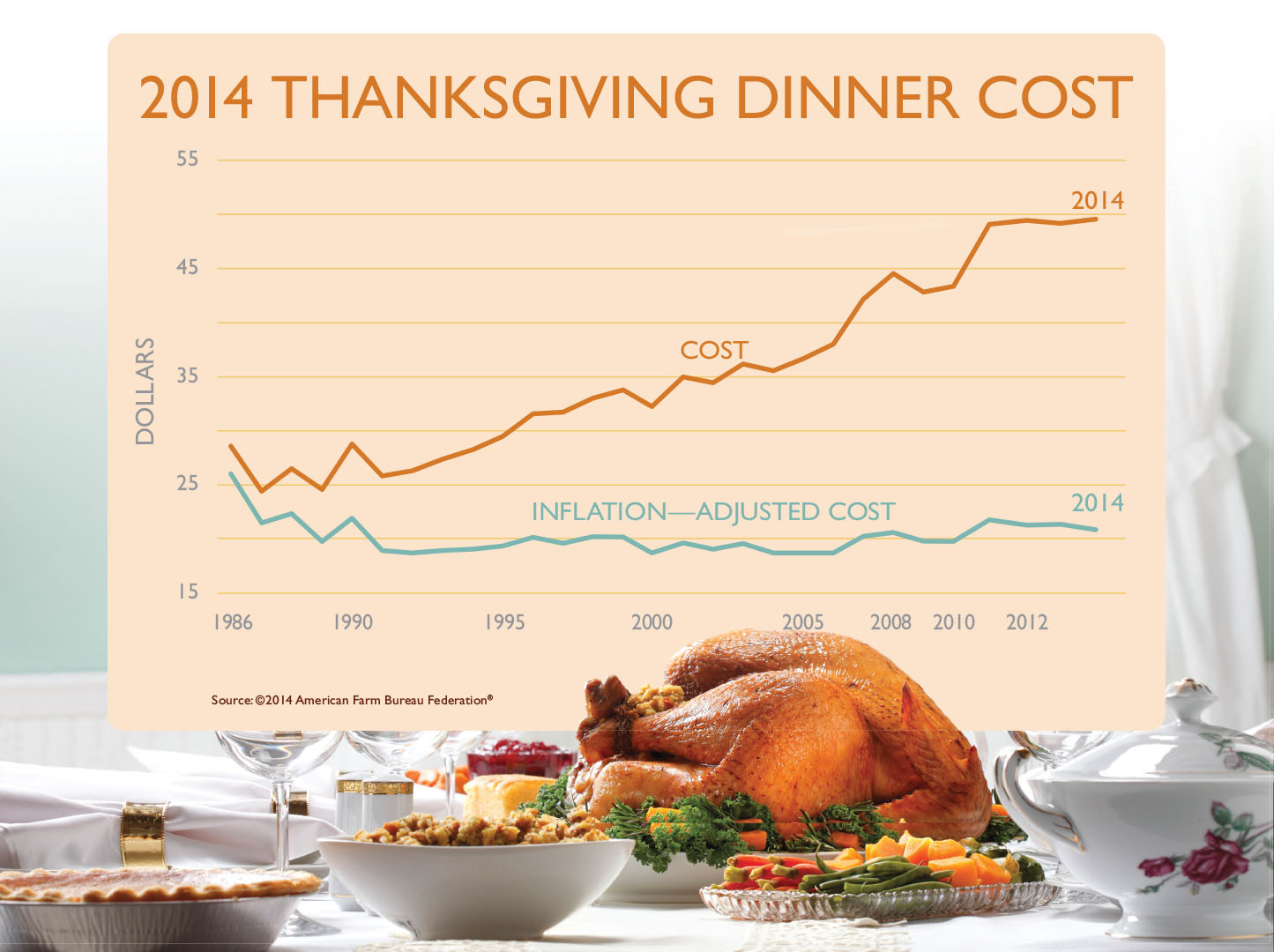
The American Farm Bureau Federation’s 29th annual informal price survey of classic items found on the Thanksgiving Day dinner table indicates the average cost of this year’s feast for 10 is $49.41, a 37-cent increase from last year’s average of $49.04.

The big ticket item – a 16-pound turkey – came in at $21.65 this year. That’s roughly $1.35 per pound, a decrease of less than 1 cent per pound, or a total of 11 cents per whole turkey, compared to 2013.

“Turkey production has been somewhat lower this year and wholesale prices are a little higher, but consumers should find an adequate supply of birds at their local grocery store,” AFBF Deputy Chief Economist John Anderson said. Some grocers may use turkeys as “loss leaders,” a common strategy deployed to entice shoppers to come through the doors and buy other popular Thanksgiving foods.

The AFBF survey shopping list includes turkey, bread stuffing, sweet potatoes, rolls with butter, peas, cranberries, a relish tray of carrots and celery, pumpkin pie with whipped cream, and beverages of coffee and milk, all in quantities sufficient to serve a family of 10. There is also plenty for leftovers.

Foods showing the largest increases this year were sweet potatoes, dairy products and pumpkin pie mix. Sweet potatoes came in at $3.56 for three pounds. A half pint of whipping cream was $2.00; one gallon of whole milk, $3.76; and a 30-ounce can of pumpkin pie mix, $3.12. A one-pound relish tray of carrots and celery ($.82) and one pound of green peas ($1.55) also increased in price. A combined group of miscellaneous items, including coffee and ingredients necessary to prepare the meal (butter, evaporated milk, onions, eggs, sugar and flour) rose to $3.48.

In addition to the turkey, other items that declined modestly in price included a 14-ounce package of cubed bread stuffing, $2.54; 12 ounces of fresh cranberries, $2.34; two nine-inch pie shells, $2.42; and a dozen brown-n-serve rolls, $2.17.

The average cost of the dinner has remained around $49 since 2011.

“America’s farmers and ranchers remain committed to continuously improving the way they grow food for our tables, both for everyday meals and special occasions like Thanksgiving dinner that many of us look forward to all year,” Anderson said. “We are blessed to be able to provide a special holiday meal for 10 people for about $5.00 per serving – less than the cost of most fast food meals.”

The stable average price reported this year by Farm Bureau for a classic Thanksgiving dinner tracks closely with the government’s Consumer Price Index for food eaten at home (available online at http://www.bls.gov/news.release/cpi.nr0.htm), which indicates a 3-percent increase compared to a year ago.

A total of 179 volunteer shoppers checked prices at grocery stores in 35 states. Farm Bureau volunteer shoppers are asked to look for the best possible prices, without taking advantage of special promotional coupons or purchase deals, such as spending $50 and receiving a free turkey.

Shoppers with an eye for bargains in all areas of the country should be able to purchase individual menu items at prices comparable to the Farm Bureau survey averages. Another option for busy families without a lot of time to cook is ready-to-eat Thanksgiving meals for up to 10 people, with all the trimmings, which are available at many supermarkets and take-out restaurants for around $50 to $75.

The AFBF survey was first conducted in 1986. While Farm Bureau does not make any scientific claims about the data, it is an informal gauge of price trends around the nation. Farm Bureau’s survey menu has remained unchanged since 1986 to allow for consistent price comparisons.

Source: Cyndie Sirekis,  AFBF Director of Internal Communications

2016-05-31T19:32:14-07:00November 20th, 2014|

West Sacramento Urban Farm

By: Monique Bienvenue; Cal Ag Today Social Media Manager/Reporter

West Sacramento has its first urban farm in the Broderick neighborhood of West Sacramento: 5th & C St. Farm. What was once a vacant city lot is now a 2/3 acre farm growing over 50 varieties of vegetables, melons, flowers and herbs. Most of what is grown is almost never sold in stores. These crops are planted specifically for their flavor, picked when the produce is ripe and delivered the day of harvest.

Diversity, companion planting, crop rotation, lunar cycle planting, compost, and working with nature are the central values held by 5th & C St. Farms. All goods are grown naturally using 100% organic compost. The farm never uses any chemical fertilizers, insecticides or sprays. Sustainability, selling locally and providing people with nutrient dense, delicious food is what drives this farm.

Visitors and guests interested in seeing small scale agriculture thriving in the midst of a busy city are welcome to visit the farm. 5th & C St Farms is living proof that small scale farmers can make a difference in the local food system.

2016-05-31T19:32:14-07:00November 20th, 2014|
Go to Top