About Patrick Cavanaugh

This author has not yet filled in any details.
So far Patrick Cavanaugh has created 1490 blog entries.

NEW TECHNOLOGY FOR CALIFORNIA VITICULTURE INDUSTRY

–>

Thermal Plant Treatment Introduced to Viticulture Industry

With Promising Results


By Laurie Greene, Associate Editor


Thermal Plant Treatment (TPT), a unique patented technology, uses heated air to help reduce pesticide needs and has also shown surprising benefits with higher fruit set, when applied at blossom; thicker skin development on fruit; reduced fungal development by drying crops after rain storms; and improved yields.


Since the inception of the technology in 2001, the basic treatment protocol onto crops has consisted of a tractor-pulled machine moving at 3-4 MPH (5-6KPH), applying 100ºC (215F) heated air, at a wind velocity of 85-100 (135-160 MPH).

 
The machine, built exclusively for AgroThermal Systems by American Grape Harvesters of Fresno, California, is engineered to configure the treatment properly onto each crop.


Wine, developed from thermally treated wine grapes from the Napa Valley, Sonoma and Central Oregon is being compared with non treated wine grapes from the same vineyards.


Master of Wine, Philip Goodband
Agrothermal CEO Marty Fischer said TPT’s Master of Wine, Philip Goodband uses his expert tasting ability and knowledge of Enology to differentiate and accurately explain the differences between the test and control wines on a blind basis. “Having a world leading Master of Wine as part of our team said Fischer, adds expert validation to the differences we are seeing TPT create in wine quality.” Testing will continue, adding in blueberries, cane berries, pears and cherries.


Lazo TPC Global, Inc., doing business as AgroThermal Systems, is a California corporation that holds patents for Thermal Pest Control and has patents pending on other aspects of Thermal technology under the umbrella of Thermal Plant Treatment. 

2016-05-31T19:43:10-07:00November 8th, 2013|

Date Season Finishing up After Weather Issues

California’s Bard Valley Finishes Up Date Season


Weather Challenges Hurt Quality
By Patrick Cavanaugh, Editor

Bard Valley fig growers in the southeast part of the state, where most of the California dates are produced is wrapping up the season, however it followed challenging summer rains, which set up a process where some of the dates would start to ferment, or sour, and could not be harvested.

“This week we are getting the bags down and cutting the fruit arms in the trees, and cleaning up equipment, ” said Ron Hill with Royal Medjool Date Gardens, Winter Haven. “ The last dates were harvested last week and we are trimming up our young trees and getting ready for next season.”

Overall, production was up but there was some souring. Hill noted that bags are put over the fruit branches to protect the dates from windstorms and so that any dates that drop off will stay in the bag. “You always have the heat, along with sugar in the dates and when the rain came, it raised the humidity.

Often times there is 10 pounds of fruit which fall in the bag, and we had about 60 percent of that fruit that was probably bad,” said Hill. “Overall, the industry lost about 20 percent of production.”

Hill noted that the Coachella date production area had more problems.

Hill noted that when the crews were taking down the bags they were able to harvest some late maturing dates on the fruiting branches. We were able to get another five or 10 pounds per tree, which helped in overall volume.

Hill noted that the date industry is able to name their own price just as long as they are sensible. “We have a big chunk of the industry and we set the price before we even harvest,” said Hill. “If the price needs to be adjusted because things are moving slow then the industry works with the buyers.

Total date production in the Bard Valley was 16 to 18 million pounds this year, up a bit from last year.

2016-05-31T19:43:10-07:00November 8th, 2013|

Small Farm Conference March 9-11 Rohnert Park

California Small Farm Conference

Attendance Scholarships Available!

APPLICATION DEADLINE:  December 6, 2013

CONFERENCE: March 9-11, 2014

The California Small Farm Conference is a unique opportunity for small-acreage farmers and ranchers to get a leg up – and you might even qualify for a scholarship to attend. Small farmers and ranchers, student farmer/ranchers, farmer/rancher employees and farmer market managers are eligible to apply for scholarships to attend the conference.

This year’s California Small Farm Conference will be held at the Doubletree Hotel in Rohnert Park, California, on March 9 – 11, 2014. It’s a tremendous opportunity to network with other farmers, visit innovative farms and markets in the Sonoma/Marin region, and learn valuable lessons about on-farm practices, marketing opportunities and other ways to boost your operation.

Scholarships are awarded based on a number of criteria including farm and household income.  Scholarship awards include registration to the three-day conference, all workshops and networking sessions, conference meals, and a Sunday Field Course at a discounted rate of $25.  Lodging and travel costs are offered depending upon the distance traveled to Rohnert Park, California.

Applications:

   Download the online application at: http://www.californiafarmconference.com/index.php/attend/scholarshipor

   Call 1-888-712-4188 to request an application by mail or fax, or

   Email conference@californiafarmconference.comto request an application, or

All applications must be received by December 6, 2013.   Applications received after close of business on December 6, 2013 through December 31, 2013 shall be placed on a waiting list.

About the California Small Farm Conference: Founded in 1982 by the Small Farm Center at the University of California, Davis, the California Small Farm Conference (http://www.californiafarmconference.com/) is the state’s premier gathering for not only small farmers, but farmers’ market managers, agricultural students, researchers, writers and food advocates to come together to network, learn, discuss and grow.

The Conference is a unique opportunity for smalleracreage producers to gain insight from technical experts, network with other farmers and ranchers, and learn sustainable farming practices, business aspects, and more.

Get all the latest updates on the 27th annual California Small Farm Conference by “liking” us on Facebook http://www.facebook.com/CaliforniaSmallFarmConferencewhere we regularly post news, photos, tips and more.

2016-05-31T19:43:11-07:00November 7th, 2013|

FOUNDING DIRECTOR ANNOUNCED FOR NEW WORLD FOOD CENTER AT UC DAVIS

Roger Beachy to Direct World Food Center


Announced TODAY, acclaimed plant biologist Roger Beachy will become the founding director of the new World Food Center at the University of California, Davis.


Beachy, internationally known for scientific leadership and groundbreaking research in crop disease-resistance, is charged with linking transformative research with partnerships to address challenges and opportunities at the intersection of food, agriculture and health.

  Celebrating the announcement are, from left, Karen Ross, secretary of the California Department of Food and Agriculture; Rep. John Garamendi, D-Walnut Grove; UC Davis Chancellor Linda P.B. Katehi; and Roger Beachy (Gregory Urquiaga/UC Davis photo)

The World Food Center’s mission is to increase the economic benefit from campus research; influence national and international policy; and convene teams of scientists and innovators from industry, academia, government and nongovernmental organizations to tackle food-related challenges in California and around the world.


“Based on the history of UC Davis and its role in helping make California agriculture the envy of the world, I believe the World Food Center can make a transformative difference positively influencing food production and consumption here and around the world,” said Karen Ross, secretary of the California Department of Food and Agriculture.


“UC Davis is one of the very few universities in the world equipped to address global food challenges in a comprehensive manner,” Beachy said, with the added advantage of being geographically located in California’s Central Valley — the nation’s most productive agricultural region, which drives the state’s $43.5 billion annual farm economy.


Beachy, an elected member of the National Academy of Sciences and the 2001 recipient of the prestigious Wolf Prize in Agriculture, is currently the founding executive director and CEO of the Global Institute for Food Security in Saskatchewan, Canada. He was appointed in 2009 by President Obama as the first director of the U.S. Department of Agriculture’s National Institute of Food and Agriculture, where he served until 2011.

2016-05-31T19:43:11-07:00November 7th, 2013|

BULLETIN: USDA ISSUES FRAUD ALERT!

–>

FRAUD ALERT! Producers Be Aware of
Circulating Fraudulent Letter
USDA has been made aware TODAYthat there is a fraudulent letter circulating to producers and/or contractors. The signature line in these letters reads “Frank Rutenberg” and the sender claims to be a USDA employee seeking information about the recipient. 
These letters are a fraud, the sender is fictitious and recipients should NOT respond to these letters.
Should you receive one of these fraudulent letters, please notify your local Farm Service Agency or a USDA Service Center representative.
Please share this information with your fellow farmers and ranchers.

2016-05-31T19:43:11-07:00November 6th, 2013|

TENSION BETWEEN FOOD AND WATER SUPPLIES

CALIFORNIA AG WATER STRESS REFLECTS GLOBAL SITUATION  

According to World Resources Institute (WRI), currently more than 25 percent of the world’s agriculture is grown in highly water-stressed areas. That includes half of irrigated cropland, which itself is responsible for 40 percent of the global food supply.


Water stress is defined by the amount of water used in an area compared to its renewable supply. In highly water-stressed regions, 40 percent or more of the supply is used up annually; when that ratio reaches 80 percent, it’s considered extreme. In addition to hurting agriculture production, a stressed supply also affects water managers’ ability to respond to droughts and other severe or chronic shortages.


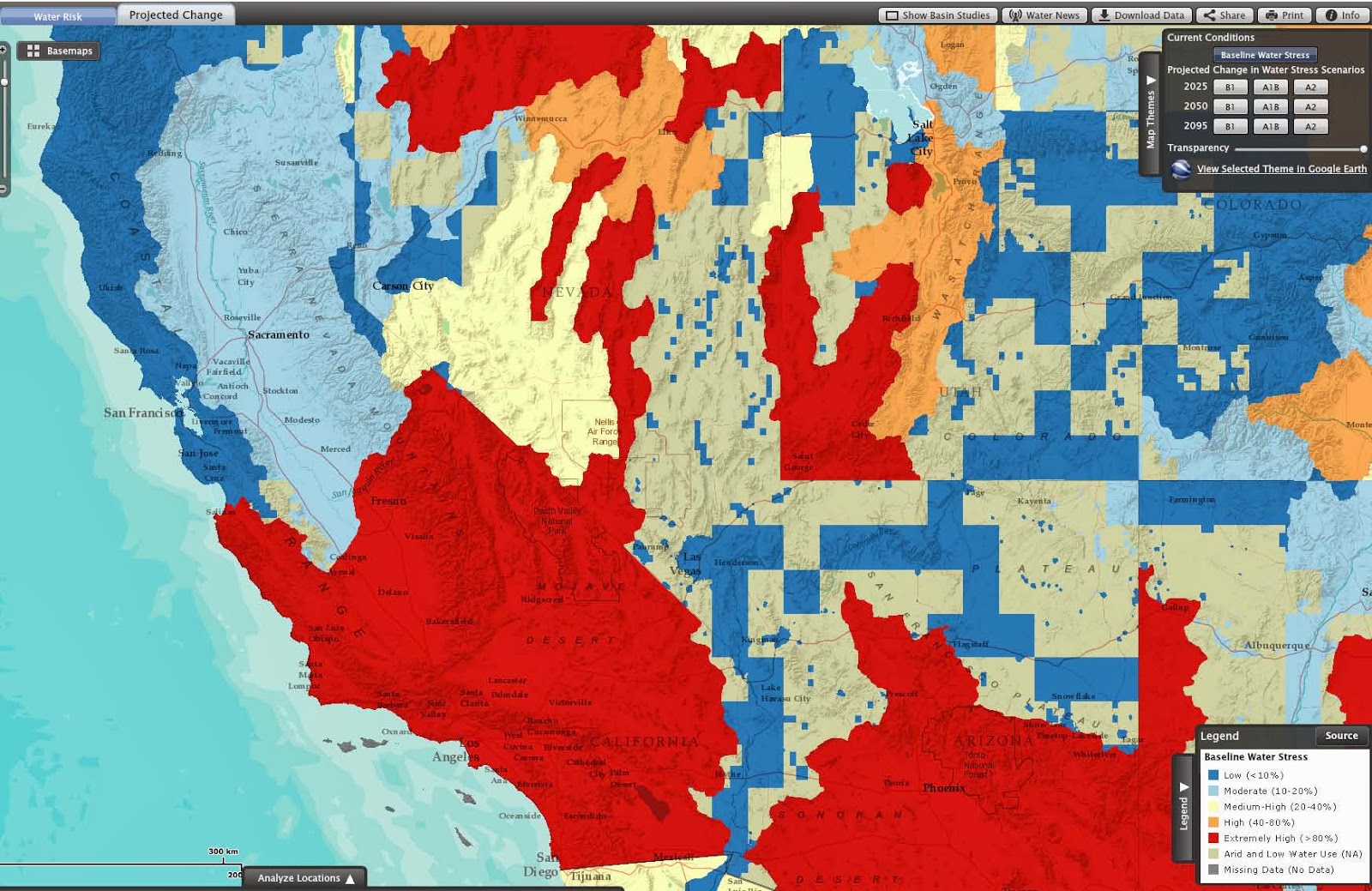
Water demand in some parts of the world already exceeds natural local supply, as it does in California. Overlaying global crop production maps with WRI’s Aqueduct’s Water Risk Atlas reveals agriculture’s current exposure to water stress. The Atlas also shows projected changes.
Current Water Risk, Featuring California View (Source: WRI)
Finding a balance between water availability and agriculture is essential, especially as the global population expands. Only by looking at food and water together is it possible to address the challenges within both.


Forecasts for 2030 water demand, under business-as-usual conditions, show a 50% rise.  Agriculture will drive nearly half of the additional demand, because global calorie production needs to increase 69 percent to feed 9.6 billion people by 2050.
The food-water tension won’t affect just agriculture; agriculture’s growing thirst will squeeze water availability for municipal use, energy production, and manufacturing, as we are seeing in our own state.


By 2050, the world will need about 60 percent more calories annually to feed 9 billion people. Cutting current food loss and waste levels in half would shrink the size of this food gap by 22 percent.


That is why WRI is working on mapping how the world’s relationship with water will be changing in the coming decades and identifying sustainable solutions to increase food production.
Projected Water Risk, Featuring California View (Source: WRI)
To ensure a water- and food-secure future, solutions include:

      1. Reduced food loss and waste (Nearly 25% of global food calories produced go uneaten.)  
      2. Improved storage methods 
      3. Food redistribution
      4. Better food date labels 
      5.  Reduced portion sizes
      6. Consumer awareness campaigns
      7. Collaboration on solutions 
      8. Food loss and waste reduction targets
      9. Collaborative initiatives
      10. Shift to healthier diets 
      11. Reduced biofuel demand 
      12. Achieved low replacement fertility rates (population growth)
      13. Increased crop yields through better soil and water management.
      14. Better data on where and how agriculture is water-constrained provides a tool for a more robust agricultural sector that does not overtax water and other natural resources. 
      15. So, while California’s agricultural water situation is dire, particularly in the Central Valley, unfortunately, we are NOTalone.

      Sources:  
      Lindsay Abrams, Salon   
      World Resources Institute/Coco Cola Corporation

      WRI is a global research organization that works closely with leaders to turn big ideas into action to sustain a healthy environment—the foundation of economic opportunity and human well-being.

      2016-05-31T19:43:11-07:00November 6th, 2013|

      YOLO FOOD BANK RECEIVES RPE’S “TASTEFUL SELECTIONS” DONATIONS

      RPE Gives Back By Donating To Yolo County Food Bank

      TODAY, RPE Inc. and Tasteful Selections donated 20,000 pounds of Idaho russet potatoes to the Yolo Food Bank.  After RPE hosted the Tasteful Selections Trucktoberfest Showdown in West Sacramento in California’s Yolo County last month, Tasteful Selections wanted to give back to a great area that was so good to them during their event.

      At the Showdown, local celebrity Kat Maudru, The Chairman Food Truck co-owner Kevin Kiwata, and Development Director of Yolo Food Bank Linda Zablotny-Hurst judged the event. The $1,000 grand prize went to Swabbies, known as the best Sacramento live music venue and restaurant on the river, which created a purple potato gnocchi dish with fresh marinara sauce.

      Tasteful Selections originally planned to donate a pound of potatoes to Yolo Food Bank for every pound of potatoes sold during Trucktoberfest. After learning more about Yolo County, which has a food insecurity level of 17 percent, Tasteful Selections decided to increase that donation to 20,000 pounds, which will be distributed to families in need.
      “At RPE we love to give back to the community,” said Russell Wysocki, CEO and President of RPE, “and we’re excited to help Yolo Food Bank bring the holidays to people throughout the county.”

      The donation will be arrive just in time for the Thanksgiving season and the food bank’s holiday distribution program, which brings holiday meals to local families in need each November, December and March. The holiday distribution program feeds more than 15,000 residents of Yolo County annually.

      Tasteful Selections LLC is a joint venture of RPE, CSS Farms and Plover River Farms Alliance Inc. and a vertically integrated grower, shipper, marketer of premium specialty potatoes with unique attributes for size and flavor. A second-generation family farm, RPE prides itself on maintaining a high level of business integrity that includes commitments to environmental sustainability, as well as category innovation and retail solutions.

      2016-05-31T19:43:11-07:00November 6th, 2013|

      JUDGE ISSUES DECISION IN TRI-FANUCCHI FARMS, INC.

      Tri-Fanucchi Farms to Accommodate UFW Requests
      Administrative Law Judge (ALJ) Thomas Sobel, issued his 23-page decision TODAY in the Tri-Fanucchi Farms, Inc., Case heard in Visalia on October 21, 2013.
      After a long hiatus in bargaining, the United Farm Workers of America, AFL-CIO requested information from and a meeting with Tri-Fanucchi, a farm near Bakersfield.
      Tri-Fanucchi refused to provide information to the Union, to recognize the Union as the collective bargaining representative of its employees, and to bargain with the Union on the grounds that UFW had abandoned the farmworkers for 24 years.
      ALJ Sobel ruled that the Tri-Fanucchi’s claim of Union abandonment is not available under the Agricultural Labor Relations Act (ALRA) and that, in view of the company’s admissions, the allegations in the Union’s Complaint must be taken as true.
      Tri-Fanucchi was ordered, among other things, to provide information to, and to recognize and meet and bargain with the Union as the collective bargaining representative of its employees.
      Tri-Fanucchi was also mandated to post the following:
      NOTICE TO AGRICULTURAL EMPLOYEES
      After investigating charges that were filed by the United Farm Workers of America, in the Visalia Office of the Agricultural Labor Relations Board (ALRB), the General Counsel of the ALRB issued a complaint that we had violated the law. After a hearing at which all parties had an opportunity to present evidence, the ALRB found that we had violated the Agricultural Labor Relations Act (Act) by failing to supply the Union with information to which it was entitled under the Act.
      The ALRB has told us to post and publish this Notice.
      The Agricultural Labor Relations Act is a law that gives you and all other farm workers in California these rights:
      1. To organize yourselves;
      2. To form, join or help a labor organization or bargaining representative;
      3. To vote in a secret ballot election to decide whether you want a union to represent you;
      4. To bargain with your employer about your wages and working conditions through a union chosen by a majority of the employees and certified by the Board;
      5. To act together with other workers to help and protect one another; and
      6. To decide not to do any of these things.
      Because you have these rights, we promise that:
      WE WILL NOT refuse to provide the Union with information necessary to foster informed collective bargaining.
      WE WILL NOT refuse to meet and to bargain collectively and in good faith with the Union as the representative of our employees for the purpose of collective bargaining.
      WE WILL NOT in any like or related manner, refuse to bargain with the Union over wages, hours or conditions of employment, or interfere with, restrain or coerce employees from exercising their right under the Act
      DATED:
      If you have any questions about your rights as farm workers or about this Notice, you may contact any office of the Agricultural Labor Relations Board.
      2016-05-31T19:43:11-07:00November 6th, 2013|

      CALIFORNIA AG INDUSTRY COMMENTS ON FSMA

      State Senator Galgiani Welcomes Food Safety Input


      Proposed federal rules on food safety are a “one-size-fits-all” approach, which, in some cases,  are “excessive and unnecessary” and could pose “undue hardships” on growers, while not guaranteeing against bacterial outbreaks.


      A panel of industry representatives shared their opinions yesterday at a Stockton City Hall informational hearing with State Senator Cathleen Galgiani, D-Stockton, chairwoman of the Senate Committee on Agriculture.


      Sen. Galgiani was seeking input from industry members about proposed FSMA produce safety rules, which are still being tweaked and will not take effect until at least 2015.   


      Food safety experts, the director of inspection services for the California Department of Food and Agriculture, and representatives for growers whose crops range from citrus fruits to almonds were among Monday’s speakers.


      Much of the concern expressed at the meeting was over a proposed rule requiring growers to conduct weekly bacteria testing of surface water.

      “A weekly water test is excessive and unnecessary,” said Scott Horsfall, head of the California Leafy Green Marketing Agreement. He said water tests are expensive and would not result in increased food safety. “We require a monthly water test. The water used in California is very, very clean. We’re not going to move the needle (on food safety) by requiring a weekly test.”


      “With the diversity of California agriculture comes a complexity that, in my opinion, people in the rest of the country cannot comprehend,” said Jamie Johansson of the California Farm Bureau Federation, the harshest critic of the proposed rules. He called them a “broad overreach of executive power” and called for  simplification of the rules and review by farmers.


      Sources:
      Western United Dairymen,

      Stockton Record

      California State Senator Christeen Galgiani’s website:

      2016-05-31T19:43:11-07:00November 6th, 2013|

      Time Running Out for Immigration Bill

      Republicans Must Compromise

      On Immigration Bill

      By Patrick Cavanaugh, Editor

      and Laurie Greene, Associate Editor

      While it’s true that the majority of workers on California farms do not have legal status. And while there is a limited number of legal ag worker programs, the primary one being H2-A which is a stymied, and stifled program that only provides about four percent of the legal workforce, there is a critical need to get an Immigration Billed signed by the President.

      Craig Regelbrugge
      “We only have a few more weeks to get something done, but I believe it will happen,” said Craig Regelbrugge, Co-chair of Agricultural Coalition for Immigration Reform, speaking at the recent 32nd Annual Agribusiness Management Conference in Fresno.

      ‘There is more enforcement and much of that is in the form of I-9 audits, where government officials come in and audits a farmer’s paperwork, which leads to the firing of a large number of very experience workers,” said Regelbrugge. “These workers are generally not deported, but instead move on to rebuild their lives doing something else.”

      “All this is leading to uncertainty and labor shortages with many crops such as pears, strawberries not getting completely harvested this year,” Regelbrugge.  “We are also seeing lost opportunities and offshoring of production to foreign countries that have the labor and resources to produce crops and then export it to us.  This all leads to economic and job loss and the ripple effect across the ag sector of the economy,” he noted.

      “There is still time in the remaining few weeks for the house to work on a compromise,” he said. “Republicans should move bills that support their fundamental principals like market oriented, limited Government, individual initiative such as what immigration reform is all about,” noted Regelbrugge.

      Central Valley Congressmen David Valadon and Jeff Denham deserve credit in their support of immigration reform. We need Devin Nunes to support the bill along with the third ranking Kevin McCarthy with us as well.

      A 21st Century America requires a 21st Century Immigration system. Doing nothing is not an option. The bottom line is that the house must act this fall.

      Also speaking at the conference was Monte Lake, a distinguished lawyer from the valley, specializing in agricultural employment, immigration and regulatory law.

      Monte Lake
       “Our challenge over the years has been to unify agriculture,” said Lake. “We have made progress by uniting all the players who have been impacted to develop a program that works.”

      “We need reform,” Lake continued. “We have a shortage of labor, not just a projected shortage, and it is a national problem.

      Lake believes national immigration reform affects the Central Valley more than elsewhere. “Locally, many workers are undocumented and U.S. Immigration and Customs Enforcement (ICE) is in the Valley. Packers are now targeted and directed to fire 80% of their workforce. This often devastatingly disrupts harvest time. Before long, electronic verification of employment documents will be mandated.”

      “The H2A program is the only guest worker program for agriculture and it does not work; only 4% of the workforce in California come through it,” said Lake. “H2A must have been designed by Soviet bureaucracy—it is cumbersome, unworkable and untimely for perishable commodities. The average bureaucratic delay is 22 days, and wage rates are not market-based.”

       “The way to look at your future is you must have a Washington-perspective of what is doable,” Lake suggested. “A program that works must have basic standards demanded by the American public, including an acceptable basic wage, housing, and reasonable hours—a balance of worker and grower benefits.”

      “But, here’s the challenge: it is not the world we want, it is the world we can achieve politically.”

      The Senate has passed legislation for comprehensive agriculture immigration reform—theblue card program for the undocumented. Any undocumented who has worked in agriculture for 2 years, with a few caveats, can qualify for legal status. It is controversial because it touches on amnesty.

      The intent is keep these individuals because we want to transition to an essential guest worker program, so we provide an incentive for undocumented farm workers to remain in agriculture. Visa programs and organized labor are against this.

      The Senate supports factors such as administrative-free, work for anybody at will, administered by Department of Agriculture and not Department of Labor, with no cap on workers, careful consideration of wages for profitability, predictability and inflation.

      Likewise, the House has drafted legislation that improves H2A but lacks structural changes. Undocumented workers can work for a 2-year period, but they must go home afterwards. A mass departure of farmworkers for an unspecified time concerns agricultural employers.

      “Plus, mechanization has its limitations, and imports will increase,” Lake predicted.

      Lake described a big advertisement by the agricultural industry this week in POLITICO, a widely read publication in Washington DC that shows an aircraft carrier sailing from American shores. On the deck is every type of agriculture, the message being that we are exporting our agricultural products overseas and must be able to compete internationally.

      “We’ve go to solve this problem. If we fail, we will continue to have ICE and the H2A program,” warned Lake.

      Lake summed up, “You have a good delegation in the Valley from both parties that recognizes the economic reality necessitating a viable immigration system. We’re talking about components: land, water, and labor.”

      Lake emphasized, “You have to support and encourage the delegation; keep them active. Urge all of your colleagues in the industry to do the same. Make a lot of noise in Washington, DC because it impacts you. Keep up the pressure. Keep up the good work.”

      2016-05-31T19:43:11-07:00November 6th, 2013|
      Go to Top