About Patrick Cavanaugh

This author has not yet filled in any details.
So far Patrick Cavanaugh has created 1490 blog entries.

Post Methyl Bromide Era Creates Questions

Without Methyl Bromide, Then What?

 By Brian German, Associate Broadcaster

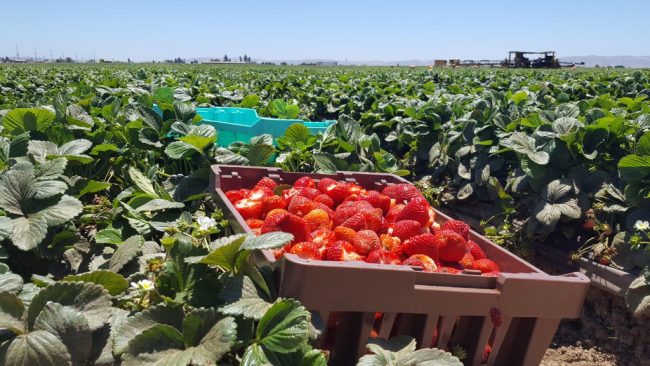
Methyl bromide was first identified as an ozone-depleting compound in 1991 and was scheduled to be phased out by 2005. California strawberry growers found it irreplaceable and fought for exemptions that allowed the fumigant to be used through 2016.  Mark Bolda is a UC Cooperative Extension Farm Advisor who specializes in strawberries and caneberries and also serves as the County Director for Santa Cruz County.  He discussed the work being done to find an effective alternative to methyl bromide.

Mark Bolda is working to help berry growers with the loss of Methyl Bromide

“It’s not just one thing does it all; it’s going to be one thing and then you add other things on top of that. … We don’t have the silver bullet anymore; it’s gone.  We need to figure it out using the systems approach,” Bolda said.

The inability to use methyl bromide is causing some concerns for strawberry growers, who are looking at what new type of management approach to take.  “Everybody’s familiar with the concept of integrated pest management for insects, and really, we need to approach this post methyl bromide era using integrated pest management,” Bolda said.

Growers are worried about how vulnerable their crops are going to be to various soil diseases without methyl bromide, as researchers have yet to find an alternative that is equally effective.  One of the ways to combat disease is to focus on the details of planting.

“In strawberries, you have different chill times. You know, if you add cold conditioning, you give the plant more vigor. The colors of the plastic that you’re using to manage the temperatures of the soil, the amount of fertilizer that your using, all of these things now, we need to start to integrate into the way we are growing the strawberries,” Bolda said.

Methyl bromide controls a variety of pests in agriculture.  It was also commonly used to treat commodities like grapes, asparagus and other imported goods to prevent introducing pests to the U.S.  Bolda expressed disappointment in the lack of preparation in finding an adequate replacement for methyl bromide. “Here we are, zero hour, and we don’t have this worked out. I think, to some extent, there’s been a lack of leadership in the industry,” Bolda said.

The quest for replacing the fumigant might have gotten a late start, but industry experts have been working double-time to find solutions. “We have got all of the researchers in this industry together, working as a unit, and there’s a lot of smart people working on this problem right now. …. What do we need to research? What do we know? What do we not know? Let’s go,” Bolda said.

Nearly 90 percent of methyl bromide use in California was for pre-plant soil fumigation in strawberries, nursery crops, grapes, and tree fruits and nuts.  Growers are preparing for a 5 to 10 percent drop in yield as a result of methyl bromide’s absence and are looking for ways to make up that deficit.

“Maybe using more precise fertility practices, adding cold conditioning to the plant, taking it away, using different varieties.  All of this is going to start to go into this system,” Bolda said

The phasing out of methyl bromide is most impacting to the strawberry industry, which is California’s third most valuable crop behind almonds and grapes, with annual farmgate sales of $2.5 billion dollars.  The biggest disease threats to strawberry fields are macrophomina phaseolina and fusarium, which can both have devastating results in crops.  “It’s plant collapse. You’ll see it kick in once the plant loads up in fruit and gets a little warm. It’s just too much stress for the plant,” Bolda explained.

Methyl bromide will be missed by growers, but its absence is allowing them to demonstrate their creativity in finding new solutions to a problem. “We’re starting to see some methods that are pretty interesting,” Bolda said. One such method is steam, which involves pushing steam into the soil to kill certain pathogens.

Breeding in resistance to disease can also be beneficial; however, it can have some negative consequences as well.  “When you have strong tolerance, you’re taking a hit on something else. There’s no such thing as a free lunch. You might have a plant that’s super resistant but then the yields are low, it doesn’t fruit until late. There’s always the trade off,” Bolda said.

Getting a good chill before planting can also be effective in making the plant more vigorous and better able to withstand disease pressure.  “It’s a little complicated because the longer you chill, the later you’re planting times get, and if you’re planting in the middle of December, [there’s] not a light of sunlight in the middle of December, so you know, there’s a trade off there too,” Bolda said.

Crop rotation can also assist with some soil diseases, but more research is needed to determine just how effective it is.

Methyl iodide was showing some success as a possible replacement for methyl bromide, but its use became a problematic issue.  “It became a political problem. I don’t think the industry stood it’s ground on it, and the industry, basically they struck their flags and left the field. Of course, the entire problem was defined by the opposition,” Bolda said.

Growers might have some difficulty working out a new pest management program without the use of methyl bromide, but Bolda explained that understanding the problem at hand is an excellent step in the right direction.   “Don’t just turn scientists loose and just say, ‘study and do experiments.’ No. Define the problem. I think what we’ve done with the fumigants over this last two years. Getting everybody together and working as a unit, we have defined the problem and now that mental energy and that mental potential is moving. You need to define it in order to bring the people in to solve it,” Bolda said.

It’s going to take some time to work out a program that best replaces methyl bromide, but Bolda is optimistic about the future.  “Sometimes the solutions aren’t so obvious, but they’re starting to show up and you know, the thing is that some of these will be radically different,” Bolda said.
 

2017-02-20T16:10:40-08:00February 13th, 2017|

Grafting Rootstocks on Tomatoes, A Growing Trend

Grafting Can Yield Bigger, Better Tomatoes

By Jessica Theisman, Associate Editor

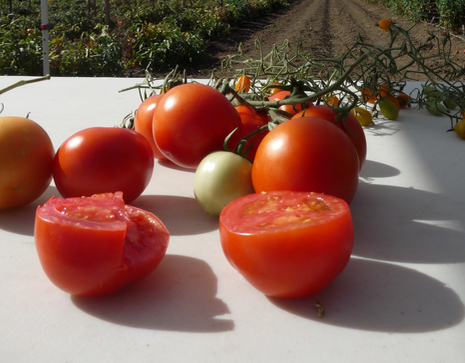
Brenna Aegerter is a San Joaquin County Cooperative Extension Farm Advisor. She specializes in vegetable crops, and she’s working on tomato plant grafting for market tomatoes. “Right, they would be doing it at the greenhouse. They’d start off the plants like normal, except they’re planting both the rootstock and the regular fruiting variety, so you’re planting two seeds. Then, these little seedlings are cut in half and put back together with the root stock on the bottom” Aegerter said.

The tomatoes are then placed in a dark, humid chamber, which allows them to heal for about one week. Following this step, the plants are then moved back into the greenhouse. This process speeds up the growth cycle on these plants by about two weeks. When the tomatoes are ready to ship, they look the same as any tomato plant except; these have a plastic clip that helps support the graft union. “It’s really soft, like a biodegradable silicon,” Aegerter said.

There are a few reasons why this process is necessary. “We want to increase the vigor of the plants, and we want more fruit, more vine, and bigger fruit. This is for fresh market tomatoes,” Aegerter explained.

It is not necessary on processing tomatoes, as the grower wants total tonnage. “We’re looking for some resistance to some of these diseases that we have. The idea being that maybe we can reduce,” Adgerter said.

One way to avoid the soil borne diseases is to plant tomatoes with the grafting union above the soil. These tomatoes however, have a tall transplant and most of the stem is buried. There’s no way in current production practices to plant with the union above ground. “But even with the deep roots, the rootstock is vigorous,” Aegerter said.

This rootstock must be bred. Sometimes they are a wild species, but for the most part, they are hybrids of wild and cultivated tomatoes. They contain some characteristics of a wild tomato but have a tomato rootstock breeder. The breeder, Monsanto/Seminis, is working worldwide for different markets. “[Their] job is breeding rootstocks,” Aegerter said.

This practice is an emerging standard that is becoming more common in other parts of the country. This takes place in the Southeast such as North Carolina. They are growing stake tomatoes, which is a very different production system. They pick multiple times while growers in California pick once.

The greenhouses aren’t set up with automated grafting. All of the grafting is done by hand. “To bring that cost down to a price that we’d like to see, they’re going to have to be more automated. But how can they justify the decision to invest in very expensive automated grafting equipment, if they don’t know if the market is there?” she said.

2017-02-10T16:50:02-08:00February 10th, 2017|

Ag Unite Addresses Critical Ag Issues

Ag Unite Brings Stanislaus County Together

By Jessica Theisman, Associate Editor

The Stanislaus County Farm Bureau was recently recognized with a Program of Excellence Award from the American Farm Bureau for its Ag Unite program.

One of the big goals of Ag Unite is gathering money for political action. “We raised money for political action, and we also raised money for legal defense funds because there’s a lot of lawsuits that are happening, where a lot of people have had issues with government overreaching,” said Wayne Zipser, Executive Director of the Stanislaus County Farm Bureau.

Wayne Zipser

An example of government overreach is with John Duarte of Duarte Nursery in Stanislaus County. That case involves Duarte Nursery versus the Army Corps. of Engineers. The court ruled that the company violated the Clean Water Act by plowing its property, even though the Act exempts normal farming practices.

“We’re looking to raise money for that and for a variety of other things that we know that are going to come along. We know that it’s not the last thing that’s going to happen, certainly not the first. We need to get elected people in the legislature who understand. We must have people that have more of a moderate and an understanding of what agriculture is, what it’s based with, and how we can be able to survive in California,” Zipser said. “The farmers and I today field calls constantly. We’ve got some new legislation that has come along, and it’s costing them a lot of money. It’s costing them a lot of things, and they’re fed up. We need to get more involved, and that’s what Ag Unite was all about. Getting more people involved and trying to bridge everyone together, not only if you’re a farmer, but the tractor salesmen, the seed sales folks, the car dealerships, the insurance companies.”

Zipser explained that these ancillary companies are involved when agriculture is attacked.  “They, our consumers, and the very people that rely on the farmers and ranchers are attacked. [Those] who not only provide jobs, but also provide food in a safe and reliable food supply.”

Stanislaus-area farmers truly wanted to see Ag Unite happen, according to Zipser. They are pushing to get other farm bureaus to get involved and participate in events to keep the discussions going.  “Again, we only represent 1 percent of the population of the producers, so we have to speak with a loud voice,” he said.

One of the major, potentially devastating regulations for Stanislaus County farmers is the California Water Resources Control Board’s plan to take 40 percent of the water from the Tuolumne, Stanislaus and Merced rivers to increase flows in the Sacramento Delta for salmon.

Those who attended the meeting about the plan in December were not just farmers. They were teachers, public safety folks and the district attorney. According to Zipser, they all talked about what the potential devastation if 40 percent of the flow from the Tuolumne, Merced and Stanislaus rivers was diverted, and the impact to not only local economies, but even crime and school children.

“This is what unification is. It’s uniting and protecting our industry because it is our number one industry here in Stanislaus County. We have some of the biggest food processors in the world that reside right here in our county. It is vital for the health of our communities to push back and to fight this,” Zipser said.

Another regulation that passed last year was the overtime bill, which forces farmers to pay more overtime for the extra hours that Zipser said farm workers wanted to work to earn more money. Now, they’re going to get paid less.

“Sometimes, there is unintended consequences to legislation. It may be the very same people who wanted to protect those that they thought they were protecting … they’re hurting them because it’s going to reduce their hours, and it’s going to reduce money in their pocket,” Zipser said. “We don’t like that, because we want to make sure that our folks who are working for us in this industry are protected. Our farmers and ranchers do that without question. They are part of the family. Unintended consequences are what I believe that this overtime bill was going to create.”

Of course, the farm industry wants everyone to thrive: the pruners, the tractor drivers, the welders, the harvester, the irrigators, and the mechanics.

According to Zipser, farmers were talking about how some of these workers have been employed with them for 20 to 40 years, have bought homes and put their kids through college and have thrived.

“This is the way they did business in the past, and somebody comes along and they want to change it all up. Again, an unintended consequence. That farm worker who could send their child through college might not be able to now or won’t be able to buy that home, and that is the American dream. We want to buy a home and we want to make a better life for our kids. Sometimes things step in the way of that,” Zipser said.

“The farmers contribute so much, if you take everything into consideration. They are truly our folks who are heroes.”


2017-02-08T23:29:15-08:00February 8th, 2017|

California Cattlemen Challenge Illegal Listing of Grey Wolf

Ranchers Fighting to Protect Livestock

By: Jessica Theisman, Associate Editor

On January 31, the California Cattlemen’s Association (CCA) and the California Farm Bureau Federation filed a lawsuit challenging the California Fish and Game Commission’s June 2014 decision to list the grey wolf as an endangered species under the California Endangered Species Act. This decision went into effect on January 1, 2017, and has many farmers and ranchers upset.

“The organizations are represented by the Pacific Legal Foundation, a nationwide leader in litigation aimed at ensuring limited government, private property rights and sensible environmental protections. The suit alleges that endangered listing of the gray wolf under the California Endangered Species Act was improper for three reasons,” the CCA said in a news release.

This subspecies of grey wolf originally descended from Canada. It is not native to the state of California, as the law requires, and definitely not an asset for California’s agriculture industry. Secondly, there is an abundant and healthy population of this species throughout the western United States. The Commission focused too much on the California populations, the CCA alleges. Lastly, the commission impermissibly listed the grey wolf based on the occasional presence in California by a single wolf at that time.

“The Fish and Game Commission took a big bite out of its own credibility with this unjustified listing,” said Damien Schiff, PLF Principal Attorney, in the CCA’s release. “The agency managed to label the gray wolf as ‘endangered’ only by myopically and illegally ignoring its population outside California.”

Ranchers’ livestock fall prey to these predators, and this new policy will cause a huge impact on the rural economies that depend upon agriculture. CCA president and Butte County cattleman Dave Daley said in the news release that the lawsuit is necessary for ranchers to ensure the humane treatment of their livestock.

“Under California law, you can’t even pursue a species that is listed as endangered,” Daley said. “If a rancher sees a wolf attacking one of his or her calves, he or she can’t chase the wolf away without breaking the law. Ranchers are not seeking open season on wolves, we just want sensible wolf management that also allows us to protect our livestock. That will require delisting the gray wolf.”

The case is California Cattlemen’s Association, et. al. v. California Fish and Game Commission, filed in the Superior Court of California for the County of San Diego. Those interested in the case can visit www.pacificlegal.org for more information.

2021-05-12T11:17:10-07:00February 7th, 2017|

Conflict of Interest Between ALRB and UFW

ALRB and UFW Conflicts Concern Industry

By Brian German, Associate Broadcaster

Governor Jerry Brown’s appointments to the Agricultural Labor Relations Board (ALRB) is causing quite a bit of concern for farmworkers and ag employers alike.

George Radanovich is the President of the California Fresh Fruit Association and a former California congressman who served from 1995 until 2011, representing California’s 19th District. He expressed his disappointment in so many United Farm Workers of America advocates being appointed to the ALRB.

“The board is there to protect the interests of the farmworker. What they’re doing is trying to protect the interests of the United Farm Workers, and that goes completely against what they were created by law to do,” Radanovich said.

William Gould, who was appointed by Governor Brown to chair the ALRB in 2014, announced his resignation recently.  In his resignation letter, he noted that during his tenure, only one petition for unionization had come before the board.  Gould also previously noted that the board spent more of its time on petitions from workers trying to kick out the UFW, rather than petitions seeking to join the union.  That seems pretty telling as to how desirable the UFW is to farm workers.

“The UFW only represents about 2 precent of farmworkers in the state,” Radanovich said. “And the reason is, is because farmworkers are happy with the growers. I mean, there’s a very good relationship there, and they view the UFW as intrusive.”

Radanovich referenced what happened with Gerawan Farms as an illustration of the already problematic relationship between ALRB and the UFW.  “Way back in the ’90s, there was a union vote to unionize, and the UFW just sat back and didn’t mobilize. They didn’t unionize the farmworkers. Twenty years later, they walk back into the operation and say, ‘Okay, it takes effect now.’ Where would that happen anywhere else?” Radanovich said.

The Gerawan workers decided to have a new election, with a majority of workers expressing their disinterest in joining the UFW.  However, those votes were never officially counted.

“They refused to count the votes because it’s real obvious that they’re going to lose, the union would. So the ALRB says, ‘Well, we just won’t count the votes,’ ” Radanovich explained.

According to him, the employment landscape has changed dramatically since the establishment of the UFW in 1962, essentially making the UFW obsolete.  “The reason UFW is so weak and they can’t get membership is because the farmworker is pretty well off today having a good relationship with their employer, and that’s better than union status. The farmworker really is in a better position if he’s got a good relationship with the grower, which accounts for about 90 percent of what’s out there in ag labor today,” Radanovich said.

Radanovich is also a wine grape grower in Mariposa and has a first-hand understanding of just how hardworking and appreciated farmworkers are.  “Growers know that if they don’t take care of their farmworkers, there’s going to be nobody there to pick the fruit. So there’s a natural inclination for the farmer to want to take care of the farmworker. And none of that is accounted for in the way that the ALRB implements these rules.”

The ALRB is designed to be a neutral organization, but filling it with so many UFW sympathizers appears to be a significant conflict of interest.  “It’s really unjust. The ALRB is not there to promote union membership; they’re there to protect the farmworker and I think they’ve lost their focus. … I mean, you only need a union in there if the grower has failed the farmworker and that’s not happening,” Radanovich said. “They’re taking good care of their farmworkers and giving them opportunity and providing them a living at the prevailing wage.”


2017-02-07T16:34:53-08:00February 6th, 2017|

FSMA Requirements Must Be Addressed

FSMA Requirements Must be Understood and Documented

By Patrick Cavanaugh, Farm News Director

When it comes to the Food Safety Modernization Act (FSMA), there are now some big changes for food processors, farmers and farm employees.

“One of the things we’re seeing that has changed as of recently, mainly due to the Food Safety Modernization Act, is there are standardized curriculum requirements within what we call the food processor rule, or the preventive controls rule, but now that’s going back to the farm in what’s called the produce safety rule,” said Jeremiah Szabo, vice president of operations for Safe Food Alliance, a division of DFA of California.

“These rules are actually regulations that have been published and finalized by the Food & Drug Administration, and there are federal regulations, of which the states are going to adopt and manage and regulate,” Szabo said.

“One of the things we’ve been doing, and what our organization has been preparing for, is really beefing up the number of trainers we have on staff, their qualifications, sending them to lead instructor courses as we did, actually, starting about a year ago,” he said.

“We were involved with becoming lead instructors, and we have lead instructors on staff, to offer the preventive controls qualified individual training for food processors, which is a mandatory requirement when it comes to education requirements for those individuals at every food processor site that will manage their food safety system,” Szabo said.

The training includes documentation, record-keeping and education of staff working at those facilities, as well as their supply chain management and sanitation practice management.

Szabo said that the two-and-a-half day training has been successful. “As of March of 2016, we’ve conducted about 20 of those food processor trainings in California and other states.”

“They’ve been really successful,” he said. “I think the practicality that comes with those courses is really important for the industry to hone in and to learn about how regulators are going to be expecting food facilities to document their food safety plan, as well as implement their food safety plan in their facilities.

Szabo noted that as the Safe Food Alliance was rolling out the preventive controls for qualified individual training, there were FDA and state regulators present in the training to learn about the preventive controls along with the industry. “This was good because the industry could hear from both sides of the aisle,” Szabo said.

On the farm side of the FSMA rule, farms not exempted from that rule will require eight hours of standardized training. “It involves things that are mentioned in the regulations, such as employee qualifications and education when it comes to personal hygiene for those employees that are interacting with the harvest activities, as well as the produce itself,” Szabo said.

For farms, there are eight modules of training, including worker health and hygiene and soil amendments, as well as agricultural production and post-harvest water quality.

“We’ve also partnered with the California Farm Bureau and their Farm Employee Labor Services Association to offer the training to farm supervisors and farm managers, as well as anybody else on the farm who are managing farm food safety plans and training and education,” Szabo said.

2017-02-01T19:33:27-08:00February 1st, 2017|

MRL Issues for Exporting Crops Worldwide

Challenges of MRLs on Exported Crops

By: Jessica Theisman, Associate Editor

California farmers are careful with agricultural crop protection products because it is critical that they produce safe and wholesome food for their customers across the nation and the export markets.

“I think that there are some real challenges facing growers in California today as they send their commodities around the world. They’re facing increasing challenges of knowing what the right chemicals are to apply and on what levels” said Thomas Jones, Senior Analytical Services Director for the Safe Food Alliance, a division of DFA of California.

Thomas Jones

“We have our own strict regulations within California, not only for the application, but also for the maximum residue levels (MRLs) that are allowed in various crops. That is also carried on to the federal level.  As we go into other countries, they may have entirely different regulations,” Jones said.

It can be confusing to not only farmers, but to registrants of materials, because there’s a lack of standardization on the MRLs in different countries. “Historically, there was the CODEX system, which was a UN-based system, gearing towards a more international standard for pesticide residues. Very well-thought out, very scientifically-based,” Jones explained.

Increasingly, many countries don’t want to adopt the CODEX system. Those countries wish to set up their own system and tolerances. “They may be responding to their own political pressures within their countries. We are seeing a process called de-harmonization, in which every country wants to establish its own positive list of what is allowed and what is not allowed in products,” Jones said.

Some of these countries have systems that agree with the U.S. and California state regulations; others, not so much. Jones said, “It is important that the growers not only know what is legal in this country and in our state, but also what is allowed in the target markets that they’re looking at.”

Other marketers in areas such as the European Union are creating their own standards due to consumer pressure. “Some of these marketers put on random low MRLs on some of their own products and keep them high on the others in the store. It’s all about getting a marketing edge,” Jones said.

“Some of those may or may not be based on any scientific standards. Anything that they can get out of the print media or an educational course is essential. It is important to work with your PCA, as well. It is important that they know what they’re up against as far as growing these crops” he said.

DFA of California is available to growers to help them qualify to meet the standards in the U.S. and abroad. “We have training programs. We do training twice a year on fumigation safety for the various processors of dried foods and tree nuts, particularly in terms of commodity fumigations and what treatments are allowed and not,” Jones said. “We also have a full-service pesticide testing laboratory and are very aware of the requirements in these other countries, so we are happy to help both processors and growers with our monitoring efforts.”


2017-01-31T23:39:19-08:00January 31st, 2017|

Pesticide Expert Brian Leahy Has Respect for Weeds

Brian Leahy Reminds Growers About DPR’s Mission

By Patrick Cavanaugh, Farm News Director

Brian Leahy is the Director of the California Department of Pesticide Regulation (DPR). Leahy was among the first organic rice growers, and he said he had a very intimate relationship with weeds. “I have lot of respect for weeds, and a lot of respect for weed management. So, with that, we know that weeds are an important challenge in agriculture and in our over society,” he said.

Brian Leahy

Leahy noted that herbicide solutions are very cost effective when they work, but they come with challenges. “And those challenges include the Department of Pesticide Regulation. We are a science-based organization. We have about 400 employees; 300 of them are classified as scientists. We have well over 100 Ph.D.s, we have people with graduate programs from three different continents.”

“We are a very science-based organization. We have very good scientists, but we also incorporate what we call Risk Management. So myself, along with my chief Deputy Director Christopher Reardon, take a look at what the scientists do, and we make risk management decisions. I think it is an important role,” Leahy said. “We use a lot of data, and we are very good at collecting data. Our core mission, of course, is to protect the environment and human health. That is at the center.”

Leahy noted that farm workers and farmers have the closest contact to pesticides, as do folks who are helping with cleaning, such as custodians and janitors.

“But that is our main mission, and it includes the community,” he said. “California has done a remarkable job of building on farmland and adjacent to farmland. We have schools, houses, hospitals, daycare centers, all very close to farmland that uses pesticides. So we have focused on protection of human health as well as how we use pesticides.”

“I would really emphasize farm worker protection, the long-term studies on pesticides show that the folks most at risk are the handlers,” Leahy said.” Of course the other big thing we are supposed to do is protect our environment. That is actually getting to be a much more challenging endeavor. It includes our water quality, it includes pollinators, and off site movement.”

“The third component of our mission has been to foster reduced-risk pesticides. That can take all kinds of forms. We have been engaged in landscaping in this state, because we know which plant in your front yard or backyard is going to determine which pesticides and herbicides you need to use,” Leahy said. “IPM tells you to look at your environment, so we are encouraging that. We are looking at cultural practices and ways to reduce the reliance on pesticides. So that is a part of our mission as well.”

One the most important relationships DPR has is with the county ag commissioners. “Recently, I spent the day with the County Ag Commissioner of Monterey County – a very challenging position,” Leahy said. “We met a couple of Board of Supervisors, we met with labor folks, we met with public health officers, and we met with the superintendent of the school district, which has a lot of schools in the middle of farms. She also has a student population where 11 percent are homeless, some of the poorest students in the state in her school district. She is trying to ensure that her children are safe as they learn. And her relationship with her County Agricultural Commissioner is very important.”

“These County Agricultural Commissioners put about 300 biologists in the field to do pesticide enforcement and education. Enforcement is very important, education is even more important. So, we give them somewhere around $27 million a year to run their pesticide program. They do a very good job. So that is a very important relationship we have,” Leahy said.

Leahy explained that DPR and CDFA have a very vigorous pesticide residue-testing program here in the state. “We test more products than the Federal government does. We look at what might be our biggest challenges and found … cactus from Mexico with residues of Organophosphate materials, which [were] banned in the ’60s. If you ate them, it would make you feel like you had the flu. So we have begun to target what we think are some of the most problematic crops in countries,” he said.

“We are starting to do enforcement, going after retailers and brokers. They have no business selling food that will make people sick,” Leahy said. “It is not a good business practice, and we need to make sure they get that message.”

“It also helps us with enforcement. On a very rare occasion, we will find a California grower who used a pesticide that should not even be on that crop,” Leahy said. “If that happens, we will go in and have them destroy the crop, fine them and get them to realize that it is probably wise, probably in their best interest. But it is a very important tool. What we have found is the most important thing is simply working together. We build very strong relationships with the farmers, the farm workers, the registrant community, with all the stakeholders. And there are a lot of stakeholders in pesticide.”

Leahy said that pesticides are kind of a challenging business because what they are doing is changing human behavior. “If we want to ensure that if you are producing food, you have the tools that you need; we simply want to make sure that those tools do the job and don’t keep moving and doing harm to your neighbors, yourself or the environment. But this collaborative approach is the only one that works, and we want to do that; a lot of active listening.”

Product registration is a very important part of the DPR program. Leahy said that introducing a new active ingredient into the market is a half-a-billion dollar endeavor. “There are years when we don’t see a new active ingredient. And other years, maybe you see four, which is a big number. Not a lot of new herbicides coming into the marketplace. And every time something comes in, there is a change, either a new AI or a even a new use. There are a lot of people looking at that,” he said.

“I can tell you that the water community looks very closely at pesticides. Every time we try to introduce something new, something to control ants or something to control weeds, they want reassurances that it is not going to end up in the water supply, in the storm water, in the drinking water, all of it. The water community are our partners, so we have to listen to them.”

“Then we have all of the stakeholders like the Center for Biological Diversity and all those folks that really care about environmental issues, and they will sue you very quickly if they feel like there is going to be a challenge to one of their critters. So it is challenging to get in new chemistry. This is kind of a cautionary tale that the ag industry must be sure to use materials correctly. Resistance management should always be on our minds,” he noted.

“A number of things have made us successful. I talked about the registration process, looking at the chemistry, and getting a really good idea of how that chemistry is going to behave in the human body and the environment before we put it in.

“Looking at it as we go, we have an incredible system to collect data. We try to capture every pesticide illness in the state. We work hard to do that. We listen to people who have complaints and issues and we follow up and so we can direct our science to determine how to make it better,” Leahy noted.

Recently, the National Academy of Sciences looked at the DPR program. According to Leahy, one of the things that they said was that DPR was “incredible at mitigation, which basically means that they figure out how that pesticide moves off-target.”

“We have made an amazing amount of progress. Society is always asking us to go further, and we will. This is a plug once again to remind you that weeds and insect pests are quick at adapting, that resistance is a real issue. We don’t want to lose tools because they are hard to replace. So mix it up,” Leahy said.

“As we all know, there is no silver bullet for resistance – there are multiple ways of preventing resistance -so just keep that in mind. … We want to keep the tools that we have, but we want to be able to use the new ones and the core of that is a prevention program,” Leahy said.


2021-05-12T11:02:00-07:00January 30th, 2017|

Ag Unite Works to Bridge Gap with Consumers

Ag Unite Program Brings Industry Together

By Jessica Theisman, Associate Editor


The Stanislaus County Farm Bureau was recognized recently with a Program of Excellence Award from the American Farm Bureau. California Ag Today spoke to Wayne Zipser, a walnut and almond grower and Executive Director of the Stanislaus County Farm Bureau, about the news.

“About one of 20 counties throughout the nation are selected for their unique programs. We submitted our Ag Unite, a kind of brand that started in Butte County Farm Bureau. The theme is Uniting Agriculture, getting all the industry together, not just farm bureau members, but the industry together in one room at one time to talk about how we can come together and unite our industry. We can be a stronger industry. Stronger with a stronger voice” Zipser said.

“We had over a thousand people at the Ag Pavilion in Modesto Junior College last May. We brought in a couple of guest speakers, but the theme of it was, again, uniting our industry together to make a stronger voice.”

Zipser said the inspiration for Ag Unite came from Colleen Aguilar of the Butte County Farm Bureau. “It was her idea; she wanted it to be brought down through the other farm bureaus to not only raise awareness, but to raise money and be a stronger political voice. We did that. It was very, very successful, and Colleen was the brainchild of this.”

Aguilar and the staff from the Stanislaus County Farm Bureau were in Phoenix recently at the American Farm Bureau meeting, where they received the award.

“It was collective effort. We did the application and, certainly, we included Butte County Farm Bureau,” Zipser said. “We must get farmers and ranchers involved in the political process. We’ve seen more than a thousand people come together in Modesto on a water hearing last month and that was a show of unity,” he said.   “I think it’s vastly important in agriculture, because there’s so few of us producers. We need to come together and unify ourselves and to stand up to these over-burdensome regulations that are facing us every year and every day in California,” he added.

Part of that gap that they need to fill is between the farming industry and consumers. “I think there is a parallel between the producer and the consumer because we all want to have safe and reliable food supply. We are continuing to work with our consumers to make sure that they feel that they’re getting the value, not only in the value of the product that they’re consuming, but also the safety and the reliability of it as well,” Zipser said.

A clever way they are staying in touch is through YouTube. There are film clips available from both Butte and Stanislaus counties if users type in “Ag Unite.” Local offices for both farm bureaus can also be contacted for information.


2017-01-29T20:11:49-08:00January 29th, 2017|

Fresno County Growers Grateful For Rainfall

Rainfall Helps Water Cover Crops

By Brian German, Associate Broadcaster

The amount of rainfall the state has already received comes as a delight for many growers.  Joe Del Bosque, Commissioner of the California Water Commission, noted how appreciated the rainfall has been.  “It’ll help replenish the moisture in our fields. We also have some cover crops growing that need rain and some dry land wheat that we’re growing that needs some rain,” Del Bosque said.

Del Bosque is also the president and CEO of Empresas Del Bosque Incorporated, a diversified farming operation on the west side of Fresno County in Firebaugh.  He talked about a cover crop he’s got going for their organic melons. “We plant it in the wintertime. We don’t irrigate it because we can’t afford to buy water for a cover crop. We plant it in the wintertime so the rains will provide for it, then we mulch it in the spring and then plant our melons,” Del Bosque said.

That cover crop also helps to build tilth and adds important organic matter to the soils, really helping those organic melons grow.  The success of that cover crop depends largely on the amount of rain, which is much better this year than many years prior.  “It’s good for the trees to get wet, to get cold and go into dormancy. There have been years where we didn’t get hardly any rain in January. We couldn’t put on our dormant sprays because the bark was dry. This year we should be able to do that,” Del Bosque said.

It cab be a bit of gamble planting the cover crop, but it seems to have paid off for Del Bosque this year.  “Absolutely, yeah, if we don’t get rain, we don’t get a crop because we can’t afford to buy $1,000 water for our cover crop. We have to save that for our main crop,” Del Bosque said.

Del Bosque said they have laid about a third or more of their acreage fallow because they don’t have adequate water to grow anything on it; but idling farmland has its own set of consequences: “We found that laying land idle because of a lack of water for two or three years in a row starts to hurt that soil. So we decided recently to try putting in dry land grain just to keep something growing on that land and keep it alive.”

At the Empresas Del Bosque farm, they grow cantaloupes, almonds, asparagus, cherries and tomatoes on about 2,200 acres.  Del Bosque expressed his hopes that almond prices will stabilize after so much fluctuation.  “They came down a lot from 2015. They firmed up a little bit. We hope they don’t go down any further. … That’s the thing that, when we were selling almonds for $4 a pound and paying $1,000 water, we were coming out okay. Now that the almonds are $2 a pound, we can’t afford $1,000 per acre foot of water. We hope the cost of water comes down significantly this year so that it comes out all right.”

2017-01-26T20:48:25-08:00January 26th, 2017|
Go to Top