PLEASE RSVP FOR TWILIGHT FIELD DAY

Twilight Field Day, Sept. 12, Five Points

Sustainable agricultural systems involving precision irrigation and conservation tillage will be featured at the University of California Cooperative Extension’s annual Twilight Field Day and bus tour Sept. 12 from 1 p.m. to 8 p.m.
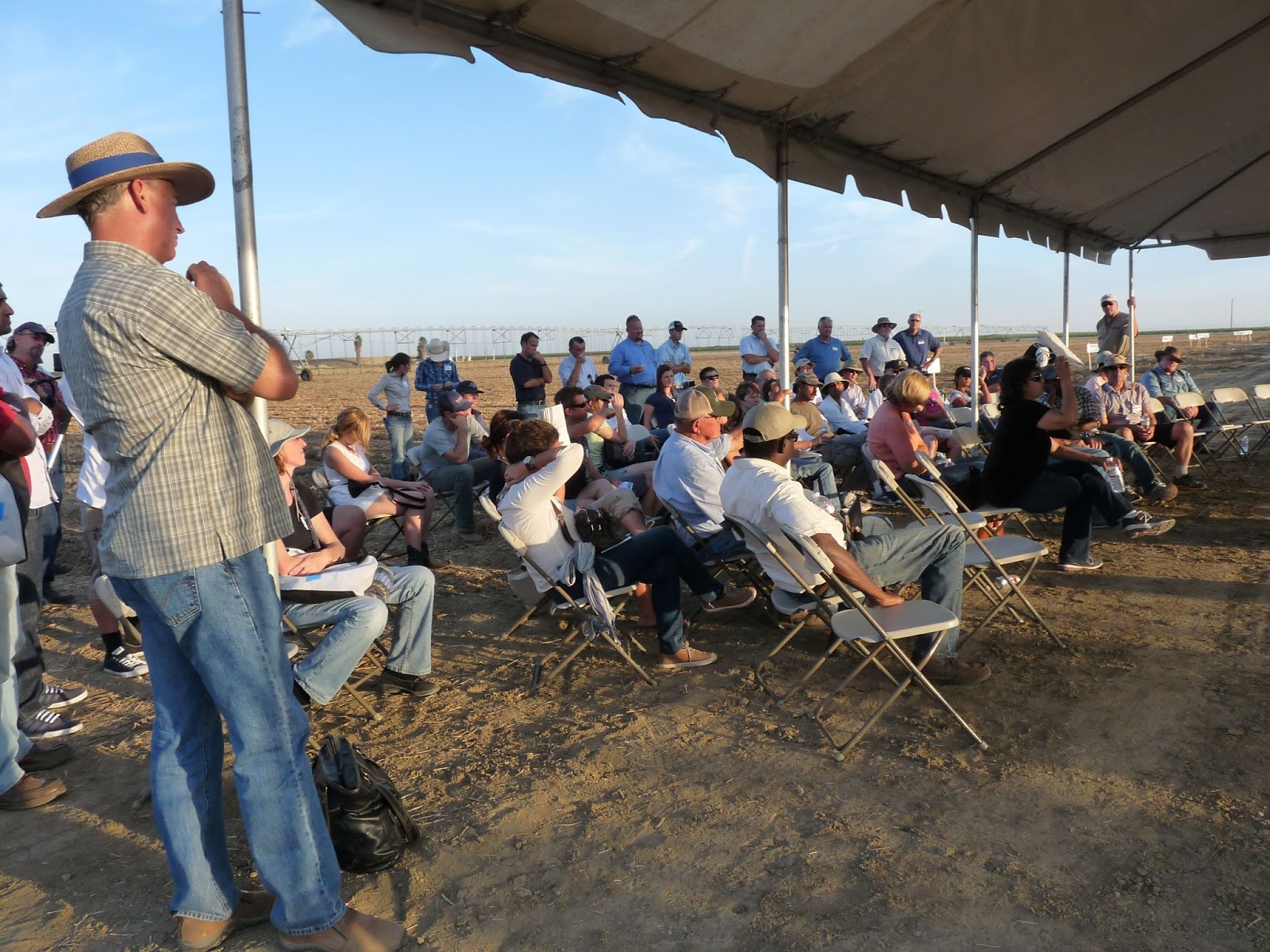
A crowd gathers for a presentation last year in the early evening.
“We want to introduce more farmers to these proven technologies,” said Jeff Mitchell, UCCE farm advisor and field day coordinator. “We’ve done the research. These systems work and they save water, reduce dust, store carbon in the soil, and save farmers money.”

This year, the expanded event includes an afternoon bus tour to three San Joaquin Valley farms where conservation agriculture systems are successfully implemented.

Registrants will gather at 1 p.m. at the UC Westside Research and Extension Center, 17353 West Oakland Ave., Five Points, Calif. to load on buses.

The bus tour includes three stops:

1 – Johnny and Joann Tacharra Dairy in Burrel – The Tacharras will explain the application of dairy waste water through an overhead irrigation system to grow forage crops.

2 – Armando Galvan of Five Points Ranch – Galvan will show his refined irrigation system to apply water to vegetable and row crops. Galvan installs special nozzles on the overhead irrigation drop lines to improve water infiltration and avoid ponding and crusting on the soil surface.

3 – Scott Schmidt of Farming ‘D’ Ranch in Five Points – Schmidt will discuss new management strategies to successfully implement new agricultural systems.

Following the tour, participants will reconvene at 4 p.m. at the UC Westside REC for a workshop on the economic and environmental benefits of conservation agriculture systems.

The event continues with a free barbecue dinner, entertainment by the Wheelhouse Country Band, and a keynote address by Suat Irmak, director of the Nebraska Water Center and professor of biological systems engineering.

Jeff Mitchell will name the 2013 Conservation Tillage Farmer Innovator of the Year award winner.

The expanded event coincides with a concerted effort by the Conservation Agricultural Systems Innovation (CASI) Center to grow the conservation agriculture movement in California.

CASI is a diverse group of UC researchers, farmers, public and private industry, and environmental groups formed to develop and exchange information on sustainable agricultural systems for California row crops.

“In each century, there are just a handful of times when agriculture can transform itself in revolutionary ways,” Mitchell said. “There is growing evidence that today presents one of those rare chances for agriculture in the San Joaquin Valley to reinvent itself.”

The event is free but pre-registration is requested.

RSVP to Diana Nix at dlnix@ucdavis.edu

2016-05-31T19:45:20-07:00September 4th, 2013|

THIEF HAS POSTED PHOTOS TO TRY TO SELL STOLEN EQUIPMENT

Crime Alert

Help Needed to Locate Rice Chopper in Photos

The Sutter County Sheriff’s Department discovered the attached photos of a rice chopper on a crime suspect’s phone. The suspect had been sending the photos to potential buyers.

Deputies need help identifying the victim of the theft, as well as the location of where the photos were taken so the equipment can be recovered.

Please take a look at the attached images and call the Sutter County Sheriff’s Department with any information at (530) 822-7307.

2016-05-31T19:45:20-07:00September 4th, 2013|

RIM FIRE’S EFFECT ON RANCHERS WHOSE LIVESTOCK SURVIVED

Spared Rancher Faces New Pressures

By Laurie Greene, Associate Editor
RIM FIRE UPDATE: InciWeb reported TODAY at 6 pm that the Rim Fire has burned 235,841 Acres (368 square miles) to date and is 80% contained. The estimated containment date for the Rim Fire is September 20, 2013.
Tuolumne County Agricultural Commissioner Vicki Helmar told California Ag Todaythere are no cattle loss statistics yet because even though the Rim Fire is becoming more contained, the fire is still burning, and the scattered cattle are still being rescued and transported.
Marian Rocha Zimmerly, CFO of Farms of Tuolumne County, a countywide program for the support and growth of agriculture, agri-tourism, and preservation of open space, said in addition to cattle, livestock in the area includes sheep, goats, llamas and horses. Most of these animals have been returned to their ranchers or relocated elsewhere in the county.
One fortunate area rancher and former California Sheep Commissioner, Ann Shaeffer of Big Creek Meadow Ranch in Groveland had taken fire prevention measures by removing ladder fuel, and had downsized her cattle to decrease her feed bill.
Shaeffer said, “We dodged a bullet because the fire was all around us, but my sheep ranch remained untouched. The ranch, one or two miles from the fire’s edge that reached CA 120, suffered no direct loss from the fire.
However, Shaeffer is facing new challenges; the fire has forced wildlife such as bucks, lions and coyotes to come down to her area in search of food and water. Shaeffer has a great dog to protect her sheep, but, at present, her grazing land and two ponds will have to be shared with these animals.
What these pressures mean, “only time will tell how wildlife regroups itself,” she said.
Another concern for this burned-out region is erosion when it rains.
Additionally, as many ranchers in the area, she has supplemental agribusiness with homestay guests and local festivals. Her land contains an 1870 historic stagecoach barn (which survived) where Teddy Roosevelt stayed while visiting John Muir. The future of this secondary ag industry here is in question.
Shaeffer says the whole community pulled together by helping each other where they could. Shaeffer took in her neighbors’ unsheltered livestock when his barn burned down. He, like others, had insurance for the barn, but not for the new shipment of hay housed in the barn.
Shaeffer summed it all up by expressing her gratefulness for her ranch surviving the fire and by declaring, “this gives ‘wildfire’ a whole new definition.”
2016-05-31T19:45:20-07:00September 4th, 2013|

MEETING ON SEPTEMBER 10TH IN SACRAMENTO

CDFA and Calif. Water Commission

To Meet for Urgent Water Reliability

The California State Board of Food and Agriculture and the California Water Commission will hold a joint meeting concerning the state’s water supply on September 10th in Sacramento. The meeting will be held from 10 a.m. to 3 p.m. at the California Department of Food and Agriculture, 1220 ‘N’ Street – Main Auditorium, Sacramento, CA 95814.

“California’s current water situation spells uncertainty for agricultural interests throughout this state,” said CDFA Secretary Karen Ross. “We need to work proactively with farmers and ranchers to address groundwater overdraft and water transfers – providing a level of reliability over the next few years.”

On May 20th, Governor Edmund G. Brown, Jr. issued an Executive Order to streamline approvals for water transfers to protect California’s farms. The order was in response to the very dry conditions occurring within the state. Currently, water allocations for this year remain low with 35 percent of requested amounts through the State Water Project and 20 percent of requested amounts through the federal Central Valley Project. Even if this winter provides a normal wet year, growers throughout the state are preparing for a reduced water supply as nine of the State’s major reservoirs are below historic average levels, and six of these are below 50 percent total capacity. This meeting provides a forum for agricultural stakeholders, water representatives, and government officials to discuss California’s water situation and make recommendations to the state board.

Invited speakers include: Director Mark Cowin, California Department of Water Resources, Randy Record, Chair of the Association of California Water Agencies (ACWA); Mike Wade, California Farm Water Coalition; Chris White, Central California Irrigation District; Victoria Whitney, State Water Resources Control Board; Karla Nemeth; California Natural Resources Agency; Marvin Meyers, Meyers Farming; Joe MacIlvaine, Paramount Farming; John Sweigard, Merced Irrigation District and Kris Beal, Vineyard Team.

Craig McNamara, President of the California
State Board of Food and Agriculture.
“With the strong potential for drought conditions next year – flexibility within the statewide water system is needed” said Craig McNamara, president of the California State Board of Food and Agriculture. “I’m hopeful that this meeting can help inform policy discussions and encourage action by state and federal agencies.”

The California State Board of Food and Agriculture advises the governor and the CDFA secretary on agricultural issues and consumer needs. The state board conducts forums that bring together local, state and federal government officials, agricultural representative and citizens to discuss current issues of concern to California agriculture.

The California Water Commission consists of nine members appointed by the Governor and subject to Senate confirmation. Its historical role includes advising the Director of the Department of Water Resources on matters within the Department’s jurisdiction, approving rules and regulations, and monitoring and reporting on the construction of the State Water Project.

2016-05-31T19:45:20-07:00September 4th, 2013|

2013 SEEN AS HEAVY INSECT PRESSURE YEAR

Some Crops Are Coming In, After
A Very Tough Pest Year


Vern Crawford, a Kern County PC

Vern Crawford, a long time pest control advisor with Wilbur-Ellis (Shafter branch) spoke to California Ag Today about the goings on in Kern County and elsewhere.


“The Upland, Acala type cotton will soon be defoliated. Pima cotton fields are full bloom but we are past any new bolls being made from the flowering branches. Defoliation for Pima will begin in about a month,” Crawford said.


It’s full-on harvest of the earlier pistachios, and Kern County almonds are about 2/3 harvested. All the soft shells are at the huller and growers are now picking the hard shells.


“Dried black-eyed beans are doing well. Traditionally, it’s good to have them on the ground by October, as growers do not want to get caught with cold rain and fog,” noted Crawford.  “If that happens, the bean grower is trapped and the crop will need to go to cattle feed.”


“And what a year for alfalfa growers,” said Crawford. “In 2012 we hardly had to spray for anything, except for the alfalfa weevils at the early cutting.”


In 2013, you name the bug and it was a problem. “We had the Blue Alfalfa Aphid that we could not get under control with the usual insecticides. We think it’s a new biotype. We had some significant yield losses especially on the first and second cuttings, which are the high dollar cuttings,” said Crawford. “It was very bad in Imperial County, the Colorado River area, and Kern County.”


“We are looking for a Section 18 for Carbine from FMC, for next year’s hay season to control the Blue Alfalfa Aphid,” noted Crawford.


“Then we had the western yellow-striped armyworm for two cuttings, and now we are getting the alfalfa caterpillar, the pea aphid, along with the cow pea aphid. So we have had a lot of pressure on nearly every cutting this season,” Crawford said.


And almond growers saw enormous mite pressure. “Some growers sprayed four times, which cost the growers as much as $400 per acre. Normally it would cost under $100 per acre with Agri-Mek or other products, which did not seem to work too well this season,” he said.


“Then, inventory for some of the materials was exhausted about mid-season,” said Crawford. “Some growers turned to the old standby product, Omite, and got great results.


“In some fields, which were simply out of control, we flew on some dusting sulfur. On those 100 degree days, the sulfur fumed within the canopy and took care of the mites,” Crawford said.


Last year’s costs were among the cheapest in years for almond growers because of low pest pressure. However, this year could have been the most expensive year; Crawford said some growers were hit by the leaf-footed plant bug and stinkbug. “And everyone was worried about Navel Orangeworm (NOW) after getting hit hard last season. This year, some growers came through with three applications for NOW,” he said.

2016-05-31T19:45:20-07:00September 3rd, 2013|

MORE SCHOOL GARDENS TO BE CULTIVATED

WGA Donates for More School Gardens


Western Growers Foundation presented fifty Arizona K-12 schools with $75,000 in grant money to create and sustain their own edible gardens.  Each school received $1,500.  The grants were provided through the Arizona Department of Agriculture as part of the United States Department of Agriculture (USDA) Specialty Crop Block Grant.  Pending completion of paperwork, the schools will receive their funds by the end of this month.

Western Growers Foundation was created by Western Growers members as a way to give back to their communities. The Foundation’s mission is to plant and sustain a fruit and vegetable garden in every willing Arizona and California school.
 

Edible school gardens give children the opportunity to learn where their food comes from and the importance of good nutrition. The school gardens program is an important educational tool that Western Growers Foundation uses to promote good nutrition to our schoolchildren in Arizona and California.


“It’s staggering to think that the majority of children go without eating even one serving of fruits and vegetables a day when they should be having 5-9 servings,” said Paula Olson, vice president of marketing at Western Growers, who oversees the Foundation’s Edible School Gardens project. “Coupled with the fact that 30% of U.S. children are obese and half are overweight, it’s imperative that we do all we can to promote healthy living.” 
 

The Edible School Gardens Program is open to all K-12 schools, both public and private, in Arizona.  Western Growers Foundation is expecting a new round of grants to be announced by the end of this year.  “If schools are interested in participating, we encourage them to watch the Foundation’s website http://www.westerngrowersfoundation.org/ for the announcement,” Olson added.


For a list of schools that received the grants, see below or click here to go the Foundation’s webpage. To donate, visit www.westerngrowersfoundation.org/donate.
 

2016-05-31T19:45:20-07:00September 3rd, 2013|

CALIFORNIA DESALINATION RESEARCH AWARDS

Desalination to Solve Water Shortage?

One possible solution to the water shortage experienced by California’s agricultural industry is desalination. Desalination is not new, but current methods such as reverse osmosis (RO) and flash distillation are expensive. If a cost-effective way to extract the freshwater from ocean water could be found, farms and communities would benefit.

“Reclamation Commissioner Michael L. Connor announced that nine entities will share more than $1.1 million in awards in support of laboratory and pilot scale research studies in the field of water desalination and purification. Through required cost shares of up to 75%, Reclamation’s funding will be leveraged to support a total of $3 million in research.”

“‘Desalination and other advanced water treatment technologies have the potential to provide new water sources for communities,’ Commissioner Connor said. ‘This research effort will examine innovative technologies that have the potential to reduce the cost of treating brackish water – helping to create new tools for addressing future water challenges.’”

The projects in California selected for funding this year are:
  • Evaluation of a Zero Liquid Discharge Desalination System by Trussell Technologies of Pasadena, Calif.
  • Sephton Water Technology, Inc. of Kensington, Calif., will test a prototype barometric evaporator at the existing pilot facility in Imperial County, Calif., to treat water at the Salton Sea.
  • University of California, Los Angeles has proposed a new technology concept of cyclic reverse osmosis to enable a wide variety of water sources over a wider range of salinities while using optimal energy.

The Bureau of Reclamation is the largest wholesale water supplier and the second largest producer of hydroelectric power in the United States, with operations and facilities in the 17 Western States. Its facilities also provide substantial flood control, recreation, and fish and wildlife benefits.

2016-05-31T19:45:20-07:00September 1st, 2013|

CALIFORNIA FAMILY FARMERS PRODUCE RECORD HIGH REVENUES

California Ag Reaches New High
California’s 80,500 farms and ranches received a record high $44.7 billion for their output last year. The State’s agriculture revenues increased three percent for 2012 from the revised 2011 income level of $43.3 billion, according to USDA’s National Agricultural Statistics Service and Economic Research Service.

California’s cash receipts represented 11.3 percent of the U.S. total for 2012.

California remains the number one dairy state in the nation, producing 20.9 percent of the nation’s milk supply last year. Dairy producers received $6.90 billion for their milk production in 2012, down 10 percent from 2011.

The number of licensed herds dropped 1.5 percent from 2011, while the change in number of cows was up 30,000 as small operations were shuttered and the larger dairies built up herds. Milk prices received by producers dropped from an average $18.54 per hundred pounds of milk sold in 2011 to $16.52 in 2012.

The decline in milk prices received that began in September 2011 continued into the first half of 2012. November saw the highest all milk price received, $19.92, which was 40 cents below the prior year’s highest monthly return per hundredweight.

Dairy producers experienced increased feed costs and limited feed availability due to the drought conditions in the nation’s corn growing regions. Cost of production per cow per month was up 12.3 percent based on the California Department of Food and Agriculture’s Cost of Production Survey. The high production costs, primarily feed, kept California dairies struggling financially in 2012.

The prior year the state net loss of dairies was 48, while 2012 saw a decline of only 25 dairies. National and global supply and demand conditions for finished dairy products were steady with national exports remaining strong in terms of volume and total value.

Twelve California products exceeded $1 billion in receipts for 2012, one more than in 2011. Nine of the twelve commodities registered an increase in value. The commodity with the largest percentage increase with receipts over $1 billion was Pistachios, at a 27 percent increase in value. All three of the major nut crops; almond, walnuts, and pistachios exceeded the billion dollar threshold.

The value of grapes edged higher than that of almonds in 2012, ranking second in the top ten commodities by cash receipts. Final grower returns could change the sales values for the commodities, resulting in an updated dollar amount in next year’s report.

2016-05-31T19:45:20-07:00September 1st, 2013|

GREEN PRICE IS $75 PER TON LOWER THAN LAST YEAR

Gallo Sets Thompson Price at $250 a Ton

While the California raisin industry is still trying to negotiate a per ton price, E & J Gallo Winery has come out with a $250 per ton offer for any Thompsons that are harvested green for the winery, noted Nat DiBuduo, president and CEO if Allied Grape Growers in Fresno

The price is down from last year’s $325 a ton price.  It will most likely mean that many raisin producers will opt for raisin production instead of for juice.

DiBuduo said that he was somewhat surprised by the price drop, but added that crop is 25 percent larger this year.

2016-05-31T19:45:21-07:00August 31st, 2013|

PROGRAM FOR METHYL BROMIDE ALTERNATIVES

UC Researches Alternatives to 
Banned Methyl Bromide 


Pamela Kan-Rice, Assistant Director, UC ANR, reportedon August 29, 2013 that California growers have used methyl bromide, a soil fumigant, to effectively sterilize pre-planted fields since the 1960s. But now methyl bromide is about to be phased out under an international ban.

Methyl bromide contributes to ozone depletion high in the atmosphere and was banned by developed countries in 2005 under the Montreal Protocol, an international treaty to protect the stratospheric ozone layer. Since then, the treaty has allowed limited use of methyl bromide for certain crops, but many of these exemptions are gone and the rest will end soon.


Rootstocks for almonds and stone fruits were tested for resistance to Prunus replant disease complex near Parlier. (Photo credit: UC ANR)

To help growers find workable substitutes, University of California researchers are part of a team working to optimize methyl bromide alternatives for western crops including almonds, strawberries and nursery stock.

The Pacific Area-Wide Pest Management Program for Integrated Methyl Bromide Alternatives (PAW-MBA), funded by a$5 million, five-year USDA grant, is developing and evaluating alternatives to methyl bromide for production crops such as grapes, strawberries and tree nuts as well as nursery crops such as cut flowers, forest trees and sweet potatoes.

“One goal of the program, conducted by a team of UC and U.S. Department of Agriculture researchers, was to identify methyl bromide alternatives that were immediately useful and economically feasible,” says Greg Browne, a USDA plant pathologist at UC Davis who coordinates the PAW-MBA program. “Another was to foster development of nonfumigant strategies for managing soilborne pests.”

The team has identified methyl bromide alternatives that are both effective and economical for key California crops. When the best alternative is another fumigant, the researchers found ways to use less and to cut emissions. In addition, the researchers are developing alternatives that go beyond fumigants, including steam sterilization and other nontoxic approaches.

Summaries of projects:

TIF film, substrates and nonfumigant soil disinfestation maintain fruit yields
Strawberry growers use methyl bromide primarily to control soilborne diseases. Now, new UC research shows that this crop can be grown without fumigants at small scales. Three nontoxic methods — nonsoil substrates, anaerobic soil disinfestation and steam disinfestation — produced strawberry yields as high as those in conventionally fumigated soil.

“Instead of understanding soil, we’ve just been fumigating it,” says Steve Fennimore, a UC Cooperative Extension specialist in Salinas who led this team. “Using physical tools is a different approach.” Researchers will next evaluate whether these alternative methods can be scaled up to commercial production fields, and whether they work in different strawberry production areas of California.

Managing almond and stone fruit replant disease complex with less soil fumigant
Almond and stone fruit growers need methyl bromide alternatives to control nematodes and Prunus replant disease, a soilborne disorder that stunts new orchards and cuts yields. UC and USDA researchers tested alternative fumigants, spot and strip fumigation and nonfumigant methods including rotating orchards with sudangrass and using nematode-resistant rootstock.

“Spot treatments provided adequate control of Prunus replant disease and may be very helpful to growers needing to use less fumigant for costs savings or regulatory restrictions,” Browne says. In addition, integrating the various treatments tested may also help control the replant disease with less fumigant use.

Preplant 1,3-D treatments test well for perennial crop nurseries, with challenges
California supplies nursery stock to the state’s fruit, nut and vineyard industries, as well as more than 60 percent of the rose plants and fruit and nut trees sold nationwide. This perennial nursery stock must be completely nematode-free, and growers use methyl bromide primarily to control these tiny soilborne worms.

However, alternative fumigants such as 1,3-dichloropropene (1,3-D) don’t work as well in fine soils. “We asked how we could make them work better,” says Brad Hanson, a UC Cooperative Extension specialist in the Department of Plant Sciences at UC Davis. The researchers showed that 1,3-D controlled nematodes in fine soil when they tilled it deeper, injected the fumigant deeper and used tarps that kept more of the fumigant in the soil.

Fumigant emission reductions with TIF warrant regulatory changes
Fumigants are regulated partly because they help make smog. Totally impermeable film (TIF) can help keep fumigants in the soil and out of the air. New UC research shows that fumigant emissions can drop 64 percent when fields are tarped with TIF for twice as long as usual (10 days instead of 5).

“We’re now working on safe use,” says Suduan Gao, a USDA soil scientist in Parlier who led the team. “The goal is to keep the fumigant under the tarp long enough that there won’t be a surge in emissions when it’s cut open.” This work gives regulatory agencies a new way to let growers keep using enough fumigant to control pests and diseases while minimizing the smog-forming emissions.

2016-05-31T19:45:21-07:00August 31st, 2013|
Go to Top